


Judges 15:17
Bible text: King James Version (1769 Blayney text) · Public domain
Bible text: Berean Standard Bible · Public domain
Bible text: American Standard Version (1901) · Public domain
Bible text: World English Bible, Messianic edition · Public domain
Bible text: Geneva Bible (1599) · Public domain
Bible text: Young's Literal Translation · Public domain
- וַיְהִיvay·Hiand it wasH1961Conj-w ¦ V-Qal-ConsecImperf-3msVerb Qal Consecutive Imperfect 3rd Singular Masculineוַandיְהִיit was
- כְּכַלֹּתוֹke·kha·lo·Towhen he finishedH3615Prep-k ¦ V-Piel-Inf ¦ 3msVerb Piel Infinitive Constructכְּwhenכַלֹּתfinishedוֹhe
- לְדַבֵּרle·da·Berto speakH1696Prep-l ¦ V-Piel-InfVerb Piel Infinitive Constructלְtoדַבֵּרspeak
- וַיַּשְׁלֵךְvai·yash·Lekhand he threwH7993Conj-w ¦ V-Hiphil-ConsecImperf-3msVerb Hiphil Consecutive Imperfect 3rd Singular Masculineוַandיַּשְׁלֵךְhe threw
- הַלְּחִיha·le·Chithe jawboneH3895Art ¦ N-msNoun Singular Masculine Absoluteהַtheלְּחִיjawbone
- מִיָּדוֹmi·ya·Dofrom his handH3027Prep-m ¦ N-csc ¦ 3msNoun Singular common gender Constructמִfromיָּדhandוֹhis
- וַיִּקְרָאvai·yik·Ra'and he calledH7121Conj-w ¦ V-Qal-ConsecImperf-3msVerb Qal Consecutive Imperfect 3rd Singular Masculineוַandיִּקְרָאhe called
- לַמָּקוֹםla·ma·Kom<to> the placeH4725Prep-l ¦ N-msNoun Singular Masculine Absoluteלַ<to> theמָּקוֹםplace
- הַהוּאha·Hu'<the> thatH1931Art ¦ Pro-3msPronoun Personal 3rd Singular Masculineהַ<the>הוּאthat
- רָמַתRa·matRamathH7437N-fscNoun Singular Feminine Construct
- לֶחִיLe·chiLehiH7437N-msNoun Singular Masculine Absolute
English is a literal word-by-word gloss of the Hebrew, not the KJV's wording. Why?
This is the original text the KJV's translators worked from — each Hebrew word with its own literal English meaning in this verse, prepared by scholars at Tyndale House, Cambridge. The KJV translates whole sentences, not word by word, so its wording differs: one Hebrew word can become several English words, and the KJV may choose “the LORD” where the gloss reads “Yahweh”. Both are faithful — they answer different questions. For the KJV's own rendering, switch to the KJV text.
Details
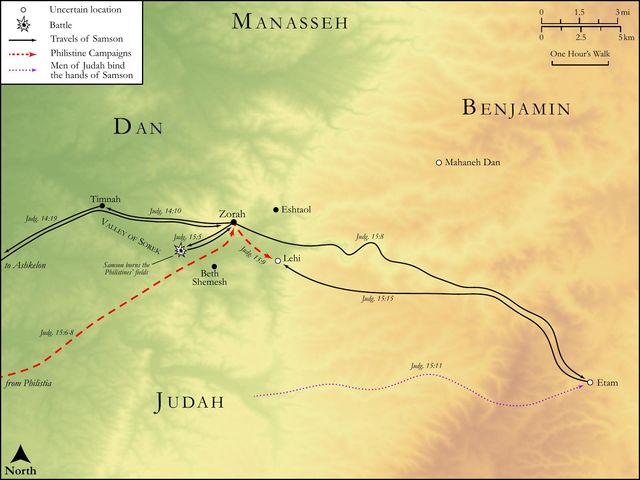
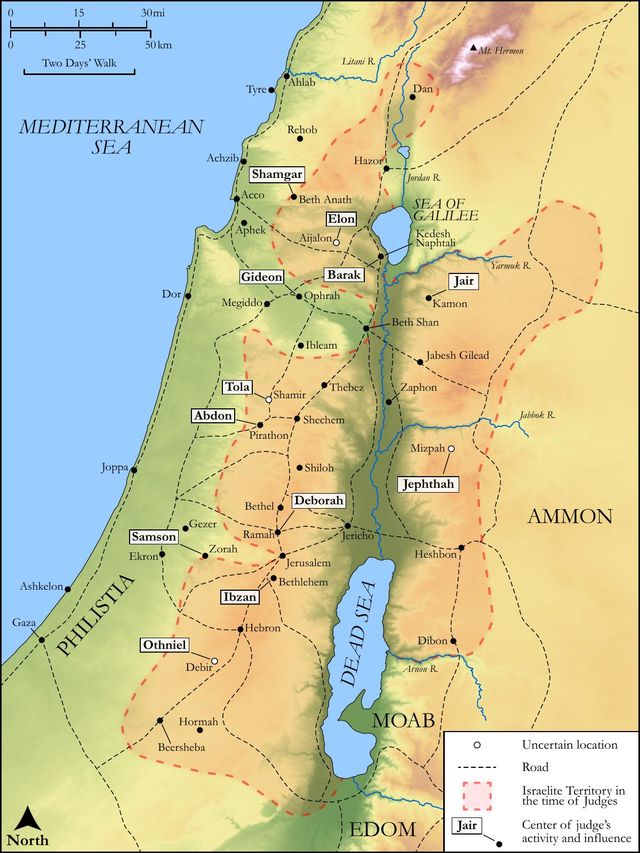
See on the biblical-era maps
Study this verse
Public-domain commentary
Matthew Henry
From his Commentary on the Whole Bible. Henry comments on passages, not single verses — this entry covers Judges 15:9–17. His two-level outline is real structure in the source text, so it is rendered as structure.
Here is, I. Samson violently pursued by the Philistine. They went up in a body, a more formidable force than they had together when Samson smote them hip and thigh; and they pitched in Judah, and spread themselves up and down the country, to find out Samson, who they heard had come this way, Jdg 15:9. When the men of Judah, who had tamely submitted to their yoke, pleaded that they had paid their tribute, and that none of their tribe had given them any offence, they freely own they designed nothing in this invasion but to seize Samson; they would fight neither against small nor great, but only that judge of Israel (Jdg 15:10), to do to him as he has done to us, that is, to smite his hip and thigh, as he did ours - an eye for an eye. Here was an army sent against one man, for indeed he was himself an army. Thus a whole band of men was sent to seize our Lord Jesus, that blessed Samson, though a tenth part would have served now that his hour had come, and ten times as many would have done nothing if he had not yielded.
II.Samson basely betrayed and delivered up by the men of Judah, Jdg 15:11.
Of Judah were they? Degenerate branches of that valiant tribe! Utterly unworthy to carry in their standard the lion of the tribe of Judah. Perhaps they were disaffected to Samson because he was not of their tribe. Out of a foolish fondness for their forfeited precedency, they would rather be oppressed by Philistines than rescued by a Danite. Often has the church's deliverance been obstructed by such jealousies and pretended points of honour. Rather it was because they stood in awe of the Philistines, and were willing, at any rate, to get them out of their country. If their spirits had not been perfectly cowed and broken by their sins and troubles, and they had not been given up to a spirit of slumber, they would have taken this fair opportunity to shake off the Philistine's yoke. If they had had the least spark of ingenuousness and courage remaining in them, having so brave a man as Samson was to head them, they would now have made one bold struggle for the recovery of their liberty; but no marvel if those that had debased themselves to hell in the worship of their dung-hill gods (Isa 57:9) thus debased themselves to the dust, in submission to their insulting oppressors. Sin dispirits men, nay, it infatuates them, and hides from their eyes the things that belong to their peace. Probably Samson went into the border of that country to offer his service, supposing his brethren would have understood how that God by his hand would deliver them, as Moses did, Act 7:25. But they thrust him from them, and very disingenuously,
1.Blamed him for what he had done against the Philistines, as if he had done them a great injury. Such ungrateful returns have those often received that have done the best service imaginable to their country. Thus our Lord Jesus did many good works, and for these they were ready to stone him.
2.They begged of him that he would suffer them to bind him, and deliver him up to the Philistines. Cowardly unthankful wretches! Fond of their fetters and in love with servitude! Thus the Jews delivered up our Saviour, under pretence of a fear lest the Romans should come and take away their place and nation. With what a sordid servile spirit do they argue, Knowest thou not that the Philistines rule over us? And whose fault was that? They knew they had no right to rule over them, nor would they have been sold into their hands if they had not first sold themselves to work wickedness.
III.Samson tamely yielding to be bound by his countrymen, and delivered into the hands of his enraged enemies, Jdg 15:12, Jdg 15:13.
Now easily could he have beaten them off, and kept the top of his rock against these 3000 men, and none of them all could, or durst, have laid hands on him; but he patiently submitted,
1.That he might give an example of great meekness, mixed with great strength and courage; as one that had rule over his own spirit, he knew how to yield as well as how to conquer.
2.That, by being delivered up to the Philistine, he might have an opportunity of making a slaughter among them.
3.That he might be a type of Christ, who, when he had shown what he could do, in striking those down that came to seize him, yielded to be bound and led as a lamb to the slaughter. Samson justified himself in what he had done against the Philistines: "As they did to me, so I did to them; it was a piece of necessary justice, and they ought not to retaliate it upon me, for they began." He covenants with the men of Judah that, if he put himself into their hands, they should not fall upon him themselves, because then he should be tempted to fall upon them, which he was very loth to do. This they promised him (Jdg 15:13), and then he surrendered. The men of Judah, being his betrayers, were in effect his murderers; they would not kill him themselves, but they did that which was worse, they delivered him into the hands of the uncircumcised Philistines, who they knew would do worse than kill him, would abuse and torment him to death. Perhaps they thought, as some think Judas did when he betrayed Christ, that he would by his great strength deliver himself out of their hands; but no thanks to them if he had delivered himself, and, if they thought he would do so, they might of themselves have thought this again, that he could and would deliver them too if they would adhere to him and make him their head. Justly is their misery prolonged who, to oblige their worst enemies, thus abuse their best friend. Never were men so infatuated except those who thus treated our blessed Saviour.
IV.Samson making his part good against the Philistines, even when he was delivered into their hands, fast pinioned with two new cords.
The Philistines, when they had him among them, shouted against him (Jdg 15:14), so triumphing in their success, and insulting over him. If God had not tied their hands faster than the men of Judah had tied his, they would have shot at him (as their archers did at Saul) to dispatch him immediately, rather than have shouted at him, and given him time to help himself. But their security and joy were a presage of their ruin. When they shouted against him as a man run down, confident that all was their own, then the Spirit of the Lord came upon him, came mightily upon him, inspired him with more than ordinary strength and resolution. Thus fired,
1.He presently got clear of his bonds. The two new cords, upon the first struggle he gave, broke, and were melted (as the original word is) from off his hands, no doubt to the great amazement and terror of those that shouted against him, whose shouts were hereby turned into shrieks. Observe, When the Spirit of the Lord came upon him, his cords were loosed. Where the Spirit of the Lord is there is liberty, and those are free indeed who are thus freed. This typified the resurrection of Christ by the power of the Spirit of holiness. In it he loosed the bands of death, and its cords, the grave-clothes, fell from his hands without being loosed, as Lazarus's were, because it was impossible that the mighty Saviour should be holden of them; and thus he triumphed over the powers of darkness that shouted against him, as if they had him sure.
2.He made a great destruction among the Philistines, who all gathered about him to make sport with him, Jdg 15:15. See how poorly he was armed: he had no better weapon than the jaw-bone of an ass, and yet what execution he did with it! he never laid it out of his hand till he had with it laid 1000 Philistines dead upon the spot; and thus that promise was more than accomplished. One of you shall chase a thousand, Jos 23:10. A jaw-bone was an inconvenient thing to grasp, and, one would think, might easily be wrested out of his hand, and a few such blows as he gave with it might have crushed and broken it, and yet it held good to the last. Had it been the jaw-bone of a lion, especially that which he himself had slain, it might have helped to heighten his fancy and to make him think himself the more formidable; but to take the bone of that despicable animal was to do wonders by the foolish things of the world, that the excellency of the power might be of God and not of man. One of David's worthies slew 300 Philistines at once, but it was with a spear, Ch1 11:11. Another slew of them till his hand was weary and stuck to his sword, Sa2 23:10. But they all came short of Samson. What could be thought too hard, too much, for him to do, on whom the Spirit of the Lord came mightily! Through God we shall do valiantly. It was strange the men of Judah did not now come in to his aid: cowards can strike a falling enemy. But he was to be a type of him that trod the wine-press alone.
V.Samson celebrating his own victory, since the men of Judah would not do even that for him.
He composed a short song, which he sang to himself, for the daughters of Israel did not meet him, as afterwards they did Saul, to sing, with more reason, Samson hath slain his thousands. The burden of this song was, With the jaw-bone of an ass, heaps upon heaps, have I slain a thousand men, Jdg 15:16. The same word in Hebrew (chamor) signifies both an ass and a heap, so that this is an elegant paronomasia, and represents the Philistines falling as tamely as asses. He also gave a name to the place, to perpetuate the Philistines' disgrace, Jdg 15:17. Ramath-lehi, the lifting up of the jaw-bone. Yet he did not vain-gloriously carry the bone about with him for a show, but threw it away when he had done with it. So little were relics valued then.
Continue studying Judges 15:17 across the web’s major study libraries — every link below opens this exact verse, chapter, or book on the destination site.
Read & Compare
 BibleGatewayThis verse in more than 200 translations and 70 languages.
 Bible.comThe YouVersion reader — hundreds of translations, reading plans, and highlights.
 ESV.orgCrossway's official English Standard Version reader.
 NET BibleThe NET translation with 60,000+ translators' notes on every rendering decision.
 STEP BibleTyndale House's free study tool — original text, vocabulary, and scholarly resources.
 BibliaLogos Bible Software's free web reader.
 USCCBThe New American Bible (Revised Edition) with the U.S. bishops' study notes.
Commentaries
 BibleHub CommentariesDozens of classic commentaries on this verse, gathered on one page.
 StudyLightMore than 100 commentary sets — the largest collection on the web.
 BibleRefPlain-English commentary on what this verse means, verse by verse.
 Enduring WordDavid Guzik's free commentary on this chapter, widely used by Bible teachers.
 Bible Study ToolsVerse commentary alongside Greek and Hebrew study aids.
Original Language & Research
- BibleHub InterlinearThe verse word by word — original language, transliteration, and English.
- BibleHub LexiconEvery word's original-language definition and Strong's entry.
 Blue Letter BibleDeep-study tools — Strong's numbers, concordance, and word studies.
 SefariaThe Hebrew text with Rashi and centuries of Jewish commentary.
Sermons, Hymns & Audio


TrulyRandomVerse is not affiliated with these sites and doesn’t control their content. They’re linked because they’re genuinely useful.
Summary
Judges 15:17 captures the immediate aftermath of Samson's monumental victory over the Philistines, where he, empowered by the Spirit of the Lord, used a donkey's jawbone to slay a thousand men. Following his triumphant poetic declaration, this verse records Samson's symbolic act of discarding the extraordinary instrument of war and, in a significant cultural gesture, naming the very place of his victory "Ramathlehi," which means "Jawbone Height," thereby establishing an enduring memorial to God's astounding intervention and the decisive, divinely-enabled triumph achieved through the most unlikely of means.
Context
ShowHideLiterary Context
This verse serves as the concluding action of Samson's dramatic and divinely-empowered confrontation with the Philistines, detailed specifically in Judges 15:9-19. The narrative immediately preceding this verse describes Samson's binding by his own people and his subsequent delivery to the Philistines. However, the Spirit of the Lord comes mightily upon him, enabling him to snap his bonds as if they were flax and to find a fresh jawbone of a donkey. With this improbable weapon, he slays a thousand Philistines in an overwhelming display of supernatural strength, culminating in his boastful, yet God-acknowledging, poem in Judges 15:16. Judges 15:17 then marks the physical cessation of the battle, as Samson discards the now-superfluous weapon and names the site. This action sets the stage for his subsequent cry of thirst and God's miraculous provision of water from a hollow place in Judges 15:18-19, highlighting Samson's profound dependence on God, not only for strength in battle but also for sustenance afterward.
Historical & Cultural Context
The era of the Judges (approximately 12th-11th centuries BC) was a turbulent period for Israel, marked by cycles of apostasy, oppression by surrounding nations, and subsequent divine deliverance through charismatic leaders. The Philistines, a powerful "Sea Peoples" group who had settled along the coastal plain of Canaan, were a persistent and dominant military threat to Israel. In Israel, the practice of naming places after significant events was deeply ingrained, as when Jacob called the name of the place Peniel. These names functioned as mnemonic devices, historical records, and theological markers, commemorating divine interventions, major battles, or covenant ceremonies. For Samson to name the site "Ramathlehi" was to establish a permanent, tangible testimony to God's power and Israel's temporary triumph over their oppressors. This act reinforced the narrative of God's active involvement in their history, ensuring that the memory of this extraordinary event would be passed down through generations, serving as a reminder of divine faithfulness and miraculous provision.
Key Themes
ShowHideJudges 15:17 profoundly contributes to several overarching themes within the book of Judges and the broader biblical narrative. Firstly, it powerfully underscores the theme of Divine Empowerment, demonstrating that God's power is not constrained by human weakness or the inadequacy of instruments. Samson's superhuman strength is unequivocally a supernatural gift from the Spirit of the Lord, enabling him to achieve feats utterly beyond natural human capability. Secondly, the act of naming the place highlights the theme of Commemoration and Memorialization, emphasizing the vital importance of remembering God's mighty deeds for future generations. This aligns with a recurring biblical motif where significant events are marked by named places, altars, or monuments (e.g., Genesis 28:19, Exodus 17:15). Thirdly, Samson's action of casting away the jawbone, immediately followed by his desperate cry for water in Judges 15:18, subtly introduces the theme of Human Dependence on God, even after monumental victories. It illustrates that the instrument of victory is temporary and that true sustenance, power, and ultimate deliverance originate solely from the Lord.
Exposition and Analysis
ShowHideKey Word Analysis
ShowHideA primitive root meaning "to throw out, down or away (literally or figuratively)." In this context, Samson's act of "casting away" the jawbone is highly symbolic. It signifies the completion of its divine purpose and Samson's recognition that the power was not inherent in the instrument itself, but in the Spirit of the Lord who enabled him. This action underscores the temporary and instrumental nature of the jawbone, preventing it from being glorified or seen as the source of victory.
Referring to "the cheek (from its fleshiness); hence, the jaw-bone." The choice of this word emphasizes the common, mundane, and seemingly insignificant nature of the weapon. It was not a weapon of war crafted by human hands, but a discarded bone from a dead animal. This highlights the profound irony and divine power at play: God chose the most unlikely and humble instrument to achieve a monumental victory, demonstrating that His strength is made perfect in weakness.
A compound name meaning "height of a jaw-bone." This name, given to the "place" (H4725, mâqôwm, a spot or locality) by Samson through the act of "calling" (H7121, qârâʼ, to name or proclaim), serves as a permanent memorial. It transforms an ordinary geographical feature into a living testimony to the extraordinary event that occurred there. The name ensures that the site itself would perpetually narrate the story of God's miraculous intervention and the astounding victory achieved through an utterly improbable instrument, serving as a constant reminder for future generations.
Verse Breakdown
ShowHide"And it came to pass, when he had made an end of speaking"
This clause directly links Judges 15:17 to Samson's triumphant, yet boastful, poetic declaration in Judges 15:16. The phrase "made an end" (from H3615, kâlâh, to finish or complete) signifies the completion of his immediate task—not only the physical act of battle but also the verbal proclamation of his victory. This marks a transition from the intense action and exultation to the aftermath.
"that he cast away the jawbone out of his hand"
This action is profoundly symbolic. By discarding the jawbone (H7993, shâlak), Samson demonstrates that the weapon itself was merely an instrument, now no longer needed. It was not the source of his strength, nor was it to be glorified. This act subtly points to the temporary nature of earthly means in accomplishing divine purposes and underscores that the true power resided solely in God. It also suggests a moment of transition—the battle is decisively over, and the tool of war is put aside.
"and called that place Ramathlehi"
This act of naming (H7121, qârâʼ) is culturally significant in Israel, as in the names Bethel and Beer-sheba. It transformed an ordinary location (H4725, mâqôwm) into a memorial, permanently associating the place with the extraordinary event that occurred there. By naming it "Ramathlehi" (H7437, "Jawbone Height"), Samson ensured that the site would forever bear witness to God's miraculous deliverance and the astounding victory achieved through him, serving as a constant reminder of divine power and intervention for future generations.
Literary Devices
ShowHideThe narrative of Judges 15:17 is rich with Symbolism and Irony. The jawbone itself is a potent symbol: a common, seemingly insignificant, and even unclean object (from a dead animal) becomes the instrument of a monumental victory. This powerfully symbolizes God's ability to use the weak and foolish things of the world to shame the strong and wise, a recurring biblical theme. The Irony is palpable in the stark disparity between the humble, discarded weapon and the overwhelming outcome—a single bone wielded by one man defeats a thousand armed Philistine warriors. Furthermore, the act of naming the place "Ramathlehi" serves as an act of Commemoration and Memorialization, a common literary and cultural device in the Old Testament to ensure that significant divine acts are remembered, celebrated, and passed down through generations, reinforcing the historical and theological continuity of God's work among His people.
Theological and Thematic Connections
ShowHideJudges 15:17 powerfully illustrates God's sovereign power and His freedom to work through any means He chooses, often selecting the most unlikely instruments to accomplish His grand purposes. Samson's discarding of the jawbone after the victory underscores that the power was never inherent in the object itself, but flowed directly from the Spirit of God. This challenges human tendencies to rely on visible strength, impressive resources, or conventional methods, instead pointing to an invisible, divine source as the ultimate wellspring of true power and effectiveness. The naming of "Ramathlehi" further emphasizes the profound importance of remembering and testifying to God's mighty acts, ensuring that His faithfulness, miraculous provision, and omnipotence are not forgotten but serve as a foundational anchor for future faith and a testament to His enduring character.
Reflection and Application
ShowHideJudges 15:17 offers profound and enduring lessons for contemporary believers. Just as Samson cast away the jawbone, recognizing it as merely an instrument, we are called to release our grip on our own perceived strengths, talents, achievements, or material resources, acknowledging with humility that true power, ultimate victory, and lasting fruitfulness come solely from God. This verse challenges us to critically examine what "jawbones" we might be clinging to, mistakenly believing them to be the source of our effectiveness, rather than humbly depending on the Lord's supernatural enablement. It also serves as a poignant reminder of the vital importance of remembering God's past faithfulness and miraculous victories in our lives, both individually and corporately. By intentionally recalling, commemorating, and sharing His interventions, we build a robust foundation of faith for future challenges, trusting that the God who delivered us before will continue to do so. Our personal and communal "Ramathlehis" are the testimonies of His power, meant to be cherished, remembered, and proclaimed for His glory.
Questions for Reflection
ShowHideFAQ
ShowHideWhy did Samson cast away the jawbone?
ShowHideSamson cast away the jawbone primarily to signify the completion of the immediate task and to communicate a profound theological truth: the jawbone itself was merely an instrument, not the source of his power. This action emphasizes that the extraordinary strength and victory came solely from the Spirit of God, not from the physical properties or inherent might of the bone. It highlights the temporary nature of the tool once its divine purpose was served, moving Samson from the intensity of battle to a state of exhaustion and subsequent dependence on God for water, as seen in Judges 15:18. This act prevents the glorification of the instrument and directs all glory to God.
What is the significance of naming the place "Ramathlehi"?
ShowHideThe naming of the place "Ramathlehi" (meaning "Height of the Jawbone" or "Jawbone Hill") holds profound significance within Israel's culture and biblical theology. In Israel, naming a place after a pivotal event served as a permanent memorial and a historical marker. This act ensured that the miraculous victory achieved through God's power would be remembered by future generations, transforming an ordinary geographical feature into a living testimony. It served as a tangible reminder of divine power displayed in a specific location, a testament to God's ability to use unlikely instruments, and His faithfulness in delivering His people from their oppressors, thereby reinforcing the narrative of God's active involvement in Israel's history.
Christ-Centered Fulfillment
ShowHideSamson's victory with the jawbone and the subsequent naming of Ramathlehi powerfully foreshadow the ultimate triumph of Jesus Christ. Samson, empowered by the Spirit, used a common, seemingly weak instrument to achieve a miraculous, albeit temporary, deliverance for Israel. This points profoundly to Christ, who, though fully God, humbled Himself, taking on the form of a servant and becoming obedient even to death on a cross (Philippians 2:7-8). The cross, like the jawbone, appeared to be an instrument of weakness, shame, and defeat, yet through it, God accomplished the definitive, eternal victory over sin, death, and the powers of darkness (Colossians 2:15). Just as Samson discarded the jawbone because the power was not in the object but in God, Christ's victory was not dependent on human strength or earthly means, but on the divine power of God, powerfully demonstrated in His resurrection (Romans 1:4). The memorial of Ramathlehi, commemorating a past deliverance, finds its ultimate fulfillment in the enduring reality of Christ's finished work on the cross and His glorious resurrection, a victory we continually remember and proclaim through the Lord's Supper until He comes again (1 Corinthians 11:26). He is the true "stronger man" who has bound the strong man (Satan) and plundered his house, bringing eternal liberation and establishing His everlasting kingdom (Mark 3:27).