


1 Corinthians 11:26
बाइबल पाठ: King James Version (1769 Blayney text) · सार्वजनिक डोमेन
बाइबल पाठ: Berean Standard Bible · सार्वजनिक डोमेन
बाइबल पाठ: American Standard Version (1901) · सार्वजनिक डोमेन
बाइबल पाठ: World English Bible, Messianic edition · सार्वजनिक डोमेन
बाइबल पाठ: Geneva Bible (1599) · सार्वजनिक डोमेन
बाइबल पाठ: Young's Literal Translation · सार्वजनिक डोमेन
बाइबल पाठ: Biblica® Open Hindi Contemporary Version™, © 1978, 2009, 2016, 2019 Biblica, Inc. · CC BY-SA 4.0“Biblica” is a trademark registered in the United States Patent and Trademark Office by Biblica, Inc., used with permission.
- ὁσάκιςhosakisAs often asG3740CONJConjunction
- γὰρgarforG1063CONJConjunction
- ἐὰνeanwhenG1437CONDConjunction
- ἐσθίητεesthiēteyou shall eatG2068V-PAS-2PVerb Present Active Subjunctive 2nd Plural
- τὸνton<the>G3588T-ASMDefinite article Accusative Singular Masculine
- ἄρτονartonbreadG740N-ASMNoun Accusative Singular Masculine
- τοῦτονtoutonthisG3778D-ASMDemonstrative pronoun Accusative Singular Masculine
- καὶkaiandG2532CONJConjunction
- τὸto<the>G3588T-ASNDefinite article Accusative Singular Neuter
- ποτήριονpotērioncupG4221N-ASNNoun Accusative Singular Neuter
- τοῦτοtoutothisG3778D-ASNDemonstrative pronoun Accusative Singular Neuter
- πίνητεpinētemay drinkG4095V-PAS-2PVerb Present Active Subjunctive 2nd Plural
- τὸνtontheG3588T-ASMDefinite article Accusative Singular Masculine
- θάνατονthanatondeathG2288N-ASMNoun Accusative Singular Masculine
- τοῦtouof theG3588T-GSMDefinite article Genitive Singular Masculine
- κυρίουkuriouLordG2962N-GSM-TNoun Genitive Singular Masculine Title
- καταγγέλλετεkatangelleteyou proclaimG2605V-PAI-2PVerb Present Active Indicative 2nd Plural
- ἄχριachriuntilG891PREPPreposition
- οὗhouthatG3739R-GSMRelative pronoun Genitive Singular Masculine
- ἂνanwhenG302PRTParticle or Disjunctive
- ἔλθῃelthēHe may comeG2064V-2AAS-3SVerb 2nd Aorist Active Subjunctive 3rd Singular
अंग्रेज़ी यूनानी का शब्दशः, शब्द-दर-शब्द अर्थ है, KJV का पाठ नहीं। क्यों?
यह वही मूल पाठ है जिससे KJV के अनुवादकों ने काम किया — इस पद में हर यूनानी शब्द अपने शब्दशः अंग्रेज़ी अर्थ के साथ, जिसे कैम्ब्रिज के टिंडेल हाउस के विद्वानों ने तैयार किया है। KJV पूरे वाक्यों का अनुवाद करता है, शब्द-दर-शब्द नहीं, इसलिए उसका पाठ अलग होता है: एक यूनानी शब्द कई अंग्रेज़ी शब्द बन सकता है, और KJV वहाँ “charity” जहाँ शब्दार्थ “love” कहता है चुन सकता है। दोनों विश्वसनीय हैं — वे अलग-अलग प्रश्नों का उत्तर देते हैं। KJV का अपना अनुवाद देखने के लिए KJV पाठ पर जाएँ।
विवरण
बाइबल-काल के मानचित्रों पर देखें
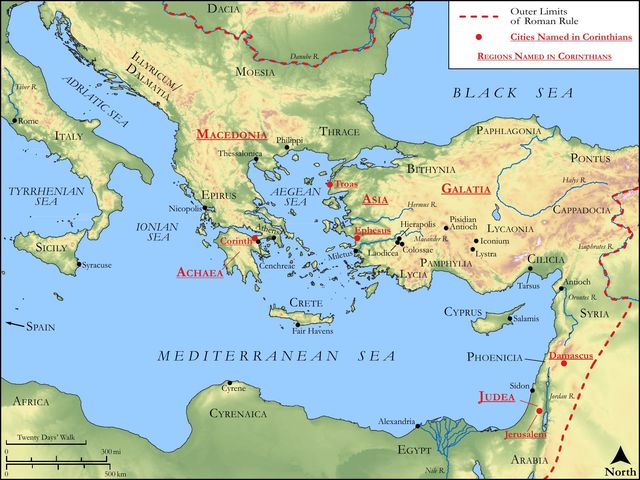

इस पद का अध्ययन करें
सार्वजनिक डोमेन व्याख्या
मैथ्यू हेनरी
उनकी Commentary on the Whole Bible से। हेनरी अनुच्छेदों पर व्याख्या करते हैं, अकेले पदों पर नहीं — यह प्रविष्टि 1 Corinthians 11:23–34 को समाविष्ट करती है। उनकी 4-स्तरीय रूपरेखा मूल पाठ की वास्तविक संरचना है, इसलिए उसे संरचना के रूप में ही दिखाया गया है।
To rectify these gross corruptions and irregularities, the apostle sets the sacred institution here to view. This should be the rule in the reformation of all abuses.
I.He tells us how he came by the knowledge of it.
He was not among the apostles at the first institution; but he had received from the Lord what he delivered to them, Co1 11:23. He had the knowledge of this matter by revelation from Christ: and what he had received he communicated, without varying from the truth a tittle, without adding or diminishing.
II.He gives us a more particular account of the institution than we meet with elsewhere. We have here an account,
1.Of the author - our Lord Jesus Christ. The king of the church only has power to institute sacraments.
2.The time of the institution: It was the very night wherein he was betrayed; just as he was entering on his sufferings which are therein to be commemorated.
3.The institution itself. Our Saviour took bread, and when he had given thanks, or blessed (as it is in Mat 26:26), he broke, and said, Take, eat; this is my body, broken for you; this do in remembrance of me. And in like manner he took the cup, when he had supped, saying, This cup is the New Testament in my blood; this do, as oft as you drink it, in remembrance of me, Co1 11:24, Co1 11:25. Here observe,
(1.)The materials of this sacrament; both,
[1.]As to the visible signs; these are bread and the cup, the former of which is called bread many times over in this passage, even after what the papists call consecration. What is eaten is called bread, though it be at the same time said to be the body of the Lord, a plain argument that the apostle knew nothing of their monstrous and absurd doctrine of transubstantiation. The latter is as plainly a part of this institution as words can make it. St. Matthew tells us, our Lord bade them all drink of it (Mat 26:27), as if he would, by this expression, lay in a caveat against the papists' depriving the laity of the cup. Bread and the cup are both made use of, because it is a holy feast. Nor is it here, or any where, made necessary, that any particular liquor should be in the cup. In one evangelist, indeed, it is plain that wine was the liquor used by our Saviour, though it was, perhaps, mingled with water, according to the Jewish custom; vide Lightfoot on Mt. 26. But this by no means renders it unlawful to have a sacrament where persons cannot come at wine. In every place of scripture in which we have an account of this part of the institution it is always expressed by a figure. The cup is put for what was in it, without once specifying what the liquor was, in the words of the institution.
[2.]The things signified by these outward signs; they are Christ's body and blood, his body broken, his blood shed, together with all the benefits which flow from his death and sacrifice: it is the New Testament in his blood. His blood is the seal and sanction of all the privileges of the new covenant; and worthy receivers take it as such, at this holy ordinance. They have the New Testament, and their own title to all the blessings of the new covenant, confirmed to them by his blood.
(2.)We have here the sacramental actions, the manner in which the materials of the sacrament are to be used.
[1.]Our Saviour's actions, which are taking the bread and cup, giving thanks, breaking the bread, and giving about both the one and the other.
[2.]The actions of the communicants, which were to take the bread and eat, to take the cup and drink, and both in remembrance of Christ. But the external acts are not the whole nor the principal part of what is to be done at this holy ordinance; each of them has a significancy. Our Saviour, having undertaken to make an offering of himself to God, and procure, by his death, the remission of sins, with all other gospel benefits, for true believers, did, at the institution, deliver his body and blood, with all the benefits procured by his death, to his disciples, and continues to do the same every time the ordinance is administered to the true believers. This is here exhibited, or set forth, as the food of souls. And as food, though ever so wholesome or rich, will yield no nourishment without being eaten, here the communicants are to take and eat, or to receive Christ and feed upon him, his grace and benefits, and by faith convert them into nourishment to their souls. They are to take him as their Lord and life, yield themselves up to him, and live upon him. He is our life, Col 3:4.
(3.)We have here an account of the ends of this institution.
[1.]It was appointed to be done in remembrance of Christ, to keep fresh in our minds an ancient favour, his dying for us, as well as to remember an absent friend, even Christ interceding for us, in virtue of his death, at God's right hand. The best of friends, and the greatest acts of kindness, are here to be remembered, with the exercise of suitable affections and graces. The motto on this ordinance, and the very meaning of it, is, When this you see, remember me.
[2.]It was to show forth Christ's death, to declare and publish it. It is not barely in remembrance of Christ, of what he has done and suffered, that this ordinance was instituted; but to commemorate, to celebrate, his glorious condescension and grace in our redemption. We declare his death to be our life, the spring of all our comforts and hopes. And we glory in such a declaration; we show forth his death, and spread it before God, as our accepted sacrifice and ransom. We set it in view of our own faith, for our own comfort and quickening; and we own before the world, by this very service, that we are the disciples of Christ, who trust in him alone for salvation and acceptance with God.
(4.)It is moreover hinted here, concerning this ordinance,
[1.]That it should be frequent: As often as you eat this bread, etc. Our bodily meals return often; we cannot maintain life and health without this. And it is fit that this spiritual diet should be taken often tool The ancient churches celebrated this ordinance every Lord's day, if not every day when they assembled for worship.
[2.]That it must be perpetual. It is to be celebrated till the Lord shall come; till he shall come the second time, without sin, for the salvation of those that believe, and to judge the world. This is our warrant for keeping this feast. It was our Lord's will that we should thus celebrate the memorials of his death and passion, till he come in his own glory, and the Father's glory, with his holy angels, and put an end to the present state of things, and his own mediatorial administration, by passing the final sentence. Note, The Lord's supper is not a temporary, but a standing and perpetual ordinance.
III.He lays before the Corinthians the danger of receiving unworthily, of prostituting this institution as they did, and using it to the purposes of feasting and faction, with intentions opposite to its design, or a temper of mind altogether unsuitable to it; or keeping up the covenant with sin and death, while they are there professedly renewing and confirming their covenant with God.
1.It is great guilt which such contract. They shall be guilty of the body and blood of the Lord (Co1 11:27), of violating this sacred institution, of despising his body and blood. They act as if they counted the blood of the covenant, wherewith they are sanctified, an unholy thing, Heb 10:29. They profane the institution, and in a manner crucify their Saviour over again. Instead of being cleansed by his blood, they are guilty of his blood.
2.It is a great hazard which they run: They eat and drink judgment to themselves, Co1 11:29. They provoke God, and are likely to bring down punishment on themselves. No doubt but they incur great guilt, and so render themselves liable to damnation, to spiritual judgments and eternal misery. Every sin is in its own nature damning; and therefore surely so heinous a sin as profaning such a holy ordinance is so. And it is profaned in the grossest sense by such irreverence and rudeness as the Corinthians were guilty of. But fearful believers should not be discouraged from attending at this holy ordinance by the sound of these words, as if they bound upon themselves the sentence of damnation by coming to the table of the Lord unprepared. Thus sin, as well as all others, leaves room for forgiveness upon repentance; and the Holy Spirit never indited this passage of scripture to deter serious Christians from their duty, though the devil has often made this advantage of it, and robbed good Christians of their choicest comforts. The Corinthians came to the Lord's table as to a common feast, not discerning the Lord's body - not making a difference or distinction between that and common food, but setting both on a level: nay, they used much more indecency at this sacred feast than they would have done at a civil one. This was very sinful in them, and very displeasing to God, and brought down his judgments on them: For this cause many are weak and sickly among you, and many sleep. Some were punished with sickness, and some with death. Note, A careless and irreverent receiving of the Lord's supper may bring temporal punishments. Yet the connection seems to imply that even those who were thus punished were in a state of favour with God, at least many of them: They were chastened of the Lord, that they should not be condemned with the world, Co1 11:32. Now divine chastening is a sign of divine love: Whom the Lord loveth he chasteneth (Heb 12:6), especially with so merciful a purpose, to prevent their final condemnation. In the midst of judgment, God remembers mercy: he frequently punishes those whom he tenderly loves. It is kindness to use the rod to prevent the child's ruin. He will visit such iniquity as this under consideration with stripes, and yet make those stripes the evidence of his lovingkindness. Those were in the favour of God who yet so highly offended him in this instance, and brought down judgments on themselves; at least many of them were; for they were punished by him out of fatherly good-will, punished now that they might not perish for ever. Note, It is better to bear trouble in this world than to be miserable to eternity. And God punishes his people now, to prevent their eternal woe.
IV.He points out the duty of those who would come to the Lord's table.
1.In general: Let a man examine himself (Co1 11:28), try and approve himself. Let him consider the sacred intention of this holy ordinance, its nature, and use, and compare his own views in attending on it and his disposition of mind for it; and, when he has approved himself to his own conscience in the sight of God, then let him attend. Such self-examination is necessary to a right attendance at this holy ordinance. Note, Those who, through weakness of understanding, cannot try themselves, are by no means fit to eat of this bread and drink of this cup; nor those who, upon a fair trial, have just ground to charge themselves with impenitency, unbelief, and alienation from the life of God. Those should have the wedding-garment on who would be welcome at this marriage-feast-grace in habit, and grace in exercise.
2.The duty of those who were yet unpunished for their profanation of this ordinance: If we would judge ourselves, we should not be judged, Co1 11:31. If we would thoroughly search and explore ourselves, and condemn and correct what we find amiss, we should prevent divine judgments. Note, To be exact and severe on ourselves and our own conduct is the most proper way in the world not to fall under the just severity of our heavenly Father. We must not judge others, lest we be judged (Mat 7:1); but we must judge ourselves, to prevent our being judged and condemned by God. We may be critical as to ourselves, but should be very candid in judging others.
V.He closes all with a caution against the irregularities of which they were guilty (Co1 11:33, Co1 11:34), charging them to avoid all indecency at the Lord's table. They were to eat for hunger and pleasure only at home, and not to change the holy supper to a common feast; and much less eat up the provisions before those who could bring none did partake of them, lest they should come together for condemnation. Note, Our holy duties, through our own abuse, may prove matter of condemnation. Christians may keep Sabbaths, hear sermons, attend at sacraments, and only aggravate guilt, and bring on a heavier doom. A sad but serious truth! O! let all look to it that they do not come together at any time to God's worship, and all the while provoke him, and bring down vengeance on themselves. Holy things are to be used in a holy manner, or else they are profaned. What else was amiss in this matter, he tells them, he would rectify when he came to them.
ऐतिहासिक व्याख्या
19 सदियों की व्याख्या-परंपरा
इस पद पर बची हुई 10 टिप्पणियाँ। हर एक पर तिथि अंकित है, इसलिए यह सूची नहीं, समयरेखा की तरह पढ़ी जाती है।
किसी चिह्न को चुनकर उसके उद्धरण पर जाएँ। जहाँ लेखकों ने कुछ ही दशकों के अंतर पर लिखा है, वहाँ चिह्न ऊपर-नीचे क्रम में रखे जाते हैं।
Now concerning the Thanksgiving (Eucharist), thus give thanks. First, concerning the cup: We thank thee, our Father, for the holy vine of David Thy servant, which Thou madest known to us through Jesus Thy Servant; to Thee be the glory for ever. And concerning the broken bread: We thank Thee, our Father, for the life and knowledge which Thou modest known to us through Jesus Thy Servant; to Thee be the glory for ever. Even as this broken bread was scattered over the hills, and was gathered together and became one, so let Thy Church be gathered together from the ends of the earth into Thy kingdom; for Thine is the glory and the power through Jesus Christ for ever. But let no one eat or drink of your Thanksgiving (Eucharist), but they who have been baptized into the name of the Lord; for concerning this also the Lord hath said, Give not that which is holy to the dogs.
But after ye are filled, thus give thanks: We thank Thee, holy Father, for Thy holy name which Thou didst cause to tabernacle in our hearts, and for the knowledge and faith and immortality, which Thou modest known to us through Jesus Thy Servant; to Thee be the glory for ever. Thou, Master almighty, didst create all things for Thy name's sake; Thou gavest food and drink to men for enjoyment, that they might give thanks to Thee; but to us Thou didst freely give spiritual food and drink and life eternal through Thy Servant. Before all things we thank Thee that Thou art mighty; to Thee be the glory for ever. Remember, Lord, Thy Church, to deliver it from all evil and to make it perfect in Thy love, and gather it from the four winds, sanctified for Thy kingdom which Thou hast prepared for it; for Thine is the power and the glory for ever. Let grace come, and let this world pass away. Hosanna to the God (Son) of David! If any one is holy, let him come; if any one is not so, let him repent. Maran atha. Amen. But permit the prophets to make Thanksgiving as much as they desire.
And because we make mention of His passion in all sacrifices (for the Lord's passion is the sacrifice which we offer), we ought to do nothing else than what He did. For Scripture says, "For as often as ye eat this bread and drink this cup, ye do show forth the Lord's death till He come." As often, therefore, as we offer the cup in commemoration of the Lord and of His passion, let us do what it is known the Lord did. And let this conclusion be reached, dearest brother: if from among our predecessors any have either by ignorance or simplicity not observed and kept this which the Lord by His example and teaching has instructed us to do, he may, by the mercy of the Lord, have pardon granted to his simplicity. But we cannot be pardoned who are now admonished and instructed by the Lord to offer the cup of the Lord mingled with wine according to what the Lord offered, and to direct letters to our colleagues also about this, so that the evangelical law and the Lord's tradition may be everywhere kept, and there be no departure from what Christ both taught and did.
Being mindful, therefore, of those things that He endured for our sakes, we give You thanks, O God Almighty, not in such a manner as we ought, but as we are able, and fulfil His constitution: "For in the same night that He was betrayed, He took bread" [1 Corinthians 11:23] in His holy and undefiled hands, and, looking up to You His God and Father, "He broke it, and gave it to His disciples, saying, This is the mystery of the new covenant: take of it, and eat. This is my body, which is broken for many, for the remission of sins." In like manner also "He took the cup," and mixed it of wine and water, and sanctified it, and delivered it to them, saying: "Drink all of this; for this is my blood which is shed for many, for the remission of sins: do this in remembrance of me. For as often as you eat this bread and drink this cup, you do show forth my death until I come." Being mindful, therefore, of His passion, and death, and resurrection from the dead, and return into the heavens, and His future second appearing, wherein He is to come with glory and power to judge the quick and the dead, and to recompense to every one according to his works, we offer to You, our King and our God, according to His constitution, this bread and this cup, giving You thanks, through Him, that You have thought us worthy to stand before You, and to sacrifice to You; and we beseech You that You will mercifully look down upon these gifts which are here set before You, O God, who standest in need of none of our offerings. And accept them, to the honour of Your Christ, and send down upon this sacrifice Your Holy Spirit, the Witness of the Lord Jesus' sufferings, that He may show this bread to be the body of Your Christ, and the cup to be the blood of Your Christ, that those who are partakers thereof may be strengthened for piety, may obtain the remission of their sins, may be delivered from the devil and his deceit, may be filled with the Holy Ghost, may be made worthy of Your Christ, and may obtain eternal life upon Your reconciliation to them, O Lord Almighty.
We also, our Father, thank You for the precious blood of Jesus Christ, which was shed for us and for His precious body, whereof we celebrate this representation, as Himself appointed us, "to show forth His death." [1 Corinthians 11:26] For through Him glory is to be given to You forever. Amen. Let no one eat of these things that is not initiated; but those only who have been baptized into the death of the Lord. But if any one that is not initiated conceal himself, and partake of the same, "he eats eternal damnation;" because, being not of the faith of Christ, he has partaken of such things as it is not lawful for him to partake of, to his own punishment. But if any one is a partaker through ignorance, instruct him quickly, and initiate him, that he may not go out and despise you.
Paul shows that the Lord’s Supper is not a meal in the normal sense but spiritual medicine, which purifies the recipient if he partakes of it reverently. It is the memorial of our redemption, so that mindful of our Redeemer we might follow him more closely.
Therefore, whenever you receive, what does the Apostle say to you? Whenever we receive, we proclaim the death of the Lord. If we proclaim his death, we proclaim the forgiveness of sins. Whenever his blood is poured out, it is poured out for the forgiveness of sins; I must always receive it, so that my sins are always forgiven. As I always sin, I must always have the medicine.
Next, having spoken concerning that Supper, he connects the things present with the things of that time, that even as on that very evening and reclining on that very couch and receiving from Christ Himself this sacrifice, so also now might men be affected; and he saith,
"For as often as ye eat this bread, and drink this cup, ye proclaim the Lord's death till He come."
For as Christ in regard to the bread and the cup said, "Do this in remembrance of Me," revealing to us the cause of the giving of the Mystery, and besides what else He said, declaring this to be a sufficient cause to ground our religious fear upon:-(for when thou considerest what thy Master hath suffered for thee, thou wilt the better deny thyself:)-so also Paul saith here: "as often as ye eat ye do proclaim His death." And this is that Supper. Then intimating that it abides unto the end, he saith, "till He come."
Proclaiming the death according to the flesh of the only begotten Son of God, that is, of Jesus Christ, and confessing his resurrection from the dead and his ascension into heaven, we celebrate the unbloody sacrifice in the churches, and we thus approach the spiritual blessings and are made holy, becoming partakers of the holy flesh and of the precious blood of Christ, the Savior of us all.
Daniel the disciple of Arsenius used to talk also about a hermit in Scetis, saying that he was a great man but simple in the faith, and in his ignorance he thought and said that the bread which we receive is not in very truth the Body of Christ, but a symbol of His Body. Two of the monks heard what he said but because they knew of his sublime works and labours, they imagined that he had said it in innocence and simple-mindedness; and so they came to him and said unto him, ‘Abba, someone told us something that we do not believe; he said that this bread that we receive is not in very truth the Body of Christ, but a mere symbol.’ He said to them, ‘I said that.’ They begged him, saying, ‘You mustn’t say that, abba; according to what the Catholic Church has handed down to us, even so do we believe, that is to say, this bread is the Body of Christ in very truth, and is not a mere symbol. It is the same as when God took dust from the earth, and made man in His image; just as no one can say that he is not the image of God, so also with the bread of which He said, “This is My Body” is not to be regarded as a merely commemorative thing; we believe that it is indeed the Body of Christ.’ The hermit said, ‘Unless I can be convinced by the thing itself I will not listen to this.’ Then the monks said to him, ‘Let us pray to God all week about this mystery, and we believe that He will reveal the truth to us.’ The hermit agreed to this with great joy, and each went to his cell. Then the hermit prayed, saying, ‘O Lord, you know that it is not out of wickedness that I do not believe, so in order that I may not go astray through ignorance, reveal to me, Lord Jesus Christ, the truth of this mystery.’ The other two brothers prayed to God and said, ‘Lord Jesus Christ, give this hermit understanding about this mystery, and we believe that he will not be lost.’ God heard the prayer of the two monks. When the week was over they came to the church, and the three of them sat down by themselves on one seat, the hermit between the other two. The eyes of their understanding were opened, and when the time of the mysteries arrived, and the bread was laid upon the holy table, there appeared to the three of them as it were a child on the table. Then the priest stretched out his hand to break the bread, and behold the angel of the Lord came down from heaven with a knife in his hand, and he killed the child and pressed out his blood into the cup. When the priest broke off from the bread small pieces, the hermit went forward to receive communion and a piece of living flesh smeared and dripping with blood was given to him. Now when he saw this he was afraid and he cried out loudly, saying, ‘Lord, I believe that the bread is Your Body, and that the cup is Your Blood.’ At once the flesh that was in his hand became bread, and he took it and gave thanks to God. The brothers said to him, ‘God knows the nature of men, and that we are unable to eat living flesh, and so He turneth His Body into bread, and His Blood into wine for those who receive Him in faith.’ Then they gave thanks to God for the hermit, because He had not let Satan destroy him, and the three of them went back to their cells joyfully.
You speak of 'sagging faith', however. That is quite another matter: In the last resort faith is an act of will, inspired by love. Our love may be chilled and our will eroded by the spectacle of the shortcomings, folly, and even sins of the Church and its ministers, but I do not think that one who has once had faith goes back over the line for these reasons (least of all anyone with any historical knowledge). 'Scandal' at most is an occasion of temptation – as indecency is to lust, which it does not make but arouses. It is convenient because it tends to turn our eyes away from ourselves and our own faults to find a scape-goat. But the act of will of faith is not a single moment of final decision : it is a permanent indefinitely repeated act > state which must go on – so we pray for 'final perseverance'. The temptation to 'unbelief (which really means rejection of Our Lord and His claims) is always there within us. Pan of us longs to find an excuse for it outside us. The stronger the inner temptation the more readily and severely shall we be 'scandalized' by others. I think I am as sensitive as you (or any other Christian) to the 'scandals', both of clergy and laity. I have suffered grievously in my life from stupid, tired, dimmed, and even bad priests; but I now know enough about myself to be aware that I should not leave the Church (which for me would mean leaving the allegiance of Our Lord) for any such reasons: I should leave because I did not believe, and should not believe any more, even if I had never met any one in orders who was not both wise and saintly...
The only cure for sagging of fainting faith is Communion. Though always Itself, perfect and complete and inviolate, the Blessed Sacrament does not operate completely and once for all in any of us. Like the act of Faith it must be continuous and grow by exercise. Frequency is of the highest effect. Seven times a week is more nourishing than seven times at intervals. Also I can recommend this as an exercise (alas! only too easy to find opportunity for): make your communion in circumstances that affront your taste. Choose a snuffling or gabbling priest or a proud and vulgar friar; and a church full of the usual bourgeois crowd, ill-behaved children – from those who yell to those products of Catholic schools who the moment the tabernacle is opened sit back and yawn – open necked and dirty youths, women in trousers and often with hair both unkempt and uncovered. Go to Communion with them (and pray for them). It will be just the same (or better than that) as a mass said beautifully by a visibly holy man, and shared by a few devout and decorous people. (It could not be worse than the mess of the feeding of the Five Thousand – after which [Our] Lord propounded the feeding that was to come.)
वेब के प्रमुख बाइबल-अध्ययन पुस्तकालयों में 1 Corinthians 11:26 का अध्ययन जारी रखें — नीचे का हर लिंक गंतव्य साइट पर यही पद, अध्याय या पुस्तक खोलता है।
पढ़ें और तुलना करें
 BibleGatewayयह पद 200 से अधिक अनुवादों और 70 भाषाओं में।
 Bible.comYouVersion रीडर — सैकड़ों अनुवाद, पठन योजनाएँ और हाइलाइट।
 ESV.orgCrossway का आधिकारिक English Standard Version रीडर।
 NET BibleNET अनुवाद, हर निर्णय पर अनुवादकों की 60,000 से अधिक टिप्पणियों के साथ।
 STEP Bibleटिंडेल हाउस का निःशुल्क अध्ययन साधन — मूल पाठ, शब्दावली और विद्वत्तापूर्ण संसाधन।
 BibliaLogos Bible Software का निःशुल्क वेब रीडर।
 USCCBNew American Bible (संशोधित संस्करण), अमेरिकी बिशपों की अध्ययन टिप्पणियों के साथ।
टीकाएँ
 BibleHub Commentariesइस पद पर दर्जनों क्लासिक टीकाएँ, एक ही पृष्ठ पर।
 StudyLight100 से अधिक टीका-संग्रह — वेब का सबसे बड़ा संग्रह।
 BibleRefसरल अंग्रेज़ी में टीका कि इस पद का अर्थ क्या है, पद-दर-पद।
 Enduring Wordइस अध्याय पर डेविड गुज़िक की निःशुल्क टीका, जिसे बाइबल शिक्षक बहुत उपयोग करते हैं।
 Bible Study Toolsयूनानी और इब्रानी अध्ययन-साधनों के साथ पद की टीका।
मूल भाषा और शोध
- BibleHub Interlinearपद शब्द-दर-शब्द — मूल भाषा, लिप्यंतरण और अंग्रेज़ी।
- BibleHub Lexiconहर शब्द का मूल-भाषा अर्थ और उसकी स्ट्रॉन्ग प्रविष्टि।
 Blue Letter Bibleगहन अध्ययन के साधन — स्ट्रॉन्ग संख्याएँ, शब्दानुक्रमणिका और शब्द-अध्ययन।
 CNTR Collationइस पद की सबसे प्राचीन यूनानी पांडुलिपियाँ, अक्षर-दर-अक्षर मिलाई गईं।
प्रवचन, भजन और ऑडियो


TrulyRandomVerse इन साइटों से संबद्ध नहीं है और उनकी सामग्री को नियंत्रित नहीं करता। ये इसलिए जोड़ी गई हैं क्योंकि ये सचमुच उपयोगी हैं।
Summary
1 Corinthians 11:26 encapsulates the profound meaning of the Lord's Supper, revealing it not merely as a ritual of remembrance but as a dynamic proclamation of Christ's redemptive death and a forward-looking anticipation of His glorious return. Paul instructs the Corinthian believers, and by extension all Christians, that each act of partaking in the bread and cup serves as a public declaration of the central truth of the Gospel, bridging the past sacrifice of Christ with His future advent.
Context
दिखाएँछिपाएँLiterary Context
This verse is deeply embedded within Paul's extensive instruction to the Corinthian church regarding their conduct during corporate worship, specifically addressing their misuse and misunderstanding of the Lord's Supper. Immediately preceding 1 Corinthians 11:26, Paul recounts the institution of the Supper directly from the Lord Himself (1 Corinthians 11:23-25). He emphasizes that this tradition was received from Christ, not invented by man, thereby underscoring its divine origin and sacred nature. The Corinthians had been treating the Supper as a common meal, leading to divisions, gluttony, and neglect of the poor among them, which dishonored its true purpose. Paul's correction here serves to re-establish the solemnity and theological significance of the meal, contrasting their disorderly practice with the reverent observance intended by Christ.
Historical & Cultural Context
The city of Corinth was a bustling, cosmopolitan port city, known for its wealth, diverse population, and prevalent immorality. The early Christian community there was a mix of Jews and Gentiles, struggling to integrate their new faith with their pre-conversion cultural practices. Feasting was a common social activity in the Greco-Roman world, often associated with pagan temple worship or private clubs. The Corinthians likely brought these cultural assumptions into their church gatherings, blurring the lines between a sacred meal and a secular banquet. This led to issues like some members eating to excess while others went hungry, creating social stratification within the church, directly contrary to the unity symbolized by the Lord's Supper. Paul's letter, therefore, addresses not only theological error but also practical issues of justice and communal behavior within the context of their shared meals.
Key Themes
दिखाएँछिपाएँ1 Corinthians 11:26 contributes significantly to several major themes in 1 Corinthians and the broader New Testament. Foremost is the theme of Christian unity and community, which is severely lacking in Corinth, as evidenced by their divisions during the Supper (1 Corinthians 11:18-22). The verse also highlights the centrality of Christ's atoning death as the foundation of Christian faith, a message Paul consistently emphasizes throughout his epistles (1 Corinthians 15:3). Furthermore, it introduces a crucial eschatological dimension to Christian worship, reminding believers of the future return of Christ, a hope that shapes their present conduct and strengthens their endurance (Titus 2:13). The Supper, therefore, is not just a backward glance at the cross but a forward gaze towards the consummation of God's kingdom.
Exposition and Analysis
दिखाएँछिपाएँKey Word Analysis
दिखाएँछिपाएँThis verb, G2605, means "to proclaim," "to announce publicly," or "to declare." It implies an active, outward declaration, far more than a mere private remembrance. When believers partake of the bread and cup, they are not just recalling an event in their minds, but are actively broadcasting the central truth of the Gospel – Christ's death – to one another, to God, and to the world. This public proclamation underscores the communal and testimonial nature of the Lord's Supper.
Derived from G2288, this word refers to physical death, but in a theological context, it signifies the atoning sacrifice of Christ. It is not merely a historical event but the pivotal act of redemption. The "Lord's death" refers specifically to Jesus's crucifixion, by which He paid the penalty for sin and inaugurated the new covenant. The Supper, therefore, is a tangible reminder of the profound cost and infinite value of His sacrifice.
This verb, G2064, means "to come or go" and here refers to the future advent of Christ. The phrase "till he come" introduces an eschatological dimension, transforming the Supper from solely a memorial into a forward-looking anticipation. It reminds believers that the redemptive work begun at the cross will be consummated at Christ's return, giving the Supper a continuous, unfolding significance that stretches from the past into the future.
Verse Breakdown
दिखाएँछिपाएँ"For as often as ye eat this bread, and drink this cup"
This introductory clause establishes the recurring nature of the Lord's Supper ("as often as"). It implies that this is a regular, ongoing ordinance for believers, not a one-time event. The "bread" symbolizes Christ's body, broken for us, and the "cup" represents His blood, shed for the new covenant. The act of eating and drinking signifies participation and identification with Christ's sacrifice.
"ye do shew the Lord's death"
This is the core action and purpose of the Supper. The word "shew" (proclaim/declare) emphasizes that the meal is a public testimony. It is not a secret ritual but a visible declaration of the central truth of the Gospel: the atoning death of Jesus Christ. This proclamation is made both to God (as an act of worship and obedience) and to the world (as a witness to salvation).
"till he come"
This phrase adds a crucial eschatological dimension. The Lord's Supper is not only a remembrance of the past (Christ's death) but also an anticipation of the future (His return). It connects the first advent of Christ with His second coming, serving as a constant reminder of the blessed hope and motivating believers to live in light of His impending return. The Supper is thus a bridge between Calvary and Christ's glorious return.
Literary Devices
दिखाएँछिपाएँThe verse employs several significant literary devices. Symbolism is paramount, with "this bread" representing Christ's broken body and "this cup" symbolizing His shed blood for the new covenant. These elements are not merely physical food and drink but powerful visual and tactile representations of profound theological truths. The phrase "ye do shew" functions as a metonymy, where the act of eating and drinking stands for the broader act of proclaiming or declaring. The Supper itself is a ritual act that serves as a prophetic sign, pointing backward to the historical event of the crucifixion and forward to the future event of Christ's return. The entire verse also functions as a chiasm of sorts, moving from the present act ("eat...drink") to the past event ("Lord's death") and then to the future event ("till he come"), creating a comprehensive theological scope within a concise statement.
Theological and Thematic Connections
दिखाएँछिपाएँ1 Corinthians 11:26 profoundly connects the past, present, and future of God's redemptive plan. The Lord's Supper is a tangible link to the historical reality of Christ's atoning death, making His sacrifice present to believers in a spiritual sense. It is a continuous act of worship and obedience for the church in the present age, fostering unity and reminding believers of their shared identity in Christ. Crucially, it also points forward to the glorious return of Christ, serving as a constant reminder of the "blessed hope" and motivating believers to live in anticipation of His coming kingdom. This tri-fold temporal connection imbues the Supper with immense theological weight, making it a central ordinance of Christian faith and practice.
Reflection and Application
दिखाएँछिपाएँ1 Corinthians 11:26 calls believers to a profound and intentional engagement with the Lord's Supper, transforming it from a mere routine into a powerful act of worship and witness. It challenges us to reflect deeply on the immense cost of our salvation, remembering that the bread and cup represent the broken body and shed blood of our Savior, who willingly gave Himself for our sins. This remembrance should evoke profound gratitude, humility, and renewed commitment to Christ. Furthermore, the "till he come" reminds us that our faith is not static but dynamic, propelling us forward with hope and expectation for Christ's glorious return. This hope should shape our priorities, motivate our evangelism, and inspire us to live lives worthy of His calling, eagerly awaiting the day when we will feast with Him eternally. The Supper, therefore, is a call to live purposefully in the present, grounded in the past, and driven by the future.
Questions for Reflection
दिखाएँछिपाएँFAQ
दिखाएँछिपाएँWhat does "ye do shew the Lord's death" mean in practical terms for believers today?
दिखाएँछिपाएँIn practical terms, "ye do shew the Lord's death" means that when believers partake in the Lord's Supper, they are not just privately remembering Christ's sacrifice, but are publicly declaring their faith in His atoning work. This declaration is multifaceted: it is a declaration to God of our worship and obedience, a declaration to fellow believers of our shared faith and unity in Christ, and a declaration to the world of the central truth of the Gospel – that Jesus died for our sins and rose again. It's a visible, communal testimony to the power and efficacy of the cross, serving as a powerful reminder of the foundation of our salvation and the hope we have in Christ. This public witness is a core aspect of Christian worship, as seen in passages like Romans 10:9-10.
Christ-Centered Fulfillment
दिखाएँछिपाएँ1 Corinthians 11:26 finds its ultimate fulfillment in Christ, as the Lord's Supper is entirely centered on His person and work. The "bread" and "cup" are not mere symbols but tangible representations of His body broken and His blood shed, which accomplished the New Covenant prophesied in the Old Testament (Jeremiah 31:31-34). Jesus Himself instituted this meal on the night of His betrayal, giving it profound significance as a memorial of His substitutionary atonement (Luke 22:19-20). The proclamation of "the Lord's death" points directly to Christ as the ultimate sacrifice, the Lamb of God who takes away the sin of the world (John 1:29). Furthermore, the eschatological phrase "till he come" anchors the Supper in Christ's future return, when He will consummate His kingdom and gather His redeemed people for the Marriage Supper of the Lamb (Revelation 19:7-9). Thus, every aspect of the Lord's Supper, as described in this verse, points to Christ as the beginning, middle, and end of God's redemptive story, making Him the central figure of our faith, our hope, and our worship.