


John 21:22
Bible text: King James Version (1769 Blayney text) · Public domain
Bible text: Berean Standard Bible · Public domain
Bible text: American Standard Version (1901) · Public domain
Bible text: World English Bible, Messianic edition · Public domain
Bible text: Geneva Bible (1599) · Public domain
Bible text: Young's Literal Translation · Public domain
- λέγειlegeiSaysG3004V-PAI-3SVerb Present Active Indicative 3rd Singular
- αὐτῷautōto himG846P-DSMPersonal pronoun Dative Singular Masculine
- ὁho<the>G3588T-NSMDefinite article Nominative Singular Masculine
- Ἰησοῦς·IēsousJesusG2424N-NSM-PNoun Nominative Singular Masculine Individual
- ἐὰνeanIfG1437CONDConjunction
- αὐτὸνautonhimG846P-ASMPersonal pronoun Accusative Singular Masculine
- θέλωthelōI shall desireG2309V-PAS-1SVerb Present Active Subjunctive 1st Singular
- μένεινmeneinto remainG3306V-PANVerb Present Active Infinitive
- ἕωςhe'ōsuntilG2193PREPPreposition
- ἔρχομαιerchomaiI comeG2064V-PNI-1SVerb Present Middle Or Passive Deponent Indicative 1st Singular
- τίtiwhat [is it]G5101I-NSNInterrogative pronoun Nominative Singular Neuter
- πρὸςprostoG4314PREPPreposition
- σέ;seyou?G4771P-2ASPersonal pronoun Accusative 2nd Singular
- σύsuYou yourselfG4771P-2NSPersonal pronoun Nominative 2nd Singular
- μοιmoiMeG3165P-1DSPersonal pronoun Dative 1st Singular
- ἀκολούθειakoloutheido followG190V-PAM-2SVerb Present Active Imperative 2nd Singular
English is a literal word-by-word gloss of the Greek, not the KJV's wording. Why?
This is the original text the KJV's translators worked from — each Greek word with its own literal English meaning in this verse, prepared by scholars at Tyndale House, Cambridge. The KJV translates whole sentences, not word by word, so its wording differs: one Greek word can become several English words, and the KJV may choose “charity” where the gloss reads “love”. Both are faithful — they answer different questions. For the KJV's own rendering, switch to the KJV text.
Details
See on the biblical-era maps
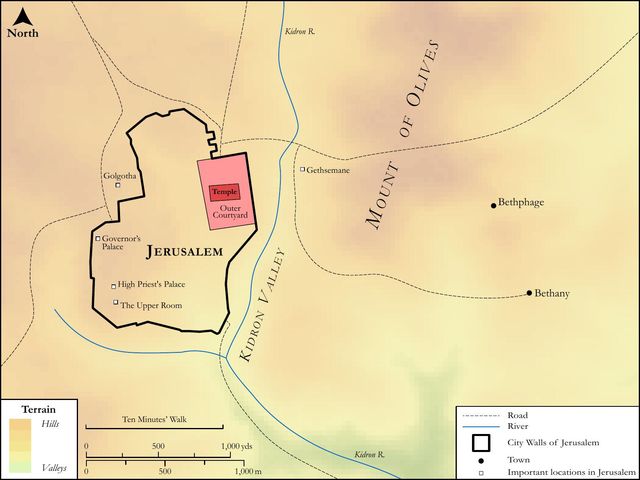
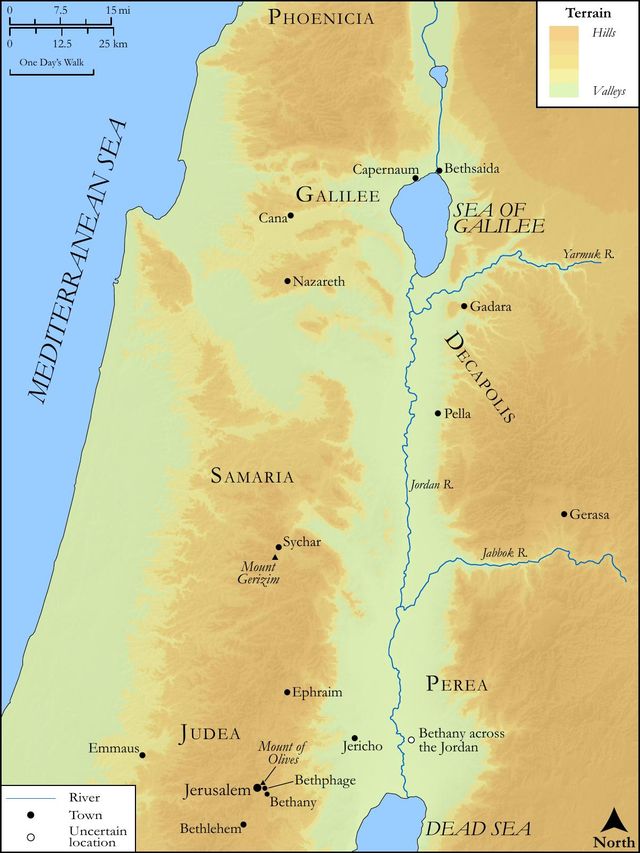
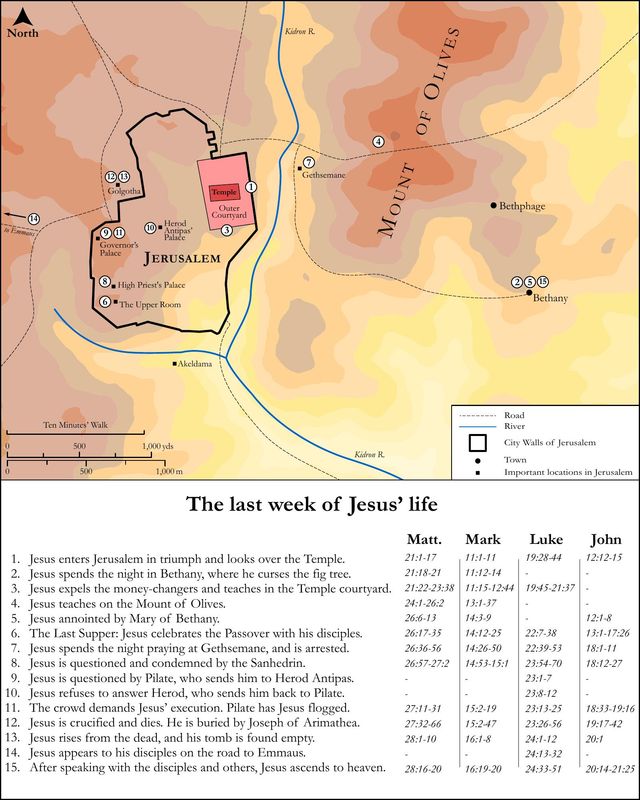
Study this verse
Public-domain commentary
Matthew Henry
From his Commentary on the Whole Bible. Henry comments on passages, not single verses — this entry covers John 21:20–25. His four-level outline is real structure in the source text, so it is rendered as structure.
In these verses, we have,
I.The conference Christ had with Peter concerning John, the beloved disciple, in which we have,
1.The eye Peter cast upon him (Joh 21:20): Peter, in obedience to his Master's orders, followed him, and turning about, pleased with the honours his Master now did him, he sees the disciple whom Jesus loved following likewise. Observe here,
(1.)How John is described. He does not name himself, as thinking his own name not worthy to be preserved in these records; but gives such a description of himself as sufficiently informs us whom he meant, and withal gives us a reason why he followed Christ so closely. He was the disciple whom Jesus loved, for whom he had a particular kindness above the rest; and therefore you cannot blame him for coveting to be as much as possible within hearing of Christ's gracious words during those few precious minutes with which Christ favoured his disciples. It is probable that mention in here made of John's having leaned on Jesus's breast and his enquiring concerning the traitor, which he did at the instigation of Peter (Joh 13:24), as a reason why Peter made the following enquiry concerning him, to repay him for the former kindness. Then John was in the favourite's place, lying in Christ's bosom, and he improved the opportunity to oblige Peter. And now that Peter was in the favourite's place, called to take a walk with Christ, he thought himself bound in gratitude to put such a question for John as he thought would oblige him, we all being desirous to know things to come. Note, As we have interest at the throne of grace, we should improve it for the benefit of one another. Those that help us by their prayers at one time should be helped by us with ours at another time. This is the communion of saints.
(2.)What he did: he also followed Jesus, which shows how well he loved his company; where he was there also would this servant of his be. When Christ called Peter to follow him, it looked as if he designed to have some private talk with him; but such an affection John had to his Master that he would rather do a thing that seemed rude than lose the benefit of any of Christ's discourse. What Christ said to Peter he took as said to himself; for that word of command, Follow me, was given to all the disciples. At least he desired to have fellowship with those that had fellowship with Christ, and to accompany those that attended him. The bringing of one to follow Christ should engage others. Draw me and we will run after thee, Sol 1:4.
(3.)The notice Peter took of it: He, turning about, seeth him. This may be looked upon either,
[1.]As a culpable diversion from following his Master; he should have been wholly intent upon that, and have waited to hear what Christ had further to say to him, and then was he looking about him to see who followed. Note, The best men find it hard to attend upon the Lord without distraction, hard to keep their minds so closely fixed as they should be in following Christ: and a needless and unseasonable regard to our brethren often diverts us from communion with God. Or,
[2.]As a laudable concern for his fellow-disciples. He was not so elevated with the honour his Master did him, in singling him out from the rest, as to deny a kind look to one that followed. Acts of love to our brethren must go along with actings of faith in Christ.
2.The enquiry Peter made concerning him (Joh 21:21): "Lord, and what shall this man do? Thou hast told me my work - to feed the sheep; and my lot - to be carried whither I would not. What shall be his work, and his lot?" Now this may be taken as the language, (1.) Of concern for John, and kindness to him: "Lord, thou showest me a great deal of favour. Here comes thy beloved disciple, who never forfeited thy favour, as I have done; he expects to be taken notice of; hast thou nothing to say to him? Wilt thou not tell how he must be employed, and how he must be honoured?" (2.) Or of uneasiness at what Christ had said to him concerning his sufferings: "Lord, must I alone be carried whither I would not? Must I be marked out to be run down, and must this man have no share of the cross?" It is hard to reconcile ourselves to distinguishing sufferings, and the troubles in which we think we stand alone. (3.) Or of curiosity, and a fond desire of knowing things to come, concerning others, as well as himself. It seems, by Christ's answer, there was something amiss in the question. When Christ had given him the charge of such a treasure, and the notice of such a trial, it had well become him to have said, "Lord, and what shall I do then to approve myself faithful to such a trust, in such a trial? Lord, increase my faith. As my day is, let my strength be." But instead of this, [1.] He seems more concerned for another than for himself. So apt are we to be busy in other men's matters, but negligent in the concerns of our own souls - quick-sighted abroad, but dim-sighted at home - judging others, and prognosticating what they will do, when we have enough to do to prove our own work, and understand our own way. [2.] He seems more concerned about events than about duty. John was younger than Peter, and, in the course of nature, likely to survive him: "Lord," says he, "what times shall he be reserved for?" Whereas, if God by his grace enable us to persevere to the end, and finish well, and get safely to heaven, we need not ask, "What shall be the lot of those that shall come after us?" Is it not well if peace and truth be in my days? Scripture-predictions must be eyed for the directing of our consciences, not the satisfying of our curiosity.
3.Christ's reply to this enquiry (Joh 21:22), "If I will that he tarry till I come, and do not suffer as thou must, what is that to thee. Mind thou thy own duty, the present duty, follow thou me."
(1.)There seems to be here an intimation of Christ's purpose concerning John, in two things: - [1.] That he should not die a violent death, like Peter, but should tarry till Christ himself came by a natural death to fetch him to himself. The most credible of the ancient historians tell us that John was the only one of all the twelve that did not actually die a martyr. He was often in jeopardy, in bonds and banishments; but at length died in his bed in a good old age. Note, First, At death Christ comes to us to call us to account; and it concerns us to be ready for his coming. Secondly, Though Christ calls out some of his disciples to resist unto blood, yet not all. Though the crown of martyrdom is bright and glorious, yet the beloved disciple comes short of it. [2.] That he should not die till after Christ's coming to destroy Jerusalem: so some understand his tarrying till Christ comes. All the other apostles died before that destruction; but John survived it many years. God wisely so ordered it that one of the apostles should live so long as to close up the canon of the New Testament, which John did solemnly (Rev 22:18), and to obviate the design of the enemy that sowed tares even before the servants fell asleep. John lived to confront Ebion, and Cerinthus, and other heretics, who rose betimes, speaking perverse things.
(2.)Others think that it is only a rebuke to Peter's curiosity, and that his tarrying till Christ's second coming is only the supposition of an absurdity: "Wherefore askest thou after that which is foreign and secret? Suppose I should design that John should never die, what does that concern thee? It is nothing to thee, when or where, or how, John must die. I have told thee how thou must die for thy part; it is enough for thee to know that, Follow thou me." Note, It is the will of Christ that his disciples should mind their own present duty, and not be curious in their enquiries about future events, concerning either themselves or others.
[1.]There are many things we are apt to be solicitous about that are nothing to us. Other people's characters are nothing to us; it is out of our line to judge them, Rom 14:4. Whatsoever they are, saith Paul, it makes no matter to me. Other people's affairs are nothing to us to intermeddle in; we must quietly work, and mind our own business. Many nice and curious questions are put by the scribes and disputers of this world concerning the counsels of God, and the state of the invisible world, concerning which we may say, What is this to us? What do you think will become of such and such? is a common question, which may easily be answered with another: What is that to me? To his own Master he stands or falls. What is it to us to know the times and the seasons? Secret things belong not to us.
[2.]The great thing that is all in all to us is duty, and not event; for duty is ours, events are God's - our own duty, and not another's; for every one shall bear his own burden - our present duty, and not the duty of the time to come; for sufficient to the day shall be the directions thereof: a good man's steps are ordered by the Lord, (Psa 37:23); he is guided step by step. Now all our duty is summed up in this one of following Christ. We must attend his motions, and accommodate ourselves to them, follow him to do him honour, as the servant his master; we must walk in the way in which he walked, and aim to be where he is. And, if we will closely attend to the duty of following Christ, we shall find neither heart nor time to meddle with at which does not belong to us.
4.The mistake which arose from this saying of Christ, that that disciple should not die, but abide with the church to the end of time; together with the suppressing of this motion by a repetition of Christ's words, Joh 21:23. Observe here,
(1.)The easy rise of a mistake in the church by misconstruing the sayings of Christ, and turning a supposition to a position. Because John must not die a martyr, they conclude he must not die at all.
[1.]They were inclined to expect it because they could not choose but desire it. Quod volumus facile crediumus - We easily believe what we wish to be true. For John to abide in the flesh when the rest were gone, and to continue in the world till Christ's second coming, they think, will be a great blessing to the church, which in every age might have recourse to him as an oracle. When they must lose Christ's bodily presence, they hope they shall have that of his beloved disciple; as if that must supply the want of his, forgetting that the blessed Spirit, the Comforter, was to do that. Note, We are apt to dote too much on men and means, instruments and external helps, and to think we are happy if we may but have them always with us; whereas God will change his workmen, and yet carry on his work, that the excellency of the power may be of God, and not of men. There is no need of immortal ministers to be the guides of the church, while it is under the conduct of an eternal Spirit.
[2.]Perhaps they were confirmed in their expectations when they now found that John survived all the rest of the apostles. Because he lived long, they were ready to think he should live always; whereas that which waxeth old is ready to vanish away, Heb 8:13.
[3.]However, it took rise from a saying of Christ's, misunderstood, and then made a saying of the church. Hence learn, First, The uncertainty of human tradition, and the folly of building our faith upon it. Here was a tradition, an apostolical tradition, a saying that went abroad among the brethren. It was early; it was common; it was public; and yet it was false. How little then are those unwritten traditions to be relied upon which the council of Trent hath decreed to be received with a veneration and pious affection equal to that which is owing to the holy scripture. Here was a traditional exposition of scripture. No new saying of Christ's advanced, but only a construction put by the brethren upon what he did really say, and yet it was a misconstruction. Let the scripture be its own interpreter and explain itself, as it is in a great measure its own evidence and proves itself, for it is light. Secondly, The aptness of men to misinterpret the sayings of Christ. The grossest errors have sometimes shrouded themselves under the umbrage of incontestable truths; and the scriptures themselves have ben wrested by the unlearned and unstable. We must not think it strange if we hear the sayings of Christ misinterpreted, quoted to patronise the errors of antichrist, and the impudent doctrine of transubstantiation - for instance, pretending to build upon that blessed word of Christ, This is my body.
(2.)The easy rectifying of such mistakes, by adhering to the word of Christ, and abiding by that. So the evangelist here corrects and controls that saying among the brethren, by repeating the very words of Christ. He did not say that the disciple should not die. Let us not say so then; but he said, If I will that he tarry till I come, what is that to thee? He said so, and no more. Add thou not unto his words. Let the words of Christ speak for themselves, and let no sense be put upon them but what is genuine and natural; and in that let us agree. Note, The best end of men's controversies would be to keep to the express words of scripture, and speak, as well as think, according to that word, Isa 8:20. Scripture language is the safest and most proper vehicle of scripture truth: the words which the Holy Ghost teacheth, Co1 2:13. As the scripture itself, duly attended to, is the best weapon wherewith to wound all dangerous errors (and therefore deists, Socinians, papists, and enthusiasts do all they can to derogate the authority of scripture), so the scripture itself, humbly subscribed to, is the best weapon - salve to heal the wounds that are made by different modes of expression concerning the same truths. Those that cannot agree in the same logic and metaphysics, and the propriety of the same terms of air, and the application of them, may yet agree in the same scripture terms, and then may agree to love one another.
II.We have here the conclusion of this gospel, and with it of the evangelical story, Joh 21:24, Joh 21:25.
This evangelist ends not so abruptly as the other three did, but with a sort of cadency.
1.This gospel concludes with an account of the author or penman of it, connected by a decent transition to that which went before (Joh 21:24): This is the disciple which testifies of these things to the present age, and wrote these things for the benefit of posterity, even this same that Peter and his Master had that conference about in the foregoing verses - John the apostle. Observe here,
(1.)Those who wrote the history of Christ were not ashamed to put their names to it. John here does in effect subscribe his name. As we are sure who was the author of the first five books of the Old Testament, which were the foundation of that revelation, so we are sure who were the penmen of the four gospels and the Acts, the pentateuch of the New Testament. The record of Christ's life and death is not the report of we know not who, but was drawn up by men of known integrity, who were ready not only to depose it upon oath, but, which was more, to seal it with their blood.
(2.)Those who wrote the history of Christ wrote upon their own knowledge, not by hearsay, but what they themselves were eye and ear witnesses of. The penman of this history was a disciple, a beloved disciple, one that had leaned on Christ's breast, that had himself heard his sermons and conferences, had seen his miracles, and the proofs of his resurrection. This is he who testifies what he was well assured of.
(3.)Those who wrote the history of Christ, as they testified what they had seen, so they wrote what they had first testified. It was published by word of mouth, with the greatest assurance, before it was committed to writing. They testified it in the pulpit, testified it at the bar, solemnly averred it, stedfastly avowed it, not as travellers give an account of their travels, to entertain the company, but as witnesses upon oath give account of what they know in a matter of consequence, with the utmost caution and exactness, to found a verdict upon. What they wrote they wrote as an affidavit, which they would abide by. Their writings are standing testimonies to the world of the truth of Christ's doctrine, and will be testimonies either for us or against us according as we do or do not receive it.
(4.)It was graciously appointed, for the support and benefit of the church, that the history of Christ should be put into writing, that it might with the greater fulness and certainty spread to every place, and last through every age.
2.It concludes with an attestation of the truth of what had been here related: We know that his testimony is true. This may be taken either,
(1.)As expressing the common sense of mankind in matters of this nature, which is, that the testimony of one who is an eye-witness, is of unspotted reputation, solemnly deposes what he has seen, and puts it into writing for the greater certainty, is an unexceptionable evidence. We know, that is, All the world knows, that the testimony of such a one is valid, and the common faith of mankind requires us to give credit to it, unless we can disprove it; and in other cases verdict and judgment are given upon such testimonies. The truth of the gospel comes confirmed by all the evidence we can rationally desire or expect in a thing of this nature. The matter of fact, that Jesus did preach such doctrines, and work such miracles, and rise from the dead, is proved, beyond contradiction, by such evidence as is always admitted in other cases, and therefore to the satisfaction of all that are impartial; and then let the doctrine recommend itself, and let the miracles prove it to be of God. Or,
(2.)As expressing the satisfaction of the churches at that time concerning the truth of what is here related. Some take it for the subscription of the church of Ephesus, others of the angels or ministers of the churches of Asia to this narrative. Not as if an inspired writing needed any attestation from men, or could thence receive any addition to its credibility; but hereby they recommended it to the notice of the churches, as an inspired writing, and declared the satisfaction they received by it. Or,
(3.)As expressing the evangelist's own assurance of the truth of what he wrote, like that (Joh 19:35), He knows that he saith true. He speaks of himself in the plural number, We know, not for majesty-sake, but for modesty-sake, as Jo1 1:1, That which we have seen; and Pe2 1:16. Note, The evangelists themselves were entirely satisfied of the truth of what they have testified and transmitted to us. They do not require us to believe what they did not believe themselves; no, they knew that their testimony was true, for they ventured both this life and the other upon it; threw away this life, and depended upon another, on the credit of what they spoke and wrote.
3.It concludes with an et cetera, with a reference to many other things, very memorable, said and done by our Lord Jesus, which were well known by many then living, but not thought fit to be recorded for posterity, Joh 21:25. There were many things very remarkable and improvable, which, if they should be written at large, with the several circumstances of them, even the world itself, that is, all the libraries in it, could not contain the books that might be written. Thus he concludes like an orator, as Paul (Heb 11:32), What shall I more say? For the time would fail me. If it be asked why the gospels are not larger, why they did not make the New Testament history as copious and as long as the Old, it may be answered,
(1.)It was not because they had exhausted their subject, and had nothing more to write that was worth writing; no, there were many of Christ's sayings and doings not recorded by any of the evangelists, which yet were worthy to be written in letter of gold. For,
[1.]Every thing that Christ said and did was worth our notice, and capable of being improved. He never spoke an idle word, nor did an idle thing; nay, he never spoke nor did any thing mean, or little, or trifling, which is more than can be said of the wisest or best of men.
[2.]His miracles were many, very many, of many kinds, and the same often repeated, as occasion offered. Though one true miracle might perhaps suffice to prove a divine commission, yet the repetition of the miracles upon a great variety of persons, in a great variety of cases, and before a great variety of witnesses, helped very much to prove them true miracles. Every new miracle rendered the report of the former the more credible; and the multitude of them renders the whole report incontestable.
[3.]The evangelists upon several occasions give general accounts of Christ's preaching and miracles, inclusive of many particulars, as Mat 4:23, Mat 4:24; Mat 9:35; Mat 11:1; Mat 14:14, Mat 14:36; Mat 15:30; Mat 19:2; and many others. When we speak of Christ, we have a copious subject before us; the reality exceeds the report, and, after all, the one half is not told us. St. Paul quotes one of Christ's sayings, which is not recorded by any of the evangelists (Act 20:35), and doubtless there were many more. All his sayings were apophthegms.
(2.)But it was for these three reasons: - [1.] Because it was not needful to write more. This is implied here. There were many other things, which were not written because there was no occasion for writing them. What is written is a sufficient revelation of the doctrine of Christ and the proof of it, and the rest was but to the same purport. Those that argue from this against the sufficiency of the scripture as the rule of our faith and practice, and for the necessity of unwritten traditions, ought to show what there is in the traditions they pretend to be perfective of the written word; we are sure there is that which is contrary to it, and therefore reject them. By these therefore let us be admonished, for of making many books there is no end, Ecc 12:12. If we do not believe and improve what is written, neither should we if there had been much more. [2.] It was not possible to write all. It was possible for the Spirit to indite all, but morally impossible for the penmen to pen all. The world could not contain the books. It is a hyperbole common enough and justifiable, when no more is intended than this, that it would fill a vast and incredible number of volumes. It would be such a large and overgrown history as never was; such as would jostle out all other writings, and leave us no room for them. What volumes would be filled with Christ's prayers, had we the record of all those he made, when he continued all night in prayer to God, without any vain repetitions? Much more if all his sermons and conferences were particularly related, his miracles, his cures, all his labours, all his sufferings; it would have been an endless thing. [3.] It was not advisable to write much; for the world, in a moral sense, could not contain the books that should be written. Christ said not what he might have said to his disciples, because they were not able to bear it; and for the same reason the evangelists wrote not what they might have written. The world could not contain, chōrēsai. It is the word that is used, Joh 8:37, "My word has no place in you." They would have been so many that they would have found no room. All people's time would have been spent in reading, and other duties would thereby have been crowded out. Much is overlooked of what is written, much forgotten, and much made the matter of doubtful disputation; this would have been the case much more if there had been such a world of books of equal authority and necessity as the whole history would have swelled to; especially since it was requisite that what was written should be meditated upon and expounded, which God wisely thought fit to leave room for. Parents and ministers, in giving instruction, must consider the capacities of those they teach, and, like Jacob, must take heed of over-driving. Let us be thankful for the books that are written, and not prize them the less for their plainness and brevity, but diligently improve what God has thought fit to reveal, and long to be above, where our capacities shall be so elevated and enlarged that there will be no danger of their being over-loaded.
The evangelist, concluding with Amen, thereby sets to his seal, and let us set to ours, an Amen of faith, subscribing to the gospel, that it is true, all true; and an Amen of satisfaction in what is written, as able to make us wise to salvation. Amen; so be it.
Historical interpretation
Nine Centuries of Reception
17 surviving comments on this verse. Each one is dated, so this reads as a timeline rather than a list.
Select a marker to jump to its quote. Markers stagger vertically where authors wrote within a few decades of each other.
And observe, I pray thee, here also the absence of pride in the Evangelist; for having mentioned the opinion of the disciples, he corrects it, as though they had not comprehended what Jesus meant. "Jesus said not," he tells us, "that he shall not die, but, If I will that he tarry."
Wherefore hath he reminded us of that reclining? Not without cause or in a chance way, but to show us what boldness Peter had after the denial. For he who then did not dare to question Jesus, but committed the office to another, was even entrusted with the chief authority over the brethren, and not only doth not commit to another what relates to himself, but himself now puts a question to his Master concerning another. John is silent, but Peter speaks. He showeth also here the love which he bare towards him; for Peter greatly loved John, as is clear from what followed, and their close union is shown through the whole Gospel, and in the Acts.
(Hom. lxxxviii. 2) But if it be asked, How then did James assume the see of Jerusalem? I answer, that our Lord enthroned Peter, not as Bishop of this see, but as Doctor of the whole world: Then Peter, turning about, seeth the disciple whom Jesus loved following, which also leaned on his breast at supper. It is not without meaning that that circumstance of leaning on His breast is mentioned, but to show what confidence Peter had after his denial. For he who at the supper dared not ask himself, but gave his question to John to put, has the superintendence over his brethren committed to him, and whereas before he gave a question which concerned himself to another to put, he now asks questions himself of his Master concerning others. Our Lord then having foretold such great things of him, and committed the world to him, and prophesied his martyrdom, and made known his greater love, Peter wishing to have John admitted to a share of this calling, says, And what shall this man do? as if to say, Will he not go the same way with us? For Peter had great love for John, as appears from the Gospels and Acts of the Apostles, which give many proofs of their close friendship. So Peter does John the same turn, that John had done him; thinking that he wanted to ask about himself, but was afraid, he puts the question for him. However, inasmuch as they were now going to have the care of the world committed to them, and could not remain together without injury to their charge, our Lord says, If I will that he tarry till I come, what is that to thee? as if to say, Attend to the work committed to thee, and do it: if I will that he abide here, what is that to thee?
(Hom. lxxxviii) The Evangelist then corrects the opinion taken up by the disciples.
"Then went this saying abroad among the brethren, that that disciple should not die; yet Jesus said not that he shall not die; but, If I will that he tarry till I come, what is that to thee?" "Do not thou on any account suppose," He saith, "that I order your matters after a single rule." And this He did to withdraw them from their unseasonable sympathy for each other; for since they were about to receive the charge of the world, it was necessary that they should no longer be closely associated together; for assuredly this would have been a great loss to the world. Wherefore He saith unto him, "Thou hast had a work entrusted to thee, look to it, accomplish it, labor and struggle. What if I will that he tarry here? Look thou to and care for thine own matters."
Since he spake from strong affection, and wishing not to be torn away from him, Christ, to show that however much he might love, he could not go beyond His love, saith, "If I will that he tarry - what is that to thee?" By these words teaching us not to be impatient, nor curious beyond what seemeth good to Him. For because Peter was ever hot, and springing forward to enquiries such as this, to cut short his warmth, and to teach him not to enquire farther, He saith this.
When therefore Christ had foretold great things to him, and committed the world to him, and spake beforehand of his martyrdom, and testified that his love was greater than that of the others, desiring to have John also to share with him, he said, "And what shall this man do?" "Shall he not come the same way with us?" And as at that other time not being able himself to ask, he puts John forward, so now desiring to make him a return, and supposing that he would desire to ask about the matters pertaining to himself, but had not courage, he himself undertook the questioning. What then saith Christ? "If I will that he tarry till I come, what is that to thee?"
"Then went this saying abroad among the brethren, that that disciple dieth not: yet Jesus said not unto him, He dieth not; but, Thus do I wish him to remain till I come, what is that to thee?" You see the great extent in this Gospel of a question which, by its depth, must exercise in no ordinary way the mind of the inquirer. For why is it said to Peter, "Follow me," and not to the others who were likewise present? Who can readily believe that anything else was meant than what the brethren who lived at the time believed, namely, that that disciple was not to die, but to abide in this life till Jesus came? But John himself removed such an idea, by giving a flat contradiction to the report that the Lord had said so. For why should he add, "Jesus saith not, He dieth not," save to prevent what was false from taking hold of the hearts of men?
The Lord either said what he said to Peter about his martyrdom, or he said it about the gospel of John. As regards the martyrdom and this “Follow me,” [he means] suffer for me, suffer what I did. Because Christ was crucified, Peter too was crucified … while John experienced none of this. That is what is meant by, “It is thus that I wish him to remain.” Let him fall asleep without wounds, without torment, and wait for me. You, Peter, “Follow me,” suffer what I did. That’s one way these words can be explained.…As regards the Gospel of John, though, this is what I think is meant: that Peter wrote about the Lord, others too wrote; but their writing was more concerned with the Lord’s humanity.… But while there is something about the divinity of Christ in Peter’s letters, in John’s gospel it is very much to the fore.… He soared above the clouds and soared above the stars, soared above the angels, soared above every creature and arrived at the Word through which all things were made.
It is no unimportant question why the Lord, when He manifested Himself for the third time to the disciples, said unto the Apostle Peter, "Follow me;" but of the Apostle John, "Thus I wish him to remain till I come, what is that to thee?" When the Lord, then, had announced beforehand to Peter by what death he was to glorify God, "He saith unto him, Follow me. Then Peter, turning about, seeth the disciple whom Jesus loved following; who also leaned on His breast at supper, and said, Lord, which is he that shall betray Thee? Peter, therefore, seeing him, saith to Jesus, Lord, and what [of] this man? Jesus saith unto him, Thus do I wish him to remain till I come, what is that to thee? Follow thou me."
There are two states of life, therefore, preached and commended to herself from heaven, that are known to the Church, whereof the one is in faith, the other in sight; one in the temporal sojourn in a foreign land, the other in the eternity of the [heavenly] abode; one in labor, the other in repose; one on the way, the other in the fatherland; one in active work, the other in the wages of contemplation; one declines from evil and makes for good, the other has no evil to decline from, and has great good to enjoy; the one fights with a foe, the other reigns without a foe; the one is brave in the midst of adversities, the other has no experience of adversity; the one is bridling its carnal lusts, the other has full scope for spiritual delights; the one is anxious with the care of conquering, the other secure in the peace of victory; the one is helped in temptations, the other, free from all temptations, rejoices in the Helper Himself; the one is occupied in relieving the indigent, the other is there, where no indigence is found; the one pardons the sins of others, that its own may be pardoned to itself, the other neither has anything to pardon nor does aught for which pardon has to be asked; the one is scourged with evils that it may not be elated with good things, the other is free from all evil by such a fullness of grace that, without any temptation to pride, it may cleave to that which is supremely good; the one discerneth both good and evil, the other has only that which is good presented to view: therefore the one is good, but miserable as yet; the other, better and blessed. This one was signified by the Apostle Peter, that other by John.
Let no one, however, separate these distinguished apostles. In that which was signified by Peter, they were both alike; and in that which was signified by John, they will both be alike hereafter. In their representative character, the one was following, the other tarrying; but in their personal faith they were both of them enduring the present evils of the misery here, both of them expecting the future good things of the blessedness to come. And such is the case, not with them alone, but with the holy universal Church, the spouse of Christ, who has still to be rescued from the present trials, and to be preserved in the future happiness. And these two states of life were symbolized by Peter and John, the one by the one, the other by the other; but in this life they both of them walked for a time by faith, and the other they shall both of them enjoy eternally by sight. For the whole body of the saints, therefore, inseparably belonging to the body of Christ, and for their safe pilotage through the present tempestuous life, did Peter, the first of the apostles, receive the keys of the kingdom of heaven for the binding and loosing of sins; and for the same congregation of saints, in reference to the perfect repose in the bosom of that mysterious life to come did the evangelist John recline on the breast of Christ.
(Tract. cxxiii) He who denied and loved, died in perfect love for Him, for Whom he had promised to die with wrong haste. It was necessary that Christ should first die for Peter's salvation, and then Peter die for Christ's Gospel.
(Tract. cxxiv) Our Lord having foretold to Peter by what death he should glorify God, bids him follow Him. And when He had spoken this, He saith unto him, Follow Me. Why does He say, Follow Me, to Peter, and not to the others who were present, who as disciples were following their Master? Or if we understand it of his martyrdom, was Peter the only one who died for the Christian truth? Was not James put to death by Herod? Some one will say that James was not crucified, and that this was fitly addressed to Peter, because he not only died, but suffered the death of the cross, as Christ did.
(Tract. cxxiv) He calls himself the disciple whom Jesus loved, because Jesus had a greater and more familiar love for him, than for the rest; so that He made him lie on His breast at supper. In this way John the more commends the divine excellency of that Gospel which he preached. Some think, and they no contemptible commentators upon Scripture, that the reason why John was loved more than the rest, was, because he had lived in perfect chastity from his youth up. Then went this saying abroad among the brethren, that that disciple should not die: yet Jesus said not unto him, He shall not die; but, If I will that he tarry till I come, what is that to thee?
(Tract. cxxiv) Jesus saith unto him, What is that to thee? and He then repeats, Follow thou Me, as if John would not follow Him, because he wished to remain till He came; Then went this saying abroad among the disciples, that that disciple should not die. Was it not a natural inference of the disciple's? But John himself does away with such a notion: Yet Jesus said not unto him, He shall not die; but, If I will that he tarry till I come, what is that to thee? But if any so will, let him contradict, and say that what John says is true, viz. that our Lord did not say that that disciple should not die, but that nevertheless this was signified by using such words as John records.
(Tract. cxxiv.) Or perhaps he will allow that John still lies in his sepulchre at Ephesus, but asleep, not dead; and will give us a proof, that the soil over his grave is moist and watery, owing to his respiration. But why should our Lord grant it as a great privilege to the disciple whom He loved, that he should sleep this long time in the body, when he released Peter rent the burden of the flesh by a glorious martyrdom, and gave him what Paul had longed for, when he said, I have a desire to depart and be with Christ? If there really takes place at John's grave that which report says, it is either done to commend his precious death, since that had not martyrdom to commend it, or for some other cause not known to us. Yet the question remains, Why did our Lord say of one who was about to die, I will that he tarry till I come? It may be asked too why our Lord loved John the most, when Peter loved our Lord the most? I might easily reply, that the one who loved Christ the more, was the better man, and the one whom Christ loved the more, the more blessed; only this would not be a defence of our Lord's justice. This important question then I will endeavour to answer. The Church acknowledges two modes of life, as divinely revealed, that by faith, and that by sight. The one is represented by the Apostle Peter, in respect of the primacy of his Apostleship; the other by John: wherefore to the one it is said, Follow Me, i. e. imitate Me in enduring temporal sufferings; of the other it is said, I will that he tarry till I come: as if to say, Do thou follow Me, by the endurance of temporal sufferings, let him remain till I come to give everlasting bliss; or to open out the meaning more, Let action be perfected by following the example of My Passion, but let contemplation wait inchoate till at My coming it be completed: wait, not simply remain, continue, but wait for its completion at Christ's coming. Now in this life of action it is true, the more we love Christ, the more we are freed from sin; but He does not love us as we are, He frees us from sin, that we may not always remain as we are, but He loves us heretofore rather, because hereafter we shall not have that which displeases Him, and which He frees us from. So then let Peter love Him, that we may be freed from this mortality; let John be loved by Him, that we may be preserved in that immortality. John loved less than Peter, because, as he represented that life in which we are much more loved, our Lord said, I will that he remain (i. e. wait) till I come; seeing that that greater love we have not yet, but wait till we have it at His coming. And this intermediate state is represented by Peter who loves, but is loved less, for Christ loves us in our misery less than in our blessedness: and we again love the contemplation of truth such as it will be then, less in our present state, because as yet we neither know nor have it. But let none separate those illustrious Apostles; that which Peter represented, and that which John represented, both were sometime to be.
The whole of the one is passed here to the end of this world, and there finds its termination, the other is deferred for its completion till after the end of this world, but has no end in the world to come. Hence it is said to the latter, "Follow me;" but of the former, "Thus I will that he tarry till I come, what is that to thee? follow thou me." For what means this last? So far as my wisdom goes, so far as I comprehend, what is it but this, Follow thou me by imitating me in the endurance of temporal evils; let him remain till I come to restore everlasting good? And this may be expressed more clearly in this way: Let perfected action, informed by the example of my passion, follow me; but let contemplation only begun remain [so] till I come, to be perfected when I come. For the godly plenitude of patience, reaching forward even unto death, followeth Christ; but the fullness of knowledge tarrieth till Christ come, to be manifested then.
The inspired Evangelist points to himself obscurely, but still sufficiently to indicate who is meant. For he it was who was the beloved disciple, and who leaned upon Christ's Breast at the last Supper, and asked who it was that should betray Him. Peter, then, observing him, longed for information, and sought to know in what perils he would be involved in the time to come, and in what way his life would end. But the question seemed unseemly, and it appeared to savour rather of a meddlesome and inquisitive spirit, that, after having learnt what was to happen unto himself, he should seek to know the future fate of others. For this cause, then, I think the Lord makes no direct reply to his question or inquiry, but, diverting the aim of the questioner, does not say that John will not die, but, If I will that he tarry till I come, what is that to thee? That is to say, Thou hast heard, O Peter, the things concerning thyself, what need is there for thee to ask questions about others, and to seek to fathom out of season the knowledge of the Divine decrees. For if he never die at all, He says, what consolation will this be to thy heart? The man who is wise and prudent, then, if he is doomed to die, will not trouble himself as to whether another will be saved alive or not; for it will be enough for him to suffer his own doom, and he will receive no comfort at all from the misfortune or good cheer of another. The passage is fraught with some such meaning as this. Peter's speech here seems to imply that the blessed Peter anxiously desired to know what was destined to be John's fate, as he would have considered it a consolation in his own sufferings if John were surely fated to, die by torture, either of the same or of some other kind. And do not be amazed at this, but rather take the following thought into consideration. It is common to us, however profitless it be, to like at times not to be seen to be the only ones who are suffering, or who are destined to undergo some dreadful fate, but to prefer to hear that others have either suffered it already or are expected to suffer it in the future.
Antony was confused as he meditated upon the depths of God’s judgements, and he asked God, ‘Lord, how is it that some die young and others grow old and sick? Why are there some poor and some rich? Why are there those who are bad and rich and oppress the good poor?’ He heard a voice saying to him, ‘Antony, worry about yourself; these other matters are up to God, and it will not do you any good to know them.’
Peter hearing that he was to suffer death for Christ, asks whether John was to die: Then Peter, turning about, seeth the disciple whom Jesus loved following; which also leaned on His breast at supper, and said, Lord, which is he that betrayeth Thee? Peter seeing him saith to Jesus, Lord, and what shall this man do?
i. e. Shall he not die?
Or let him say, Christ did not deny that John was to die, for whatever is born dies; but said, I will that he tarry till I come, i. e. to live to the end of the world, and then he shall suffer martyrdom for Me. And therefore they confess that he still lives, but will be killed by Antichrist, and will preach Christ's name with Elias. But if his sepulchre be objected, then they say that he entered in alive, and went out of it afterwards.
When our Lord says to Peter, Follow Me, He confers upon him the superintendence over all the faithful, and at the same time bids him imitate Him in every thing, word and work. He shows too His affection for Peter; for those who are most dear to us, we bid follow us.
Some have understood, Till I come, to mean, Till I come to punish the Jews who have crucified Me, and strike them with the Roman rod. For they say that this Apostle lived up to the time of Vespasian, who took Jerusalem, and dwelt near when it was taken. Or, Till I come, i. e. till I give him the commission to preach, for to you I commit now the pontificate of the world: and in this follow Me, but let him remain till I come and call him, as I do thee now.
I will that he tarry, i. e. I will not that he suffer martyrdom, but wait for the quiet dissolution of the flesh, when I shall come and receive him into eternal blessedness.
Continue studying John 21:22 across the web’s major study libraries — every link below opens this exact verse, chapter, or book on the destination site.
Read & Compare
 BibleGatewayThis verse in more than 200 translations and 70 languages.
 Bible.comThe YouVersion reader — hundreds of translations, reading plans, and highlights.
 ESV.orgCrossway's official English Standard Version reader.
 NET BibleThe NET translation with 60,000+ translators' notes on every rendering decision.
 STEP BibleTyndale House's free study tool — original text, vocabulary, and scholarly resources.
 BibliaLogos Bible Software's free web reader.
 USCCBThe New American Bible (Revised Edition) with the U.S. bishops' study notes.
Commentaries
 BibleHub CommentariesDozens of classic commentaries on this verse, gathered on one page.
 StudyLightMore than 100 commentary sets — the largest collection on the web.
 BibleRefPlain-English commentary on what this verse means, verse by verse.
 Enduring WordDavid Guzik's free commentary on this chapter, widely used by Bible teachers.
 Bible Study ToolsVerse commentary alongside Greek and Hebrew study aids.
Original Language & Research
- BibleHub InterlinearThe verse word by word — original language, transliteration, and English.
- BibleHub LexiconEvery word's original-language definition and Strong's entry.
 Blue Letter BibleDeep-study tools — Strong's numbers, concordance, and word studies.
 CNTR CollationThe earliest Greek manuscripts of this verse, collated letter by letter.
Sermons, Hymns & Audio


TrulyRandomVerse is not affiliated with these sites and doesn’t control their content. They’re linked because they’re genuinely useful.
Summary
In John 21:22, Jesus delivers a profound and direct instruction to Peter, redirecting his focus from the destiny of another disciple (John) back to his own personal calling and unwavering obedience to Christ. This pivotal exchange, occurring after Peter's reinstatement and the prophecy of his martyrdom, underscores the intensely personal nature of discipleship and the necessity of prioritizing one's individual walk with the Lord above comparison or concern for others' paths.
Context
ShowHideLiterary Context
This verse is situated within the closing chapter of John's Gospel, detailing Jesus' third post-resurrection appearance to His disciples, specifically at the Sea of Tiberias. The immediate preceding verses (John 21:15-19) describe Jesus' three-fold questioning of Peter regarding his love, followed by the commission to "feed My sheep" and a prophecy of Peter's future martyrdom. Peter, having just been confronted with his own destiny, then turns and sees "the disciple whom Jesus loved" (traditionally identified as John) following them. His question in John 21:21 ("Lord, and what shall this man do?") prompts Jesus' sharp yet loving response in John 21:22, which serves as a crucial redirection, not only for Peter but for all disciples. The subsequent verse, John 21:23, clarifies the misunderstanding that arose from Jesus' words, emphasizing the conditional nature of His statement.
Historical & Cultural Context
The setting is the Sea of Galilee, a familiar place for the disciples, where many of them had been called by Jesus to "follow Him" at the beginning of His ministry. Fishing was their livelihood, and their return to it after Jesus' crucifixion highlights a period of uncertainty before His final instructions. The concept of a master-disciple relationship was well-established in Jewish culture, where disciples were expected to emulate their teacher and follow his path. However, Jesus' unique call involved a personal, spiritual allegiance that transcended typical rabbinic discipleship. Peter's question reflects a natural human tendency to compare and contrast one's own lot with that of others, a common social dynamic. Jesus' response challenges this tendency, asserting His sovereign authority over each individual's life and calling, a concept deeply rooted in the Old Testament understanding of God's personal covenant with His people.
Key Themes
ShowHideJohn 21:22 powerfully contributes to several overarching themes in John's Gospel and the broader New Testament. Firstly, it highlights Individual Discipleship and Divine Sovereignty, emphasizing that each believer's path and destiny are uniquely determined by God's will. Peter's specific call to martyrdom (John 21:18-19) is distinct from John's, whose longevity is hinted at. Secondly, the verse underscores the theme of Undivided Focus on Christ, urging disciples to concentrate on their personal relationship and obedience to Jesus rather than being distracted by the lives, roles, or perceived destinies of others. This theme is echoed in Jesus' call to "seek first the kingdom of God" (Matthew 6:33). Finally, the definitive command, "follow thou me," reinforces the central New Testament theme of Personal Allegiance and Obedience to Jesus Christ as the primary duty of every disciple, a call that transcends all other concerns. This echoes the initial call to discipleship found throughout the Gospels, such as in Matthew 4:19.
Exposition and Analysis
ShowHideKey Word Analysis
ShowHideThis word, G2309, signifies a deliberate determination or choice stemming from subjective impulse or desire. It denotes an active option rather than passive acquiescence. In the context of Jesus' statement, it underscores His divine prerogative and sovereign will in determining the course of John's life. It is not a mere wish, but an authoritative declaration of intent.
G3306 means to stay, abide, continue, or remain in a given place, state, or relation. Here, it refers to John's continued physical presence or life on earth. Jesus' use of this word highlights the specific nature of John's longevity, contrasting it with Peter's foretold immediate martyrdom. It speaks to the duration of John's earthly ministry and life.
G190 means to be in the same way with, to accompany, and specifically, to follow as a disciple. This is a fundamental command in Christian discipleship, implying not just physical proximity but also adherence to Jesus' teachings, example, and mission. It is a call to continuous, personal allegiance and obedience, irrespective of others' paths.
Verse Breakdown
ShowHide"Jesus saith unto him,"
This opening phrase establishes the speaker and the recipient, emphasizing the direct, personal nature of this instruction from Jesus to Peter. It follows a moment of Peter's curiosity, setting the stage for a crucial teaching.
"If I will that he tarry till I come,"
This is a conditional clause, revealing Jesus' sovereign authority over the lives of His disciples. The phrase "till I come" is open to interpretation, often understood as referring to Jesus' Second Coming, but also potentially to a spiritual coming, or even a coming in judgment or a specific divine appointment for John. The key is that John's destiny is entirely within Jesus' divine will, not subject to Peter's inquiry or human comparison.
"what [is that] to thee?"
This is a direct, rhetorical question serving as a gentle but firm rebuke. It challenges Peter's misplaced curiosity and concern for another's path, effectively asking, "Why does this concern you?" or "It is none of your business." It serves to redirect Peter's attention away from external comparisons and back to his own immediate responsibilities.
"follow thou me."
This is the unequivocal, imperative command that forms the core of the verse. It is a singular, personal directive to Peter, reiterating the fundamental call of discipleship. It emphasizes personal allegiance, obedience, and focus on Christ, regardless of the paths or destinies of others. This command encapsulates the essence of the Christian walk.
Literary Devices
ShowHideThe verse employs several significant literary devices. The most prominent is the Rhetorical Question ("what [is that] to thee?"). This question is not posed to elicit information but to make a forceful point: Peter's concern for John's destiny is irrelevant to his own calling. It serves as a sharp, yet loving, redirection, highlighting the personal and non-comparative nature of discipleship. Following this, Jesus issues a direct Imperative ("follow thou me"). This command is concise and absolute, cutting through Peter's distraction and re-centering his focus on his primary duty. The verse also implicitly uses Contrast, juxtaposing Peter's foretold martyrdom with John's implied longevity, and further contrasting Peter's outward curiosity with the inward, personal commitment demanded by Christ. This contrast underscores the unique and individual nature of each disciple's journey with the Lord.
Theological and Thematic Connections
ShowHideJohn 21:22 offers profound theological insights into the nature of Christian discipleship and God's sovereign plan. It asserts Christ's absolute authority over the individual destinies of His followers, emphasizing that each person's journey, gifts, and calling are uniquely ordained by God. This truth liberates believers from the burden of comparison, envy, or judgment, redirecting their gaze to the singular command of Christ. The passage underscores that true discipleship is not about measuring oneself against others or being preoccupied with their paths, but about a personal, unwavering allegiance to Jesus Christ alone. This focus on individual responsibility and divine sovereignty fosters humility and trust, reminding us that our ultimate purpose is to obey and glorify the One who calls us.
Reflection and Application
ShowHideJohn 21:22 provides timeless wisdom for every believer navigating the complexities of faith and community. In a world saturated with social comparison, Jesus' words to Peter serve as a powerful antidote to the temptation of looking sideways at others' paths, successes, or perceived failures. Our spiritual journey is deeply personal, uniquely designed by God for His purposes. Instead of expending energy on what someone else is doing, or why their life seems different from ours, we are called to fix our eyes on Jesus and diligently pursue the specific path He has laid out for us. This means embracing our own unique calling, gifts, and challenges with contentment and unwavering focus. The ultimate directive remains: "follow thou me"—a call to continuous, personal, and unreserved obedience to Christ, trusting His sovereign plan for our individual lives.
Questions for Reflection
ShowHideFAQ
ShowHideWhat did Jesus mean by "If I will that he tarry till I come"? Did John not die?
ShowHideJesus' statement, "If I will that he tarry till I come," was a conditional hypothetical, not a definitive prophecy that John would never die. The Greek word "tarry" (G3306, ménō) means to remain or abide. This phrase has often been interpreted in a few ways: it could refer to Jesus' Second Coming, a spiritual "coming" in judgment, or simply a reference to John's longevity compared to Peter's imminent martyrdom. John 21:23 explicitly clarifies that a rumor spread among the disciples that John would not die, but the Gospel writer corrects this misunderstanding, stating, "Jesus said not unto him, He shall not die; but, If I will that he tarry till I come, what is that to thee?" This correction confirms that Jesus did not promise John immortality but rather asserted His sovereign right to determine John's lifespan and destiny, just as He determined Peter's. Historically, John is believed to have lived to old age, dying a natural death, unlike Peter who was martyred.
Christ-Centered Fulfillment
ShowHideWhile John 21:22 directly addresses Peter's curiosity about John, its Christ-centered fulfillment lies in the universal call to discipleship and the singular focus required for all who follow Jesus. The command "follow thou me" is the essence of Christ's invitation to humanity, echoing His initial call to the disciples at the Sea of Galilee to become "fishers of men" (Matthew 4:19). This directive is not merely about physical proximity but about a radical reorientation of one's life around the person and mission of Jesus. In Christ, we find the ultimate example of perfect obedience to the Father's will (Philippians 2:8), and His call to us is to emulate that obedience, regardless of the unique path He sets for each of us. Our lives are not to be compared to others, for Christ Himself is the standard and the goal. He is the "way, the truth, and the life" (John 14:6), and to follow Him is to participate in His life, death, and resurrection, ultimately leading to eternal life and glorification with Him (Romans 8:17). Thus, Peter's redirection becomes a timeless reminder that our singular devotion belongs to Christ, the author and perfecter of our faith (Hebrews 12:2).