


Matthew 16:28
Bible text: King James Version (1769 Blayney text) · Public domain
Bible text: King James Version with Strong's numbers · Public domain
Bible text: Berean Standard Bible · Public domain
Bible text: American Standard Version (1901) · Public domain
Bible text: World English Bible, Messianic edition · Public domain
Bible text: Geneva Bible (1599) · Public domain
Bible text: Young's Literal Translation · Public domain
- ἈμὴνAmēnAmenG281INJ-HEBInterjection
- λέγωlegōI sayG3004V-PAI-1SVerb Present Active Indicative 1st Singular
- ὑμῖνhuminto youG4771P-2DPPersonal pronoun Dative 2nd Plural
- εἰσίνeisinthere areG1510V-PAI-3PVerb Present Active Indicative 3rd Plural
- τινεςtinessomeG5100X-NPMIndefinite pronoun Nominative Plural Masculine
- τῶνtōnof thoseG3588T-GPMDefinite article Genitive Plural Masculine
- ὧδεhōdehereG5602ADVAdverb
- ἑστώτωνhestōtōnalready standingG2476V-RAP-GPMVerb Perfect Active Participle Genitive Plural Masculine
- οἵτινεςoitineswhoG3748R-NPMRelative pronoun Nominative Plural Masculine
- οὐoucertainlyG3756PRT-NNegative Particle Negative
- μὴmēnotG3361PRT-NNegative Particle Negative
- γεύσωνταιgeusōntaishall tasteG1089V-ADS-3PVerb Aorist Middle Deponent Subjunctive 3rd Plural
- θανάτουthanatouof deathG2288N-GSMNoun Genitive Singular Masculine
- ἕωςhe'ōsuntilG2193PREPPreposition
- ἂνanwhenG302PRTParticle or Disjunctive
- ἴδωσινidōsinthey may have seenG1492V-2AAS-3PVerb 2nd Aorist Active Subjunctive 3rd Plural
- τὸνtontheG3588T-ASMDefinite article Accusative Singular Masculine
- υἱὸνhuionSonG5207N-ASM-TNoun Accusative Singular Masculine Title
- τοῦtou<the>G3588T-GSMDefinite article Genitive Singular Masculine
- ἀνθρώπουanthrōpouof ManG444N-GSM-TNoun Genitive Singular Masculine Title
- ἐρχόμενονerchomenoncomingG2064V-PNP-ASMVerb Present Middle Or Passive Deponent Participle Accusative Singular Masculine
- ἐνeninG1722PREPPreposition
- τῇtēatheG3588T-DSFDefinite article Dative Singular Feminine
- βασιλείᾳbasileiakingdomG932N-DSFNoun Dative Singular Feminine
- αὐτοῦautouof HimG846P-GSMPersonal pronoun Genitive Singular Masculine
English is a literal word-by-word gloss of the Greek, not the KJV's wording. Why?
This is the original text the KJV's translators worked from — each Greek word with its own literal English meaning in this verse, prepared by scholars at Tyndale House, Cambridge. The KJV translates whole sentences, not word by word, so its wording differs: one Greek word can become several English words, and the KJV may choose “charity” where the gloss reads “love”. Both are faithful — they answer different questions. For the KJV's own rendering, switch to the KJV text.
Details
See on the biblical-era maps

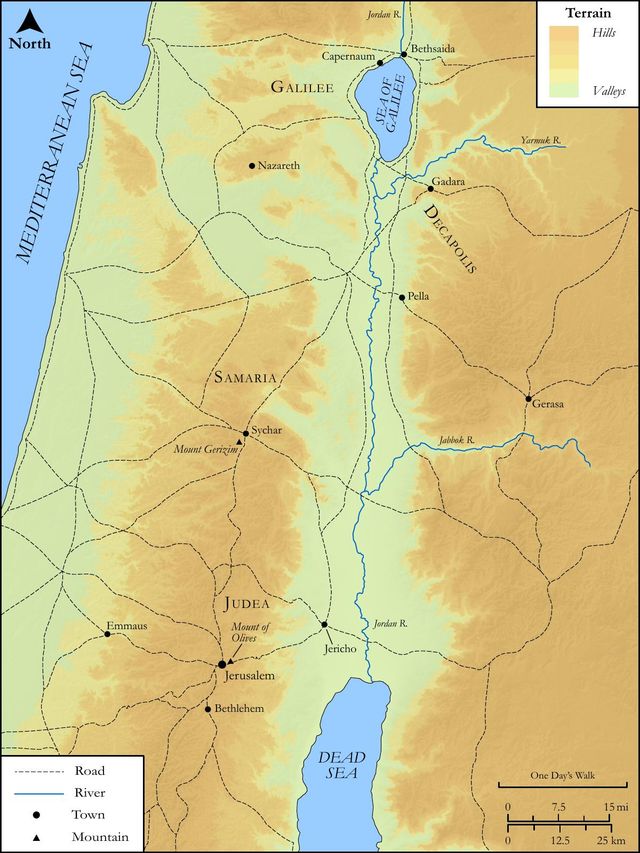
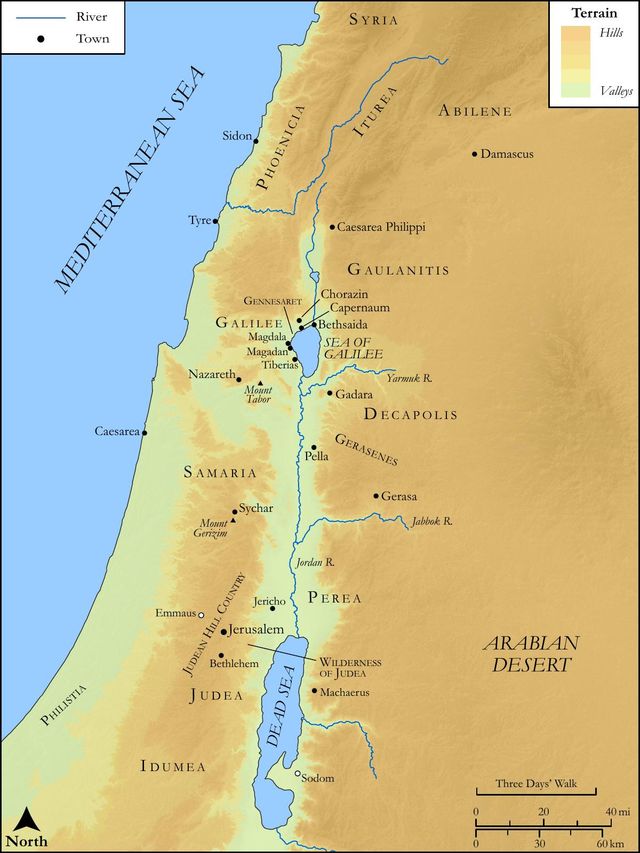
Study this verse
Public-domain commentary
Matthew Henry
From his Commentary on the Whole Bible. Henry comments on passages, not single verses — this entry covers Matthew 16:24–28. His four-level outline is real structure in the source text, so it is rendered as structure.
Christ, having shown his disciples that he must suffer, and that he was ready and willing to suffer, here shows them that they must suffer too, and must be ready and willing. It is a weighty discourse that we have in these verses.
I.Here is the law of discipleship laid down, and the terms fixed, upon which we may have the honour and benefit of it, Mat 16:24.
He said this to his disciples, not only that they might instruct others concerning it, but that by this rule they might examine their own security. Observe,
1.What it is to be a disciple of Christ; it is to come after him. When Christ called his disciples, this was the word of command, Follow me. A true disciple of Christ is one that doth follow him in duty, and shall follow him to glory. He is one that comes after Christ, not one that prescribes to him, as Peter now undertook to do, forgetting his place. A disciple of Christ comes after him, as the sheep after the shepherd, the servant after his master, the soldiers after their captain; he is one that aims at the same end that Christ aimed at, the glory of God, and the glory of heaven: and one that walks in the same way that he walked in, is led by his Spirit, treads in his steps, submits to his conduct, and follows the Lamb, whithersoever he goes, Rev 14:4.
2.What are the great things required of those that will be Christ's disciples; If any man will come, ei tis thelei - If any man be willing to come. It denotes a deliberate choice, and cheerfulness and resolution in that choice. Many are disciples more by chance or the will of others than by any act of their own will; but Christ will have his people volunteers, Psa 110:3. It is as if Christ had said, "If any of the people that are not my disciples, be steadfastly minded to come to me, and if you that are, be in like manner minded to adhere to me, it is upon these terms, these and no other; you must follow me in sufferings as well as in other things, and therefore when you sit down to count the cost, reckon upon it."
Now what are these terms?
(1.)Let him deny himself. Peter had advised Christ to spare himself, and would be ready, in the like case, to take the advice; but Christ tells them all, they must be so far from sparing themselves, that they must deny themselves. Herein they must come after Christ, for his birth, and life, and death, were all a continued act of self-denial, a self-emptying, Phi 2:7, Phi 2:8. If self-denial be a hard lesson, and against the grain to flesh and blood, it is no more than what our Master learned and practised before us and for us, both for our redemption and for our instruction; and the servant is not above his lord. Note, All the disciples and followers of Jesus Christ must deny themselves. It is the fundamental law of admission into Christ's school, and the first and great lesson to be learned in this school, to deny ourselves; it is both the strait gate, and the narrow way; it is necessary in order to our learning all the other good lessons that are there taught. We must deny ourselves absolutely, we must not admire our own shadow, nor gratify our own humour; we must not lean to our own understanding, nor seek our own things, nor be our own end. We must deny ourselves comparatively; we must deny ourselves for Christ, and his will and glory, and the service of his interest in the world; we must deny ourselves for our brethren, and for their good; and we must deny ourselves for ourselves, deny the appetites of the body for the benefit of the soul.
(2.)Let him take up his cross. The cross is here put for all sufferings, as men or Christians; providential afflictions, persecutions for righteousness' sake, every trouble that befalls us, either for doing well or for not doing ill. The troubles of Christians are fitly called crosses, in allusion to the death of the cross, which Christ was obedient to; and it should reconcile us to troubles, and take off the terror of them, that they are what we bear in common with Christ, and such as he hath borne before us. Note,
[1.]Every disciple of Christ hath his cross, and must count upon it; as each hath his special duty to be done, so each hath his special trouble to be borne, and every one feels most from his own burthen. Crosses are the common lot of God's children, but of this common lot of God's children, but of this common lot each hath his particular share. That is our cross which Infinite Wisdom has appointed for us, and a Sovereign Providence has laid on us, as fittest for us. It is good for us to call the cross we are under our own, and entertain it accordingly. We are apt to think we could bear such a one's cross better than our own; but that is best which is, and we ought to make the best of it.
[2.]Every disciple of Christ must take up that which the wise God hath made his cross. It is an allusion to the Roman custom of compelling those that were condemned to be crucified, to carry their cross: when Simon carried Christ's cross after him, this phrase was illustrated. First, It is supposed that the cross lies in our way, and is prepared for us. We must not make crosses to ourselves, but must accommodate ourselves to those which God has made for us. Our rule is, not to go a step out of the way of duty, either to meet a cross, or to miss one. We must not by our rashness and indiscretion pull crosses down upon our own heads, but must take them up when they are laid in our way. We must so manage an affliction, that it may not be a stumbling-block or hindrance to us in any service we have to do for God. We must take it up out of our way, by getting over the offence of the cross; None of these things move me; and we must then go on with it in our way, though it lie heavy. Secondly, That which we have to do, is, not only to bear the cross (that a stock, or a stone, or a stick may do), not only to be silent under it, but we must take up the cross, must improve it to some good advantage. We should not say, "This is an evil, and I must bear it, because I cannot help it;" but, "This is an evil, and I will bear it, because it shall work for my good." When we rejoice in our afflictions, and glory in them, then we take up the cross. This fitly follows upon denying ourselves; for he that will not deny himself the pleasures of sin, and the advantages of this world for Christ, when it comes to the push, will never have the heart to take up his cross. "He that cannot take up the resolution to live a saint, has a demonstration within himself, that he is never likely to die a martyr;" so Archbishop Tillotson.
(3.)Let him follow me, in this particular of taking up the cross. Suffering saints must look unto Jesus, and take from him both direction and encouragement in suffering. Do we bear the cross? We therein follow Christ, who bears it before us, bears it for us, and so bears it from us. He bore the heavy end of the cross, the end that had the curse upon it, that was a heavy end, and so made the other light and easy for us. Or, we may take it in general, we must follow Christ in all instances of holiness and obedience. Note, The disciples of Christ must study to imitate their Master, and conform themselves in every thing to his example, and continue in well-doing, whatever crosses lie in their way. To do well and to suffer ill, is to follow Christ. If any man will come after me, let him follow me; that seems to be idem per idem - the same thing over again. What is the difference? Surely it is this, "If any man will come after me, in profession, and so have the name and credit of a disciple, let him follow me in truth, and so do the work and duty of a disciple." Or thus, "If any man will set out after me, in good beginnings, let him continue to follow me with all perseverance." That is following the Lord fully, as Caleb did. Those that come after Christ, must follow after him.
II.Here are arguments to persuade us to submit to these laws, and come up to these terms.
Self-denial, and patient suffering, are hard lessons, which will never be learned if we consult with flesh and blood; let us therefore consult with our Lord Jesus, and see what advice he gives us; and here he gives us,
1.Some considerations proper to engage us to these duties of self-denial and suffering for Christ. Consider,
(1.)The weight of that eternity which depends upon our present choice (Mat 16:25); Whosoever will save his life, by denying Christ, shall lose it: and whosoever is content to lose his life, for owning Christ, shall find it. Here are life and death, good and evil, the blessing and the curse, set before us. Observe,
[1.]The misery that attends the most plausible apostasy. Whosoever will save his life in this world, if it be by sin, he shall lose it in another; he that forsakes Christ, to preserve a temporal life and avoid a temporal death, will certainly come short of eternal life, and will be hurt of the second death, and eternally held by it. There cannot be a fairer pretence for apostasy and iniquity than saving the life by it, so cogent is the law of self-preservation; and yet even that is folly, for it will prove in the end self-destruction; the life saved is but for a moment, the death shunned is but as a sleep; but the life lost is everlasting, and the death run upon is the depth and complement of all misery, and an endless separation from all good. Now, let any rational man consider of it, take advice and speak his mind, whether there is any thing got, at long run, by apostasy, though a man save his estate, preferment, or life, by it.
[2.]The advantage that attends the most perilous and expensive constancy; Whosoever will lose his life for Christ's sake in this world, shall find it in a better, infinitely to his advantage. Note, First, Many a life is lost, for Christ's sake, in doing his work, by labouring fervently for his name; in suffering work, by choosing rather to die than to deny him or his truths and ways. Christ's holy religion is handed down to us, sealed with the blood of thousands, that have not known their own souls, but have despised their lives (as Job speaks in another case), though very valuable ones, when they have stood in competition with their duty and the testimony of Jesus, Rev 20:4. Secondly, Though many have been losers for Christ, even of life itself, yet never any one was, or will be, a loser by him in the end. The loss of other comforts, for Christ, may possibly be made up in this world (Mar 10:30); the loss of life cannot, but it shall be made up in the other world, in an eternal life; the believing prospect of which hath been the great support of suffering saints in all ages. An assurance of the life they should find, in lieu of the life they hazarded, hath enabled them to triumph over death in all its terrors; to go smiling to a scaffold, and stand singing at a stake, and to call the utmost instances of their enemies' rage but a light affliction.
[3.]The worth of the soul which lies at stake, and the worthlessness of the world in comparison of it (Mat 16:26). What is a man profited, if he gain the whole world and lose his own soul? tēn psuchēn autou; the same word which is translated his life (Mat 16:25), for the soul is the life, Gen 2:7. This alludes to that common principle, that, whatever a man gets, if he lose his life, it will do him no good, he cannot enjoy his gains. But it looks higher, and speaks of the soul as immortal, and a loss of it beyond death, which cannot be compensated by the gain of the whole world. Note, First, Every man has a soul of his own. The soul is the spiritual and immortal part of man, which thinks and reasons, has a power of reflection and prospect, which actuates the body now, and will shortly act in a separation from the body. Our souls are our own not in respect of dominion and property (for we are not our own, All souls are mine, saith God), but in respect of nearness and concern; our souls are our own, for they are ourselves. Secondly, It is possible for the soul to be lost, and there is danger of it. The soul is lost when it is eternally separated from all the good to all the evil that a soul is capable of; when it dies as far as a soul can die; when it is separated from the favour of God, and sunk under his wrath and curse. A man is never undone till he is in hell. Thirdly, If the soul be lost, it is of the sinner's own losing. The man loses his own soul, for he does that which is certainly destroying to it, and neglects that which alone would be saving, Hos 13:9. The sinner dies because he will die; hes blood is on his own head. Fourthly, One soul is worth more than all the world; our own souls are of greater value to us than all the wealth, honour, and pleasures of this present time, if we had them. Here is the whole world set in the scale against one soul, and Tekel written upon it; it is weighed in the balance, and found too light to weigh it down. This is Christ's judgment upon the matter, and he is a competent Judge; he had reason to know the price of souls, for he redeemed them; nor would he under-rate the world, for he made it. Fifthly, The winning of the world is often the losing of the soul. Many a one has ruined his eternal interest by his preposterous and inordinate care to secure and advance his temporal ones. It is the love of the world, and the eager pursuit of it, that drowns men in destruction and perdition. Sixthly, The loss of the soul is so great a loss, that the gain of the whole world will not countervail it, or make it up. He that loses his soul, though it be to gain the world, makes a very bad bargain for himself, and will sit down at last an unspeakable loser. When he comes to balance the account, and to compare profit and loss, he will find that, instead of the advantage he promised himself, he is ruined to all intents and purposes, is irreparably broken.
What shall a man give in exchange for his soul? Note, If once the soul be lost, it is lost for ever. There is no antallagma - counter-price, that can be paid, or will be accepted. It is a loss that can never be repaired, never be retrieved. If, after that great price which Christ laid down to redeem our souls, and to restore us to the possession of them, they be so neglected for the world, that they come to be lost, that new mortgage will never be taken off; there remains no more sacrifice for sins, nor price for souls, but the equity of redemption is eternally precluded. Therefore it is good to be wise in time, and do well for ourselves.
2.Here are some considerations proper to encourage us in self-denial and suffering for Christ.
(1.)The assurance we have of Christ's glory, at his second coming to judge the world, Mat 16:27. If we look to the end of all these things, the period of the world, and the posture of souls then, we shall thence form a very different idea of the present state of things. If we see things as the will appear then, we shall see them as they should appear now.
The great encouragement to steadfastness in religion is taken from the second coming of Christ, considering it,
[1.]As his honour; The Son of man shall come in the glory of his Father, with his angels. To look upon Christ in his state of humiliation, so abased, so abused, a reproach of men, and despised of the people, would discourage his followers from taking any pains, or running any hazards for him; but with an eye of faith to see the Captain of our salvation coming in his glory, in all the pomp and power of the upper world, will animate us, and make us think nothing too much to do, or too hard to suffer, or him. The Son of man shall come. He here gives himself the title of his humble state (he is the Son of man), to show that he is not ashamed to own it. His first coming was in the meanness of his children, who being partakers of flesh, he took part of the same; but his second coming will be in the glory of his Father. At his first coming, he was attended with poor disciples; at his second coming, he will be attended with glorious angels; and if we suffer with him, we shall be glorified with him, Ti2 2:12.
[2.]As our concern; Then he shall reward every man according to his works. Observe, First, Jesus Christ will come as a Judge, to dispense rewards and punishments, infinitely exceeding the greatest that any earthly potentate has the dispensing of. The terror of men's tribunal (Mat 10:18) will be taken off by a believing prospect of the glory of Christ's tribunal. Secondly, Men will then be rewarded, not according to their gains in this world, but according to their works, according to what they were and did. In that day, the treachery of backsliders will be punished with eternal destruction, and the constancy of faithful souls recompensed with a crown of life. Thirdly, The best preparative for that day is to deny ourselves, and take up our cross, and follow Christ; for so we shall make the Judge our Friend, and these things will then pass well in the account. Fourthly, The rewarding of men according to their works is deferred till that day. Here good and evil seem to be dispensed promiscuously; we see not apostasy punished with immediate strokes, nor fidelity encouraged with immediate smiles, from heaven; but in that day all will be set to rights. Therefore judge nothing before the time, Ti2 4:6-8.
(2.)The near approach of his kingdom in this world, v. 28. It was so near, that there were some attending him who should live to see it. As Simeon was assured that he should not see death till he had seen the Lord's Christ come in the flesh; so some here are assured that they shall not taste death (death is a sensible thing, its terrors are seen, its bitterness is tasted) till they had seen the Lord's Christ coming in his kingdom. At the end of time, he shall come in his Father's glory; but now, in the fulness of time, he was to come in his own kingdom, his mediatorial kingdom. Some little specimen was given of his glory a few days after this, in his transfiguration (Mat 17:1); then he tried his robes. But this points at Christ's coming by the pouring out of his Spirit, the planting of the gospel church, the destruction of Jerusalem, and the taking away of the place and nation of the Jews, who were the most bitter enemies to Christianity. Here was the Son of man coming in his kingdom. Many then present lived to see it, particularly John, who lived till after the destruction of Jerusalem, and saw Christianity planted in the world. Let this encourage the followers of Christ to suffer for him,
[1.]That their undertaking shall be succeeded; the apostles were employed in setting up Christ's kingdom; let them know, for their comfort, that whatever opposition they meet with, yet they shall carry their point, shall see of the travail of their soul. Note, It is a great encouragement to suffering saints to be assured, not only of the safety, but of the advancement of Christ's kingdom among men; not only notwithstanding their sufferings, but by their sufferings. A believing prospect of the success of the kingdom of grace, as well as of our share in the kingdom of glory, may carry us cheerfully through our sufferings.
[2.]That their cause shall be pleaded; their deaths shall be revenged, and their persecutors reckoned with.
[3.]That this shall be done shortly, in the present age. Note, The nearer the church's deliverances are, the more cheerful should we be in our sufferings for Christ. Behold the Judge standeth before the door. It is spoken as a favour to those that should survive the present cloudy time, that they should see better days. Note, It is desirable to share with the church in her joys, Dan 12:12. Observe, Christ saith, Some shall live to see those glorious days, not all; some shall enter into the promised land, but others shall fall in the wilderness. He does not tell them who shall live to see this kingdom, lest if they had known, they should have put off the thoughts of dying, but some of them shall; Behold, the Lord is at hand. The Judge standeth before the door; be patient, therefore, brethren.
Historical interpretation
Nine Centuries of Reception
14 surviving comments on this verse. Each one is dated, so this reads as a timeline rather than a list.
Select a marker to jump to its quote. Markers stagger vertically where authors wrote within a few decades of each other.
They that stand where Jesus stands, are they that have the foundations of their souls rested upon Jesus; of whom such as stood firmest are said not to taste death till they see the Word of God; which comes in His kingdom when they see that excellence of God which they cannot see while they are involved in divers sins, which is to taste death, forasmuch as the soul that sinneth, dies. For as life, and the living bread, is He that came down from heaven, so His enemy death is the bread of death. And of these breads there are some that eat but a little, just tasting them, while some eat more abundantly. They that sin neither often, nor greatly, these only taste death; they that have partaken more perfectly of spiritual virtue do not taste it only, but feed ever on the living bread. That He says, Until they see, does not fix any time at which shall be done what had not been done before, but mentions just what is necessary; for he that once sees Him in His glory, shall after that by no means taste death.
The Lord teaches that both deeds and words, and speech and action, equally furnish the faith of our hope. For it might seem that he had imposed a grievous burden upon human infirmity; namely that, when people had begun to have a sense of life by experiencing it, they should let go its enjoyment which is gratifying to their bodies. He taught that they should deny themselves for the sake of themselves—that is, they should not wish to be that which they had once begun to be. These things which are held close are accompanied by the enticements of gratifying joy, but they may lead to a wavering and uncertain hope. Therefore it was necessary by the authority of a real and manifest example that he teach them of the loss of present things and place these in the context of future gains. All of this might seem contrary to the power and perception of current judgment. After he had warned of the cross to be borne and the soul to be ruined and the eternity of life to be exchanged for the loss of the world, he turned toward his disciples and said that some of them would not taste death until they beheld the Son of man in the glory of his own kingdom. Moreover, Jesus himself tasted death and showed the faithful already a taste of death. And so deeds.
"Verily, verily, I say unto you, There are some of them that stand here, which shall not taste of death, until they see the Son of Man coming in His kingdom."
Thus, inasmuch as He had discoursed much of dangers and death, and of His own passion, and of the slaughter of the disciples, and had laid on them those severe injunctions; and these were in the present life and at hand, but the good things in hope and expectation: for example, "They save their life who lose it;" "He is coming in the glory of His Father;" "He renders His rewards:" He willing to assure their very sight, and to show what kind of glory that is wherewith He is to come, so far as it was possible for them to learn it; even in their present life He shows and reveals this; that they should not grieve any more, either over their own death, or over that of their Lord, and especially Peter in His sorrow.
And see what He doth. Having discoursed of hell, and of the kingdom (for as well by saying, "He that findeth his life shall lose it, and whosoever will lose it for my sake, shall find it;" as by saying, "He shall reward every man according to his works," He had manifested both of these): having, I say, spoken of both, the kingdom indeed He shows in the vision, but hell not yet.
Why so? Because had they been another kind of people, of a grosser sort, this too would have been necessary; but since they are approved and considerate, He leads them on the gentler way. But not therefore only doth He make this disclosure, but because to Himself also it was far more suitable.
Not however that He passes over this subject either, but in some places He almost brings even before our eyes the very realities of hell; as when He introduces the picture of Lazarus, and mentions him that exacted the hundred pence, and him that was clad in the filthy garments, and others not a few.
Because He had said, Whoso will save, shall lose, and whoso will lose shall save, opposing saving to losing, that none should hence conclude that there was any equality between the losing on one side, and the saving on the other, He adds, What does it profit a man, if he shall gain the whole world, but suffer the loss of his soul? As though He had said, Say not that he who escapes the dangers which threaten him for Christ's sake, saves his soul, that is, his temporal life; but add to his temporal life the whole world, and what of all these things will profit a man if his soul perishes for ever? Suppose you should see all your servants in joy, and yourself placed in the greatest evils, what profit would you reap from being their master? Think over this within your own soul, when by the indulgence of the flesh that soul looks for its own destruction,
But if you should reign over the whole world, you would not be able to buy your soul; whence it follows, Or what shall a man give in exchange for his soul? As much as to say, if you lose goods, you may have it in your power to give other goods to recover them; but if you lose your soul, you can neither give another soul, nor any thing else in ransom for it. And what marvel is it if this happen in the soul, when we see the same happen in the body; for if you should surround a body afflicted with an incurable disease with ten thousand diadems, they would not heal it.
He said not in such glory as is that of the Father, that you might not suppose a difference of glory, but He says, The glory of the Father, that it might be shown to be the same glory. But if the glory is one, it is evident that the substance is one. What then fearest thou, Peter, hearing of death? For then shalt thou see Me in glory. But if I be in glory, so also shall ye be. But in making mention of His glory, He mingleth therewith things terrible, bringing forward the judgment, as it follows, And then shall he render to each man according to his works.
This He said to call to their minds not only the punishment of sinners, but the prizes and crowns of the righteous.
(Hom. lvi.) Willing to show what is that glory in which He shall come hereafter, He revealed it to them in this present life, so far as it was possible for them to receive it, that they might not have sorrow in their Lord's death.
Therefore He does not reveal the names of those who should ascend into the mount, because the rest would be very desirous to accompany them whither they might look upon the pattern of His glory, and would be grieved as though they were passed over.
And He indeed spake it, in part to refresh the good, but I ever shudder at hearing it, for I am not of them that are crowned, and I suppose that others also share with us in our fear and anxiety. For whom is this saying not enough to startle, when he hath entered into his own conscience; and to make him shudder, and convince him that we have need of sackcloth, and of prolonged fasting, more than the people of the Ninevites? For not for an overthrow of a city, and the common end, are we concerned, but for eternal punishment, and the fire that is never quenched.
Wherefore also I praise and admire the monks that have occupied the desert places, as for the rest, so for this saying. For they after having made their dinners, or rather after supper (for dinner they know not at any time, because they know that the present time is one of mourning and fasting); after supper then, in saying certain hymns of thanksgiving unto God, they make mention of this expression also. And if ye would hear the very hymns themselves, that ye too may say them continually, I will rehearse to you the whole of that sacred song. The words of it then stand as follows: "Blessed God, who feedest me from my youth up, who givest food to all flesh; fill our hearts with joy and gladness, that always having all sufficiency we may abound unto every good work in Christ Jesus our Lord; with whom be unto Thee glory, honor and might, with the Holy Spirit, forever. Amen. Glory to Thee, O Lord, glory to Thee, O Holy One, glory to Thee. O King, that Thou hast given us meat to make us glad. Fill us with the Holy Ghost, that we may be found well-pleasing before Thee, not being ashamed, when Thou renderest to every man according to his works."
Now this hymn is in all parts worthy of admiration, but especially the above ending of it. That is, because meals and food are wont to dissipate and weigh down, they put this saying as a kind of bridle upon the soul, at the time of indulgence reminding it of the time of judgment.
Peter was for twenty-four years Bishop of the Church of Rome. We cannot doubt that, amongst other things necessary for the instruction of the church, he himself delivered to them the treasury of the sacred books, which, no doubt, had even then begun to be read under his presidency and teaching.
(Verse 28.) Truly I say to you, there are some standing here who will not taste death until they see the Son of Man coming in his kingdom. He wanted to heal the terror of the apostles with the hope of promised things, saying: The Son of Man is coming in the glory of his Father with his angels. Moreover, with the authority of a judge added: and he will repay each one according to his works. The silent thought of the apostles could bear such a scandal: you now say that killing and death are coming, but what you promise to be present in the glory of the Father with the ministry of angels and the power of a judge, this will be in the future, and will be delayed for a long time. Therefore, foreseeing what the knowers of secret things could object, he counterbalances present fear with present reward. For he says: There are some of those standing here who will not taste death until they see the Son of Man coming in his kingdom; so that the manner in which he will come afterwards may be shown to you at the present time, because of your unbelief.
Having thus called upon His disciples to deny themselves and take up their cross, the hearers were filled with great terror, therefore these severe tidings are followed by more joyful; For the Son of Man shall come in the glory of his Father with the holy Angels. Dost thou fear death? Hear the glory of the triumph. Dost thou dread the cross? Hear the attendance of the Angels.
For there is no difference of Jew or Gentile, man or woman, poor or rich, whore not persons but works are accepted.
But the secret thought of the Apostles might have suffered an offence of this sort; The killings and deaths you speak of as to be now, but the promise of your coming in glory is put off to a long distant time. He that knows secret things therefore, seeing that they might object this, requites a present fear with a present reward, saying, Verily I say unto you, There be some of those standing here that shall not taste death until the Son of Man come in his kingdom.
Since the disciples had not yet received power from on high, it was perhaps not unnatural that they should fall occasionally into human weaknesses and, thinking something of this sort, say, “How shall someone deny himself? Or how can someone, by losing his own life, save it?” …Therefore, to lead them away from reasonings of this sort and, so to speak, forge courage anew within them, communicating to them a longing for the glory to come, he says, “There are some standing here,” hinting at Peter and the sons of Zebedee; for these were taken up with him at the transfiguration, which Christ calls “the kingdom,” as demonstrating the ineffability of [his] authority and the immutable nature of [his] kinship with the Father. And in this [saying] he also hints at the importance and the fearfulness of his second coming, showing this coming to be a prelude and, as it were, a confirmation of that. For he will come “in the glory of God, the Father,” not in the humble condition that is commensurate with us.
What is here said, therefore, was fulfilled in the three disciples to whom the Lord, when transfigured in the mount, showed the joys of the eternal inheritance; (vid. Bed. in Luc. 9:27.) these saw Him coming in His kingdom, that is, shining in His effulgent radiance, in which, after the judgment passed, He shall be beheld by all the saints.
(Hom. in Ev. xxxii. 4.) Or the connection may be thus; The Holy Church has a period of persecution, and a period of peace; and our Redeemer accordingly distinguishes between these periods in His commands; in time of persecution the life is to be laid down; but in time of peace, those earthly lusts which might gain too great power over us are to be broken through; whence He says, What does it profit a man?
(ubi sup.) Or, by the kingdom of God is meant the present Church, and because some of His disciples were to live so long in the body as to behold the Church of God built up and raised against the glory of this world, this comfortable promise is given them, There be some of them standing here.
He continues: "Amen I say to you, there are some standing here who will not taste death until they see the Son of man coming in his kingdom." The kingdom of God, dearest brothers, is not always called the coming kingdom in sacred Scripture, but sometimes the present Church is so called. Hence it is written: "The Son of man will send his angels, and they will gather out of his kingdom all causes of scandal." In that kingdom, indeed, there will be no scandals, where certainly the reprobate are not admitted. By this example it is understood that in this passage the kingdom of God refers to the present Church. And because some of the disciples were going to live in the body long enough to see the Church of God built and raised up against the glory of this world, it is now said as a consoling promise: "There are some of those standing here who will not taste death until they see the kingdom of God." But when the Lord was giving such great precepts about the death that must be undergone, what need was there to come suddenly to this promise? If we consider carefully, we recognize with what great dispensation of love this is done. For to the inexperienced disciples something had to be promised even about the present life, so that they could be strengthened more firmly for the future. Thus to the Israelite people, about to be freed from the land of Egypt, the promised land was promised, and when they were to be called to heavenly gifts, they were persuaded by earthly promises. Why was this? So that while there was something they could receive nearby, they might then more faithfully believe what they could hear about from afar. For a carnal people, if they did not receive small things, would not believe in great things. Therefore Almighty God, by granting earthly things, persuades toward heavenly things, so that by receiving what they could see, they might learn to hope for what they could not see at all; and they would become all the more firm regarding invisible things, inasmuch as visible promises supported them toward certainty of hope.
(e Bed. in Luc. 9.) It is of the saints He speaks as tasting death, by whom the death of the body is tasted just as it were sipping, while the life of the soul is, held fast in possession.
. He had said that the Son of Man would come in His glory. So that they would not disbelieve Him, He says "there be some here" who would see, as far as they were able, the glory of the second coming in the Transfiguration. At the same time He shows what great glory will belong to those who suffer for His sake. For as His flesh shone like lightning on that occasion, so in due proportion will the saints shine forth then at His second coming. Here He is hinting at Peter, James and John, whom He took with Him on the mountain and showed them His kingdom, that is, the future condition in which He would come and both He and the righteous would be radiant. He is saying, therefore, "Some of you here shall not die until you have seen Me transfigured." See, then, that it is those who stand firm in goodness who see Jesus radiantly transfigured, and they are ever advancing in faith and in the commandments.
Continue studying Matthew 16:28 across the web’s major study libraries — every link below opens this exact verse, chapter, or book on the destination site.
Read & Compare
 BibleGatewayThis verse in more than 200 translations and 70 languages.
 Bible.comThe YouVersion reader — hundreds of translations, reading plans, and highlights.
 ESV.orgCrossway's official English Standard Version reader.
 NET BibleThe NET translation with 60,000+ translators' notes on every rendering decision.
 STEP BibleTyndale House's free study tool — original text, vocabulary, and scholarly resources.
 BibliaLogos Bible Software's free web reader.
 USCCBThe New American Bible (Revised Edition) with the U.S. bishops' study notes.
Commentaries
 BibleHub CommentariesDozens of classic commentaries on this verse, gathered on one page.
 StudyLightMore than 100 commentary sets — the largest collection on the web.
 BibleRefPlain-English commentary on what this verse means, verse by verse.
 Enduring WordDavid Guzik's free commentary on this chapter, widely used by Bible teachers.
 Bible Study ToolsVerse commentary alongside Greek and Hebrew study aids.
Original Language & Research
- BibleHub InterlinearThe verse word by word — original language, transliteration, and English.
- BibleHub LexiconEvery word's original-language definition and Strong's entry.
 Blue Letter BibleDeep-study tools — Strong's numbers, concordance, and word studies.
 CNTR CollationThe earliest Greek manuscripts of this verse, collated letter by letter.
Sermons, Hymns & Audio


TrulyRandomVerse is not affiliated with these sites and doesn’t control their content. They’re linked because they’re genuinely useful.
Summary
Matthew 16:28 presents a profound and often debated declaration from Jesus to His disciples, immediately following Peter's confession and Jesus' first prediction of His passion. This verse serves as a powerful assurance, promising that some of those present would not experience physical death before witnessing a significant manifestation of the Son of Man's kingly authority and the inauguration of His kingdom, offering a glimpse of His divine glory and validating His messianic claims.
Context
ShowHideLiterary Context
This verse concludes a pivotal section in Matthew's Gospel. It follows Peter's monumental confession of Jesus as "the Christ, the Son of the living God" in Matthew 16:16, which then leads to Jesus' declaration about building His church and entrusting Peter with the keys of the kingdom. Immediately after this, Jesus begins to explicitly teach His disciples about His impending suffering, death, and resurrection in Jerusalem (Matthew 16:21). Peter's subsequent rebuke of Jesus, and Jesus' sharp response, "Get behind me, Satan!" (Matthew 16:23), underscore the radical nature of Jesus' path. The call to radical discipleship, involving self-denial and cross-bearing, and the warning about losing one's life to save it, or gaining the world at the cost of one's soul, are presented in Matthew 16:24-27. Verse 28, therefore, acts as a counterpoint and a powerful encouragement, offering a promise of visible glory and vindication after the challenging call to suffering.
Historical & Cultural Context
Jesus' ministry was unfolding in a Jewish context under Roman occupation. The Jewish people eagerly awaited a Messiah who would establish an earthly kingdom, overthrow Roman rule, and restore Israel's sovereignty. The disciples, like many Jews, likely held these nationalistic expectations. Jesus' repeated emphasis on suffering and death for Himself and His followers would have been deeply counter-intuitive and discouraging to them. The promise of "seeing the Son of Man coming in his kingdom" within their lifetime would have resonated with their hopes for a tangible manifestation of divine power, even if their understanding of "kingdom" still needed refinement. This declaration would have been understood against the backdrop of Old Testament prophecies concerning a glorious, reigning Messiah, such as those found in Daniel 7:13-14.
Key Themes
ShowHideMatthew 16:28 contributes significantly to several key themes within Matthew's Gospel and broader New Testament theology. Firstly, it highlights the Imminence of Christ's Kingdom Manifestation, indicating a near-term, visible display of His kingly power and glory, not merely a distant eschatological event. Secondly, it serves as a Foretaste of Glory, widely interpreted as a direct prophecy of the Transfiguration, which occurs just six days later and is recounted in Matthew 17:1-8, Mark 9:2-8, and Luke 9:28-36. This event, witnessed by Peter, James, and John, provided a powerful, tangible glimpse into Jesus' divine majesty and the reality of His kingdom, validating His identity and mission. Thirdly, the verse offers Assurance Amidst Suffering, providing encouragement to disciples who had just been called to radical self-denial and cross-bearing, assuring them that their commitment would be vindicated by a powerful display of Christ's reigning authority.
Exposition and Analysis
ShowHideKey Word Analysis
ShowHideFrom a Hebrew root meaning "firm" or "trustworthy," this adverb signifies "truly," "certainly," or "so be it." Jesus' use of "Amen, I say to you" (often translated "Verily I say unto you") emphasizes the absolute truth and authority of His statement, signaling a weighty and reliable pronouncement.
This verb means to "taste" literally, but also figuratively to "experience" or "partake of." In the phrase "taste of death," it is a common idiom meaning to experience death. The negative "shall not taste of death" therefore means they will not experience death before the promised event.
This verb signifies "to come" or "to go" in a wide variety of applications, both literal and figurative. In this context, it denotes an arrival, presence, or powerful manifestation of the Son of Man. It does not exclusively imply a physical, final return, but can refer to an active, visible display of His authority and presence.
This noun refers to "royalty," "rule," or a "realm." When Jesus speaks of "His kingdom," He refers to His sovereign reign and dominion, which can manifest in various ways—spiritually, physically, and eschatologically. Here, it points to a visible display of His royal power.
Verse Breakdown
ShowHide"Verily I say unto you"
This solemn opening, characteristic of Jesus' teaching, underscores the absolute truth and certainty of the declaration that follows, demanding the disciples' full attention and belief.
"There be some standing here, which shall not taste of death"
Jesus indicates that not all of His immediate audience, but a subset of them, would live to witness the event He is about to describe. This establishes a near-term fulfillment within the lifetime of His contemporaries.
"till they see the Son of man coming in his kingdom"
This is the core of the prophecy. "The Son of man" is Jesus' preferred self-designation, emphasizing both His humanity and His divine, authoritative role as depicted in Daniel 7:13-14. The phrase "coming in his kingdom" refers to a powerful, visible manifestation of His kingly rule and glory. The most widely accepted interpretation connects this directly to the Transfiguration, which occurred just six days later, where Peter, James, and John witnessed Jesus in a glorified state, a powerful foretaste of His kingdom's glory. Other interpretations include the resurrection, Pentecost, or the destruction of Jerusalem in A.D. 70, all of which represent significant manifestations of Christ's authority and the advance of His kingdom.
Literary Devices
ShowHideMatthew 16:28 employs several significant literary devices. The phrase "Verily I say unto you" functions as a solemn declaration, emphasizing the absolute truth and authority of Jesus' words, drawing the listener's full attention to the impending revelation. The idiom "taste of death" is a powerful metonymy or euphemism for experiencing physical death, making the promise of not experiencing it before a certain event even more striking. The title "Son of man" is a rich messianic title that carries deep Old Testament connotations, particularly from Daniel 7, denoting both Jesus' humanity and His divine, sovereign authority. The concept of "coming in his kingdom" is a form of prophecy, a forward-looking statement whose fulfillment is debated but widely understood to refer to a visible manifestation of Jesus' divine power and kingly reign, such as the Transfiguration. The verse also uses synecdoche in "some standing here," referring to a part (a few disciples) representing the whole group present, and implying a specific, select group who would witness the promised event.
Theological and Thematic Connections
ShowHideMatthew 16:28 is a pivotal verse that bridges Jesus' teaching on the cost of discipleship with the assurance of His divine authority and the reality of His kingdom. Theologically, it underscores the inaugurated nature of God's kingdom—it is both "already" present in Christ's person and work, and "not yet" fully consummated. The promise of "seeing the Son of man coming in his kingdom" provides a tangible, immediate validation of Jesus' identity and mission, particularly after the challenging call to self-denial and suffering. It assures the disciples that their commitment to a suffering Messiah would not be in vain, but would lead to a powerful encounter with His glory. This immediate manifestation serves as a down payment on the future, full realization of His kingdom, reinforcing the trustworthiness of all His prophecies.
Reflection and Application
ShowHideMatthew 16:28, while historically fulfilled in events like the Transfiguration, continues to offer profound spiritual nourishment for believers today. It reminds us that following Christ, even when it involves significant personal cost and self-denial, is never without the promise of experiencing His glory and the reality of His kingdom. Just as the disciples were given a glimpse of Christ's majesty after being called to take up their cross, we too are assured that our faithfulness, even amidst hardship, will be met with divine revelation and the tangible presence of God's reign. This verse calls us to cultivate a vision that extends beyond immediate difficulties, fixed on the certain hope of Christ's ultimate triumph and the ongoing manifestation of His kingdom in our lives and in the world. It encourages us to live with an eschatological hope that empowers present obedience, knowing that the King is indeed "coming" in various ways, bringing His power and presence.
Questions for Reflection
ShowHideFAQ
ShowHideWhat does "taste of death" mean in this verse?
ShowHideThe phrase "taste of death" (Greek: geúomai [G1089] thánatos [G2288]) is an ancient idiom meaning to experience or undergo death. Therefore, Jesus' statement "shall not taste of death" means that some of the people standing there would not die before the promised event took place. This emphasizes the imminence and certainty of the "Son of man coming in his kingdom" within that generation's lifetime.
What is the most widely accepted interpretation of "the Son of man coming in his kingdom"?
ShowHideThe most widely accepted interpretation among biblical scholars is that Jesus is referring to the Transfiguration, which is recorded just six days later in Matthew 17:1-8, Mark 9:2-8, and Luke 9:28-36. In this event, Peter, James, and John—who were among those "standing here"—witnessed Jesus glorified, speaking with Moses and Elijah, receiving affirmation from the Father. This was a powerful, visible manifestation of His divine glory and a foretaste of His kingdom's power. Other interpretations include the resurrection, Pentecost, or the destruction of Jerusalem in A.D. 70, all of which represent significant manifestations of Christ's authority and the advance of His kingdom.
Christ-Centered Fulfillment
ShowHideMatthew 16:28 finds its Christ-centered fulfillment not in a single event, but in the unfolding reality of Jesus' messianic reign, inaugurated through His life, death, and resurrection, and powerfully displayed in the Transfiguration. The "Son of man coming in his kingdom" is ultimately fulfilled in Jesus' triumph over sin and death, His ascension to the right hand of the Father, and the subsequent outpouring of the Holy Spirit at Pentecost, which empowered the church to advance His spiritual kingdom across the earth. The Transfiguration, a direct and immediate fulfillment, offered Peter, James, and John a prefigurement of Christ's ultimate glory, validating His identity as the divine King. This glimpse of glory served as an anchor for their faith, particularly as they faced the scandal of the cross. Furthermore, the "coming in his kingdom" also points forward to the present reality of Christ's spiritual reign through His church (Ephesians 1:20-23), and ultimately to His glorious return when His kingdom will be fully and visibly established for all eternity (Revelation 11:15). Thus, Matthew 16:28 is a multifaceted prophecy, assuring the disciples of an imminent, visible manifestation of Christ's kingly power, which foreshadows and guarantees the full and final establishment of His eternal dominion.