


Luke 9:27
Bible text: King James Version (1769 Blayney text) · Public domain
Bible text: King James Version with Strong's numbers · Public domain
Bible text: Berean Standard Bible · Public domain
Bible text: American Standard Version (1901) · Public domain
Bible text: World English Bible, Messianic edition · Public domain
Bible text: Geneva Bible (1599) · Public domain
Bible text: Young's Literal Translation · Public domain
- λέγωlegōI sayG3004V-PAI-1SVerb Present Active Indicative 1st Singular
- δὲdenowG1161CONJConjunction
- ὑμῖνhuminto youG4771P-2DPPersonal pronoun Dative 2nd Plural
- ἀληθῶςalēthōstruthfullyG230ADVAdverb
- εἰσίνeisinthere areG1510V-PAI-3PVerb Present Active Indicative 3rd Plural
- τινεςtinessomeG5100X-NPMIndefinite pronoun Nominative Plural Masculine
- τῶνtōnof thoseG3588T-GPMDefinite article Genitive Plural Masculine
- αὐτοῦautouthereG847ADVAdverb
- ἑστηκότωνhestēkotōnalready standingG2476V-RAP-GPMVerb Perfect Active Participle Genitive Plural Masculine
- οἳhoiwhoG3739R-NPMRelative pronoun Nominative Plural Masculine
- οὐoucertainlyG3756PRT-NNegative Particle Negative
- μὴmēnotG3361PRT-NNegative Particle Negative
- γεύσωνταιgeusōntaimay tasteG1089V-ADS-3PVerb Aorist Middle Deponent Subjunctive 3rd Plural
- θανάτουthanatouof deathG2288N-GSMNoun Genitive Singular Masculine
- ἕωςhe'ōsuntilG2193PREPPreposition
- ἂνanmaybeG302PRTParticle or Disjunctive
- ἴδωσινidōsinthey may have seenG1492V-2AAS-3PVerb 2nd Aorist Active Subjunctive 3rd Plural
- τὴνtēntheG3588T-ASFDefinite article Accusative Singular Feminine
- βασιλείανbasileiankingdomG932N-ASFNoun Accusative Singular Feminine
- τοῦtou<the>G3588T-GSMDefinite article Genitive Singular Masculine
- θεοῦtheouof GodG2316N-GSM-TNoun Genitive Singular Masculine Title
English is a literal word-by-word gloss of the Greek, not the KJV's wording. Why?
This is the original text the KJV's translators worked from — each Greek word with its own literal English meaning in this verse, prepared by scholars at Tyndale House, Cambridge. The KJV translates whole sentences, not word by word, so its wording differs: one Greek word can become several English words, and the KJV may choose “charity” where the gloss reads “love”. Both are faithful — they answer different questions. For the KJV's own rendering, switch to the KJV text.
Details
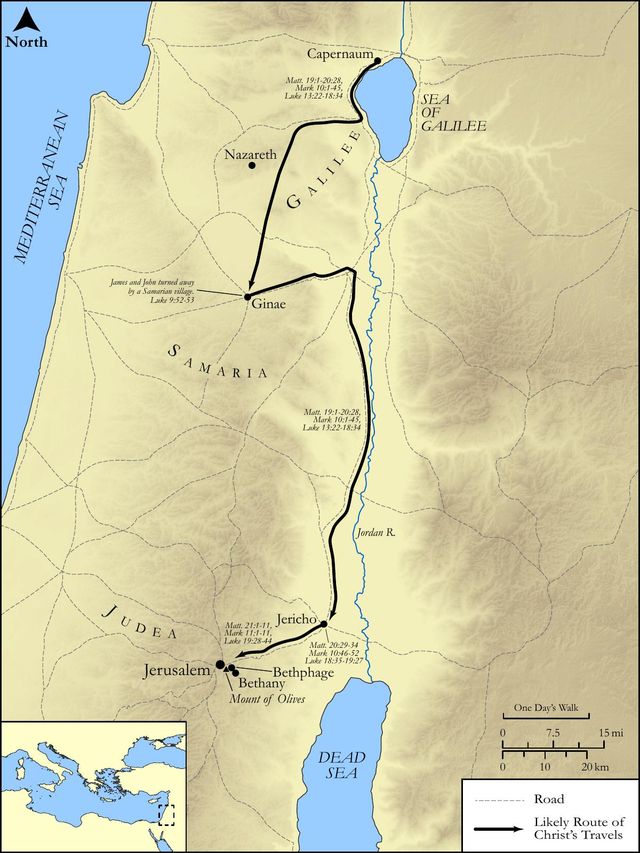
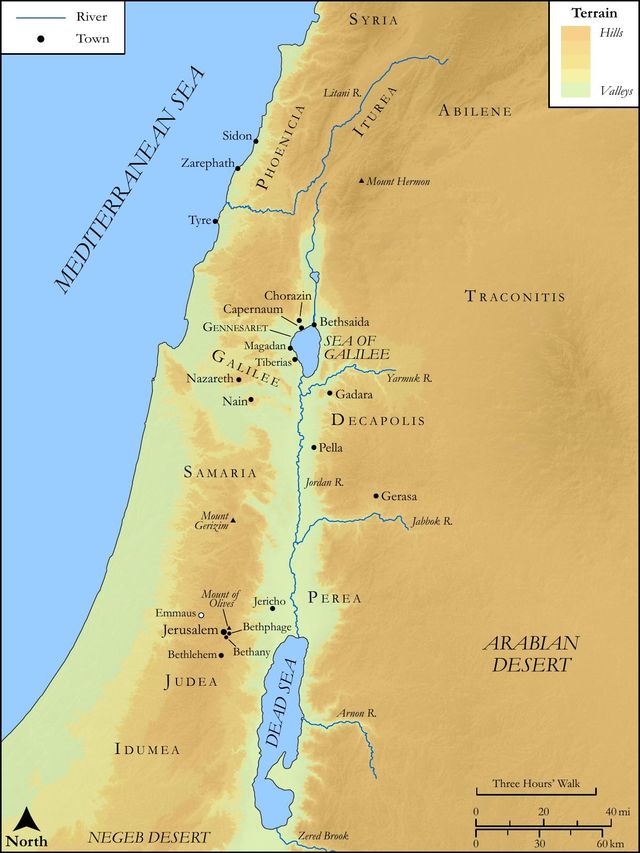
See on the biblical-era maps

Study this verse
Public-domain commentary
Matthew Henry
From his Commentary on the Whole Bible. Henry comments on passages, not single verses — this entry covers Luke 9:18–27. His three-level outline is real structure in the source text, so it is rendered as structure.
In these verses, we have Christ discoursing with his disciples about the great things that pertained to the kingdom of God; and one circumstance of this discourse is taken notice of here which we had not in the other evangelists - that Christ was alone praying, and his disciples with him, when he entered into this discourse, Luk 9:18. Observe, 1. Though Christ had much public work to do, yet he found some time to be alone in private, for converse with himself, with his Father, and with his disciples. 2. When Christ was alone he was praying. It is good for us to improve our solitude for devotion, that, when we are alone, we may not be alone, but may have the Father with us. 3. When Christ was alone, praying, his disciples were with him, to join with him in his prayer; so that this was a family-prayer. Housekeepers ought to pray with their households, parents with their children, masters with their servants, teachers and tutors with their scholars and pupils. 4. Christ prayed with them before he examined them, that they might be directed and encouraged to answer him, by his prayers for them. Those we give instructions to we should put up prayers for and with. He discourses with them,
I.Concerning himself; and enquires,
1.What the people said of him: Who say the people that I am? Christ knew better than they did, but would have his disciples made sensible, by the mistakes of others concerning him, how happy they were that were led into the knowledge of him and of the truth concerning him. We should take notice of the ignorance and errors of others, that we may be the more thankful to him who has manifested himself to us, and not unto the world, and may pity them, and do what we can to help them and to teach them better. They tell him what conjectures concerning him they had heard in their converse with the common people. Ministers would know better how to suit their instructions, reproofs, and counsels, to the case of ordinary people, if they did but converse more frequently and familiarly with them; they would then be the better able to say what is proper to rectify their notions, correct their irregularities, and remove their prejudices. The more conversant the physician is with his patient, the better he knows what to do for him. Some said that he was John Baptist, who was beheaded but the other day; others Elias, or one of the old prophets; any thing but what he was.
2.What they said of him. "Now see what an advantage you have by your discipleship; you know better." "So we do," saith Peter, "thanks be to our Master for it; we know that thou art the Christ of God, the Anointed of God, the Messiah promised." It is matter of unspeakable comfort to us that our Lord Jesus is God's anointed, for then he has unquestionable authority and ability for his undertaking; for his being anointed signifies his being both appointed to it and qualified for it. Now one would have expected that Christ should have charged his disciples, who were so fully apprized and assured of this truth, to publish it to every one they met with; but no, he strictly charged them to tell no man that thing as yet, because there is a time for all things. After his resurrection, which completed the proof of it, Peter made the temple ring of it, that God had made this same Jesus both Lord and Christ (Act 2:36); but as yet the evidence was not ready to be summed up, and therefore it must be concealed; while it was so, we may conclude that the belief of it was not necessary to salvation.
II.Concerning his own sufferings and death, of which he had yet said little.
Now that his disciples were well established in the belief of his being the Christ, and able to bear it, he speaks of them expressly, and with great assurance, Luk 9:22. It comes in as a reason why they must not yet preach that he was the Christ, because the wonders that would attend his death and resurrection would be the most convincing proof of his being the Christ of God. It was by his exaltation to the right hand of the Father that he was fully declared to be the Christ, and by the sending of the Spirit thereupon (Act 2:33); and therefore wait till that is done.
III.Concerning their sufferings for him.
So far must they be from thinking how to prevent his sufferings that they must rather prepare for their own.
1.We must accustom ourselves to all instances of self-denial and patience, Luk 9:23. This is the best preparative for martyrdom. We must live a life of self-denial, mortification, and contempt of the world; we must not indulge our ease and appetite, for then it will be hard to bear toil, and weariness, and want, for Christ. We are daily subject to affliction, and we must accommodate ourselves to it, and acquiesce in the will of God in it, and must learn to endure hardship. We frequently meet with crosses in the way of duty; and, though we must not pull them upon our own heads, yet, when they are laid for us, we must take them up, carry them after Christ, and make the best of them.
2.We must prefer the salvation and happiness of our souls before any secular concern whatsoever. Reckon upon it,
(1.)That he who to preserve his liberty or estate, his power or preferment, nay, or to save his life, denies Christ and his truths, wilfully wrongs his conscience, and sins against God, will be, not only not a saver, but an unspeakable loser, in the issue, when profit and loss come to be balanced: He that will save his life upon these terms will lose it, will lose that which is of infinitely more value, his precious soul.
(2.)We must firmly believe also that, if we lose our life for cleaving to Christ and our religion, we shall save it to our unspeakable advantage; for we shall be abundantly recompensed in the resurrection of the just, when we shall have it again a new and an eternal life.
(3.)That the gain of all the world, if we should forsake Christ, and fall in with the interests of the world, would be so far from countervailing the eternal loss and ruin of the soul that it would bear no manner of proportion to it, Luk 9:25. If we could be supposed to gain all the wealth, honour, and pleasure, in the world, by denying Christ, yet when, by so doing, we lose ourselves to all eternity, and are cast away at last, what good will our worldly gain do us? Observe, In Matthew and Mark the dreadful issue is a man's losing his own soul, here it is losing himself, which plainly intimates that our souls are ourselves. Animus cujusque is est quisque - The soul is the man; and it is well or ill with us according as it is well or ill with our souls. If they perish for ever, under the weight of their own guilt and corruption, it is certain that we are undone. The body cannot be happy if the soul be miserable in the other world; but the soul may be happy though the body be greatly afflicted and oppressed in this world. If a man be himself cast away, ē zēmiōtheis - if he be damaged, - or if he be punished, si mulctetur - if he have a mulct put upon his soul by the righteous sentence of Christ, whose cause and interest he has treacherously deserted, - if it be adjudged a forfeiture of all his blessedness, and the forfeiture be taken, where is his gain? What is his hope?
3.We must therefore never be ashamed of Christ and his gospel, nor of any disgrace or reproach that we may undergo for our faithful adherence to him and it, Luk 9:26. For whosoever shall be ashamed of me and of my words, of him shall the Son of man be ashamed, and justly. When the service and honour of Christ called for his testimony and agency, he denied them, because the interest of Christ was a despised interest, and every where spoken against; and therefore he can expect no other than that in the great day, when his case calls for Christ's appearance on his behalf, Christ will be ashamed to own such a cowardly, worldly, sneaking spirit, and will say, "He is none of mine; he belongs not to me." As Christ had a state of humiliation and of exaltation, so likewise has his cause. They, and they only, that are willing to suffer with it when it suffers, shall reign with it when it reigns; but those that cannot find in their hearts to share with it in its disgrace, and to say, If this be to be vile, I will be yet more vile, shall certainly have no share with it in its triumphs. Observe here, How Christ, to support himself and his followers under present disgraces, speaks magnificently of the lustre of his second coming, in prospect of which he endured the cross, despising the shame.
(1.)He shall come in his own glory. This was not mentioned in Matthew and Mark. He shall come in the glory of the Mediator, all the glory which the Father restored to him, which he had with God before the worlds were, which he had deposited and put in pledge, as it were, for the accomplishing of his undertaking, and demanded again when he had gone through it. Now, O Father, glorify thou me, Joh 17:4, Joh 17:5. He shall come in all that glory which the Father conferred upon him when he set him at his own right hand, and gave him to be head over all things to the church; in all the glory that is due to him as the assertor of the glory of God, and the author of the glory of all the saints. This is his own glory.
(2.)He shall come in his Father's glory. The Father will judge the world by him, having committed all judgment to him; and therefore will publicly own him in the judgment as the brightness of his glory and the express image of his person.
(3.)He shall come in the glory of the holy angels. They shall all attend him, and minister to him, and add every thing they can to the lustre of his appearance. What a figure will the blessed Jesus make in that day! Did we believe it, we should never be ashamed of him or his words now.
Lastly, To encourage them in suffering for him, he assures them that the kingdom of God would now shortly be set up, notwithstanding the great opposition that was made to it, Luk 9:27. "Though the second coming of the Son of man is at a great distance, the kingdom of God shall come in its power in the present age, while some here present are alive." They saw the kingdom of God when the Spirit was poured out, when the gospel was preached to all the world and nations were brought to Christ by it; they saw the kingdom of God triumph over the Gentile nations in their conversion, and over the Jewish nation in its destruction.
Historical interpretation
Nine Centuries of Reception
10 surviving comments on this verse. Each one is dated, so this reads as a timeline rather than a list.
Select a marker to jump to its quote. Markers stagger vertically where authors wrote within a few decades of each other.
(in Cons. Mon. cap. 4.) But He has left His own life for an example of blameless conversation to those who are willing to obey Him; as He says, Come after me, meaning thereby not a following of His body, for that would be impossible to all, since our Lord is in heaven, but a due imitation of His life according to their capacities.
(in reg. fus. int. 6.) A denial of one's self is indeed a total forgetfulness of things past, and a forsaking of his own will and affection.
(ubi sup.) Now a desire of suffering death for Christ and a mortification of one's members which are upon the earth, and a manful resolution to undergo any danger for Christ, and an indifference towards the present life, this it is to take up one's cross. Hence it is added, And let him take up his cross daily.
(ubi sup. lnt. 8.) Herein then stands a man's perfection, that he should have his affections hardened, even towards life itself, and have ever about him the answer (ἀποκρίμα.) of death a, that he should by no means trust in himself. (2 Cor. 1:9.) But perfection takes its beginning from the relinquishment of things foreign to it; suppose these to be possessions or vain-glory, or affection for things that profit not.
Thus, if we wish not to fear death, let us stand where Christ is, so that he may say of us too, “There are some standing here that shall not taste death.” It is not enough to stand unless the standing is where Christ is, for only those who can stand with Christ cannot taste death. It is therein lawful through the quality of the very word to ponder that those who are seen to have deserved the fellowship with Christ will not have even the perception of death. Surely the death of the body may be tasted by dedication; the life of the soul may be held by possession.But what is it to taste death? Unless, perhaps, bread may be death, just as bread is life? For there are those who eat the bread of sorrow; there are also the Ethiopian peoples who received the dragon as food. May it be far from us to devour the dragon’s poison, for we have the true Bread, that Bread which came down from heaven. He who keeps what is written eats that Bread. Thus there are those who will not taste death until they see the kingdom of God.
Perhaps because the Lord knew that the disciples would believe even the difficult mystery of the Passion and Resurrection, He wished to be Himself the proclaimer of His own Passion and Resurrection.
Now our Lord while He ever raises us to look to the future reward of virtue, and teaches us how good it is to despise worldly things, so also He supports the weakness of the human mind by a present recompense. For it is a hard thing to take up the cross, and expose your life to danger and your body to death; to give up what you are, when you wish to be what you are not; and even the loftiest virtue seldom exchanges things present for future. The good Master then, lest any man should be broken down by despair or weariness, straightway promises that He will be seen by the faithful, in these words, But I say unto you, There are some standing here who shall not taste of death till they see the kingdom of God.
If then we also wish not to fear death, let us stand where Christ is. For they only cannot taste death who are able to stand with Christ, wherein we may consider from the nature of the very word, that they will not experience even the slightest perception of death, who are thought worthy to obtain union with Christ. At least let us suppose that the death of the body is tasted by touch, the life of the soul preserved by possession; for here not the death of the body, but of the soul, is denied.
(Hom. 55. in Matt.) Now the Saviour of His great mercy and lovingkindness will have no one serve Him unwillingly and from constraint, but those only who come of their own accord, and are grateful for being allowed to serve Him. And so not by compelling men and putting a yoke upon them, but by persuasion and kindness, He draws unto Him every where those who are willing, saying, If any man will, &c.
(Hom. 32. in Ev) In two ways also is the cross taken up, either when the body is afflicted through abstinence, or the mind; touched by sympathy.
(Hom. 32. in Ev.) Since then the holy Church has one time of persecution, another time of peace, our Lord has noticed both times in His command to us. For at the time of persecution we must lay down our soul, that is our life, which He signified, saying, Whosoever shall lose his life. But in time of peace, those things which have the greatest power to subdue us, our earthly desires, must be vanquished; which He signified, saying, What does it profit a man, &c. Now we commonly despise all fleeting things, but still we are so checked by that feeling of shame so common to man, that we are yet unable to express in words the uprightness which we preserve in our hearts. But to this wound the Lord indeed subjoins a suitable application, saying, For whoever shall be ashamed of me and my words, of him shall the Son of man be ashamed.
(Hom. 32. in Ev.) Or, by the kingdom of God in this place, is meant the present Church; and some of His disciples were to live in the body up to that time, when they should behold the Church of God built and raised up against the glory of the world.
He continues: "But I say to you truly, there are some standing here who will not taste death until they see the kingdom of God." The kingdom of God, dearest brothers, is not always called the coming kingdom in sacred Scripture, but sometimes the present Church is so called. Hence it is written: "The Son of man will send his angels, and they will gather out of his kingdom all causes of scandal." In that kingdom, indeed, there will be no scandals, where certainly the reprobate are not admitted. By this example it is understood that in this passage the kingdom of God refers to the present Church. And because some of the disciples were going to live in the body long enough to see the Church of God built and raised up against the glory of this world, it is now said as a consoling promise: "There are some of those standing here who will not taste death until they see the kingdom of God." But when the Lord was giving such great precepts about the death that must be undergone, what need was there to come suddenly to this promise? If we consider carefully, we recognize with what great dispensation of love this is done. For to the inexperienced disciples something had to be promised even about the present life, so that they could be strengthened more firmly for the future. Thus to the Israelite people, about to be freed from the land of Egypt, the promised land was promised, and when they were to be called to heavenly gifts, they were persuaded by earthly promises. Why was this? So that while there was something they could receive nearby, they might then more faithfully believe what they could hear about from afar. For a carnal people, if they did not receive small things, would not believe in great things. Therefore Almighty God, by granting earthly things, persuades toward heavenly things, so that by receiving what they could see, they might learn to hope for what they could not see at all; and they would become all the more firm regarding invisible things, inasmuch as visible promises supported them toward certainty of hope. Hence rightly also it is said through the Psalmist: "He gave them the lands of the nations, and they took possession of the labors of the peoples, that they might keep his statutes and observe his law." So therefore in this passage, Truth speaking to the inexperienced disciples promises that the kingdom of God will be seen on earth, so that it might be more faithfully hoped for by them in heaven. From that very kingdom which we now see exalted in the world, let us hope for the kingdom which we believe is to be received in heaven. For there are some who are counted by the name of Christianity, but do not have the faith of Christianity. They judge that only visible things exist, they do not desire invisible things, because they do not even suspect that they exist. We stand at the bodies of the holy martyrs, my brothers. Would they have given their flesh over to death unless they were most certainly convinced that there was a life for which they ought to die? And behold, those who so believed shine forth with miracles. For to their dead bodies the living sick come and are healed, perjurers come and are tormented by a demon, the demon-possessed come and are set free. How then do they live there where they live, if in so many miracles they live here where they are dead?
I will tell you, brothers, a story brief in words but not small in merit, which I learned from certain devout elders who narrated it. In the time of the Goths there was a certain very religious matron who frequently came to the church of these martyrs. One day when she had come to pray as was her custom, upon leaving she found two monks standing there in pilgrim's garb. She believed them to be pilgrims and ordered that something be given to them as alms. But before her almoner could approach them to distribute the alms, they came closer to her and said: "You visit us now; we will seek you out on the day of judgment, and whatever we can, we will provide for you." Having said this, they vanished from her sight. Terrified, she returned to pray and poured herself out at great length in tears. And after this she became all the more persistent in prayer, the more certain she was of the promise. But if, according to the words of Paul, faith is the substance of things hoped for, the evidence of things not seen, we can no longer tell you to believe in the life to come, because behold, those who live in that life are visibly presented to human eyes. For what can be seen is better said to be known than believed. Therefore the Lord wished us to know the life to come rather than merely believe in it, since he visibly shows us that those whom he invisibly receives live with him.
He rightly addressed Himself to all, since He treats of the higher things (which relate to the belief in His birth and passion) apart with His disciples.
Now unless a man renounces himself, he comes not near to Him, who is above him; it is said therefore, Let him deny himself.
We are bid then to take up the cross of which we have above spoken, and having taken it, to follow our Lord who bore His own cross. Hence it follows, And let him follow me.
But I tell you truly, there are some standing here who will not taste death before they see the kingdom of God. The kingdom of God in this place is called the present Church; and because some of the disciples were to live in the body to such an extent that they would see the Church of God constructed and raised against the glory of this world, it is now said with a comforting promise: There are some standing here who will not taste death before they see the kingdom of God. But since the Lord was giving so many precepts of undergoing death, what was necessary that He suddenly came to this promise? Except that something also had to be promised to the unlearned disciples concerning the present life, so that they could be more firmly established in the future, for which He promised them to see the kingdom of God on earth, so that this might be more faithfully presumed by them in heaven. But if we wish to accept the kingdom of God in this sentence as the future blessedness in heaven, even this some of those standing there saw not many days later on the mountain, namely so that by the contemplation of enduring joy, even if briefly experienced, they might more modestly endure the adversities of the passing present age. With a most fitting word, indeed, He testifies that the saints taste death, by whom the death of the body is, of course, tasted by sipping, and the life of the soul is held by possessing.
By the cross, He speaks of an ignominious death, meaning, that if any one will follow Christ, he must not for his own sake flee from even an ignominious death.
He is ashamed of Christ who says, Am I to believe on Him that is crucified? He also is ashamed of His words who despises the simplicity of the Gospel. But of him shall the Lord be ashamed in His kingdom, in the same manner as if a master of a household should have a bad servant, and be ashamed to have him.
That is, the glory in which the righteous shall be. Now He said this of His transfiguration, which was the type of the glory to come; as if He said, There are some standing here, Peter, James, and John, who shall not reach death before they have seen at the time of My transfiguration what will be the glory of those who confess Me.
(Isaac. Monac.) He rightly joins these two, Let him deny himself, and let him take up his cross, for as he who is prepared to ascend the cross conceives in his mind the intention of death, and so goes on thinking to have no more part in this life, so he who is willing to follow our Lord, ought first to deny himself, and so take up his cross, that his will may be ready to endure every calamity.
Continue studying Luke 9:27 across the web’s major study libraries — every link below opens this exact verse, chapter, or book on the destination site.
Read & Compare
 BibleGatewayThis verse in more than 200 translations and 70 languages.
 Bible.comThe YouVersion reader — hundreds of translations, reading plans, and highlights.
 ESV.orgCrossway's official English Standard Version reader.
 NET BibleThe NET translation with 60,000+ translators' notes on every rendering decision.
 STEP BibleTyndale House's free study tool — original text, vocabulary, and scholarly resources.
 BibliaLogos Bible Software's free web reader.
 USCCBThe New American Bible (Revised Edition) with the U.S. bishops' study notes.
Commentaries
 BibleHub CommentariesDozens of classic commentaries on this verse, gathered on one page.
 StudyLightMore than 100 commentary sets — the largest collection on the web.
 BibleRefPlain-English commentary on what this verse means, verse by verse.
 Enduring WordDavid Guzik's free commentary on this chapter, widely used by Bible teachers.
 Bible Study ToolsVerse commentary alongside Greek and Hebrew study aids.
Original Language & Research
- BibleHub InterlinearThe verse word by word — original language, transliteration, and English.
- BibleHub LexiconEvery word's original-language definition and Strong's entry.
 Blue Letter BibleDeep-study tools — Strong's numbers, concordance, and word studies.
 CNTR CollationThe earliest Greek manuscripts of this verse, collated letter by letter.
Sermons, Hymns & Audio


TrulyRandomVerse is not affiliated with these sites and doesn’t control their content. They’re linked because they’re genuinely useful.
Summary
Luke 9:27 records one of Jesus' most profound and debated statements, made immediately after His teaching on the radical demands of discipleship. He declares to His followers that some among them would not experience physical death before witnessing a powerful manifestation of the Kingdom of God, a promise widely understood to find its primary fulfillment in the subsequent event of the Transfiguration, where His divine glory was revealed to Peter, James, and John. This verse serves as both an assurance of God's imminent reign and a glimpse into the glorious reality that awaits those who faithfully follow Christ, even amidst suffering.
Context
ShowHideLiterary Context
This verse is strategically placed within Luke's Gospel, immediately following Jesus' challenging discourse on the cost of discipleship. In Luke 9:23, Jesus calls His followers to "deny themselves and take up their cross daily and follow me." He then warns that those who seek to save their lives will lose them, while those who lose their lives for His sake will save them (Luke 9:24). The preceding verse, Luke 9:26, issues a stark warning: "For whoever is ashamed of me and of my words, of him will the Son of Man be ashamed when he comes in his glory and the glory of the Father and of the holy angels." Thus, Luke 9:27 serves as a powerful counterpoint and encouragement, offering a glimpse of the glorious reality of God's Kingdom to those who embrace the costly path of discipleship, assuring them that a tangible demonstration of God's reign was near. The immediate narrative flow continues with the Transfiguration account in Luke 9:28-36, which is widely regarded as the fulfillment of this very promise.
Historical & Cultural Context
Jesus' proclamation of the "kingdom of God" resonated deeply with Jewish expectations of a Messiah who would establish God's sovereign rule. However, their primary expectation was often a political and earthly kingdom that would liberate them from Roman oppression and restore Israel's national glory. Jesus consistently redefined this expectation, emphasizing a spiritual kingdom that was both present and future, inaugurated through His person and work. The disciples, like many Jews of their time, likely struggled to reconcile their preconceived notions of a conquering king with Jesus' teachings on suffering, self-denial, and a kingdom that was "not of this world" (John 18:36). Jesus' statement in Luke 9:27 would have been particularly intriguing and perhaps perplexing, given their understanding of a future, cataclysmic arrival of the Kingdom. The promise of "seeing the kingdom of God" within their lifetime, without tasting death, would have hinted at a unique and powerful revelation, distinct from the popular political aspirations.
Key Themes
ShowHideThe central theme in Luke 9:27 is the Imminent Manifestation of God's Kingdom. Jesus' entire ministry revolved around the announcement and inauguration of this Kingdom, a concept referring to God's sovereign rule and reign, both present in the person of Christ and future in its full consummation. This verse highlights the tension between the "already" and the "not yet" of the Kingdom. Another key theme is the Revelation of Divine Glory. The promise of "seeing the kingdom of God" points towards a visual, experiential encounter with God's power and majesty, which is vividly portrayed in the Transfiguration, where Jesus' divine nature is unveiled before His chosen disciples (Luke 9:29). This revelation serves to Validate Jesus' Identity and Mission, confirming His claims of being the Son of God and the bringer of God's reign, thereby strengthening the faith of His disciples for the trials and ultimate suffering that lay ahead, particularly His crucifixion.
Exposition and Analysis
ShowHideKey Word Analysis
ShowHideThis primary verb means to "taste" or, by implication, "to eat." Figuratively, it means "to experience" something, whether good or ill. In this context, "taste of death" is a common idiom meaning to experience death. Jesus is stating that certain individuals will not undergo the experience of death before the promised event.
Derived from a verb meaning "to die," this noun refers to physical death, the separation of body and soul. In a broader sense, it can also refer to spiritual death or the power of death. Here, it specifically denotes the physical cessation of life, emphasizing the temporal nature of the promise.
From the word for "king," this noun properly signifies "royalty" or "rule," and concretely, "a realm." In the New Testament, "the kingdom of God" refers to God's sovereign reign, His active rule over creation and humanity. It is both a present reality, inaugurated by Christ, and a future hope, to be fully realized at His return.
Verse Breakdown
ShowHide"But I tell you of a truth"
This emphatic introductory phrase, "But I tell you of a truth" (ἀληθῶς λέγω ὑμῖν), underscores the absolute certainty and solemnity of Jesus' following statement. It signals that what He is about to say is not a mere opinion or possibility, but a divine declaration of undeniable truth, demanding the full attention and belief of His audience.
"there be some standing here"
Jesus indicates that the fulfillment of His prophecy will occur within the lifetime of at least some of His immediate audience. This narrows the scope of the promise, suggesting a specific, observable event that certain individuals present would witness, rather than a universal or distant eschatological event for all humanity.
"which shall not taste of death"
This is a biblical idiom meaning "they shall not experience death." It explicitly states that these individuals will remain alive to witness the promised event. This further emphasizes the imminence and the tangible nature of the coming manifestation of God's Kingdom for those particular witnesses.
"till they see the kingdom of God"
The climax of the promise. The phrase "the kingdom of God" refers to God's sovereign rule and reign. "See" (eídō) here implies not just a physical perception but an experiential understanding or recognition of its arrival or manifestation. The most immediate and widely accepted fulfillment of this promise is the Transfiguration, where Peter, James, and John witnessed a powerful revelation of Jesus' divine glory, a foretaste of His coming in power and the glory of His Kingdom.
Literary Devices
ShowHideLuke 9:27 employs several significant literary devices. The phrase "shall not taste of death" is a powerful Idiom, a common biblical expression meaning to experience death. This vivid imagery personalizes the concept of dying, making it more immediate and impactful. The statement itself serves as a profound Foreshadowing, hinting at a future event of immense significance that will dramatically reveal the nature of God's Kingdom. Given its immediate proximity to the Transfiguration, it acts as a direct prophetic setup for that miraculous event. Furthermore, the "kingdom of God" functions as a central Theological Concept throughout Jesus' teachings, representing God's active, sovereign rule. In this verse, its "seeing" points to a tangible manifestation of this spiritual reality, bridging the gap between abstract theological truth and concrete, observable experience.
Theological and Thematic Connections
ShowHideLuke 9:27 profoundly connects the costly call to discipleship with the glorious reality of God's Kingdom. It assures those who embrace self-denial and cross-bearing that their commitment is not in vain, for they will witness the power and glory of the very reign for which they suffer. The promise of "seeing the kingdom of God" is not merely about a future event but about a present, powerful manifestation of God's sovereign rule, primarily fulfilled in the Transfiguration. This event revealed Jesus' divine identity and the nature of His Kingdom as one of glory and power, providing a necessary encouragement and validation to the disciples before the ultimate suffering of the cross. It teaches us that God's Kingdom is both a spiritual reality to be entered into now and a future consummation to be fully revealed, with glimpses of its glory provided along the way to sustain faith.
Reflection and Application
ShowHideLuke 9:27 offers profound encouragement and a vital perspective for believers navigating the challenges of discipleship today. Just as Jesus' disciples were given a tangible glimpse of His glory and the reality of His Kingdom, we too are assured that our commitment to Christ, even when it involves self-denial and bearing our cross, is not in vain. This verse reminds us that the present hardships and sacrifices of following Jesus are temporary and lead to an eternal reality rooted in God's glorious reign. It calls us to live with an eternal perspective, knowing that the "sufferings of this present time are not worthy to be compared with the glory that is to be revealed to us" (Romans 8:18). We are citizens of God's Kingdom now, called to embody its values of righteousness, peace, and joy in the Holy Spirit (Romans 14:17), even as we eagerly anticipate its full and final triumph at Christ's return. This promise strengthens our faith, grounds our hope, and motivates our perseverance in the face of a world often hostile to Kingdom values.
Questions for Reflection
ShowHideFAQ
ShowHideWhat does Jesus mean by "taste of death"?
ShowHideThe phrase "taste of death" is a common biblical idiom that simply means to experience physical death. Jesus is stating that certain individuals among those present would not die before witnessing a significant manifestation of the Kingdom of God. This emphasizes that the promised event would occur within their lifetime, making it a tangible and observable reality for them.
When was this prophecy fulfilled?
ShowHideThe most widely accepted and textually supported interpretation is that this prophecy was fulfilled just six days later with the Transfiguration, as recorded in Luke 9:28-36. In this event, Peter, James, and John—three of the disciples present—witnessed Jesus' divine glory revealed, accompanied by Moses and Elijah. This served as a powerful preview of the Kingdom coming in power and glory, validating Jesus' claims and strengthening His inner circle for the trials ahead. Other interpretations suggest fulfillment in Jesus' Resurrection and Ascension, and the outpouring of the Holy Spirit at Pentecost (Acts 2:1-4), which marked the spiritual inauguration of the Church as a manifestation of God's kingdom on earth. While these events also represent powerful displays of God's reign, the immediate textual proximity strongly favors the Transfiguration as the primary fulfillment.
Is the "kingdom of God" a present reality or a future event?
ShowHideThe "kingdom of God" is both a present reality and a future event. Jesus inaugurated the Kingdom through His first coming, and it is present wherever His sovereign rule is acknowledged and lived out, particularly through the work of the Holy Spirit in the lives of believers (Luke 17:21). Believers are already citizens of this Kingdom (Colossians 1:13) and are called to live according to its values now. However, the Kingdom's full consummation, where God's rule is universally acknowledged and all evil is eradicated, awaits Christ's second coming (Revelation 11:15). Thus, we live in the "already but not yet" tension of the Kingdom.
Christ-Centered Fulfillment
ShowHideLuke 9:27 finds its profound Christ-centered fulfillment not merely in a future event, but in the very person and work of Jesus Christ Himself. The promise to "see the kingdom of God" is primarily realized in the Transfiguration, where Jesus' divine glory was unveiled before His inner circle (Luke 9:28-36). This was a direct, tangible manifestation of the Kingdom's King in His radiant majesty, a foretaste of His ultimate reign. The Kingdom of God, which Jesus constantly preached, is intrinsically linked to His identity as the Son of God and the Messiah. His incarnation (John 1:14), His atoning death on the cross (Colossians 1:19-20), His victorious resurrection (Romans 1:4), and His ascension to the right hand of the Father (Acts 2:33) are all essential stages in the establishment and demonstration of God's sovereign rule through Him. The "seeing" of the Kingdom, therefore, is ultimately seeing Christ in His glory, recognizing His authority, and experiencing the transformative power of His reign. Through Christ, believers are delivered from the domain of darkness and transferred into His glorious Kingdom (Colossians 1:13), living as citizens of His eternal dominion even now, eagerly awaiting His glorious return when His Kingdom will be fully and finally consummated.