


Luke 9:28
- ἘγένετοEgenetoIt came to passG1096V-2ADI-3SVerb 2nd Aorist Middle Deponent Indicative 3rd Singular
- δὲdenowG1161CONJConjunction
- μετὰmetaafterG3326PREPPreposition
- τοὺςtous<the>G3588T-APMDefinite article Accusative Plural Masculine
- λόγουςlogoussayingsG3056N-APMNoun Accusative Plural Masculine
- τούτουςtoutoustheseG3778D-APMDemonstrative pronoun Accusative Plural Masculine
- ὡσεὶhōseiaboutG5616PREPPreposition
- ἡμέραιhēmeraidaysG2250N-NPFNoun Nominative Plural Feminine
- ὀκτώoktōeightG3638A-NUIAdjective
- καὶkaiandG2532CONJConjunction
- παραλαβὼνparalabōnhaving takenG3880V-2AAP-NSMVerb 2nd Aorist Active Participle Nominative Singular Masculine
- τὸνton<the>G3588T-ASMDefinite article Accusative Singular Masculine
- ΠέτρονPetronPeterG4074N-ASM-PNoun Accusative Singular Masculine Individual
- καὶkaiandG2532CONJConjunction
- ἸωάννηνIōannēnJohnG2491N-ASM-PNoun Accusative Singular Masculine Individual
- καὶkaiandG2532CONJConjunction
- ἸάκωβονIakōbonJamesG2385N-ASM-PNoun Accusative Singular Masculine Individual
- ἀνέβηanebēHe went upG305V-2AAI-3SVerb 2nd Aorist Active Indicative 3rd Singular
- εἰςeisonG1519PREPPreposition
- τὸtotheG3588T-ASNDefinite article Accusative Singular Neuter
- ὄροςorosmountainG3735N-ASNNoun Accusative Singular Neuter
- προσεύξασθαιproseuxasthaito prayG4336V-ADNVerb Aorist Middle Deponent Infinitive
English is a literal word-by-word gloss of the Greek, not the KJV's wording. Why?
This is the original text the KJV's translators worked from — each Greek word with its own literal English meaning in this verse, prepared by scholars at Tyndale House, Cambridge. The KJV translates whole sentences, not word by word, so its wording differs: one Greek word can become several English words, and the KJV may choose “charity” where the gloss reads “love”. Both are faithful — they answer different questions. For the KJV's own rendering, switch to the KJV text.
Details
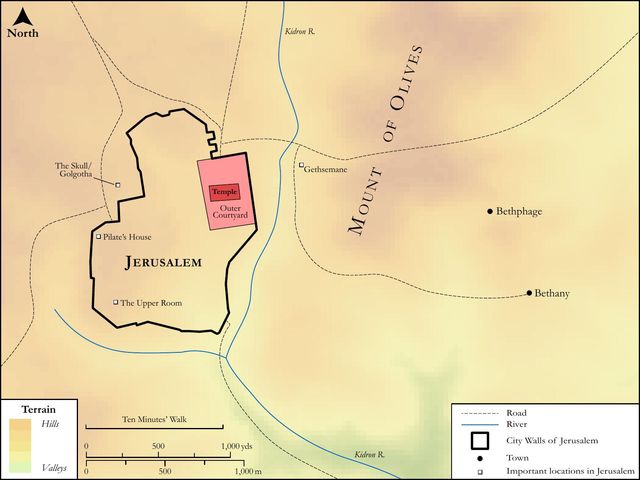
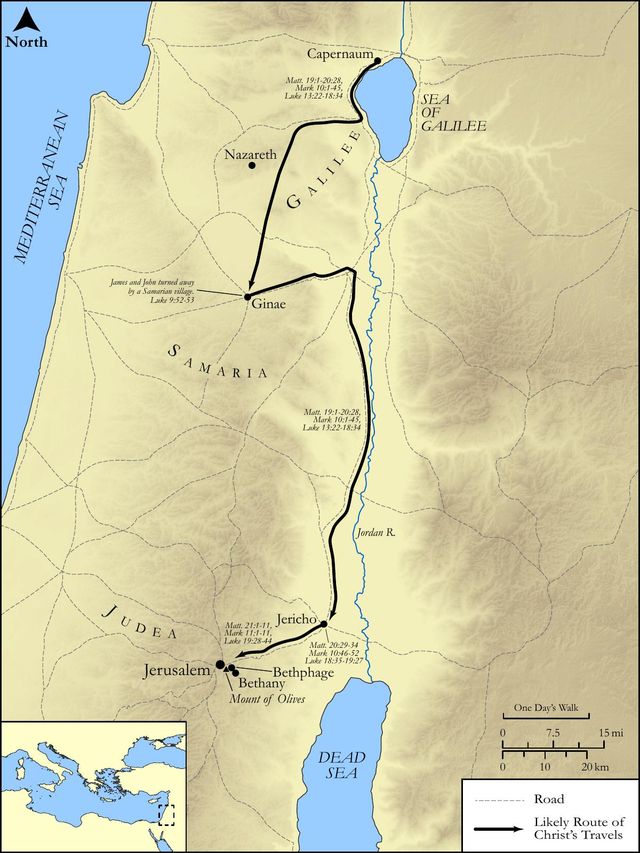
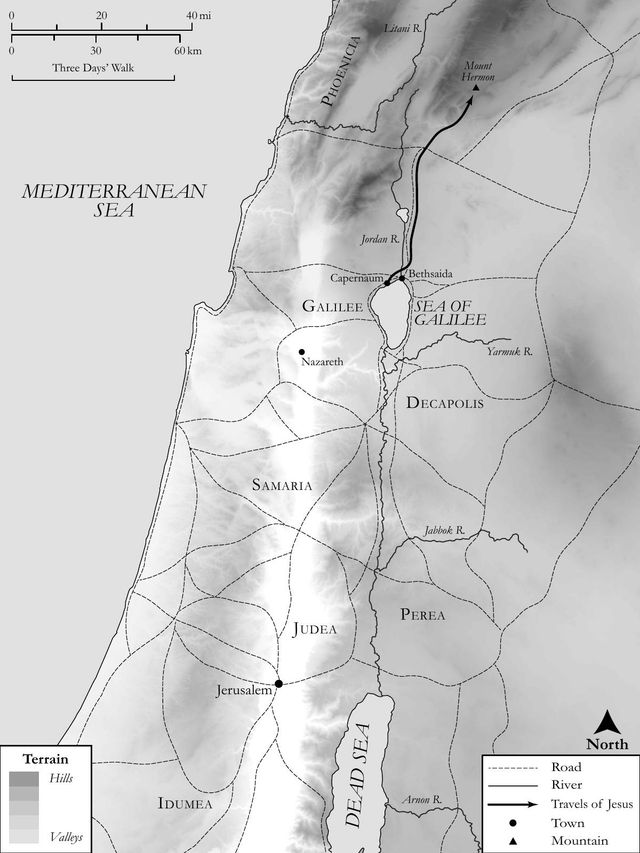
See on the biblical-era map
Study this verse
Public-domain commentary
Matthew Henry
From his Commentary on the Whole Bible. Henry comments on passages, not single verses — this entry covers Luke 9:28–36. His three-level outline is real structure in the source text, so it is rendered as structure.
We have here the narrative of Christ's transfiguration, which was designed for a specimen of that glory of his in which he will come to judge the world, of which he had lately been speaking, and, consequently, an encouragement to his disciples to suffer for him, and never to be ashamed of him. We had this account before in Matthew and Mark, and it is well worthy to be repeated to us, and reconsidered by us, for the confirmation of our faith in the Lord Jesus, as the brightness of his Father's glory and the light of the world, for the filling of our minds with high and honourable thoughts of him, notwithstanding his being clothed with a body, and giving us some idea of the glory which he entered into at his ascension, and in which he now appears within the veil, and for the raising and encouraging of our hopes and expectations concerning the glory reserved for all believers in the future state.
I.Here is one circumstance of the narrative that seems to differ from the other two evangelists that related it.
They said that it was six days after the foregoing sayings; Luke says that it was about eight days after, that is, it was that day sevennight, six whole days intervening, and it was the eighth day. Some think that it was in the night that Christ was transfigured, because the disciples were sleepy, as in his agony, and in the night his appearance in splendour would be the more illustrious; if in the night, the computation of the time would be the more doubtful and uncertain; probably, in the night, between the seventh and eighth day, and so about eight days.
II.Here are divers circumstances added and explained, which are very material.
1.We are here told that Christ had this honour put upon him when he was praying: He went up into a mountain to pray, as he frequently did (Luk 9:28), and as he prayed he was transfigured. When Christ humbled himself to pray, he was thus exalted. He knew before that this was designed for him at this time, and therefore seeks it by prayer. Christ himself must sue out the favours that were purposed for him, and promised to him: Ask of me, and I will give thee, Psa 2:8. And thus he intended to put an honour upon the duty of prayer, and to recommend it to us. It is a transfiguring, transforming duty; if our hearts be elevated and enlarged in it, so as in it to behold the glory of the Lord, we shall be changed into the same image from glory to glory, Co2 3:18. By prayer we fetch in the wisdom, grace, and joy, which make the face to shine.
2.Luke does not use the word transfigured - metamorphōthē (which Matthew and Mark used), perhaps because it had been used so much in the Pagan theology, but makes use of a phrase equivalent, to eidos tou prosōpou heteron - the fashion of his countenance was another thing from what it had been: his face shone far beyond what Moses's did when he came down from the mount; and his raiment was white and glistering: it was exastraptōn - bright like lightning (a word used only here), so that he seemed to be arrayed all with light, to cover himself with light as with a garment.
3.It was said in Matthew and Mark that Moses and Elias appeared to them; here it is said that they appeared in glory, to teach us that saints departed are in glory, are in a glorious state; they shine in glory. He being in glory, they appeared with him in glory, as all the saints shall shortly do.
4.We are here told what was the subject of the discourse between Christ and the two great prophets of the Old Testament: They spoke of his decease, which he should accomplish at Jerusalem. Elegon tēn exodon autou - his exodus, his departure; that is, his death.
(1.)The death of Christ is here called his exit, his going out, his leaving the world. Moses and Elias spoke of it to him under that notion, to reconcile him to it, and to make the foresight of it the more easy to his human nature. The death of the saints is their exodus, their departure out of the Egypt of this world, their release out of a house of bondage. Some think that the ascension of Christ is included here in his departure; for the departure of Israel out of Egypt was a departure in triumph, so was his when he went from earth to heaven.
(2.)This departure of his he must accomplish; for thus it was determined, the matter was immutably fixed in the counsel of God, and could not be altered.
(3.)He must accomplish it at Jerusalem, though his residence was mostly in Galilee; for his most spiteful enemies were at Jerusalem, and there the sanhedrim sat, that took upon them to judge of prophets.
(4.)Moses and Elias spoke of this, to intimate that the sufferings of Christ, and his entrance into his glory, were what Moses and the prophets had spoken of; see Luk 24:26, Luk 24:27; Pe1 1:11.
(5.)Our Lord Jesus, even in his transfiguration, was willing to enter into a discourse concerning his death and sufferings, to teach us that meditations on death, as it is our departure out of this world to another, are never unseasonable, but in a special manner seasonable when at any time we are advanced, lest we should be lifted up above measure. In our greatest glories on earth, let us remember that here we have no continuing city.
5.We are here told, which we were not before, that the disciples were heavy with sleep, Luk 9:32. When the vision first began, Peter, and James, and John were drowsy, and inclined to sleep. Either it was late, or they were weary, or had been disturbed in their rest the night before; or perhaps a charming composing air, or some sweet and melodious sounds, which disposed them to soft and gentle slumbers, were a preface to the vision; or perhaps it was owing to a sinful carelessness: when Christ was at prayer with them, they did not regard his prayer as they should have done, and, to punish them for that, they were left to sleep on now, when he began to be transfigured, and so lost an opportunity of seeing how that work of wonder was wrought. These three were now asleep, when Christ was in his glory, as afterwards they were, when he was in his agony; see the weakness and frailty of human nature, even in the best, and what need they have of the grace of God. Nothing could be more affecting to these disciples, one would think, than the glories and the agonies of their Master, and both in the highest degree; and yet neither the one nor the other would serve to keep them awake. What need have we to pray to God for quickening grace, to make us not only alive, but lively! Yet that they might be competent witnesses of this sign from heaven, to those that demanded one, after awhile they recovered themselves, and became perfectly awake; and then they took an exact view of all those glories, so that they were able to give a particular account, as we find one of them does, of all that passed when they were with Christ in the holy mount, Pe2 1:18.
6.It is here observed that it was when Moses and Elias were now about to depart that Peter said, Lord, it is good to be here, let us make three tabernacles. Thus we are often not sensible of the worth of our mercies till we are about to lose them; nor do we covet and court their continuance till they are upon the departure. Peter said this, not knowing what he said. Those know not what they say that talk of making tabernacles on earth for glorified saints in heaven, who have better mansions in the temple there, and long to return to them.
7.It is here added, concerning the cloud that overshadowed them, that they feared as they entered into the cloud. This cloud was a token of God's more peculiar presence. It was in a cloud that God of old took possession of the tabernacle and temple, and, when the cloud covered the tabernacle, Moses was not able to enter (Exo 40:34, Exo 40:35), and, when it filled the temple, the priests could not stand to minister by reason of it, Ch2 5:14. Such a cloud was this, and then no wonder that the disciples were afraid to enter into it. But never let any be afraid to enter into a cloud with Jesus Christ; for he will be sure to bring them safely through it.
8.The voice which came from heaven is here, and in Mark, related not so fully as in Matthew: This is my beloved Son, hear him: though those words, in whom I am well pleased, which we have both in Matthew and Peter, are not expressed, they are implied in that, This is my beloved Son; for whom he loves, and in whom he is well pleased, come all to one; we are accepted in the Beloved.
Lastly, The apostles are here said to have kept this vision private. They told no man in those days, reserving the discovery of it for another opportunity, when the evidences of Christ's being the Son of God were completed in the pouring out of the Spirit, and that doctrine was to be published to all the world. As there is a time to speak, so there is a time to keep silence. Every thing is beautiful and useful in its season.
Historical interpretation
Seventeen Centuries of Reception
17 surviving comments on this verse. Each one is dated, so this reads as a timeline rather than a list.
Select a marker to jump to its quote. Markers stagger vertically where authors wrote within a few decades of each other.
is it that He Himself withal should set upon His own official chair men who were mindful rather to enjoin-(but) not likewise to practise-sanctity of the flesh, which (sanctity) He had in all ways recommended to their teaching and practising?-first by His own example, then by all other arguments; while He tells (them) that "the kingdom of heavens" is "children's; " while He associates with these (children) others who, after marriage, remained (or became)virgins; " while He calls (them) to (copy) the simplicity of the dove, a bird not merely innocuous, but modest too, and whereof one male knows one female; while He denies the Samaritan woman's (partner to be) a husband, that He may show that manifold husbandry is adultery; while, in the revelation of His own glory, He prefers, from among so many saints and prophets, to have with him Moses and Elias -the one a monogamist, the other a voluntary celibate (for Elias was nothing else than John, who came "in the power and spirit of Elias" ); while that "man gluttonous and toping," the "frequenter of luncheons and suppers, in the company of publicans and sinners," sups once for all at a single marriage, though, of course, many were marrying (around Him); for He willed to attend (marriages) only so often as (He willed) them to be.
And this is just the way of the Creator. "In the mouth of three witnesses," says He, "shall every word be established." He withdraws to a mountain.
You ought to be very much ashamed of yourself on this account too, for permitting him to appear on the retired mountain in the company of Moses and Elias, whom he had come to destroy.
On the other hand, he whose "heart" was habitually found "lifted up" rather than fattened up, who in forty days and as many nights maintained a fast above the power of human nature, while spiritual faith subministered strength (to his body), both saw with his eyes God's glory, and heard with his ears God's voice, and understood with his heart God's law: while He taught him even then (by experience) that man liveth not upon bread alone, but upon every word of God; in that the People, though fatter than he, could not constantly contemplate even Moses himself, fed as he had been upon God, nor his leanness, sated as it had been with His glory! Deservedly, therefore, even while in the flesh, did the Lord show Himself to him, the colleague of His own fasts, no less than to Elijah. For Elijah withal had, by this fact primarily, that he had imprecated a famine, already sufficiently devoted himself to fasts: "The Lord liveth," he said, "before whom I am standing in His sight, if there shall be dew in these years, and rain-shower.
Our Lord, when He made known to His disciples the great mystery of His second coming, that it might not seem that they were to believe in His words only, proceeds to works, manifesting to them, through the eyes of their faith, the image of His kingdom; as it follows, And it came to pass about an eight days after these sayings, he took Peter and John and James, and went up into a mountain to pray.
You may know that Peter, James and John did not taste death and were worthy to see the glory of the resurrection. It says “about eight days after these words, he took those three alone and led them onto the mountain.” Why is it that he says “eight days after these words”? He that hears the words of Christ and believes will see the glory of Christ at the time of the resurrection. The resurrection happened on the eighth day, and most of the psalms were written “For the eighth.” It shows us that he said that he who because of the Word of God shall lose his own soul will save it, since he renews his promises at the resurrection. But Matthew and Mark say that they were taken after six days. We may say this means after six thousand years, because a thousand years in God’s sight are as one day. We counted more than six thousand years. We prefer to understand six days as a symbol, because God created the works of the world in six days, so that we understand works through the time and the world through the works.
Only three, three chosen, were led to the mountain.… This perhaps means none can see the glory of the resurrection except he who has preserved the mystery of the Trinity intact with the undefiled purity of faith. Peter, who received the keys of the kingdom, John, to whom his mother was entrusted, and James, who was the first to mount a bishop’s throne, ascended.
If then we also wish not to fear death, let us stand where Christ is. For they only cannot taste death who are able to stand with Christ, wherein we may consider from the nature of the very word, that they will not experience even the slightest perception of death, who are thought worthy to obtain union with Christ. At least let us suppose that the death of the body is tasted by touch, the life of the soul preserved by possession; for here not the death of the body, but of the soul, is denied.
Or, Peter went up, who received the keys of the kingdom of heaven; John, to whom was committed our Lord's mother; James, who first suffered martyrdom. (Acts 12:1.)
Now in a mystical manner, after the words above said, is exhibited the transfiguration of Christ, since he who hears the words of Christ, and believes, shall see the glory of His resurrection. For, on the eighth day the resurrection took place. Hence also several Psalms are written, 'for the eighth,' (pro octava.) or perhaps it was that He might make manifest what He had said, that he who for the word of God shall lose his own life, shall save it, seeing that He will make good His promises at the resurrection.
But Matthew and Mark have related that He took them with Him after six days, of which we may say after 6000 years, (for a thousand years in the Lord's sight are as one day;) but more than 6000 years are reckoned. We had rather then take the six days symbolically, that in six days the works of the world were completed, that by the time we may understand the works, by the works the world. And so the times of the world being finished, the resurrection to come is declared; or because, He who has ascended above the world, and has passed beyond the moments of this life, is waiting, seated as it were on a high place, for the everlasting fruit of the resurrection.
I should think that in the three who are taken up into the mountain, was contained in a mystery the human race, because from the three sons of Noah sprung the whole race of man; I did not perceive that they were chosen out. Three then are chosen to ascend the mountain, because none can see the glory of the resurrection, but they who have preserved the mystery of the Trinity with inviolable purity of faith.
Or else, according to your capacity is the word either lessened or increased to you, and unless you ascend the summit of a higher wisdom, you behold not what glory there is in the word of God. Now the garments of the Word, are the discourses of the Scriptures, and certain clothings of the Divine mind; and as His raiment shone white, so in the eyes of your understanding, the sense of the divine words becomes clear. Hence after Moses, Elias; that is, the Law and the Prophets in the Word. For neither can the Law exist without the Word, nor the Prophet, unless he prophesied of the Son of God.
(Hom. 56. in Matt.) Or else this took place because the multitude said He was Elias or Jeremias, to show the distinction between our Lord and His servants. And to make it plain that He was not an enemy of God, and transgressor of the law, He showed these two standing by Him; (for else, Moses the lawgiver, and Elias who was zealous for the glory of God, had not stood by Him,) but also to give testimony to the virtues of the men. For each had ofttimes exposed Himself to death in keeping the divine commands. He wishes also His disciples to imitate them in the government of the people, that they might be indeed meek like Moses, and zealous like Elias. He introduces them also to set forth the glory of His cross, to console Peter and the others who feared His Passion. Hence it follows, And spake of his decease, which he should accomplish at Jerusalem.
"I say to you, there are some of those standing here who shall not taste of death until they have seen the kingdom of God." … By the "kingdom of God" he means the sight of the glory in which he will appear at his revelation to the inhabitants of earth. He will come in the glory of God the Father and not in a humble condition like ours. How did he make those who received the promise spectators of a thing so wonderful? He goes up into the mountain taking three chosen disciples with him. He is transformed to such a surpassing and godlike brightness that his garments even glittered with rays of fire and seemed to flash like lightning.
Not as though His body changed its human form, but a certain glistening glory overspread it.
And he went up into the mountain to pray. He indeed went up into the mountain to pray, and thus to be transfigured, to show that those who expect the fruit of the resurrection, who desire to see the king in his beauty, ought to dwell in mind in the heights and devote themselves to continuous prayers. He takes only three disciples with him, because many are called, but few are chosen (Matthew XX). And those who here keep the faith with which they are imbued, with an incorrupt mind of the Holy Trinity, deserve to rejoice there in its eternal vision.
For as He rose from the dead after the seventh day of the Sabbath, during which He lay in the tomb, we also after the six ages of this world, and the seventh of the rest of souls, which meanwhile is passed in another life, shall rise again as it were in the eighth age.
Hence He ascends the mountain to pray and be transfigured, to show that those who expect the fruit of the resurrection, and desire to see the King in His glory, ought to have the dwelling place of their hearts on high, and be ever on their knees in prayer.
Now the transfigured Saviour shows the glory of His own coming, or our resurrection; who as He then appeared to His Apostles shall in like manner appear to all the elect. But the raiment of the Lord is taken for the band of His Saints, which in truth when our Lord was upon earth seemed to be despised, but when He sought the mount, shines with a new whiteness; for now are we the sons of God; and it does not yet appear what we shall be. But we know that, when he shall appear, we shall be like him. (1 John 3:2.)
And it came to pass about eight days after these sayings, that he took Peter and James and John. On the eighth day, the Lord manifests to the disciples the glory of the promised future blessedness, so that, with the sweetness of heavenly life shown, he may refresh the hearts of all who can hear these things, and with the number of eight days, he may teach that the true joy of the resurrection is to come. For he himself rose from the dead on the eighth day, that is, after the sixth day of the Sabbath, on which he ascended the cross, and the seventh day of the Sabbath, on which he rested in the tomb. And we too, after the six ages of this world, in which we rejoice to suffer and labor for the Lord, and the seventh age of the rest of souls, which is meanwhile in another life, will rise again in a kind of eighth age. For that which Matthew and Mark say of the Lord being transfigured after six days does not result in the order of time, nor in the reason of the mystery. Because they only place the intermediate days, therefore they say absolutely that it happened after six days: he here includes both the first and the last, and thus more fittingly mentions about eight days. And this one signifies that the saints must rest from labor after six ages of the world, while the other one designates that we shall rise in the eighth time. Hence also fittingly the sixth psalm is inscribed For the eighth, whose beginning is, O Lord, rebuke me not in your anger. Because indeed after the six ages in which it is permitted to work, it is necessary to insist in prayers that in the eighth time of retribution we are not rebuked by an angry judge. Which indeed the Lord himself wanted to teach us in this place by the example of his prayer being shown, about which it follows:
(Orat. de Trans fig. §. 8.) Matthew and Mark indeed say that the transfiguration took place on the sixth day after the promise made to the disciples, but Luke on the eighth. But there is no disagreement in these testimonies, but they who make the number six, taking off a day at each end, that is, the first and the last, the day on which He makes the promise, and that on which He fulfilled it, have reckoned only the intervening ones, but He who makes the number eight, has counted in each of the two days above mentioned. But why were not all called, but only some, to behold the sight? There was only one indeed who was unworthy to see the divinity, namely Judas, according to the word of Isaiah, Let the wicked be taken away, that he should not behold the glory of God. (Isai. 26:10 LXX.) If then he alone had been sent away, he might have, as it were from envy, been provoked to greater wickedness. Henceforward He takes away from the traitor every pretext for his treachery, seeing that He left below the rest of the company of the Apostles. But He took with Him three, that in the mouths of two or three witnesses every word should be established. He took Peter, indeed, because He wished to show him that the witness he had borne to Him was confirmed by the witness of the Father, and that he was as it were to preside over the whole Church. He took with Him James, who was to be the first of all the disciples to die for Christ; but He took John as the clearest singer of the sacred doctrine, that having seen the glory of the Son, which submits not to time, he might sound forth, In the beginning was the Word. (John 1:1.)
(ut sup. 10.) Servants however pray in one way; our Lord prayed in another. For the prayer of the servant is offered up by the lifting up of the mind to God, but the holy mind of Christ, (who was hypostatically [ὑπόστασιν] united to God,) prayed, that He might lead us by the hand to the ascent, whereby we mount up in prayer to God, and teach us that He is not opposed to God, but reverences the Father as His beginning; (ὡς ἀρχὴν ἑαυτὸν) nay, even tempting the tyrant, who sought from Him whether He were God, (which the power of His miracles declared,) He concealed as it were under the bait a hook; that he who had deceived man with the hope of divinity might fitly himself be caught with the clothing of humanity. Prayer is the revelation of Divine glory; as it follows, And as he prayed, the fashion of his countenance was altered.
(ut sup. 13.) Now the devil, seeing His face shining in prayer, recollected Moses, whose face was glorified. But Moses indeed was arrayed with a glory, which came from without; our Lord, with that which proceeded from the inherent brightness of Divine glory. (Exod. 34:29.) For since in the hypostatical union there is one and the same glory of the Word and the flesh, He is transfigured not as receiving what He was not, but manifesting to His disciples, what He was. Hence, according to Matthew, it is said, that He was transfigured before them, and that His face shone as the sun; (Mat. 17:2.) for what the sun is in things of sense, God is in spiritual things. And as the sun, which is the fountain of light, cannot be easily seen, but its light is perceived from that which reaches the earth; so the countenance of Christ shines more intensely, like the sun, but His raiment is white as snow; as it follows, And his raiment was white and glistering; that is, lighted up by its participation of the divine light. And a little afterwards, But while these things were so, that it might be shown there was but one Lord of the new and old covenant, and the mouths of heretics might be shut, and men might believe on the resurrection, and He also, who was transfigured, be believed to be the Lord of the living and the dead, Moses and Elias, as servants, stand by their Lord in His glory; hence it follows, And behold there talked with him two men. For it became men, seeing the glory and confidence of their fellow servants, to admire indeed the merciful condescension of the Lord, but to emulate those who had laboured before them, and looking to the pleasantness of future blessings, to be the more strengthened for conflicts. For he who has known the reward of his labours, will the more easily endure them.
Or, He takes these with Him as men who were able to conceal this thing, and reveal it to no one else. But going up into a mountain to pray, He teaches us to pray solitary, and going up, into stooping to earthly things.
The Transfiguration and the walking on the water are glimpses of the beauty and the effortless power over all matter which will belong to men when they are really waked by God.
Continue studying Luke 9:28 across the web’s major study libraries — every link below opens this exact verse, chapter, or book on the destination site.
Read & Compare
 BibleGatewayThis verse in more than 200 translations and 70 languages.
 Bible.comThe YouVersion reader — hundreds of translations, reading plans, and highlights.
 ESV.orgCrossway's official English Standard Version reader.
 NET BibleThe NET translation with 60,000+ translators' notes on every rendering decision.
 STEP BibleTyndale House's free study tool — original text, vocabulary, and scholarly resources.
 BibliaLogos Bible Software's free web reader.
 USCCBThe New American Bible (Revised Edition) with the U.S. bishops' study notes.
Commentaries
 BibleHub CommentariesDozens of classic commentaries on this verse, gathered on one page.
 StudyLightMore than 100 commentary sets — the largest collection on the web.
 BibleRefPlain-English commentary on what this verse means, verse by verse.
 Enduring WordDavid Guzik's free commentary on this chapter, widely used by Bible teachers.
 Bible Study ToolsVerse commentary alongside Greek and Hebrew study aids.
Original Language & Research
- BibleHub InterlinearThe verse word by word — original language, transliteration, and English.
- BibleHub LexiconEvery word's original-language definition and Strong's entry.
 Blue Letter BibleDeep-study tools — Strong's numbers, concordance, and word studies.
 CNTR CollationThe earliest Greek manuscripts of this verse, collated letter by letter.
Sermons, Hymns & Audio


TrulyRandomVerse is not affiliated with these sites and doesn’t control their content. They’re linked because they’re genuinely useful.
Summary
Luke 9:28 serves as the immediate prelude to the Transfiguration, detailing Jesus' intentional withdrawal to a mountain with His closest disciples—Peter, John, and James—for the purpose of prayer. This verse establishes the critical timing and setting for one of the most profound revelations of Christ's divine glory in the Gospels, emphasizing the spiritual preparation and intimate fellowship preceding such a monumental event.
Context
ShowHideLiterary Context
This verse is strategically placed immediately following Jesus' pivotal discourse on His impending suffering and death, as foretold in Luke 9:22, and His subsequent call for radical discipleship, where He instructs His followers to "take up their cross daily and follow Me" (Luke 9:23-27). The "about an eight days after these sayings" directly links the challenging demands of discipleship and the somber prediction of suffering to the glorious affirmation of the Transfiguration. It suggests that the revelation of Jesus' glory was not merely an isolated event but a divine counterpoint and encouragement, designed to strengthen the disciples' faith in the face of the difficult truths Jesus had just revealed about His mission and their own.
Historical & Cultural Context
Mountains in biblical narratives often serve as significant locations for divine encounters and revelations, such as Mount Sinai for the giving of the Law (Exodus 19). Jesus frequently retreated to mountains for prayer and solitude, a practice that aligns with the Jewish tradition of seeking God in elevated, isolated places, symbolizing a departure from the mundane and an ascent towards the divine. The selection of Peter, John, and James as an inner circle was a common practice among rabbis and teachers of the time, who often had a core group of closer disciples for more intensive instruction and shared experiences. This practice allowed for deeper, more intimate moments of teaching and revelation, preparing them for unique roles in the future.
Key Themes
ShowHideThis verse contributes to several overarching themes within Luke's Gospel. Firstly, it underscores the Importance of Prayer, a recurring motif in Luke, where Jesus is often depicted praying before significant moments in His ministry (e.g., His baptism in Luke 3:21 and the selection of the twelve apostles in Luke 6:12). Secondly, it highlights the Preparation for Revelation, showing that divine encounters are often preceded by intentional spiritual discipline and withdrawal. Thirdly, the selection of the Inner Circle of disciples (Peter, John, and James) reinforces their unique role in witnessing pivotal events, from the raising of Jairus's daughter to the agony in Gethsemane (Luke 22:39-46), signaling the profound significance of the upcoming event.
Exposition and Analysis
ShowHideKey Word Analysis
ShowHideThis verb, often translated as "to become" or "to come into being," indicates a divinely orchestrated event or a transition in the narrative. Here, it signifies that the Transfiguration was not a random occurrence but a preordained, significant development in Jesus' ministry, unfolding according to God's sovereign plan. It marks a shift from Jesus' teaching on suffering to a revelation of His glory.
Referring to "these sayings," this term encompasses Jesus' preceding teachings, particularly His first prediction of His passion and the call to cross-bearing discipleship. The use of lógos here emphasizes the weight and authority of Jesus' words, establishing a direct causal and thematic link between His challenging pronouncements and the subsequent divine affirmation of His identity and mission.
This word specifically means "to pray to God" or "to supplicate." It highlights Jesus' consistent and profound reliance on communion with the Father. In this context, it underscores that the Transfiguration was not merely a display of power but a moment of intimate, spiritual interaction between the Son and the Father, initiated and facilitated by prayer. It portrays prayer as the conduit for divine revelation and strength.
Verse Breakdown
ShowHide"¶ And it came to pass about an eight days after these sayings"
This phrase establishes the precise timing of the event, linking it directly to Jesus' recent, weighty teachings about His impending suffering and the call to costly discipleship. Luke's "eight days" likely includes the day of the discourse and the day of the Transfiguration, emphasizing a full week's passage and the subsequent day, signifying a complete cycle of preparation and a new beginning. This temporal marker highlights the deliberate, divinely appointed nature of the upcoming revelation, serving as a powerful follow-up and affirmation.
"he took Peter and John and James"
Jesus' selection of these three disciples—His inner circle—for this profound experience underscores the unique significance of the event. They were consistently chosen to witness pivotal moments in His ministry, indicating their privileged position and the depth of their spiritual preparation for what they were about to behold. Their inclusion signifies the profound importance and intimacy of the revelation that was to follow.
"and went up into a mountain to pray"
This action sets the scene for a sacred encounter. The "mountain" is a symbolic location in biblical narrative, often associated with divine revelation, solitude, and communion with God. Jesus' ascent "to pray" emphasizes the spiritual discipline and intimate fellowship with the Father that preceded this glorious manifestation. It portrays prayer not just as a habit but as a necessary prerequisite for receiving divine insight and experiencing God's presence.
Literary Devices
ShowHideLuke employs several Literary Devices in this verse to heighten its significance. The specific temporal marker, "about an eight days after these sayings," creates a sense of Narrative Pacing, indicating a deliberate pause and a direct connection between Jesus' challenging teachings on suffering and the subsequent revelation of His glory. This temporal link serves as a form of Foreshadowing, hinting that the Transfiguration will provide a divine counter-narrative or affirmation to the difficult truths just shared. The act of going "up into a mountain to pray" is rich with Symbolism. The "mountain" is a traditional biblical locus for divine encounter and revelation (e.g., Mount Sinai), signifying a separation from the mundane and an ascent to a sacred space. Prayer itself is presented as the essential conduit for this divine encounter, emphasizing Jesus' profound reliance on the Father and modeling the spiritual discipline necessary for receiving revelation.
Theological and Thematic Connections
ShowHideLuke 9:28 profoundly connects Jesus' humanity with His divinity, setting the stage for a unique revelation of His true identity as the Son of God. The act of prayer, a deeply human expression of dependence, precedes the divine manifestation of glory, showing that even the Son of God sought communion with the Father before pivotal moments. This highlights the Trinitarian dynamic at play—the Son praying to the Father, leading to the Father's affirmation of the Son. The selection of the inner circle also underscores the pedagogical purpose of the Transfiguration: to strengthen the faith of these key disciples, who had just heard the unsettling news of Jesus' impending suffering, by offering them a glimpse of His ultimate glory and the ultimate triumph that awaited Him beyond the cross. This divine affirmation served as a crucial anchor for their faith during the trials to come.
Reflection and Application
ShowHideLuke 9:28 offers profound insights into the spiritual disciplines and divine patterns that shape our walk with God. Just as Jesus, before a momentous revelation, withdrew to a mountain to pray, we are called to prioritize dedicated time for communion with God, especially before significant decisions, challenging circumstances, or when seeking deeper spiritual understanding. This verse reminds us that genuine spiritual growth and divine encounters often require intentional separation from the noise and distractions of the world. Finding our own "mountain"—a quiet, consecrated space for prayer—is not merely an option but a vital practice for cultivating intimacy with God and preparing our hearts to receive His revelations. Moreover, the sequence of events—Jesus' challenging teachings followed by a glorious affirmation—teaches us that periods of difficulty or demanding truths often precede deeper spiritual insights and experiences of God's presence and glory.
Questions for Reflection
ShowHideFAQ
ShowHideWhy does Luke say "about an eight days" when Matthew and Mark say "after six days"?
ShowHideThe apparent discrepancy between Luke's "about an eight days" (Luke 9:28) and Matthew's and Mark's "after six days" (Matthew 17:1 and Mark 9:2) is best understood as a difference in counting methods, rather than a contradiction. Matthew and Mark likely count only the full days between the discourse and the Transfiguration. Luke, characteristic of his precise historical approach, most probably uses an inclusive reckoning, counting the day of the discourse itself and the day of the Transfiguration, thus encompassing a full week plus the new day. This "inclusive counting" was common in ancient Jewish practice (e.g., "three days and three nights" for Jesus' resurrection, including parts of days). Both accounts accurately convey that the Transfiguration occurred approximately one week after Jesus' initial prediction of His suffering and call to discipleship.
Christ-Centered Fulfillment
ShowHideLuke 9:28, the prelude to the Transfiguration, finds its Christ-centered fulfillment in the ultimate glorification of Jesus as the Son of God, not merely in a momentary display but in His complete triumph over sin and death. The mountain, a place of divine encounter, foreshadows the ultimate ascent of Christ to the Father's right hand after His resurrection, as described in Acts 1:9-11. Jesus' prayer before this revelation highlights His perfect humanity and dependence on the Father, even as He is fully divine. This intimate communion prefigures His ongoing intercessory work for believers at the Father's side, as affirmed in Romans 8:34. The Transfiguration itself, initiated by prayer, offers a glimpse of the glory that awaited Christ through His suffering, serving as a powerful affirmation of His identity as the Messiah, the one chosen by God, echoing the Father's voice at His baptism (Luke 3:22). Ultimately, this event, rooted in prayer and leading to a revelation of glory, points forward to the future glorification of all believers who are united with Christ, transformed into His likeness (2 Corinthians 3:18) and sharing in His eternal reign (Revelation 22:5).