


Luke 9:37
Bible text: King James Version (1769 Blayney text) · Public domain
Bible text: Berean Standard Bible · Public domain
Bible text: American Standard Version (1901) · Public domain
Bible text: World English Bible, Messianic edition · Public domain
Bible text: Geneva Bible (1599) · Public domain
Bible text: Young's Literal Translation · Public domain
- ἘγένετοEgenetoIt came to passG1096V-2ADI-3SVerb 2nd Aorist Middle Deponent Indicative 3rd Singular
- δὲdethenG1161CONJConjunction
- ἐνeninG1722PREPPreposition
- τῇtēatheG3588T-DSFDefinite article Dative Singular Feminine
- ἑξῆςhexēsnextG1836ADVAdverb
- ἡμέρᾳhēmeradayG2250N-DSFNoun Dative Singular Feminine
- κατελθόντωνkatelthontōnwhen were descendingG2718V-2AAP-GPMVerb 2nd Aorist Active Participle Genitive Plural Masculine
- αὐτῶνautōntheyG846P-GPMPersonal pronoun Genitive Plural Masculine
- ἀπὸapofromG575PREPPreposition
- τοῦtoutheG3588T-GSNDefinite article Genitive Singular Neuter
- ὄρουςorousmountainG3735N-GSNNoun Genitive Singular Neuter
- συνήντησενsunēntēsenmetG4876V-AAI-3SVerb Aorist Active Indicative 3rd Singular
- αὐτῷautōwith HimG846P-DSMPersonal pronoun Dative Singular Masculine
- ὄχλοςochlosa crowdG3793N-NSMNoun Nominative Singular Masculine
- πολύςpolusgreatG4183A-NSMAdjective Nominative Singular Masculine
English is a literal word-by-word gloss of the Greek, not the KJV's wording. Why?
This is the original text the KJV's translators worked from — each Greek word with its own literal English meaning in this verse, prepared by scholars at Tyndale House, Cambridge. The KJV translates whole sentences, not word by word, so its wording differs: one Greek word can become several English words, and the KJV may choose “charity” where the gloss reads “love”. Both are faithful — they answer different questions. For the KJV's own rendering, switch to the KJV text.
Details
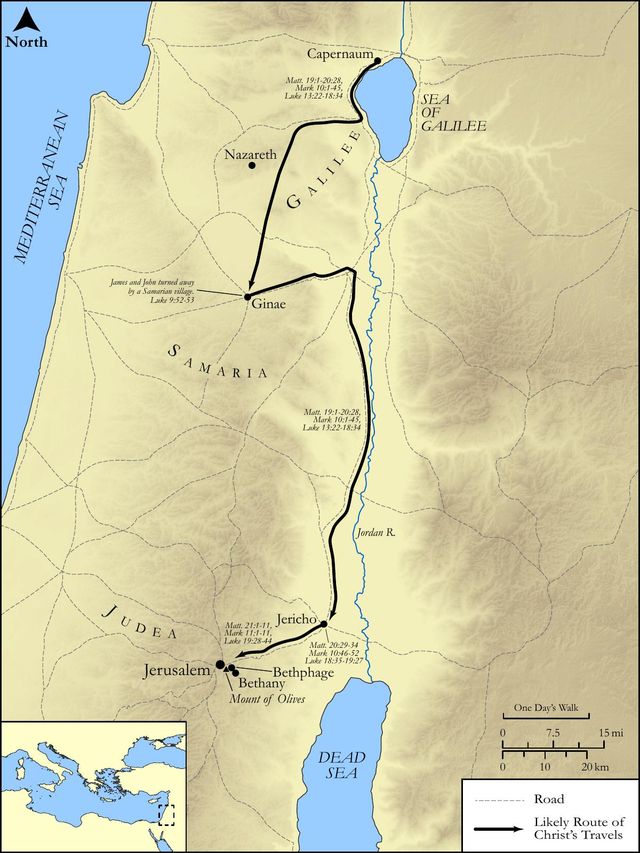
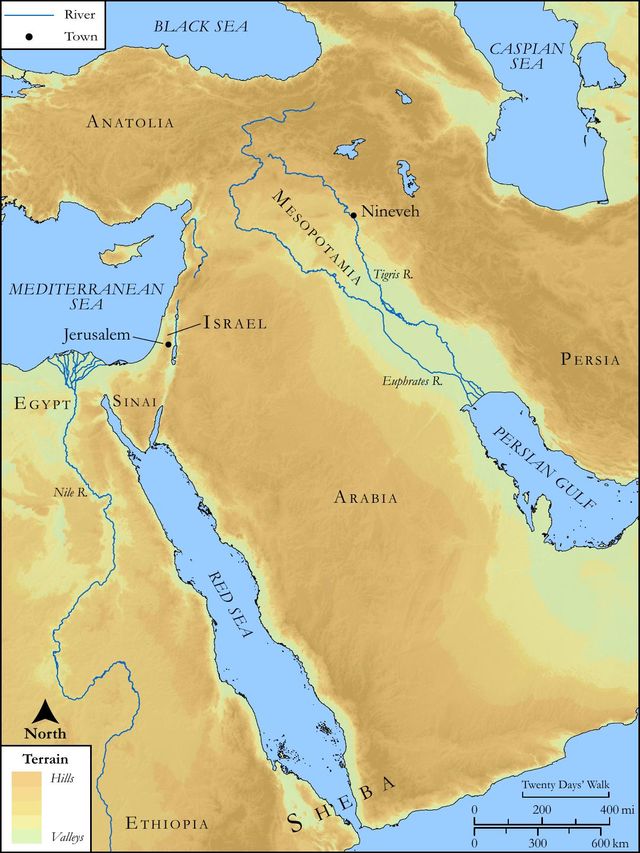
See on the biblical-era maps

Study this verse
Public-domain commentary
Matthew Henry
From his Commentary on the Whole Bible. Henry comments on passages, not single verses — this entry covers Luke 9:37–42.
This passage of story in Matthew and Mark follows immediately upon that of Christ's transfiguration, and his discourse with his disciples after it; but here it is said to be on the next day, as they were coming down from the hill, which confirms the conjecture that Christ was transfigured in the night, and, it should seem, though they did not make tabernacles as Peter proposed, yet they found some shelter to repose themselves in all night, for it was not till next day that they came down from the hill, and then he found things in some disorder among his disciples, though not so bad as Moses did when he came down from the mount. When wise and good men are in their beloved retirements, they would do well to consider whether they are not wanted in their public stations.
In this narrative here, observe, 1. How forward the people were to receive Christ at his return to them. Though he had been but a little while absent, much people met him, as, at other times, much people followed him; for so it was foretold concerning him, that to him should the gathering of the people be. 2. How importunate the father of the lunatic child was with Christ for help for him (Luk 9:38): I beseech thee, look upon my son; this is his request, and it is a very modest one; one compassionate look from Christ is enough to set every thing to rights. Let us bring ourselves and our children to Christ, to be looked upon. His plea is, He is my only child. They that have many children may balance their affliction in one with their comfort in the rest; yet, if it be an only child that is a grief, the affliction in that may be balanced with the love of God in giving his only-begotten Son for us. 3. How deplorable the case of the child was, Luk 9:39. He was under the power of an evil spirit, that took him; and diseases of that nature are more frightful than such as arise merely from natural causes: when the fit seized him without any warning given, he suddenly cried out, and many a time his shrieks had pierced the heart of his tender father. This malicious spirit tore him, and bruised him, and departed not from him but with great difficulty, and a deadly gripe at parting. O the afflictions of the afflicted in this world! And what mischief doth Satan do where he gets possession! But happy they that have access to Christ! 4. How defective the disciples were in their faith. Though Christ had given them power over unclean spirits, yet they could not cast out this evil spirit, Luk 9:40. Either they distrusted the power they were to fetch in strength fRom. or the commission given to them, or they did not exert themselves in prayer as they ought; for this Christ reproved them. O faithless and perverse generation. Dr. Clarke understands this as spoken to his disciples: "Will ye be yet so faithless and full of distrust that ye cannot execute the commission I have given you?" 5. How effectual the cure was, which Christ wrought upon this child, Luk 9:42. Christ can do that for us which his disciples cannot: Jesus rebuked the unclean spirit then when he raged most. The devil threw the child down, and tore him, distorted him, as if he would have pulled him to pieces. But one word from Christ healed the child, and made good the damage the devil had done him. And it is here added that he delivered him again to his father. Note, When our children are recovered from sickness, we must receive them as delivered to us again, receive them as life from the dead, and as when we first received them. It is comfortable to receive them from the hand of Christ, to see him delivering them to us again: "Here, take this child, and be thankful; take it, and bring it up for me, for thou hast it again from me. Take it, and do not set thy heart too much upon it." With such cautions as these, parents should receive their children from Christ's hands, and then with comfort put them again into his hands.
Historical interpretation
Seven Centuries of Reception
6 surviving comments on this verse. Each one is dated, so this reads as a timeline rather than a list.
Select a marker to jump to its quote. Markers stagger vertically where authors wrote within a few decades of each other.
(non occ.) It seems indeed to me that this was a wise man. For he said not to the Saviour, "Do this or that," but, Look on my son, for this suffices for His salvation; as the prophet said, Look on me, and have mercy on me; and he says, on my son, to show that his was a reasonable forwardness in crying out aloud among the multitude. He adds, for he is mine only child. As if to say, There is none other I can expect to be the consolation of my old age. He next enters into the sufferings, that he may move his Hearer to compassion, saying, And, lo, the spirit taketh him. He then seems to accuse the disciples, but his answer is rather a justification of his casting aside his fear, saying, And I besought thy disciples to cast him out: and they could not. As if he said, Think not that I have come lightly unto Thee. Marvellous is Thy greatness! I did not intrude upon Thy presence at once, but went first to Thy disciples. Because they failed to work the cure, I am now compelled to approach Thee. Our Lord therefore does not blame him, but the faithless generation; for it follows, And Jesus answering said, O faithless and perverse generation.
He might indeed have healed him by His simple command, but He makes his sufferings public, bringing the weak in faith to the sight of things present. Then the devil, when he perceived our Lord, rends and dashes the child clown; as it follows, And as he was yet a coming, the devil threw him down, and tare him; that so first the sufferings should be made manifest, then the remedy be applied.
(Hom. 57. in Matt.) But that this man was much weakened in faith, the writings of the Gospel show us in several places. In that place where he says, Help thou my unbelief; (Mark 9:21, 23.) and, If thou canst. And in that where Christ said, All things are possible to him that believeth, &c.
(ubi sup.) Hence it seems to me more correct to account the father of the demoniac unbelieving, because he also casts reproach upon the holy Apostles, saying that they could not subdue the evil spirits. But it were better to have sought favour from God by honouring Him, for He has respect to them that fear Him. But he who says that those are weak with respect to their power over evil spirits, who have obtained that power from Christ, calumniates rather the grace than those who are adorned with that grace in whom Christ works. Christ is therefore offended with the accusation of the saints, to whom was entrusted the word of holy preaching. Wherefore the Lord rebukes him and those like-minded with him, saying, O faithless and perverse generation. As if He said, Because of your unbelief the grace has not received its accomplishment.
(Hom. 57. in Matt.) Now He does not direct His words to him alone, but to all the Jews, lest He should cause him to doubt. For it must have been that many were offended.
(ubi sup.) Hereby also He shows that His departure was desired by Him, not because the suffering of the cross was grievous, but rather their conversation.
(ubi sup.) The Lord however does this not for display, but for the father's sake, that upon seeing the devil disturbed at the mere summons, he might thus at least be led to the belief of the future miracles; of which it follows, And Jesus rebuked the unclean spirit, and healed the child, and delivered him again unto his father.
Certain places accord with certain events. On the Mount our Lord prays, is transfigured, reveals the secrets of His glory to His disciples; as He descends to the lower parts, He is received by a large concourse. As it is said, And it came to pass, that on the next day, when he was come down from the hill, much people met him. Above He makes known the voice of the Father, below He expels the evil spirits. Hence it follows, And, behold, a man of the company cried out, saying, Master, I beseech thee look upon my son.
Not that weariness has overcome His patience, but after the manner of a physician, when he sees a sick man acting contrary to his commands, he says, 'How long shall I come to thy house, when I order one thing, you do another. But to prove that He was not angry with the man, but with the sin, He immediately added, Bring thy son hither.
Now in a mystical manner in proportion to their deserts docs our Lord daily ascend to some men, seeing that the perfect and those whose conversation is in heaven, He glorifies by exalting higher, instructing them in things eternal, and teaching them things which can not be heard by the multitude, but to others he descends, in that He strengthens the earthly and foolish men, teaching and chastening them. Now this demoniac Matthew calls a lunatic; Mark, deaf and dumb. (Matt. 17:15, Mark 9:25.) Matthew signifies those who change as the moon, increasing and decreasing through different vices, Mark those who are dumb in not confessing the faith, deaf in not hearing the very word of faith. While the boy is coming to our Lord, he is dashed to the ground; because men when turned to the Lord are often grievously afflicted by the devil, that he may instil a hatred of virtue, or revenge the injury of his expulsion. As in the beginning of the Church he waged as many fierce conflicts as he had to bewail losses suddenly brought upon His kingdom. But our Lord rebukes not the boy who suffered violence, but the evil spirit who inflicted it; for he who desires to correct the sinner, ought by reproof and abhorrence to drive away the vice, but to revive the man by gentleness, until he can restore him to the spiritual father of the Church.
And it happened on the following day, as they were descending from the mountain, a great crowd met Him, and behold, a man from the crowd shouted out, saying: Master, I beseech You, look upon my son, for he is my only one. The places match the events: On the mountain, the Lord prays, is transformed, reveals to the disciples the secrets of His majesty; descending to the lower places, He is met by the crowd, struck by the lamentation of the wretched. Above, He reveals the mysteries of the kingdom to the disciples; below, He reproaches the crowds for the sins of unbelief. Above, He discloses the Father's voice to those who could follow Him; below, He expels wicked spirits from those who were being tormented. Even now, according to the quality of merits, He ceases not to ascend and descend for some. For those who are still earthly and beginners, as if seeking the low places, He strengthens, teaches, and corrects; but the perfect, whose conversation is in the heavens, He glorifies by exalting more highly, instructs more freely about eternal things, and often teaches those things which the crowds cannot even hear.
(ubi sup.) This also our Lord commands, since He knew His disciples to be imperfect, seeing that they had not yet received the full measure of the Spirit, lest the hearts of others who had not seen should be prostrated by sorrow, and lest the traitor should be stirred up to a frantic hatred.
By the word perverse, He shows that this wickedness in them was not originally or by nature, for by nature indeed they were upright, being the seed of Abraham, but became perverted through malice.
Continue studying Luke 9:37 across the web’s major study libraries — every link below opens this exact verse, chapter, or book on the destination site.
Read & Compare
 BibleGatewayThis verse in more than 200 translations and 70 languages.
 Bible.comThe YouVersion reader — hundreds of translations, reading plans, and highlights.
 ESV.orgCrossway's official English Standard Version reader.
 NET BibleThe NET translation with 60,000+ translators' notes on every rendering decision.
 STEP BibleTyndale House's free study tool — original text, vocabulary, and scholarly resources.
 BibliaLogos Bible Software's free web reader.
 USCCBThe New American Bible (Revised Edition) with the U.S. bishops' study notes.
Commentaries
 BibleHub CommentariesDozens of classic commentaries on this verse, gathered on one page.
 StudyLightMore than 100 commentary sets — the largest collection on the web.
 BibleRefPlain-English commentary on what this verse means, verse by verse.
 Enduring WordDavid Guzik's free commentary on this chapter, widely used by Bible teachers.
 Bible Study ToolsVerse commentary alongside Greek and Hebrew study aids.
Original Language & Research
- BibleHub InterlinearThe verse word by word — original language, transliteration, and English.
- BibleHub LexiconEvery word's original-language definition and Strong's entry.
 Blue Letter BibleDeep-study tools — Strong's numbers, concordance, and word studies.
 CNTR CollationThe earliest Greek manuscripts of this verse, collated letter by letter.
Sermons, Hymns & Audio


TrulyRandomVerse is not affiliated with these sites and doesn’t control their content. They’re linked because they’re genuinely useful.
Summary
Luke 9:37 marks a pivotal transition in Jesus' ministry, immediately following the profound revelation of His Transfiguration. This verse brings the narrative from an intimate, divine encounter on a mountaintop back to the bustling reality of human need and public ministry, highlighting Jesus' unwavering commitment to His mission despite moments of transcendent glory. It sets the stage for further demonstrations of His power and compassion amidst the pressing demands of the multitudes.
Context
ShowHideLiterary Context
This verse serves as a crucial bridge in Luke's narrative, directly succeeding the awe-inspiring account of the Transfiguration of Jesus. Having ascended a high mountain with Peter, James, and John, Jesus was glorified before them, conversed with Moses and Elijah, and received affirmation from the Father's voice. The descent "on the next day" from this pinnacle of divine revelation to the waiting "much people" underscores a fundamental pattern in Jesus' life: moments of profound spiritual intimacy and divine affirmation consistently precede or lead back to active, compassionate engagement with a needy world. The immediate narrative following this verse, the healing of a demon-possessed boy, further emphasizes the stark contrast between divine glory and earthly suffering, and Jesus' immediate response to the latter.
Historical & Cultural Context
In Scripture, mountains are often places of divine encounter, revelation, and solitude, as seen with Moses on Mount Sinai. Conversely, the plains or lower regions were where daily life, commerce, and public gatherings occurred. Jesus' consistent pattern of retreating to mountains for prayer or significant revelation, only to descend to minister to the crowds, reflects this cultural understanding and His dual nature as both divine Son and accessible Messiah. The "much people" gathering at the base of the mountain was a common sight, as news of Jesus' miracles and teachings spread rapidly, creating constant demand for His presence, healing, and instruction. This illustrates the widespread anticipation and desperation for a deliverer in first-century Galilee and Judea.
Key Themes
ShowHideLuke 9:37 contributes significantly to several overarching themes in Luke's Gospel. Firstly, it highlights the transition from divine glory to earthly ministry, emphasizing that even the most profound spiritual experiences are not ends in themselves but preparation for service. Secondly, the verse underscores the unceasing and overwhelming human need for Jesus, as "much people met him," reflecting the pervasive suffering and spiritual hunger that Jesus continually addressed with compassion, as seen in His tenderness for the harassed and helpless crowds. Thirdly, it powerfully demonstrates Jesus' unwavering accessibility and commitment to His mission. Despite His divine nature and recent transcendent experience, He did not retreat but descended directly into the midst of human suffering, mirroring the pattern of His ministry where moments of solitude and prayer were consistently followed by intense public engagement and service.
Exposition and Analysis
ShowHideKey Word Analysis
ShowHideThis verb, often translated "to become" or "to happen," is a common Lukan literary device (e.g., Luke 1:8, Luke 2:1). It signals a new event or development in the narrative, serving as a transition marker. Here, it smoothly shifts the scene from the Transfiguration to the immediate resumption of public ministry, emphasizing the unfolding of God's plan.
This term refers to a "throng," "multitude," or "crowd," often implying a large, unorganized gathering. It highlights the sheer number of individuals who sought Jesus, underscoring the widespread interest in His ministry and the constant demands placed upon Him. The use of this word consistently throughout the Gospels paints a picture of Jesus' ministry being deeply embedded in the public sphere, constantly surrounded by those in need.
This verb means "to meet with" or "to encounter." In this context, it signifies an intentional convergence, implying that the crowd was actively waiting for Jesus at the base of the hill. It suggests not a chance encounter but a deliberate seeking out of Jesus by those eager for His presence, power, or teaching, setting the stage for the immediate needs that would be presented to Him.
Verse Breakdown
ShowHide"And it came to pass,"
This introductory phrase, characteristic of Luke's writing, serves as a narrative connector, signaling a new event or development. It smoothly transitions the reader from the preceding account of the Transfiguration to the subsequent events, emphasizing the continuous flow of Jesus' ministry.
"that on the next day,"
The temporal marker "on the next day" explicitly links this event to the Transfiguration, which occurred the day before. This immediate succession highlights that Jesus did not linger in His moment of glory but promptly returned to the demands of His earthly mission, emphasizing the urgency and continuity of His work.
"when they were come down from the hill,"
This clause describes the physical descent of Jesus and His three disciples from the mountain where the Transfiguration took place. The "hill" (or mountain) symbolizes a place of divine encounter and solitude, contrasting sharply with the lower ground where human activity and suffering reside. Their descent signifies Jesus' deliberate movement from heavenly glory back into the sphere of human need.
"much people met him."
This final clause reveals the immediate reality awaiting Jesus: a large crowd. The phrase "much people" (Greek: ochlos polys) emphasizes the sheer number and pressing presence of the multitude. Their act of "meeting him" suggests they were actively waiting for Him, eager for His attention, teaching, or healing, setting the scene for the immediate continuation of His public ministry and the challenges that would arise from it.
Literary Devices
ShowHideLuke 9:37 employs several significant literary devices. Juxtaposition is prominent, as the verse dramatically contrasts the preceding scene of divine glory and intimate revelation on the mountaintop with the immediate, bustling reality of a large, needy crowd awaiting Jesus below. This sharp shift highlights the dual nature of Jesus' mission: His divine identity and His earthly service. Symbolism is also at play, with the "hill" or "mountain" representing a place of spiritual height, divine encounter, and withdrawal, while the lower ground where the "much people" gather symbolizes the realm of human need, suffering, and public ministry. The descent thus becomes a symbolic act of condescension and engagement. Furthermore, the verse functions as a form of foreshadowing, immediately setting the stage for the urgent human needs that Jesus will address, particularly the healing of the demon-possessed boy in the very next verses, demonstrating that His glory is not for His own exaltation but for the redemption and restoration of humanity.
Theological and Thematic Connections
ShowHideLuke 9:37 encapsulates a profound theological truth about the nature of divine revelation and its purpose. It teaches that moments of spiritual elevation and intimate communion with God are not meant for prolonged withdrawal but are often a divine equipping for renewed engagement with the world's brokenness. Jesus' immediate descent from the glory of the Transfiguration to the waiting crowds illustrates that true spiritual power is manifested not in isolation but in compassionate service to humanity. This pattern underscores God's heart for the lost and suffering, demonstrating that His glory is ultimately revealed in His redemptive work among people, not merely in transcendent displays. It calls believers to integrate their spiritual experiences with practical, outward-focused ministry, understanding that our "mountaintop" moments are often preparation for the "valley" of human need.
Reflection and Application
ShowHideLuke 9:37 offers a powerful paradigm for the Christian life, reminding us that our most profound spiritual experiences are often preparation for renewed engagement with the world. It challenges the notion that spiritual growth is solely about personal ascent or withdrawal. Instead, it emphasizes that true spiritual maturity involves descending from our "mountaintops" – whether moments of deep worship, insightful study, or personal revelation – and re-entering the sphere of human activity, ready to serve, to share the Gospel, and to address the pressing needs around us. This verse encourages a balanced and holistic faith, one that integrates deep intimacy with God with active, compassionate service to others. It calls us to be available and approachable, just as Jesus was, recognizing that the world is full of "much people" waiting to encounter the transforming power of Christ through His followers. Our spiritual highs are not for our own enjoyment alone, but to empower us for the mission of Christ in a broken world.
Questions for Reflection
ShowHideFAQ
ShowHideWhat is the significance of the "next day" in Luke 9:37?
ShowHideThe phrase "on the next day" is highly significant because it immediately follows the Transfiguration, which was a profound, intimate, and glorious experience for Jesus and His three disciples. The swift transition signifies that Jesus did not linger in His moment of divine exaltation. Instead, He promptly returned to the pressing demands of His earthly ministry. This immediate return to the crowds underscores Jesus' unwavering commitment to His mission to serve humanity, demonstrating that even the highest spiritual experiences are not ends in themselves but serve to equip and propel one into compassionate action for others, as seen in His continuous acts of healing and teaching.
Christ-Centered Fulfillment
ShowHideLuke 9:37 powerfully encapsulates the very essence of Christ's incarnational ministry and His ultimate redemptive work. The descent from the mountain of glory to the waiting "much people" serves as a profound microcosm of the Son of God's greater descent from heavenly glory to dwell among humanity. Just as Jesus left the transcendent realm of the Transfiguration to meet the pressing needs of suffering people, so too did He, in His incarnation, empty Himself, taking the form of a servant, leaving the ineffable glory of heaven to enter into the messiness of a fallen world. This verse beautifully illustrates the compassionate heart of God, who does not remain distant in His majesty but actively seeks out and engages with His creation in its brokenness. It foreshadows the ultimate act of condescension and love: Christ's journey to the cross, where He, the glorious Son, descended to the lowest depths of human suffering and sin to take away the sin of the world, thereby making Himself accessible to all who would believe. His willingness to move from divine affirmation to public demand exemplifies His mission to be Immanuel, God with us, fully present in our human condition to bring salvation and healing.