


Luke 9:38
Bible text: King James Version (1769 Blayney text) · Public domain
Bible text: King James Version with Strong's numbers · Public domain
Bible text: Berean Standard Bible · Public domain
Bible text: American Standard Version (1901) · Public domain
Bible text: World English Bible, Messianic edition · Public domain
Bible text: Geneva Bible (1599) · Public domain
Bible text: Young's Literal Translation · Public domain
- καὶkaiAndG2532CONJConjunction
- ἰδοὺidoubeholdG2400INJInterjection
- ἀνὴρanēra manG435N-NSMNoun Nominative Singular Masculine
- ἀπὸapofromG575PREPPreposition
- τοῦtoutheG3588T-GSMDefinite article Genitive Singular Masculine
- ὄχλουochloucrowdG3793N-GSMNoun Genitive Singular Masculine
- ἐβόησενeboēsencriedG994V-AAI-3SVerb Aorist Active Indicative 3rd Singular
- λέγων·legōnsayingG3004V-PAP-NSMVerb Present Active Participle Nominative Singular Masculine
- διδάσκαλεdidaskaleTeacherG1320N-VSM-TNoun Vocative Singular Masculine Person Gentilic
- δέομαίdeomaiI imploreG1189V-PNI-1SVerb Present Middle Or Passive Deponent Indicative 1st Singular
- σουsouYouG4771P-2GSPersonal pronoun Genitive 2nd Singular
- ἐπιβλέψαιepiblepsaito lookG1914V-AANVerb Aorist Active Infinitive
- ἐπὶepiuponG1909PREPPreposition
- τὸνtontheG3588T-ASMDefinite article Accusative Singular Masculine
- υἱόνhuionsonG5207N-ASMNoun Accusative Singular Masculine
- μουmouof mineG3165P-1GSPersonal pronoun Genitive 1st Singular
- ὅτιhotiforG3754CONJConjunction
- μονογενήςmonogenēsan only childG3439A-NSMAdjective Nominative Singular Masculine
- μοίmoito meG3165P-1DSPersonal pronoun Dative 1st Singular
- ἐστιν·estinhe isG1510V-PAI-3SVerb Present Active Indicative 3rd Singular
English is a literal word-by-word gloss of the Greek, not the KJV's wording. Why?
This is the original text the KJV's translators worked from — each Greek word with its own literal English meaning in this verse, prepared by scholars at Tyndale House, Cambridge. The KJV translates whole sentences, not word by word, so its wording differs: one Greek word can become several English words, and the KJV may choose “charity” where the gloss reads “love”. Both are faithful — they answer different questions. For the KJV's own rendering, switch to the KJV text.
Details
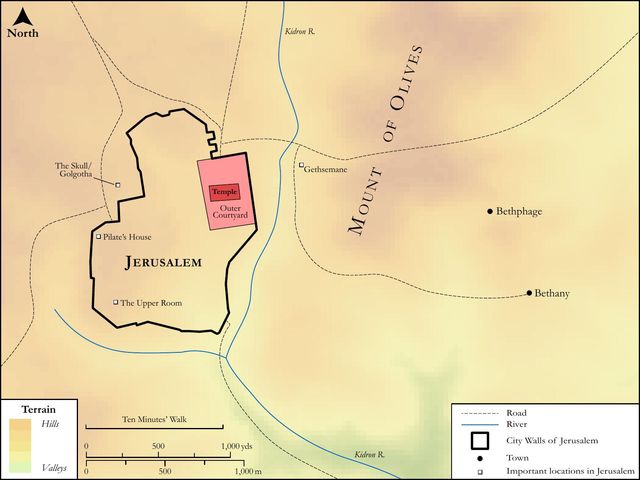
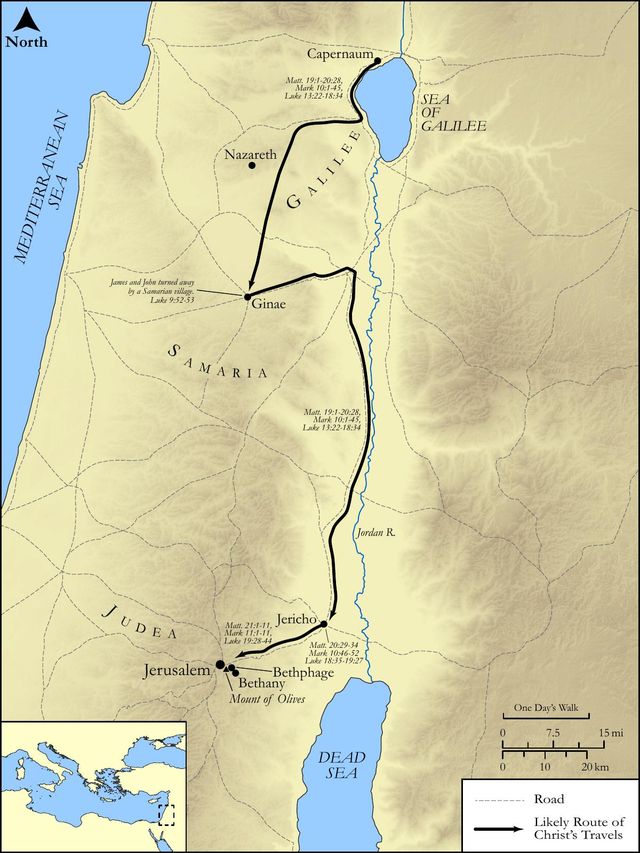
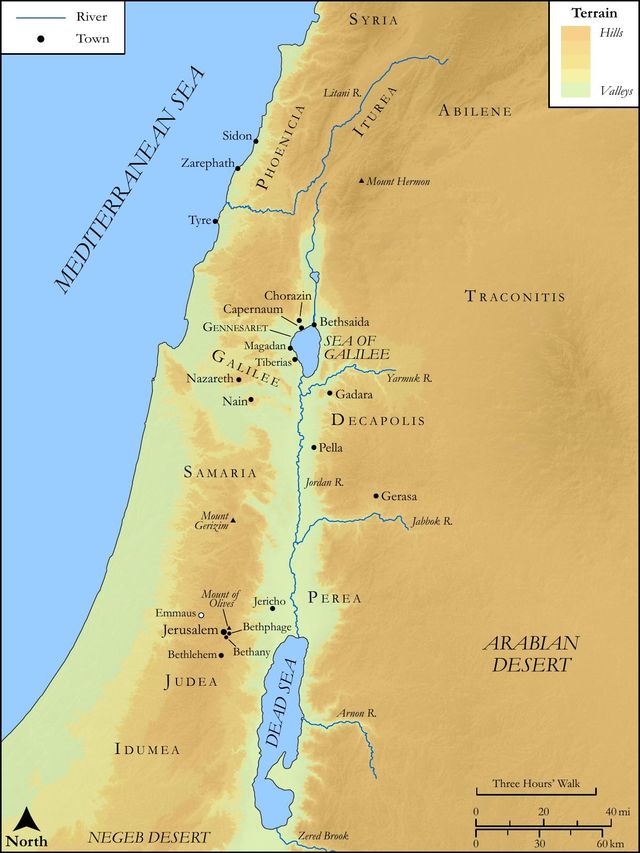
See on the biblical-era maps
Study this verse
Public-domain commentary
Matthew Henry
From his Commentary on the Whole Bible. Henry comments on passages, not single verses — this entry covers Luke 9:37–42.
This passage of story in Matthew and Mark follows immediately upon that of Christ's transfiguration, and his discourse with his disciples after it; but here it is said to be on the next day, as they were coming down from the hill, which confirms the conjecture that Christ was transfigured in the night, and, it should seem, though they did not make tabernacles as Peter proposed, yet they found some shelter to repose themselves in all night, for it was not till next day that they came down from the hill, and then he found things in some disorder among his disciples, though not so bad as Moses did when he came down from the mount. When wise and good men are in their beloved retirements, they would do well to consider whether they are not wanted in their public stations.
In this narrative here, observe, 1. How forward the people were to receive Christ at his return to them. Though he had been but a little while absent, much people met him, as, at other times, much people followed him; for so it was foretold concerning him, that to him should the gathering of the people be. 2. How importunate the father of the lunatic child was with Christ for help for him (Luk 9:38): I beseech thee, look upon my son; this is his request, and it is a very modest one; one compassionate look from Christ is enough to set every thing to rights. Let us bring ourselves and our children to Christ, to be looked upon. His plea is, He is my only child. They that have many children may balance their affliction in one with their comfort in the rest; yet, if it be an only child that is a grief, the affliction in that may be balanced with the love of God in giving his only-begotten Son for us. 3. How deplorable the case of the child was, Luk 9:39. He was under the power of an evil spirit, that took him; and diseases of that nature are more frightful than such as arise merely from natural causes: when the fit seized him without any warning given, he suddenly cried out, and many a time his shrieks had pierced the heart of his tender father. This malicious spirit tore him, and bruised him, and departed not from him but with great difficulty, and a deadly gripe at parting. O the afflictions of the afflicted in this world! And what mischief doth Satan do where he gets possession! But happy they that have access to Christ! 4. How defective the disciples were in their faith. Though Christ had given them power over unclean spirits, yet they could not cast out this evil spirit, Luk 9:40. Either they distrusted the power they were to fetch in strength fRom. or the commission given to them, or they did not exert themselves in prayer as they ought; for this Christ reproved them. O faithless and perverse generation. Dr. Clarke understands this as spoken to his disciples: "Will ye be yet so faithless and full of distrust that ye cannot execute the commission I have given you?" 5. How effectual the cure was, which Christ wrought upon this child, Luk 9:42. Christ can do that for us which his disciples cannot: Jesus rebuked the unclean spirit then when he raged most. The devil threw the child down, and tore him, distorted him, as if he would have pulled him to pieces. But one word from Christ healed the child, and made good the damage the devil had done him. And it is here added that he delivered him again to his father. Note, When our children are recovered from sickness, we must receive them as delivered to us again, receive them as life from the dead, and as when we first received them. It is comfortable to receive them from the hand of Christ, to see him delivering them to us again: "Here, take this child, and be thankful; take it, and bring it up for me, for thou hast it again from me. Take it, and do not set thy heart too much upon it." With such cautions as these, parents should receive their children from Christ's hands, and then with comfort put them again into his hands.
Historical interpretation
Seven Centuries of Reception
6 surviving comments on this verse. Each one is dated, so this reads as a timeline rather than a list.
Select a marker to jump to its quote. Markers stagger vertically where authors wrote within a few decades of each other.
(non occ.) It seems indeed to me that this was a wise man. For he said not to the Saviour, "Do this or that," but, Look on my son, for this suffices for His salvation; as the prophet said, Look on me, and have mercy on me; and he says, on my son, to show that his was a reasonable forwardness in crying out aloud among the multitude. He adds, for he is mine only child. As if to say, There is none other I can expect to be the consolation of my old age. He next enters into the sufferings, that he may move his Hearer to compassion, saying, And, lo, the spirit taketh him. He then seems to accuse the disciples, but his answer is rather a justification of his casting aside his fear, saying, And I besought thy disciples to cast him out: and they could not. As if he said, Think not that I have come lightly unto Thee. Marvellous is Thy greatness! I did not intrude upon Thy presence at once, but went first to Thy disciples. Because they failed to work the cure, I am now compelled to approach Thee. Our Lord therefore does not blame him, but the faithless generation; for it follows, And Jesus answering said, O faithless and perverse generation.
He might indeed have healed him by His simple command, but He makes his sufferings public, bringing the weak in faith to the sight of things present. Then the devil, when he perceived our Lord, rends and dashes the child clown; as it follows, And as he was yet a coming, the devil threw him down, and tare him; that so first the sufferings should be made manifest, then the remedy be applied.
(Hom. 57. in Matt.) But that this man was much weakened in faith, the writings of the Gospel show us in several places. In that place where he says, Help thou my unbelief; (Mark 9:21, 23.) and, If thou canst. And in that where Christ said, All things are possible to him that believeth, &c.
(ubi sup.) Hence it seems to me more correct to account the father of the demoniac unbelieving, because he also casts reproach upon the holy Apostles, saying that they could not subdue the evil spirits. But it were better to have sought favour from God by honouring Him, for He has respect to them that fear Him. But he who says that those are weak with respect to their power over evil spirits, who have obtained that power from Christ, calumniates rather the grace than those who are adorned with that grace in whom Christ works. Christ is therefore offended with the accusation of the saints, to whom was entrusted the word of holy preaching. Wherefore the Lord rebukes him and those like-minded with him, saying, O faithless and perverse generation. As if He said, Because of your unbelief the grace has not received its accomplishment.
(Hom. 57. in Matt.) Now He does not direct His words to him alone, but to all the Jews, lest He should cause him to doubt. For it must have been that many were offended.
(ubi sup.) Hereby also He shows that His departure was desired by Him, not because the suffering of the cross was grievous, but rather their conversation.
(ubi sup.) The Lord however does this not for display, but for the father's sake, that upon seeing the devil disturbed at the mere summons, he might thus at least be led to the belief of the future miracles; of which it follows, And Jesus rebuked the unclean spirit, and healed the child, and delivered him again unto his father.
This lesson proves that he delivered us from the power of unclean spirits. We heard read that a man ran toward him from among the crowd and related the intolerable illness of his son. He said that he was cruelly torn by an evil spirit and suffered violent convulsions. The manner of his approach was not free from fault, because he shouted loudly against the company of the holy apostles, saying that they could not rebuke Satan. It would have been more fitting for him to honor Jesus when asking his aid and imploring grace. He grants us our request when we honor and confide in him as being the Almighty, whose power nothing can withstand.
Certain places accord with certain events. On the Mount our Lord prays, is transfigured, reveals the secrets of His glory to His disciples; as He descends to the lower parts, He is received by a large concourse. As it is said, And it came to pass, that on the next day, when he was come down from the hill, much people met him. Above He makes known the voice of the Father, below He expels the evil spirits. Hence it follows, And, behold, a man of the company cried out, saying, Master, I beseech thee look upon my son.
Not that weariness has overcome His patience, but after the manner of a physician, when he sees a sick man acting contrary to his commands, he says, 'How long shall I come to thy house, when I order one thing, you do another. But to prove that He was not angry with the man, but with the sin, He immediately added, Bring thy son hither.
Now in a mystical manner in proportion to their deserts docs our Lord daily ascend to some men, seeing that the perfect and those whose conversation is in heaven, He glorifies by exalting higher, instructing them in things eternal, and teaching them things which can not be heard by the multitude, but to others he descends, in that He strengthens the earthly and foolish men, teaching and chastening them. Now this demoniac Matthew calls a lunatic; Mark, deaf and dumb. (Matt. 17:15, Mark 9:25.) Matthew signifies those who change as the moon, increasing and decreasing through different vices, Mark those who are dumb in not confessing the faith, deaf in not hearing the very word of faith. While the boy is coming to our Lord, he is dashed to the ground; because men when turned to the Lord are often grievously afflicted by the devil, that he may instil a hatred of virtue, or revenge the injury of his expulsion. As in the beginning of the Church he waged as many fierce conflicts as he had to bewail losses suddenly brought upon His kingdom. But our Lord rebukes not the boy who suffered violence, but the evil spirit who inflicted it; for he who desires to correct the sinner, ought by reproof and abhorrence to drive away the vice, but to revive the man by gentleness, until he can restore him to the spiritual father of the Church.
(ubi sup.) This also our Lord commands, since He knew His disciples to be imperfect, seeing that they had not yet received the full measure of the Spirit, lest the hearts of others who had not seen should be prostrated by sorrow, and lest the traitor should be stirred up to a frantic hatred.
By the word perverse, He shows that this wickedness in them was not originally or by nature, for by nature indeed they were upright, being the seed of Abraham, but became perverted through malice.
Continue studying Luke 9:38 across the web’s major study libraries — every link below opens this exact verse, chapter, or book on the destination site.
Read & Compare
 BibleGatewayThis verse in more than 200 translations and 70 languages.
 Bible.comThe YouVersion reader — hundreds of translations, reading plans, and highlights.
 ESV.orgCrossway's official English Standard Version reader.
 NET BibleThe NET translation with 60,000+ translators' notes on every rendering decision.
 STEP BibleTyndale House's free study tool — original text, vocabulary, and scholarly resources.
 BibliaLogos Bible Software's free web reader.
 USCCBThe New American Bible (Revised Edition) with the U.S. bishops' study notes.
Commentaries
 BibleHub CommentariesDozens of classic commentaries on this verse, gathered on one page.
 StudyLightMore than 100 commentary sets — the largest collection on the web.
 BibleRefPlain-English commentary on what this verse means, verse by verse.
 Enduring WordDavid Guzik's free commentary on this chapter, widely used by Bible teachers.
 Bible Study ToolsVerse commentary alongside Greek and Hebrew study aids.
Original Language & Research
- BibleHub InterlinearThe verse word by word — original language, transliteration, and English.
- BibleHub LexiconEvery word's original-language definition and Strong's entry.
 Blue Letter BibleDeep-study tools — Strong's numbers, concordance, and word studies.
 CNTR CollationThe earliest Greek manuscripts of this verse, collated letter by letter.
Sermons, Hymns & Audio


TrulyRandomVerse is not affiliated with these sites and doesn’t control their content. They’re linked because they’re genuinely useful.
Summary
Luke 9:38 presents a poignant scene where a man from the crowd desperately appeals to Jesus, recognizing His unique authority and power. The father's urgent cry for his "only child," who is suffering from an affliction beyond the disciples' help, underscores the depth of his anguish and the profound hope he places in Jesus as his last resort for healing and deliverance.
Context
ShowHideLiterary Context
This verse immediately follows the dramatic account of the Transfiguration on the mountain, where Jesus' divine glory was revealed to Peter, James, and John (Luke 9:28-36). As Jesus and the three disciples descend from this spiritual high point, they are met by a large crowd, including the father with his afflicted son. The narrative juxtaposition highlights the transition from divine revelation to human suffering, demonstrating Jesus' readiness to engage with the pressing needs of humanity even after experiencing profound spiritual communion. The subsequent verses (Luke 9:39-42) reveal that the other disciples, who had remained at the base of the mountain, had attempted and failed to cast out the demon afflicting the boy, setting the stage for Jesus' powerful and decisive intervention. This failure of the disciples underscores the unique authority and power of Jesus.
Historical & Cultural Context
In first-century Judea, illness and affliction were often attributed to demonic influence or divine judgment, leading to significant social stigma and despair. While there were traditional healers and exorcists, their success was inconsistent, and many suffered without relief. The presence of a "large crowd" (Luke 9:37) is typical of Jesus' ministry, as people flocked to Him, drawn by His teachings and miraculous healings. The father's public outcry reflects the common practice of seeking out renowned healers, often in a desperate and public manner, to gain attention and intervention. The emphasis on the child being "mine only child" (G3439, monogenḗs) would have resonated deeply with the cultural value placed on children, especially male heirs, and the profound grief associated with the potential loss or suffering of a sole offspring, making the father's plea all the more compelling and relatable to the audience.
Key Themes
ShowHideThis verse powerfully contributes to several overarching themes in Luke's Gospel and the broader biblical narrative. Firstly, it highlights the theme of Human Desperation and Divine Compassion, showing the depth of human need and Jesus' immediate response to suffering. Secondly, the father's address to Jesus as "Master" (G1320, didáskalos) reinforces the theme of Jesus' Authority and Unique Identity, portraying Him not merely as a teacher but as one possessing inherent power over evil and disease, a theme consistently demonstrated throughout Luke's Gospel. Thirdly, the specific detail of the "only child" (G3439, monogenḗs) emphasizes the theme of Preciousness of Life and Parental Love, echoing other instances in Luke where Jesus restores life to only children, such as the widow's son at Nain (Luke 7:11-17) and Jairus's daughter (Luke 8:40-56). These narratives collectively underscore Jesus' profound compassion for the vulnerable and His power to overcome even the most dire circumstances.
Exposition and Analysis
ShowHideKey Word Analysis
ShowHideDerived from "ana" (up) and "boaō" (to cry aloud). This word signifies a loud, urgent, and often desperate shout or call. It conveys the intensity of the father's distress and his determination to be heard above the noise of the crowd, emphasizing the depth of his anguish and the pressing nature of his need. It's not a mere speaking, but a forceful, attention-grabbing cry.
Meaning an instructor, teacher, or master. While often translated as "teacher," in Luke's Gospel, the term epistata (ἐπιστάτα, used by Luke in similar contexts, though not the direct Strong's number for didáskalos here, it's important to note the KJV's choice of "Master" reflects a deeper sense of authority) is frequently used by those who recognize Jesus' unique position of authority, especially His disciples or those seeking His help. It implies not just intellectual respect but an acknowledgment of His commanding presence and ability to act.
From monos (only) and ginomai (to become, to be born). This term means "only-born" or "sole." Its inclusion is highly significant, intensifying the father's plea by highlighting the unique preciousness and irreplaceable nature of the suffering son. It evokes profound empathy and underscores the immense personal tragedy the father faces, making his appeal to Jesus all the more desperate and compelling.
Verse Breakdown
ShowHide"And, behold, a man of the company cried out, saying,"
The conjunction "And" (G2532, kaí) connects this event directly to the preceding narrative of the Transfiguration, indicating an immediate shift in setting and focus. "Behold" (G2400, idoú) functions as an interjection, drawing the reader's attention to the sudden and dramatic appearance of this man. The phrase "a man of the company" (G435, anḗr G575, apó G3793, óchlos) indicates he emerged from the large crowd, signifying his determination to reach Jesus despite the throng. His act of "crying out" (G310, anaboáō) conveys extreme urgency and desperation, a public display of profound need.
"Master, I beseech thee, look upon my son:"
The address "Master" (G1320, didáskalos) signifies the man's recognition of Jesus' authority and perhaps His teaching role, but in this context, it carries an implicit acknowledgment of Jesus' power. "I beseech thee" (G1189, déomai G4675, soû) is a strong plea, indicating a humble yet earnest request, almost binding himself to the petition. The specific request "look upon my son" (G1914, epiblépō G1909, epí G3450, moû G5207, huiós) is more than a casual glance; epiblépō implies gazing with favor, pity, or compassionate regard, signifying a desire for Jesus' merciful and active attention to his child's plight.
"for he is mine only child."
The conjunction "for" (G3754, hóti) introduces the reason and justification for the father's intense plea. The declaration "he is mine only child" (G2076, estí G3427, moí G3439, monogenḗs) is the emotional core of the verse. This detail, unique to Luke's account of this miracle, amplifies the tragedy and the father's desperation. It highlights the irreplaceable nature of the child and the profound parental anguish, appealing directly to Jesus' compassion and reinforcing the urgency of the situation.
Literary Devices
ShowHideLuke masterfully employs several literary devices in this verse to evoke empathy and emphasize the gravity of the situation. The immediate opening, "And, behold," uses an Exclamation or Interjection to grab the reader's attention, signaling a sudden and significant event. The father's direct address, "Master, I beseech thee, look upon my son," is a powerful example of Direct Address and Pathos. It appeals directly to Jesus' authority and compassion, while simultaneously drawing the reader into the emotional intensity of the father's plea. The most poignant device is the use of Emphasis through the phrase "for he is mine only child." This specific detail, unique to Luke's account of this healing, amplifies the father's desperation and the preciousness of the child, creating a deep sense of Pathos that resonates with universal themes of parental love and loss. It also serves as a form of Foreshadowing, hinting at the extraordinary nature of the miracle Jesus is about to perform, as the healing of an "only child" often carries profound symbolic weight in Luke's Gospel, pointing to Jesus' life-giving power.
Theological and Thematic Connections
ShowHideLuke 9:38 stands as a powerful testament to the accessibility of Jesus to those in desperate need and His profound compassion for human suffering. The father's cry, born out of a situation beyond human remedy, illustrates a core theological truth: when all other avenues fail, Jesus remains the ultimate hope and authority. This encounter highlights Jesus' unique power over spiritual and physical ailments, contrasting sharply with the disciples' prior inability to help. It underscores the divine nature of Jesus' ministry, where His presence alone brings the potential for radical transformation and healing, reaffirming His role as the compassionate Son of God who hears and responds to the cries of the afflicted.
Reflection and Application
ShowHideThis poignant scene from Luke 9:38 offers profound lessons for our own lives. The father's desperate cry, "Master, I beseech thee, look upon my son: for he is mine only child," resonates deeply with the human experience of helplessness in the face of overwhelming challenges, especially when those we love are suffering. His action serves as a powerful model for us: to bring our deepest, most urgent needs directly to Jesus, without hesitation or reservation. It reminds us that no problem is too great, no pain too profound, for the Lord to address. Even when we have exhausted all other options, or when those we rely on have failed, Jesus remains the ultimate source of hope and intervention. We are encouraged to approach Him with the same raw honesty, humility, and desperate faith, trusting that His compassion and power are sufficient for every impossible situation. This narrative calls us to cultivate a persistent and expectant prayer life, believing that Jesus is not only willing but able to "look upon" our needs with favor and bring about miraculous change.
Questions for Reflection
ShowHideFAQ
ShowHideWhy is the detail "mine only child" so important in Luke's account?
ShowHideThe detail "mine only child" (G3439, monogenḗs) is profoundly significant for several reasons. Firstly, it heightens the emotional intensity of the father's plea, evoking deep empathy from the audience. Losing or seeing an only child suffer was, and remains, one of the most devastating experiences a parent could face, representing the loss of lineage, hope, and the future. By including this detail, Luke underscores the father's immense anguish and desperation, making his cry to Jesus all the more urgent and compelling. Secondly, it connects this miracle to other instances in Luke's Gospel where Jesus demonstrates His life-giving power over death and disease for "only children," such as the widow's son at Nain (Luke 7:11-17) and Jairus's daughter (Luke 8:40-56). This recurring motif emphasizes Jesus' unique compassion and authority over life and death, portraying Him as the ultimate source of hope and restoration, particularly for the vulnerable and those facing irreplaceable loss.
Christ-Centered Fulfillment
ShowHideThe desperate cry of the father in Luke 9:38, pleading for his "only child," finds its ultimate echo and fulfillment in the person and work of Jesus Christ. Just as this earthly father brought his precious, suffering son to the Master, God the Father, in His infinite love, gave His own "only begotten Son" (G3439, monogenḗs), Jesus Christ, for the salvation of a suffering humanity (John 3:16). Jesus, the true Master and Lord, descended from the glory of the Transfiguration, a glimpse of His divine majesty, to meet the raw, chaotic reality of human brokenness and demonic oppression. He is the compassionate High Priest who sympathizes with our weaknesses (Hebrews 4:15). The father's plea for Jesus to "look upon" his son with favor and pity is answered by Christ's redemptive gaze upon all who are afflicted by sin and its consequences. Through His life, death, and resurrection, Jesus not only healed the boy in Luke 9 but also conquered the ultimate power of sin and death, offering eternal life and deliverance to all who cry out to Him (Romans 6:23). He is the Lamb of God who takes away the sin of the world (John 1:29), the one who willingly became a "suffering servant" (Isaiah 53:4-5) to bear our infirmities and sorrows, ultimately offering Himself as the perfect sacrifice for our spiritual and eternal well-being.