


Luke 9:42
- ἔτιetiWhileG2089ADVAdverb
- δὲdethenG1161CONJConjunction
- προσερχομένουproserchomenouwhen is coming nearG4334V-PNP-GSMVerb Present Middle Or Passive Deponent Participle Genitive Singular Masculine
- αὐτοῦautouheG846P-GSMPersonal pronoun Genitive Singular Masculine
- ἔρρηξενerrēxenthrew downG4486V-AAI-3SVerb Aorist Active Indicative 3rd Singular
- αὐτὸνautonhimG846P-ASMPersonal pronoun Accusative Singular Masculine
- τὸtotheG3588T-NSNDefinite article Nominative Singular Neuter
- δαιμόνιονdaimoniondemonG1140N-NSNNoun Nominative Singular Neuter
- καὶkaiandG2532CONJConjunction
- συνεσπάραξενsunesparaxenthrew [him] into convulsionsG4952V-AAI-3SVerb Aorist Active Indicative 3rd Singular
- ἐπετίμησενepetimēsenRebukedG2008V-AAI-3SVerb Aorist Active Indicative 3rd Singular
- δὲdethenG1161CONJConjunction
- ὁho<the>G3588T-NSMDefinite article Nominative Singular Masculine
- ἸησοῦςIēsousJesusG2424N-NSM-PNoun Nominative Singular Masculine Individual
- τῷtōtheG3588T-DSNDefinite article Dative Singular Neuter
- πνεύματιpneumatispiritG4151N-DSNNoun Dative Singular Neuter
- τῷtō<the>G3588T-DSNDefinite article Dative Singular Neuter
- ἀκαθάρτῳakathartōuncleanG169A-DSNAdjective Dative Singular Neuter
- καὶkaiandG2532CONJConjunction
- ἰάσατοiasatohealedG2390V-ADI-3SVerb Aorist Middle Deponent Indicative 3rd Singular
- τὸνtontheG3588T-ASMDefinite article Accusative Singular Masculine
- παῖδαpaidaboyG3816N-ASMNoun Accusative Singular Masculine
- καὶkaiandG2532CONJConjunction
- ἀπέδωκενapedōkengave backG591V-2AAI-3SVerb 2nd Aorist Active Indicative 3rd Singular
- αὐτὸνautonhimG846P-ASMPersonal pronoun Accusative Singular Masculine
- τῷtōto theG3588T-DSMDefinite article Dative Singular Masculine
- πατρὶpatrifatherG3962N-DSMNoun Dative Singular Masculine
- αὐτοῦautouof himG846P-GSMPersonal pronoun Genitive Singular Masculine
English is a literal word-by-word gloss of the Greek, not the KJV's wording. Why?
This is the original text the KJV's translators worked from — each Greek word with its own literal English meaning in this verse, prepared by scholars at Tyndale House, Cambridge. The KJV translates whole sentences, not word by word, so its wording differs: one Greek word can become several English words, and the KJV may choose “charity” where the gloss reads “love”. Both are faithful — they answer different questions. For the KJV's own rendering, switch to the KJV text.
Details
See on the biblical-era map

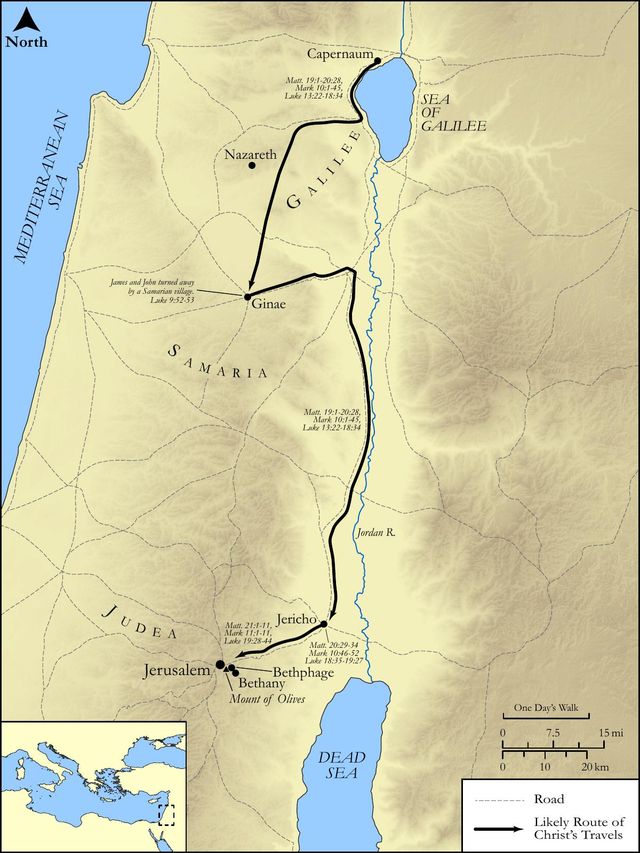
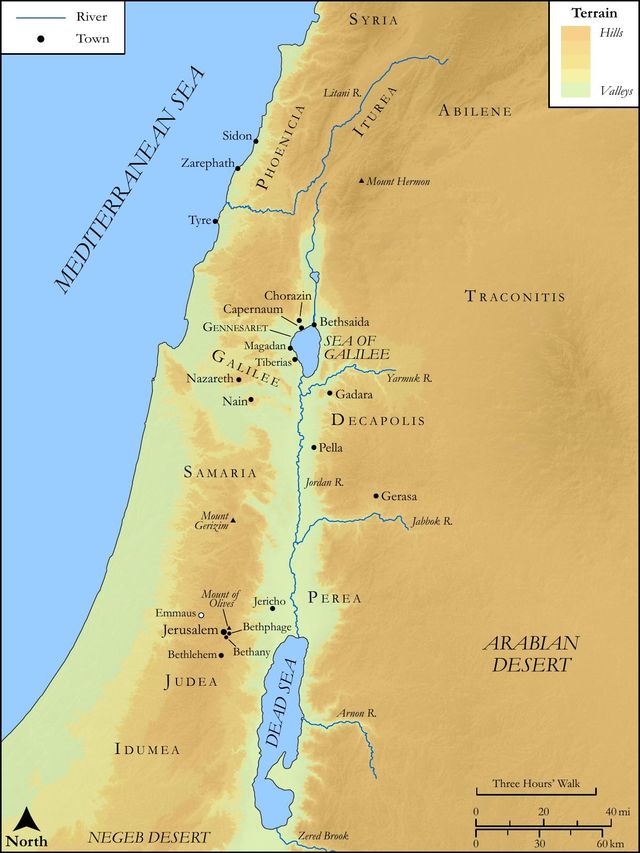
Study this verse
Public-domain commentary
Matthew Henry
From his Commentary on the Whole Bible. Henry comments on passages, not single verses — this entry covers Luke 9:37–42.
This passage of story in Matthew and Mark follows immediately upon that of Christ's transfiguration, and his discourse with his disciples after it; but here it is said to be on the next day, as they were coming down from the hill, which confirms the conjecture that Christ was transfigured in the night, and, it should seem, though they did not make tabernacles as Peter proposed, yet they found some shelter to repose themselves in all night, for it was not till next day that they came down from the hill, and then he found things in some disorder among his disciples, though not so bad as Moses did when he came down from the mount. When wise and good men are in their beloved retirements, they would do well to consider whether they are not wanted in their public stations.
In this narrative here, observe, 1. How forward the people were to receive Christ at his return to them. Though he had been but a little while absent, much people met him, as, at other times, much people followed him; for so it was foretold concerning him, that to him should the gathering of the people be. 2. How importunate the father of the lunatic child was with Christ for help for him (Luk 9:38): I beseech thee, look upon my son; this is his request, and it is a very modest one; one compassionate look from Christ is enough to set every thing to rights. Let us bring ourselves and our children to Christ, to be looked upon. His plea is, He is my only child. They that have many children may balance their affliction in one with their comfort in the rest; yet, if it be an only child that is a grief, the affliction in that may be balanced with the love of God in giving his only-begotten Son for us. 3. How deplorable the case of the child was, Luk 9:39. He was under the power of an evil spirit, that took him; and diseases of that nature are more frightful than such as arise merely from natural causes: when the fit seized him without any warning given, he suddenly cried out, and many a time his shrieks had pierced the heart of his tender father. This malicious spirit tore him, and bruised him, and departed not from him but with great difficulty, and a deadly gripe at parting. O the afflictions of the afflicted in this world! And what mischief doth Satan do where he gets possession! But happy they that have access to Christ! 4. How defective the disciples were in their faith. Though Christ had given them power over unclean spirits, yet they could not cast out this evil spirit, Luk 9:40. Either they distrusted the power they were to fetch in strength fRom. or the commission given to them, or they did not exert themselves in prayer as they ought; for this Christ reproved them. O faithless and perverse generation. Dr. Clarke understands this as spoken to his disciples: "Will ye be yet so faithless and full of distrust that ye cannot execute the commission I have given you?" 5. How effectual the cure was, which Christ wrought upon this child, Luk 9:42. Christ can do that for us which his disciples cannot: Jesus rebuked the unclean spirit then when he raged most. The devil threw the child down, and tore him, distorted him, as if he would have pulled him to pieces. But one word from Christ healed the child, and made good the damage the devil had done him. And it is here added that he delivered him again to his father. Note, When our children are recovered from sickness, we must receive them as delivered to us again, receive them as life from the dead, and as when we first received them. It is comfortable to receive them from the hand of Christ, to see him delivering them to us again: "Here, take this child, and be thankful; take it, and bring it up for me, for thou hast it again from me. Take it, and do not set thy heart too much upon it." With such cautions as these, parents should receive their children from Christ's hands, and then with comfort put them again into his hands.
Historical interpretation
Seven Centuries of Reception
6 surviving comments on this verse. Each one is dated, so this reads as a timeline rather than a list.
Select a marker to jump to its quote. Markers stagger vertically where authors wrote within a few decades of each other.
(non occ.) It seems indeed to me that this was a wise man. For he said not to the Saviour, "Do this or that," but, Look on my son, for this suffices for His salvation; as the prophet said, Look on me, and have mercy on me; and he says, on my son, to show that his was a reasonable forwardness in crying out aloud among the multitude. He adds, for he is mine only child. As if to say, There is none other I can expect to be the consolation of my old age. He next enters into the sufferings, that he may move his Hearer to compassion, saying, And, lo, the spirit taketh him. He then seems to accuse the disciples, but his answer is rather a justification of his casting aside his fear, saying, And I besought thy disciples to cast him out: and they could not. As if he said, Think not that I have come lightly unto Thee. Marvellous is Thy greatness! I did not intrude upon Thy presence at once, but went first to Thy disciples. Because they failed to work the cure, I am now compelled to approach Thee. Our Lord therefore does not blame him, but the faithless generation; for it follows, And Jesus answering said, O faithless and perverse generation.
He might indeed have healed him by His simple command, but He makes his sufferings public, bringing the weak in faith to the sight of things present. Then the devil, when he perceived our Lord, rends and dashes the child clown; as it follows, And as he was yet a coming, the devil threw him down, and tare him; that so first the sufferings should be made manifest, then the remedy be applied.
(Hom. 57. in Matt.) But that this man was much weakened in faith, the writings of the Gospel show us in several places. In that place where he says, Help thou my unbelief; (Mark 9:21, 23.) and, If thou canst. And in that where Christ said, All things are possible to him that believeth, &c.
(ubi sup.) Hence it seems to me more correct to account the father of the demoniac unbelieving, because he also casts reproach upon the holy Apostles, saying that they could not subdue the evil spirits. But it were better to have sought favour from God by honouring Him, for He has respect to them that fear Him. But he who says that those are weak with respect to their power over evil spirits, who have obtained that power from Christ, calumniates rather the grace than those who are adorned with that grace in whom Christ works. Christ is therefore offended with the accusation of the saints, to whom was entrusted the word of holy preaching. Wherefore the Lord rebukes him and those like-minded with him, saying, O faithless and perverse generation. As if He said, Because of your unbelief the grace has not received its accomplishment.
(Hom. 57. in Matt.) Now He does not direct His words to him alone, but to all the Jews, lest He should cause him to doubt. For it must have been that many were offended.
(ubi sup.) Hereby also He shows that His departure was desired by Him, not because the suffering of the cross was grievous, but rather their conversation.
(ubi sup.) The Lord however does this not for display, but for the father's sake, that upon seeing the devil disturbed at the mere summons, he might thus at least be led to the belief of the future miracles; of which it follows, And Jesus rebuked the unclean spirit, and healed the child, and delivered him again unto his father.
And Jesus rebuked the unclean spirit, and healed the boy, and gave him back to his father. He does not rebuke the boy, who was suffering the attack, but the demon which was causing it, because one who desires to correct a sinner must drive away the vice by surely reproving and hating it, but ought to restore the man with love, until he can be returned healthy to the spiritual fathers of the Church.
Certain places accord with certain events. On the Mount our Lord prays, is transfigured, reveals the secrets of His glory to His disciples; as He descends to the lower parts, He is received by a large concourse. As it is said, And it came to pass, that on the next day, when he was come down from the hill, much people met him. Above He makes known the voice of the Father, below He expels the evil spirits. Hence it follows, And, behold, a man of the company cried out, saying, Master, I beseech thee look upon my son.
Not that weariness has overcome His patience, but after the manner of a physician, when he sees a sick man acting contrary to his commands, he says, 'How long shall I come to thy house, when I order one thing, you do another. But to prove that He was not angry with the man, but with the sin, He immediately added, Bring thy son hither.
Now in a mystical manner in proportion to their deserts docs our Lord daily ascend to some men, seeing that the perfect and those whose conversation is in heaven, He glorifies by exalting higher, instructing them in things eternal, and teaching them things which can not be heard by the multitude, but to others he descends, in that He strengthens the earthly and foolish men, teaching and chastening them. Now this demoniac Matthew calls a lunatic; Mark, deaf and dumb. (Matt. 17:15, Mark 9:25.) Matthew signifies those who change as the moon, increasing and decreasing through different vices, Mark those who are dumb in not confessing the faith, deaf in not hearing the very word of faith. While the boy is coming to our Lord, he is dashed to the ground; because men when turned to the Lord are often grievously afflicted by the devil, that he may instil a hatred of virtue, or revenge the injury of his expulsion. As in the beginning of the Church he waged as many fierce conflicts as he had to bewail losses suddenly brought upon His kingdom. But our Lord rebukes not the boy who suffered violence, but the evil spirit who inflicted it; for he who desires to correct the sinner, ought by reproof and abhorrence to drive away the vice, but to revive the man by gentleness, until he can restore him to the spiritual father of the Church.
(ubi sup.) This also our Lord commands, since He knew His disciples to be imperfect, seeing that they had not yet received the full measure of the Spirit, lest the hearts of others who had not seen should be prostrated by sorrow, and lest the traitor should be stirred up to a frantic hatred.
By the word perverse, He shows that this wickedness in them was not originally or by nature, for by nature indeed they were upright, being the seed of Abraham, but became perverted through malice.
Continue studying Luke 9:42 across the web’s major study libraries — every link below opens this exact verse, chapter, or book on the destination site.
Read & Compare
 BibleGatewayThis verse in more than 200 translations and 70 languages.
 Bible.comThe YouVersion reader — hundreds of translations, reading plans, and highlights.
 ESV.orgCrossway's official English Standard Version reader.
 NET BibleThe NET translation with 60,000+ translators' notes on every rendering decision.
 STEP BibleTyndale House's free study tool — original text, vocabulary, and scholarly resources.
 BibliaLogos Bible Software's free web reader.
 USCCBThe New American Bible (Revised Edition) with the U.S. bishops' study notes.
Commentaries
 BibleHub CommentariesDozens of classic commentaries on this verse, gathered on one page.
 StudyLightMore than 100 commentary sets — the largest collection on the web.
 BibleRefPlain-English commentary on what this verse means, verse by verse.
 Enduring WordDavid Guzik's free commentary on this chapter, widely used by Bible teachers.
 Bible Study ToolsVerse commentary alongside Greek and Hebrew study aids.
Original Language & Research
- BibleHub InterlinearThe verse word by word — original language, transliteration, and English.
- BibleHub LexiconEvery word's original-language definition and Strong's entry.
 Blue Letter BibleDeep-study tools — Strong's numbers, concordance, and word studies.
 CNTR CollationThe earliest Greek manuscripts of this verse, collated letter by letter.
Sermons, Hymns & Audio


TrulyRandomVerse is not affiliated with these sites and doesn’t control their content. They’re linked because they’re genuinely useful.
Summary
Luke 9:42 presents a powerful display of Jesus' inherent authority and profound compassion, occurring immediately after His Transfiguration. As Jesus descends from the mountain, He encounters a boy suffering from severe demonic oppression, whom His disciples had been unable to heal. In a dramatic confrontation, the evil spirit unleashes a final, violent attack on the child, but Jesus swiftly and authoritatively rebukes the demon, completely healing the boy and fully restoring him to his father. This pivotal moment underscores Christ's absolute dominion over spiritual forces and His holistic redemptive power.
Context
ShowHideLiterary Context
This miraculous healing occurs at a critical juncture in Luke's Gospel, directly following the Transfiguration of Jesus. Jesus, Peter, James, and John descend from the mountain to find the remaining disciples in a state of helplessness, unable to cast out a demon from a boy brought to them by his desperate father (Luke 9:37-40). The father's lament and the disciples' failure set the stage for Jesus' immediate and decisive intervention, highlighting His unique authority compared to His followers at this stage of their training. The event also serves as a stark contrast to the glory witnessed on the mountain, immediately plunging Jesus back into the reality of human suffering and spiritual warfare, emphasizing the practical outworking of His divine power.
Historical & Cultural Context
In the 1st-century Jewish world, illnesses and afflictions were often attributed to demonic influence, and exorcism was a recognized practice, though often performed with incantations or rituals. This cultural understanding meant that a demon-possessed individual was not merely sick but under the direct, malevolent control of an evil spirit, leading to social stigma and isolation for the afflicted and their families. The failure of the disciples would have been a significant public embarrassment, further emphasizing the perceived power of the demon and the inadequacy of human efforts. Jesus' method, however, was distinct: He did not use elaborate rituals but commanded with inherent authority, demonstrating a new paradigm of spiritual power that transcended contemporary practices and expectations. The public setting of this encounter, as Jesus descends from the mountain, would have amplified the impact of both the disciples' failure and Jesus' subsequent triumph.
Key Themes
ShowHideLuke 9:42 powerfully contributes to several overarching themes in Luke's Gospel. Firstly, it emphatically demonstrates Jesus' absolute authority over all spiritual forces, a theme consistently highlighted from the beginning of His ministry. Unlike the disciples, Jesus' command is immediate and effective, showcasing His divine nature and inherent power. Secondly, the passage underscores the destructive reality of spiritual warfare, portraying the physical and emotional devastation caused by demonic oppression. The boy's violent convulsions ("threw him down, and tare him") vividly illustrate the tangible suffering inflicted by evil. Finally, the verse profoundly illustrates Jesus' compassion and His mission of holistic restoration. He doesn't merely cast out the demon but also "healed the child, and delivered him again to his father," signifying a complete restoration of the child's physical well-being, his family relationship, and his dignity. This holistic approach is central to Luke's portrayal of Jesus' ministry, which consistently emphasizes care for the lowly and afflicted.
Exposition and Analysis
ShowHideKey Word Analysis
ShowHideThis term (G1140) refers to a demonic being, an evil spirit. In this context, it highlights the malevolent, supernatural entity directly responsible for the boy's suffering. It is not merely an illness but an active, personal force of evil.
The verb (G2008) signifies a strong, authoritative command or censure, often used by Jesus to silence or control supernatural forces or even natural elements. It denotes an exercise of inherent power and authority, not a request or an appeal, but a direct order that must be obeyed.
This word (G2390) means to cure or make whole, whether literally (physically) or figuratively. Here, it emphasizes the complete restoration of the child's physical health and well-being after the demon's departure, signifying Jesus' power to bring about not just deliverance but also full recovery.
Verse Breakdown
ShowHide"And as he was yet a coming"
This clause sets the scene, indicating that the dramatic event unfolds immediately as Jesus and His inner circle descend from the Mount of Transfiguration and approach the crowd where the other disciples and the afflicted boy are waiting. It highlights the immediacy of the confrontation.
"the devil threw him down, and tare [him]"
This vivid description portrays the demon's final, violent, and desperate act of resistance as Jesus approaches. The Greek words convey a sense of being "thrown down" (G4486, rhḗgnymi) and "torn" or "convulsed violently" (G4952, sysparássō), indicating severe physical spasms, seizures, and a last-ditch attempt by the evil spirit to maintain its hold and inflict maximal damage.
"And Jesus rebuked the unclean spirit"
This is the pivotal moment of divine intervention. Jesus does not engage in a struggle or a lengthy ritual but speaks a direct, authoritative command (G2008, epitimáō) to the "unclean spirit" (G169, akáthartos G4151, pneûma). This terse command demonstrates His absolute and inherent dominion over all demonic forces, which must obey His voice.
"and healed the child"
Following the demon's expulsion, Jesus immediately addresses the physical aftermath of the oppression. The healing (G2390, iáomai) is not a separate act of compassion but an integral part of the deliverance, signifying a complete restoration of the boy's health, which had been ravaged by the demonic presence.
"and delivered him again to his father"
This final phrase emphasizes the holistic nature of Jesus' work. Beyond spiritual deliverance and physical healing, Jesus restores the child to his rightful place within his family (G3816, paîs G3962, patḗr). The word "delivered" (G591, apodídōmi) implies giving back or restoring, highlighting the reestablishment of normal life and relationship, a powerful testament to Jesus' compassion and the completeness of His redemptive work.
Literary Devices
ShowHideLuke 9:42 employs several powerful literary devices to convey its message. The narrative uses Contrast to highlight Jesus' supreme authority against the backdrop of the disciples' impotence. The demon's violent, convulsive actions against the boy are sharply contrasted with Jesus' calm, authoritative rebuke, emphasizing the qualitative difference in their power. Dramatic Irony is present as the disciples, fresh from their own successful exorcisms (Luke 9:1), are now unable to cast out this particular demon, setting the stage for Jesus to demonstrate His unique power. The boy's suffering, described with visceral detail ("threw him down, and tare him"), serves as Pathos, evoking strong empathy and underscoring the severity of the demonic oppression and the profound need for divine intervention. Finally, the entire scene functions as Symbolism, with the demon representing the forces of evil and chaos that afflict humanity, and Jesus' swift, complete victory symbolizing His ultimate triumph over all forms of darkness and His ability to bring comprehensive restoration.
Theological and Thematic Connections
ShowHideLuke 9:42 is a profound theological statement on the nature of Christ's power and His redemptive mission. It unequivocally asserts Jesus' absolute sovereignty over the spiritual realm, demonstrating that He is not merely a healer or a prophet, but the Son of God with inherent authority to command even the most violent of evil spirits. This event underscores the reality of spiritual warfare and the tangible suffering it inflicts, while simultaneously offering the hope of complete deliverance and restoration through Christ. Jesus' holistic approach—rebuking the spirit, healing the body, and restoring family relationships—reveals His compassion and His desire for humanity's total well-being, reflecting the comprehensive nature of His salvation.
Reflection and Application
ShowHideLuke 9:42 offers powerful reassurance and a vital lesson for believers navigating a world still marked by suffering and spiritual opposition. This passage reminds us that no situation, however dire, violent, or seemingly insurmountable, lies beyond the reach of Jesus' power and compassion. When we encounter personal struggles, spiritual attacks, or the suffering of loved ones that defy human solutions or leave us feeling helpless, this account calls us to turn to Christ, who possesses all authority in heaven and on earth. His immediate and complete intervention for the boy demonstrates that He is not only able to deliver from spiritual bondage but also to bring holistic healing and restoration to every aspect of our lives—physical, emotional, and relational. It encourages us to approach Him with unwavering faith, knowing that His desire is to bring wholeness and peace, even in the face of the enemy's most violent assaults.
Questions for Reflection
ShowHideFAQ
ShowHideWhy did the demon throw the boy down and tear him as Jesus approached?
ShowHideThe demon's violent reaction—throwing the boy down and causing him to convulse ("tare him")—was a desperate, last-ditch act of resistance against Jesus' approaching presence and authority. It was a final display of its malevolent power and a futile attempt to maintain its hold on the child before being expelled. This dramatic outburst serves to highlight the severity of the demonic oppression and to underscore the immense power of Jesus, before whom even the most entrenched evil spirits must ultimately yield. It is a common pattern in the Gospels for demons to react violently when confronted by Christ's divine authority, as seen in other exorcism accounts.
Christ-Centered Fulfillment
ShowHideLuke 9:42 finds its ultimate fulfillment in the broader redemptive work of Jesus Christ, who came to destroy the works of the devil and establish His kingdom. The dramatic deliverance of the boy from demonic oppression foreshadows Christ's ultimate victory over the powers of darkness, sin, and death. Just as Jesus decisively "rebuked the unclean spirit" and brought complete restoration to the child, so too did He, through His death and resurrection, triumph over all principalities and powers, disarming them and making a public spectacle of them (Colossians 2:15). His healing of the boy's physical body points to His role as the Great Physician who heals not only our spiritual brokenness but also our physical infirmities, and ultimately promises a resurrected, perfected body (Philippians 3:21). Furthermore, by "delivering him again to his father," Jesus demonstrates His mission to reconcile humanity to God, our heavenly Father, restoring broken relationships and bringing us into His family through adoption (Ephesians 1:5). This single act of deliverance in Luke 9:42 is a microcosm of the comprehensive redemption that Christ accomplished for all who believe, overcoming the enemy and bringing us into abundant life (John 10:10).