


Luke 7:15
Bible text: King James Version (1769 Blayney text) · Public domain
Bible text: Berean Standard Bible · Public domain
Bible text: American Standard Version (1901) · Public domain
Bible text: World English Bible, Messianic edition · Public domain
Bible text: Geneva Bible (1599) · Public domain
Bible text: Young's Literal Translation · Public domain
- καὶkaiAndG2532CONJConjunction
- ἀνεκάθισενanekathisensat upG339V-AAI-3SVerb Aorist Active Indicative 3rd Singular
- ὁhotheG3588T-NSMDefinite article Nominative Singular Masculine
- νεκρὸςnekrosdead [man]G3498A-NSMAdjective Nominative Singular Masculine
- καὶkaiandG2532CONJConjunction
- ἤρξατοērxatobeganG757V-ADI-3SVerb Aorist Middle Deponent Indicative 3rd Singular
- λαλεῖνlaleinto speakG2980V-PANVerb Present Active Infinitive
- καὶkaiandG2532CONJConjunction
- ἔδωκενedōkenHe gaveG1325V-AAI-3SVerb Aorist Active Indicative 3rd Singular
- αὐτὸνautonhimG846P-ASMPersonal pronoun Accusative Singular Masculine
- τῇtēato theG3588T-DSFDefinite article Dative Singular Feminine
- μητρὶmētrimotherG3384N-DSFNoun Dative Singular Feminine
- αὐτοῦautouof himG846P-GSMPersonal pronoun Genitive Singular Masculine
English is a literal word-by-word gloss of the Greek, not the KJV's wording. Why?
This is the original text the KJV's translators worked from — each Greek word with its own literal English meaning in this verse, prepared by scholars at Tyndale House, Cambridge. The KJV translates whole sentences, not word by word, so its wording differs: one Greek word can become several English words, and the KJV may choose “charity” where the gloss reads “love”. Both are faithful — they answer different questions. For the KJV's own rendering, switch to the KJV text.
Details
See on the biblical-era maps
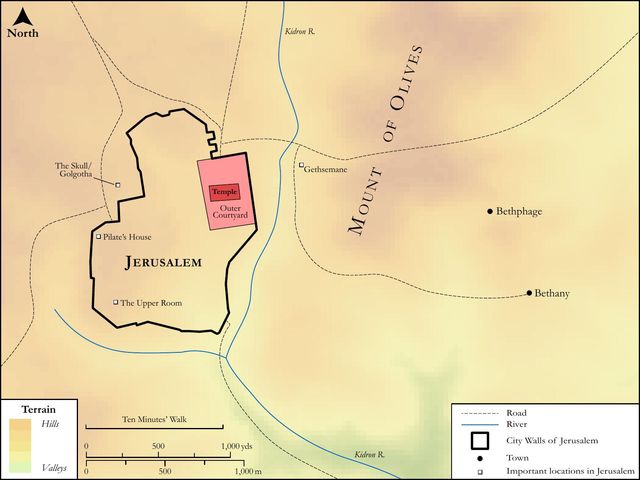
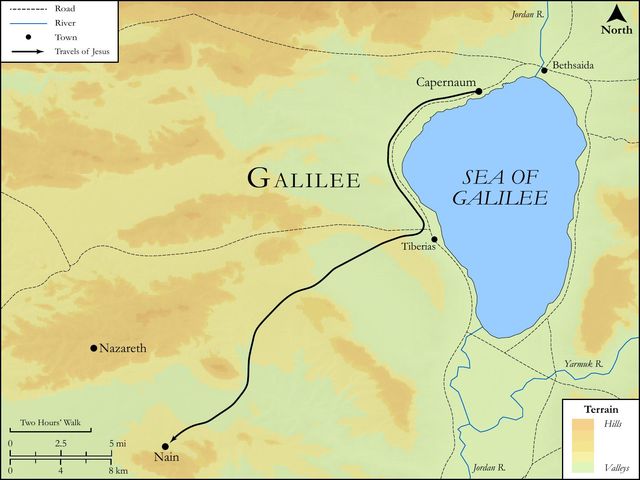
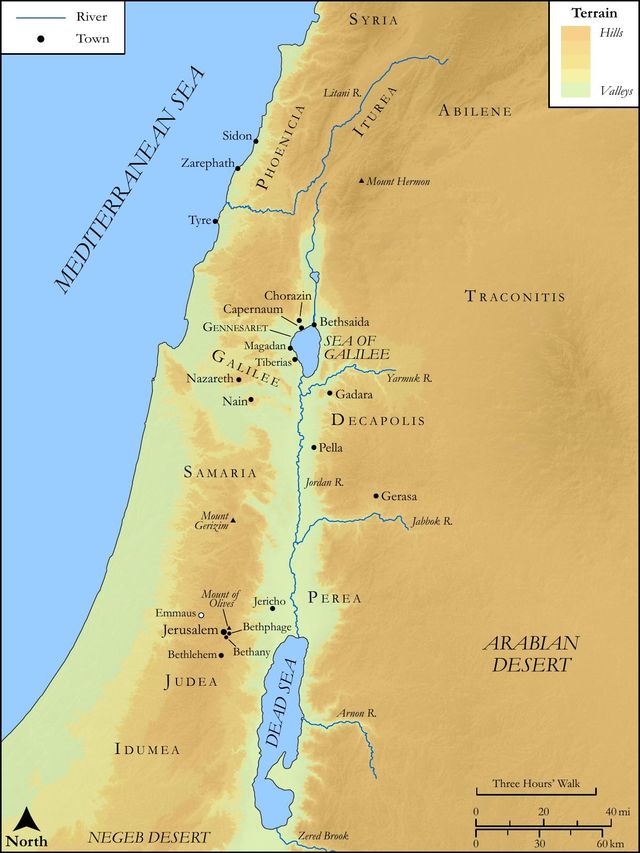
Study this verse
Public-domain commentary
Matthew Henry
From his Commentary on the Whole Bible. Henry comments on passages, not single verses — this entry covers Luke 7:11–18. His three-level outline is real structure in the source text, so it is rendered as structure.
We have here the story of Christ's raising to life a widow's son at Nain, that was dead and in the carrying out to be buried, which Matthew and Mark had made no mention of; only, in the general, Matthew had recorded it, in Christ's answer to the disciples of John, that the dead were raised up, Mat 11:5. Observe,
I.Where, and when, this miracle was wrought.
It was the next day after he had cured the centurion's servant, Luk 7:11. Christ was doing good every day, and never had cause to complain that he had lost a day. It was done at the gate of a small city, or town, called Nain, not far from Capernaum, probably the same with a city called Nais, which Jerome speaks of.
II.Who were the witnesses of it.
It is as well attested as can be, for it was done in the sight of two crowds that met in or near the gate of the city. There was a crowd of disciples and other people attending Christ (Luk 7:11), and a crowd of relations and neighbours attending the funeral of the young man, Luk 7:12. Thus there was a sufficient number to attest the truth of this miracle, which furnished greater proof of Christ's divine authority than his healing diseases; for by no power of nature, or any means, can the dead be raised.
III.How it was wrought by our Lord Jesus.
1.The person raised to life was a young man, cut off by death in the beginning of his days - a common case; man comes forth like a flower and is cut down. That he was really dead was universally agreed. There could be no collusion in the case; for Christ was entering into the town, and had not seen him till now that he met him upon the bier. He was carried out of the city; for the Jews' burying-places were without their cities, and at some distance from them. This young man was the only son of his mother, and she a widow. She depended upon him to be the staff of her old age, but he proves a broken reed; every man at his best estate is so. How numerous, how various, how very calamitous, are the afflictions of the afflicted in this world! What a vale of tears is it! What a Bochim, a place of weepers! We may well think how deep the sorrow of this poor mother was for her only son (such sorrowing is referred to as expressive of the greatest grief, - Zac 12:10), and it was the deeper in that she was a widow, broken with breach upon breach, and a full end made of her comforts. Much people of the city was with her, condoling with her loss, to comfort her.
2.Christ showed both his pity and his power in raising him to life, that he might give a specimen of both, which shine so brightly in man's redemption.
(1.)See how tender his compassions are towards the afflicted (Luk 7:13): When the Lord saw the poor widow following her son to the grave, he had compassion on her. Here was not application made to him for her, not so much as that he would speak some words of comfort to her, but, ex mero motu - purely from the goodness of his nature, he was troubled for her. The case was piteous, and he looked upon it with pity. His eye affected his heart; and he said unto her, Weep not. Note, Christ has a concern for the mourners, for the miserable, and often prevents them with the blessing of his goodness. He undertook the work of our redemption and salvation, in his love and in his pity, Isa 63:9. What a pleasing idea does this give us of the compassions of the Lord Jesus, and the multitude of his tender mercies, which may be very comfortable to us when at any time we are in sorrow! Let poor widows comfort themselves in their sorrows with this, that Christ pities them and knows their souls in adversity; and, if others despise their grief, he does not. Christ said, Weep not; and he could give her a reason for it which no one else could: "Weep not for a dead son, for he shall presently become a living one." This was a reason peculiar to her case; yet there is a reason common to all that sleep in Jesus, which is of equal force against inordinate and excessive grief for their death - that they shall rise again, shall rise in glory; and therefore we must not sorrow as those that have no hope, Th1 4:13. Let Rachel, that weeps for her children, refrain her eyes from tears, for there is hope in thine end, saith the Lord, that thy children shall come again to their own border, Jer 31:17. And let our passion at such a time be checked and claimed by the consideration of Christ's compassion.
(2.)See how triumphant his commands are over even death itself (Luk 7:14): He came, and touched the bier, or coffin, in or upon which the dead body lay; for to him it would be no pollution. Hereby he intimated to the bearers that they should not proceed; he had something to say to the dead young man. Deliver him from going down to the pit; I have found a ransom, Job 33:24. Hereupon they that bore him stood still, and probably let down the bier from their shoulders to the ground, and opened the coffin, it if was closed up; and then with solemnity, as one that had authority, and to whom belonged the issues from death, he said, Young man, I say unto thee, Arise. The young man was dead, and could not arise by any power of his own (no more can those that are spiritually dead in trespasses and sins); yet it was no absurdity at all for Christ to bid him arise, when a power went along with that word to put life into him. The gospel call to all people, to young people particularly, is, "Arise, arise from the dead, and Christ shall give you light and life." Christ's dominion over death was evidenced by the immediate effect of his word (Luk 7:15): He that was dead sat up. Have we grace from Christ? Let us show it. Another evidence of life was that he began to speak; for whenever Christ gives us spiritual life he opens the lips in prayer and praise. And, lastly, he would not oblige this young man, to whom he had given a new life, to go along with him as his disciple, to minister to him (though he owed him even his own self), much less as a trophy or show to get honour by him, but delivered him to his mother, to attend her as became a dutiful son; for Christ's miracles were miracles of mercy, and a great act of mercy this was to this widow; now she was comforted, according to the time in which she had been afflicted and much more, for she could now look upon this son as a particular favourite of Heaven, with more pleasure than if he had not died.
IV.What influence it had upon the people (Luk 7:16):
There came a fear on all; it frightened them all, to see a dead man start up alive out of his coffin in the open street, at the command of a man; they were all struck with wonder at his miracle, and glorified God. The Lord and his goodness, as well as the Lord and his greatness, are to be feared. The inference they drew from it was, "A great prophet is risen up among us, the great prophet that we have been long looking for; doubtless, he is one divinely inspired who can thus breathe life into the dead, and in him God hath visited his people, to redeem them, as was expected," Luk 1:68. This would be life from the dead indeed to all them that waited for the consolation of Israel. When dead souls are thus raised to spiritual life, by a divine power going along with the gospel, we must glorify God, and look upon it as a gracious visit to his people. The report of this miracle was carried,
1.In general, all the country over (Luk 7:17): This rumour of him, that he was the great prophet, went forth upon the wings of fame through all Judea, which lay a great way off, and throughout all Galilee, which was the region round about. Most had this notice of him, yet few believed in him, and gave up themselves to him. Many have the rumour of Christ's gospel in their ears that have not the savour and relish of it in their souls.
2.In particular, it was carefully brought to John Baptist, who was now in prison (Luk 7:18): His disciples came, and gave him an account of all things, that he might know that though he was bound yet the word of the Lord was not bound; God's work was going on, though he was laid aside.
Historical interpretation
Seven Centuries of Reception
10 surviving comments on this verse. Each one is dated, so this reads as a timeline rather than a list.
Select a marker to jump to its quote. Markers stagger vertically where authors wrote within a few decades of each other.
But some one will say of the centurion's servant, that he was not going to die. That such an one might restrain his rash tongue, the Evangelist explains that the young man whom Christ came upon was already dead, the only son of a widow. For it follows, And she was a widow, and much people of the city was. with her.
(non occ.) But the Saviour is not like to Elias mourning over the son of the widow of Sarepta, (1 Kings 17) nor as Elisha who laid his own body upon the body of the dead, (2 Kings 4) nor as Peter who prayed for Tabitha, (Acts 9:40) but is none other than He who calls those things which be not, as though they were, who can speak to the dead as to the living, (Rom. 4:17) as it follows, And he said, Young man
But straightway he arose to whom the command was made. For the Divine power is irresistible; there is no delay, no urgency of prayer, as it follows, And he that was dead sat up, and began to speak, and he gave him to his mother. These are the signs. of a true resurrection, for the lifeless body cannot speak, nor would the mother have carried back to her house her dead and lifeless son.
(Tract. de Anima et Res. Post med.) Now the proof of the resurrection we learn not so much from the words as from the works of our Saviour, who, beginning His miracles with the less wonderful, reconciled our faith to far greater. First indeed in the grievous sickness of the centurion's servant, He verged upon the power of resurrection; afterwards with a higher power he led men to the belief in a resurrection, when He raised the widow's son, who was carried out to be buried; as it is said, Now when he came nigh to the gate of the city, behold, there was a dead man carried out, the only son of his mother.
(de hom. Opif. c. 25.) He has told us the sum of misery in a few words. The mother was a widow, and had no further hope of having children, she had no one upon whom she might look in the place of him that was dead. To him alone she had given suck, he alone made her home cheerful. All that is sweet and precious to a mother, was he alone to her.
(ubi sup.) When He said, Young man, He signified that he was in the flower of his age, just ripening into manhood, who but a little while before was the sight of his mother's eyes, just entering upon the time of marriage, the scion of her race, the branch of succession, the staff of her old age.
And if it is a grave sin that you cannot wash away with the tears of your repentance, let the mother Church weep for you, who intervenes as a widowed mother for each one as if for a single son; she sympathizes with a spiritual sorrow of nature when she sees her children urged towards death by deadly vices. We are her own flesh and blood; for there are also spiritual organs, which Paul says he has, saying: So, brother, let me have joy of you in the Lord: refresh my bowels in the Lord (Philem. 20). Therefore, we are the organs of the Church; since we are the members of its body, of its flesh, and of its bones. Let the pious mother grieve, let the crowd assist: not only the crowd, but also let the good parent grieve with compassion. Now you will rise from the dead, now you will be freed from the tomb: your funeral attendants will stand, you will begin to speak the words of life, everyone will fear; for many will be corrected by the example of one. They will also praise God, who has granted us such remedies to avoid death.
For this widow surrounded by a great multitude of people seems to be more than the woman who was thought worthy by her tears to obtain the resurrection of her only son, because the Church recalls the younger people from the funeral procession to life by the contemplation of her tears, who is forbid to weep for him to whom resurrection was promised.
This dead man was borne on the bier by the four material elements to the grave, but there was a hope of his rising again because he was borne on wood, which though before it did not benefit us, yet after Christ had touched it, began to profit unto life, that it might be a sign that salvation was to be extended to the people by the wood of the cross. For we lie lifeless on the bier when either the fire of immoderate desire bursts forth, or the cold moisture breaks out, and through the sluggish state of our earthly body the vigour of our minds waxes dull.
If then thy sin is so heavy that by thy penitential tears thou canst not thyself wash it out, let the mother Church weep for thee, the multitude standing by; soon shalt thou rise from the dead and begin to speak the words of life; they all shall fear, (for by the example of one all are corrected;) they shall also praise God who has given us such great remedies for escaping death.
(Tit. Bost.) But when He bids us cease from weeping Who consoles the sorrowful, He tells us to receive consolation from those who are now dead, hoping for their resurrection. But life meeting death stops the bier, as it follows, And he came.
Christ raised him who was descending to his grave. The manner of his rising is plain to see. “He touched,” it says, “the bier and said, ‘Young man, I say unto thee, arise.’ ” How was not a word enough for raising him who was lying there? What is so difficult to it or past accomplishment? What is more powerful than the Word of God? Why then did he not work the miracle by only a word but also touched the bier? It was, my beloved, that you might learn that the holy body of Christ is productive for the salvation of man. The flesh of the almighty Word is the body of life and was clothed with his might. Consider that iron when brought into contact with fire produces the effects of fire and fulfills its functions. The flesh of Christ also has the power of giving life and annihilates the influence of death and corruption because it is the flesh of the Word, who gives life to all. May our Lord Jesus Christ also touch us that delivering us from evil works, even from fleshly lusts, he may unite us to the assemblies of the saints.
He performs the miracle not only in word, but also touches the bier, to the end that you might know that the sacred body of Christ is powerful to the saving of man. For it is the body of Life and the flesh of the Omnipotent Word, whose power it possesses. For as iron applied to fire does the work of fire, so the flesh, when it is united to the Word, which quickens all things, becomes itself also quickening, and the banisher of death.
(non occ.) But it is worthy of remark, that seven resurrections are related before our Lord's, of which the first was that of the son of the widow of Sarepta, (1 Kings 17) the second of the Shunamite's son, (2 Kings 4) the third which was caused by the remains of Elisha, (2 Kings 13) the fourth which took place at Nain, as is here related, the fifth of the ruler of the Synagogue's daughter, (Mark 5) the sixth of Lazarus, (John 11) the seventh at Christ's passion, for many bodies of the saints arose. (Mat. 27.) The eighth is that of Christ, who being free from death remained beyond for a sign that the general resurrection which is to come in the eighth age shall not be dissolved by death, but shall abide never to pass away.
Nain is a city of Galilee, within two miles of mount Tabor. But by the divine counsel there were large multitudes accompanying the Lord, that there might be many witnesses of so great a miracle. Hence it follows, And his disciples went with him, and much people.
As if He said, Cease to weep for one as dead, whom you shall soon see rise again alive.
But well does the Evangelist testify that the Lord is first moved with compassion for the mother, and then raises her son, that in the one case He might set before us for our imitation an example of piety, in the other He might build up our belief in His wonderful power. Hence it follows. And there came a fear upon all, and they glorified God, &c.
But the dead man who was carried without the gate of the city in the sight of many, signifies a man rendered senseless by the deadening power of mortal sin, and no longer concealing his soul's death within the folds of his heart, but proclaiming it to the knowledge of the world, through the evidence of words or deeds as through the gate of the city. For the gate of the city, I suppose, is some one of the bodily senses. And he is well said to be the only son of his mother, for there is one mother composed of many individuals, the Church, but every soul that remembers that it is redeemed by the death of the Lord, knows the Church to be a widow.
Or the dogma of Novatus is crushedb, who endeavouring to do away with the purifying of the penitent, denies that the mother Church, weeping for the spiritual extinction of her sons, ought to be consoled by the hope of their restoration to life.
Or the coffin on which the dead is carried is the ill at ease conscience of a desperate sinner. But they who carry him to be buried are either unclean desires, or the allurements of companions, who stood when our Lord touched the bier, because the conscience, when touched by dread of the judgment from on high, often checking its carnal lusts, and those who unjustly praise, returns to itself, and answers its Saviour's call to life.
But God has visited His people not only by the one incarnation of His Word, but by ever sending It into our hearts.
Or in another way. The centurion must be understood as one who stood foremost among many in wickedness, as long as he possesses many things in this life, i. e. is occupied with many affairs or concerns. But he has a servant, the irrational part of the soul, that is, the irascible and concupiscent part. And he speaks to Jesus, the Jews acting as mediators, that is, the thoughts and words of confession, and immediately he received his servant whole.
By the widow also you may understand a soul that has lost her husband in the divine word. Her son is the understanding, which is carried out beyond the city of the living. Its coffin is the body, which some indeed have called the tomb. But the Lord touching him raises him up, causing him to become young, and rising from sin he begins to speak and teach others. For before he would not have been believed.
Continue studying Luke 7:15 across the web’s major study libraries — every link below opens this exact verse, chapter, or book on the destination site.
Read & Compare
 BibleGatewayThis verse in more than 200 translations and 70 languages.
 Bible.comThe YouVersion reader — hundreds of translations, reading plans, and highlights.
 ESV.orgCrossway's official English Standard Version reader.
 NET BibleThe NET translation with 60,000+ translators' notes on every rendering decision.
 STEP BibleTyndale House's free study tool — original text, vocabulary, and scholarly resources.
 BibliaLogos Bible Software's free web reader.
 USCCBThe New American Bible (Revised Edition) with the U.S. bishops' study notes.
Commentaries
 BibleHub CommentariesDozens of classic commentaries on this verse, gathered on one page.
 StudyLightMore than 100 commentary sets — the largest collection on the web.
 BibleRefPlain-English commentary on what this verse means, verse by verse.
 Enduring WordDavid Guzik's free commentary on this chapter, widely used by Bible teachers.
 Bible Study ToolsVerse commentary alongside Greek and Hebrew study aids.
Original Language & Research
- BibleHub InterlinearThe verse word by word — original language, transliteration, and English.
- BibleHub LexiconEvery word's original-language definition and Strong's entry.
 Blue Letter BibleDeep-study tools — Strong's numbers, concordance, and word studies.
 CNTR CollationThe earliest Greek manuscripts of this verse, collated letter by letter.
Sermons, Hymns & Audio


TrulyRandomVerse is not affiliated with these sites and doesn’t control their content. They’re linked because they’re genuinely useful.
Summary
Luke 7:15 captures the astonishing climax of Jesus' interaction at Nain, where He encounters a funeral procession for a widow's only son. Through a simple command, Jesus brings the deceased young man back to life, who immediately sits up and speaks, demonstrating Jesus' unparalleled authority over death and His profound compassion. The verse culminates in Jesus' tender act of restoring the son to his grieving mother, signifying not only a physical resurrection but also a complete relational and social restoration.
Context
ShowHideLiterary Context
This miraculous event in Luke 7:11-17 is strategically placed in Luke's Gospel, following the healing of the Centurion's servant (Luke 7:1-10). Both narratives highlight Jesus' authority and compassion, but the raising of the dead man at Nain escalates the demonstration of His power to an unprecedented level. The immediate aftermath, described in Luke 7:16-17, shows the profound awe and fear that fell upon the crowd, who glorified God and recognized Jesus as a great prophet, confirming the significance of this sign. This miracle also serves as a powerful piece of evidence Jesus later presents to John the Baptist's disciples when they inquire about His identity (Luke 7:22).
Historical & Cultural Context
The setting is Nain, a small village in Galilee, likely chosen by Luke to emphasize Jesus' ministry reaching beyond major centers. Funerals in ancient Israel were public and deeply communal events, often involving a procession from the home to the burial site outside the city gates. The presence of a "large crowd" accompanying the widow underscores the community's shared grief. For a widow in that society, losing her "only son" was catastrophic, as it meant the loss of her primary source of support, protection, and social standing. Such a woman would be left utterly destitute and vulnerable, highlighting the profound despair Jesus encountered and the immense relief His miracle brought. The act of touching the bier, which would have rendered Jesus ritually unclean according to Mosaic Law (Numbers 19:11), further emphasizes His divine authority that transcends human ceremonial laws.
Key Themes
ShowHideLuke 7:15 powerfully illustrates several core themes within Luke's Gospel and the broader biblical narrative. Firstly, it underscores Jesus' absolute authority over death, a divine prerogative demonstrated through a simple command, not a prayer or elaborate ritual. This miracle, alongside the raising of Jairus's daughter and Lazarus, unequivocally establishes Jesus as the Lord of life. Secondly, it highlights Jesus' profound compassion for the lowly and suffering, particularly widows, a group often emphasized in Luke's Gospel as recipients of God's special care (Luke 18:1-8). His action is driven by empathy, not merely a display of power. Lastly, the event serves as compelling evidence of Jesus' Messiahship, fulfilling prophetic expectations of a time when God would intervene to bring life and restoration, affirming His unique identity as the Son of God and the promised deliverer.
Exposition and Analysis
ShowHideKey Word Analysis
ShowHideThis word, derived from a root meaning "corpse," emphasizes the absolute state of lifelessness. It signifies not merely unconsciousness or a coma, but a complete cessation of life, making the subsequent restoration all the more miraculous and undeniable. The young man was genuinely, physically deceased.
This verb, a compound of "up" (ἀνά) and "to sit" (καθίζω), describes a deliberate, active movement from a prone position to an upright, seated one. It denotes a full and conscious reanimation, not a mere twitch or reflex. This detail underscores the completeness of the miracle – the young man was not just revived, but fully restored to his faculties.
This versatile verb means "to give" or "to hand over." In this context, it conveys Jesus' intentional act of presenting the resurrected son back to his mother. It signifies a restoration of relationship and order, a return of what was lost, and a compassionate act of giving life and family back to the grieving widow.
Verse Breakdown
ShowHide"And he that was dead sat up"
This clause immediately communicates the astonishing and undeniable reality of the miracle. The subject, "he that was dead," emphasizes the prior state of absolute lifelessness, making the action of "sat up" a direct and dramatic reversal of death. It signifies a complete and instantaneous reanimation, demonstrating Jesus' supreme authority over the most ultimate human limitation.
"and began to speak"
Following the physical reanimation, this clause provides further, irrefutable proof of the young man's full restoration to consciousness and cognitive function. Speaking is a complex human act requiring brain activity, vocal cord function, and conscious thought. The phrase "began to speak" indicates a return to normal human interaction and communication, confirming that he was not merely revived but fully restored to life and personhood.
"And he delivered him to his mother"
This final clause highlights the deeply compassionate and relational aspect of Jesus' miracle. It is not just a display of power but an act of profound restoration. Jesus, the Giver of life, personally hands the son back to his grieving mother, reversing her sorrow into joy and restoring her family unit and social standing. This act completes the miracle, emphasizing the personal and redemptive purpose behind Jesus' divine intervention.
Literary Devices
ShowHideLuke 7:15 employs several powerful literary devices to underscore the significance of the event. The most prominent is Dramatic Irony, as the funeral procession, moving towards the city gates for burial, is dramatically interrupted by the Lord of Life, who reverses the expected outcome of death. This creates a profound Contrast between the hopelessness of death and the triumph of divine power. The narrative also uses Emphasis through the sequential actions: "sat up" followed by "began to speak," which builds the impact and provides irrefutable proof of the completeness of the resurrection. The final act, "delivered him to his mother," serves as a powerful Symbolism of Jesus' role as the restorer of brokenness and the Giver of life, not just physically but relationally, bringing wholeness and joy where there was despair.
Theological and Thematic Connections
ShowHideLuke 7:15 stands as a profound theological statement about Jesus' divine nature and mission. It reveals Him not merely as a prophet or healer, but as the very source of life, possessing ultimate authority over death itself. This miracle, driven by compassion for a grieving widow, underscores God's active involvement in human suffering and His desire to bring restoration and hope. It foreshadows the ultimate victory over death promised to all who believe in Christ, and serves as a powerful affirmation of the resurrection hope that is central to Christian faith. The act of returning the son to his mother also highlights the relational aspect of God's redemptive work, restoring not just individuals but families and communities.
Reflection and Application
ShowHideThe resurrection of the widow's son at Nain offers a powerful and enduring message of hope and divine intervention for believers today. In a world often marked by loss, despair, and seemingly irreversible situations, this passage reminds us that no circumstance is beyond the power of God. Just as Jesus stepped into a funeral procession, a symbol of ultimate finality, and reversed death itself, He is capable of bringing life, hope, and restoration to the most desperate areas of our lives—be it a broken relationship, a lost dream, a spiritual deadness, or overwhelming grief. This miracle calls us to trust in Christ's sovereign authority over all things, including the ultimate enemy, death. It also challenges us to cultivate a compassionate heart, mirroring Jesus' empathy for the suffering, and to be instruments of His life-giving presence in a world that desperately needs it.
Questions for Reflection
ShowHideFAQ
ShowHideWhy did Jesus choose to raise this particular young man, and not others?
ShowHideThe biblical narrative does not explicitly state why Jesus chose to raise this particular young man. However, the text emphasizes Jesus' profound "compassion" for the grieving widow, who had lost both her husband and now her only son, leaving her utterly destitute and without support in that society (Luke 7:13). This act highlights Jesus' special care for the vulnerable and overlooked, a recurring theme in Luke's Gospel. While Jesus performed many miracles, the specific instances of raising the dead (this one, Jairus's daughter in Mark 5:35-43, and Lazarus in John 11:38-44) served as powerful, undeniable signs of His divine authority over life and death, confirming His identity as the Messiah to those who witnessed them and to future generations.
Christ-Centered Fulfillment
ShowHideThe resurrection of the widow's son at Nain is a profound Christ-centered fulfillment, serving as a powerful foreshadowing and demonstration of Jesus' ultimate victory over death and His role as the Life-Giver. While this young man was restored to mortal life, only to die again, Jesus' act points forward to His own glorious resurrection from the dead (Luke 24:1-7), which guarantees the future resurrection and eternal life for all who believe in Him. Jesus is not merely one who can raise the dead; He is "the resurrection and the life" (John 11:25). His compassionate intervention at Nain reveals Him as the One who would ultimately conquer sin and death on the cross, disarming the powers of darkness (Colossians 2:15), and offering the promise of a new, imperishable body to His followers (1 Corinthians 15:53-57). Thus, Luke 7:15 is a microcosm of the gospel message: Jesus, out of divine love, enters into humanity's deepest despair (death), speaks a word of life, and restores what was lost, ultimately culminating in His redemptive work that offers eternal life and reconciliation with God for all who put their faith in Him (Romans 6:23).