


1 Kings 17:24
Bible text: King James Version (1769 Blayney text) · Public domain
Bible text: Berean Standard Bible · Public domain
Bible text: American Standard Version (1901) · Public domain
Bible text: World English Bible, Messianic edition · Public domain
Bible text: Geneva Bible (1599) · Public domain
Bible text: Young's Literal Translation · Public domain
- וַתֹּאמֶרva·To·merand she saidH559Conj-w ¦ V-Qal-ConsecImperf-3fsVerb Qal Consecutive Imperfect 3rd Singular Feminineוַandתֹּאמֶרshe said
- הָאִשָּׁהha·'i·Shahthe womanH802Art ¦ N-fsNoun Singular Feminine Absoluteהָtheאִשָּׁהwoman
- אֶל'eltoH413PrepPreposition
- אֵלִיָּהוּ'e·li·Ya·huElijahH452N-proper-mNoun Proper Masculine
- עַתָּה'a·TahnowH6258AdvAdverb
- זֶהzehthisH2088PrtParticle Demonstrative
- יָדַעְתִּיya·Da'·tiI knowH3045V-Qal-Perf-1csVerb Qal Perfect 1st Singular common gender
- כִּיkithatH3588PrtParticle Conditional
- אִישׁ'ish[are] a man ofH376N-mscNoun Singular Masculine Construct
- אֱלֹהִים'E·lo·HimGodH430N-mpNoun Plural Masculine Absolute
- אָתָּה'A·tahyouH859Pro-2msPronoun Personal 2nd Singular Masculine
- וּדְבַרu·de·varand [the] word ofH1697Conj-w ¦ N-mscNoun Singular Masculine Constructוּandדְבַר[the] word of
- יְהוָהYah·wehYahwehH3068N-properNoun Proper Title
- בְּפִיךָbe·Fi·khain your mouthH6310Prep-b ¦ N-msc ¦ 2msNoun Singular Masculine Constructבְּinפִיmouthךָyour
- אֱמֶת'e·Met[is] truthH571N-fsNoun Singular Feminine Absolute
English is a literal word-by-word gloss of the Hebrew, not the KJV's wording. Why?
This is the original text the KJV's translators worked from — each Hebrew word with its own literal English meaning in this verse, prepared by scholars at Tyndale House, Cambridge. The KJV translates whole sentences, not word by word, so its wording differs: one Hebrew word can become several English words, and the KJV may choose “the LORD” where the gloss reads “Yahweh”. Both are faithful — they answer different questions. For the KJV's own rendering, switch to the KJV text.
Details
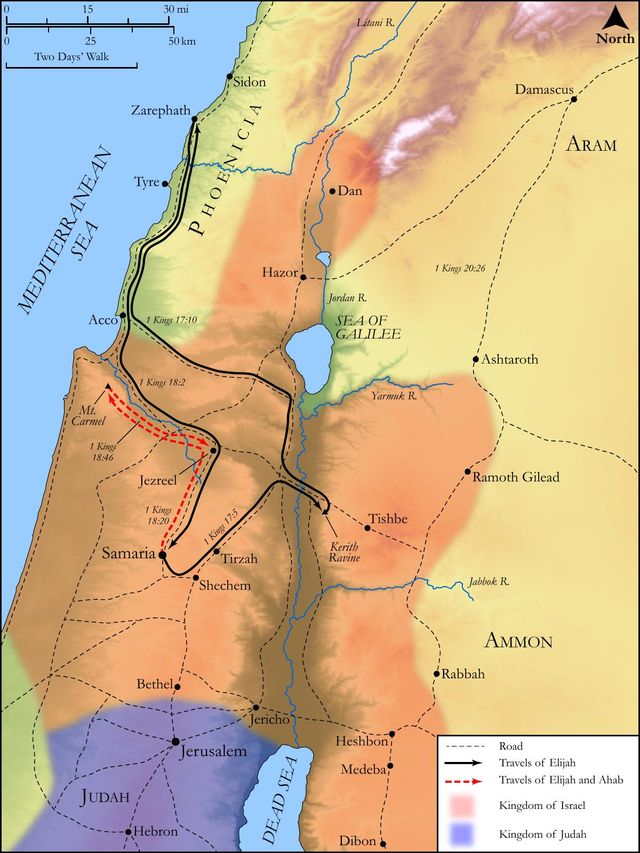
See on the biblical-era maps

Study this verse
Public-domain commentary
Matthew Henry
From his Commentary on the Whole Bible. Henry comments on passages, not single verses — this entry covers 1 Kings 17:17–24. His two-level outline is real structure in the source text, so it is rendered as structure.
We have here a further recompence made to the widow for her kindness to the prophet; as if it were a small thing to be kept alive, her son, when dead, is restored to life, and so restored to her. Observe,
I.The sickness and death of the child.
For aught that appears he was her only son, the comfort of her widowed estate. He was fed miraculously, and yet that did not secure him from sickness and death. Your fathers did eat manna, and are dead, but there is bread of which a man may eat and not die, which was given for the life of the world, Joh 6:49, Joh 6:50. The affliction was to this widow as a thorn in the flesh, lest she should be lifted up above measure with the favours that were done her and the honours that were put upon her.
1.She was nurse to a great prophet, was employed to sustain him, and had strong reason to think the Lord would do her good; yet now she loses her child. Note, We must not think it strange if we meet with very sharp afflictions, even when we are in the way of duty, and of eminent service to God.
2.She was herself nursed by miracle, and kept a good house without charge or care, by a distinguishing blessing from heaven; and in the midst of all this satisfaction she was thus afflicted. Note, When we have the clearest manifestations of God's favour and good-will towards us, even then we must prepare for the rebukes of Providence. Our mountain never stands so strong but it may be moved, and therefore, in this world, we must always rejoice with trembling.
II.Her pathetic complaint to the prophet of this affliction.
It should seem, the child died suddenly, else she would have applied to Elijah, while he was sick, for the cure of him; but being dead, dead in her bosom, she expostulates with the prophet upon it, rather to give vent to her sorrow than in any hope of relief, Kg1 17:18. 1. She expresses herself passionately: What have I to do with thee, O thou man of God? How calmly had she spoken of her own and her child's death when she expected to die for want (Kg1 17:12) - that we may eat, and die! Yet now that her child dies, and not so miserably as by famine, she is extremely disturbed at it. We may speak lightly of an affliction at a distance, but when it toucheth us we are troubled, Job 4:5. Then she spoke deliberately, now in haste; the death of her child was now a surprise to her, and it is hard to keep our spirits composed when troubles come upon us suddenly and unexpectedly, and in the midst of our peace and prosperity. She calls him a man of God, and yet quarrels with him as if he had occasioned the death of her child, and is ready to which she had never seen him, forgetting past mercies and miracles: "What have I done against thee?" (so some understand it), "Wherein have I offended thee, or been wanting in my duty? Show me wherefore thou contendest with me." 2. Yet she expresses herself penitently: "Hast thou come to call my sin to thy remembrance, as the cause of the affliction, and so to call it to my remembrance, as the effect of the affliction?" Perhaps she knew of Elijah's intercession against Israel, and, being conscious to herself of sin, perhaps her former worshipping of Baal the god of the Sidonians, she apprehends he had made intercession against her. Note, (1.) When God removes our comforts from use he remembers our sins against us, perhaps the iniquities of our youth, though long since past, Job 13:26. Our sins are the death of our children. (2.) When God thus remembers our sins against us he designs thereby to make us remember them against ourselves and repent of them.
III.The prophet's address to God upon this occasion.
He gave no answer to her expostulation, but brought it to God, and laid the case before him, not knowing what to say to it himself. He took the dead child from the mother's bosom to his own bed, Kg1 17:19. Probably he had taken a particular kindness to the child, and found the affliction his own more than by sympathy. He retired to his chamber, and, 1. He humbly reasons with God concerning the death of the child, Kg1 17:20. He sees death striking by commission from God: Thou hast brought this evil for is there any evil of this kind in the city, in the family, and the Lord has not done it? He pleads the greatness of the affliction to the poor mother: "It is evil upon the widow; thou art the widow's God, and dost not usually bring evil upon widows; it is affliction added to the afflicted." He pleads his own concern: "It is the widow with whom I sojourn; wilt thou, that art my God, bring evil upon one of the best of my benefactors? I shall be reflected upon, and others will be afraid of entertaining me, if I bring death into the house where I come." 2. He earnestly begs of God to restore the child to life again, Kg1 17:21. We do not read before this of any that were raised to life; yet Elijah, by a divine impulse, prays for the resurrection of this child, which yet will not warrant us to do the like. David expected not, by fasting and prayer, to bring his child back to life (Sa2 12:23), but Elijah had a power to work miracles, which David had not. He stretched himself upon the child, to affect himself with the case and to show how much he was affected with it and how desirous he was of the restoration of the child - he would if he could put life into him by his own breath and warmth; also to give a sign of what God would do by his power, and what he does by his grace, in raising dead souls to a spiritual life; the Holy Ghost comes upon them, overshadows them, and puts life into them. He is very particular in his prayer: I pray thee let this child's soul come into him again, which plainly supposes the existence of the soul in a state of separation from the body, and consequently its immortality, which Grotius thinks God designed by this miracle to give intimation and evidence of, for the encouragement of his suffering people.
IV.The resurrection of the child, and the great satisfaction it gave to the mother:
the child revived, Kg1 17:22. See the power of prayer and the power of him that hears prayer, who kills and makes alive. Elijah brought him to his mother, who, we may suppose, could scarcely believe her own eyes, and therefore Elijah assures her it is her own: "It is thy son that liveth; see it is thy own, and not another," Kg1 17:23. The good woman hereupon cries out, Now I know that thou art a man of God; though she knew it before, by the increase of her meal, yet the death of her child she took so unkindly that she began to question it (a good man surely would not serve her so); but now she was abundantly satisfied that he had both the power and goodness of a man of God, and will never doubt of it again, but give up herself to the direction of his word and the worship of the God of Israel. Thus the death of the child (like that of Lazarus, Joh 11:4) was for the glory of God and the honour of his prophet.
Continue studying 1 Kings 17:24 across the web’s major study libraries — every link below opens this exact verse, chapter, or book on the destination site.
Read & Compare
 BibleGatewayThis verse in more than 200 translations and 70 languages.
 Bible.comThe YouVersion reader — hundreds of translations, reading plans, and highlights.
 ESV.orgCrossway's official English Standard Version reader.
 NET BibleThe NET translation with 60,000+ translators' notes on every rendering decision.
 STEP BibleTyndale House's free study tool — original text, vocabulary, and scholarly resources.
 BibliaLogos Bible Software's free web reader.
 USCCBThe New American Bible (Revised Edition) with the U.S. bishops' study notes.
Commentaries
 BibleHub CommentariesDozens of classic commentaries on this verse, gathered on one page.
 StudyLightMore than 100 commentary sets — the largest collection on the web.
 BibleRefPlain-English commentary on what this verse means, verse by verse.
 Enduring WordDavid Guzik's free commentary on this chapter, widely used by Bible teachers.
 Bible Study ToolsVerse commentary alongside Greek and Hebrew study aids.
Original Language & Research
- BibleHub InterlinearThe verse word by word — original language, transliteration, and English.
- BibleHub LexiconEvery word's original-language definition and Strong's entry.
 Blue Letter BibleDeep-study tools — Strong's numbers, concordance, and word studies.
 SefariaThe Hebrew text with Rashi and centuries of Jewish commentary.
Sermons, Hymns & Audio


TrulyRandomVerse is not affiliated with these sites and doesn’t control their content. They’re linked because they’re genuinely useful.
Summary
1 Kings 17:24 presents the climactic declaration of faith from the widow of Zarephath, confirming Elijah's divine commission and the absolute truthfulness of God's word spoken through him. Following the miraculous resurrection of her son, this verse encapsulates her profound realization that Elijah is truly a messenger of the Most High God, whose words are not merely human pronouncements but the infallible revelation of the Lord Himself, demonstrating His sovereign power over life and death.
Context
ShowHideLiterary Context
This verse serves as the powerful and definitive conclusion to a significant narrative segment within 1 Kings 17, which details Elijah's initial ministry during a severe famine in Israel. The chapter begins with Elijah's bold declaration of drought to King Ahab (1 Kings 17:1), followed by God's miraculous provision for Elijah at the Wadi Cherith (1 Kings 17:2-6). Subsequently, God directs Elijah to Zarephath, a Sidonian town, where he is sustained by a destitute widow through the miraculous, unfailing provision of flour and oil (1 Kings 17:8-16). The immediate preceding verses recount the most dramatic event: the death of the widow's son and his subsequent resurrection through Elijah's fervent prayer and God's intervention (1 Kings 17:17-23). Her declaration in verse 24 is the direct, emotional, and theological response to this ultimate display of Yahweh's life-giving power, serving to validate Elijah's prophetic authority and the absolute truth of his message.
Historical & Cultural Context
The narrative unfolds during the tumultuous reign of King Ahab and Queen Jezebel in the Northern Kingdom of Israel, a period characterized by intense syncretism and the aggressive promotion of Baal worship. Jezebel, a Sidonian princess, actively championed Baal, leading to a profound spiritual crisis in Israel. Elijah, as Yahweh's prophet, stood as the primary antagonist to this idolatry, asserting Yahweh's exclusive sovereignty, notably through the declaration of the drought. Zarephath, located in Sidonian territory (modern-day Lebanon), was outside the traditional boundaries of Israel. God's choice to send Elijah to a Gentile widow in a land steeped in Baal worship highlights His sovereign reach beyond the covenant nation and His compassion for all who would respond in faith, demonstrating that His power is not confined to Israel. The title "man of God" was a recognized and revered designation for prophets and divine messengers, whose words were expected to carry the authority and truth of the deity they represented. Resurrection, while rare in the Old Testament, was understood as the ultimate demonstration of divine power over death, a realm often associated with Baal in Canaanite mythology, thus Yahweh's act definitively challenged Baal's supposed dominion.
Key Themes
ShowHideThis verse powerfully contributes to several overarching themes in 1 Kings and the broader Deuteronomistic History. It underscores the sovereignty and power of Yahweh over life, death, and even the natural elements (through the drought, miraculous provision, and resurrection), directly challenging the impotence of Baal. It highlights the divine validation of true prophecy, demonstrating that Elijah is indeed a genuine "man of God" whose words are directly from Yahweh, in stark contrast to the false prophets of Baal who would later be exposed on Mount Carmel (1 Kings 18). The narrative also explores the theme of faith and obedience, as the widow's initial act of hospitality and trust in God's provision for food (1 Kings 17:15) is now deepened and confirmed by an undeniable miracle. Her declaration signifies a profound shift from a nascent, perhaps uncertain, belief to a firm, experiential conviction in the truth of God's word, echoing principles found in passages like Isaiah 55:11 where God's word is guaranteed to achieve its divine purpose.
Exposition and Analysis
ShowHideKey Word Analysis
ShowHideThis primitive root signifies more than mere intellectual acquaintance; it implies a deep, experiential, and often relational understanding. The Strong's definition highlights "to ascertain by seeing," "comprehend," "discern," and "be aware." For the widow, her "knowing" is not based on hearsay or abstract theology but on the undeniable, tangible evidence of her son's resurrection. This event moved her from a state of general belief or pragmatic trust to a profound, certain conviction rooted in direct observation of God's power.
This significant title, combining ʾîš (man, individual) and ʾĕlōhîym (God, gods, supreme God), describes a person specially chosen, set apart, and empowered by God to serve as His representative and mouthpiece. It denotes one whose life and message are entirely consecrated to and derived from Yahweh. The widow's recognition of Elijah as an "ʾîš ʾĕlōhîym" indicates her understanding that he is a legitimate, divinely authorized prophet of Yahweh, distinct from human religious figures or charlatans, and that his words carry divine weight.
Contracted from a root meaning "to be firm," this word conveys concepts of firmness, reliability, faithfulness, certainty, and reality. When applied to God's word, it means that what God says is absolutely dependable, corresponds perfectly to reality, and will unfailingly come to pass. The widow's declaration that "the word of the LORD in thy mouth is truth" means she now perceives Elijah's pronouncements not as mere human utterances, but as the utterly trustworthy, factual, and effective revelation of God Himself, proven by the resurrection of her son.
Verse Breakdown
ShowHide"And the woman said to Elijah"
This clause introduces the widow's direct, personal, and profoundly significant response to the miracle she has just witnessed. Her previous interactions with Elijah, while demonstrating a measure of faith (e.g., providing him food), were often marked by distress, questioning, or a plea for intervention. Here, her words carry the weight of certainty, conviction, and a newfound spiritual clarity.
"Now by this I know"
This phrase emphasizes a new, undeniable, and experiential understanding. The adverb "Now" (Hebrew: zeh, H2088) points to the immediate, present moment and the specific event that has just transpired—the resurrection of her son. Her knowledge is no longer based on mere reports, initial trust, or the ongoing miracle of provision, but on a direct, irrefutable, and deeply personal demonstration of divine power that transcends human capability.
"that thou art a man of God"
This is her explicit acknowledgment of Elijah's authentic prophetic identity. The resurrection of her son served as the ultimate, tangible proof, validating his claim and confirming his divine commission in her eyes. She recognizes that his power and authority are not his own, but are derived directly from Yahweh, making him a true messenger of the Most High.
"and that the word of the LORD in thy mouth is truth"
This is the ultimate theological declaration and the climax of her confession. It's not just Elijah's person that is validated, but the very message he speaks. The resurrection proves that God's word, as delivered by Elijah, is absolutely reliable, faithful, and effective, even to the point of reversing death. It underscores the power, veracity, and efficacy of divine revelation, demonstrating that when Yahweh speaks through His chosen prophet, His word is not empty but brings about what it declares.
Literary Devices
ShowHideThe verse employs several powerful literary devices. There is Dramatic Irony in that the reader, having witnessed Elijah's earlier miracles and divine commission, already knows he is a "man of God," but the widow's declaration marks her realization of this truth, creating a powerful moment of recognition and affirmation. The Repetition of "man of God" and "word of the LORD" throughout Elijah's narratives emphasizes his unique role and the divine source of his authority. The entire narrative leading up to this verse functions as a Theophany (a manifestation of God), albeit an indirect one through Elijah's Spirit-empowered actions and the miraculous outcome, culminating in the widow's verbal affirmation of God's presence and power. The resurrection itself is a profound Symbol of God's life-giving power and His ultimate victory over death, directly confirming the truth and efficacy of His spoken word.
Theological and Thematic Connections
ShowHideThis pivotal declaration by the widow of Zarephath resonates deeply with the broader biblical understanding of divine revelation and the nature of God's word. It establishes a crucial principle: true prophets are validated not by human charisma or eloquence, but by the fulfillment of their words and the accompanying demonstrations of God's power. This act of resurrection, a unique and powerful miracle, serves as irrefutable proof that Yahweh is the living God, active in human affairs, and that His word, spoken through His chosen messenger, is absolute truth. This truth is not merely intellectual information but carries transformative, life-giving power, capable of reversing even death. The widow's faith moves from a pragmatic trust in provision to a profound, experiential conviction in the very character and reliability of God as revealed through His prophet, underscoring that God's word is not only true but effective.
Reflection and Application
ShowHideThe widow's declaration in 1 Kings 17:24 offers a profound model for our own journey of faith and our understanding of divine truth. Her "now by this I know" speaks to the transformative power of encountering God's truth in a tangible, undeniable way. While we may not witness resurrections in our daily lives, God's word, the Bible, consistently proves itself true through its historical accuracy, fulfilled prophecy, its internal consistency, and, most importantly, its transformative power in the lives of individuals who embrace it. This verse calls us to move beyond a superficial or merely intellectual understanding of God to an experiential knowledge of His faithfulness and the absolute reliability of His promises. It encourages us to trust that when God speaks, whether through the inspired Scriptures or through the Holy Spirit's guidance, His word is truth and will accomplish its purpose. In moments of doubt, or when facing seemingly impossible circumstances, we are reminded that the God who raised the widow's son is the same God who holds all power and whose word is eternally true and effective. Our faith is not in a human messenger, but in the God who speaks through His infallible word.
Questions for Reflection
ShowHideFAQ
ShowHideWhat does it mean for Elijah to be a "man of God"?
ShowHideThe title "man of God" (Hebrew: ʾîš ʾĕlōhîm) is a distinguished designation in the Old Testament, indicating someone who is specifically chosen, appointed, and empowered by Yahweh to serve as His representative and mouthpiece. It signifies a person in a special covenant relationship with God, whose life and message are consecrated to divine purposes. Such individuals often performed miracles, delivered prophetic messages, and acted as intermediaries between God and His people, conveying His will and power. In Elijah's case, it highlights his unique authority and the divine origin of his words and actions, distinguishing him from ordinary individuals or false prophets, and confirming that his message was not his own but truly "the word of the LORD." This title underscores the divine authority behind his pronouncements and miraculous deeds throughout 1 Kings.
Christ-Centered Fulfillment
ShowHideThe dramatic resurrection of the widow's son and her subsequent declaration in 1 Kings 17:24 foreshadows the ultimate "Man of God," Jesus Christ, and the supreme truth of His word. While Elijah, as a prophet, raised one boy from death, Jesus repeatedly demonstrated His inherent authority over death, not only raising others like Lazarus (John 11:43-44) and Jairus's daughter (Mark 5:41-42), but ultimately conquering death Himself through His own glorious resurrection (Romans 6:9). The widow's confession, "the word of the LORD in thy mouth is truth," finds its fullest and most perfect realization in Jesus, who is not merely a messenger of truth but the embodiment of truth itself (John 14:6). His words are "spirit and life" (John 6:63), possessing inherent power to impart eternal life and bring spiritual resurrection to those who believe (John 5:24). Thus, the temporary restoration of life in Zarephath points profoundly to the eternal life and spiritual transformation offered through the word and redemptive work of Christ, the true and final "Man of God," whose every word is truth and life.