


1 Kings 17:1
Bible text: King James Version (1769 Blayney text) · Public domain
Bible text: King James Version with Strong's numbers · Public domain
Bible text: Berean Standard Bible · Public domain
Bible text: American Standard Version (1901) · Public domain
Bible text: World English Bible, Messianic edition · Public domain
Bible text: Geneva Bible (1599) · Public domain
Bible text: Young's Literal Translation · Public domain
- וַיֹּאמֶרvai·yo·Merand he saidH559Conj-w ¦ V-Qal-ConsecImperf-3msVerb Qal Consecutive Imperfect 3rd Singular Masculineוַandיֹּאמֶרhe said
- אֵלִיָּהוּ'e·li·Ya·huElijahH452N-proper-mNoun Proper Masculine
- הַתִּשְׁבִּיha·tish·Bithe TishbiteH8664Art ¦ N-msNoun Gentilic Singular Masculine AbsoluteהַtheתִּשְׁבִּיTishbite
- מִתֹּשָׁבֵיmi·to·sha·Veione of [the] resident aliens ofH8453Prep-m ¦ N-mpcNoun Plural Masculine Constructמִone ofתֹּשָׁבֵי[the] resident aliens of
- גִלְעָדgil·'AdGileadH1568N-properNoun Proper Location
- אֶל'eltoH413PrepPreposition
- אַחְאָב'ach·'AvAhabH256N-proper-mNoun Proper Masculine
- חַיchai[by] [the] lifeH2416Adj-msAdjective Singular Masculine Absolute
- יְהוָהYah·wehof YahwehH3068N-properNoun Proper Title
- אֱלֹהֵי'e·lo·Hei[the] God ofH430N-mpcNoun Plural Masculine Construct
- יִשְׂרָאֵלYis·ra·'ElIsraelH3478N-properNoun Proper Location
- אֲשֶׁר'a·SherwhomH834RelParticle Relative
- עָמַדְתִּי'a·Mad·tiI standH5975V-Qal-Perf-1csVerb Qal Perfect 1st Singular common gender
- לְפָנָיוle·fa·Nav<to> before himH6440Prep-l ¦ N-mpc ¦ 3msNoun Plural Masculine Constructלְ<to>פָנָיbeforeוhim
- אִם'imifH518PrtParticle Conditional
- יִהְיֶהyih·Yehit will beH1961V-Qal-Imperf-3msVerb Qal Imperfect 3rd Singular Masculine
- הַשָּׁנִיםha·sha·Nimthe yearsH8141Art ¦ N-mpNoun Plural Masculine Absoluteהַtheשָּׁנִיםyears
- הָאֵלֶּהha·'E·leh<the> theseH428Art ¦ PrtParticle Demonstrativeהָ<the>אֵלֶּהthese
- טַלtaldewH2919N-msNoun Singular Masculine Absolute
- וּמָטָרu·ma·Tarand rainH4306Conj-w ¦ N-msNoun Singular Masculine Absoluteוּandמָטָרrain
- כִּיkithatH3588PrtParticle Conditional
- אִם'imexceptH518PrtParticle Conditional
- לְפִיle·Fito [the] mouth ofH6310Prep-l ¦ N-mscNoun Singular Masculine Constructלְtoפִי[the] mouth of
- דְבָרִיde·va·Rimy wordH1697N-msc ¦ 1csNoun Singular Masculine Constructדְבָרִwordיmy
English is a literal word-by-word gloss of the Hebrew, not the KJV's wording. Why?
This is the original text the KJV's translators worked from — each Hebrew word with its own literal English meaning in this verse, prepared by scholars at Tyndale House, Cambridge. The KJV translates whole sentences, not word by word, so its wording differs: one Hebrew word can become several English words, and the KJV may choose “the LORD” where the gloss reads “Yahweh”. Both are faithful — they answer different questions. For the KJV's own rendering, switch to the KJV text.
Details
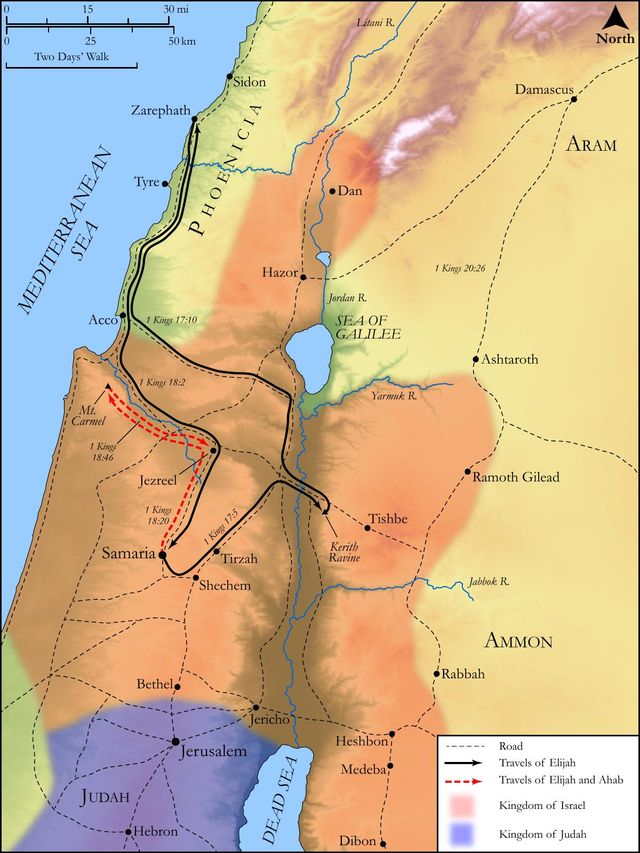
See on the biblical-era maps

Study this verse
Public-domain commentary
Matthew Henry
From his Commentary on the Whole Bible. Henry comments on passages, not single verses — this entry covers 1 Kings 17:1–7. His four-level outline is real structure in the source text, so it is rendered as structure.
The history of Elijah begins somewhat abruptly. Usually, when a prophet enters, we have some account of his parentage, are told whose son he was and of what tribe; but Elijah drops (so to speak) out of the clouds, as if, like Melchisedek, he were without father, without mother, and without descent, which made some of the Jews fancy that he was an angel sent from heaven; but the apostle has assured us that he was a man subject to like passions as we are (Jam 5:17), which perhaps intimates, not only that he was liable to the common infirmities of human nature, but that, by his natural temper, he was a man of strong passions, more hot and eager than most men, and therefore the more fit to deal with the daring sinners of the age he lived in: so wonderfully does God suit men to the work he designs them for. Rough spirits are called to rough services. The reformation needed such a man as Luther to break the ice. Observe, 1. The prophet's name: Elijahu - "My God Jehovah is he" (so it signifies), "is he who sends me and will own me and bear me out, is he to whom I would bring Israel back and who alone can effect that great work." 2. His country: He was of the inhabitants of Gilead, on the other side Jordan, either of the tribe of Gad or the half of Manasseh, for Gilead was divided between them; but whether a native of either of those tribes is uncertain. The obscurity of his parentage was no prejudice to his eminency afterwards. We need not enquire whence men are, but what they are: if it be a good thing, no matter though it come out of Nazareth. Israel was sorely wounded when God sent them this balm from Gilead and this physician thence. He is called a Tishbite from Thisbe, a town in that country. Two things we have an account of here in the beginning of his story: -
I.How he foretold a famine, a long and grievous famine, with which Israel should be punished for their sins.
That fruitful land, for want of rain, should be turned into barrenness, for the iniquity of those that dwelt therein. He went and told Ahab this; did not whisper it to the people, to make them disaffected to the government, but proclaimed it to the king, in whose power it was to reform the land, and so to prevent the judgment. It is probable that he reproved Ahab for his idolatry and other wickedness, and told him that unless he repented and reformed this judgment would be brought upon his land. There should be neither dew nor rain for some years, none but according to my word, that is, "Expect none till you hear from me again." The apostle teaches us to understand this, not only of the word of prophecy, but the word of prayer, which turned the key of the clouds, Jam 5:17, Jam 5:18. He prayed earnestly (in a holy indignation at Israel's apostasy, and a holy zeal for the glory of God, whose judgments were defied) that it might not rain; and, according to his prayers, the heavens became as brass, till he prayed again that it might rain. In allusion to this story it is said of God's witnesses (Rev 11:6), These have power to shut heaven, that it rain not in the days of their prophecy. Elijah lets Ahab know,
1.That the Lord Jehovah is the God of Israel, whom he had forsaken.
2.That he is a living God, and not like the gods he worshipped, which were dead dumb idols.
3.That he himself was God's servant in office, and a messenger sent from him: "It is he before whom I stand, to minister to him," or "whom IO now represent, in whose stead I stand, and in whose name I speak, in defiance of the prophets of Baal and the groves." 4. That, notwithstanding the present peace and prosperity of the kingdom of Israel, God was displeased with them for their idolatry and would chastise them for it by the want of rain (which, when he withheld it, it was not in the power of the gods they served to bestow; for are there any of the vanities of the heathen that can give rain? Jer 14:22), which would effectually prove their impotency, and the folly of those who left the living God, to make their court to such as could do neither good nor evil; and this he confirms with a solemn oath - As the Lord God of Israel liveth, that Ahab might stand the more in awe of the threatening, the divine life being engaged for the accomplishment of it. 5. He lets Ahab know what interest he had in heaven: It shall be according to my word. With what dignity does he speak when he speaks in God's name, as one who well understood that commission of a prophet (Jer 1:10), I have set thee over the nations and over the kingdoms. See the power of prayer and the truth of God's word; for he performeth the counsel of his messengers.
II.How he was himself taken care of in that famine.
1.How he was hidden. God bade him go and hide himself by the brook Cherith, Kg1 17:3. This was intended, not so much for his preservation, for it does not appear that Ahab immediately sought his life, but as a judgment to the people, to whom, if he had publicly appeared, he might have been a blessing both by his instructions and his intercession, and so have shortened the days of their calamity; but God had determined it should last three years and a half, and therefore, so long, appointed Elijah to abscond, that he might not be solicited to revoke the sentence, the execution of which he had said should be according to his word. When God speaks concerning a nation, to pluck up and destroy, he finds some way or other to remove those that would stand in the gap to turn away his wrath. It bodes ill to a people when good men and good ministers are ordered to hide themselves. When God intended to send rain upon the earth then he bade Elijah go and show himself to Ahab, Kg1 18:1. For the present, in obedience to the divine command, he went and dwelt all alone in some obscure unfrequented place, where he was not discovered, probably among the reeds of the brook. If Providence calls us to solitude and retirement, it becomes us to acquiesce; when we cannot be useful we must be patient, and when we cannot work for God we must sit still quietly for him.
2.How he was fed. Though he could not work there, having nothing to do but to meditate and pray (which would help to prepare him for his usefulness afterwards), yet he shall eat, for he is in the way of his duty, and verily he shall be fed, in the day of famine he shall be satisfied. When the woman, the church, is driven into the wilderness, care it taken that she be fed and nourished there, time, times, and half a time, that is, three years and a half, which was just the time of Elijah's concealment. See Rev 12:6, Rev 12:14. Elijah must drink of the brook, and the ravens were appointed to bring him meat (Kg1 17:4) and did so, Kg1 17:6. Here,
(1.)The provision was plentiful, and good, and constant, bread and flesh twice a day, daily bread and food convenient. We may suppose that he fared not so sumptuously as the prophets of the groves, who did eat at Jezebel's table (Kg1 18:19), and yet better than the rest of the Lord's prophets, whom Obadiah fed with bread and water, Kg1 18:4. It ill becomes God's servants, especially his servants the prophets, to be nice and curious about their food and to affect dainties and varieties; if nature be sustained, no matter though the palate be not pleased; instead of envying those who have daintier fare, we should think how many there are, better than we, who live comfortably upon coarser fare and would be glad of our leavings. Elijah had but one meal brought him at a time, every morning and every evening, to teach him not to take thought for the morrow. Let those who have but from hand to mouth learn to live upon Providence, and trust it for the bread of the day in the day; thank God for bread this day, and let tomorrow bring bread with it.
(2.)The caterers were very unlikely; the ravens brought it to him. Obadiah, and others in Israel that had not bowed the knee to Baal, would gladly have entertained Elijah; but he was a man by himself, and must be red in an extraordinary way. He was a figure of John the baptist, whose meat was locusts and wild honey. God could have sent angels to minister to him, as he did afterwards (Oba 1:19 :5) and as he did to our Saviour (Mat 4:11), but he chose to send by winged messengers of another nature, to show that when he pleases he can serve his own purposes by the meanest creatures as effectually as by the mightiest. If it be asked whence the ravens had this provision, how and where it was cooked, and whether they came honestly by it, we must answer, as Jacob did (Gen 27:20), The Lord our God brought it to them, whose the earth is and the fulness thereof, the world and those that dwell therein. But why ravens?
[1.]They are birds of prey, ravenous devouring creatures, more likely to have taken his meat from him, or to have picked out his eyes (Pro 30:17); but thus Samson's riddle is again unriddled, Out of the eater comes forth meat.
[2.]They are unclean creatures.Every raven after his kind was, by the law, forbidden to be eaten (Lev 11:15), yet Elijah did not think the meat they brought ever the worse for that, but ate and gave thanks, asking no question for conscience' sake. Noah's dove was to him a more faithful messenger than his raven; yet here the ravens are faithful and constant to Elijah.
[3.]Ravens feed on insects and carrion themselves, yet they brought the prophet man's meat and wholesome food. It is a pity that those who bring the bread of life to others should themselves take up with that which is not bread.
[4.]Ravens could bring but a little, and broken meat, yet Elijah was content with such things as he had, and thankful that the was fed, though not feasted.
[5.]Ravens neglect their own young ones, and do not feed them; yet when God pleases they shall feed his prophet. Young lions and young ravens may lack, and suffer hunger, but not those that fear the Lord, Psa 34:10.
[6.]Ravens are themselves fed by special providence (Job 38:41; Psa 147:9), and now they fed the prophet. Have we experienced God's special goodness to us and ours? Let us reckon ourselves obliged thereby to be kind to those that are his, for his sake. Let us learn hence, First, To acknowledge the sovereignty and power of God over all the creatures; he can make what use he pleases of them, either for judgment or mercy. Secondly, To encourage ourselves in God in the greatest straits, and never to distrust him. He that could furnish a table in the wilderness, and make ravens purveyors, cooks, and servitors to his prophet, is able to supply all our need according to his riches in glory.
Thus does Elijah, for a great while, eat his morsels alone, and his provision of water, which he has in an ordinary way from the brook, fails him before that which he has by miracle. The powers of nature are limited, but not the powers of the God of nature. Elijah's brook dried up (Kg1 17:7) because there was no rain. If the heavens fail, earth fails of course; such are all our creature-comforts; we lose them when we most need them, like the brooks in summer, Job 6:15. But there is a river which makes glad the city of God and which never runs dry (Psa 46:4), a well of water that springs up to eternal life. Lord, give us that living water!
Historical interpretation
Historical reception
3 surviving comments on this verse. Each one is dated, so this reads as a timeline rather than a list.
Select a marker to jump to its quote. Markers stagger vertically where authors wrote within a few decades of each other.
Elijah was sent to prevent Ahab’s insane rage and to show with words and actions of power and vigor the truth of the curses that the fathers had proclaimed against the transgres sors of the law of God, as they were not vain threats.… Moses wrote a large book of curses and ordered Joshua to proclaim them before the assembly of all the tribes of Israel with great clamor and loudly. He especially mentions the harsh famine and the other evils that follow it, the deprivation of the rain, the aridity and infertility of the land. Ahab despised and laughed at them, because he saw how abundant his supplies were, thanks to his father who was an impious king like him. Therefore, that arrogant king necessarily had to be punished for his arrogance.But the main reason why Elijah was sent was Jezebel, whose pride the Lord wanted to humiliate and whose falsehood he wanted to disclose. She had actually appointed herself as minister of Baal and had entrusted herself with the religious service for this god. She also proclaimed that Baal was the supreme god who ruled over those living in heaven and on earth and sent rain, watered the skies and gave fertility to the ground. She took as witnesses her fellow citizens, the Sidonians and the Tyrians and the other peoples of Phoenicia who were prosperous in those days in wealth and possessions more than any other of the neighboring nations and were also the most fervent worshipers of Baal. It was with good reason and according to justice that Elijah rose and came at that time of distress, and finally issued a stern rebuke against Ahab and his leaders and threatened to bring on them a sky of iron, as Moses had predicted, and a land of bronze.
Exactly at the time when the prophet and father of the prophets Elijah appeared, the rebellion of Ahab and his wife Jezebel had increased to such an extent that they not only trampled the law and fear of God underfoot, nor were content to promote the worship of idols, but even persecuted and killed the prophets and the saints.
Great is the virtue of fasting. Indeed, its military appearance is so beautiful that it delightfully attracts and elevates humans to heaven for fasting and for Christ: so powerful that it raises men up to heaven. And to use more human than divine examples, from the fasting mouth of Elijah a voice was uttered that closed heaven to the sacrilegious people of the Jews. For when Ahab, the king, had set up an altar to the idol, according to the words of the prophet, there was no rain for three years and six months upon the earth. A fitting punishment which would appropriately restrain intemperance; that the heavens should be closed to the impious, who have defiled the earth. It is fitting also that the prophet of the sacrilegious king should be sent to the widow in Zarephath of Sidon, who, since she preferred devotion to food, deserved not to feel the hardship of the public drought alone. Therefore, the jug of meal did not run out, even when the flow of the river failed. What does his remaining cover? He, while fasting, raised the widow's son from the dead; he, while fasting, caused rains to fall from his mouth; he, while fasting, brought forth fire from heaven; he, while fasting, was carried up to heaven in a chariot; and through a forty-day fast he obtained divine presence. Then at last he deserved more, when he fasted more. By his fasting he made the waters of the Jordan stand still, and the flowing river bed, suddenly dried up, he crossed over with a dusty footprint. By divine decree, he was deemed worthy to be taken up to heaven with his body; for he lived a heavenly life in the flesh and displayed the practice of heavenly conduct on earth.
Continue studying 1 Kings 17:1 across the web’s major study libraries — every link below opens this exact verse, chapter, or book on the destination site.
Read & Compare
 BibleGatewayThis verse in more than 200 translations and 70 languages.
 Bible.comThe YouVersion reader — hundreds of translations, reading plans, and highlights.
 ESV.orgCrossway's official English Standard Version reader.
 NET BibleThe NET translation with 60,000+ translators' notes on every rendering decision.
 STEP BibleTyndale House's free study tool — original text, vocabulary, and scholarly resources.
 BibliaLogos Bible Software's free web reader.
 USCCBThe New American Bible (Revised Edition) with the U.S. bishops' study notes.
Commentaries
 BibleHub CommentariesDozens of classic commentaries on this verse, gathered on one page.
 StudyLightMore than 100 commentary sets — the largest collection on the web.
 BibleRefPlain-English commentary on what this verse means, verse by verse.
 Enduring WordDavid Guzik's free commentary on this chapter, widely used by Bible teachers.
 Bible Study ToolsVerse commentary alongside Greek and Hebrew study aids.
Original Language & Research
- BibleHub InterlinearThe verse word by word — original language, transliteration, and English.
- BibleHub LexiconEvery word's original-language definition and Strong's entry.
 Blue Letter BibleDeep-study tools — Strong's numbers, concordance, and word studies.
 SefariaThe Hebrew text with Rashi and centuries of Jewish commentary.
Sermons, Hymns & Audio


TrulyRandomVerse is not affiliated with these sites and doesn’t control their content. They’re linked because they’re genuinely useful.
Summary
First Kings 17:1 serves as a dramatic and pivotal introduction to the prophet Elijah the Tishbite, who emerges abruptly from the region of Gilead to confront King Ahab with a profound declaration of divine judgment. This verse initiates a severe, multi-year drought, directly challenging the perceived authority of Baal, the Canaanite god of rain and fertility, and emphatically asserting the absolute sovereignty of the LORD God of Israel over all creation and human affairs. It marks the commencement of a critical period in Israel's history, demonstrating Yahweh's direct and active response to the nation's pervasive idolatry and spiritual apostasy under Ahab's reign.
Context
ShowHideLiterary Context
This verse acts as a stark and abrupt narrative pivot from the preceding account of King Ahab's egregious wickedness in 1 Kings 16. The immediate context details Ahab's unprecedented spiritual decline, marked by his marriage to Jezebel, a Phoenician princess, and his aggressive promotion of Baal worship within Israel. Specifically, 1 Kings 16:30-33 describes Ahab's construction of a temple and altar for Baal in Samaria, along with an Asherah pole, indicating a national embrace of paganism. Elijah's sudden appearance, without any prior mention or lineage, underscores his role as a divinely appointed, independent agent of God, appearing seemingly out of nowhere to confront the prevailing spiritual darkness and directly challenge the king's apostasy. This abruptness heightens the dramatic tension and emphasizes the divine origin of his message.
Historical & Cultural Context
The Northern Kingdom of Israel, under the joint influence of King Ahab and Queen Jezebel, had plunged into a deep spiritual crisis, abandoning the covenant with Yahweh for the worship of Canaanite deities. Jezebel, a zealous devotee of Baal, actively imported and aggressively promoted the cult of Baal and Asherah, gods of the Zidonians, whom Ahab served, commonly associated with fertility, rain, and agricultural prosperity. Baal was specifically revered as the storm god, believed to control the heavens, sending rain and dew essential for bountiful harvests. Therefore, Elijah's declaration of a drought was not merely a meteorological prediction but a direct, theological assault on Baal's perceived dominion and a devastating blow to the very foundation of Canaanite religious belief. For the Israelites, who were bound by the Mosaic Covenant, the drought also served as a potent reminder of the covenant curses for disobedience, particularly the withholding of rain as explicitly warned in Deuteronomy 11:16-17. The mention of Elijah's origin from Gilead, a region east of the Jordan, may subtly emphasize his outsider status, contrasting him with the corrupt and idolatrous urban centers of Samaria and Jezreel.
Key Themes
ShowHideThis pivotal verse introduces and develops several profound theological and narrative themes. Foremost is the assertion of Divine Sovereignty over Nature, powerfully demonstrating that Yahweh, and not Baal, holds absolute and exclusive control over the elements, specifically rain and dew. This directly undermines the core tenets of Baal worship and sets the stage for a dramatic theological contest. Secondly, it initiates a direct Confrontation of Idolatry, establishing the central conflict of Elijah's ministry: the spiritual battle between the living God of Israel and the lifeless, impotent idols. Elijah's prophetic act is a direct challenge to the nation's widespread apostasy. Thirdly, the verse highlights The Authority and Power of the Prophetic Word, as Elijah speaks with an authority that is clearly not his own but God's, declaring that the drought will cease "but according to my word," signifying that his words are the very words of Yahweh, empowered by divine decree. Finally, Elijah's bold stance before King Ahab, a powerful and hostile monarch, exemplifies Bold Faith and Obedience, showcasing the unwavering courage required to stand for God's truth in a corrupt and idolatrous society, echoing the faithfulness called for in the foundational command to love God with all one's being in Deuteronomy 6:4-5.
Exposition and Analysis
ShowHideKey Word Analysis
ShowHideThis word, derived from H2416, signifies the vibrant, active, and enduring reality of Yahweh, standing in stark contrast to the inert and powerless idols of Baal. It is a common and profound oath formula in the Old Testament, affirming the speaker's absolute certainty based on the very existence and vitality of God. Elijah's declaration, "As the LORD God of Israel liveth," is a direct theological proclamation, asserting that the God of Israel is not merely a concept or a regional deity, but a living, active, and responsive being who intimately intervenes in human history and holds ultimate control over creation.
The phrase "before whom I stand," derived from H5975, denotes Elijah's posture as a direct servant, minister, or representative in the divine court. It implies intimate access to God's presence and authority, much like a trusted official serving a king or a priest ministering before the altar. This expression profoundly underscores Elijah's prophetic office, indicating that he is not speaking his own words or acting on his own initiative, but rather serving as a direct emissary of the Almighty, empowered by divine commission to deliver God's authoritative message.
While the KJV translates "my word" (Hebrew, dᵊḇārî, a suffixed form of H1697), this term, dâbâr, encompasses not only spoken utterance but also a matter, thing, or decree. In the context of prophetic declaration, it signifies that Elijah's words are inextricably linked to and empowered by God's own word. The prophet serves merely as the mouthpiece; the ultimate authority, efficacy, and power reside entirely with Yahweh. The drought will not end by human will, natural processes, or the rituals of Baal worshipers, but only when God, through His prophet, declares it, highlighting the absolute dependence of the prophetic message on divine revelation and authority.
Verse Breakdown
ShowHide"And Elijah the Tishbite, [who was] of the inhabitants of Gilead"
This clause introduces the prophet with striking abruptness, emphasizing his sudden appearance and divine appointment. His origin from Tishbe, likely a town in the rugged region of Gilead east of the Jordan, suggests a background distinct from the corrupt urban centers of Israel and highlights his status as an outsider, uncompromised by the prevailing idolatry of Ahab's court. This introduction immediately establishes him as God's chosen instrument, appearing independently of human institutions or political maneuvering.
"said unto Ahab"
This concise phrase highlights the direct and courageous confrontation between God's prophet and the wicked king. Elijah does not send a messenger or deliver his decree through intermediaries but personally confronts Ahab, demonstrating remarkable boldness and unwavering commitment to his prophetic calling in the face of immense personal danger and royal hostility.
"[As] the LORD God of Israel liveth, before whom I stand"
This is a solemn and powerful prophetic oath, serving as both a declaration of Elijah's unwavering allegiance and the source of his profound authority. It emphatically affirms the living reality, active presence, and covenant faithfulness of Yahweh, the true God of Israel, in stark opposition to the lifeless and impotent idols of Baal. Elijah's posture "before whom I stand" signifies his intimate relationship with God and his role as a direct, authorized servant and messenger, acting under explicit divine commission.
"there shall not be dew nor rain these years, but according to my word"
This is the core of Elijah's prophetic declaration and the divine judgment. It directly challenges Baal, the supposed god of weather and fertility, by asserting Yahweh's absolute and exclusive control over both dew (a crucial source of moisture in arid climates) and rain. The concluding phrase, "but according to my word," powerfully emphasizes that the drought's commencement and its eventual cessation are solely dependent on God's sovereign will, communicated and enacted through Elijah, rather than on natural cycles or the desperate rituals of Baal worshipers.
Literary Devices
ShowHideThe opening of 1 Kings 17 employs several potent literary devices to establish the dramatic tone and theological stakes. There is a powerful Dramatic Introduction of Elijah, who appears suddenly and without any prior narrative context, creating an immediate sense of urgency, mystery, and divine intervention. This abruptness underscores his role as an agent of God, not of human design. The declaration itself functions as a Solemn Oath/Divine Challenge, framed by the emphatic "As the LORD God of Israel liveth, before whom I stand," which imbues Elijah's words with undeniable divine authority and sets up a direct, theological confrontation between the living Yahweh and the impotent Baal. The statement also utilizes stark Contrast, pitting the living, active, and sovereign God of Israel against the lifeless, false god Baal, whose supposed domain (rain and fertility) is directly attacked and undermined. Furthermore, the Symbolism of the drought is profound; it is not merely a natural phenomenon but a tangible manifestation of divine judgment and a spiritual test. The withholding of rain symbolizes the spiritual barrenness and desolation brought about by Israel's apostasy, serving as a severe call to repentance and a powerful demonstration of God's absolute power over creation.
Theological and Thematic Connections
ShowHideFirst Kings 17:1 is a foundational text for understanding God's active sovereignty, His unwavering commitment to His covenant with Israel, and His decisive response to human idolatry. The impending drought is presented as a clear demonstration of divine judgment, meticulously designed to expose the utter futility of Baal worship and to compel Israel to return to the LORD. It profoundly underscores that God is not a distant or passive deity but one who intervenes directly and powerfully in history, utilizing natural phenomena to achieve His redemptive and disciplinary purposes. This verse sets the stage for a profound theological contest, asserting Yahweh's unique identity as the only living God capable of controlling creation and sustaining life, thereby challenging the very basis of Israel's widespread apostasy. The power of the prophetic word, spoken by God's authorized messenger, becomes the primary instrument through which divine will is enacted on earth, highlighting the critical importance of listening to and obeying God's voice, especially in times of profound spiritual rebellion.
Reflection and Application
ShowHideElijah's bold and uncompromising declaration in 1 Kings 17:1 serves as a powerful and enduring reminder for believers today that God remains absolutely sovereign over all circumstances, including those that appear chaotic, overwhelming, or entirely beyond human control. In a world frequently plagued by spiritual drought—manifested as a pervasive lack of truth, justice, genuine faith, and moral clarity—this verse calls us to recognize the insidious futility of contemporary "idols." These modern-day Baals might include rampant materialism, self-worship, destructive political ideologies, or technological advancements that promise ultimate fulfillment and salvation apart from God. Just as Elijah courageously stood before King Ahab, we are called to stand firm in our faith, speaking God's truth to power and challenging societal norms, cultural trends, and personal habits that contradict God's revealed will. Our posture, like Elijah's "before whom I stand," signifies our profound identity as devoted servants of the living God, commissioned to bear witness to His truth and to pray fervently for His divine intervention in a world desperately parched and in dire need of spiritual rain. This passage profoundly encourages us to cultivate a deep, abiding, and unwavering faith that trusts implicitly in God's ultimate control and His miraculous power to bring about transformative change, even through seemingly impossible or adverse circumstances.
Questions for Reflection
ShowHideFAQ
ShowHideWhy did God use a drought as a judgment against Israel?
ShowHideGod used a drought as a judgment against Israel primarily for two interconnected and profound reasons, deeply rooted in their covenant relationship with Him and the very nature of Baal worship. Firstly, it was a direct and undeniable challenge to Baal, the Canaanite god of storms, rain, and fertility, whose worship King Ahab and Queen Jezebel were aggressively promoting throughout the land. By withholding rain and dew, Yahweh unequivocally demonstrated His absolute sovereignty over the very domain Baal was believed to control, thereby exposing Baal as a powerless, lifeless idol. This was a dramatic theological confrontation designed to prove, beyond any doubt, that the LORD God of Israel alone is the living and true God, as later spectacularly demonstrated on Mount Carmel in 1 Kings 18. Secondly, the drought served as a direct fulfillment of the covenant curses for Israel's disobedience and idolatry. According to the Mosaic Covenant, specifically passages like Deuteronomy 11:16-16 and Leviticus 26:18-20, God had explicitly warned that if His people turned away from Him to worship other gods, He would shut up the heavens, and there would be no rain. The drought was thus a tangible and severe consequence of their apostasy, intended to humble them, reveal the gravity of their sin, and ultimately prompt them to repent and return to the LORD, their rightful and covenant-keeping God.
Christ-Centered Fulfillment
ShowHideElijah's dramatic appearance and authoritative declaration in 1 Kings 17:1 profoundly foreshadow the ultimate Prophet, Jesus Christ, who speaks with unparalleled divine authority and exercises absolute dominion over all creation. Just as Elijah declared a physical drought as a judgment for Israel's idolatry, Christ came into a world suffering from an even more profound spiritual drought—a famine of the word of God, a pervasive lack of truth, and a deep thirst for righteousness (Amos 8:11). Jesus, the true Lamb of God who takes away the sin of the world, confronts the idolatry of the human heart—self-worship, materialism, and rebellion against God—not with a physical drought, but with a transformative call to repentance and a gracious offer of living water that satisfies eternally (John 4:10-14). He is the one before whom all creation stands, capable of calming raging storms with a mere word (Mark 4:39) and bringing spiritual rain to parched souls. Elijah's ministry, marked by divine power, miraculous provision, and direct confrontation with false gods, points decisively to Christ as the true and living God who alone can satisfy the deepest thirsts of humanity, bring forth new spiritual life, and usher in an era where the Holy Spirit is poured out like refreshing rain upon all flesh (Acts 2:17).