


1 Kings 22:14
Bible text: King James Version (1769 Blayney text) · Public domain
Bible text: Berean Standard Bible · Public domain
Bible text: American Standard Version (1901) · Public domain
Bible text: World English Bible, Messianic edition · Public domain
Bible text: Geneva Bible (1599) · Public domain
Bible text: Young's Literal Translation · Public domain
- וַיֹּאמֶרvai·Yo·merand he saidH559Conj-w ¦ V-Qal-ConsecImperf-3msVerb Qal Consecutive Imperfect 3rd Singular Masculineוַandיֹּאמֶרhe said
- מִיכָיְהוּmi·Kha·ye·huMicaiahH4321N-proper-mNoun Proper Masculine
- חַיchai[by] [the] lifeH2416Adj-msAdjective Singular Masculine Absolute
- יְהוָהYah·wehof YahwehH3068N-properNoun Proper Title
- כִּיkiforH3588PrtParticle Conditional
- אֶת'et<obj.>H853DirObjMParticle Object Indicator
- אֲשֶׁר'a·Sher[that] whichH834RelParticle Relative
- יֹאמַרyo·Marhe will sayH559V-Qal-Imperf-3msVerb Qal Imperfect 3rd Singular Masculine
- יְהוָהYah·wehYahwehH3068N-properNoun Proper Title
- אֵלַי'e·Laito meH413Prep ¦ 1csPreposition Definiteאֵלַtoיme
- אֹתוֹ'o·To<obj.> itH853DirObjM ¦ 3msParticle Object Indicatorאֹת<obj.>וֹit
- אֲדַבֵּר'a·da·BerI will speakH1696V-Piel-Imperf-1csVerb Piel Imperfect 1st Singular common gender
English is a literal word-by-word gloss of the Hebrew, not the KJV's wording. Why?
This is the original text the KJV's translators worked from — each Hebrew word with its own literal English meaning in this verse, prepared by scholars at Tyndale House, Cambridge. The KJV translates whole sentences, not word by word, so its wording differs: one Hebrew word can become several English words, and the KJV may choose “the LORD” where the gloss reads “Yahweh”. Both are faithful — they answer different questions. For the KJV's own rendering, switch to the KJV text.
Details
See on the biblical-era maps
Study this verse
Public-domain commentary
Matthew Henry
From his Commentary on the Whole Bible. Henry comments on passages, not single verses — this entry covers 1 Kings 22:1–14. His two-level outline is real structure in the source text, so it is rendered as structure.
Though Ahab continued under guilt and wrath, and the dominion of the lusts to which he had sold himself, yet, as a reward for his professions of repentance and humiliation, though the time drew near when he should descend into battle and perish, yet we have him blessed with a three years' peace (Kg1 22:1) and an honourable visit made him by Jehoshaphat king of Judah, Kg1 22:2. The Jews have a fabulous conceit, that when Ahab humbled himself for his sin, and lay in sackcloth, he sent for Jehoshaphat to come to him, to chastise him; and that he staid with him for some time, and gave him so many stripes every day. This is a groundless tradition. He came now, it is probable, to consult him about the affairs of their kingdoms. It is strange that so great a man as Jehoshaphat would pay so much respect to a kingdom revolted from the house of David, and that so good a man should show so much kindness to a king revolted from the worship of God. But, though he was a godly man, his temper was too easy, which betrayed him into snares and inconveniences. The Syrians durst not give Ahab any disturbance. But,
I.Ahab here meditates a war against the Syrians, and advises concerning it with those about him, Kg1 22:3.
The king of Syria gave him the provocation; when he lay at his mercy, he promised to restore him his cities (Kg1 20:34), and Ahab foolishly took his word, when he ought not to have dismissed him till the cities were put into his possession. But now he knows by experience, what he ought before to have considered, that as the kisses, so the promises, of an enemy are deceitful, and there is no confidence to be put in leagues extorted by distress. Benhadad is one of those princes that think themselves bound by their word no further and no longer than it is for their interest. Whether any other cities were restored we do not find, but Ramoth-Gilead was not, a considerable city in the tribe of Gad, on the other side Jordan, a Levites' city, and one of the cities of refuge. Ahab blames himself, and his people, that they did not bestir themselves to recover it out of the hands of the Syrians, and to chastise Ben-hadad's violation of his league; and resolves to let that ungrateful perfidious prince know that as he had given him peace he could give him trouble. Ahab has a good cause, yet succeeds not. Equity is not to be judged of by prosperity.
II.He engages Jehoshaphat, and draws him in, to join with him in this expedition, for the recovery of Ramoth-Gilead, Kg1 22:4.
And here I do not wonder that Ahab should desire the assistance of so pious and prosperous a neighbour. Even bad men have often coveted the friendship of the good. It is desirable to have an interest in those that have an interest in heaven, and to have those with us that have God with them. But it is strange that Jehoshaphat will go so entirely into Ahab's interests as to say, I am as thou art, and my people as thy people. I hope not; Jehoshaphat and his people are not so wicked and corrupt as Ahab and his people. Too great a complaisance to evildoers has brought many good people, through unwariness, into a dangerous fellowship with the unfruitful works of darkness. Jehoshaphat had like to have paid dearly for his compliment when, in battle, he was taken for Ahab. Yet some observe that in joining with Israel against Syria he atoned for his father's fault in joining with Syria against Israel, Kg1 15:19, Kg1 15:20.
III.At the special instance and request of Jehoshaphat, he asks counsel of the prophets concerning this expedition.
Ahab thought it enough to consult with his statesmen, but Jehoshaphat moves that they should enquire of the word of the Lord, Kg1 22:5. Note,
1.Whithersoever a good man goes he desires to take God along with him, and will acknowledge him in all his ways, ask leave of him, and look up to him for success.
2.Whithersoever a good man goes he ought to take his religion along with him, and not be ashamed to own it, no, not when he is with those who have no kindness for it. Jehoshaphat has not left behind him, at Jerusalem, his affection, his veneration, for the word of the Lord, but both avows it and endeavours to introduce it into Ahab's court. If Ahab drew him into his wars, he will draw Ahab into his devotions.
IV.Ahab's 400 prophets, the standing regiment he had of them (prophets of the groves they called them), agreed to encourage him in this expedition and to assure him of success, Kg1 22:6. He put the question to them with a seeming fairness: Shall I go or shall I forbear? But they knew which way his inclination was and designed only to humour the two kings. To please Jehoshaphat, they made use of the name Jehovah: He shall deliver it into the hand of the king; they stole the word from the true prophets (Jer 23:30) and spoke their language. To please Ahab they said, Go up. They had indeed probabilities on their side: Ahab had, not long since, beaten the Syrians twice; he had now a good cause, and was much strengthened by his alliance with Jehoshaphat. But they pretended to speak by prophecy, not by rational conjecture, by divine, not human, foresight: "Thou shalt certainly recover Ramoth-Gilead." Zedekiah, a leading man among these prophets, in imitation of the true prophets, illustrated his false prophecy with a sign, Kg1 22:11. He made himself a pair of iron horns, representing the two kings, and their honour and power (both of which were signified by horns, exaltation and force), and with these the Syrians must be pushed. All the prophets agreed, as one man, that Ahab should return from this expedition a conqueror, Kg1 22:12. Unity is not always the mark of a true church and a true ministry. Here were 400 men that prophesied with one mind and one mouth, and yet all in an error.
V.Jehoshaphat cannot relish this sort of preaching; it is not like what he was used to.
The false prophets cannot so mimic the true but that he who had spiritual senses exercised could discern the fallacy, and therefore he enquired for a prophet of the Lord besides, Kg1 22:7. He is too much of a courtier to say any thing by way of reflection on the king's chaplains, but he waits to see a prophet of the Lord, intimating that he could not look upon these to be so. They seemed to be somewhat (whatever they were, it made no matter to him), but, in conference, they added nothing to him, they gave him no satisfaction, Gal 2:6. One faithful prophet of the Lord was worth them all.
VI.Ahab has another, but one he hates, Micaiah by name, and, to please Jehoshaphat, he is willing to have him sent for, Kg1 22:8-10.
Ahab owned that they might enquire of the Lord by him, that he was a true prophet, and one that knew God's mind. And yet,
1.He hated him, and was not ashamed to own to the king of Judah that he did so, and to give this for a reason. He doth not prophesy good concerning me, but evil. And whose fault was that? If Ahab had done well, he would have heard nothing but good from heaven; if he do ill, he may thank himself for all the uneasiness which the reproofs and threats of God's word gave him. Note, Those are wretchedly hardened in sin, and are ripening apace for ruin, who hate God's ministers because they deal plainly with them and faithfully warn them of their misery and danger by reason of sin, and reckon those their enemies that tell them the truth.
2.He had (it should seem) imprisoned him; for, when he committed him (Kg1 22:26), he bade the officer carry him back, namely, to the place whence he came. We may suppose that this was he that reproved him for his clemency to Ben-hadad (Kg1 20:38, etc.) and for so doing was cast into prison, where he had lain these three years. This was the reason why Ahab knew where to find him so readily, Kg1 22:9. But his imprisonment had not excluded him for divine visits: the spirit of prophecy continued with him there. He was bound, but the word of the Lord was not. Nor did it in the lease abate his courage, nor make him less confident or faithful in delivering his message. Jehoshaphat gave too gentle a reproof to Ahab for expressing his indignation against a faithful prophet: Let not the king say so, Kg1 22:8. He should have said, "Thou art unjust to the prophet, unkind to thyself, and puttest an affront upon his Lord and thine, in saying so." Such sinners as Ahab must be rebuked sharply. However he so far yielded to the reproof that, for fear of provoking Jehoshaphat to break off from his alliance with him, he orders Micaiah to be sent for with all speed, Kg1 22:9. The two kings sat each in their robes and chairs of state, in the gate of Samaria, ready to receive this poor prophet, and to hear what he had to say; for many will give God's word the hearing that will not lend it an obedient ear. They were attended with a crowd of flattering prophets, that could not think of prophesying any thing but what was very sweet and very smooth to two such glorious princes now in confederacy. Those that love to be flattered shall not want flatterers.
VII.Micaiah is pressed by the officer that fetches him to follow the cry, Kg1 22:13.
That officer was unworthy the name of an Israelite who pretended to prescribe to a prophet; but he thought him altogether such a one as the rest, who studied to please men and not God. He told Micaiah how unanimous the other prophets were in foretelling the king's good success, how agreeable it was to the king, intimating that it was his interest to say as they said - he might thereby gain, not only enlargement, but preferment. Those that dote upon worldly things themselves think every body else should do so too, and true or false, right or wrong, speak and act for their secular interest only. He intimated likewise that it would be to no purpose to contradict such a numerous and unanimous vote; he would be ridiculed, as affecting a foolish singularity, if he should. But Micaiah, who knows better things, protests, and backs his protestation with an oath, that he will deliver his message from God with all faithfulness, whether it be pleasing or displeasing to his prince (Kg1 22:14): "What the Lord saith to me, that will I speak, without addition, diminution, or alteration." This was nobly resolved, and as became one who had his eye to a greater King than either of these, arrayed with brighter robes, and sitting on a higher throne.
Continue studying 1 Kings 22:14 across the web’s major study libraries — every link below opens this exact verse, chapter, or book on the destination site.
Read & Compare
 BibleGatewayThis verse in more than 200 translations and 70 languages.
 Bible.comThe YouVersion reader — hundreds of translations, reading plans, and highlights.
 ESV.orgCrossway's official English Standard Version reader.
 NET BibleThe NET translation with 60,000+ translators' notes on every rendering decision.
 STEP BibleTyndale House's free study tool — original text, vocabulary, and scholarly resources.
 BibliaLogos Bible Software's free web reader.
 USCCBThe New American Bible (Revised Edition) with the U.S. bishops' study notes.
Commentaries
 BibleHub CommentariesDozens of classic commentaries on this verse, gathered on one page.
 StudyLightMore than 100 commentary sets — the largest collection on the web.
 BibleRefPlain-English commentary on what this verse means, verse by verse.
 Enduring WordDavid Guzik's free commentary on this chapter, widely used by Bible teachers.
 Bible Study ToolsVerse commentary alongside Greek and Hebrew study aids.
Original Language & Research
- BibleHub InterlinearThe verse word by word — original language, transliteration, and English.
- BibleHub LexiconEvery word's original-language definition and Strong's entry.
 Blue Letter BibleDeep-study tools — Strong's numbers, concordance, and word studies.
 SefariaThe Hebrew text with Rashi and centuries of Jewish commentary.
Sermons, Hymns & Audio


TrulyRandomVerse is not affiliated with these sites and doesn’t control their content. They’re linked because they’re genuinely useful.
Summary
Micaiah's resolute declaration serves as a foundational statement of prophetic integrity and unwavering obedience to God's unadulterated word. In stark contrast to the numerous court prophets who spoke pleasing lies, Micaiah's oath-bound commitment to deliver only what the Lord revealed, regardless of personal consequence or royal displeasure, encapsulates the essence of true divine messengerhood, prioritizing divine truth above all human considerations and demonstrating profound courage in the face of political pressure.
Context
ShowHideLiterary Context
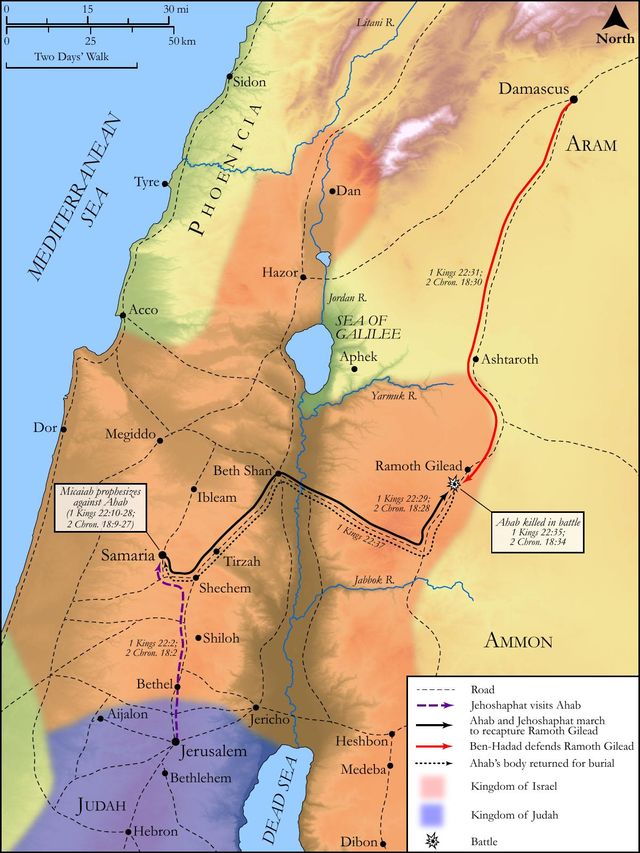
This pivotal verse is situated within a dramatic confrontation between King Ahab of Israel, allied with King Jehoshaphat of Judah, and the prophet Micaiah. The immediate narrative begins with Ahab's desire to reclaim Ramoth-Gilead from Aram, a strategically important city. Ahab consults 400 of his court prophets, who unanimously predict victory, echoing the king's desires and flattering his ambitions. Jehoshaphat, however, senses the flattery and insists on consulting a true prophet of Yahweh. Reluctantly, Ahab sends for Micaiah, whom he openly despises, stating, "He never prophesies good concerning me, but only evil". Before Micaiah's arrival, a messenger attempts to persuade him to align his prophecy with the favorable words of the 400, setting the stage for Micaiah's bold and uncompromising declaration of allegiance to God's word alone. This declaration is the crucial turning point, establishing Micaiah's prophetic authority and integrity before he delivers the true, unfavorable prophecy concerning Ahab's demise.
Historical & Cultural Context
The setting is the divided monarchy, with Israel (North) and Judah (South) often in complex political alliances or conflicts. Ramoth-Gilead was a strategically important city in Transjordan, frequently contested between Israel and Aram. In the courts of the nations, it was common for kings to employ prophets or diviners whose primary role was often to legitimize royal policies and offer favorable omens. These "court prophets" often served as instruments of political power rather than independent divine spokespersons. True prophets of Yahweh, like Micaiah, often stood in opposition to these court figures, delivering messages that challenged royal authority or condemned unrighteousness, frequently at great personal risk. The solemn oath "[As] the LORD liveth" was a common and powerful affirmation in ancient Israel, invoking God as the living witness and guarantor of the truthfulness of the statement, underscoring the gravity and divine authority of Micaiah's resolve.
Key Themes
ShowHideMicaiah's declaration profoundly contributes to several key themes within 1 Kings and the broader prophetic literature. Foremost is the unwavering obedience to God's word, illustrating that a true prophet's fidelity is to the divine message, not to human desires or political expediency. This verse sharply defines the nature of true prophecy in contrast to false prophecy; while the 400 prophets speak from their own spirit or for human gain, Micaiah speaks only "what the LORD saith," highlighting that genuine prophecy is rooted in direct divine revelation and faithful transmission, even when it leads to suffering or unpopularity, as seen in the later persecution of Micaiah. Furthermore, it underscores the divine authority over human desire, asserting that God's word is sovereign and cannot be manipulated or censored by human rulers, a theme consistently found in prophetic books like Jeremiah and Ezekiel.
Exposition and Analysis
ShowHideKey Word Analysis
ShowHideThis refers to the covenant name of God, Yahweh, the self-existent and eternal One. By invoking "the LORD," Micaiah is not merely swearing by a deity, but by the personal, living God of Israel who is the ultimate source of truth and authority. This name underscores the absolute sovereignty and reliability of the message Micaiah is about to deliver, grounding his words in divine reality rather than human fabrication.
This verb signifies the act of speaking or declaring, often with authority or intention. In this context, it emphasizes that the words Micaiah is committed to speaking originate directly from God. It highlights the prophet's role as a passive recipient and faithful conveyor of a message, rather than its originator. This choice of word underscores the divine revelation and the prophet's precise transmission of God's will.
While also meaning "to speak," this verb often carries a nuance of arranging, commanding, or declaring with force and purpose. The repetition of the concept of speaking, first as God "saith" and then as Micaiah "will speak," creates a powerful rhetorical emphasis on the direct and unaltered transmission of God's word. It signifies Micaiah's unyielding resolve to deliver the message precisely as he received it, without addition, subtraction, or modification, regardless of the consequences. This commitment to faithful articulation is central to his prophetic integrity.
Verse Breakdown
ShowHide"And Micaiah said"
This introductory phrase immediately sets Micaiah apart from the previous 400 prophets. His voice emerges as singular and distinct, signaling a departure from the unanimous, yet false, consensus. It positions him as the lone, true voice of Yahweh in a corrupted court, highlighting his courage and unique divine commission.
"[As] the LORD liveth"
This solemn oath serves as the foundation of Micaiah's declaration. By invoking the living God, he places his entire being and the veracity of his words under divine scrutiny. It is an act of profound faith and courage, asserting that his allegiance is solely to Yahweh, whose very existence guarantees the truth of what he is about to say, regardless of the king's power or the threat to his own life.
"what the LORD saith unto me"
This clause explicitly identifies the source of Micaiah's message: direct, personal revelation from Yahweh. It highlights the prophet's role as a recipient and messenger, not an originator. His words are not based on human wisdom, political calculation, or a desire to please, but on divine communication, emphasizing the objective and authoritative nature of the prophecy.
"that will I speak"
This concluding phrase affirms Micaiah's unwavering commitment to deliver the divine message without compromise. It is a declaration of absolute obedience and integrity. Despite the messenger's counsel to conform and Ahab's known animosity, Micaiah asserts his resolve to speak only and exactly what God has revealed, embodying the ideal of prophetic faithfulness even unto personal peril.
Literary Devices
ShowHideThe verse powerfully employs Oath as a literary device, specifically a solemn oath invoking the living God ("As the LORD liveth"). This device immediately elevates the gravity and truthfulness of Micaiah's subsequent statement, establishing his words as divinely sanctioned and unassailable. There is also a strong element of Contrast at play, setting Micaiah's integrity and singular devotion to Yahweh's word against the backdrop of the 400 false prophets who speak what is pleasing to the king. This contrast highlights the fundamental difference between true and false prophecy. Furthermore, the verse serves as an act of Foreshadowing, as Micaiah's resolute commitment to speaking God's word, despite its unpopularity, prepares the audience for the dire and ultimately fulfilled prophecy he is about to deliver concerning Ahab's death. The Irony is palpable: Ahab, who despises Micaiah because he "never prophesies good," is about to receive the very truth that will lead to his downfall, precisely because Micaiah refuses to compromise.
Theological and Thematic Connections
ShowHideMicaiah's steadfast declaration embodies a core theological principle: the absolute sovereignty and authority of God's word, and the non-negotiable duty of His messengers to proclaim it faithfully. This verse underscores that divine truth is not subject to human manipulation, political expediency, or popular consensus. It is a powerful reminder that true faithfulness involves prioritizing God's revealed will above all personal comfort, societal pressure, or even the threat of persecution. Micaiah stands as a paradigm of prophetic integrity, highlighting that the authenticity of a prophet (or any messenger of God) is measured by their unwavering commitment to speak what God has truly said, regardless of the cost. His example challenges believers across all generations to discern and uphold divine truth, speaking it with courage and integrity in a world often seeking agreeable messages over uncomfortable truths.
Reflection and Application
ShowHideMicaiah's unwavering commitment to speak only what the Lord commands offers a profound challenge and inspiration for believers today. In a world saturated with information, opinions, and competing narratives, the call to discern and articulate divine truth with integrity is more vital than ever. Micaiah's example compels us to examine the sources of our own convictions and the motivations behind our speech. Are we willing to prioritize God's word above personal popularity, professional advancement, or even the comfort of our social circles? This applies not only to those in formal teaching or leadership roles but to every Christian called to live out and articulate their faith authentically. It reminds us that true faithfulness means aligning our words and actions with what God has revealed, trusting His wisdom and sovereignty above all else, even when it leads to opposition or discomfort. Our integrity as followers of Christ is measured by our readiness to echo His truth, regardless of the prevailing winds of culture or personal cost.
Questions for Reflection
ShowHideFAQ
ShowHideWhy did King Ahab dislike Micaiah so intensely?
ShowHideKing Ahab's strong dislike for Micaiah stemmed from the prophet's consistent delivery of unfavorable prophecies concerning the king. Unlike the 400 court prophets who flattered Ahab with promises of victory and prosperity, Micaiah consistently spoke God's true word, which often involved judgment and bad news for Ahab. For instance, Micaiah had previously prophesied Ahab's doom for his role in the murder of Naboth and the seizure of his vineyard, as recorded in 1 Kings 21:17-24. Ahab preferred to hear messages that aligned with his desires and ambitions, making Micaiah's truthful, yet often negative, pronouncements deeply irritating and unwelcome. This aversion highlights the common human tendency to reject truth when it challenges personal comfort or power.
What was the immediate outcome of Micaiah's prophecy for King Ahab?
ShowHideDespite Micaiah's clear and truthful prophecy that Ahab would be defeated and die at Ramoth-Gilead, as detailed in 1 Kings 22:17-23, King Ahab chose to disregard the warning. He went into battle, attempting to evade the prophecy by disguising himself. However, a "randomly shot" arrow struck him between the joints of his armor, mortally wounding him. Ahab was propped up in his chariot until evening, and he died as the sun set. His blood was washed from the chariot in the pool of Samaria, where dogs licked it up, fulfilling an earlier prophecy from Elijah concerning Ahab's demise, found in 1 Kings 22:34-38. This tragic outcome powerfully affirmed the absolute truth and sovereignty of God's word spoken through Micaiah.
Christ-Centered Fulfillment
ShowHideMicaiah's resolute declaration, "what the LORD saith unto me, that will I speak," finds its ultimate and perfect fulfillment in the person and ministry of Jesus Christ. Jesus is the quintessential Prophet, the very "Word made flesh" who dwelt among us, as magnificently declared in John 1:14. He consistently affirmed that He spoke only what the Father commanded Him, stating, "I do nothing on my own authority, but speak just as the Father taught me," a profound truth echoed in John 8:28. His entire earthly ministry was characterized by perfect obedience to the Father's will and an unwavering commitment to proclaim divine truth, even when it led to rejection, suffering, and ultimately, the cross. Unlike Micaiah, who was a messenger, Jesus is the message itself, the final and complete revelation of God to humanity, as expounded in Hebrews 1:1-2. He is not merely a speaker of truth, but the very embodiment of truth, proclaiming "I am the way, and the truth, and the life" in John 14:6, and His words are spirit and life, as He Himself affirmed in John 6:63. Just as Micaiah's truth-telling led to his imprisonment but vindicated God's word, so too did Christ's perfect obedience and truth-speaking lead to His crucifixion, yet ultimately resulted in the triumph of God's redemptive plan and His glorious resurrection, securing eternal life for all who believe.