


1 Kings 20:34
- וַיֹּאמֶרvai·Yo·merand he saidH559Conj-w ¦ V-Qal-ConsecImperf-3msVerb Qal Consecutive Imperfect 3rd Singular Masculineוַandיֹּאמֶרhe said
- אֵלָיו'e·Lavto himH413Prep ¦ 3msPrepositionאֵלָיtoוhim
- הֶעָרִיםhe·'a·Rimthe citiesH5892Art ¦ N-mpNoun Plural Masculine Absoluteהֶtheעָרִיםcities
- אֲשֶׁר'a·SherwhichH834RelParticle Relative
- לָקַחla·kachhe tookH3947V-Qal-Perf-3msVerb Qal Perfect 3rd Singular Masculine
- אָבִי'a·Vimy fatherH1N-msc ¦ 1csNoun Singular Masculine Constructאָבִfatherיmy
- מֵאֵתme·'Etfrom withH854Prep-m ¦ PrepPrepositionמֵfromאֵתwith
- אָבִיךָ'a·Vi·khayour fatherH1N-msc ¦ 2msNoun Singular Masculine Constructאָבִיfatherךָyour
- אָשִׁיב'a·ShivI will returnH7725V-Hiphil-Imperf-1csVerb Hiphil Imperfect 1st Singular common gender
- וְחוּצוֹתVe·chu·tzotand streetsH2351Conj-w ¦ N-fpNoun Plural Feminine Absoluteוְandחוּצוֹתstreets
- תָּשִׂיםta·Simyou will makeH7760V-Qal-Imperf-2msVerb Qal Imperfect 2nd Singular Masculine
- לְךָle·Khafor yourselfPrep-l ¦ 2msSuffix Personal 2nd Singular Masculineלְforךָyourself
- בְדַמֶּשֶׂקve·da·Me·sekin DamascusH1834Prep-b ¦ N-properNoun Proper LocationבְinדַמֶּשֶׂקDamascus
- כַּאֲשֶׁרka·'a·Sherjust asH834Prep-k ¦ RelParticle Relativeכַּjustאֲשֶׁרas
- שָׂםsamhe madeH7760V-Qal-Perf-3msVerb Qal Perfect 3rd Singular Masculine
- אָבִי'a·Vimy fatherH1N-msc ¦ 1csNoun Singular Masculine Constructאָבִfatherיmy
- בְּשֹׁמְרוֹןbe·Sho·me·Ronin SamariaH8111Prep-b ¦ N-properNoun Proper LocationבְּinשֹׁמְרוֹןSamaria
- וַאֲנִיva·'a·Niand IH589Conj-w ¦ Pro-1csPronoun Personal 1st Singular common genderוַandאֲנִיI
- בַּבְּרִיתba·be·Ritwith the covenantH1285Prep-b ¦ N-fsNoun Singular Feminine Absoluteבַּwith theבְּרִיתcovenant
- אֲשַׁלְּחֶךָּ'a·sha·le·Che·kaI will let go youH7971V-Piel-Imperf-1cs ¦ 2msVerb Piel Imperfect 1st Singular common genderאֲשַׁלְּחֶI will let goךָּyou
- וַיִּכְרָתvai·yikh·rotand he madeH3772Conj-w ¦ V-Qal-ConsecImperf-3msVerb Qal Consecutive Imperfect 3rd Singular Masculineוַandיִּכְרָתhe made
- לוֹloto himPrep-l ¦ 3msSuffix Personal 3rd Singular Masculineלtoוֹhim
- בְרִיתve·Rita covenantH1285N-fsNoun Singular Feminine Absolute
- וַיְשַׁלְּחֵהוּVay·sha·le·Che·huand he let go himH7971Conj-w ¦ V-Piel-ConsecImperf-3ms ¦ 3msVerb Piel Consecutive Imperfect 3rd Singular Masculineוַandיְשַׁלְּחֵhe let goהוּhim
English is a literal word-by-word gloss of the Hebrew, not the KJV's wording. Why?
This is the original text the KJV's translators worked from — each Hebrew word with its own literal English meaning in this verse, prepared by scholars at Tyndale House, Cambridge. The KJV translates whole sentences, not word by word, so its wording differs: one Hebrew word can become several English words, and the KJV may choose “the LORD” where the gloss reads “Yahweh”. Both are faithful — they answer different questions. For the KJV's own rendering, switch to the KJV text.
Details
See on the biblical-era maps
Study this verse
Public-domain commentary
Matthew Henry
From his Commentary on the Whole Bible. Henry comments on passages, not single verses — this entry covers 1 Kings 20:31–43. His two-level outline is real structure in the source text, so it is rendered as structure.
Here is an account of what followed upon the victory which Israel obtained over the Syrians.
I.Ben-hadad's tame and mean submission.
Even in his inner chamber he feared, and would, if he could, flee further, though none pursued. His servants, seeing him and themselves reduced to the last extremity, advised that they should surrender at discretion, and make themselves prisoners and petitioners to Ahab for their lives, Kg1 20:31. The servants will put their lives in their hands, and venture first, and their master will act according as they speed. Their inducement to take this course is the great reputation the kings of Israel had for clemency above any of their neighbours: "We have heard that they are merciful kings, not oppressive to their subjects that are under their power" (as governments then went, that of Israel was one of the most easy and gentle), "and therefore not cruel to their enemies when they lie at their mercy." Perhaps they had this notion of the kings of Israel because they had heard that the God of Israel proclaimed his name gracious and merciful, and they concluded their kings would make their God their pattern. It was an honour to the kings of Israel to be thus represented, as indeed every Israelite is then dressed as becomes him when he puts on bowels of mercies. "They are merciful kings, therefore we may hope to find mercy upon our submission." This encouragement poor sinners have to repent and humble themselves before God. "Have we not heard that the God of Israel is a merciful God? Have we not found him so? Let us therefore rend our hearts and return to him." Joe 2:13. That is evangelical repentance which flows from an apprehension of the mercy of God in Christ; there is forgiveness with him. Two things Ben-hadad's servants undertake to represent to Ahab: - 1. Their master a penitent; for they girded sackcloth on their loins, as mourners, and put ropes on their heads, as condemned criminals going to execution, pretending to be sorry that they had invaded his country and disturbed his repose, and owning that they deserved to be hanged for it. Here they are ready to do penance for it, and throw themselves at the feet of him whom they had injured. Many pretend to repent of their wrong-doing, when it does not succeed, who, if they had prospered in it, would have justified it and gloried in it. 2. Their master a beggar, a beggar for his life: Thy servant Ben-hadad saith, "I pray thee, let me live, Kg1 20:32. Though I live a perpetual exile from my own country, and captive in this, yet, upon any terms, let me live." What a great change is here, (1.) In his condition! How has he fallen from the height of power and prosperity to the depths of disgrace and distress, and all the miseries of poverty and slavery! See the uncertainty of human affairs; such turns are they subject to that the spoke which was uppermost may soon come to be undermost. (2.) In his temper - in the beginning of the chapter hectoring, swearing, and threatening, and none more high in his demands, but here crouching and whining and none more low in his requests! How meanly does he beg hi life at the hand of him upon whom he had there been trampling! The most haughty in prosperity are commonly most abject in adversity: an even spirit will be the same in both conditions. See how God glorified himself when he looks upon proud men and abases them, and hides them in the dust together, Job 40:11-13.
II.Ahab's foolish acceptance of his submission, and the league he suddenly made with him upon it.
He was proud to be thus courted by him whom he had feared, and enquired for him with great tenderness: Is he yet alive? He is my brother, brother-king, though not brother-Israelite: and Ahab valued himself more upon his royalty than on his religion, and others accordingly. "Is he thy brother, Ahab? Did he use thee like a brother when he sent thee that barbarous message? Kg1 20:5, Kg1 20:6. Would he have called thee brother if he had been the conqueror? Would he now have called himself thy servant if he had not been reduced to the utmost strait? Canst thou suffer thyself to be thus imposed upon by a forced and counterfeit submission?" This word brother they caught at (Kg1 20:33), and were thereby encouraged to go and fetch him to the king. He that calls him brother will let him live. Let poor penitents hear God, in his word, calling them children (Jer 31:20), catch at it, echo to it, and call him Father. Ben-hadad, upon his submission, shall not only be honourably conveyed (he took him up into the chariot), but treated with as an ally (Kg1 20:34): he made a covenant with him, not consulting God's prophets, or the elders of the land, or himself, concerning what was fit to be insisted on, but, as if Ben-hadad had been conqueror, he shall make his own terms. He might now have demanded some of Ben-hadad's cities, when all of them lay at the mercy of his victorious army; but was content with the restitution of his own. He might now have demanded the stores, and treasures, and magazines of Damascus, to augment the wealth and strength of his own kingdom, but was content with a poor liberty, at his own expense, to build streets there, a point of honour and no advantage, or no more than what the kings of Syria had had in Samaria, though they had never had so much power as he had now to support the demand of it. With this covenant he sent him away, without so much as reproving him for his blasphemous reflections upon the God of Israel, for whose honour Ahab had no concern. Note, There are those on whom success is ill bestowed; they know not how to serve God, or their generation, or even their own true interests, with their prosperity. Let favour be shown to the wicked, yet will he not learn righteousness.
III.The reproof given to Ahab for his clemency to Ben-hadad and his covenant with him.
It was given him by a prophet, in the name of the Lord, the Jews say by Micaiah, and not unlikely, for Ahab complains of him (Kg1 22:8) that he used to prophesy evil concerning him. This prophet designed to reprove Ahab by a parable, that he might oblige him to condemn himself, as Nathan and the woman of Tekoa did David. To make his parable the more plausible, he finds it necessary to put himself into the posture of a wounded soldier.
1.With some difficulty he gets himself wounded, for he would not wound himself with his own hands. He commanded one of his brother prophets, his neighbour, or companion (for so the word signifies), to smite him, and this in God's name (Kg1 20:35), but finds him not so willing to give the blow as he is to receive it; he refused to smite him: others, he thought, were forward enough to smite prophets, they need not smite one another. We cannot but think it was from a good principle he declined it. "If it must be done, let another do it, not I; I cannot find it in my heart to strike my friend." Good men can much more easily receive a wrongful blow than give one; yet because he disobeyed an express command of God (which was so much the worse if he was himself a prophet), like that other disobedient prophet (Kg1 13:24), he was presently slain by a lion, Kg1 20:36. This was intended, not only to show, in general, how provoking disobedience is (Col 3:6), but to intimate to Ahab (who no doubt was told the story) that if a good prophet were thus punished for sparing his friend and God's, when God said, Smite, of much sorer punishment should a wicked king be thought worthy, who spared his enemy and God's, when God said, Smite. Shall mortal man pretend to be more just than God, more pure or more compassionate than his Maker? We must be merciful as he is merciful, and not otherwise. The next he met with made no difficulty of smiting him (Volenti non fit injuria - He that asks for an injury is not wronged by it) and did it so that he wounded him, Kg1 20:37. He fetched blood with the blow, probably in his face.
2.Wounded as he was, and disguised with ashes that he might not be known to be a prophet, he made his application to the king in a story wherein he charged himself with such a crime as the king was now guilty of in sparing Ben-hadad, and waited for the king's judgment upon it. The case in short is this - A prisoner taken in the battle was committed to his custody by a man (we may suppose one that had authority over him as his superior officer) with this charge, If he be missing, thy life shall be for his life, Kg1 20:39. The prisoner has made his escape through his carelessness. Can the chancery in the king's breast relieve him against his captain, who demands his life in lieu of the prisoner's? "By no means," says the king, "thou shouldst either not have undertaken the trust or been more careful and faithful to it; there is no remedy (Currat lex - Let the law take its course), thou hast forfeited thy bond, and execution must go out upon it: So shall thy doom be, thou thyself hast decided it." Now the prophet has what he would have, puts off his disguise, and is known by Ahab himself to be a prophet (Kg1 20:41) and plainly tells him, "Thou art the man. Is it my doom? No, it is thine; thou thyself hast decided it. Out of thy own mouth art thou judged. God, thy superior and commander-in-chief, delivered into thy hands one plainly marked for destruction both by his own pride and God's providence, and thou hast not carelessly lost him, but wittingly and willingly dismissed him, and so hast been false to thy trust, and lost the end of thy victory; expect therefore no other than that thy life shall go for his life, which thou hast spared" (and so it did, Kg1 22:35), "and thy people for his people, whom likewise thou hast spared," and so they did afterwards, Kg2 10:32, Kg2 10:33. When their other sins brought them low, this came into the account. There is a time when keeping back the sword from blood is doing the work of the Lord deceitfully, Jer 48:10. Foolish pity spoils the city.
3.We are told how Ahab resented this reproof. He went to his house heavy and displeased (Kg1 20:43), not truly penitent, or seeking to undo what he had done amiss, but enraged at the prophet, exasperated against God (as if he had been too severe in the sentence passed upon him), and yet vexed at himself, every way out of humour, notwithstanding his victory. He who by his providence had mortified the pride of one king, by his word cast a damp upon the triumphs of another. Be wise therefore, O you kings! and be instructed to serve the Lord with fear and rejoice with trembling, Psa 2:10, Psa 2:11.
Historical interpretation
Historical reception
2 surviving comments on this verse. Each one is dated, so this reads as a timeline rather than a list.
No one doubts that when the judgment of the heart goes astray and is seized by the night of ignorance, our thoughts and our deeds, which proceed from the deliberation of discretion, are involved in the greater darkness of sin. Finally, because he never had this eye of discretion, he who by God’s judgment first deserved to rule over the people of Israel was cast out of his kingdom like something dark out of a healthy body. Having been deceived by the darkness and error of this light, he decided that his own sacrifices were more acceptable to God than obedience to Samuel’s command, and in the very act by which he had hoped that he would propitiate the divine majesty he committed sin instead. Ignorance of this discretion, I say, constrained Ahab, the king of Israel, after the triumph of the glorious victory that had been conceded to him by God’s favor, to believe that his own mercy was better than the very severe execution of the divine command, which seemed to him to be a cruel decree. Enfeebled by this thought, he wished to temper a bloody victory with clemency and, having been made dark throughout his body because of his impudent mercy, he was condemned to a death from which there was no recourse. - "Conference 2.2.6-3.2"
For no one can doubt that when the judgment of our heart goes wrong and is overwhelmed by the night of ignorance, our thoughts and deeds, which are the result of deliberation and discretion, must be involved in the darkness of still greater sins. Finally, the man who in the judgment of God was the first to be worthy to be king of his people Israel, because he was lacking in this “eye” of discretion, was, as if his whole body were full of darkness, actually cast down from the kingdom. While being deceived by the darkness of this “light” and in error, he imagined that his own offerings were more acceptable to God than obedience to the command of Samuel. And so he failed in that very act by which he had hoped to propitiate the Divine Majesty. And ignorance, I say, of this discretion led Ahab the king of Israel, after a triumph and splendid victory which had been granted to him by the favor of God, to imagine that mercy on his part was better than the stern execution of the divine command, which seemed a cruel rule to him. Moved by this consideration, while he desired to temper a bloody victory with mercy, he was on account of his indiscriminating clemency rendered full of darkness in his whole body and condemned irreversibly to death.
Continue studying 1 Kings 20:34 across the web’s major study libraries — every link below opens this exact verse, chapter, or book on the destination site.
Read & Compare
 BibleGatewayThis verse in more than 200 translations and 70 languages.
 Bible.comThe YouVersion reader — hundreds of translations, reading plans, and highlights.
 ESV.orgCrossway's official English Standard Version reader.
 NET BibleThe NET translation with 60,000+ translators' notes on every rendering decision.
 STEP BibleTyndale House's free study tool — original text, vocabulary, and scholarly resources.
 BibliaLogos Bible Software's free web reader.
 USCCBThe New American Bible (Revised Edition) with the U.S. bishops' study notes.
Commentaries
 BibleHub CommentariesDozens of classic commentaries on this verse, gathered on one page.
 StudyLightMore than 100 commentary sets — the largest collection on the web.
 BibleRefPlain-English commentary on what this verse means, verse by verse.
 Enduring WordDavid Guzik's free commentary on this chapter, widely used by Bible teachers.
 Bible Study ToolsVerse commentary alongside Greek and Hebrew study aids.
Original Language & Research
- BibleHub InterlinearThe verse word by word — original language, transliteration, and English.
- BibleHub LexiconEvery word's original-language definition and Strong's entry.
 Blue Letter BibleDeep-study tools — Strong's numbers, concordance, and word studies.
 SefariaThe Hebrew text with Rashi and centuries of Jewish commentary.
Sermons, Hymns & Audio


TrulyRandomVerse is not affiliated with these sites and doesn’t control their content. They’re linked because they’re genuinely useful.
Summary
1 Kings 20:34 details the terms of a significant covenant between the defeated Aramean King Ben-Hadad and King Ahab of Israel. This agreement stipulated the restoration of Israelite cities previously seized by Aram and granted Israel unique commercial rights within Damascus. While appearing to be a strategic and economic triumph for Ahab, this decision to spare Ben-Hadad, rather than executing him as implied by divine judgment, ultimately incurred God's severe displeasure and set the stage for Ahab's tragic demise.
Context
ShowHideLiterary Context
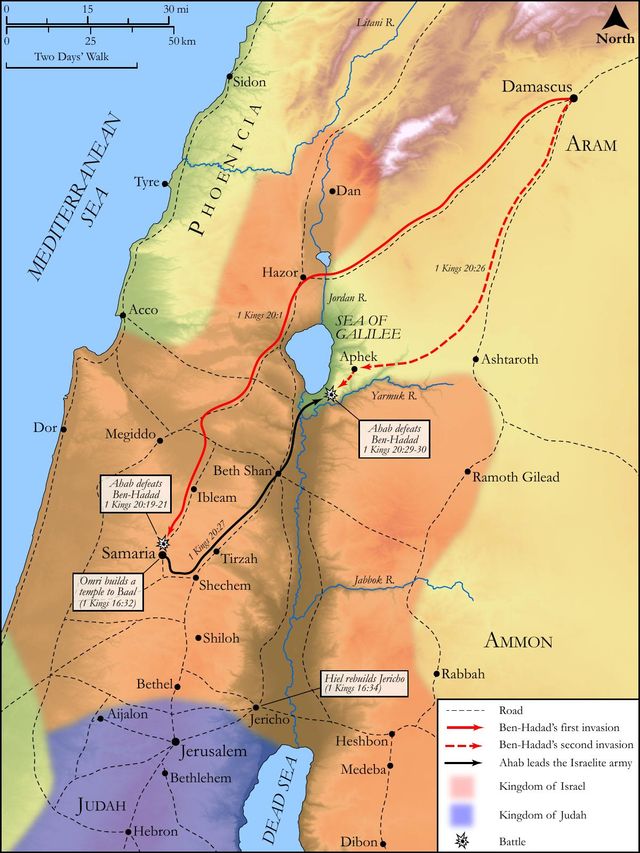
This pivotal verse concludes the dramatic account of the two wars between Israel and Aram in 1 Kings 20. Ben-Hadad, King of Aram, had twice launched arrogant and overwhelming assaults on Samaria, Israel's capital (1 Kings 20:1-12). In both instances, despite Israel's numerical inferiority, Yahweh miraculously intervened, granting Ahab's forces decisive victories and demonstrating His sovereignty over the gods of Aram (1 Kings 20:13-28). Following his second crushing defeat, Ben-Hadad, in a desperate act of surrender, approached Ahab in sackcloth and with a rope around his neck, appealing for mercy (1 Kings 20:31-33). Contrary to ancient Near Eastern custom, which often dictated the execution of a defeated king who had defied a divine power, Ahab surprisingly addressed Ben-Hadad as "my brother" and forged this covenant. This act of leniency immediately drew a severe prophetic rebuke, foreshadowing dire consequences for Ahab's kingdom and ultimately his own life (1 Kings 20:35-43).
Historical & Cultural Context
The relationship between Israel and Aram (Syria), particularly centered around Damascus, was a complex tapestry of conflict, trade, and shifting power dynamics throughout the Israelite monarchy. The "cities, which my father took from thy father" likely refers to territories lost by Israel during earlier periods of Aramean expansion, possibly under Omri or even earlier. The provision for "streets for thee in Damascus" is a crucial detail reflecting ancient Near Eastern treaty practices. Victorious powers frequently imposed commercial rights on the vanquished, which often included the establishment of designated quarters or bazaars within the defeated capital. These "streets" (Hebrew: chutzot) would grant Israelite merchants specific privileges, autonomy, and potentially even extraterritorial legal standing to conduct business, collect taxes, and administer affairs within their own commercial enclave in Damascus. This arrangement would have provided Israel with substantial economic influence, access to vital trade routes, and a tangible symbol of Ben-Hadad's subjugation and Ahab's newfound regional dominance.
Key Themes
ShowHideThis verse encapsulates several profound themes central to the narrative of 1 Kings. Firstly, it highlights the tension between divine will and human pragmatism. God had orchestrated a miraculous victory, implying a divine judgment upon Ben-Hadad, yet Ahab chose a politically and economically advantageous alliance over executing that judgment. This decision is immediately condemned by a prophet, who declares that because Ahab spared Ben-Hadad, his own life would be taken in Ben-Hadad's place (1 Kings 20:42). Secondly, it underscores the theme of obedience versus disobedience in kingship. Ahab's failure to fully carry out God's implied judgment, despite clear divine intervention on his behalf, mirrors similar failures by earlier kings (e.g., Saul's disobedience regarding Agag in 1 Samuel 15:7-9). Finally, the covenant itself speaks to themes of restoration and influence, as Israel reclaims lost territories and gains unprecedented commercial access, marking a period of apparent strength and prosperity for Ahab's reign, albeit one built on a foundation of compromise that would ultimately lead to his demise (1 Kings 22:37-38).
Exposition and Analysis
ShowHideKey Word Analysis
ShowHideThis primitive word, H1, signifies "father" in both a literal and figurative sense, extending to ancestors or the head of a family/dynasty. In this verse, its repeated use ("my father took from thy father," "as my father made in Samaria") emphasizes the dynastic nature of the conflict and the historical grievances being addressed. It highlights that the terms of the covenant are not merely between two individuals, but between two long-standing rival kingdoms, represented by their respective ruling houses.
Derived from a root meaning "to sever" or "separate by a wall," H2351 refers to "outside" or "outdoors," often translated as "street," "highway," or "field." In the context of Damascus, "streets" (plural, chutzot) signifies more than just public thoroughfares. It denotes specific, designated commercial districts or enclaves where Israelite merchants would have the right to establish permanent trading posts, conduct business, and potentially operate under their own jurisdiction, similar to a foreign concession. This was a significant economic and political concession from Ben-Hadad, granting Israel a foothold within the Aramean capital.
From a root implying "cutting" (referencing the ancient practice of cutting animals and passing between the pieces to ratify an agreement), signifies a formal "compact," "confederacy," or "league." Here, it refers to a binding political treaty between two kings. While in the broader biblical narrative, berit often refers to God's solemn promises, in this instance, it is a human-made agreement. Its profound theological implication arises from Ahab's decision to enter into this berit despite God's implied will for a more complete judgment on Ben-Hadad, highlighting the tension between human expediency and divine purpose.
Verse Breakdown
ShowHide"And [Benhadad] said unto him, The cities, which my father took from thy father, I will restore;"
This opening clause reveals Ben-Hadad's desperate and submissive posture. Having suffered a crushing defeat, he offers to return territories that had been seized by his predecessor from Ahab's predecessor. This concession is a direct result of his military failure and a clear acknowledgment of Israel's momentary dominance. The reference to "my father" and "thy father" underscores the long-standing dynastic conflict and the historical justice being sought by Israel.
"and thou shalt make streets for thee in Damascus, as my father made in Samaria."
This is the second, and arguably more significant, term of the covenant. Ben-Hadad grants Ahab the right to establish Israelite commercial quarters in Damascus. This mirrors a previous arrangement where Ben-Hadad's father had established similar privileges in Samaria during a period of Aramean ascendancy. This reciprocal (though now reversed) arrangement highlights the economic and strategic importance of such commercial enclaves in ancient Near Eastern diplomacy, signifying Israel's newfound economic influence and access to key trade routes.
"Then [said Ahab], I will send thee away with this covenant."
Ahab's concise response signifies his acceptance of Ben-Hadad's terms. His decision to "send him away" (i.e., release him) rather than execute him is the critical moment that immediately draws divine condemnation. Ahab prioritizes political and economic gain over what a prophet subsequently implies was God's will for total victory and judgment on Ben-Hadad.
"So he made a covenant with him, and sent him away."
This concluding clause confirms the formalization of the agreement and Ben-Hadad's release. The brevity of the statement belies the profound theological implications of Ahab's choice, setting the immediate stage for the prophetic confrontation that follows and foreshadowing the tragic trajectory of Ahab's reign.
Literary Devices
ShowHideThe passage employs several potent literary devices to convey its message. Irony is prominent, as the defeated Ben-Hadad dictates terms that Ahab, the victor, accepts, seemingly against God's implied will for a more decisive judgment. The image of the once-arrogant Aramean king, who had previously boasted of overwhelming Samaria, now humbly offering concessions to save his life, creates a stark ironic contrast with his earlier hubris. There is also clear Foreshadowing, as Ahab's leniency towards Ben-Hadad immediately precedes a prophetic denunciation that predicts Ahab's own death in Ben-Hadad's place. This sets up the tragic trajectory of Ahab's reign, culminating in his demise in the very next chapter. Furthermore, the passage presents a significant Contrast between God's clear, miraculous intervention to grant Israel victory and Ahab's subsequent humanly pragmatic, politically motivated decision to spare his enemy, highlighting the recurring biblical theme of human shortsightedness versus divine purpose.
Theological and Thematic Connections
ShowHideAhab's decision in 1 Kings 20:34 stands as a stark theological lesson regarding the nature of obedience and the perilous consequences of compromise. Despite Yahweh's miraculous intervention on Israel's behalf, granting them a decisive victory over a formidable enemy, Ahab chose political expediency over divine judgment. This act of leniency, while appearing merciful or advantageous in the short term, was a direct contradiction to the prophetic word that followed, which strongly implied that God intended a more severe judgment on Ben-Hadad. The passage underscores that true victory, in God's eyes, often involves a complete carrying out of His will, even when it seems counterintuitive or costly from a human perspective. Ahab's failure to fully execute God's judgment on Ben-Hadad foreshadows the eventual downfall of his own dynasty, illustrating that partial obedience is still disobedience, and that God holds His leaders accountable for their stewardship of His victories.
Reflection and Application
ShowHideAhab's choice to make a covenant with Ben-Hadad, despite God's clear hand in delivering the victory, serves as a powerful cautionary tale for believers today. It challenges us to examine our own lives and decisions: do we fully embrace and obey God's revealed will, or do we often opt for what seems more pragmatic, politically advantageous, or personally convenient? In moments of spiritual victory or divine blessing, are we tempted to "make peace" with lingering issues, compromise with sin, or spare "enemies" (habits, attitudes, influences) that God intends for us to utterly defeat? This passage reminds us that short-term gains or seemingly beneficial alliances, when made contrary to God's purposes, can have long-term negative consequences, leading to spiritual vulnerability and ultimately hindering God's greater plan for our lives. Our obedience, even when it seems costly or counter-cultural, is paramount to experiencing the fullness of God's blessing and avoiding the pitfalls of compromise.
Questions for Reflection
ShowHideFAQ
ShowHideWhy was Ahab's covenant with Ben-Hadad considered a failure or a sin?
ShowHideAhab's covenant was considered a failure primarily because it went against God's implied will for a more decisive judgment on Ben-Hadad. While the text doesn't explicitly state "Thou shalt kill Ben-Hadad," the context of God's miraculous deliverance of Israel and the subsequent prophetic rebuke strongly suggest that God intended for Ben-Hadad to be executed as an enemy of Yahweh and His people. The prophet explicitly tells Ahab in 1 Kings 20:42, "Because you have let go out of your hand the man whom I had devoted to destruction, therefore your life shall go for his life, and your people for his people." Ahab prioritized political and economic advantages (restored cities, commercial rights in Damascus) over complete obedience to God's judgment, demonstrating a lack of faith and a pragmatic approach that ultimately cost him his life.
What exactly were the "streets" in Damascus that Ahab was granted?
ShowHideThe "streets" (Hebrew: chutzot) in this context refer to designated commercial districts or bazaars within the city of Damascus. This was not merely permission for Israelites to walk freely on public thoroughfares, but rather the right to establish and operate their own permanent trading posts, shops, or even administrative centers within the Syrian capital. Such arrangements were common in ancient Near Eastern treaties and provided significant economic influence, trade privileges, and potentially even a degree of extraterritoriality or self-governance for the foreign merchants within their designated quarter. It represented a major economic and strategic concession by Ben-Hadad, highlighting Israel's newfound dominance.
What happened to Ben-Hadad after this covenant?
ShowHideAfter this covenant, Ben-Hadad was released by Ahab and returned to Damascus. The peace between Israel and Aram, however, was short-lived. 1 Kings 22:1 states that "three years passed without war between Aram and Israel." Following this period, Ahab, in alliance with Jehoshaphat of Judah, initiated a campaign to reclaim Ramoth-Gilead from Aram, leading to the battle where Ahab was killed (1 Kings 22:2-38). Ben-Hadad continued to reign over Aram for some time after Ahab's death, eventually being succeeded by Hazael, who murdered him (2 Kings 8:7-15).
Christ-Centered Fulfillment
ShowHideAhab's failure to fully execute God's judgment on Ben-Hadad, opting instead for a self-serving covenant, stands in stark contrast to the perfect obedience and complete victory of Jesus Christ. While Ahab sought a temporary peace for political gain, Jesus came to establish an eternal covenant, not with enemies to be spared, but through His own sacrifice to utterly defeat the spiritual enemies of sin, death, and the devil. Unlike Ahab, who compromised God's will, Christ perfectly fulfilled the Father's will, even to the point of death on the cross (Hebrews 10:7). He did not make a "covenant" with evil but triumphed over all hostile powers, disarming them and leading them captive in His victory (Colossians 2:15). The "streets" that Ahab gained in Damascus were earthly and temporary, but Christ, through His atoning work, grants His followers access to the very throne room of God and establishes a spiritual kingdom that will never end, fulfilling the ultimate promise of a superior and everlasting covenant (Hebrews 8:6). Where Ahab failed to fully conquer, Christ, the true King, has secured a complete and final victory, calling His followers not to compromise with the world, but to engage in spiritual warfare against its dark forces, knowing that the ultimate triumph is already His (Ephesians 6:12).