


2 Kings 10:33
- מִןminfromH4480PrepPreposition
- הַיַּרְדֵּןhai·yar·Denthe JordanH3383Art ¦ N-properNoun Proper LocationהַtheיַּרְדֵּןJordan
- מִזְרַחmiz·Rach[the] rising ofH4217N-mscNoun Singular Masculine Construct
- הַשֶּׁמֶשׁha·She·meshthe sunH8121Art ¦ N-csNoun Singular common gender Absoluteהַtheשֶּׁמֶשׁsun
- אֵת'et<obj.>H853DirObjMParticle Object Indicator
- כָּלkolallH3605N-mscNoun Singular Masculine Construct
- אֶרֶץ'E·retz[the] land ofH776N-fscNoun Singular Feminine Construct
- הַגִּלְעָדha·gil·'Ad<the> GileadH1568Art ¦ N-properNoun Proper Locationהַ<the>גִּלְעָדGilead
- הַגָּדִיha·ga·Dithe Gadite[s]H1425Art ¦ N-msNoun Gentilic Singular Masculine AbsoluteהַtheגָּדִיGadite[s]
- וְהָרֻאובֵנִיve·ha·ru·ve·Niand the Reubenite[s]H7206Conj-w ¦ Art ¦ N-msNoun Gentilic Singular Masculine AbsoluteוְandהָtheרֻאובֵנִיReubenite[s]
- וְהַמְנַשִּׁיve·ham·na·Shiand the Manassite[s]H4520Conj-w ¦ Art ¦ N-msNoun Gentilic Singular Masculine AbsoluteוְandהַtheמְנַשִּׁיManassite[s]
- מֵעֲרֹעֵרme·'a·ro·'Erfrom AroerH6177Prep-m ¦ N-properNoun Proper LocationמֵfromעֲרֹעֵרAroer
- אֲשֶׁר'a·SherwhichH834RelParticle Relative
- עַל'al[is] atH5921PrepPreposition
- נַחַלNa·chal[the] wadi ofH5158N-mscNoun Singular Masculine Construct
- אַרְנֹן'ar·NonArnonH769N-properNoun Proper Location
- וְהַגִּלְעָדve·ha·gil·'Adand <the> GileadH1568Conj-w ¦ Art ¦ N-properNoun Proper Locationוְandהַ<the>גִּלְעָדGilead
- וְהַבָּשָׁןve·ha·ba·Shanand <the> BashanH1316Conj-w ¦ Art ¦ N-properNoun Proper Locationוְandהַ<the>בָּשָׁןBashan
English is a literal word-by-word gloss of the Hebrew, not the KJV's wording. Why?
This is the original text the KJV's translators worked from — each Hebrew word with its own literal English meaning in this verse, prepared by scholars at Tyndale House, Cambridge. The KJV translates whole sentences, not word by word, so its wording differs: one Hebrew word can become several English words, and the KJV may choose “the LORD” where the gloss reads “Yahweh”. Both are faithful — they answer different questions. For the KJV's own rendering, switch to the KJV text.
Details
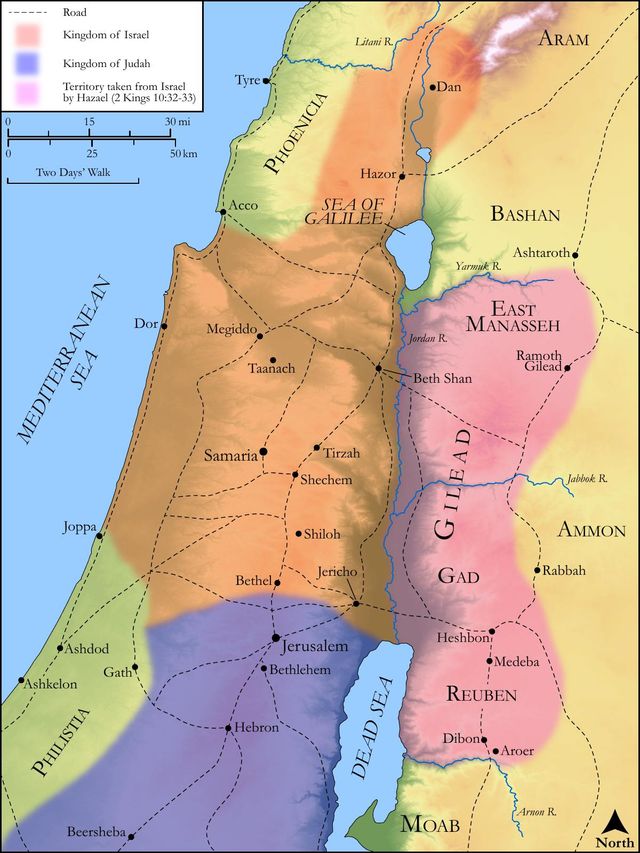
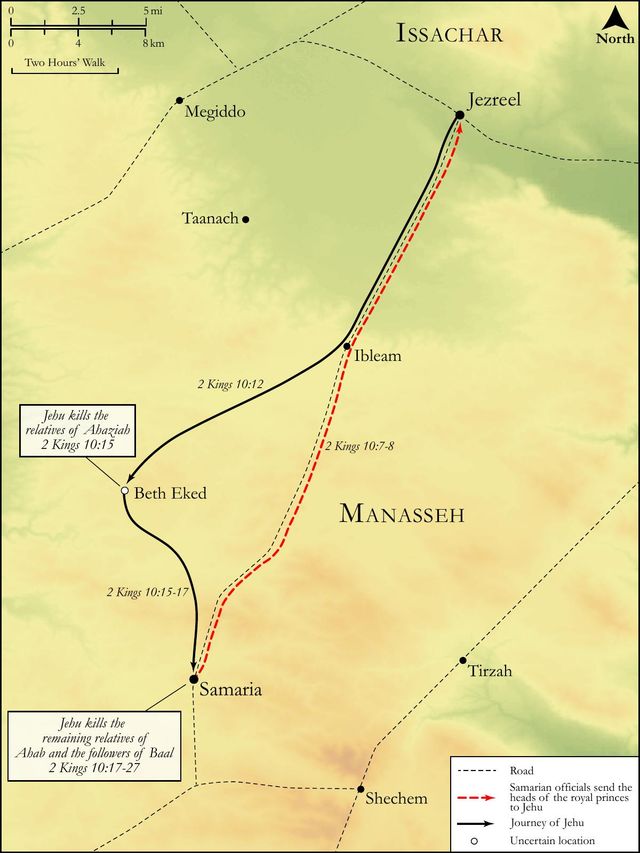
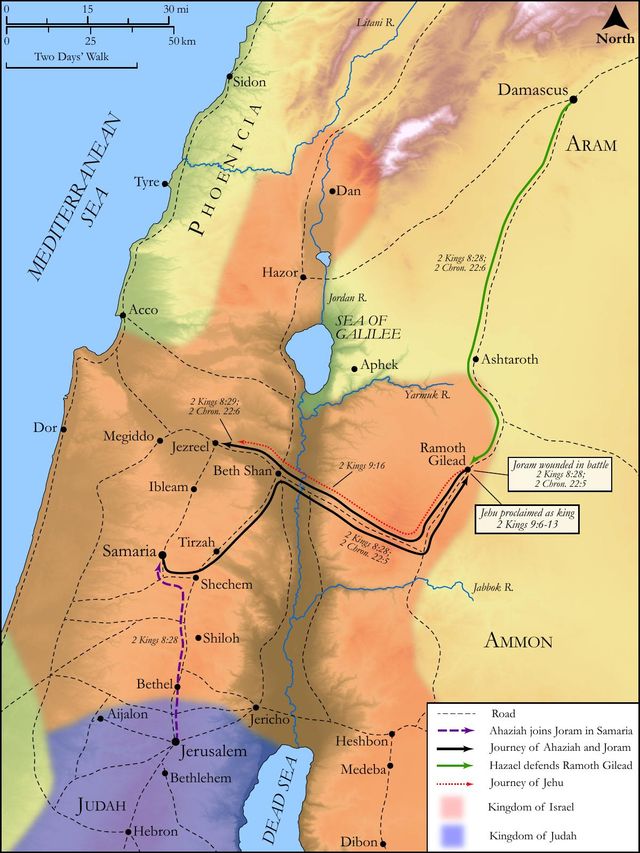
See on the biblical-era map
Study this verse
Public-domain commentary
Matthew Henry
From his Commentary on the Whole Bible. Henry comments on passages, not single verses — this entry covers 2 Kings 10:29–36. His three-level outline is real structure in the source text, so it is rendered as structure.
Here is all the account of the reign of Jehu, though it continued twenty-eight years. The progress of it answered not to the glory of its beginning. We have here,
I.God's approbation of what Jehu had done.
Many, it is probable, censured him as treacherous and barbarous - called him a rebel, a usurper, a murderer, and prognosticated ill concerning him, that a family thus raised would soon be ruined; but God said, Well done (Kg2 10:30), and then it signified little who said otherwise.
1.God pronounced that to be right which he had done. It is justly questionable whether he did it from a good principle and whether he did not take some false steps in the doing of it; and yet (says God), Thou hast done well in executing that which is right in my eyes. The extirpating of idolaters and idolatry was a thing right in God's eyes, for it is an iniquity he visits as surely and severely as any: it was according to all that was in his heart, all he desired, all he designed. Jehu went through with his work.
2.God promised him a reward, that his children of the fourth generation from him should sit upon the throne of Israel. This was more than what took place in any of the dignities or royal families of that kingdom; of the house of Ahab there were indeed four kings, Omri, Ahab, Ahaziah, and Joram, but the last two were brothers, so that it reached but to the third generation, and that whole family continued but about forty-five years in all, whereas Jehu's continued in four, besides himself, and in all about 120 years. Note, No services done for God shall go unrewarded.
II.Jehu's carelessness in what he was further to do.
By this it appeared that his heart was not right with God, that he was partial in his reformation.
1.He did not put away all the evil. He departed from the sins of Ahab, but not from the sins of Jeroboam - discarded Baal, but adhered to the calves. The worship of Baal was indeed the greater evil, and more heinous in the sight of God, but the worship of the calves was a great evil, and true conversion is not only from gross sin, but from all sin - not only from false gods, but from false worships. The worship of Baal weakened and diminished Israel, and made them beholden to the Sidonians, and therefore he could easily part with that; but the worship of the calves was a politic idolatry, was begun and kept up for reasons of state, to prevent the return of the ten tribes to the house of David, and therefore Jehu clave to that. True conversion is not only from wasteful sins, but from gainful sins - not only from those sins that are destructive to the secular interest, but from those that support and befriend it, in forsaking which is the great trial whether we can deny ourselves and trust God.
2.He put away evil, but he did not mind that which was good (Kg2 10:31): He took no heed to walk in the law of the Lord God of Israel. He abolished the worship of Baal, but did not keep up the worship of God, nor walk in his law. He had shown great care and zeal for the rooting out of a false religion; but in the true religion,
(1.)He showed no care, took no heed, lived at large, was not at all solicitous to please God and to do his duty, took no heed to the scriptures, to the prophets, to his own conscience, but walked at all adventures. Those that are heedless, it is to be feared, are graceless; for, where there is a good principle in the heart, it will make men cautious and circumspect, desirous to please God and jealous of doing any thing to offend him.
(2.)He showed no zeal; what he did in religion he did not do with his heart, with all his heart, but did it as if he did it not, without any liveliness or concern. It seems, he was a man that had little religion himself, and yet God made use of him as an instrument of reformation in Israel. It is a pity but that those that do good to others should always be good themselves.
III.The judgment that came upon Israel in his reign.
We have reason to fear that when Jehu took no heed himself to walk in God's law the people were generally as careless as he, both in their devotions and in their conversations. There was a general decay of piety and increase of profaneness; and therefore it is not strange that the next news we hear is, In those days the Lord began to cut Israel short, Kg2 10:32. Their neighbours encroached upon them on every side; they were short in their duty to God, and therefore God cut them short in their extent, wealth, and power. Hazael king of Syria was, above any other, vexatious and mischievous to them, smote them in all the coasts of Israel, particularly the countries on the other side Jordan, which lay next him, and most exposed; on these he made continual inroads, and laid them waste. Now the Reubenites and Gadites smarted for the choice which their ancestors made of an inheritance on that side Jordan, which Moses reproved them for, Num. 32. Now Hazael did what Elisha foresaw and foretold he would do. Yet, for doing it, God had a quarrel with him and with his kingdom, as we may find, Amo 1:3, Amo 1:4. Because those of Damascus have threshed Gilead with threshing instruments of iron, therefore (says God) I will send a fire into the house of Hazael, which shall devour the palaces of Benhadad.
Lastly, The conclusion of Jehu's reign, Kg2 10:34-36. Notice is taken, in general, of his might; but, because he took no heed to serve God, the memorials of his mighty enterprises and achievements are justly buried in oblivion.
Continue studying 2 Kings 10:33 across the web’s major study libraries — every link below opens this exact verse, chapter, or book on the destination site.
Read & Compare
 BibleGatewayThis verse in more than 200 translations and 70 languages.
 Bible.comThe YouVersion reader — hundreds of translations, reading plans, and highlights.
 ESV.orgCrossway's official English Standard Version reader.
 NET BibleThe NET translation with 60,000+ translators' notes on every rendering decision.
 STEP BibleTyndale House's free study tool — original text, vocabulary, and scholarly resources.
 BibliaLogos Bible Software's free web reader.
 USCCBThe New American Bible (Revised Edition) with the U.S. bishops' study notes.
Commentaries
 BibleHub CommentariesDozens of classic commentaries on this verse, gathered on one page.
 StudyLightMore than 100 commentary sets — the largest collection on the web.
 BibleRefPlain-English commentary on what this verse means, verse by verse.
 Enduring WordDavid Guzik's free commentary on this chapter, widely used by Bible teachers.
 Bible Study ToolsVerse commentary alongside Greek and Hebrew study aids.
Original Language & Research
- BibleHub InterlinearThe verse word by word — original language, transliteration, and English.
- BibleHub LexiconEvery word's original-language definition and Strong's entry.
 Blue Letter BibleDeep-study tools — Strong's numbers, concordance, and word studies.
 SefariaThe Hebrew text with Rashi and centuries of Jewish commentary.
Sermons, Hymns & Audio


TrulyRandomVerse is not affiliated with these sites and doesn’t control their content. They’re linked because they’re genuinely useful.
Summary
This verse meticulously details the initial territorial losses suffered by the northern kingdom of Israel under King Jehu, as King Hazael of Syria began to conquer the Transjordanian regions. It marks the commencement of divine judgment for Israel's partial obedience and continued idolatry, specifically enumerating the lands east of the Jordan, including Gilead, Bashan, and the territories of the Gadites, Reubenites, and the half-tribe of Manasseh, from Aroer by the Arnon River northward.
Context
ShowHideLiterary Context
This verse immediately follows the declaration that the Lord began to cut Israel short through Hazael. It provides the specific geographical details of this divine judgment. The preceding verses highlight King Jehu's zealous, albeit incomplete, obedience. While he meticulously eradicated the worship of Baal, as commanded by God, he failed to fully turn from the idolatrous practices introduced by Jeroboam I—specifically, the golden calves at Bethel and Dan, as noted in Jehu's partial obedience. This partial obedience, despite its significant positive aspects, set the stage for the consequences outlined in this verse, underscoring a recurring theme in the Books of Kings: the direct correlation between Israel's fidelity to the covenant and their national well-being.
Historical & Cultural Context
The events described here occurred during the reign of King Jehu of Israel (c. 841-814 BCE). Hazael was a powerful and aggressive king of Aram-Damascus, who seized power around the same time as Jehu. Aram-Damascus was a formidable regional power, frequently clashing with Israel. The Transjordanian territories—Gilead and Bashan—were historically significant and strategically vital. They were fertile lands, rich in resources, and served as a buffer zone for the core Israelite territories west of the Jordan. These lands had been allocated to the tribes of Reuben, Gad, and the half-tribe of Manasseh during the conquest, as detailed in Numbers chapter 32 and Joshua chapter 13. Their loss represented a significant diminishment of Israel's territory and influence, a direct consequence of their spiritual failures.
Key Themes
ShowHideThis verse powerfully illustrates several key themes. Firstly, it highlights Divine Judgment and Consequences, demonstrating God's sovereignty in using foreign powers (Hazael) as instruments of discipline against His disobedient people. The territorial loss is a direct result of Israel's spiritual unfaithfulness and Jehu's failure to fully obey God's commands, particularly his retention of the golden calves, which constituted continued idolatry. Secondly, the detailed enumeration of the lost regions emphasizes the theme of Territorial Loss and Diminishment of Israel, a stark reversal of the promises of land expansion given to Abraham. This shrinking of the promised land serves as a visible sign of God's displeasure. Lastly, it underscores the Sovereignty of God over nations and the Consequences of Idolatry, setting the stage for a period of severe oppression and foreshadowing the eventual exile of the northern kingdom, as seen in later judgments like those described in Amos's prophecies.
Exposition and Analysis
ShowHideKey Word Analysis
ShowHideA region East of the Jordan, likely derived from "Gal-ed," meaning "heap of witness." It was a mountainous and fertile area, known for its balm and strategic importance, encompassing territories of Gad, Reuben, and southern Manasseh. Its loss represented a significant blow to Israel's agricultural and economic base.
A region East of the Jordan, north of Gilead, renowned for its rich pastures, strong oak trees, and robust cattle. This fertile plain was part of the inheritance of the half-tribe of Manasseh. Its strategic location and agricultural wealth made it a highly valuable conquest for Hazael, further diminishing Israel's resources.
A city located on the northern bank of the Arnon River, which traditionally formed the southern boundary of the Transjordanian territories of Reuben and Gad. Its mention precisely defines the southern extent of the conquered territory, indicating a comprehensive loss from south to north in the Transjordanian region.
Verse Breakdown
ShowHide"From Jordan eastward"
This phrase establishes the general geographical scope of the conquest, indicating the lands on the east side of the Jordan River, which were historically part of Israel's inheritance but geographically distinct from the main Israelite heartland.
"all the land of Gilead, the Gadites, and the Reubenites, and the Manassites"
This clause provides a comprehensive enumeration of the specific regions and the tribes whose territories were affected. "All the land of Gilead" is a general term, followed by the specific tribal allocations within that region and further north, emphasizing the totality of the loss.
"from Aroer, which [is] by the river Arnon"
This specifies the southern boundary of the conquered territory. Aroer, situated by the Arnon River, marked the traditional southern border of Israel's Transjordanian lands, indicating that Hazael's conquest extended from this precise southern point.
"even Gilead and Bashan"
This phrase reiterates and clarifies the northern extent of the conquest. While "Gilead" was mentioned earlier as a general region, its repetition here alongside "Bashan" (which is north of Gilead) emphasizes that the entire Transjordanian territory, from its southern border up through its northernmost fertile plains, was lost.
Literary Devices
ShowHideThe verse employs several literary devices to convey the gravity and precision of Israel's territorial loss. Geographical Listing or Enumeration is prominent, with the meticulous naming of regions (Gilead, Bashan) and tribes (Gadites, Reubenites, Manassites) to underscore the comprehensive nature of the conquest. This detailed inventory serves to emphasize the extent of the diminishing inheritance. The phrase "from Aroer, which is by the river Arnon, even Gilead and Bashan" functions as a form of Merism, using two extremes (south to north) to encompass the entire territory in between. This highlights the complete loss of the Transjordanian lands. Furthermore, the verse, read in light of the preceding declaration that the Lord began to cut Israel short, implies a Divine Passive or Divine Agency, where Hazael's actions are understood as God's instrument of judgment. This subtle theological framing elevates the historical event to a demonstration of divine sovereignty and covenant consequences.
Theological and Thematic Connections
ShowHideThe loss of these significant territories east of the Jordan is a profound theological statement. It serves as a tangible manifestation of God's covenant curses for disobedience, echoing warnings found throughout the Torah. The land, a central component of God's promises to Abraham and his descendants, was not an unconditional gift but was contingent upon Israel's faithfulness to the covenant. This verse demonstrates that even partial obedience, while commendable in some aspects (like Jehu's zeal against Baal), does not negate the consequences of unaddressed sin, particularly idolatry. God's justice is unwavering, and He uses even foreign adversaries to bring about His purposes of discipline and purification for His people.
Reflection and Application
ShowHideThe detailed account of Israel's territorial losses in 2 Kings 10:33 offers a sobering reflection for believers today. It serves as a powerful reminder that God's covenant faithfulness includes discipline for disobedience. Even when we exhibit zeal in certain areas of our faith, partial obedience or unaddressed sin can lead to significant spiritual losses. Just as Israel lost physical territory due to their spiritual compromises, we too can experience a diminishing of our spiritual inheritance, joy, peace, or effectiveness when we fail to pursue wholehearted devotion to God. This passage challenges us to examine areas of our lives where we might be holding back from God, clinging to "golden calves" of our own making, whether they be idols of comfort, security, or self-reliance. It calls us to a radical, uncompromising obedience, trusting that God's ways, though sometimes involving painful discipline, are always for our ultimate good and His glory.
Questions for Reflection
ShowHideFAQ
ShowHideWhy did God allow Hazael to conquer Israel if Jehu had destroyed Baal worship?
ShowHideJehu's obedience was partial, not complete. While he commendably eradicated the widespread and egregious worship of Baal, he failed to remove the golden calves at Bethel and Dan, which had been set up by Jeroboam I as alternative worship sites to Jerusalem. This constituted a continued form of idolatry and a political sin against the true worship of Yahweh. God's covenant demands complete fidelity, and His judgment for idolatry was consistent, regardless of other positive actions. This demonstrates that God's standard is not merely the absence of the worst sins, but wholehearted devotion and obedience to His commands, as seen in the Lord's assessment of Jehu's heart.
What was the significance of the Transjordanian territories?
ShowHideThese lands—Gilead and Bashan—were part of Israel's original inheritance, promised by God and allocated to the tribes of Reuben, Gad, and the half-tribe of Manasseh, as recorded in Numbers chapter 32. They were highly fertile, rich in agricultural resources, and strategically important as a buffer zone for the core Israelite territories west of the Jordan River. Their loss was a significant blow to Israel's power, economy, and national identity. It symbolized the shrinking of God's promised land due to the nation's unfaithfulness, a tangible sign of divine displeasure and the beginning of a period of national decline.
Does this verse suggest God punishes nations for their leaders' sins?
ShowHideYes, in the context of the Old Testament covenant with Israel, the nation's well-being was intrinsically tied to the obedience of its leaders and the collective spiritual state of the people. While individuals were held accountable for their sins, corporate sin and the failures of leadership often led to national consequences, such as territorial loss, famine, or military defeat. This was part of God's covenantal dealings with Israel as a whole, demonstrating that national prosperity and security were contingent upon national faithfulness to Him, as outlined in the covenant blessings and curses of Deuteronomy chapter 28.
Christ-Centered Fulfillment
ShowHideThe territorial losses detailed in 2 Kings 10:33 serve as a stark reminder of the consequences of covenant unfaithfulness and partial obedience under the Old Covenant. Israel's inability to maintain their promised land due to sin points to a deeper human brokenness and the need for a more perfect King and a more enduring kingdom. This diminishing of the earthly inheritance foreshadows the ultimate spiritual inheritance offered through Christ. Unlike the kings of Israel, whose partial obedience led to national decline, Jesus Christ lived a life of perfect, unblemished obedience, fulfilling all righteousness. His sacrifice on the cross secured for believers an eternal inheritance that cannot be lost to foreign powers or temporal judgments, a heavenly kingdom that is unshakeable. The true "land" or "territory" that believers inherit is not a physical plot of ground, but participation in Christ's spiritual reign and the promise of new heavens and a new earth, where righteousness dwells and there is no more curse or loss. Thus, the sad narrative of Israel's shrinking borders under the Old Covenant ultimately magnifies the boundless and secure spiritual dominion and inheritance provided through the perfect King, Jesus Christ.