


Numbers 32:33
Bible text: King James Version (1769 Blayney text) · Public domain
Bible text: King James Version with Strong's numbers · Public domain
Bible text: Berean Standard Bible · Public domain
Bible text: American Standard Version (1901) · Public domain
Bible text: World English Bible, Messianic edition · Public domain
Bible text: Geneva Bible (1599) · Public domain
Bible text: Young's Literal Translation · Public domain
- וַיִּתֵּןvai·yi·Tenand he gaveH5414Conj-w ¦ V-Qal-ConsecImperf-3msVerb Qal Consecutive Imperfect 3rd Singular Masculineוַandיִּתֵּןhe gave
- לָהֶםla·Hemto <the> themPrep-l ¦ 3mpSuffix Personal 3rd Plural Masculineלָto <the>הֶםthem
- מֹשֶׁהmo·ShehMosesH4872N-proper-mNoun Proper Masculine
- לִבְנֵיliv·neito [the] descendants ofH1121Prep-l ¦ N-mpcNoun Plural Masculine Constructלִtoבְנֵי[the] descendants of
- גָדgadGadH1410N-proper-mNoun Proper Masculine
- וְלִבְנֵיve·liv·Neiand to [the] descendants ofH1121Conj-w ¦ Prep-l ¦ N-mpcNoun Plural Masculine Constructוְandלִtoבְנֵי[the] descendants of
- רְאוּבֵןre·'u·VenReubenH7205N-proper-mNoun Proper Masculine
- וְלַחֲצִיve·la·cha·Tziand to [the] half ofH2677Conj-w ¦ Prep-l ¦ N-mscNoun Singular Masculine Constructוְandלַtoחֲצִי[the] half of
- שֵׁבֶטShe·vet[the] tribe ofH7626N-mscNoun Singular Masculine Construct
- מְנַשֶּׁהme·na·ShehManassehH4519N-proper-mNoun Proper Masculine
- בֶןven[the] son ofH1121N-mscNoun Singular Masculine Construct
- יוֹסֵףyo·SefJosephH3130N-proper-mNoun Proper Masculine
- אֶת'et<obj.>H853DirObjMParticle Object Indicator
- מַמְלֶכֶתmam·Le·khet[the] kingdom ofH4467N-fscNoun Singular Feminine Construct
- סִיחֹןsi·ChonSihonH5511N-proper-mNoun Proper Masculine
- מֶלֶךְMe·lekh[the] king ofH4428N-mscNoun Singular Masculine Construct
- הָאֱמֹרִיha·'e·mo·Rithe Amorite[s]H567Art ¦ N-msNoun Gentilic Singular Masculine AbsoluteהָtheאֱמֹרִיAmorite[s]
- וְאֶתve·'Etand <obj.>H853Conj-w ¦ DirObjMParticle Object Indicatorוְandאֶת<obj.>
- מַמְלֶכֶתmam·Le·khet[the] kingdom ofH4467N-fscNoun Singular Feminine Construct
- עוֹגogOgH5747N-proper-mNoun Proper Masculine
- מֶלֶךְMe·lekh[the] king ofH4428N-mscNoun Singular Masculine Construct
- הַבָּשָׁןha·ba·Shan<the> BashanH1316Art ¦ N-properNoun Proper Locationהַ<the>בָּשָׁןBashan
- הָאָרֶץha·'A·retzthe landH776Art ¦ N-fsNoun Singular Feminine Absoluteהָtheאָרֶץland
- לְעָרֶיהָle·'a·Rei·hato its citiesH5892Prep-l ¦ N-mpc ¦ 3fsNoun Plural Masculine Constructלְtoעָרֶיcitiesהָits
- בִּגְבֻלֹתbig·vu·Lotwith territoriesH1367Prep-b ¦ N-fpcNoun Plural Feminine Constructבִּwithגְבֻלֹתterritories
- עָרֵי'a·Rei[the] cities ofH5892N-mpcNoun Plural Masculine Construct
- הָאָרֶץha·'A·retzthe landH776Art ¦ N-fsNoun Singular Feminine Absoluteהָtheאָרֶץland
- סָבִיבsa·Vivall aroundH5439N-csNoun Singular common gender Absolute
English is a literal word-by-word gloss of the Hebrew, not the KJV's wording. Why?
This is the original text the KJV's translators worked from — each Hebrew word with its own literal English meaning in this verse, prepared by scholars at Tyndale House, Cambridge. The KJV translates whole sentences, not word by word, so its wording differs: one Hebrew word can become several English words, and the KJV may choose “the LORD” where the gloss reads “Yahweh”. Both are faithful — they answer different questions. For the KJV's own rendering, switch to the KJV text.
Details
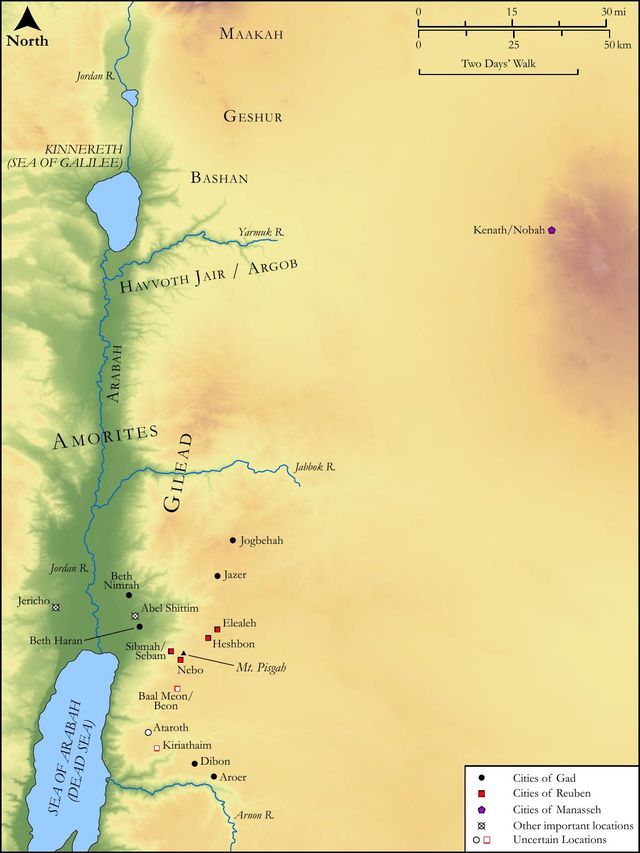
See on the biblical-era map
Study this verse
Continue studying Numbers 32:33 across the web’s major study libraries — every link below opens this exact verse, chapter, or book on the destination site.
Read & Compare
 BibleGatewayThis verse in more than 200 translations and 70 languages.
 Bible.comThe YouVersion reader — hundreds of translations, reading plans, and highlights.
 ESV.orgCrossway's official English Standard Version reader.
 NET BibleThe NET translation with 60,000+ translators' notes on every rendering decision.
 STEP BibleTyndale House's free study tool — original text, vocabulary, and scholarly resources.
 BibliaLogos Bible Software's free web reader.
 USCCBThe New American Bible (Revised Edition) with the U.S. bishops' study notes.
Commentaries
 BibleHub CommentariesDozens of classic commentaries on this verse, gathered on one page.
 StudyLightMore than 100 commentary sets — the largest collection on the web.
 BibleRefPlain-English commentary on what this verse means, verse by verse.
 Enduring WordDavid Guzik's free commentary on this chapter, widely used by Bible teachers.
 Bible Study ToolsVerse commentary alongside Greek and Hebrew study aids.
Original Language & Research
- BibleHub InterlinearThe verse word by word — original language, transliteration, and English.
- BibleHub LexiconEvery word's original-language definition and Strong's entry.
 Blue Letter BibleDeep-study tools — Strong's numbers, concordance, and word studies.
 SefariaThe Hebrew text with Rashi and centuries of Jewish commentary.
Sermons, Hymns & Audio


TrulyRandomVerse is not affiliated with these sites and doesn’t control their content. They’re linked because they’re genuinely useful.
Summary
Numbers 32:33 formally records the allocation of the Transjordanian territory—specifically the former kingdoms of Sihon and Og—to the tribes of Gad, Reuben, and the half-tribe of Manasseh. This pivotal verse marks the fulfillment of Moses' agreement with these tribes, who had requested this fertile land east of the Jordan River as their inheritance, provided they first assisted the other tribes in conquering the land of Canaan proper. It signifies the initial phase of Israel's settlement and the tangible outcome of their recent military victories, underscoring themes of divine provision, covenant faithfulness, and tribal identity.
Context
ShowHideLiterary Context
Numbers 32:33 concludes a significant narrative arc that began at the start of the chapter. The preceding verses detail the request of the tribes of Gad and Reuben for the fertile Transjordanian pastureland, suitable for their abundant livestock. Moses' initial apprehension, rooted in the memory of the Kadesh-Barnea rebellion and the fear of discouraging the other tribes from entering Canaan, is overcome by the Transjordanian tribes' solemn pledge to lead the charge in the conquest of the land west of the Jordan. This verse, therefore, acts as the definitive statement of Moses' approval and the formal transfer of the conquered territories. It sets the stage for the detailed tribal allocations that will follow in Joshua, serving as a crucial bridge between the wilderness wanderings and the full settlement of the Promised Land. The broader context of Numbers emphasizes Israel's journey from Sinai to the plains of Moab, marked by divine guidance, repeated rebellions, and the gradual unfolding of God's covenant promises, culminating in the preparation for entry into the Promised Land.
Historical & Cultural Context
The setting for Numbers 32:33 is the plains of Moab, east of the Jordan River, immediately prior to the Israelites' crossing into Canaan. The kingdoms of Sihon, king of the Amorites, and Og, king of Bashan, were formidable regional powers whose defeat by Israel (recorded in Numbers 21:21-35) was a monumental victory, demonstrating God's power and paving the way for Israel's expansion. This victory was not merely military but theological, as it involved the defeat of peoples whose land God had promised to Israel. Culturally, the concept of tribal inheritance and land allotment was central to Israelite identity and societal structure. Land was not just property; it was a divine gift, a sign of covenant blessing, and the basis for tribal lineage and economic stability. The request of the Transjordanian tribes, while seemingly pragmatic, carried significant implications for their participation in the broader national destiny and their commitment to the unified conquest of the land.
Key Themes
ShowHideThis verse powerfully encapsulates several key themes prevalent in Numbers and throughout the Pentateuch. Firstly, it highlights the fulfillment of divine promise and human covenant. The land itself was a central component of God's promise to Abraham, and its distribution, even in this initial phase, underscores God's faithfulness in bringing His people into their inheritance. Secondly, it emphasizes leadership integrity and accountability, as Moses honors the agreement made with the Transjordanian tribes, demonstrating the importance of keeping one's word. Thirdly, the narrative illustrates the principle of corporate responsibility and unity. The tribes received their inheritance only after committing to assist their brethren, reinforcing the idea that individual blessings are often tied to communal obligation and mutual support, a theme echoed in the call for Israel to be "one people" before God (e.g., Deuteronomy 6:4). Finally, the specific mention of the conquered kingdoms underscores the theme of divine power and victory over formidable foes, reminding Israel that their inheritance was secured not by their own might but by God's intervention, as seen in the accounts of Israel's victories.
Exposition and Analysis
ShowHideKey Word Analysis
ShowHideThis Hebrew verb (H5414), frequently translated as "gave," carries significant weight here. It signifies a formal, authoritative transfer of possession, not merely a casual handing over. In this context, it implies Moses' legitimate authority, divinely sanctioned, to distribute the conquered land. It underscores the idea that this allocation is a binding and final act, fulfilling the prior agreement and establishing a legal claim for the tribes involved. This "giving" is an act of covenant faithfulness on Moses' part, mirroring God's own faithfulness in "giving" the land to Israel.
The use of "kingdom" (H4467) rather than simply "land" or "territory" is crucial. It highlights the political and sovereign nature of the conquered entities. Sihon and Og were not just tribal chiefs but kings ruling established kingdoms with their own administrative structures and cities. By "giving" their kingdoms, Moses is not just parcelling out empty land but transferring sovereign control over existing political entities, including their infrastructure and populations. This emphasizes the scale and significance of Israel's military victories and the comprehensive nature of their new inheritance.
In older English, "coasts" did not exclusively refer to land bordering a sea. The Hebrew word gᵉbûwlâh (H1367) means "boundary," "border," or "region." Here, it signifies the full extent of the conquered kingdoms, including their defined borders and the surrounding regions. The phrase "the land, with the cities thereof in the coasts, even the cities of the country round about" is an emphatic way of stating that the entire territory, including its urban centers and outlying areas, was granted. It ensures no ambiguity regarding the scope of the inheritance.
Verse Breakdown
ShowHide"And Moses gave unto them, [even] to the children of Gad, and to the children of Reuben, and unto half the tribe of Manasseh the son of Joseph"
This initial clause identifies the grantor (Moses, acting with divine authority) and the specific recipients of the land. The explicit naming of "the children of Gad, and to the children of Reuben, and unto half the tribe of Manasseh" underscores the precise and formal nature of this allocation, reflecting the importance of tribal identity and inheritance in Israelite society. The inclusion of "the son of Joseph" for Manasseh clarifies its lineage and distinguishes it from Ephraim, the other half-tribe of Joseph.
"the kingdom of Sihon king of the Amorites, and the kingdom of Og king of Bashan"
This part specifies the exact territories being granted. These were not unclaimed lands but conquered kingdoms, indicating the recent, decisive victories Israel had achieved under God's guidance. Naming Sihon and Og, notorious Amorite kings, emphasizes the formidable nature of the foes overcome and the magnitude of the inheritance. This also serves as a historical marker, linking the land distribution directly to the events of Numbers 21.
"the land, with the cities thereof in the coasts, [even] the cities of the country round about"
This concluding phrase describes the comprehensive nature of the inheritance. It clarifies that the grant includes not just the open land but also all the urban centers ("cities thereof") within the boundaries ("in the coasts") and the surrounding rural areas ("the country round about"). This detailed description ensures that the full extent of the former kingdoms, including their infrastructure and resources, was transferred to the Transjordanian tribes, solidifying their claim and providing a complete inheritance.
Literary Devices
ShowHideNumbers 32:33 employs several literary devices to convey its significance. The most prominent is Legal/Administrative Language, evident in the precise naming of the grantor, the recipients, and the specific territories. This formal tone lends authority and finality to the act of land distribution, underscoring its binding nature within the covenant community. There is also an element of Repetition and Elaboration in the phrase "the land, with the cities thereof in the coasts, even the cities of the country round about." This redundancy serves to emphasize the completeness of the grant, ensuring that no part of the conquered territory is omitted from the inheritance. Furthermore, the verse functions as a Fulfillment Narrative, bringing to a climactic close the story of the Transjordanian tribes' request and Moses' conditional agreement. It provides a sense of resolution and progress in the larger narrative of Israel's journey to the Promised Land, serving as a tangible sign of God's faithfulness to His promises.
Theological and Thematic Connections
ShowHideNumbers 32:33 stands as a powerful testament to the intricate relationship between divine promise, human responsibility, and corporate unity in the unfolding of God's redemptive plan. The granting of this land, secured through divine victory, underscores God's unwavering faithfulness to His covenant with Abraham to give his descendants a land. Yet, it also highlights the human element: the tribes' proactive request and their solemn commitment to assist their brethren in the conquest of Canaan proper. This balance between divine provision and human participation is a recurring motif in Scripture, reminding us that while God orchestrates His purposes, He often calls His people to active, obedient involvement. The specific allocation to these tribes, while seemingly a deviation from the main inheritance west of the Jordan, serves as a crucial precedent for the meticulous land distribution that follows in Joshua, emphasizing the importance of order, justice, and the fulfillment of agreements within the community of faith. It also foreshadows the diverse ways God provides for His people, sometimes in unexpected locations, yet always within the framework of His overarching plan.
Reflection and Application
ShowHideNumbers 32:33 offers profound lessons for contemporary believers, particularly regarding the intersection of personal desire, communal responsibility, and divine provision. The Transjordanian tribes' request for land east of the Jordan, while legitimate, required them to commit to a larger, more arduous task—assisting their brethren in the conquest of Canaan. This illustrates that personal blessings and inheritances often come with responsibilities and a call to serve the greater good of the community. It challenges us to consider whether our pursuits are aligned with the collective mission of God's people and if we are willing to contribute to the spiritual battles of others, even when our own immediate needs seem met. Furthermore, Moses' integrity in fulfilling his promise to these tribes serves as a powerful model for leadership and personal character: our word matters, and faithfulness in small agreements builds trust and strengthens community bonds. Ultimately, this passage reminds us that our "inheritance" in Christ, though spiritual, calls us to active participation in His kingdom work, supporting one another as we collectively press forward in faith.
Questions for Reflection
ShowHideFAQ
ShowHideWhy did these specific tribes want land east of the Jordan, and why was Moses initially hesitant?
ShowHideThe tribes of Gad and Reuben, along with half the tribe of Manasseh, possessed large flocks and herds, and they saw that the land east of the Jordan (Transjordan) was exceptionally fertile and well-suited for pasturage. They requested this land as their inheritance rather than crossing the Jordan into Canaan proper. Moses was initially hesitant because he feared their request would discourage the rest of the Israelites from entering and conquering Canaan, reminiscent of the rebellion at Kadesh-Barnea (see Numbers 14:1-4). He worried it would be perceived as a lack of faith or commitment to the divine command to conquer the entire Promised Land. However, their assurance that they would first go armed before their brethren and help conquer Canaan appeased Moses, leading to the agreement fulfilled in Numbers 32:33.
What was the significance of conquering Sihon and Og before this land distribution?
ShowHideThe defeat of Sihon, king of the Amorites, and Og, king of Bashan, was immensely significant. These were powerful, established kings who refused Israel passage, leading to a divinely ordained conflict (see Numbers 21:21-35). Their defeat demonstrated God's power and faithfulness to His promise to give Israel victory over their enemies. It also provided the specific territory that became the inheritance of the Transjordanian tribes. Without these decisive victories, there would have been no land east of the Jordan to distribute, making them a crucial prerequisite for the events of Numbers 32.
Christ-Centered Fulfillment
ShowHideNumbers 32:33, detailing the initial distribution of the Promised Land, finds its profound Christ-centered fulfillment in the spiritual inheritance secured for believers through Jesus Christ. Just as the physical land was a tangible expression of God's covenant faithfulness to Israel, so too is the spiritual inheritance in Christ the ultimate demonstration of God's promises fulfilled. The land given to the Transjordanian tribes, though a physical possession, ultimately pointed to a greater "rest" and a more enduring inheritance. In Christ, believers receive not merely earthly territory but "every spiritual blessing in the heavenly places" (Ephesians 1:3). Jesus is the true "conqueror" who, through His death and resurrection, defeated sin and death, securing our eternal inheritance (Colossians 2:15). The physical land, with its boundaries and cities, foreshadowed the boundless spiritual kingdom of God, into which believers are brought through faith. Our "Promised Land" is not a geographical location but a spiritual reality—a new creation, a new covenant, and eternal life with God, all made possible by the ultimate "Lamb of God who takes away the sin of the world" (John 1:29). The temporary possession of land gives way to the eternal possession of God Himself, our "portion and inheritance" (Psalm 73:26), a reality further expounded in Hebrews 4:9-11 as the true rest that remains for the people of God.