


Numbers 32:32
Bible text: King James Version (1769 Blayney text) · Public domain
Bible text: Berean Standard Bible · Public domain
Bible text: American Standard Version (1901) · Public domain
Bible text: World English Bible, Messianic edition · Public domain
Bible text: Geneva Bible (1599) · Public domain
Bible text: Young's Literal Translation · Public domain
- נַחְנוּNach·nuweH5168Pro-1cpPronoun Personal 1st Plural common gender
- נַעֲבֹרna·'a·Vorwe will pass overH5674V-Qal-Imperf-1cpVerb Qal Imperfect 1st Plural common gender
- חֲלוּצִיםcha·lu·TzimequippedH2502V-Qal-PassPrtcpl-mpVerb Qal Participle Passive Plural Masculine Absolute
- לִפְנֵיlif·Nei<to> beforeH6440Prep-l ¦ N-mpcNoun Plural Masculine Constructלִ<to>פְנֵיbefore
- יְהוָהYah·wehYahwehH3068N-properNoun Proper Title
- אֶרֶץ'E·retz[the] land ofH776N-fscNoun Singular Feminine Construct
- כְּנָעַןke·Na·'anCanaanH3667N-properNoun Proper Location
- וְאִתָּנוּve·'i·Ta·nuand [will be] with usH854Conj-w ¦ Prep ¦ 1cpPreposition Definiteוְandאִתָּ[will be] withנוּus
- אֲחֻזַּת'a·chu·Zat[the] possession ofH272N-fscNoun Singular Feminine Construct
- נַחֲלָתֵנוּna·cha·la·Te·nuour inheritanceH5159N-fsc ¦ 1cpNoun Singular Feminine Constructנַחֲלָתֵinheritanceנוּour
- מֵעֵבֶרme·'E·verfrom [the] other sideH5676Prep-m ¦ N-mscNoun Singular Masculine Constructמֵfromעֵבֶר[the] other side
- לַיַּרְדֵּןlai·yar·Denof the JordanH3383Prep-l ¦ N-properNoun Proper Locationלַof theיַּרְדֵּןJordan
English is a literal word-by-word gloss of the Hebrew, not the KJV's wording. Why?
This is the original text the KJV's translators worked from — each Hebrew word with its own literal English meaning in this verse, prepared by scholars at Tyndale House, Cambridge. The KJV translates whole sentences, not word by word, so its wording differs: one Hebrew word can become several English words, and the KJV may choose “the LORD” where the gloss reads “Yahweh”. Both are faithful — they answer different questions. For the KJV's own rendering, switch to the KJV text.
Details
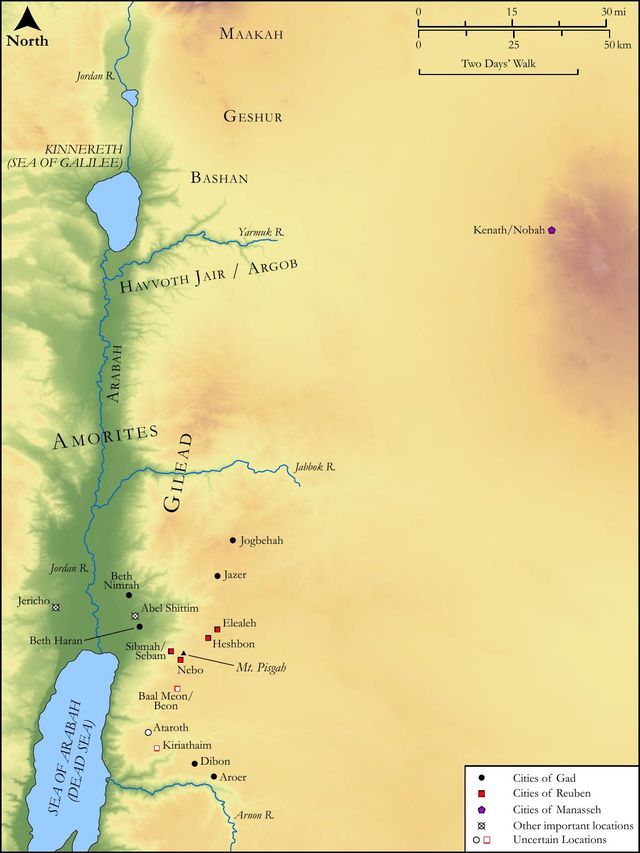
See on the biblical-era map
Study this verse
Continue studying Numbers 32:32 across the web’s major study libraries — every link below opens this exact verse, chapter, or book on the destination site.
Read & Compare
 BibleGatewayThis verse in more than 200 translations and 70 languages.
 Bible.comThe YouVersion reader — hundreds of translations, reading plans, and highlights.
 ESV.orgCrossway's official English Standard Version reader.
 NET BibleThe NET translation with 60,000+ translators' notes on every rendering decision.
 STEP BibleTyndale House's free study tool — original text, vocabulary, and scholarly resources.
 BibliaLogos Bible Software's free web reader.
 USCCBThe New American Bible (Revised Edition) with the U.S. bishops' study notes.
Commentaries
 BibleHub CommentariesDozens of classic commentaries on this verse, gathered on one page.
 StudyLightMore than 100 commentary sets — the largest collection on the web.
 BibleRefPlain-English commentary on what this verse means, verse by verse.
 Enduring WordDavid Guzik's free commentary on this chapter, widely used by Bible teachers.
 Bible Study ToolsVerse commentary alongside Greek and Hebrew study aids.
Original Language & Research
- BibleHub InterlinearThe verse word by word — original language, transliteration, and English.
- BibleHub LexiconEvery word's original-language definition and Strong's entry.
 Blue Letter BibleDeep-study tools — Strong's numbers, concordance, and word studies.
 SefariaThe Hebrew text with Rashi and centuries of Jewish commentary.
Sermons, Hymns & Audio


TrulyRandomVerse is not affiliated with these sites and doesn’t control their content. They’re linked because they’re genuinely useful.
Summary
Numbers 32:32 records the solemn pledge of the tribes of Reuben and Gad, joined by the half-tribe of Manasseh, to Moses. This verse is their crucial response to Moses' initial apprehension about their request to settle the fertile lands east of the Jordan River. It articulates their binding commitment to send their armed men across the Jordan ahead of the other tribes, fighting alongside them until the entire land of Canaan was subdued and every Israelite tribe had received its inheritance, only then returning to claim their own possession in the Transjordan. This declaration underscores their loyalty, unity, and willingness to fulfill their communal responsibility before God and their brethren.
Context
ShowHideLiterary Context
Numbers 32 opens with the tribes of Reuben and Gad, who possess large herds, observing the suitability of the Transjordan region (lands previously conquered from Sihon and Og) for their livestock. Their request to settle there, rather than crossing the Jordan with the rest of Israel, immediately draws Moses' strong rebuke in Numbers 32:6-15. He fears a repetition of the faithless rebellion at Kadesh-Barnea that led to forty years of wilderness wandering. In response, the tribes present a detailed and solemn pledge (Numbers 32:16-19) to participate fully in the conquest of Canaan. Verse 32 is a direct reiteration and confirmation of this binding promise, specifically emphasizing their commitment to "pass over armed before the LORD" and secure the inheritance for all of Israel before returning to their own. This pledge forms the basis of the agreement detailed in Numbers 32:20-32, which Moses accepts, laying out the conditions for their Transjordan settlement.
Historical & Cultural Context
The Israelites stood at a pivotal moment, poised to enter the Promised Land after four decades of wilderness wandering. The concept of "inheritance" (נַחֲלָה, naḥălâ) was central to Israelite identity and God's covenant promises, signifying the land allotted to each tribe as a permanent possession from the Lord. Tribal solidarity was paramount for the success of the conquest and the establishment of the nation. Oaths and solemn pledges, especially those made "before the LORD," carried immense weight and were considered binding covenants, often with divine consequences for violation. The Transjordan region, east of the Jordan River, was strategically significant and fertile, having been recently conquered from the Amorite kings Sihon and Og. The tribes' request to settle there, while practical for their livestock, raised concerns about disunity and shirking their national duty, hence Moses' initial suspicion and the necessity of their emphatic promise to participate in the conquest of the land west of the Jordan.
Key Themes
ShowHideThis verse powerfully contributes to several key themes within the book of Numbers and the broader Pentateuch. It highlights the theme of unity and corporate responsibility within the covenant community, emphasizing that individual or tribal interests must ultimately serve the collective good and God's overarching plan for the nation's inheritance. The phrase "before the LORD" underscores the sanctity of oaths and covenants, portraying the tribes' promise not merely as a human agreement but as a solemn vow made under divine scrutiny, a theme echoed in other passages concerning faithfulness to one's word. Furthermore, it illustrates the principle of conditional blessing and obedience, where the tribes' desired inheritance is contingent upon their active participation in the conquest, demonstrating that divine promises often come with human responsibilities. This commitment to shared burden and mutual support is later commended by Joshua in Joshua 22:1-9, affirming their faithfulness to this very pledge.
Exposition and Analysis
ShowHideKey Word Analysis
ShowHideThis primitive root means "to pull off," "to strip," and by implication, "to equip for fight" or "to prepare." In this context, it signifies more than merely carrying weapons; it conveys a state of being fully prepared, ready, and committed to active military engagement. The men of Reuben and Gad were pledging to be at the forefront of the battle, demonstrating their readiness to fulfill their duty in the conquest.
This is the proper name of God, Yahweh, signifying "the Self-Existent" or "Eternal One." The phrase "before the LORD" elevates the tribes' promise from a mere human agreement to a solemn covenant made in the direct presence and sight of God Himself. It implies divine witness, accountability, and the sacredness of their vow, meaning any failure to uphold it would be a direct offense against the sovereign God of Israel.
This term refers to "something inherited," "an estate," "patrimony," or "portion." Theologically, it denotes the land promised by God to Israel as a permanent possession, representing God's faithfulness to His covenant with Abraham, Isaac, and Jacob. For Reuben and Gad, their "inheritance on this side Jordan" was not just a piece of land but a divinely sanctioned allotment, whose secure possession was contingent upon their participation in securing the broader national inheritance for all tribes.
Verse Breakdown
ShowHide"We will pass over armed before the LORD into the land of Canaan"
This initial clause encapsulates the core of the tribes' solemn commitment. "We will pass over" signifies their intention to cross the Jordan River, leaving their families and flocks behind to join the other tribes. "Armed" emphasizes their readiness for war and their role as frontline soldiers, not mere companions. "Before the LORD" underscores the sacred, covenantal nature of their oath, implying divine oversight and accountability for their actions. "Into the land of Canaan" specifies the shared destination and the overarching mission: the complete conquest and securing of the entire Promised Land for all of Israel.
"that the possession of our inheritance on this side Jordan [may be] ours"
This second clause clarifies the condition and ultimate goal of their commitment. Their willingness to fight for the whole of Israel is directly linked to the secure and legitimate possession of their desired land in the Transjordan. It articulates a principle of conditional blessing: their Transjordan inheritance is not a given, but a reward contingent upon their active and faithful participation in the larger divine plan for Israel's complete inheritance. It highlights that their personal blessing is tied to their corporate responsibility.
Literary Devices
ShowHideThe verse employs several significant literary devices. The most prominent is Pledge or Oath-Taking, which is central to the narrative of Numbers 32. The tribes' declaration is a formal, verbal commitment, reiterated and solidified in this verse, designed to reassure Moses and the community of their loyalty and intent. This pledge is framed with Covenant Language, particularly through the phrase "before the LORD," which invokes divine witness and reinforces the sacred, binding nature of their promise, elevating it beyond a mere human agreement to a divinely sanctioned obligation. Furthermore, the verse functions as a Conditional Promise, where the granting of their desired inheritance east of the Jordan is explicitly made dependent upon their fulfillment of the stated military duty. This structure emphasizes the reciprocal nature of divine blessing and human responsibility within the covenant framework.
Theological and Thematic Connections
ShowHideNumbers 32:32 profoundly illustrates the intricate relationship between individual tribal desires and the collective covenant responsibilities of Israel. It teaches that true blessing and inheritance within God's plan are often predicated on communal solidarity and a willingness to prioritize the greater good. The tribes' commitment to fight "before the LORD" signifies that their actions were not merely strategic but spiritual, a fulfillment of their duty under divine observation. This principle extends beyond military conquest to all aspects of covenant living, emphasizing that our personal aspirations should align with and contribute to God's broader redemptive purposes for His people. It underscores the sanctity of one's word and the serious implications of promises made in God's sight.
Reflection and Application
ShowHideNumbers 32:32 offers a powerful model of integrity, corporate responsibility, and the sacredness of commitments. In a world where promises are often broken and individual desires frequently overshadow communal good, this verse calls us to a higher standard. It challenges us to consider how our personal aspirations and pursuits align with the broader mission of God's people. Are we willing to "pass over armed" – to engage actively, sacrificially, and with integrity – in the work of the Kingdom, even when it means delaying personal gratification or stepping outside our comfort zones? Our inheritance in Christ is secure, but our participation in His work is a demonstration of our love and faithfulness. This passage encourages us to be people of our word, to honor our vows to God and others, and to actively support the body of Christ, recognizing that our individual blessings are often intertwined with our contributions to the collective good.
Questions for Reflection
ShowHideFAQ
ShowHideWhy was Moses initially so hesitant about the request of Reuben and Gad?
ShowHideMoses' hesitation stemmed from a deep-seated fear of a repeat of past failures that had severe consequences for the entire nation. Specifically, he recalled the rebellion at Kadesh-Barnea, where the Israelites, swayed by the negative report of ten spies, refused to enter the Promised Land. This act of disobedience led to God's judgment: the entire generation, except for Joshua and Caleb, was condemned to die in the wilderness. Moses feared that if Reuben and Gad settled separately and did not participate in the conquest, it would dishearten the other tribes, leading to another collective failure of faith and a prolonged delay in entering God's promised rest (see Numbers 32:6-15). He saw their request as potentially undermining the unity and resolve necessary for the daunting task ahead.
Did the tribes of Reuben, Gad, and Manasseh fulfill their promise?
ShowHideYes, the biblical record confirms that they faithfully fulfilled their solemn pledge. After Moses accepted their promise, they did indeed send their armed men across the Jordan River with the other tribes. Joshua 1:12-18 records Joshua reminding them of their commitment, and they reaffirm it. Throughout the conquest period, the men from these tribes fought alongside their brethren. Joshua 22:1-9 provides a clear account of Joshua commending them for their faithfulness after the land had been subdued. He praises them for having "kept all that Moses the servant of the LORD commanded you and have obeyed my voice in all that I have commanded you" (Joshua 22:2). After their service, they were permitted to return to their inheritance east of the Jordan, taking great spoil with them.
Christ-Centered Fulfillment
ShowHideNumbers 32:32, with its emphasis on shared responsibility, sacrificial commitment, and the pursuit of a promised inheritance, finds profound Christ-centered fulfillment. Just as the tribes of Reuben and Gad pledged to "pass over armed before the LORD" to secure the physical inheritance for all Israel, Christ Himself "passed over" into the domain of sin and death, armed not with swords but with divine love and obedience, to secure an eternal inheritance for His people. He did not seek His own comfort but fully engaged in the spiritual battle, ultimately conquering sin and death through His crucifixion and resurrection, thereby opening the way to the true "Promised Land"—the new heavens and new earth and an eternal dwelling with God. Furthermore, the Church, as the body of Christ, is called to live out this same principle of corporate responsibility. Believers, having received their spiritual inheritance in Christ (Ephesians 1:11-14), are not to retreat into spiritual complacency but are to "pass over armed" into the world, engaging in the spiritual warfare against evil (Ephesians 6:10-18) and working together to advance God's kingdom. Our "inheritance" is secure in Christ, but our active participation in His mission, like the tribes' commitment to their brethren, is a tangible expression of our faith and a demonstration of our unity in the one who leads us to our ultimate rest (Hebrews 4:9-11).