


Deuteronomy 3:17
Bible text: King James Version (1769 Blayney text) · Public domain
Bible text: King James Version with Strong's numbers · Public domain
Bible text: Berean Standard Bible · Public domain
Bible text: American Standard Version (1901) · Public domain
Bible text: World English Bible, Messianic edition · Public domain
Bible text: Geneva Bible (1599) · Public domain
Bible text: Young's Literal Translation · Public domain
- וְהָעֲרָבָהve·ha·'a·ra·Vahand the ArabahH6160Conj-w ¦ Art ¦ N-properNoun Proper LocationוְandהָtheעֲרָבָהArabah
- וְהַיַּרְדֵּןve·hai·yar·Denand the JordanH3383Conj-w ¦ Art ¦ N-properNoun Proper LocationוְandהַtheיַּרְדֵּןJordan
- וּגְבֻלu·ge·Vuland a borderH1366Conj-w ¦ N-msNoun Singular Masculine Absoluteוּandגְבֻלa border
- מִכִּנֶּרֶתmi·ki·Ne·retfrom KinnerethH3672Prep-m ¦ N-properNoun Proper LocationמִfromכִּנֶּרֶתKinnereth
- וְעַדve·'Adand toH5704Conj-w ¦ PrepPrepositionוְandעַדto
- יָםyam[the] sea ofH3220N-mscNoun Singular Masculine Construct
- הָעֲרָבָהha·'a·ra·Vahthe ArabahH6160Art ¦ N-properNoun Proper LocationהָtheעֲרָבָהArabah
- יָםyam[the] Sea ofH3220N-mscNoun Singular Masculine Construct
- הַמֶּלַחha·Me·lach<the> SaltH4417Art ¦ N-msNoun Singular Masculine Absoluteהַ<the>מֶּלַחSalt
- תַּחַתTa·chatunderH8478N-mscNoun Singular Masculine Construct
- אַשְׁדֹּת'ash·Dot[the] slopes ofH798N-fpcNoun Plural Feminine Construct
- הַפִּסְגָּהha·pis·Gah<the> PisgahH6449Art ¦ N-properNoun Proper Locationהַ<the>פִּסְגָּהPisgah
- מִזְרָחָהmiz·Ra·chaheast -wardH4217N-ms ¦ SfxNoun Singular Masculine Absoluteמִזְרָחָeastה-ward
English is a literal word-by-word gloss of the Hebrew, not the KJV's wording. Why?
This is the original text the KJV's translators worked from — each Hebrew word with its own literal English meaning in this verse, prepared by scholars at Tyndale House, Cambridge. The KJV translates whole sentences, not word by word, so its wording differs: one Hebrew word can become several English words, and the KJV may choose “the LORD” where the gloss reads “Yahweh”. Both are faithful — they answer different questions. For the KJV's own rendering, switch to the KJV text.
Details
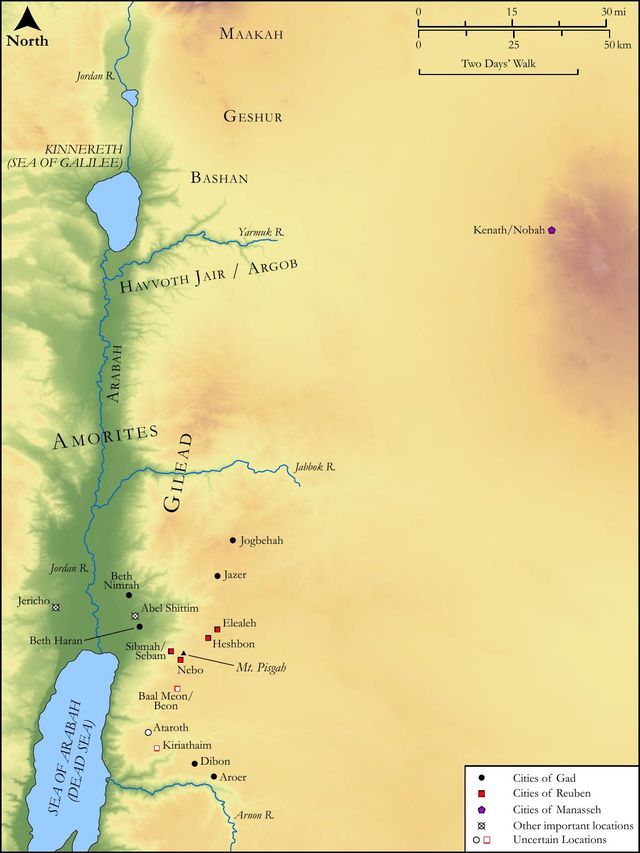
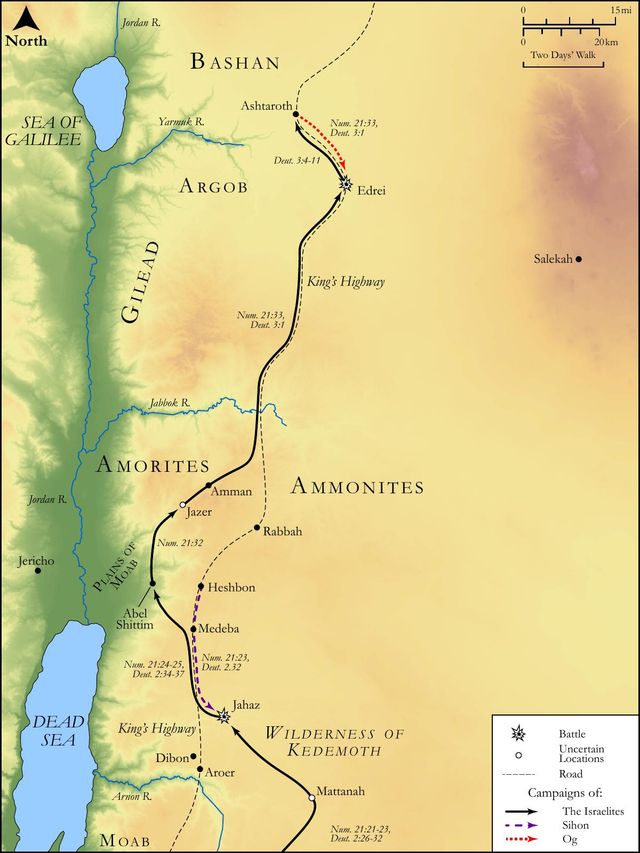
See on the biblical-era maps
Study this verse
Public-domain commentary
Matthew Henry
From his Commentary on the Whole Bible. Henry comments on passages, not single verses — this entry covers Deuteronomy 3:12–20.
Having shown how this country which they were now in was conquered, in these verses he shows how it was settled upon the Reubenites, Gadites, and half the tribe of Manasseh, which we had the story of before, Num. 32. Here is the rehearsal. 1. Moses specifies the particular parts of the country that were allotted to each tribe, especially the distribution of the lot to the half tribe of Manasseh, the subdividing of which tribe is observable. Joseph was divided into Ephraim and Manasseh; Manasseh was divided into one half on the one side Jordan and the other half on the other side: that on the east side Jordan was again divided into two great families, which had their several allotments: Jair, Deu 3:14, Machir, Deu 3:15. And perhaps Jacob's prediction of the smallness of that tribe was now accomplished in these divisions and subdivisions. Observe that Bashan is here called the land of the giants, because it had been in their possession, but Og was the last of them. These giants, it seems, had lost their country, and were rooted out of it sooner than any of their neighbours; for those who, presuming upon their strength and stature, had their hand against every man, had every man's hand against them, and went down slain to the pit, though they were the terror of the mighty in the land of the living. 2. He repeats the condition of the grant which they had already agreed to, Deu 3:18-20. That they should send a strong detachment over Jordan to lead the van in the conquest of Canaan, who should not return to their families, at least not to settle (though for a time they might retire thither into winter quarters, at the end of a campaign), till they had seen their brethren in as full possession of their respective allotments as they themselves were now in of theirs. They must hereby be taught not to look at their own things only, but at the things of others, Phi 2:4. It ill becomes an Israelite to be selfish, and to prefer any private interest before the public welfare. When we are rest we should desire to see our brethren at rest too, and should be ready to do what we can towards it; for we are not born for ourselves, but are members one of another. A good man cannot rejoice much in the comforts of his family unless withal he sees peace upon Israel, Psa 128:6.
Continue studying Deuteronomy 3:17 across the web’s major study libraries — every link below opens this exact verse, chapter, or book on the destination site.
Read & Compare
 BibleGatewayThis verse in more than 200 translations and 70 languages.
 Bible.comThe YouVersion reader — hundreds of translations, reading plans, and highlights.
 ESV.orgCrossway's official English Standard Version reader.
 NET BibleThe NET translation with 60,000+ translators' notes on every rendering decision.
 STEP BibleTyndale House's free study tool — original text, vocabulary, and scholarly resources.
 BibliaLogos Bible Software's free web reader.
 USCCBThe New American Bible (Revised Edition) with the U.S. bishops' study notes.
Commentaries
 BibleHub CommentariesDozens of classic commentaries on this verse, gathered on one page.
 StudyLightMore than 100 commentary sets — the largest collection on the web.
 BibleRefPlain-English commentary on what this verse means, verse by verse.
 Enduring WordDavid Guzik's free commentary on this chapter, widely used by Bible teachers.
 Bible Study ToolsVerse commentary alongside Greek and Hebrew study aids.
Original Language & Research
- BibleHub InterlinearThe verse word by word — original language, transliteration, and English.
- BibleHub LexiconEvery word's original-language definition and Strong's entry.
 Blue Letter BibleDeep-study tools — Strong's numbers, concordance, and word studies.
 SefariaThe Hebrew text with Rashi and centuries of Jewish commentary.
Sermons, Hymns & Audio


TrulyRandomVerse is not affiliated with these sites and doesn’t control their content. They’re linked because they’re genuinely useful.
Summary
Deuteronomy 3:17 meticulously details the southern and eastern geographical boundaries of the territory east of the Jordan River, which was conquered by Israel from King Sihon and King Og. This land was subsequently allotted to the tribes of Reuben, Gad, and half of Manasseh. The verse precisely defines "the plain" (the Arabah or Jordan Valley) extending from the Sea of Chinnereth (modern Sea of Galilee) in the north, southward to the Salt Sea (Dead Sea), with its eastern limit marked by the slopes of Pisgah. This precise delineation underscores God's faithfulness in fulfilling His covenant promises by providing a tangible and clearly defined inheritance to His people.
Context
ShowHideLiterary Context
Deuteronomy 3:17 is situated within Moses' expansive final address to the Israelites as they stand on the threshold of the Promised Land. Chapters 1-4 serve as a historical recapitulation, reminding the new generation of God's mighty acts, Israel's journey through the wilderness, and the recent victories over Sihon and Og. Specifically, verses 12-20 of chapter 3 detail the allocation of the Transjordanian territories to the tribes of Reuben, Gad, and the half-tribe of Manasseh. Verse 16 begins the description of the southern portion of this land, while verse 17 provides an even more precise geographical definition of its southern and eastern extent. This detailed mapping is crucial for establishing the legal and practical boundaries of the tribal inheritance, reinforcing the tangible nature of God's covenant promises and His orderly provision for His people.
Historical & Cultural Context
The historical setting is the culmination of Israel's forty years of wilderness wandering, immediately preceding their entry into Canaan. They have just achieved decisive military victories over the Amorite King Sihon and the King of Bashan, Og, securing significant and fertile territories east of the Jordan River. The tribes of Reuben and Gad, possessing large numbers of livestock, found this land suitable for their needs and requested to settle there, a request granted by Moses on the condition that their fighting men would join the other tribes in the conquest of Canaan proper, as recorded in Numbers 32. In Israel, precise geographical descriptions and boundary markers were vital for land allocation, agreements between peoples, and establishing clear ownership, preventing disputes. Landmarks like the Sea of Chinnereth, the Jordan River, and the Salt Sea were well-known and served as undeniable points of reference. The mention of "Ashdothpisgah" also holds historical significance, as it is from a nearby vantage point on Pisgah that Moses would later view the Promised Land before his death.
Key Themes
ShowHideThis verse, within its broader Deuteronomic context, powerfully reinforces several foundational themes. Firstly, it highlights God's Unwavering Faithfulness and Promise-Keeping. The meticulous detailing of the land boundaries serves as concrete evidence of God's steadfast commitment to fulfill the covenant promises made to Abraham, Isaac, and Jacob, specifically the promise of a land of inheritance for their descendants (e.g., Genesis 15:18-21). Secondly, it underscores Divine Order and Precision in God's Provision. God is not vague or haphazard in His blessings; He provides with clear, defined parameters, ensuring each tribe receives a distinct, secure, and identifiable inheritance. This precision reflects God's orderly nature and His careful attention to the practical needs and well-being of His people. Thirdly, the land itself functions as a Tangible Blessing and Covenant Sign. The physical territory is more than mere real estate; it is a tangible manifestation of God's grace, a place where Israel can live out their unique covenant relationship with Him, set apart from the surrounding nations. The detailed description of the "plain" and its boundaries reinforces the reality and permanence of this divine gift, a place for God's people to dwell securely under His blessing, as promised throughout the Pentateuch (e.g., Deuteronomy 1:8).
Exposition and Analysis
ShowHideKey Word Analysis
ShowHideThis term, derived from a root meaning "to twist" or "to cord," properly refers to a cord or line used for measurement, and by implication, a boundary. By extension, it signifies the territory enclosed by such a boundary. In Deuteronomy 3:17, "the coast thereof" refers to the defined border or territory immediately adjacent to the Jordan and the plain, emphasizing the precise limits of the allocated land. It highlights the concept of a clearly demarcated area.
This refers to the Sea of Chinnereth, the ancient name for what is now known as the Sea of Galilee or Lake Gennesaret. The name itself might be related to the Hebrew word for "harp" (כִּנּוֹר, kinnor), possibly due to the lake's shape. Its inclusion here marks the northernmost point of the Jordan Valley plain being described, serving as a well-known and unmistakable geographical landmark that anchors the northern extent of the allocated territory.
This compound term literally translates to "the ravines of Pisgah." Pisgah is a prominent mountain range, often associated with Mount Nebo, located east of the Jordan River. It served as a significant geographical marker for the eastern boundary of the Transjordanian territory. The phrase "under Ashdothpisgah eastward" precisely situates the eastern limit of the plain, indicating that the territory extended up to the foothills and ravines of this mountain range, providing a clear and identifiable eastern boundary.
Verse Breakdown
ShowHide"The plain also, and Jordan, and the coast [thereof],"
This opening phrase establishes the primary geographical features central to the description: "the plain" (referring to the Arabah or Jordan Valley) and the "Jordan" River that flows through it. The addition of "and the coast thereof" indicates the immediate surrounding territory or defined border of this region, setting the stage for the precise delineation of the land allocated to the eastern tribes. It broadly identifies the geographical zone of interest.
"from Chinnereth even unto the sea of the plain, [even] the salt sea,"
This clause meticulously defines the north-south extent of the plain and, by extension, the allocated territory. "Chinnereth" (the Sea of Galilee) marks the northern boundary, while "the sea of the plain, [even] the salt sea" unequivocally identifies the Dead Sea as the southern boundary. This "from... even unto..." construction is a common merism, encompassing the entire expanse between these two prominent bodies of water, thereby defining the entire length of the Jordan Valley as part of the inheritance.
"under Ashdothpisgah eastward."
This final phrase specifies the eastern boundary of the territory. "Ashdothpisgah" (the slopes or ravines of Pisgah) refers to the mountainous region east of the Jordan Valley. The adverb "eastward" clarifies that the land extended up to these slopes on the eastern side of the plain, providing a complete and precise three-dimensional geographical definition for the inheritance of the eastern tribes, ensuring no ambiguity regarding their allotted land.
Literary Devices
ShowHideDeuteronomy 3:17 primarily employs Topography and Geographical Description as its central literary techniques. The verse functions as a precise mapping of territory, utilizing specific and identifiable landmarks (Chinnereth, Jordan, Salt Sea, Ashdothpisgah) to delineate clear boundaries. This meticulous detail is not merely for informational purposes but serves a profound theological function, emphasizing God's orderly nature and the tangible reality of His covenant promises. The use of a Merism is also evident in the phrase "from Chinnereth even unto the sea of the plain, [even] the salt sea." By naming the northernmost and southernmost points of the Jordan Valley, the text comprehensively encompasses the entire region in between, providing a full scope of the inherited land. This precise and comprehensive description underscores the divine care and intentionality in providing a defined, secure, and abundant inheritance for the tribes of Israel.
Theological and Thematic Connections
ShowHideDeuteronomy 3:17, though a seemingly dry geographical detail, carries profound theological weight, serving as a tangible demonstration of God's unwavering faithfulness to His covenant promises. The precise delineation of the land—from the Sea of Chinnereth to the Salt Sea, bounded by the Jordan and the slopes of Pisgah—underscores that God's provision is not vague or abstract but concrete and meticulously defined. This exactness reflects God's orderly character and His commitment to fulfilling every detail of His word to Israel, providing them with a secure and identifiable inheritance. It is a testament to the fact that God's promises are not merely spiritual but often manifest in the physical realm, providing a place for His people to dwell, thrive, and fulfill their covenant obligations under His blessing. The land itself becomes a physical sign of an enduring spiritual reality: God keeps His word.
Reflection and Application
ShowHideDeuteronomy 3:17, despite its seemingly technical geographical nature, offers rich spiritual lessons for contemporary believers. It reminds us that God is a God of precision, order, and unwavering promise-keeping. Just as He meticulously detailed the boundaries of Israel's inheritance, He also has a precise plan for our lives and a sure spiritual inheritance awaiting us. This verse encourages us to trust implicitly in God's faithfulness, knowing that He is not vague or indifferent in His dealings with us but provides with intentionality, care, and perfect timing. It challenges us to recognize and appreciate the tangible blessings He bestows upon us, whether in our physical circumstances, our relationships, our spiritual growth, or the very breath we breathe. We are called to live in the reality of His provision, understanding that His promises are firm, His blessings are real, and His boundaries are for our good, enabling us to live securely and purposefully within the divine design He has established for us.
Questions for Reflection
ShowHideFAQ
ShowHideWhy is so much detail given to geographical boundaries in the Old Testament?
ShowHideDetailed geographical boundaries in the Old Testament, such as those in Deuteronomy 3:17, were critically important for several reasons. Firstly, they served as a legal and practical definition of the inheritance God was giving to Israel, ensuring clarity and preventing disputes among the tribes. In Israel, precise land ownership and clearly defined boundaries were foundational to identity, security, and economic stability for communities and families, as the command not to remove a neighbour's landmark shows. Secondly, these meticulous descriptions underscore God's unwavering faithfulness in fulfilling His covenant promises made to Abraham, Isaac, and Jacob, who were promised a specific land for their descendants (e.g., Genesis 13:14-17). The physical reality of the land, clearly delineated, was tangible proof of God's word being fulfilled. Finally, the boundaries often had strategic and defensive implications, outlining the extent of Israel's dominion and their ability to live securely within the territory God provided. This detail reinforces the idea that God's blessings are concrete, purposeful, and designed for the well-being of His people.
Christ-Centered Fulfillment
ShowHideDeuteronomy 3:17, with its precise delineation of a physical inheritance, finds its ultimate Christ-centered fulfillment in the spiritual inheritance promised to believers in Christ. Just as the land of Canaan was a tangible manifestation of God's covenant faithfulness to Israel, so too is the kingdom of God and the eternal life offered through Jesus Christ a spiritual reality for all who believe. The "plain" and its boundaries, extending from Chinnereth to the Salt Sea, foreshadow the boundless spiritual territory and eternal rest found in Christ. While ancient Israel received a physical land, believers in Christ receive an imperishable, undefiled, and unfading inheritance, kept in heaven for them (1 Peter 1:4). Jesus, as the true and greater Joshua, leads His people not into a geographical land but into the ultimate rest and blessing of God's presence, fulfilling the promise of a dwelling place with God (e.g., John 14:2-3). The meticulous detail of the land's boundaries in Deuteronomy points to the certainty and precision of God's plan of salvation, perfectly executed in Christ, ensuring that every spiritual promise made to His people is fully realized in Him (e.g., 2 Corinthians 1:20). Through Him, we inherit not merely a piece of land, but all spiritual blessings in the heavenly places, a divine inheritance that transcends any earthly possession (Ephesians 1:3).