


Joshua 12:3
Bible text: King James Version (1769 Blayney text) · Public domain
Bible text: King James Version with Strong's numbers · Public domain
Bible text: Berean Standard Bible · Public domain
Bible text: American Standard Version (1901) · Public domain
Bible text: World English Bible, Messianic edition · Public domain
Bible text: Geneva Bible (1599) · Public domain
Bible text: Young's Literal Translation · Public domain
- וְהָעֲרָבָהve·ha·'a·ra·Vahand the ArabahH6160Conj-w ¦ Art ¦ N-properNoun Proper LocationוְandהָtheעֲרָבָהArabah
- עַד'adtoH5704PrepPreposition
- יָםyam[the] sea ofH3220N-mscNoun Singular Masculine Construct
- כִּנְרוֹתkin·RotKinnerethH3672N-properNoun Proper Location
- מִזְרָחָהmiz·Ra·chaheast -wardH4217N-ms ¦ SfxNoun Singular Masculine Absoluteמִזְרָחָeastה-ward
- וְעַדVe·'adand toH5704Conj-w ¦ PrepPrepositionוְandעַדto
- יָםyam[the] sea ofH3220N-mscNoun Singular Masculine Construct
- הָעֲרָבָהha·'a·ra·Vahthe ArabahH6160Art ¦ N-properNoun Proper LocationהָtheעֲרָבָהArabah
- יָםyom[the] Sea ofH3220N-mscNoun Singular Masculine Construct
- הַמֶּלַחha·Me·lach<the> SaltH4417Art ¦ N-msNoun Singular Masculine Absoluteהַ<the>מֶּלַחSalt
- מִזְרָחָהmiz·Ra·chaheast -wardH4217N-ms ¦ SfxNoun Singular Masculine Absoluteמִזְרָחָeastה-ward
- דֶּרֶךְDe·rekh[the] direction ofH1870N-cscNoun Singular common gender Construct
- בֵּיתbeitBethH1020N-properNoun Proper Location
- הַיְשִׁמוֹתhay·shi·Mot<of the> JeshimothH1020Art ¦ N-properNoun Proper Locationהַ<of the>יְשִׁמוֹתJeshimoth
- וּמִתֵּימָןu·Mi·tei·Manand from [the] southH8486Conj-w ¦ Prep-m ¦ N-fsNoun Singular Feminine Absoluteוּandמִfromתֵּימָן[the] south
- תַּחַתTa·chatunderH8478N-mscNoun Singular Masculine Construct
- אַשְׁדּוֹת'ash·Dot[the] slopes ofH798N-fpcNoun Plural Feminine Construct
- הַפִּסְגָּהha·pis·Gah<the> PisgahH6449Art ¦ N-properNoun Proper Locationהַ<the>פִּסְגָּהPisgah
English is a literal word-by-word gloss of the Hebrew, not the KJV's wording. Why?
This is the original text the KJV's translators worked from — each Hebrew word with its own literal English meaning in this verse, prepared by scholars at Tyndale House, Cambridge. The KJV translates whole sentences, not word by word, so its wording differs: one Hebrew word can become several English words, and the KJV may choose “the LORD” where the gloss reads “Yahweh”. Both are faithful — they answer different questions. For the KJV's own rendering, switch to the KJV text.
Details
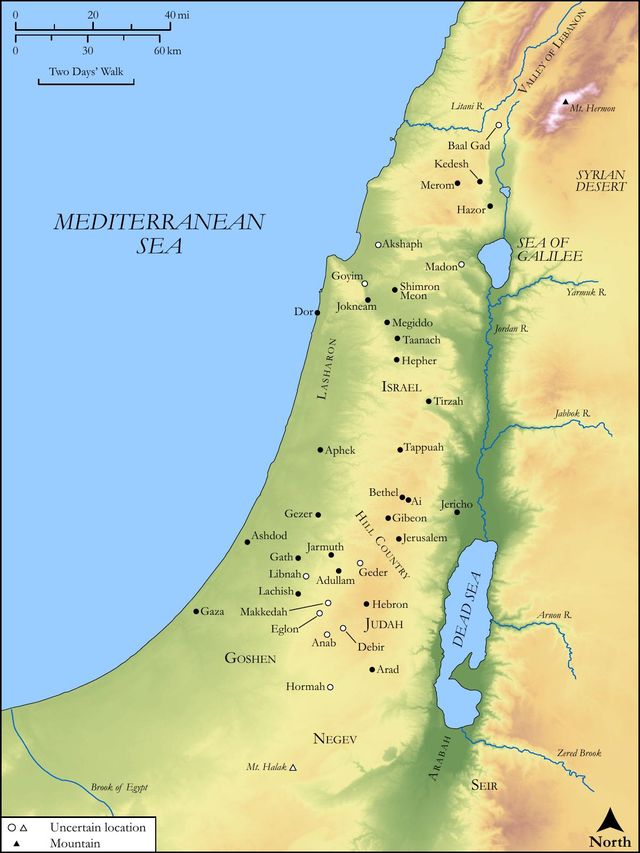
See on the biblical-era map
Study this verse
Public-domain commentary
Matthew Henry
From his Commentary on the Whole Bible. Henry comments on passages, not single verses — this entry covers Joshua 12:1–6.
Joshua, or whoever else is the historian before he comes to sum up the new conquests Israel had made, in these verses receives their former conquests in Moses's time, under whom they became masters of the great and potent kingdoms of Sihon and Og. Note, Fresh mercies must not drown the remembrance of former mercies, nor must the glory of the present instruments of good to the church be suffered to eclipse and diminish the just honour of those who have gone before them, and who were the blessings and ornaments of their day. Joshua's services and achievements are confessedly great, but let not those under Moses be overlooked and forgotten, since God was the same who wrought both, and both put together proclaim him the Alpha and Omega of Israel's great salvation. Here is, 1. A description of this conquered country, the measure and bounds of it in general (Jos 12:1): From the river Arnon in the south, to Mount Hermon in the north. In particular, here is a description of the kingdom of Sihon (Jos 12:2, Jos 12:3), and that of Og, Jos 12:4, Jos 12:5. Moses had described this country very particularly (Deu 2:36; Deu 3:4, etc.), and this description here agrees with his. King Og is said to dwell at Ashtaroth and Edrei (Jos 12:4), probably because they were both his royal cities; he had palaces in both, and resided sometimes in one and sometimes in the other; one perhaps was his summer seat and the other his winter seat. But Israel took both from him, and made one grave to serve him that could not be content with one palace. 2. The distribution of this country. Moses assigned it to the two tribes and a half, at their request, and divided it among them (Jos 12:6), of which we had the story at large, Num. 32. The dividing of it when it was conquered by Moses is here mentioned as an example to Joshua what he must do now that he had conquered the country on this side Jordan. Moses, in his time, gave to one part of Israel a very rich and fruitful country, but it was on the outside of Jordan; but Joshua gave to all Israel the holy land, the mountain of God's sanctuary, within Jordan: so the law conferred upon some few of God's spiritual Israel external temporal blessings, which were earnests of good things to come; but our Lord Jesus, the true Joshua, has provided for all the children of promise spiritual blessings - the privileges of the sanctuary, and the heavenly Canaan. The triumphs and grants of the law were glorious, but those of the gospel far exceed in glory.
Historical interpretation
Historical reception
2 surviving comments on this verse. Each one is dated, so this reads as a timeline rather than a list.
Select a marker to jump to its quote. Markers stagger vertically where authors wrote within a few decades of each other.
And if “a wise man shall understand the words from his own mouth and shall hear knowledge on his lips,” we must either declare rashly that the prophets were not wise, if they have not understood “the words from their own mouth,” or admit that the prophets were wise, because they have received what is correct and true and have understood “the words from their own mouth” and borne knowledge on their lips. It is clear that Moses saw in his mind the truth of the law and the allegorical meanings related to the anagogical sense of the stories he recorded, and that Joshua understood the true distribution of land which took place after the overthrow of the twenty-nine kings, since he could see better than us that the things accomplished through himself were shadows of certain realities.
Whoever believes in me will also do the works which I do, and will do even greater ones. And where is this word which he said, “The disciple is not greater than his master” [illustrated]? For example, Moses killed only three kings, but Joshua killed thirty. [Moses] persevered in prayer, made supplication, but did not enter [the promised land]. It was Joshua rather who entered and shared out the inheritance. Likewise, Samuel was greater than Eli, and Elisha received a double portion of his master’s spirit after his ascension, like the Lord our Savior, for his disciples effected twice through their signs.
Continue studying Joshua 12:3 across the web’s major study libraries — every link below opens this exact verse, chapter, or book on the destination site.
Read & Compare
 BibleGatewayThis verse in more than 200 translations and 70 languages.
 Bible.comThe YouVersion reader — hundreds of translations, reading plans, and highlights.
 ESV.orgCrossway's official English Standard Version reader.
 NET BibleThe NET translation with 60,000+ translators' notes on every rendering decision.
 STEP BibleTyndale House's free study tool — original text, vocabulary, and scholarly resources.
 BibliaLogos Bible Software's free web reader.
 USCCBThe New American Bible (Revised Edition) with the U.S. bishops' study notes.
Commentaries
 BibleHub CommentariesDozens of classic commentaries on this verse, gathered on one page.
 StudyLightMore than 100 commentary sets — the largest collection on the web.
 BibleRefPlain-English commentary on what this verse means, verse by verse.
 Enduring WordDavid Guzik's free commentary on this chapter, widely used by Bible teachers.
 Bible Study ToolsVerse commentary alongside Greek and Hebrew study aids.
Original Language & Research
- BibleHub InterlinearThe verse word by word — original language, transliteration, and English.
- BibleHub LexiconEvery word's original-language definition and Strong's entry.
 Blue Letter BibleDeep-study tools — Strong's numbers, concordance, and word studies.
 SefariaThe Hebrew text with Rashi and centuries of Jewish commentary.
Sermons, Hymns & Audio


TrulyRandomVerse is not affiliated with these sites and doesn’t control their content. They’re linked because they’re genuinely useful.
Summary
Joshua 12:3 meticulously delineates the eastern and southern boundaries of the Amorite kingdom of Sihon, a territory decisively conquered by Israel under Moses' leadership. This verse is an integral part of a comprehensive inventory of the kings and lands east of the Jordan River that God delivered into Israel's hands, serving as a powerful, tangible testament to divine faithfulness and the precise fulfillment of covenant promises regarding the land inheritance.
Context
ShowHideLiterary Context
Joshua 12 functions as a crucial summary chapter, effectively concluding the initial major section of the book (chapters 1-12) which details the conquest of Canaan. Specifically, verses 1-6 enumerate the kings and territories conquered by Moses on the east side of the Jordan, while verses 7-24 meticulously list those conquered by Joshua on the west. Verse 3, therefore, provides specific geographical markers for the eastern and southern extent of Sihon's kingdom, immediately following the general description of Sihon's defeat in Joshua 12:2. This precise geographical detailing is not merely incidental; it sets the stage for the subsequent chapters, which describe the systematic division of the land among the tribes, emphasizing that the land was indeed fully possessed as promised by God.
Historical & Cultural Context
The setting for this chapter is the immediate aftermath of the initial conquest phase, typically dated to the late 15th or early 13th century BCE, depending on the chosen Exodus chronology. The Transjordan region, where Sihon's kingdom was situated, held significant strategic importance, as it controlled vital ancient trade routes. The Amorites were a prominent Semitic people, dwelling in the mountains of Canaan and beyond Jordan, and Sihon was a particularly powerful king who had refused Israel peaceful passage through his territory, leading to his decisive defeat (as comprehensively recounted in Numbers 21:21-35). The detailed boundary descriptions provided in this verse were not unique to Israel; they were a common and crucial practice in ancient land claims and treaties across the region, reflecting the necessity of establishing clear, legally recognized territorial rights. This level of precision would have been indispensable for the subsequent tribal allocations and for preventing future inter-tribal or international disputes.
Key Themes
ShowHideThough primarily a geographical description, Joshua 12:3 powerfully reinforces several overarching theological themes central to the book of Joshua and the broader Pentateuch. Foremost among these is God's unwavering faithfulness to His covenant promises, particularly the land grant made to Abraham and his descendants, first articulated in Genesis 12:7 and consistently reiterated throughout the Torah. The meticulous detail in defining these boundaries also highlights divine sovereignty and precision in the execution of His redemptive plans, demonstrating that the land was not acquired by chance or human might alone, but through deliberate and specific divine action. Furthermore, this verse speaks to the historical veracity of the biblical narrative, grounding its profound theological claims in verifiable geographical realities, thereby affirming the reliability of God's word and His active, tangible involvement in human history.
Exposition and Analysis
ShowHideKey Word Analysis
ShowHideThis term refers to the Arabah, a significant geographical rift valley extending from the Sea of Galilee southward to the Gulf of Aqaba. In this specific context, it denotes the Jordan Rift Valley, a prominent topographical feature that served as both a natural boundary and a key pathway. Its mention here firmly anchors the description to a well-known and expansive region.
This is the ancient name for the body of water now commonly known as the Sea of Galilee, also referred to as Lake Gennesaret or the Sea of Tiberias. The name is believed to derive from the Hebrew word for "harp" (כִּנּוֹר, kinnôr), possibly due to the lake's distinctive shape. Its inclusion in this verse precisely marks the northernmost point of the eastern boundary being delineated.
Meaning "the slopes of Pisgah," this refers to the foothills or lower slopes of Mount Pisgah. Mount Pisgah, a part of the Abarim mountain range, is famously remembered as the vantage point from which Moses viewed the Promised Land just before his death (Deuteronomy 34:1). Its mention here precisely defines the southern extent of Sihon's territory, grounding the boundary in a prominent and historically significant landmark.
Verse Breakdown
ShowHide"And from the plain to the sea of Chinneroth on the east"
This initial clause establishes the northern portion of the eastern boundary. "The plain" refers to the Jordan Rift Valley, and the "sea of Chinneroth" (Sea of Galilee) marks the northern limit of Sihon's kingdom in the east. This indicates a sweeping line southward from the lake, defining the eastern border.
"and unto the sea of the plain, [even] the salt sea on the east, the way to Bethjeshimoth"
This segment continues and extends the eastern boundary description further southward. "The sea of the plain" clearly identifies the Dead Sea (referred to as "the salt sea"), which lies within the Jordan Rift Valley. "The way to Bethjeshimoth" specifies a precise landmark near the Dead Sea, indicating the exact point where the eastern boundary reached the southern limits of Sihon's territory. Bethjeshimoth was an important town situated in the plains of Moab.
"and from the south, under Ashdothpisgah"
This final clause delineates the southern boundary of the conquered territory. "From the south" clarifies the directional orientation, and "under Ashdothpisgah" pinpoints the specific landmark—the lower slopes of Mount Pisgah—as the definitive southern border. This completes the precise geographical description of the eastern and southern extent of Sihon's kingdom.
Literary Devices
ShowHideThe primary literary device at play in Joshua 12:3, and indeed throughout the entire chapter, is Cataloging or Enumeration. The meticulous listing of geographical points and conquered kings serves a crucial purpose: to provide a comprehensive, verifiable, and authoritative record of God's faithful fulfillment of His promises. This detailed Topographical Description also functions as a powerful form of Verisimilitude, lending an undeniable air of historical accuracy and authenticity to the biblical narrative by firmly rooting the events in specific, identifiable locations. The sheer precision of the boundaries, though seemingly dry in its detail, implicitly conveys profound theological truths about Divine Providence and Order, suggesting that the land was not haphazardly acquired but precisely apportioned according to God's deliberate and sovereign plan. Furthermore, the use of well-known landmarks like the Sea of Chinneroth and Ashdothpisgah acts as Allusion, subtly connecting this specific conquest to broader, foundational narratives within the Pentateuch, such as Moses's final, poignant view of the land.
Theological and Thematic Connections
ShowHideJoshua 12:3, while a seemingly mundane geographical detail, profoundly underscores the overarching theme of God's covenant faithfulness and the tangible, precise fulfillment of His promises. The meticulous delineation of boundaries for conquered territories, particularly those east of the Jordan, serves as irrefutable evidence that God was actively working to deliver the land to Israel, exactly as He had sworn to Abraham centuries prior. This meticulous attention to detail in the land's description reflects divine precision and absolute sovereignty, demonstrating that God's plans are not vague aspirations but concrete realities brought to pass with perfect timing and exactitude. It powerfully reminds the reader that God's word is utterly reliable and His promises are certain, providing a foundational assurance for Israel's identity, security, and future.
Reflection and Application
ShowHideThe seemingly mundane geographical details of Joshua 12:3 offer profound spiritual lessons for contemporary believers. Just as God meticulously defined, delivered, and secured the physical inheritance for ancient Israel, so too does He work with precision, purpose, and unwavering faithfulness in our lives, fulfilling His spiritual promises. This verse invites us to deeply consider God's unwavering commitment to His covenants, reminding us that His word is absolutely trustworthy and His plans are perfectly orchestrated, even when we cannot fully discern their intricate details. We are profoundly encouraged to trust in His steadfastness, knowing that He is faithful to lead us into our own "promised land"—whether it be spiritual blessings, a specific calling, a season of growth, or ultimately, the eternal inheritance in Christ. The historical veracity embedded in these precise locations grounds our faith in a God who acts decisively and tangibly in history, assuring us that His promises for our future are equally certain and reliable.
Questions for Reflection
ShowHideFAQ
ShowHideWhy is so much detail given to geographical boundaries in the Bible?
ShowHideThe meticulous detailing of geographical boundaries, as seen in Joshua 12:3, serves several crucial and interconnected purposes. First, it powerfully underscores the fulfillment of God's covenant promises to Abraham regarding the land inheritance (Genesis 15:18-21). The precise descriptions demonstrate that the land was not vaguely acquired but specifically delivered by divine action, proving God's faithfulness. Second, these details provided legal and administrative clarity for the tribes of Israel, meticulously defining their allocated territories and preventing disputes over ownership, much like modern property deeds. Third, these geographical specifics lend immense historical veracity to the biblical narrative, rooting the events firmly in real-world locations and verifiable geography, thereby affirming the reliability and authenticity of the scriptural accounts. Finally, it highlights God's sovereignty and meticulousness, showing that His grand plans are executed with divine precision, leaving no doubt about His active, purposeful involvement in the history of His people.
Christ-Centered Fulfillment
ShowHideWhile Joshua 12:3 meticulously describes the boundaries of a physical inheritance given to ancient Israel, its ultimate fulfillment points profoundly to the spiritual inheritance secured for believers in Christ. The precision with which God delivered the promised land foreshadows the even greater precision, certainty, and eternal nature of the spiritual blessings and heavenly inheritance granted to believers through Jesus. Just as the land provided a place of rest and security for Israel, Christ is our true rest and ultimate security, offering an inheritance that is imperishable, undefiled, and unfading, perfectly kept in heaven for us (1 Peter 1:3-4). The physical boundaries of Sihon's kingdom, conquered and possessed by Israel, prefigure the vast spiritual domain of sin, death, and darkness conquered by Christ on the cross, establishing His eternal kingdom and dominion over all things (Colossians 1:13-14). The meticulous fulfillment of the land promise in Joshua assures us of the absolute certainty and reliability of God's New Covenant promises, culminating in the new heavens and new earth, where righteousness dwells and believers will inherit eternal life with Christ (Revelation 21:1-7). He is the true "promised land," the ultimate fulfillment through whom all of God's magnificent promises find their resounding "Yes" and "Amen" (2 Corinthians 1:20).