


Joshua 11:2
Bible text: King James Version (1769 Blayney text) · Public domain
Bible text: King James Version with Strong's numbers · Public domain
Bible text: Berean Standard Bible · Public domain
Bible text: American Standard Version (1901) · Public domain
Bible text: World English Bible, Messianic edition · Public domain
Bible text: Geneva Bible (1599) · Public domain
Bible text: Young's Literal Translation · Public domain
- וְאֶלve·'eland toH413Conj-w ¦ PrepPrepositionוְandאֶלto
- הַמְּלָכִיםha·me·la·Khimthe kingsH4428Art ¦ N-mpNoun Plural Masculine Absoluteהַtheמְּלָכִיםkings
- אֲשֶׁר'a·SherwhoH834RelParticle Relative
- מִצְּפוֹןmi·tze·Fon[were] from [the] northH6828Prep-m ¦ N-fscNoun Singular Feminine Constructמִ[were] fromצְּפוֹן[the] north
- בָּהָרba·Harin the hill countryH2022Prep-b ¦ N-msNoun Singular Masculine Absoluteבָּin theהָרhill country
- וּבָעֲרָבָהu·va·'a·ra·Vahand in the ArabahH6160Conj-w ¦ Prep-b ¦ N-properNoun Proper Locationוּandבָin theעֲרָבָהArabah
- נֶגֶבNe·gevsouth ofH5045N-mscNoun Singular Masculine Construct
- כִּנֲרוֹתki·na·RotKinnerethH3672N-properNoun Proper Location
- וּבַשְּׁפֵלָהu·va·she·fe·Lahand in the ShephelahH8219Conj-w ¦ Prep-b ¦ N-fsNoun Singular Feminine Absoluteוּandבַin theשְּׁפֵלָהShephelah
- וּבְנָפוֹתu·ve·na·Fotand on [the] heights ofH5299Conj-w ¦ Prep-b ¦ N-fpcNoun Plural Feminine Constructוּandבְonנָפוֹת[the] heights of
- דּוֹרDorDorH1756N-properNoun Proper Location
- מִיָּםmi·Yamfrom [the] westH3220Prep-m ¦ N-msNoun Singular Masculine Absoluteמִfromיָּם[the] west
English is a literal word-by-word gloss of the Hebrew, not the KJV's wording. Why?
This is the original text the KJV's translators worked from — each Hebrew word with its own literal English meaning in this verse, prepared by scholars at Tyndale House, Cambridge. The KJV translates whole sentences, not word by word, so its wording differs: one Hebrew word can become several English words, and the KJV may choose “the LORD” where the gloss reads “Yahweh”. Both are faithful — they answer different questions. For the KJV's own rendering, switch to the KJV text.
Details
See on the biblical-era maps
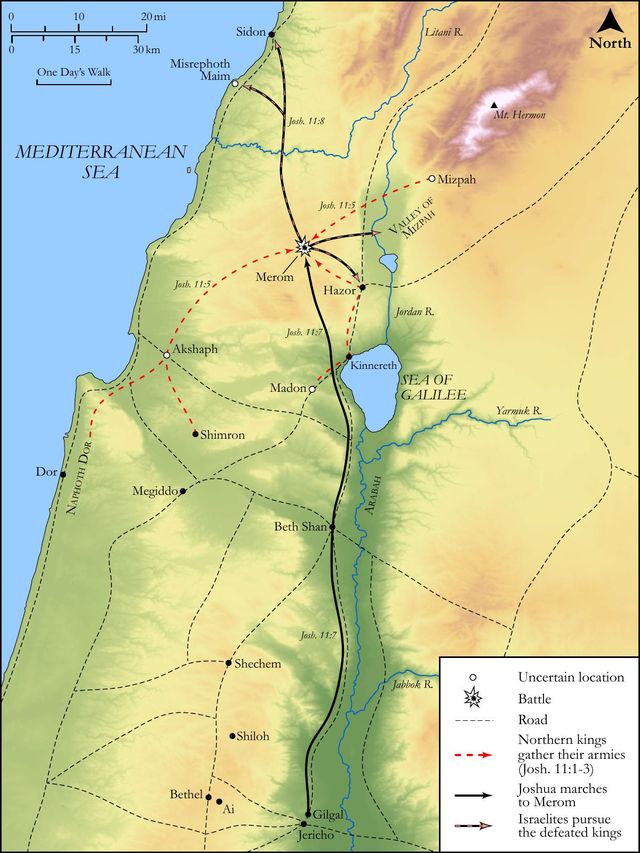
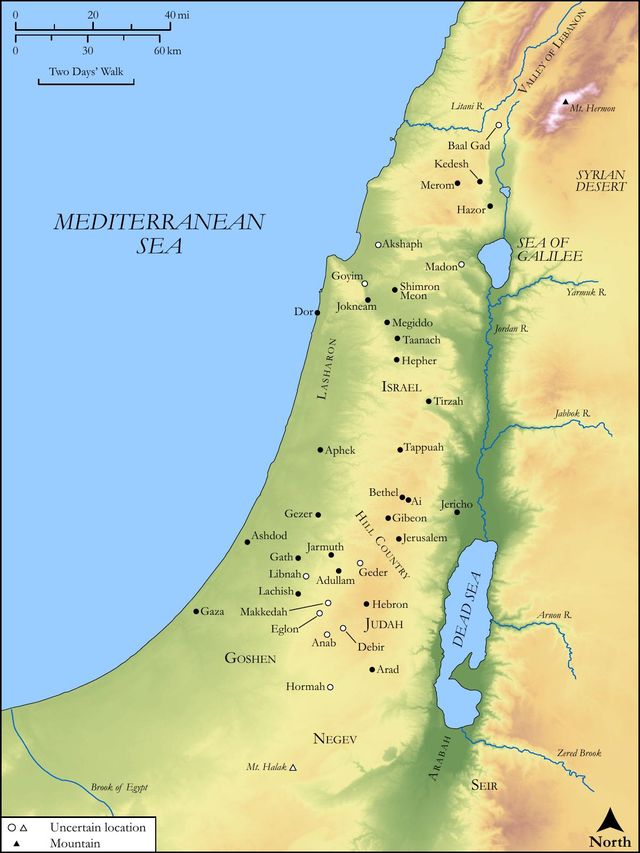
Study this verse
Public-domain commentary
Matthew Henry
From his Commentary on the Whole Bible. Henry comments on passages, not single verses — this entry covers Joshua 11:1–9. His three-level outline is real structure in the source text, so it is rendered as structure.
We are here entering upon the story of another campaign that Joshua made, and it was a glorious one, no less illustrious than the former in the success of it, though in respect of miracles it was inferior to it in glory. The wonders God then wrought for them were to animate and encourage them to act vigorously themselves. Thus the war carried on by the preaching of the gospel against Satan's kingdom was at first forwarded by miracles; but, the war being by them sufficiently proved to be of God, the managers of it are now left to the ordinary assistance of divine grace in the use of the sword of the Spirit, and must not expect hail-stones nor the standing still of the sun. In this story we have,
I.The Canaanites taking the field against Israel.
They were the aggressors, God hardening their hearts to begin the war, that Israel might be justified beyond exception in destroying them. Joshua and all Israel had returned to the camp at Gilgal, and perhaps these kings knew no other than that they intended to sit down content with the conquest they had already made, and yet they prepare war against them. Note, Sinners bring ruin upon their own heads, so that God will be justified when he speaks, and they alone shall bear the blame for ever. Judah had now couched as a lion gone up from the prey; if the northern kings rouse him up, it is at their peril, Gen 49:9. Now,
1.Several nations joined in this confederacy, some in the mountains and some in the plains, Jos 11:2. Canaanites from east and west, Amorites, Hittites, Perizzites, etc. (Jos 11:3), of different constitutions and divided interests among themselves, and yet they here unite against Israel as against a common enemy. Thus are the children of this world more unanimous, and therein wiser, than the children of light. The oneness of the church's enemies should shame the church's friends out of their discords and divisions, and engage them to be one.
2.The head of this confederacy was Jabin king of Hazor (Jos 11:1), as Adoni-zedec was of the former; it is said (Jos 11:10) Hazor had been the head of all those kingdoms, which could not have revolted without occasioning ill-will; but this was forgotten and laid aside upon this occasion, by consent of parties, Luk 23:12. When they had all drawn up their forces together, every kingdom bringing in its quota, they were a very great army, much greater than the former, as the sand on the sea shore in multitude, and upon this account much stronger and more formidable, that they had horses and chariots very many, which we do not find the southern kings had; hereby they had a great advantage against Israel, for their army consisted only of foot, and they never brought horses nor chariots into the field. Josephus tells us that the army of the Canaanites consisted of 300,000 foot, 10,000 horses, and 20,000 chariots. Many there be that rise up against God's Israel; doubtless their numbers made them very confident of success, but it proved that so much the greater slaughter was made of them.
II.The encouragement God gave to Joshua to give them the meeting, even upon the ground of their own choosing (Jos 11:6):
Be not afraid because of them. Joshua was remarkable for his courage - it was his master grace, and yet it seems he had need to be again and again cautioned not to be afraid. Fresh dangers and difficulties make it necessary to fetch in fresh supports and comforts from the word of God, which we have always nigh unto us, to be made use of in every time of need. Those that have God on their side need not be disturbed at the number and power of their enemies; more are those that are with us than those that are against us; those have the hosts of the Lord that have the Lord of hosts engaged for them. For his encouragement,
1.God assures him of success, and fixes the hour: Tomorrow about this time, when an engagement (it is probable) was expected and designed on both sides, I will deliver them up slain. Though they were to be slain by the sword of Israel, yet it is spoken of as God's work, that he would deliver them up.
2.He appoints him to hough their horses, hamstring them, lame them, and burn their chariots, not only that Israel might not use them hereafter, but that they might not fear them now, their God designing this contempt to be put upon them. Let Israel look upon their chariots but as rotten wood designed for the fire, and their horses of war as disabled things, scarcely good enough for the cart. This encouragement which God here gave to Joshua no doubt he communicated to the people, who perhaps were under some apprehensions of danger from this vast army, notwithstanding the experience they had had of God's power engaged for them. And the wisdom and goodness of God are to be observed,
(1.)In infatuating the counsels of the enemy, that all the kings of Canaan, who were not dispersed at such a distance from each other but that they might have got all together in a body, did not at first confederate against Israel, but were divided into the southern and northern combination, and so became the less formidable. And,
(2.)In preparing his people to encounter the greater force, by breaking the less. They first engage with five kings together, and now with many more. God proportions our trials to our strength and our strength to our trials.
III.Joshua's march against these confederate forces, Jos 11:7.
He came upon them suddenly, and surprised them in their quarters. He made this haste,
1.That he might put them into the greater confusion, by giving them an alarm, when they little thought he was near them.
2.That he might be sure not to come short of the honour God had fixed, to give him the meeting at the enemies' camp, tomorrow about this time. It is fit we should keep time with God.
IV.His success, Jos 11:8.
He obtained the honour and advantage of a complete victory; he smote them and chased them, in the several ways they took in their flight; some fled towards Zidon, which lay to the northwest, others towards Mizpeh, eastward, but the parties Joshua sent out pursued them each way. So the Lord delivered them into the hand of Israel; they would not deliver themselves into the hands of Israel to be made proselytes and tributaries, and so offered up to God's grace (Rom 15:16), and therefore God delivered them into their hands to be made sacrifices to his justice; for God will be honoured by us or upon us.
V.His obedience to the orders given him, in destroying the horses and chariots (Jos 11:9), which was an instance,
1.Of his subjection to the divine will, as one under authority, that must do as he is bidden.
2.Of his self-denial, and crossing his own genius and inclination in compliance with God's command.
3.Of his confidence in the power of God engaged for Israel, which enabled them to despise the chariots and horses which others trusted in, Psa 20:7; Psa 33:17.
4.Of his care to keep up in the people the like confidence in God, by taking that from them which they would be tempted to trust too much to. This was cutting of a right hand.
Continue studying Joshua 11:2 across the web’s major study libraries — every link below opens this exact verse, chapter, or book on the destination site.
Read & Compare
 BibleGatewayThis verse in more than 200 translations and 70 languages.
 Bible.comThe YouVersion reader — hundreds of translations, reading plans, and highlights.
 ESV.orgCrossway's official English Standard Version reader.
 NET BibleThe NET translation with 60,000+ translators' notes on every rendering decision.
 STEP BibleTyndale House's free study tool — original text, vocabulary, and scholarly resources.
 BibliaLogos Bible Software's free web reader.
 USCCBThe New American Bible (Revised Edition) with the U.S. bishops' study notes.
Commentaries
 BibleHub CommentariesDozens of classic commentaries on this verse, gathered on one page.
 StudyLightMore than 100 commentary sets — the largest collection on the web.
 BibleRefPlain-English commentary on what this verse means, verse by verse.
 Enduring WordDavid Guzik's free commentary on this chapter, widely used by Bible teachers.
 Bible Study ToolsVerse commentary alongside Greek and Hebrew study aids.
Original Language & Research
- BibleHub InterlinearThe verse word by word — original language, transliteration, and English.
- BibleHub LexiconEvery word's original-language definition and Strong's entry.
 Blue Letter BibleDeep-study tools — Strong's numbers, concordance, and word studies.
 SefariaThe Hebrew text with Rashi and centuries of Jewish commentary.
Sermons, Hymns & Audio


TrulyRandomVerse is not affiliated with these sites and doesn’t control their content. They’re linked because they’re genuinely useful.
Summary
Joshua 11:2 provides a meticulous geographical enumeration of the diverse northern Canaanite kings who formed a formidable confederacy under Jabin of Hazor. This verse highlights the widespread and strategically significant origins of the opposition Israel faced, encompassing rulers from mountainous regions, fertile plains, valleys, and the crucial coastal borders. It powerfully underscores the immense scale of the challenge confronting Joshua's campaign, thereby setting the stage for a climactic battle that would ultimately magnify God's sovereign power and unwavering faithfulness in delivering the Promised Land to His people.
Context
ShowHideLiterary Context
Joshua 11:2 is an integral component of the narrative detailing Israel's northern campaign, which represents the final major military phase of the conquest of Canaan. Following the decisive victories in the central highlands (as seen in Joshua 8) and the successful southern campaign (documented in Joshua 10), this chapter shifts the geographical focus to the powerful city-states in the north. Verse 1 introduces Jabin, the influential king of Hazor, as the orchestrator of this grand alliance. Verse 2 then meticulously elaborates on the vast geographical scope of this confederacy, listing the diverse regions from which these allied kings and their armies assembled. This detailed enumeration serves to emphasize the sheer scale and formidable nature of the threat, preparing the reader for the description of their immense numbers in Joshua 11:4 and the subsequent decisive battle at the Waters of Merom (Joshua 11:5-9), culminating in the complete destruction of Hazor itself (Joshua 11:10-15).
Historical & Cultural Context
In the days of Joshua, Canaan was a political landscape fragmented into numerous independent city-states, each governed by its own king. These city-states frequently formed temporary alliances, often for mutual defense against common threats or for offensive military campaigns. Hazor, explicitly mentioned in Joshua 11:1, was widely recognized as the largest and most influential city-state in northern Canaan, making its king, Jabin, the natural and undisputed leader of such a formidable coalition. The geographical markers detailed in verse 2—"north of the mountains" (likely referring to the central highlands and Upper Galilee), "plains south of Chinneroth" (the fertile Jordan Valley/Galilee region), "valley" (various lowlands and wadis), and "borders of Dor on the west" (the vital Mediterranean coastal plain)—point to key strategic, agriculturally rich, and commercially important areas. This widespread alliance demonstrates a unified and desperate attempt by the Canaanite powers to resist Israel's divinely mandated expansion, which directly threatened their established control over lucrative trade routes and productive agricultural lands.
Key Themes
ShowHideThis verse powerfully underscores the overarching theme of Divine Sovereignty Amidst Human Opposition. Despite the overwhelming human confederacy detailed here, God's unwavering promise to give Israel the land (Deuteronomy 1:8) remains the ultimate and unchangeable reality. The extensive listing of diverse regions and kings highlights the Comprehensive Nature of the Conquest, demonstrating that Israel's mission was to dispossess all the inhabitants of the land, from the rugged mountains to the fertile coast, leaving no stronghold untouched by God's judgment. Furthermore, the sheer scale of the alliance described in Joshua 11:2 serves to dramatically magnify the Magnitude of God's Subsequent Victory. The defeat of such a vast, geographically dispersed, and seemingly insurmountable enemy could only be attributed to divine intervention, echoing the miraculous victories recounted earlier in the book, such as the astonishing fall of Jericho in Joshua 6.
Exposition and Analysis
ShowHideKey Word Analysis
ShowHideFrom the root מָלַךְ (malak), meaning "to reign" or "to be king." This term refers to the sovereign rulers of the various Canaanite city-states. In Joshua 11:2, the plural "kings" emphasizes the multi-faceted and widespread nature of the opposition, indicating a confederacy rather than a single dominant power, though Jabin of Hazor was clearly the primary instigator. The presence of numerous kings signifies a broad mobilization of forces across diverse territories.
Or כִּנֶּרֶת (Kinneret). This refers to the region surrounding the Sea of Galilee, which was also known as the Sea of Chinnereth (e.g., Numbers 34:11). Its name is thought to be derived from the Hebrew word for "harp" (כִּנּוֹר, kinnor), possibly due to the lake's distinctive shape. The "plains south of Chinneroth" would indicate the fertile lowlands near the lake, a highly productive agricultural area and a strategically important corridor in the Jordan Rift Valley, highlighting the economic and military significance of this part of the alliance.
An ancient and significant city located on the Mediterranean coast, south of Mount Carmel. Dor was a major port and trade center throughout various periods of antiquity, known for its strategic position along the Via Maris, a crucial coastal trade route. Its mention signifies that the coalition included kings from the vital coastal plain, extending the reach of the enemy alliance all the way to the western sea and encompassing a wide array of Canaanite power centers, demonstrating the comprehensive nature of the opposition.
Verse Breakdown
ShowHide"And to the kings that [were] on the north of the mountains"
This phrase refers to rulers whose territories lay in the highland regions situated to the north of Israel's central settlements. This likely encompasses parts of Upper Galilee and potentially the southern reaches of the Lebanon range, indicating opposition stemming from the rugged and elevated terrain, which often served as natural strongholds for defense.
"and of the plains south of Chinneroth"
This specifies kings from the fertile lowlands located to the south of the Sea of Galilee (Chinneroth). This region, part of the Jordan Rift Valley, was agriculturally productive and served as a key strategic corridor for movement and trade, making its control vital for dominance in the northern territory and signifying a well-resourced component of the alliance.
"and in the valley"
This general term likely refers to other various low-lying plains, wadis, and valleys across the northern region, indicating that the alliance was not confined to specific major geographical features but drew from diverse topographical areas. This demonstrates a broad mobilization of forces, encompassing rulers from various types of terrain beyond just the major mountains and plains.
"and in the borders of Dor on the west"
This points to kings from the coastal region, specifically those whose domains bordered the significant port city of Dor. This inclusion demonstrates the confederacy's extensive reach, extending all the way to the Mediterranean Sea, signifying a truly comprehensive and formidable alliance uniting both inland, mountainous, and coastal powers against Israel.
Literary Devices
ShowHideThe verse primarily employs Geographical Listing and Enumeration. This meticulous cataloging of specific regions and topographical features serves to emphasize the vastness, diversity, and comprehensive nature of the Canaanite opposition. By precisely naming locations ranging from the northern mountain ranges to the fertile plains south of Chinneroth, various general valleys, and the strategic coastal borders of Dor, the text highlights the formidable and widespread challenge Israel faced. This technique not only provides precise geographical context for the ancient reader but also dramatically magnifies the scale of God's subsequent victory. The sheer scope of the alliance underscores that Israel's triumph was not due to human strength or strategic advantage but was a miraculous intervention, thereby attributing the conquest entirely to divine power and faithfulness.
Theological and Thematic Connections
ShowHideJoshua 11:2, by detailing the immense and geographically diverse confederacy opposing Israel, serves a crucial theological purpose: it magnifies the power and faithfulness of God. The overwhelming odds faced by Israel highlight that their eventual victory was not a result of superior military might or strategic cunning, but a direct fulfillment of God's covenant promises to deliver the land into their hands. This passage underscores the profound theological truth that God often allows His people to face seemingly insurmountable challenges so that His glory might be unmistakably revealed in their deliverance, reinforcing absolute dependence on divine intervention. It is a powerful testament to the truth that when God is for us, no alliance, however formidable or widespread, can successfully stand against His sovereign purposes.
Reflection and Application
ShowHideJoshua 11:2, though a precise geographical listing of ancient enemies, offers profound and enduring insights for contemporary believers. It paints a vivid picture of a unified, widespread, and strategically positioned opposition. In our spiritual journeys, we often encounter challenges that feel similarly overwhelming—whether they are personal struggles, societal pressures, spiritual battles, or even the sheer magnitude of global brokenness. This verse powerfully reminds us that the scope and strength of our adversaries do not in any way diminish God's infinite power or His unwavering commitment to His promises. Just as Israel was called to trust in God's miraculous deliverance against a formidable confederacy, we are called to lean into His inexhaustible strength when faced with seemingly insurmountable odds. Our focus should never be on the daunting magnitude of the opposition, but rather on the omnipotence and faithfulness of the One who fights for us, ensuring that His victory, not merely our own effort, is ultimately displayed. This passage encourages us to identify the "confederacies" in our own lives—those things that seem too big or too numerous to overcome—and to respond with unwavering faith, knowing that God is infinitely greater than any challenge we may face.
Questions for Reflection
ShowHideFAQ
ShowHideWhy does the text list so many geographical locations for the kings?
ShowHideThe detailed geographical listing in Joshua 11:2 serves several crucial purposes. First, it powerfully emphasizes the sheer scale and comprehensive nature of the opposition Israel faced, indicating that this was not a localized skirmish but a widespread, united front of Canaanite city-states from across the entire northern region. Second, it highlights the strategic importance of the regions involved—from fertile plains vital for agriculture to crucial coastal trade routes and formidable mountainous strongholds—underscoring the immense magnitude of the territory Israel was divinely commanded to conquer. Finally, by meticulously detailing the formidable nature of the enemy, the text profoundly magnifies the subsequent divine victory, making it abundantly clear that Israel's triumph was not due to their own strength or military prowess but to God's miraculous and sovereign intervention, as powerfully demonstrated in Joshua 11:8.
What is the significance of "Chinneroth" and "Dor" in this verse?
ShowHide"Chinneroth" refers to the region surrounding the Sea of Galilee, a key agricultural area and a major freshwater source in the northern part of the land. Its mention signifies the involvement of kings from the fertile northern plains and the strategically important Jordan Rift Valley. "Dor" was a significant ancient port city located on the Mediterranean coast, south of Mount Carmel, known for its strategic position along the Via Maris, a crucial trade route. Its inclusion indicates that the confederacy extended all the way to the western sea, encompassing powerful coastal entities. The specific mention of these strategically important and geographically diverse locations demonstrates the wide geographical reach of the Canaanite alliance, encompassing both inland and coastal powers, thereby underscoring the truly formidable and comprehensive challenge Israel was up against in its divinely appointed mission to possess the entire Promised Land.
Christ-Centered Fulfillment
ShowHideJoshua 11:2, with its vivid depiction of a vast, unified opposition against God's people poised to enter their promised inheritance, powerfully foreshadows the ultimate spiritual battle against the forces of darkness, which culminated in Christ's decisive victory. Just as the Canaanite kings confederated against Israel's entry into the physical Promised Land, so too do the spiritual "principalities and powers" (Ephesians 6:12) oppose the advancement of God's kingdom and the spiritual inheritance of His people. Yet, the overwhelming victory granted to Joshua over this formidable alliance points directly to the decisive and complete triumph of Jesus Christ. Through His sacrificial death on the cross and glorious resurrection, Christ disarmed and triumphed over all spiritual adversaries, making a public spectacle of them (Colossians 2:15), securing for believers a spiritual inheritance far greater and more enduring than any earthly land. He is the true Joshua, leading His people not into a physical territory, but into eternal life, freedom from sin, and ultimate victory over death, fulfilling the promise of a new heaven and new earth where righteousness dwells forever (2 Peter 3:13). In Christ, the scope of the enemy's power is ultimately rendered impotent, and His people are guaranteed a share in His glorious reign and eternal inheritance (Revelation 20:6).