


Joshua 17:11
Bible text: King James Version (1769 Blayney text) · Public domain
Bible text: King James Version with Strong's numbers · Public domain
Bible text: Berean Standard Bible · Public domain
Bible text: American Standard Version (1901) · Public domain
Bible text: World English Bible, Messianic edition · Public domain
Bible text: Geneva Bible (1599) · Public domain
Bible text: Young's Literal Translation · Public domain
- וַיְהִיvay·Hiand it belongedH1961Conj-w ¦ V-Qal-ConsecImperf-3msVerb Qal Consecutive Imperfect 3rd Singular Masculineוַandיְהִיit belonged
- לִמְנַשֶּׁהlim·na·Shehto ManassehH4519Prep-l ¦ N-proper-mNoun Proper MasculineלִtoמְנַשֶּׁהManasseh
- בְּיִשָּׂשכָרbe·yi·so·sh·Kharin IssacharH3485Prep-b ¦ N-proper-mNoun Proper MasculineבְּinיִשָּׂשכָרIssachar
- וּבְאָשֵׁרu·ve·'a·Sherand in AsherH836Conj-w ¦ Prep-b ¦ N-proper-mNoun Proper MasculineוּandבְinאָשֵׁרAsher
- בֵּיתbeitBethH1052N-properNoun Proper Location
- שְׁאָןshe·'AnSheanH1052N-properNoun Proper Location
- וּבְנוֹתֶיהָU·ve·no·tei·haand its daughtersH1323Conj-w ¦ N-fpc ¦ 3fsNoun Plural Feminine Constructוּandבְנוֹתֶיdaughtersהָits
- וְיִבְלְעָםve·yiv·le·'Amand IbleamH2991Conj-w ¦ N-properNoun Proper LocationוְandיִבְלְעָםIbleam
- וּבְנוֹתֶיהָu·ve·no·Tei·haand its daughtersH1323Conj-w ¦ N-fpc ¦ 3fsNoun Plural Feminine Constructוּandבְנוֹתֶיdaughtersהָits
- וְאֶתve·'Etand <obj.>H853Conj-w ¦ DirObjMParticle Object Indicatorוְandאֶת<obj.>
- יֹשְׁבֵיyo·she·Vei[the] inhabitants ofH3427V-Qal-Prtcpl-mpVerb Qal Participle Plural Masculine Construct
- דֹארdorDorH1756N-properNoun Proper Location
- וּבְנוֹתֶיהָu·ve·no·Tei·haand its daughtersH1323Conj-w ¦ N-fpc ¦ 3fsNoun Plural Feminine Constructוּandבְנוֹתֶיdaughtersהָits
- וְיֹשְׁבֵיve·yo·she·Veiand [the] inhabitants ofH3427Conj-w ¦ V-Qal-Prtcpl-mpVerb Qal Participle Plural Masculine Constructוְandיֹשְׁבֵי[the] inhabitants of
- עֵין'einEn-H5874N-properNoun Proper Location
- דֹּרdor-dorH5874N-properNoun Proper Location
- וּבְנֹתֶיהָu·ve·no·Tei·haand its daughtersH1323Conj-w ¦ N-fpc ¦ 3fsNoun Plural Feminine Constructוּandבְנֹתֶיdaughtersהָits
- וְיֹשְׁבֵיve·yo·she·Veiand [the] inhabitants ofH3427Conj-w ¦ V-Qal-Prtcpl-mpVerb Qal Participle Plural Masculine Constructוְandיֹשְׁבֵי[the] inhabitants of
- תַעְנַךְta'·naKhTaanachH8590N-properNoun Proper Location
- וּבְנֹתֶיהָu·ve·no·Tei·haand its daughtersH1323Conj-w ¦ N-fpc ¦ 3fsNoun Plural Feminine Constructוּandבְנֹתֶיdaughtersהָits
- וְיֹשְׁבֵיve·yo·she·Veiand [the] inhabitants ofH3427Conj-w ¦ V-Qal-Prtcpl-mpVerb Qal Participle Plural Masculine Constructוְandיֹשְׁבֵי[the] inhabitants of
- מְגִדּוֹme·gi·DoMegiddoH4023N-properNoun Proper Location
- וּבְנוֹתֶיהָu·ve·no·Tei·haand its daughtersH1323Conj-w ¦ N-fpc ¦ 3fsNoun Plural Feminine Constructוּandבְנוֹתֶיdaughtersהָits
- שְׁלֹשֶׁתshe·Lo·shet[the] three ofH7969Adj-cscAdjective Numerical Singular common gender Construct
- הַנָּפֶתha·Na·fet<the> NaphethH5316Art ¦ N-fsNoun Singular Feminine Absoluteהַ<the>נָּפֶתNapheth
English is a literal word-by-word gloss of the Hebrew, not the KJV's wording. Why?
This is the original text the KJV's translators worked from — each Hebrew word with its own literal English meaning in this verse, prepared by scholars at Tyndale House, Cambridge. The KJV translates whole sentences, not word by word, so its wording differs: one Hebrew word can become several English words, and the KJV may choose “the LORD” where the gloss reads “Yahweh”. Both are faithful — they answer different questions. For the KJV's own rendering, switch to the KJV text.
Details
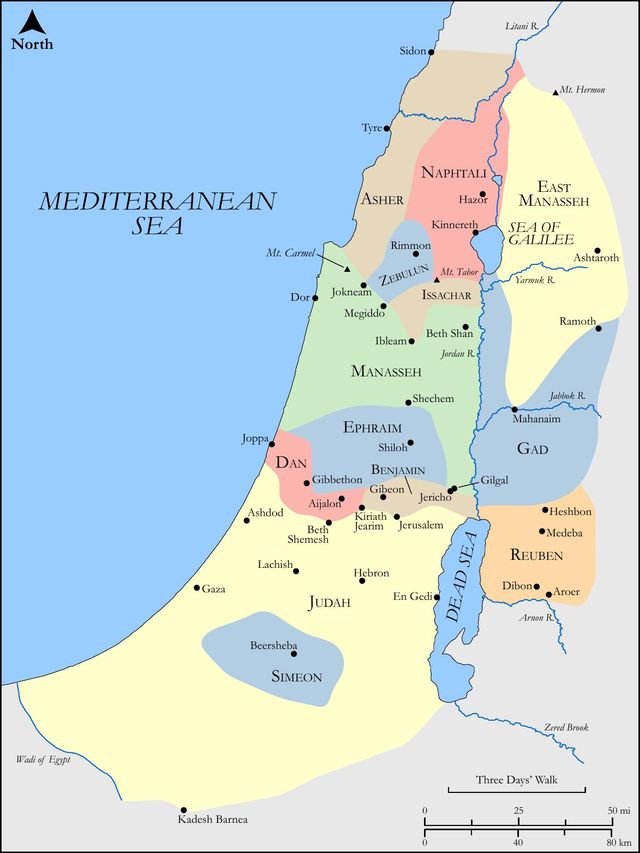
See on the biblical-era maps
Study this verse
Public-domain commentary
Matthew Henry
From his Commentary on the Whole Bible. Henry comments on passages, not single verses — this entry covers Joshua 17:7–13.
We have here a short account of the lot of this half tribe. It reached from Jordan on the east to the great sea on the west; on the south it lay all along contiguous to Ephraim, but on the north it abutted upon Asher and Issachar. Asher lay north-west, and Issachar north-east, which seems to be the meaning of that (Jos 17:10), that they (that is, Manasseh and Ephraim, as related to it, both together making the tribe of Joseph) met in Asher on the north and Issachar on the east, for Ephraim itself reached not those tribes. Some things are particularly observed concerning this lot: - 1. That there was great communication between this tribe and that of Ephraim. The city of Tappuah belonged to Ephraim, but the country adjoining to Manasseh (Jos 17:8); there were likewise many cities of Ephraim that lay within the border of Manasseh (Jos 17:9), of which before, Jos 16:9. 2. That Manasseh likewise had cities with their appurtenances in the tribes of Issachar and Asher (Jos 17:11), God so ordering it, that though every tribe had its peculiar inheritance, which might not be alienated from it, yet they should thus intermix one with another, to keep up mutual acquaintance and correspondence among the tribes, and to give occasion for the doing of good offices one to another, as became those who, though of different tribes, were all one Israel, and were bound to love as brethren. 3. That they suffered the Canaanites to live among them, contrary to the command of God, serving their own ends by conniving at them, for they made them tributaries, Jos 17:12, Jos 17:13. The Ephraimites had done the same (Jos 16:10), and from them perhaps the Manassites learned it, and with their example excused themselves in it. The most remarkable person of this half tribe in after-time was Gideon, whose great actions were done within this lot. He was of the family of Abiezer; Cesarea was in this lot, and Antipatris, famed in the latter ages of the Jewish state.
Continue studying Joshua 17:11 across the web’s major study libraries — every link below opens this exact verse, chapter, or book on the destination site.
Read & Compare
 BibleGatewayThis verse in more than 200 translations and 70 languages.
 Bible.comThe YouVersion reader — hundreds of translations, reading plans, and highlights.
 ESV.orgCrossway's official English Standard Version reader.
 NET BibleThe NET translation with 60,000+ translators' notes on every rendering decision.
 STEP BibleTyndale House's free study tool — original text, vocabulary, and scholarly resources.
 BibliaLogos Bible Software's free web reader.
 USCCBThe New American Bible (Revised Edition) with the U.S. bishops' study notes.
Commentaries
 BibleHub CommentariesDozens of classic commentaries on this verse, gathered on one page.
 StudyLightMore than 100 commentary sets — the largest collection on the web.
 BibleRefPlain-English commentary on what this verse means, verse by verse.
 Enduring WordDavid Guzik's free commentary on this chapter, widely used by Bible teachers.
 Bible Study ToolsVerse commentary alongside Greek and Hebrew study aids.
Original Language & Research
- BibleHub InterlinearThe verse word by word — original language, transliteration, and English.
- BibleHub LexiconEvery word's original-language definition and Strong's entry.
 Blue Letter BibleDeep-study tools — Strong's numbers, concordance, and word studies.
 SefariaThe Hebrew text with Rashi and centuries of Jewish commentary.
Sermons, Hymns & Audio


TrulyRandomVerse is not affiliated with these sites and doesn’t control their content. They’re linked because they’re genuinely useful.
Summary
Joshua 17:11 meticulously details the specific cities and their surrounding territories within the tribal allotments of Issachar and Asher that were designated for the tribe of Manasseh. This enumeration highlights the precise nature of Israel's inherited land, yet it implicitly foreshadows the significant challenge and subsequent failure of Manasseh to fully dispossess the indigenous Canaanite inhabitants from these strategic strongholds, laying the groundwork for a recurring theme of incomplete obedience throughout the Book of Joshua and into the period of the Judges.
Context
ShowHideLiterary Context
This verse is situated within the detailed account of the land distribution among the Israelite tribes following the initial conquest of Canaan under Joshua's leadership. Specifically, it falls within the description of Manasseh's inheritance, which was unique in that it spanned both sides of the Jordan River and included enclaves within other tribal territories. Immediately following this verse, Joshua 17:12 explicitly states the tragic outcome: "Yet the children of Manasseh could not drive out the inhabitants of those cities; but the Canaanites would dwell in that land." This direct contrast between the divine assignment (verse 11) and the human failure (verse 12) is crucial for understanding the theological message of the passage, setting up a pattern of partial obedience that plagues Israel throughout its early history, as seen in the broader narrative of Judges 1.
Historical & Cultural Context
The period described in Joshua is the transition from nomadic wandering to settled agricultural life in Canaan, a land already populated by various Canaanite city-states. These cities, such as Bethshean, Megiddo, and Dor, were often fortified, strategically located along vital trade routes, and possessed superior military technology, including iron chariots, as mentioned in Joshua 17:16. God's command to Israel was to utterly dispossess these inhabitants to prevent their idolatrous practices and moral corruption from infecting Israel, as reiterated in Deuteronomy 7:1-6. The failure to do so, as highlighted in this verse and its immediate sequel, represents a significant breach of covenant obligations and a foundational reason for the subsequent spiritual decline and cycles of oppression detailed in the Book of Judges.
Key Themes
ShowHideJoshua 17:11, especially when read in conjunction with the subsequent verses, introduces and reinforces several key themes. The most prominent is incomplete obedience, demonstrating Israel's recurring struggle to fully execute God's commands regarding the land's inhabitants, a theme that resonates throughout the book, particularly in passages like Joshua 13:1-6. This failure directly leads to the theme of persistent enemy strongholds, as the listed cities become pockets of resistance and sources of future temptation and conflict for Israel, ultimately undermining their security and spiritual purity. The detailed geographic specificity of the verse underscores the precise nature of God's promised inheritance and the clear mandate given to each tribe, making their failure all the more pronounced. Furthermore, it subtly introduces the theme of divine patience contrasted with human weakness, as God's initial provision is met with Israel's lack of faith and resolve in fulfilling the divine commission.
Exposition and Analysis
ShowHideKey Word Analysis
ShowHideOne of the two sons of Joseph (H4519), whose descendants formed a prominent tribe in Israel. Their territory was extensive, stretching from the Jordan River westward, but also included these specific enclaves within the territories of Issachar and Asher. The name "Manasseh" means "causing to forget," referring to Joseph's declaration that God had made him forget all his toil and his father's house (Genesis 41:51). Ironically, in the context of this verse, the tribe of Manasseh seems to have "forgotten" or neglected their divine mandate to fully dispossess the Canaanites.
Literally "daughter" (feminine of H1121, "son"). In this context, it refers to the smaller settlements, dependent villages, or agricultural communities surrounding the main city. The inclusion of "her towns" emphasizes that the command to dispossess was not limited to the fortified city centers but extended to the entire sphere of influence and population centers associated with these Canaanite strongholds, indicating a comprehensive inheritance and a comprehensive command for cleansing the land.
Meaning "a height" or "country." The phrase "even three countries" at the end of the verse likely refers to three distinct regional areas or clusters of these cities (e.g., the Bethshean/Ibleam area, the Dor area, and the Endor/Taanach/Megiddo area), indicating the breadth and strategic importance of the regions Manasseh was meant to conquer and occupy. It highlights the significant scope of their assigned task and the extent of their subsequent failure.
Verse Breakdown
ShowHide"And Manasseh had in Issachar and in Asher Bethshean and her towns"
This clause establishes Manasseh's unique territorial arrangement, possessing enclaves within the allotments of neighboring tribes. Bethshean (H1052), meaning "house of ease," was a strategically vital city in the Jordan Valley, controlling key trade routes and fertile agricultural land, making its possession crucial for Israel's economic and military security in the region.
"and Ibleam and her towns"
Ibleam (H2991), meaning "devouring people," located further west in the central hill country, was another significant Canaanite stronghold. Its inclusion demonstrates the scattered nature of Manasseh's assigned enclaves and the pervasive presence of unconquered pockets of resistance.
"and the inhabitants of Dor and her towns"
Dor (H1756), meaning "dwelling," was a major coastal city and port on the Mediterranean Sea. Its control would have provided Israel with access to maritime trade and a strategic foothold on the coast, making its failure to dispossess the inhabitants particularly impactful.
"and the inhabitants of Endor and her towns"
Endor (H5874), meaning "fountain of dwelling," situated near Mount Tabor, was another key location. Its later appearance in Israel's history as a place of pagan consultation (1 Samuel 28:7) underscores the long-term spiritual danger posed by leaving Canaanite strongholds intact.
"and the inhabitants of Taanach and her towns"
Taanach (H8590), of uncertain derivation, located in the Jezreel Valley (Plain of Esdraelon), was a highly strategic city, part of a cluster of fortresses that dominated this crucial northern plain, often a battleground throughout Israel's history.
"and the inhabitants of Megiddo and her towns"
Megiddo (H4023), meaning "rendezvous," perhaps the most famous of these cities, also in the Jezreel Valley, was a formidable fortress controlling a vital pass. Its strategic importance is attested by its frequent mention in the history of Israel and Judah, where Solomon built it and Josiah died there, and its symbolic association with the final battle of Armageddon in Revelation (Revelation 16:16).
"[even] three countries"
This concluding phrase, using H7969 for "three" and H5316 for "countries," summarizes the geographical scope of these enclaves. It emphasizes that these were not isolated cities but represented control over significant regional territories, making Manasseh's failure to fully occupy them a failure of substantial proportion, impacting the security and spiritual purity of a large segment of the promised land.
Literary Devices
ShowHideThe verse primarily employs Enumeration and Repetition to convey its message. The detailed listing of six cities (Bethshean, Ibleam, Dor, Endor, Taanach, Megiddo), each followed by the phrase "and her towns," provides a precise and comprehensive account of the specific territories assigned to Manasseh. This Repetition of "and her towns" emphasizes the totality of the inheritance and, by implication, the totality of the command to dispossess, highlighting that the failure was not merely in taking the main cities but in clearing out their entire spheres of influence. The phrase "even three countries" serves as a concluding Summary Statement, encapsulating the broad geographical scope of these enclaves. This meticulous detail, while seemingly a dry list, serves a crucial literary function: it sets up a dramatic tension with the very next verse, Joshua 17:12, where the stated inability to drive out the inhabitants directly contradicts the divine intention and the detailed provision outlined in this verse. This juxtaposition creates a sense of Foreshadowing, hinting at the long-term consequences of Israel's partial obedience.
Theological and Thematic Connections
ShowHideJoshua 17:11, while a seemingly dry geographical listing, serves as a crucial theological pivot point, setting the stage for one of the most persistent failures in Israel's early history: the incomplete dispossessing of the Canaanites. The detailed enumeration of the cities underscores the precision of God's provision and the clarity of the divine mandate. The subsequent failure of Manasseh, explicitly stated in the following verse, highlights the critical theme of incomplete obedience, demonstrating that God's promises are contingent not only on His faithfulness but also on human faithfulness in carrying out His commands. This partial obedience left pockets of pagan influence that would later become "thorns in your sides" (Numbers 33:55) and a source of idolatry and moral corruption, directly leading to the cycles of apostasy and judgment seen throughout the Book of Judges. It teaches that compromise with evil, even in seemingly small areas, can have devastating long-term consequences for spiritual purity and national well-being.
Reflection and Application
ShowHideThe detailed account of Manasseh's inheritance and subsequent failure in Joshua 17 offers profound spiritual lessons for believers today. Just as Manasseh was given a clear inheritance and a clear command to fully possess it by driving out the inhabitants, so too are believers given a rich spiritual inheritance in Christ, along with a divine mandate to overcome sin and worldly influences in our lives. The listed cities represent the "strongholds" in our spiritual landscape—areas of compromise, unconfessed sin, or persistent worldly patterns that we fail to fully surrender to Christ. Leaving these areas unconquered, whether it be a lingering addiction, a pattern of negative thinking, unaddressed bitterness, or a compromise with cultural values that contradict God's Word, can lead to spiritual stagnation, compromise, and a diminished experience of God's promised abundant life. This passage calls us to a radical, complete obedience, trusting in God's strength to empower us to drive out every "Canaanite" from the territory of our hearts and minds, ensuring that we fully possess the spiritual freedom and holiness that is our inheritance in Christ.
Questions for Reflection
ShowHideFAQ
ShowHideWhy did Manasseh fail to drive out the inhabitants, despite God's clear command?
ShowHideJoshua 17:12 directly states that Manasseh "could not drive out the inhabitants," and Joshua 17:16 reveals their complaint that the Canaanites possessed "chariots of iron." This suggests a combination of factors: a lack of faith in God's power to overcome superior military technology, a lack of resolve or courage, and possibly a desire for the economic benefits of coexisting with the Canaanites (e.g., forced labor, as seen in Joshua 17:13). The broader biblical narrative indicates that the Israelites often failed to fully obey God's command to dispossess the Canaanites due to a wavering commitment to His covenant, leading to long-term spiritual and social consequences. Their failure was not due to God's inability to grant victory, but their own spiritual and moral weakness.
Christ-Centered Fulfillment
ShowHideWhile Joshua 17:11 details a historical failure of the tribe of Manasseh to fully possess their earthly inheritance, it powerfully foreshadows the complete and ultimate victory achieved by Jesus Christ, who perfectly fulfills the divine mandate to dispossess spiritual enemies. The unconquered cities of Canaan represent the strongholds of sin, death, and the devil that humanity could not overcome on its own. Just as Manasseh struggled against iron chariots and fortified cities, humanity was powerless against the spiritual forces of darkness (Ephesians 6:12). However, Christ, the true Joshua, has definitively conquered these spiritual enemies through His death and resurrection, triumphing over principalities and powers on the cross (Colossians 2:15). He not only provides the inheritance of eternal life but also empowers believers through His Spirit to "drive out" the lingering effects of sin and worldly influence in their own lives (Romans 8:13). Unlike Manasseh's partial obedience, Christ's obedience was perfect and complete, securing for His people a spiritual inheritance that is incorruptible, undefiled, and unfading (1 Peter 1:4), enabling them to live in true freedom and holiness, fully possessing the spiritual "land" He has provided.