


Judges 5:19
Bible text: King James Version (1769 Blayney text) · Public domain
Bible text: Berean Standard Bible · Public domain
Bible text: American Standard Version (1901) · Public domain
Bible text: World English Bible, Messianic edition · Public domain
Bible text: Geneva Bible (1599) · Public domain
Bible text: Young's Literal Translation · Public domain
- בָּאוּBa·'uthey cameH935V-Qal-Perf-3cpVerb Qal Perfect 3rd Plural common gender
- מְלָכִיםme·la·KhimkingsH4428N-mpNoun Plural Masculine Absolute
- נִלְחָמוּnil·Cha·muthey foughtH3898V-Niphal-Perf-3cpVerb Niphal Perfect 3rd Plural common gender
- אָז'azthenH227AdvAdverb
- נִלְחֲמוּnil·cha·Muthey foughtH3898V-Niphal-Perf-3cpVerb Niphal Perfect 3rd Plural common gender
- מַלְכֵיmal·Khei[the] kings ofH4428N-mpcNoun Plural Masculine Construct
- כְנַעַןkhe·Na·'anCanaanH3667N-properNoun Proper Location
- בְּתַעְנַךְbe·ta'·Nakhat TaanachH8590Prep-b ¦ N-properNoun Proper LocationבְּatתַעְנַךְTaanach
- עַל'alatH5921PrepPreposition
- מֵיmei[the] waters ofH4325N-mpcNoun Plural Masculine Construct
- מְגִדּוֹme·gi·DoMegiddoH4023N-properNoun Proper Location
- בֶּצַעBe·tza'profit ofH1215N-mscNoun Singular Masculine Construct
- כֶּסֶףKe·sefsilverH3701N-msNoun Singular Masculine Absolute
- לֹאlo'notH3808NegParticle Negative
- לָקָחוּla·Ka·chuthey tookH3947V-Qal-Perf-3cpVerb Qal Perfect 3rd Plural common gender
English is a literal word-by-word gloss of the Hebrew, not the KJV's wording. Why?
This is the original text the KJV's translators worked from — each Hebrew word with its own literal English meaning in this verse, prepared by scholars at Tyndale House, Cambridge. The KJV translates whole sentences, not word by word, so its wording differs: one Hebrew word can become several English words, and the KJV may choose “the LORD” where the gloss reads “Yahweh”. Both are faithful — they answer different questions. For the KJV's own rendering, switch to the KJV text.
Details
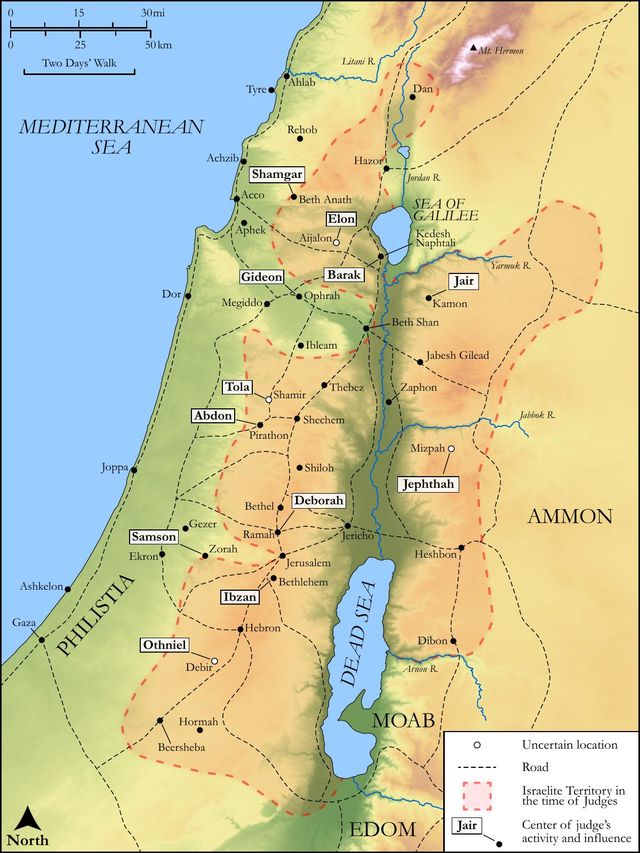
See on the biblical-era maps
Study this verse
Public-domain commentary
Matthew Henry
From his Commentary on the Whole Bible. Henry comments on passages, not single verses — this entry covers Judges 5:12–23. His four-level outline is real structure in the source text, so it is rendered as structure.
Here, I. Deborah stirs up herself and Barak to celebrate this victory in the most solemn manner, to the glory of God and the honour of Israel, for the encouragement of their friends and the greater confusion of their enemies, Jdg 5:12. 1. Deborah, as a prophetess, must do it by a song, to compose and sing which she excites herself: Awake, awake, and again, awake, awake, which intimates the sense she had of the excellency and difficulty of the work; it needed and well deserved the utmost liveliness and vigour of soul in the performance of it; all the powers and faculties of the soul in their closest intensity and application ought to be employed in it. Thus too she expresses the sense she had of her own infirmity, and aptness to flag and remit in her zeal in this work. Note, Praising God is work that we should awake to, and awake ourselves to, Psa 108:2. 2. Barak, as a general, must do it by a triumph: Lead thy captivity captive. Though the army of Sisera was cut off in the field, and no quarter given, yet we may suppose in the prosecution of the victory, when the war was carried into the enemy's country, many not found in arms were seized and made prisoners of war. These she would have led in chains after Barak, when he made his public entry into his own city, to grace his triumphs; not as if it should be any pleasure to him to trample upon his fellow-creatures, but thus he must give glory to God, and serve that great purpose of his government which is to look upon those that are proud and to abase them.
II.She gives good reason for this praise and triumph, Jdg 5:13.
This glorious victory had made the remnant of Israel, and Deborah in particular, look very great, a circumstance which they owed entirely to God.
1.The Israelites had become few and inconsiderable, and yet to them God gave dominion over nobles. Many of them were cut off by the enemy, many died of grief, and perhaps some had removed their families and effects into foreign parts; yet those few that remained, by divine assistance, with one brave and generous effort, not only shook off the yoke of oppression from their own neck, but got power over their oppressors. As long as any of God's Israel remain (and a remnant God will have in the worst of times) there is hope, be it ever so small a remnant, for God can make him that remains, though it should be but one single person, triumph over the most proud and potent.
2.Deborah was herself of the weaker sex, and the sex that from the fall had been sentenced to subjection, and yet the Lord that is himself higher than the highest authorized her to rule over the mighty men of Israel, who willingly submitted to her direction, and enabled her to triumph over the mighty men of Canaan, who fell before the army she commanded; so wonderfully did he advance the low estate of his handmaid. "The Lord made me, a woman, to have dominion over mighty men." A despised stone is made head of the corner. This is indeed the Lord's doing, and marvellous in our eyes.
III.She makes particular remarks on the several parties concerned in this great action, taking notice who fought against them, who fought for them, and who stood neuter.
1.Who fought against them. The power of the enemy must be taken notice of, that the victory may appear the more glorious. Jabin and Sisera had been mentioned in the history, but here it appears further,
(1.)That Amalek was in league with Jabin, and sent him in assistance, or endeavoured to do it. Ephraim is here said to act against Amalek (Jdg 5:14), probably intercepting and cutting off some forces of the Amalekites that were upon their march to join Sisera. Amalek had helped Moab to oppress Israel (Jdg 3:13) and now had helped Jabin; they were inveterate enemies to God's people - their hand had always been against the throne of the Lord (Exo 17:16); and therefore they were the more dangerous.
(2.)That others of the kings of Canaan, who had somewhat recovered themselves since their defeat by Joshua, joined with Jabin, and strengthened his army with their forces, having the same implacable enmity to Israel that he had, and those kingdoms, when they were in their strength, having been subject to that of Hazor, Jos 11:10. These kings came and fought, Jdg 5:19. Israel had no king; their enemies had many, whose power and influence, especially acting in confederacy, made them very formidable; and yet Israel, having the Lord for their King, was too hard for them all. It is said of these kings that they took no gain of money, they were not mercenary troops hired into the service of Jabin (such often fail in an extremity), but they were volunteers and hearty in the cause against Israel: they desired not the riches of silver, so the Chaldee, but only the satisfaction of helping to ruin Israel. Acting upon this principle, they were the more formidable, and would be the more cruel.
2.Who fought for them. The several tribes that assisted in this great exploit are here spoken of with honour; for, though God is chiefly to be glorified, instruments must have their due praise, for the encouragement of others: but, after all, it was heaven that turned the scale.
(1.)Ephraim and Benjamin, those tribes among whom Deborah herself lived, bestirred themselves, and did bravely, by her influence upon them; for her palm-tree was in the tribe of Ephraim, and very near to that of Benjamin (Jdg 5:14): Out of Ephraim was there a root, and life in the root, against Amalek. There was in Ephraim a mountain called the mount of Amalek, mentioned, Jdg 12:15, which, some think, is here meant, and some read it, there was a root in Amalek, that is, in that mountain, a strong resolution in the minds of that people to make head against the oppressors, which was the root of the matter. Herein Benjamin had set them a good example among his people. "Ephraim moved after thee, Benjamin;" though Benjamin was the junior tribe, and much inferior, especially at this time, to Ephraim, both in number and wealth, yet when they led Ephraim followed in appearing for the common cause. If we be not so bold as to lead, yet we must not be so proud and sullen as not to follow even our inferiors in a good work. Ephraim was a at a distance from the place of action, and therefore could not send forth many of its boughs to the service; but Deborah, who was one of them, knew there was a root of them, that they were hearty well-wishers to the cause. Dr. Lightfoot gives quite another sense of this. Joshua, of Ephraim, had been a root of such victories against Amalek (Ex. 17), and Ehud of Benjamin lately against Amalek and Moab.
(2.)The ice being broken by Ephraim and Benjamin, Machir (the half-tribe of Manasseh beyond Jordan) and Zebulun sent in men that were very serviceable to this great design. When an army is to be raised, especially under such disadvantages as Barak now experienced from the long disuse of arms and the dispiritedness of the people, it is of great consequence to be furnished,
[1.]With men of courage for officers, and such the family of Machir furnished them with, for thence came down governors. The children of Machir were particularly famous for their valour in Moses' time (Num 32:39), and it seems it continued in their family, the more because they were seated in the frontiers.
[2.]With men of learning and ingenuity for secretaries of war, and with such they were supplied out of Zebulun: thence came men that handle the pen of the writer, clerks that issued out orders, wrote circular letters, drew commissions, mustered their men, and kept their accounts. Thus must every man, according as he has received the gift, minister the same, for the public good (Pe1 4:10); the eyes see, and the ears hear, for the whole body. I know it is generally understood of the forwardness even of the scholars of this tribe, who studied the law and expounded it, to take up arms in this cause, though they were better skilled in books than in the art of war. So Sir Richard Blackmore paraphrases it: -
The scribes of Zebulun and learned men,
To wield the sword, laid down the pen.
(3.)Issachar did good service too; though he saw that rest was good, and therefore bowed his shoulder to bear, which is the character of that tribe (Gen 49:15), yet they disdained to bear the yoke of Jabin's tribute, and now preferred the generous toils of war to a servile rest. Though it should seem there were not many common soldiers enlisted out of that tribe, yet the princes of Issachar were with Deborah and Barak (v. 15), probably, as a great council of war to advise upon emergencies. And, it should seem, these princes of Issachar did in person accompany Barak into the field of battle. Did he go on foot? They footed it with him, not consulting their honour or ease. Did he go into the valley, the place of most danger? They exposed themselves with him, and were still at his right hand to advise him: for the men of Issachar were men that had understanding of the times, Ch1 12:32.
(4.)Zebulun and Naphtali were the most bold and active of all the tribes, not only out of a particular affection to Barak their countryman, but because, they lying nearest to Jabin, the yoke of oppression lay heavier on their necks than on those of any other tribe. Better die in honour than live in bondage; and therefore, in a pious zeal for God and their country, they jeoparded their lives unto the death in the high places of the field, Jdg 5:18. With what heroic bravery did they charge and push on even upon the chariots of iron, despising danger, and setting death itself at defiance in so good a cause!
(5.)The stars from heaven appeared, or acted at least, on Israel's side (Jdg 5:20): The stars in their courses, according to the order and direction of him who is the great Lord of their hosts, fought against Sisera, by their malignant influences, or by causing the storms of hail and thunder which contributed so much to the rout of Sisera's army. The Chaldee reads it, from heaven, from the place where the stars go forth, war was waged against Sisera, that is, the power of the God of heaven was engaged against him, making use of the ministration of the angels of heaven. Some way or other, the heavenly bodies (not arrested, as when the sun stood still at Joshua's word, but going on in their courses) fought against Sisera. Those whom God is an enemy to the whole creation is at war with. Perhaps the flashes of lightning by which the stars fought was that which frightened the horses, so as that they pranced till their very hoofs were broken (Jdg 5:22), and probably overturned the chariots of iron which they drew or turned them back upon their owners.
(6.)The river of Kishon fought against their enemies. It swept away multitudes of those that hoped to make their escape through it, Jdg 5:21. Ordinarily, it was but a shallow river, and, being in their own country, we may suppose they well knew its fords and safest passages, and yet now, probably by the great rain that fell, it was so swollen, and the stream so deep and strong, that those who attempted to pass it were drowned, being feeble and faint, and unable to make their way through it. And then were the horse-hoofs broken by means of the plungings. So it is in the margin, Jdg 5:22. The river of Kishon is called that ancient river because described or celebrated by ancient historians or poets, or rather because it was designed of old, in the counsel of God, to serve his purposes against Sisera at this time, and did so, as if it had been made on purpose; thus the water of the old pool God is said to have fashioned long ago for that use to which it was put, Isa 22:11.
(7.)Deborah's own soul fought against them; she speaks of it with a holy exultation (Jdg 5:21): O, my soul, thou hast trodden down strength. She did it by exciting others to do it, and assisting them, which she did with all her heart. Also by her prayers; as Moses conquered Amalek by lifting up his hand, so Deborah vanquished Sisera by lifting up her heart. And when the soul is employed in holy exercises, and heart-work is made of them, through the grace of God the strength of our spiritual enemies will be trodden down and will fall before us.
3.In this great engagement she observes who stood neuter, and did not side with Israel as might have been expected. It is strange to find how many, even of those who were called Israelites, basely deserted this glorious cause and declined to appear. No mention is made of Judah nor Simeon among the tribes concerned, because they, lying so very remote from the scene of action, had not an opportunity to appear, and therefore it was not expected from them; but for those that lay near, and yet would not venture, indelible marks of disgrace are here put upon them, as they deserved.
(1.)Reuben basely declined the service, Jdg 5:15, Jdg 5:16. Justly had he long ago been deprived of the privileges of the birth-right, and still does his dying father's doom stick by him: unstable as water, he shall not excel. Two things hindered them from engaging: - [1.] Their divisions. This jarring string she twice strikes upon to their shame: For the divisions of Reuben (or in these divisions) there were great thoughts, impressions, and searchings of heart. Not only for their division from Canaan by the river Jordan, which needed not to have hindered them had they been hearty in the cause, for Gilead abode beyond Jordan, and yet from Machir of Gilead came down governors; but it means either that they were divided among themselves, could not agree who should go or who should lead, each striving to gain the posts of honour and shun those of danger, some unhappy contests in their tribe kept them from uniting together, and with their brethren, for the common good, or that they were divided in their opinion of this war from the rest of the tribes, thought the attempt either not justifiable or not practicable, and therefore blamed those that engaged in it and did themselves decline it. This occasioned great searchings of heart among the rest, especially when the had reason to suspect that, whatever Reuben pretended, his sitting still now proceeded from a cooling of his affections to his brethren and an alienation of mind from them, which occasioned them many sad thoughts. It grieves us to see our mother's children angry with us for doing our duty and looking strange upon us when we most need their friendship and assistance. [2.] Their business in the world: Reuben abode among the sheepfolds, a warmer and safer place than the camp, pretending they could not conveniently leave the sheep they tended; he loved to hear the bleatings of the flocks, or, as some read it, the whistlings of the flocks, the music which the shepherds made with their oaten reeds or pipes, and the pastorals which they sung; these Reuben preferred before the martial drum and trumpet. Thus many are kept from doing their duty by the fear of trouble, the love of ease, and an inordinate affection to their worldly business and advantage. Narrow selfish spirits care not what becomes of the interests of God's church, so they can but get, keep, and save money. All seek their own, Phi 2:21.
(2.)Dan and Asher did the same, Jdg 5:17. These two lay on the sea-coast, and,
[1.]Dan pretended he could not leave his ships but they would be exposed, and therefore I pray thee have me excused. Those of that tribe perhaps pleaded that their sea-trade disfitted them for land-service and diverted them from it; but Zebulun also was a haven for ships, a sea-faring tribe, and yet was forward and active in this expedition. There is no excuse we make to shift off duty but what some or other have broken through and set aside, whose courage and resolution will rise up against us and shame us.
[2.]Asher pretended he must stay at home to repair the breaches which the sea had in some places made upon his land, and to fortify his works against the encroachments of it, or he abode in his creeks, or small havens, where his trading vessels lay to attend them. A little thing will serve those for a pretence to stay at home who have no mind to engage in the most necessary services because there are difficulty and danger in them.
(3.)But above all Meroz is condemned, and a curse pronounced upon the inhabitants of it, Because they came not to the help of the Lord, Jdg 5:23. Probably this was some city that lay near the scene of action, and therefore the inhabitants had a fair opportunity of showing their obedience to God and their concern for Israel, and of doing a good service to the common cause; but they basely declined it, for fear of Jabin's iron chariots, being willing to sleep in a whole skin. The Lord needed not their help; he made it to appear he could do his work without them; but no thanks to them: for aught they knew the attempt might have miscarried for want of their hand, and therefore they are cursed for not coming to the help of the Lord, when it was in effect proclaimed, Who is on the Lord's side? The cause between God and the mighty (the principalities and powers of the kingdom of darkness) will not admit of neutrality. God looks upon those as against him that are not with him. This curse is pronounced by the angel of the Lord, our Lord Jesus, the captain of the Lord's host (and those whom he curses are cursed indeed), and further than we have warrant and authority from him we may not curse. He that will richly reward all his good soldiers will certainly and severely punish all cowards and deserters. This city of Meroz seems to have been at this time a considerable place, since something great was expected from it; but probably, after the angel of the Lord had pronounced this curse upon it, it dwindled, and, like the fig-tree which Christ cursed, withered away, so that we never read of it after this in scripture.
Historical interpretation
Historical reception
1 surviving comment on this verse from the historical church.
(Judges 5:19) Kings came and fought. The kings of the land of Canaan said, who were subject to King Jabin. The kings of Canaan fought. It repeats the same thing in Tanach. Tanach is indeed a province where the Kishon River is. Near the waters of Megiddo. Megiddo is a city situated on the Kishon River. And what is said, Near the waters of Megiddo, is understood near the Kishon River, the city of Megiddo. Yet they took nothing as plunderers. This is said in mocking, implying that not only did they not obtain any spoils, but they were also unable to save their own lives.
Continue studying Judges 5:19 across the web’s major study libraries — every link below opens this exact verse, chapter, or book on the destination site.
Read & Compare
 BibleGatewayThis verse in more than 200 translations and 70 languages.
 Bible.comThe YouVersion reader — hundreds of translations, reading plans, and highlights.
 ESV.orgCrossway's official English Standard Version reader.
 NET BibleThe NET translation with 60,000+ translators' notes on every rendering decision.
 STEP BibleTyndale House's free study tool — original text, vocabulary, and scholarly resources.
 BibliaLogos Bible Software's free web reader.
 USCCBThe New American Bible (Revised Edition) with the U.S. bishops' study notes.
Commentaries
 BibleHub CommentariesDozens of classic commentaries on this verse, gathered on one page.
 StudyLightMore than 100 commentary sets — the largest collection on the web.
 BibleRefPlain-English commentary on what this verse means, verse by verse.
 Enduring WordDavid Guzik's free commentary on this chapter, widely used by Bible teachers.
 Bible Study ToolsVerse commentary alongside Greek and Hebrew study aids.
Original Language & Research
- BibleHub InterlinearThe verse word by word — original language, transliteration, and English.
- BibleHub LexiconEvery word's original-language definition and Strong's entry.
 Blue Letter BibleDeep-study tools — Strong's numbers, concordance, and word studies.
 SefariaThe Hebrew text with Rashi and centuries of Jewish commentary.
Sermons, Hymns & Audio


TrulyRandomVerse is not affiliated with these sites and doesn’t control their content. They’re linked because they’re genuinely useful.
Summary
Judges 5:19, a powerful declaration within the ancient Song of Deborah and Barak, vividly recounts the formidable coalition of Canaanite kings who assembled for battle against Israel in the strategically vital Jezreel Valley. This verse highlights their concerted, aggressive effort to crush God's people and, crucially, their ultimate and humiliating failure to secure any material gain or plunder from the conflict, thereby underscoring the completeness of their rout and the undeniable hand of divine intervention in Israel's victory.
Context
ShowHideLiterary Context
Judges 5 serves as a triumphant poetic recounting of the military victory described in prose in Judges 4. As one of the oldest and most significant pieces of Hebrew poetry in the Old Testament, the Song of Deborah celebrates God's decisive deliverance of Israel from Canaanite oppression under the leadership of the prophetess Deborah and the commander Barak. The song dynamically shifts between narrative recounting, fervent praise for Yahweh, and poignant calls to remembrance for those who participated or failed to participate in the battle. Verse 19 specifically focuses on the climax of the engagement from the perspective of the opposing forces, detailing their arrival and engagement before setting the stage for the dramatic description of Sisera's personal defeat and his mother's subsequent lament, as found in Judges 5:24-30. The poetic structure of the verse, with its concise yet impactful statements, emphasizes both the intensity of the Canaanite assault and the stark, unexpected outcome, contrasting their expectation of plunder with their utter lack of it.
Historical & Cultural Context
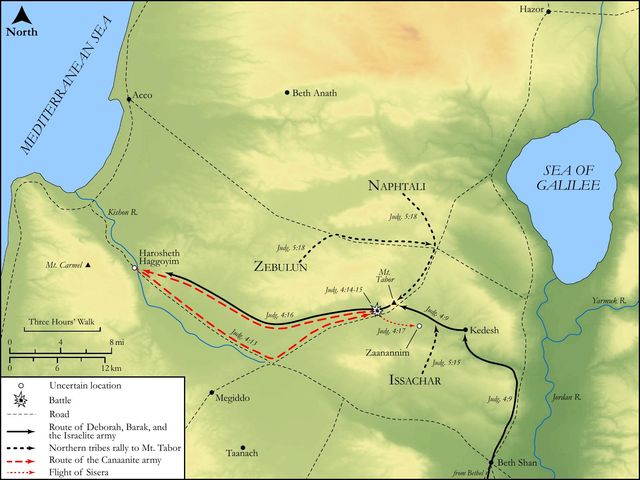
The period of the Judges, spanning roughly 1200-1000 BC, was a tumultuous era for the nascent nation of Israel, characterized by recurring cycles of apostasy, foreign subjugation, and divine deliverance through charismatic leaders known as "judges." The specific oppression detailed here was under Jabin, the powerful king of Hazor, whose formidable general Sisera commanded a technologically advanced army, boasting 900 chariots of iron, a significant military advantage of the time, as noted in Judges 4:3. The battle unfolded in the Jezreel Valley, a strategically vital and fertile plain in northern Israel, historically a frequent theater for ancient warfare due to its crucial trade routes and geographical accessibility. Taanach and Megiddo, mentioned in the verse, were prominent fortified cities within this valley, serving as key strongholds. "The waters of Megiddo" likely refer to the various streams and tributaries in the vicinity, particularly the Kishon River, which, as dramatically described in Judges 5:21, became swollen by rain and played a critical role in bogging down Sisera's iron chariots, decisively turning the tide of battle against the Canaanites. In the warfare of the nations, the acquisition of plunder (spoils, "gain of money") was a primary motivation for military campaigns and a significant reward for victorious armies, symbolizing dominance, economic enrichment, and the subjugation of the defeated. The complete absence of such gain for the Canaanite kings in this account powerfully underscores their utter and humiliating defeat.
Key Themes
ShowHideThis verse significantly contributes to several pervasive themes found throughout the book of Judges and the broader biblical narrative. Firstly, it powerfully illustrates the theme of Divine Intervention, demonstrating Yahweh's active role in fighting for His people, often employing natural elements (like the swollen river) to confound and overcome even the most powerful human armies. Secondly, the phrase "the kings of Canaan" highlights the theme of Confederated Opposition that Israel frequently faced, emphasizing that a united front of powerful rulers aligned against God's chosen nation, thereby magnifying the scale of the threat and the magnitude of the divine deliverance. Thirdly, the specific mention of Taanach and Megiddo establishes a theme of Strategic Battlegrounds, identifying places where decisive conflicts unfold and where God's sovereignty is visibly demonstrated. Megiddo, in particular, gains a symbolic status that echoes even into eschatological prophecy, notably in Revelation 16:16. Finally, the concluding declaration, "they took no gain of money," powerfully conveys the theme of Utter Defeat and Humiliation for the enemy, starkly contrasting their worldly ambitions and covetous desires with the spiritual victory achieved by God's power, where the expected material rewards of conquest were utterly denied.
Exposition and Analysis
ShowHideKey Word Analysis
ShowHideA primitive root meaning "to feed on; figuratively, to consume; by implication, to battle (as destruction)." This word emphasizes the destructive and consuming nature of the conflict. The Canaanite kings engaged in a full-scale battle, aiming to devastate Israel, but their own destructive intent was ultimately turned back upon them. The term highlights the ferocity of the engagement and the inherent violence of their purpose.
Meaning "plunder; by extension, gain (usually unjust)." This term is highly significant as it often carries a negative connotation, implying ill-gotten gain, avarice, or dishonest profit. The Canaanite kings were motivated by the prospect of plunder, seeking to enrich themselves at Israel's expense. The verse's declaration that they took "no gain" directly thwarts this covetous ambition, emphasizing not just a military defeat but a moral and economic one, where their greedy intentions yielded nothing.
Meaning "silver (from its pale color); by implication, money." This word specifies the type of "gain" the kings sought – material wealth, particularly in the form of silver or currency. Its inclusion makes the defeat even more poignant: they came for tangible, valuable spoils, yet departed empty-handed. This highlights the stark contrast between their worldly objectives and the spiritual victory secured by God, where the enemy's material desires were utterly unfulfilled.
Verse Breakdown
ShowHide"The kings came [and] fought, then fought the kings of Canaan"
This opening clause immediately establishes the formidable nature of the opposition. The repetition of the verb "fought" (or its semantic equivalent in the Hebrew) underscores the intensity, determination, and concerted effort of the enemy coalition. It signals that this was not a minor skirmish but a full-scale, unified military operation by a powerful alliance of rulers, representing a grave and organized threat to Israel's existence and freedom.
"in Taanach by the waters of Megiddo;"
This phrase precisely situates the battle, grounding the poetic narrative in historical and geographical reality. Taanach and Megiddo were strategic strongholds within the Jezreel Valley, a crucial corridor for military movements and trade. The "waters of Megiddo" refer to the local river systems, most notably the Kishon River and its tributaries. This geographical detail is profoundly significant, as later verses in the song (e.g., Judges 5:21) reveal how the swollen river became a divinely wielded weapon, turning the tide against Sisera's iron chariots and contributing decisively to the Canaanites' downfall.
"they took no gain of money."
This concluding statement serves as the powerful and ironic punchline of the verse. In ancient warfare, the spoils of war were a primary objective and a clear measure of victory and dominance. The Canaanite kings, driven by the prospect of plunder and the subjugation of Israel, achieved absolutely nothing of their material aims. This phrase signifies a total and humiliating defeat, not merely militarily but also economically and psychologically. Their avarice was met with utter emptiness, powerfully underscoring the divine intervention that prevented them from profiting from their aggression against God's people.
Literary Devices
ShowHideJudges 5:19 employs several potent literary devices to amplify its dramatic impact and theological message. The Repetition of the verb "fought" (or its semantic equivalent in the Hebrew) in the opening clause ("The kings came [and] fought, then fought the kings of Canaan") effectively emphasizes the intensity, scale, and unified nature of the conflict, drawing the listener into the dramatic scene of battle. There is a profound sense of Irony in the final declaration, "they took no gain of money." The Canaanite kings, whose primary motivation for warfare would have been the acquisition of plunder and wealth, not only failed to achieve their objective but suffered a devastating and humiliating defeat. This subversion of their expected outcome highlights the futility of their worldly ambitions when pitted against divine purpose. This ironic outcome serves as a powerful testament to God's sovereignty and His ability to confound the plans of the wicked, turning their covetous desires into emptiness.
Theological and Thematic Connections
ShowHideJudges 5:19 powerfully illustrates the profound theological truth that God is utterly sovereign over all human conflicts and that His divine purposes will ultimately prevail, often by confounding the meticulously laid schemes of those who oppose Him. The Canaanite kings, representing the epitome of worldly power and driven by the base motivation of avarice, found their plans utterly thwarted by an unexpected and decisive divine intervention. This verse serves as a potent reminder that true victory is never measured in material spoils or earthly conquests, but rather in the faithful fulfillment of God's righteous plan and the glorious deliverance of His chosen people. It underscores the enduring truth that even when formidable and seemingly insurmountable forces align against God's kingdom, His transcendent power can lead to unexpected and overwhelming victories, transforming the enemy's perceived strength into debilitating weakness and their anticipated gain into absolute nothingness.
Reflection and Application
ShowHideJudges 5:19 offers profound encouragement and a vital, timeless lesson for believers navigating the complexities of contemporary life. In a world often relentlessly driven by the pursuit of material gain, worldly power, and superficial success, this verse serves as a stark and necessary reminder that such ambitions, particularly when pursued with unrighteous intent or directed in opposition to God's divine purposes, are ultimately futile and destined for emptiness. Just as the Canaanite kings, with their formidable chariots and confederated might, gained absolutely nothing but devastating defeat, so too can our own battles—whether spiritual, relational, professional, or societal—be won not by our own strength, cunning, or material resources, but by steadfastly trusting in God's sovereign and all-sufficient power. This passage challenges us to deeply examine our own motivations: are we primarily seeking "gain of money" and fleeting earthly treasures, or are we earnestly pursuing the eternal glory of God and the advancement of His kingdom? It assures us that even when confronted by overwhelming odds, powerful adversaries, or seemingly insurmountable challenges, divine intervention can dramatically turn the tide, leading to a victory that transcends all earthly measurements and secures God's righteous and perfect plan.
Questions for Reflection
ShowHideFAQ
ShowHideWhat is the significance of Taanach and Megiddo in this verse?
ShowHideTaanach and Megiddo were ancient, strategically vital cities located within the Jezreel Valley, a fertile plain in northern Israel. This valley was a common and crucial battleground throughout antiquity due to its importance as a crossroads for major trade routes and military movements. Their specific mention in the verse grounds the poetic narrative in a precise, historically recognized location, emphasizing the real-world nature and historical accuracy of the conflict. Megiddo, in particular, became so synonymous with decisive and climactic battles that its name (Har-Megiddo, "Mountain of Megiddo") is famously associated with the final eschatological battle of Armageddon in Revelation 16:16. The "waters of Megiddo" refer to the local streams and rivers in the vicinity, most notably the Kishon River, which, as vividly described in Judges 5:21, played a crucial role in the Canaanites' defeat by swelling and bogging down their formidable iron chariots, turning their military advantage into a fatal disadvantage.
Christ-Centered Fulfillment
ShowHideJudges 5:19, with its vivid depiction of the Canaanite kings' futile pursuit of "gain of money" and their ultimate, humiliating defeat at the hands of divine intervention, powerfully foreshadows the ultimate and decisive victory of Christ over all spiritual and earthly powers that stand in opposition to God's kingdom. Just as these kings sought material plunder but found none, so too do the forces of sin, death, and the devil relentlessly seek to enslave humanity and gain dominion over creation, yet their efforts are utterly thwarted and ultimately crushed by the redemptive work of Jesus Christ. The "waters of Megiddo" that unexpectedly swept away the Canaanite chariots can be seen as a powerful type of the overwhelming divine power unleashed through Christ's sacrificial death and glorious resurrection, which definitively crushed the dominion of darkness and disarmed all hostile spiritual forces (Colossians 2:15). The true and eternal "gain" for humanity is not earthly wealth or fleeting power, but the immeasurable spiritual riches and everlasting life secured by Christ for His people, a treasure infinitely surpassing any "gain of money" (Philippians 3:7-8). Ultimately, the complete defeat of the Canaanite kings points forward to the Lamb of God, who, through His perfect sacrifice, took away the sin of the world (John 1:29) and triumphed over all the spiritual rulers and authorities, making a public spectacle of them by the cross. His unparalleled victory ensures that all who trust in Him will never be left without true and lasting gain, for their inheritance is incorruptible, undefiled, and eternal, kept in heaven for them (1 Peter 1:3-5).