


Joshua 11:1
Bible text: King James Version (1769 Blayney text) · Public domain
Bible text: King James Version with Strong's numbers · Public domain
Bible text: Berean Standard Bible · Public domain
Bible text: American Standard Version (1901) · Public domain
Bible text: World English Bible, Messianic edition · Public domain
Bible text: Geneva Bible (1599) · Public domain
Bible text: Young's Literal Translation · Public domain
- וַיְהִיvay·Hiand it wasH1961Conj-w ¦ V-Qal-ConsecImperf-3msVerb Qal Consecutive Imperfect 3rd Singular Masculineוַandיְהִיit was
- כִּשְׁמֹעַkish·Mo·a'when heardH8085Prep-k ¦ V-Qal-InfVerb Qal Infinitive Constructכִּwhenשְׁמֹעַheard
- יָבִיןya·VinJabinH2985N-proper-mNoun Proper Masculine
- מֶלֶךְMe·lekh[the] king ofH4428N-mscNoun Singular Masculine Construct
- חָצוֹרcha·TzorHazorH2674N-properNoun Proper Location
- וַיִּשְׁלַחvai·yish·Lachand he sentH7971Conj-w ¦ V-Qal-ConsecImperf-3msVerb Qal Consecutive Imperfect 3rd Singular Masculineוַandיִּשְׁלַחhe sent
- אֶל'eltoH413PrepPreposition
- יוֹבָבyo·VavJobabH3103N-proper-mNoun Proper Masculine
- מֶלֶךְMe·lekh[the] king ofH4428N-mscNoun Singular Masculine Construct
- מָדוֹןma·DonMadonH4068N-properNoun Proper Location
- וְאֶלve·'eland toH413Conj-w ¦ PrepPrepositionוְandאֶלto
- מֶלֶךְMe·lekh[the] king ofH4428N-mscNoun Singular Masculine Construct
- שִׁמְרוֹןshim·RonShimronH8110N-properNoun Proper Location
- וְאֶלve·'eland toH413Conj-w ¦ PrepPrepositionוְandאֶלto
- מֶלֶךְMe·lekh[the] king ofH4428N-mscNoun Singular Masculine Construct
- אַכְשָׁף'akh·ShafAcshaphH407N-properNoun Proper Location
English is a literal word-by-word gloss of the Hebrew, not the KJV's wording. Why?
This is the original text the KJV's translators worked from — each Hebrew word with its own literal English meaning in this verse, prepared by scholars at Tyndale House, Cambridge. The KJV translates whole sentences, not word by word, so its wording differs: one Hebrew word can become several English words, and the KJV may choose “the LORD” where the gloss reads “Yahweh”. Both are faithful — they answer different questions. For the KJV's own rendering, switch to the KJV text.
Details
See on the biblical-era maps
Study this verse
Public-domain commentary
Matthew Henry
From his Commentary on the Whole Bible. Henry comments on passages, not single verses — this entry covers Joshua 11:1–9. His three-level outline is real structure in the source text, so it is rendered as structure.
We are here entering upon the story of another campaign that Joshua made, and it was a glorious one, no less illustrious than the former in the success of it, though in respect of miracles it was inferior to it in glory. The wonders God then wrought for them were to animate and encourage them to act vigorously themselves. Thus the war carried on by the preaching of the gospel against Satan's kingdom was at first forwarded by miracles; but, the war being by them sufficiently proved to be of God, the managers of it are now left to the ordinary assistance of divine grace in the use of the sword of the Spirit, and must not expect hail-stones nor the standing still of the sun. In this story we have,
I.The Canaanites taking the field against Israel.
They were the aggressors, God hardening their hearts to begin the war, that Israel might be justified beyond exception in destroying them. Joshua and all Israel had returned to the camp at Gilgal, and perhaps these kings knew no other than that they intended to sit down content with the conquest they had already made, and yet they prepare war against them. Note, Sinners bring ruin upon their own heads, so that God will be justified when he speaks, and they alone shall bear the blame for ever. Judah had now couched as a lion gone up from the prey; if the northern kings rouse him up, it is at their peril, Gen 49:9. Now,
1.Several nations joined in this confederacy, some in the mountains and some in the plains, Jos 11:2. Canaanites from east and west, Amorites, Hittites, Perizzites, etc. (Jos 11:3), of different constitutions and divided interests among themselves, and yet they here unite against Israel as against a common enemy. Thus are the children of this world more unanimous, and therein wiser, than the children of light. The oneness of the church's enemies should shame the church's friends out of their discords and divisions, and engage them to be one.
2.The head of this confederacy was Jabin king of Hazor (Jos 11:1), as Adoni-zedec was of the former; it is said (Jos 11:10) Hazor had been the head of all those kingdoms, which could not have revolted without occasioning ill-will; but this was forgotten and laid aside upon this occasion, by consent of parties, Luk 23:12. When they had all drawn up their forces together, every kingdom bringing in its quota, they were a very great army, much greater than the former, as the sand on the sea shore in multitude, and upon this account much stronger and more formidable, that they had horses and chariots very many, which we do not find the southern kings had; hereby they had a great advantage against Israel, for their army consisted only of foot, and they never brought horses nor chariots into the field. Josephus tells us that the army of the Canaanites consisted of 300,000 foot, 10,000 horses, and 20,000 chariots. Many there be that rise up against God's Israel; doubtless their numbers made them very confident of success, but it proved that so much the greater slaughter was made of them.
II.The encouragement God gave to Joshua to give them the meeting, even upon the ground of their own choosing (Jos 11:6):
Be not afraid because of them. Joshua was remarkable for his courage - it was his master grace, and yet it seems he had need to be again and again cautioned not to be afraid. Fresh dangers and difficulties make it necessary to fetch in fresh supports and comforts from the word of God, which we have always nigh unto us, to be made use of in every time of need. Those that have God on their side need not be disturbed at the number and power of their enemies; more are those that are with us than those that are against us; those have the hosts of the Lord that have the Lord of hosts engaged for them. For his encouragement,
1.God assures him of success, and fixes the hour: Tomorrow about this time, when an engagement (it is probable) was expected and designed on both sides, I will deliver them up slain. Though they were to be slain by the sword of Israel, yet it is spoken of as God's work, that he would deliver them up.
2.He appoints him to hough their horses, hamstring them, lame them, and burn their chariots, not only that Israel might not use them hereafter, but that they might not fear them now, their God designing this contempt to be put upon them. Let Israel look upon their chariots but as rotten wood designed for the fire, and their horses of war as disabled things, scarcely good enough for the cart. This encouragement which God here gave to Joshua no doubt he communicated to the people, who perhaps were under some apprehensions of danger from this vast army, notwithstanding the experience they had had of God's power engaged for them. And the wisdom and goodness of God are to be observed,
(1.)In infatuating the counsels of the enemy, that all the kings of Canaan, who were not dispersed at such a distance from each other but that they might have got all together in a body, did not at first confederate against Israel, but were divided into the southern and northern combination, and so became the less formidable. And,
(2.)In preparing his people to encounter the greater force, by breaking the less. They first engage with five kings together, and now with many more. God proportions our trials to our strength and our strength to our trials.
III.Joshua's march against these confederate forces, Jos 11:7.
He came upon them suddenly, and surprised them in their quarters. He made this haste,
1.That he might put them into the greater confusion, by giving them an alarm, when they little thought he was near them.
2.That he might be sure not to come short of the honour God had fixed, to give him the meeting at the enemies' camp, tomorrow about this time. It is fit we should keep time with God.
IV.His success, Jos 11:8.
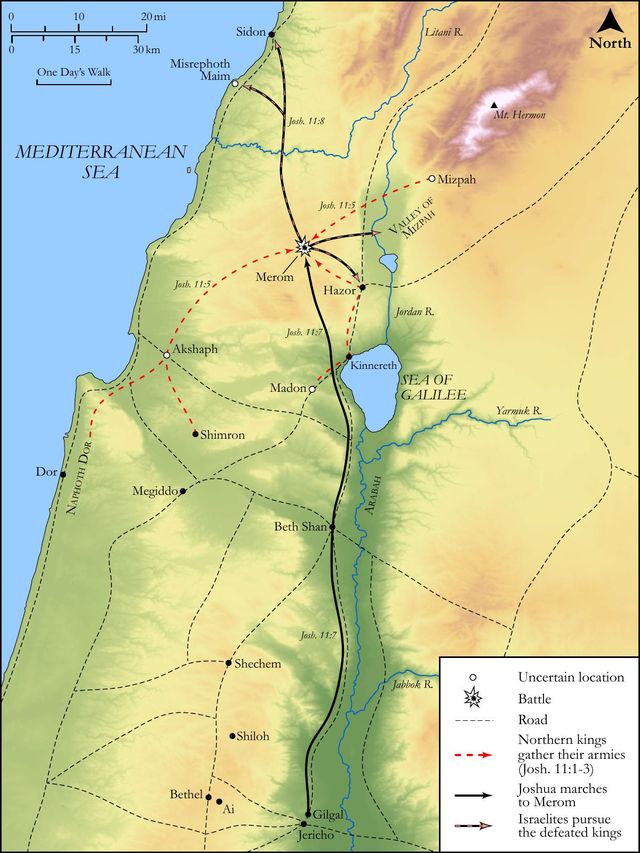
He obtained the honour and advantage of a complete victory; he smote them and chased them, in the several ways they took in their flight; some fled towards Zidon, which lay to the northwest, others towards Mizpeh, eastward, but the parties Joshua sent out pursued them each way. So the Lord delivered them into the hand of Israel; they would not deliver themselves into the hands of Israel to be made proselytes and tributaries, and so offered up to God's grace (Rom 15:16), and therefore God delivered them into their hands to be made sacrifices to his justice; for God will be honoured by us or upon us.
V.His obedience to the orders given him, in destroying the horses and chariots (Jos 11:9), which was an instance,
1.Of his subjection to the divine will, as one under authority, that must do as he is bidden.
2.Of his self-denial, and crossing his own genius and inclination in compliance with God's command.
3.Of his confidence in the power of God engaged for Israel, which enabled them to despise the chariots and horses which others trusted in, Psa 20:7; Psa 33:17.
4.Of his care to keep up in the people the like confidence in God, by taking that from them which they would be tempted to trust too much to. This was cutting of a right hand.
Historical interpretation
Historical reception
3 surviving comments on this verse. Each one is dated, so this reads as a timeline rather than a list.
But let us attempt, as God grants, to investigate certain individual kings of the opposing army; and, through the meaning of the names of each one, let us consider also the work he performs in malice.First of all, the one who is designated the author of this war, who collects the others and summons them to a conspiracy of wickedness, is named Jabin, who was king of Hazor. For he is the one who is said to have called the others together. But Jabin means "thought" or "prudence." What, then, is this "thought" or "prudence," if not that which the prophet Isaiah calls "proud thought"? For he says, "And moreover, I shall strike out the proud thought of the prince of the Assyrians, who said, 'I shall bring it to pass by my power, and, by the wisdom of my perception, I shall remove the boundaries of the nations and plunder their power.' "
Therefore, the one who is called "proud thought" in that place is this king of the Assyrians. But here, Jabin is "thought" or "prudence." For it is written that in paradise the serpent was "more prudent than all the beasts" who were upon the earth. And even that "steward of iniquity" is said to have "done prudently" that which he did. This Jabin, then, is king of Hazor. But Hazor means "court." Therefore, all the earth is the court of this king, the devil, who holds the supremacy of the whole earth as though of one court. But do you wish to verify that the court is itself the earth? In the Gospels it is written that the strong one sleeps unconcerned in his own court until a stronger one comes, who may both "bind" him and "carry away what he possesses." The king of the court, therefore, is "the prince of this world."
In prior readings, the king of Jerusalem had assembled four other kings with him against Jesus [Joshua] and against the sons of Israel. But now no longer does someone assemble four or five; on the contrary, see how great a multitude one person assembles.…You see how many swarms of opposing powers and of malicious demons may be stirred up against Jesus [Joshua] and the Israelite army. Before the coming of our Lord and Savior, all those demons, undisturbed and secure, were occupying human spirits and ruled in their minds and bodies. But when "grace appeared" in the world, the mercy "of God our Savior" instructs us to live piously and purely in this world, separated from every contagion of sin, so that each soul may receive its liberty and the "image of God" in which it was created from the beginning. Because of this, fights and battles spring forth from their iniquitous old possessors. If the first ones are overthrown, far more rise up afterwards, and they unite into one and conspire in evil, always remote from the good. And if they are conquered for a second time, again a third time other more wicked powers will rise up. So perhaps the more the people of God are increased, and the more they thrive and are multiplied, there are that many more who conspire to assault.
This one sends word to Jobab; for he himself is the one who sends word to all nations and summons them to battle. He sends word to the king of Merom. Jobab means "hostilities," but Merom means "bitternesses." Therefore, the devil sends word to another hostile power, doubtless from among the fugitive angels, and this power is the king of bitternesses. All bitternesses and difficulties in this world that are inflicted on wretched mortals issue from this author and what he does. There are diverse kinds of sin. For nothing can be more bitter than sin, even if it seems somewhat delightful at first, as Solomon writes. "But in the end," he says, "you will find what seemed sweet in the beginning to be more bitter than gall and sharper than the edge of a sword." But the nature of righteousness is the opposite: In the beginning, it seems more bitter, but in the end, when it produces fruits of virtue, it is found to be sweeter than honey. Therefore, the devil sent word to the hostile Jobab, the king of bitterness.
Continue studying Joshua 11:1 across the web’s major study libraries — every link below opens this exact verse, chapter, or book on the destination site.
Read & Compare
 BibleGatewayThis verse in more than 200 translations and 70 languages.
 Bible.comThe YouVersion reader — hundreds of translations, reading plans, and highlights.
 ESV.orgCrossway's official English Standard Version reader.
 NET BibleThe NET translation with 60,000+ translators' notes on every rendering decision.
 STEP BibleTyndale House's free study tool — original text, vocabulary, and scholarly resources.
 BibliaLogos Bible Software's free web reader.
 USCCBThe New American Bible (Revised Edition) with the U.S. bishops' study notes.
Commentaries
 BibleHub CommentariesDozens of classic commentaries on this verse, gathered on one page.
 StudyLightMore than 100 commentary sets — the largest collection on the web.
 BibleRefPlain-English commentary on what this verse means, verse by verse.
 Enduring WordDavid Guzik's free commentary on this chapter, widely used by Bible teachers.
 Bible Study ToolsVerse commentary alongside Greek and Hebrew study aids.
Original Language & Research
- BibleHub InterlinearThe verse word by word — original language, transliteration, and English.
- BibleHub LexiconEvery word's original-language definition and Strong's entry.
 Blue Letter BibleDeep-study tools — Strong's numbers, concordance, and word studies.
 SefariaThe Hebrew text with Rashi and centuries of Jewish commentary.
Sermons, Hymns & Audio


TrulyRandomVerse is not affiliated with these sites and doesn’t control their content. They’re linked because they’re genuinely useful.
Summary
Joshua 11:1 marks a pivotal moment in the Israelite conquest of Canaan, signaling a strategic shift from the southern campaigns to the formidable challenge posed by the northern kingdoms. This verse introduces Jabin, the powerful king of Hazor, who, upon receiving intelligence about Israel's decisive victories, proactively forms a massive confederacy with other northern rulers. His aim is to mount a unified and overwhelming resistance against Joshua and the advancing Israelites, thereby setting the stage for the climactic battles that would determine the ultimate fate of the Promised Land.
Context
ShowHideLiterary Context
Joshua 11:1 serves as a crucial narrative bridge, immediately following the detailed account of Joshua's successful southern campaigns. The preceding chapter, Joshua 10, meticulously recounts the defeat of the southern confederacy, culminating in the complete destruction of key cities like Makkedah, Libnah, Lachish, Eglon, Hebron, and Debir, as summarized in Joshua 10:40-43. The news of these overwhelming victories, particularly the divine intervention and the complete devotion of the inhabitants to destruction (herem), would have spread rapidly throughout Canaan, instilling widespread fear and prompting a strong, organized reaction from the remaining independent city-states. Thus, this verse signals a geographical and strategic shift from the relatively scattered resistance of the south to the more powerful and organized kingdoms of the north, establishing the narrative tension for the climactic battles described in the remainder of Joshua 11.
Historical & Cultural Context
Hazor was indisputably the largest and most significant city-state in northern Canaan in the days of Joshua, often referred to as "the head of all those kingdoms" in Joshua 11:10. Its strategic location on a major trade route connecting Egypt and Mesopotamia made its control vital for regional dominance and prosperity. Its immense size and military prowess established it as a formidable power. The Canaanite political landscape was characterized by numerous independent city-states, each governed by its own king, who frequently formed temporary alliances for mutual defense or offense when facing a common threat. Jabin's initiative to forge a grand coalition reflects this common practice of the era, demonstrating a sophisticated understanding of regional politics and the existential threat posed by Israel's relentless advance. The kings mentioned—Jobab of Madon, and the kings of Shimron and Achshaph—were significant regional players, indicating the broad scope and perceived urgency of this northern alliance.
Key Themes
ShowHideThis verse powerfully contributes to several overarching themes in the Book of Joshua. Firstly, it highlights the consolidation of opposition against God's divine plan for Israel to inherit the land. The previously scattered and localized resistance now coalesces into a unified, formidable front, underscoring the intensity and scale of the spiritual and physical warfare. Secondly, it marks a significant escalation of conflict, demonstrating that Israel's mission was not a series of minor skirmishes but a full-scale, divinely ordained conquest against deeply entrenched and powerful regional entities. This grand alliance represents the strongest human resistance Israel would face in the conquest narrative. Thirdly, and most profoundly, it sets the stage for a grand display of God's sovereignty amidst overwhelming odds. Despite the formidable nature of this coalition, the broader narrative of Joshua consistently emphasizes that Israel's ultimate victory would not be achieved by human might or strategic brilliance, but by the miraculous intervention and unwavering faithfulness of Yahweh, who had promised the land to His people (e.g., Joshua 1:3-9). The very strength and organization of the opposition serve to magnify God's power in their eventual, decisive defeat, as explicitly stated in Joshua 11:6-8.
Exposition and Analysis
ShowHideKey Word Analysis
ShowHideFrom the root meaning "to understand" or "intelligent," this name is significant not merely as a personal identifier but potentially as a dynastic title for the kings of Hazor, akin to "Pharaoh" for Egyptian rulers. The recurrence of a Jabin as king of Hazor in Judges 4:2 suggests either a persistent dynastic name or a deliberate literary connection emphasizing the enduring threat from this powerful city. In Joshua 11:1, Jabin is portrayed as a shrewd and proactive leader, demonstrating intelligence in recognizing the existential threat posed by Israel and strategically organizing a comprehensive counter-response.
Meaning "enclosure" or "village" (in a collective sense of a fortified settlement), Hazor was indeed a massive, heavily fortified city. As highlighted in Joshua 11:10, it was considered "the head of all those kingdoms," signifying its unparalleled political, military, and economic preeminence among the northern Canaanite city-states. Its strategic location and immense size made it the natural leader of any regional coalition, underscoring the gravity of the threat it posed to the advancing Israelites.
This primitive root signifies not just passive hearing, but often implies intelligent listening, attention, and even obedience. In this context, Jabin "heard" with a keen understanding of the implications of Israel's southern victories. This was not mere gossip but a strategic assessment of a dire situation. His intelligent hearing prompted immediate and decisive action, demonstrating his leadership and the perceived urgency of the threat to the remaining Canaanite strongholds.
Verse Breakdown
ShowHide"¶ And it came to pass, when Jabin king of Hazor had heard [those things],"
This opening phrase functions as a crucial narrative transition, linking the preceding accounts of Israel's successful southern campaigns with the new development in the north. The "¶" in the KJV indicates a new paragraph or section, signaling a shift in focus. "Those things" refers to the widely disseminated reports of Israel's decisive victories, the complete destruction of the southern kings and their cities, and the divine backing evident in their conquests. Jabin, as the preeminent northern king, is depicted as the first to react decisively and strategically to this existential threat, recognizing the pattern of Israel's advance.
"that he sent to Jobab king of Madon,"
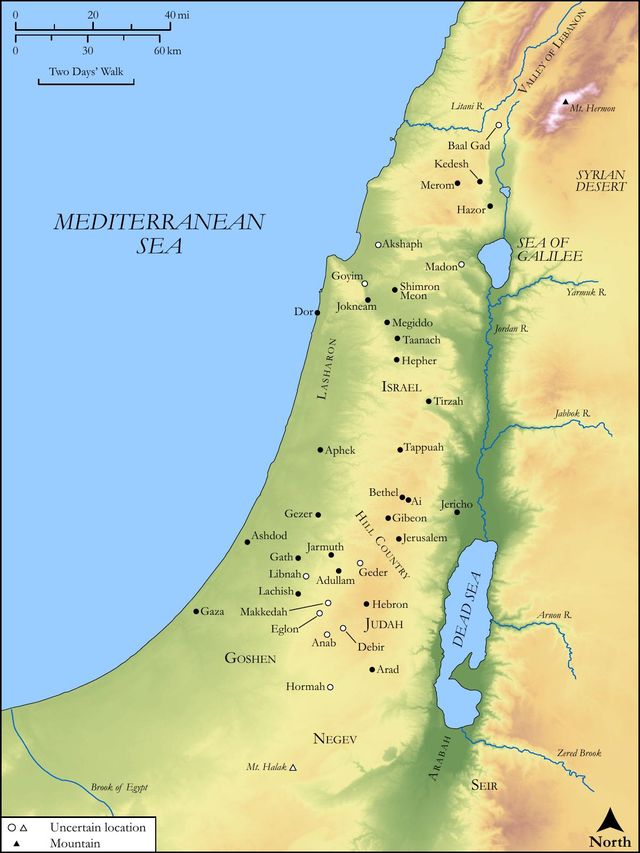
Jabin's immediate and strategic action is to dispatch envoys, indicating his leadership and the urgency of the situation. Madon was another significant Canaanite city-state, though its precise location remains a subject of scholarly debate. The act of "sending" (shâlach) implies a diplomatic initiative to forge a powerful military alliance, demonstrating Jabin's foresight and his capacity to mobilize regional powers.
"and to the king of Shimron, and to the king of Achshaph,"
These are additional prominent city-states in the northern region, further illustrating the breadth and scale of the formidable coalition Jabin is assembling. Shimron is generally identified with Khirbet Shimron, situated southwest of Nazareth, and Achshaph with Tell Kisan, located near Acco. The inclusion of these kings signifies a widespread and coordinated effort to repel the Israelite invasion, uniting disparate city-states under Jabin's strategic leadership in a desperate attempt to preserve their autonomy and existence.
Literary Devices
ShowHideThe author employs several potent literary devices in Joshua 11:1 to effectively set the scene and build narrative tension. Anticipation is a primary device, as the verse immediately builds suspense by introducing a powerful new antagonist and the rapid formation of a formidable coalition. This signals to the reader that the conflict is far from over and is about to escalate significantly. The Geographical Listing of kings and their respective cities (Madon, Shimron, Achshaph) serves to underscore the widespread nature of the opposition, emphasizing the sheer number and combined strength of the forces Israel is about to face. This detailed listing also grounds the narrative firmly in historical and geographical reality, enhancing its verisimilitude. Furthermore, the verse functions as a powerful Foreshadowing of the great battle to come, preparing the reader for a climactic confrontation that will test Israel's faith and demonstrate God's power on an even grander scale than the preceding southern campaigns.
Theological and Thematic Connections
ShowHideJoshua 11:1 vividly illustrates the persistent reality of organized opposition to God's redemptive purposes. Just as the Canaanite kings united in a desperate attempt to resist Israel's divinely ordained inheritance of the land, so too does spiritual opposition frequently coalesce against the advancement of God's kingdom in every age. This verse underscores that the path of obedience and faith often leads into direct confrontation with entrenched powers—whether political, cultural, ideological, or spiritual—that stand against God's sovereign will. It highlights the profound principle that God's people, in fulfilling their divine mandate, will inevitably encounter formidable, organized resistance, which ultimately serves to magnify God's power and faithfulness when He grants victory. The strength of the enemy is never a measure of God's capacity to deliver.
Reflection and Application
ShowHideThe formation of the northern coalition in Joshua 11:1 serves as a profound reminder that following God's call and pursuing His kingdom purposes often invites significant, organized opposition. Just as Jabin and his allies recognized the existential threat Israel posed to their established order and way of life, so too does the world system, often energized by unseen spiritual forces, resist the transformative power of the Gospel and the advance of God's kingdom in our lives and in society. This verse encourages us to be neither surprised nor disheartened by such resistance, but rather to recognize it as an indicator that we are indeed on God's path. It calls us to remember that the magnitude or apparent invincibility of the opposition does not determine the outcome, for God's power is infinitely greater than any human or spiritual confederacy. Our reliance must remain firmly on Him, trusting that He will fight our battles and ensure the ultimate triumph of His will, even when the odds seem insurmountable.
Questions for Reflection
ShowHideFAQ
ShowHideWhy was Hazor so important, and why did Jabin take the lead in forming this coalition?
ShowHideHazor was of paramount importance due to its unparalleled strategic geographical location and immense size, making it the most powerful and influential city-state in northern Canaan in the days of Joshua. It controlled vital trade routes connecting Mesopotamia, Syria, and Egypt, giving it significant economic, political, and military influence throughout the region. Scripture names it "the head of all those kingdoms" (Joshua 11:10). Jabin, as Hazor's king, naturally took the lead because he was the most powerful and strategically positioned ruler in the region. He recognized the existential threat posed by Israel's successful southern campaigns and understood that a unified front was the only viable way to resist such a formidable and divinely backed force. His initiative to form the coalition demonstrates his astute leadership, strategic foresight, and the desperate need for a consolidated defense against the advancing Israelites.
Christ-Centered Fulfillment
ShowHideJoshua 11:1, by introducing the greatest human opposition to God's people in the Old Testament, powerfully foreshadows the ultimate spiritual conflict and the triumph of God's Anointed King. Just as Jabin and his allied kings conspired to prevent Israel from inheriting their promised land, so too did the "kings of the earth set themselves, and the rulers take counsel together, against the Lord and against His Anointed" (Psalm 2:2). This finds its ultimate fulfillment in the life, death, and resurrection of Jesus Christ, who faced the consolidated opposition of religious and political powers (e.g., Matthew 27:1-2). Yet, just as God delivered Hazor and its formidable confederacy into Israel's hands, demonstrating His sovereign power, so too did God raise Jesus from the dead, demonstrating His supreme authority over all earthly and spiritual powers (Ephesians 1:20-23). The victory over Jabin's coalition prefigures Christ's decisive triumph over sin, death, and the forces of darkness, establishing His eternal kingdom and securing the true spiritual inheritance for all who believe in Him (Colossians 2:15). Ultimately, the narrative of Joshua's conquest points to Jesus, the greater Joshua, who leads His people into their eternal rest and defeats every enemy of God's kingdom, ensuring their ultimate and glorious inheritance.