


Joshua 10:3
Bible text: King James Version (1769 Blayney text) · Public domain
Bible text: King James Version with Strong's numbers · Public domain
Bible text: Berean Standard Bible · Public domain
Bible text: American Standard Version (1901) · Public domain
Bible text: World English Bible, Messianic edition · Public domain
Bible text: Geneva Bible (1599) · Public domain
Bible text: Young's Literal Translation · Public domain
- וַיִּשְׁלַחvai·yish·Lachand he sentH7971Conj-w ¦ V-Qal-ConsecImperf-3msVerb Qal Consecutive Imperfect 3rd Singular Masculineוַandיִּשְׁלַחhe sent
- אֲדֹנִי'a·do·niAdoni-H139N-proper-mNoun Proper Masculine
- צֶדֶקTze·dekZedekH139N-proper-mNoun Proper Masculine
- מֶלֶךְMe·lekh[the] king ofH4428N-mscNoun Singular Masculine Construct
- יְרוּשָׁלִַםye·ru·sha·LimJerusalemH3389N-properNoun Proper Location
- אֶל'eltoH413PrepPreposition
- הוֹהָםho·HamHohamH1944N-proper-mNoun Proper Masculine
- מֶלֶךְMe·lekh[the] king ofH4428N-mscNoun Singular Masculine Construct
- חֶבְרוֹןChev·ronHebronH2275N-properNoun Proper Location
- וְאֶלve·'eland toH413Conj-w ¦ PrepPrepositionוְandאֶלto
- פִּרְאָםpir·'AmPiramH6502N-proper-mNoun Proper Masculine
- מֶלֶךְMe·lekh[the] king ofH4428N-mscNoun Singular Masculine Construct
- יַרְמוּתyar·MutJarmuthH3412N-properNoun Proper Location
- וְאֶלve·'eland toH413Conj-w ¦ PrepPrepositionוְandאֶלto
- יָפִיעַya·Fi·a'JaphiaH3309N-proper-mNoun Proper Masculine
- מֶלֶךְMe·lekh[the] king ofH4428N-mscNoun Singular Masculine Construct
- לָכִישׁla·KhishLachishH3923N-properNoun Proper Location
- וְאֶלve·'eland toH413Conj-w ¦ PrepPrepositionוְandאֶלto
- דְּבִירde·VirDebirH1688N-proper-mNoun Proper Masculine
- מֶלֶךְMe·lekh[the] king ofH4428N-mscNoun Singular Masculine Construct
- עֶגְלוֹןeg·LonEglonH5700N-properNoun Proper Location
- לֵאמֹרle·Mor<to> sayingH559Prep-l ¦ V-Qal-InfVerb Qal Infinitive Constructלֵ<to>אמֹרsaying
English is a literal word-by-word gloss of the Hebrew, not the KJV's wording. Why?
This is the original text the KJV's translators worked from — each Hebrew word with its own literal English meaning in this verse, prepared by scholars at Tyndale House, Cambridge. The KJV translates whole sentences, not word by word, so its wording differs: one Hebrew word can become several English words, and the KJV may choose “the LORD” where the gloss reads “Yahweh”. Both are faithful — they answer different questions. For the KJV's own rendering, switch to the KJV text.
Details
See on the biblical-era maps
Study this verse
Public-domain commentary
Matthew Henry
From his Commentary on the Whole Bible. Henry comments on passages, not single verses — this entry covers Joshua 10:1–6.
Joshua and the hosts of Israel had now been a good while in the land of Canaan, and no great matters were effected; they were made masters of Jericho by a miracle, of Ai by stratagem, and of Gibeon by surrender, and that was all; hitherto the progress of their victories had not seemed proportionable to the magnificence of their entry and the glory of their beginnings. Those among them that were impatient of delays, it is probable, complained of Joshua's slowness, and asked why they did not immediately penetrate into the heart of the country, before the enemy could rally their forces to make head against them, why they stood trifling, while they were so confident both of their title and of their success. Thus Joshua's prudence, perhaps, was censured as slothfulness, cowardice, and want of spirit. But, 1. Canaan was not to be conquered in a day. God had said that by little and little he would drive out the Canaanites, Exo 23:30. He that believeth will not make haste, or conclude that the promise will never be performed because it is not performed so soon as he expected. 2. Joshua waited for the Canaanites to be the aggressors; let them first make an onset upon Israel, or the allies of Israel, and then their destruction will be, or at least will appear to be, the more just and more justifiable. Joshua had warrant sufficient to set upon them, yet he stays till they strike the first stroke, that he might provide for honest things in the sight, not only of God, but of men; and they would be the more inexcusable in their resistance, now that they had seen what favour the Gibeonites found with Israel. 3. It was for the advantage of Israel to sit still awhile, that the forces of these little kings might unite in one body, and so might the more easily be cut off at one blow. This God had in his eye when he put it into their hearts to combine against Israel; though they designed thereby to strengthen one another, that which he intended was to gather them as sheaves into the floor, to fall together under the flail, Mic 4:12. Thus oftentimes that seeming paradox proves wholesome counsel, Stay awhile, and we shall have done the sooner.
After Israel had waited awhile for an occasion to make war upon the Canaanites, a fair one offers itself. 1. Five kings combine against the Gibeonites. Adoni-zedec king of Jerusalem was the first mover and ring-leader of this confederacy. He had a good name (it signifies lord of righteousness), being a descendant perhaps from Melchizedek, king of righteousness; but, notwithstanding the goodness of his name and family, it seems he was a bad man, and an implacable enemy to the posterity of that Abraham to whom his predecessor, Melchizedek, was such a faithful friend. He called upon his neighbours to join against Israel either because he was the most honourable prince, and had the precedency among these kings (perhaps they had some dependence upon him, at least they paid a deference to him, as the most public, powerful, and active man they had among them), or because he was first or most apprehensive of the danger his country was in, not only by the conquest of Jericho and Ai, but the surrender of Gibeon, which, it seems, was the chief thing that alarmed him, it being one of the most considerable frontier towns they had. Against Gibeon therefore all the force he would raise must be leveled. Come, says he, and help me, that we may smite Gibeon. This he resolves to do, either, (1.) In policy, that he might retake the city, because it was a strong city, and of great consequence to this country in whose hands it was; or, (2.) In passion, that he might chastise the citizens for making peace with Joshua, pretending that they had perfidiously betrayed their country and strengthened the common enemy, whereas they had really done the greatest kindness imaginable to their country, by setting them a good example, if they would have followed it. Thus Satan and his instruments make war upon those that make peace with God. Marvel not if the world hate you, and treat those as deserters who are converts to Christ. 2. The Gibeonites send notice to Joshua of the distress and danger they are in, Jos 10:6. Now they expect benefit from the league they had made with Israel, because, though it was obtained by deceit, it was afterwards confirmed when the truth came out. They think Joshua obliged to help them, (1.) In conscience, because they were his servants; not in compliment, as they had said in their first address (Jos 9:8), We are thy servants, but in reality made servants to the congregation; and it is the duty of masters to take care of the poorest and meanest of their servants, and not to see them wronged when it is in the power of their hand to right them. Those that pay allegiance may reasonably expect protection. Thus David pleads with God (Psa 119:94), I am thine, save me; and so may we, if indeed we be his. (2.) In honour, because the ground of their enemies' quarrel with them was the respect they had shown to Israel, and the confidence they had in a covenant with them. Joshua cannot refuse to help them when it is for their affection to him, and to the name of his God, that they are attacked. David thinks it a good plea with God (Psa 69:7), For thy sake I have borne reproach. When our spiritual enemies set themselves in array against us, and threaten to swallow us up, let us, by faith and prayer, apply to Christ, our Joshua, for strength and succour, as Paul did, and we shall receive the same answer of peace, My grace is sufficient for thee, Co2 12:8, Co2 12:9.
Historical interpretation
Historical reception
1 surviving comment on this verse from the historical church.
There is no doubt that when a human soul associates itself with the Word of God, it is immediately going to have enemies, and that those it once considered friends will be changed into adversaries. The soul should not only expect to suffer this from humans, but it should also know that such will likewise be forthcoming from opposing powers and spiritual iniquities. Thus it happens that whoever longs for friendship with Jesus knows he must tolerate the hostilities of many.…Even now, therefore, the Gibeonites, such as they are, are assaulted because of friendship with Jesus [Joshua], even though they are “hewers of wood and carriers of water.” That is, although you are the least worthy in the church, nevertheless, because you belong to Jesus, you will be assailed by five kings.
The Gibeonites, however, are not abandoned or scorned by Jesus [Joshua] or by the leaders and elders of the Israelites; instead they offer help for their weakness.
Continue studying Joshua 10:3 across the web’s major study libraries — every link below opens this exact verse, chapter, or book on the destination site.
Read & Compare
 BibleGatewayThis verse in more than 200 translations and 70 languages.
 Bible.comThe YouVersion reader — hundreds of translations, reading plans, and highlights.
 ESV.orgCrossway's official English Standard Version reader.
 NET BibleThe NET translation with 60,000+ translators' notes on every rendering decision.
 STEP BibleTyndale House's free study tool — original text, vocabulary, and scholarly resources.
 BibliaLogos Bible Software's free web reader.
 USCCBThe New American Bible (Revised Edition) with the U.S. bishops' study notes.
Commentaries
 BibleHub CommentariesDozens of classic commentaries on this verse, gathered on one page.
 StudyLightMore than 100 commentary sets — the largest collection on the web.
 BibleRefPlain-English commentary on what this verse means, verse by verse.
 Enduring WordDavid Guzik's free commentary on this chapter, widely used by Bible teachers.
 Bible Study ToolsVerse commentary alongside Greek and Hebrew study aids.
Original Language & Research
- BibleHub InterlinearThe verse word by word — original language, transliteration, and English.
- BibleHub LexiconEvery word's original-language definition and Strong's entry.
 Blue Letter BibleDeep-study tools — Strong's numbers, concordance, and word studies.
 SefariaThe Hebrew text with Rashi and centuries of Jewish commentary.
Sermons, Hymns & Audio


TrulyRandomVerse is not affiliated with these sites and doesn’t control their content. They’re linked because they’re genuinely useful.
Summary
Joshua 10:3 details the immediate and fearful reaction of the southern Canaanite kings to Israel's growing power and the Gibeonite defection. This verse specifically identifies Adonizedek, the king of Jerusalem, as the orchestrator of a formidable coalition, dispatching a summons to four other prominent Amorite kings: Hoham of Hebron, Piram of Jarmuth, Japhia of Lachish, and Debir of Eglon, to unite against the Israelite advance. This strategic alliance sets the stage for a pivotal confrontation in the conquest of Canaan.
Context
ShowHideLiterary Context
Joshua 10:3 emerges directly from the narrative of Israel's conquest and covenant-making. The preceding chapter, Joshua 9, recounts how the Gibeonites, through cunning deception, secured a peace treaty with Israel, circumventing the divine command to utterly destroy the Canaanites. This treaty, though made under false pretenses, was honored by Joshua and the Israelite leaders due to their oath (Joshua 9:15). The immediate verses of Joshua 10 describe the alarm this Gibeonite defection caused among the Canaanite kings, particularly Adonizedek of Jerusalem, who perceived it as a direct threat to their collective security and dominance. Gibeon was a significant city, described as "one of the royal cities, and because it was larger than Ai, and all its men were mighty" (Joshua 10:2), making its alliance with Israel a strategic blow to the Canaanite resistance. Thus, verse 3 initiates the counter-movement, detailing the formation of the opposing confederacy.
Historical & Cultural Context
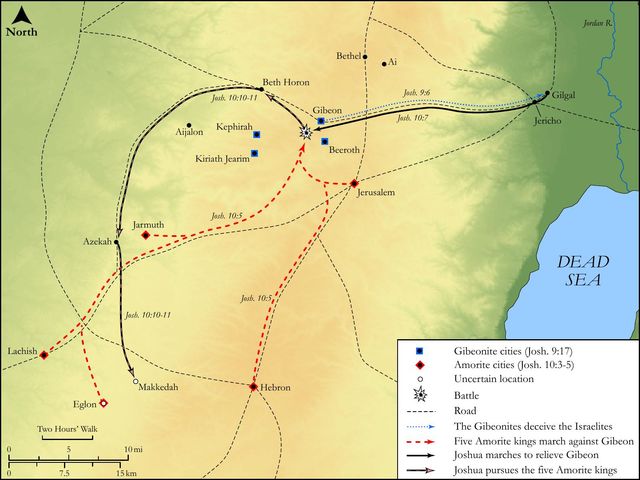
The period of the Israelite conquest was characterized by a fragmented political landscape in Canaan, comprising numerous independent city-states, each ruled by its own king. These city-states often engaged in rivalries but could form temporary alliances when faced with a common external threat. The Amorites, mentioned implicitly through the names of the kings and cities, were a dominant ethnic group in the southern highlands of Canaan. Jerusalem, even at this early stage, held significant strategic importance, situated on a defensible ridge. Hebron, Jarmuth, Lachish, and Eglon were also key strongholds in the southern region, controlling vital trade routes and agricultural lands. The act of "sending" messengers to form a coalition was a standard diplomatic and military practice of the time, reflecting the urgency and gravity of the perceived threat posed by the Israelites, whose recent victories at Jericho and Ai had undoubtedly spread fear throughout the land.
Key Themes
ShowHideThis verse contributes significantly to several overarching themes within the book of Joshua. Firstly, it underscores the theme of United Opposition against God's people. The Canaanite kings, despite their internal rivalries, coalesce in a desperate attempt to resist the divinely ordained conquest, highlighting the spiritual nature of the conflict. Secondly, it emphasizes Divine Sovereignty and Providence. While seemingly a formidable threat, this grand alliance ultimately serves God's larger purpose by gathering multiple enemy kings into one place, allowing for a decisive and comprehensive defeat that fulfills God's promise to give Israel the land (Joshua 1:3-4). Thirdly, the verse subtly introduces the theme of Covenant Faithfulness, as Israel's adherence to the Gibeonite treaty, despite its deceptive origins, directly precipitates this major confrontation, demonstrating that even unexpected circumstances can be woven into God's redemptive plan.
Exposition and Analysis
ShowHideKey Word Analysis
ShowHideThis name literally means "my lord is righteousness" or "lord of justice." The "Adoni-" prefix ("my lord") is a common element in Semitic names. The "zedek" element ("righteousness") is particularly significant, echoing the name of Melchizedek, the king of Salem and priest of God Most High, who blessed Abraham. While Melchizedek represented true righteousness and a prefigurement of Christ, Adonizedek, despite bearing a similar name, stands in direct opposition to God's righteous plan for Israel. This contrast highlights a common biblical motif where human claims to righteousness or authority clash with divine truth and purpose. His name ironically foreshadows his ultimate defeat by the God of true righteousness.
The verb "shalach" denotes a deliberate, purposeful dispatching or sending. In this context, it signifies a formal diplomatic and military initiative. Adonizedek's act of sending messengers to these specific kings indicates a strategic and urgent call for a confederation, rather than a casual invitation. It reflects his proactive leadership and the perceived gravity of the situation, initiating a coordinated response to the Israelite threat. This verb emphasizes the intentionality behind the formation of this powerful alliance.
The repeated designation of "king" for Adonizedek and each of the four other rulers underscores the political structure of Canaan at the time—a collection of independent city-states, each governed by its own monarch. The title "king" implies absolute authority within their respective domains, control over military forces, and the power to enter into treaties or wage war. The listing of five kings signifies a significant concentration of power and a unified front of the most influential southern Canaanite rulers, highlighting the formidable nature of the opposition Israel was about to face.
Verse Breakdown
ShowHide"Wherefore Adonizedek king of Jerusalem sent"
This opening clause establishes the cause and the primary actor of the subsequent events. "Wherefore" (or "Now it came to pass") links this action directly to the Gibeonite treaty and the fear it instilled (Joshua 10:1-2). Adonizedek, identified as the king of Jerusalem, takes the initiative, demonstrating Jerusalem's political prominence and his leadership among the Canaanite city-states. His act of "sending" signifies a formal, urgent summons for a military alliance.
"unto Hoham king of Hebron, and unto Piram king of Jarmuth,"
This part of the verse begins the detailed enumeration of the kings and their cities who were summoned. Hebron was a major city in the southern hill country, known for its strategic location and ancient significance. Jarmuth was another important city in the Shephelah (foothills) region. The inclusion of these kings indicates Adonizedek's intent to gather a broad and powerful coalition from key southern strongholds.
"and unto Japhia king of Lachish, and unto Debir king of Eglon, saying,"
The list continues with Japhia of Lachish and Debir of Eglon, further solidifying the geographical scope and military strength of the proposed alliance. Lachish was a formidable fortress city, archaeologically attested as a major center. Eglon was also a significant city in the Shephelah. The phrase "saying" indicates that Adonizedek's message, detailed in the following verse (Joshua 10:4), was conveyed to these rulers, urging them to join forces against Gibeon and, by extension, Israel. This collective naming emphasizes the unified nature of the impending conflict.
Literary Devices
ShowHideJoshua 10:3 employs several effective literary devices. The most prominent is Catalogue or Listing, as the verse meticulously enumerates the five kings and their respective cities. This detailed roster serves to impress upon the reader the formidable nature of the opposition Israel is about to face, emphasizing the breadth and depth of the Canaanite resistance. The specific naming of each king and city also lends a sense of historical verisimilitude and precision to the narrative. Furthermore, the verse functions as Foreshadowing, setting the stage for the climactic Battle of Gibeon described later in Joshua 10. The formation of this grand alliance signals an impending large-scale conflict, building narrative tension and anticipation. Finally, there is a subtle Irony in the name "Adonizedek," meaning "lord of righteousness," given that he is the primary antagonist opposing God's righteous conquest of the land. This ironic contrast highlights the spiritual battle between human self-righteousness or pagan claims to authority and the true righteousness of God.
Theological and Thematic Connections
ShowHideJoshua 10:3 powerfully illustrates the theological principle that human schemes, even those intended to thwart God's purposes, are ultimately subject to His sovereign will. Adonizedek and the other Amorite kings, driven by fear and a desire to preserve their dominion, formed a seemingly insurmountable alliance. However, this very act of consolidation inadvertently played into God's hands, gathering a significant portion of the southern Canaanite resistance into one place for a decisive defeat. This demonstrates God's ability to orchestrate events, using even the opposition of His enemies to advance His redemptive plan and fulfill His covenant promises to Israel concerning the land. It underscores that no earthly power, however formidable, can ultimately stand against the divine decree.
Reflection and Application
ShowHideJoshua 10:3, though seemingly a simple list of names and places, offers profound lessons for contemporary believers. It reminds us that faithfulness to God's covenant, even when it leads to unexpected alliances or provokes opposition, can be part of His larger strategy. Just as the Gibeonite treaty, initially a deception, became the catalyst for a major victory, so too can God use unforeseen circumstances and challenges in our lives to bring about His greater purposes. When we face formidable opposition, whether from external pressures or internal struggles, this passage encourages us not to despair. The formation of the Canaanite coalition, intended to crush Israel, ultimately led to their concentrated defeat. This teaches us that God is sovereign over all circumstances, even the most threatening, and can turn the strategies of our adversaries into opportunities for His glory and our deliverance. Our task is to remain faithful, trust in His overarching plan, and recognize that His power is revealed most clearly when human strength is insufficient.
Questions for Reflection
ShowHideFAQ
ShowHideWhy did Adonizedek specifically target Gibeon, and why was this alliance so significant?
ShowHideAdonizedek targeted Gibeon because Gibeon, a powerful Hivite city, had made a peace treaty with Israel (Joshua 9:15). This alliance was a direct betrayal of the Canaanite resistance and a strategic blow to their collective security. Gibeon was a major city, described as "one of the royal cities, and because it was larger than Ai, and all its men were mighty" (Joshua 10:2). Its defection meant Israel had a strong foothold within Canaanite territory without a fight. The alliance of the five Amorite kings was significant because it represented a unified front of the most powerful city-states in the southern highlands, including Jerusalem, Hebron, Lachish, Jarmuth, and Eglon. This coalition aimed to punish Gibeon for its perceived treachery and to halt Israel's advance, setting the stage for the largest and most decisive battle in the southern campaign of the conquest.
Christ-Centered Fulfillment
ShowHideJoshua 10:3, while detailing an ancient military alliance, finds profound Christ-centered fulfillment in the ongoing spiritual battle and the ultimate triumph of God's Anointed King. Adonizedek, whose name means "lord of righteousness," ironically leads an unrighteous coalition against God's people, foreshadowing the world's opposition to the true King of Righteousness, Jesus Christ. Just as the Canaanite kings united against Israel, so too have the "kings of the earth" set themselves against the Lord and His Anointed (Psalm 2:2). From the conspiracy to crucify Him (Acts 4:27-28) to the ongoing spiritual warfare against His church (Ephesians 6:12), the pattern of united opposition against God's redemptive plan persists. However, the ultimate outcome in Joshua 10, where this formidable alliance is decisively defeated by God's miraculous intervention, points forward to Christ's definitive victory over sin, death, and all opposing powers. He is the true Lamb of God who takes away the sin of the world, the King who has already triumphed over every principality and power through His cross (Colossians 2:15). Believers, united with Christ, are called to participate in His victory, knowing that no weapon formed against them shall prosper, for their King has already secured the ultimate triumph (Romans 8:37).