


Genesis 14:18
- וּמַלְכִּיu·mal·kiand Melchi-H4442Conj-w ¦ N-proper-mNoun Proper MasculineוּandמַלְכִּיMelchi-
- צֶדֶקtze·dek-zedekH4442N-proper-mNoun Proper Masculine
- מֶלֶךְMe·lekh[the] king ofH4428N-mscNoun Singular Masculine Construct
- שָׁלֵםsha·LemSalemH8004N-properNoun Proper Location
- הוֹצִיאho·Tzi'he brought outH3318V-Hiphil-Perf-3msVerb Hiphil Perfect 3rd Singular Masculine
- לֶחֶםLe·chembreadH3899N-msNoun Singular Masculine Absolute
- וָיָיִןva·Ya·yinand wineH3196Conj-w ¦ N-msNoun Singular Masculine Absoluteוָandיָיִןwine
- וְהוּאve·Hu'and heH1931Conj-w ¦ Pro-3msPronoun Personal 3rd Singular Masculineוְandהוּאhe
- כֹהֵןkho·Hen[was] a priestH3548N-msNoun Singular Masculine Absolute
- לְאֵלle·'Elof GodH410Prep-l ¦ N-msNoun Singular Masculine AbsoluteלְofאֵלGod
- עֶלְיוֹןel·YonMost HighH5945Adj-msAdjective Singular Masculine Absolute
English is a literal word-by-word gloss of the Hebrew, not the KJV's wording. Why?
This is the original text the KJV's translators worked from — each Hebrew word with its own literal English meaning in this verse, prepared by scholars at Tyndale House, Cambridge. The KJV translates whole sentences, not word by word, so its wording differs: one Hebrew word can become several English words, and the KJV may choose “the LORD” where the gloss reads “Yahweh”. Both are faithful — they answer different questions. For the KJV's own rendering, switch to the KJV text.
Details
See on the biblical-era map


Study this verse
Public-domain commentary
Matthew Henry
From his Commentary on the Whole Bible. Henry comments on passages, not single verses — this entry covers Genesis 14:17–20. His three-level outline is real structure in the source text, so it is rendered as structure.
This paragraph begins with the mention of the respect which the king of Sodom paid to Abram at his return from the slaughter of the kings; but, before a particular account is given of this, the story of Melchizedek is briefly related, concerning whom observe,
I.Who he was.
He was king of Salem and priest of the most high God; and other glorious things are said of him, Heb 7:1, etc.
1.The rabbin, and most of our rabbinical writers, conclude that Melchizedek was Shem the son of Noah, who was king and priest to those that descended from him, according to the patriarchal model. But this is not at all probable; for why should his name be changed? And how came he to settle in Canaan?
2.Many Christian writers have thought that this was an appearance of the Son of God himself, our Lord Jesus, known to Abram, at this time, by this name, as afterwards, Hagar called him by another name, Gen 16:13. He appeared to him as a righteous king, owning a righteous cause, and giving peace. It is difficult to imagine that any mere man should be said to be without father, without mother, and without descent, having neither beginning of days nor end of life, Heb 7:3. It is witnessed of Melchizedek that he liveth, and that he abideth a priest continually (Gen 14:3, Gen 14:8); nay (Gen 14:13, Gen 14:14), the apostle makes him of whom these things are spoken to be our Lord who sprang out of Judah. It is likewise difficult to think that any mere man should, at this time, be greater than Abram in the things of God, that Christ should be a priest after the order of any mere man, and that any human priesthood should so far excel that of Aaron as it is certain that Melchizedek's did.
3.The most commonly received opinion is that Melchizedek was a Canaanitish prince, that reigned in Salem, and kept up the true religion there; but, if so, why his name should occur here only in all the story of Abram, and why Abram should have altars of his own and not attend the altars of his neighbour Melchizedek who was greater than he, seem unaccountable. Mr. Gregory of Oxford tells us that the Arabic Catena, which he builds much upon the authority of, gives this account of Melchizedek, That he was the son of Heraclim, the son of Peleg, the son of Eber, and that his mother's name was Salathiel, the daughter of Gomer, the son of Japheth, the son of Noah.
II.What he did.
1.He brought forth bread and wine, for the refreshment of Abram and his soldiers, and in congratulation of their victory. This he did as a king, teaching us to do good and to communicate, and to be given to hospitality, according to our ability; and representing the spiritual provisions of strength and comfort which Christ has laid up for us in the covenant of grace for our refreshment, when we are wearied with our spiritual conflicts.
2.As priest of the most high God, he blessed Abram, which we may suppose a greater refreshment to Abram than his bread and wine were. Thus God, having raised up his Son Jesus, has sent him to bless us, as one having authority; and those whom he blesses are blessed indeed. Christ went to heaven when he was blessing his disciples (Luk 24:51); for this is what he ever lives to do.
III.What he said, Gen 14:19, Gen 14:20.
Two things were said by him: - 1. He blessed Abram from God: Blessed be Abram, blessed of the most high God, Gen 14:19. Observe the titles he here gives to God, which are very glorious. (1.) The most high God, which bespeaks his absolute perfections in himself and his sovereign dominion over all the creatures; he is King of kings. Note, It will greatly help both our faith and our reverence in prayer to eye God as the most high God, and to call him so. (2.) Possessor of heaven and earth, that is, rightful owner, and sovereign Lord, of all the creatures, because he made them. This bespeaks him a great God, and greatly to be praised (Psa 24:1), and those a happy people who have an interest in his favour and love. 2. He blessed God for Abram (Gen 14:20): and blessed be the most high God. Note, (1.) In all our prayers, we must praise God, and join hallelujahs with all our hosannahs. These are the spiritual sacrifices we must offer up daily, and upon particular occasions. (2.) God, as the most high God, must have the glory of all our victories, Exo 17:15; Sa1 7:10, Sa1 7:12; Jdg 5:1, Jdg 5:2; Ch2 20:21. In them he shows himself higher than our enemies (Exo 18:11), and higher than we; for without him we could do nothing. (3.) We ought to give thanks for others' mercies as for our own, triumphing with those that triumph. (4.) Jesus Christ, our great high priest, is the Mediator both of our prayers and praises, and not only offers up ours, but his own for us. See Luk 10:21.
IV.What was done to him:
Abram gave him tithes of all, that is, of the spoils, Heb 7:4. This may be looked upon,
1.As a gratuity presented to Melchizedek, by way of return for his tokens of respect. Note, Those that receive kindness should show kindness. Gratitude is one of nature's laws.
2.As an offering vowed and dedicated to the most high God, and therefore put into the hands of Melchizedek his priest. Note,
(1.)When we have received some signal mercy from God, it is very fit that we should express our thankfulness by some special act of pious charity. God must always have his dues out of our substance, especially when, by any particular providence, he has either preserved or increased it to us.
(2.)That the tenth of our increase is a very fit proportion to be set apart for the honour of God and the service of his sanctuary.
(3.)That Jesus Christ, our great Melchizedek, is to have homage done him, and to be humbly acknowledged by every one of us as our king and priest; and not only the tithe of all, but all we have, must be surrendered and given up to him.
Historical interpretation
Five Centuries of Reception
10 surviving comments on this verse. Each one is dated, so this reads as a timeline rather than a list.
Select a marker to jump to its quote. Markers stagger vertically where authors wrote within a few decades of each other.
Likewise, in the priest Melchizedek, we see the sacrament of the sacrifice of the Lord prefigured according to what the divine Scripture testifies and says: “And Melchizedek, the king of Salem, brought out bread and wine, for he was a priest of the most high God, and he blessed Abraham.” But that Melchizedek portrayed a type of Christ, the Holy Spirit declares in the Psalms, saying in the person of the Father to the Son: “Before the day star … I have begotten you.… You are a priest forever according to the order of Melchizedek.” The order proceeds first from the sacrifice and then descends to Melchizedek, a priest of the most high God, because he offered bread, because he blessed Abraham. For who is more a priest of the most high God than our Lord Jesus Christ, who offered sacrifice to God the Father and offered the very same thing that Melchizedek had offered, bread and wine, that is, actually, his body and blood?
This Melchizedek is Shem, who became a king due to his greatness; he was the head of fourteen nations. In addition, “he was a priest.” He received this from Noah, his father, through the rights of succession. Shem lived not only to the time of Abraham, as Scripture says, but even to [the time of] Jacob and Esau, the grandsons of Abraham. It was to him that Rebekah went to ask and was told, “Two nations are in your womb, and the older shall be a servant to the younger.” Rebekah would not have bypassed her husband, who had been delivered at the high place, or her father-in-law, to whom revelations of the divinity came continually, and gone straight to ask Melchizedek unless she had learned of his greatness from Abraham or Abraham’s son.
But one who is victorious should not claim the victory for himself; rather, he should attribute it to God. This is the teaching of Abraham, who became more humble, not more proud, in victory. Indeed, he offered a sacrifice and gave tithes; for this reason too, he received the blessing of Melchizedek, which means in translation “king of justice, king of peace.” He was indeed the priest of the most high God. Who is the king of justice, the priest of God, but he to whom it is said, “You are a priest forever according to the order of Melchizedek,” that is, Son of God, priest of the Father, the one who through the sacrifice of his body propitiated the Father for our transgressions?
What is conveyed to us by this comment, “the king of Salem and priest of God the most high”? He was, for one thing, king of Salem, the text says. Blessed Paul, after all, said the same in drawing attention to him when writing to the believers among the Hebrews, calling to mind his name and his city of origin. At the same time he plumbed the significance of his name and employed some degree of etymology in saying, “Melchizedek, king of righteousness.” You see, in the Hebrew language the word Melchi means “kingdom” and Sedek “righteousness.” Then, moving on to the name of the city, he says, “king of peace,” Salem after all meaning “peace.” On the other hand, he was a priest, possibly self-appointed, this being the way with the priests of the time, you see. So in fact his peers had either accorded him the honor on account of his preeminence in age, or he had made it his business to act as a priest, like Noah, like Abel, like Abraham when they used to offer sacrifices. In a particular manner he was to prove a type of Christ. Hence Paul too understands him in this role in the words “With no father, with no mother, with no family history, lacking beginning of days and end of life, he yet resembles the Son of God and remains a priest forever.” How, you ask, is it possible for a person to have no father or mother and to lack beginning of days and end of life? You heard that he was a type; well, neither marvel at this nor expect everything to be found in the type. You see, he would not be a type if he were likely to contain every feature that occurs in reality. So what does the saying mean? It means this: Just as Melchizedek is said to have no father or mother on account of there being no mention of his parents and to have no family history on account of there being no history for him, so too Christ, on account of his having no mother in heaven or father on earth, is said to have no family history and in fact has none.
You sent me the volume anonymous and authorless... When I read it, I realized that the most famous question about High Priest Melchizedek had been discussed there with many arguments, in an attempt to teach that he who blessed the great Patriarch was of a more divine nature and should not be considered among men... When I read the letter and found myself adjured with remarkable entreaties in the last little page not to spurn the petitioner, I searched through the books of the Ancients to see what each one said, and I answered you, as it were, with the counsel of many. And immediately on the first page of Genesis I found an exegesis by Origen concerning Melchizedek, in which he discusses the matter in many words and comes to the conclusion that he was an angel. With almost the same arguments your author has employed on the Holy Spirit, he speaks on the heavenly powers. I went on to his follower Didymus, and came to a like result. I turned to Hippolytus, Irenaeus, Eusebius of Caesarea, and Emisenus, Apollinaris also, and our Eustathius, who first sang the war trumpet against Arius as the Bishop of Antioch's Church: and I found that all of their opinions, with different arguments and byways, had arrived at one intersection, to say that Melchizedek was a Canaanite man, the king of the city of Jerusalem, which was first called Salem, then Jebus, and finally Jerusalem... I will also give the opinion of the Hebrews... they say that this was Shem, the first son of Noah, and at the time when Abram was born, he was 390 years old, reckoning them thus. After the flood, in the second year, Shem, having lived for 100 years, begot Arphaxad; And after Arphaxad was born, he lived for 500 years, that is, a total of 600 years. And when Arphaxad was thirty-five years old, he begot Salah, who also thirty years old, begot Eber, and we read that Eber begot Peleg at the age of 34. Again, Phaleg, having completed thirty years, begot Rehu: who himself, after his thirty-second year from his birth, begot Serug: of whom, when he had arrived at his thirtieth year, was born Nachor: who, when he was twenty-nine years old, begot Thare: whom we read, at the age of seventy, to have begotten Abram, and Nachor, and Aran. Calculate the number of years through each age, and you will find from the birth of Shem to the generation of Abram, three hundred and ninety years. Now Abraham died in the hundred and seventy-fifth year of his age. By calculation, it is found that Shem, his tenth-degree grandson, survived Abraham by thirty-five years.
(Verse 18.) And Melchizedek, king of Salem, brought forth bread and wine; and he was the priest of the most high God. And he blessed him. Because our work, either the Hebrew Questions or the Collection of Traditions, is once for all, therefore let us infer what the Hebrews think of this. They say that he is the son of Shem, Noah's son; and by calculating the years of his life, they show that he lived until Isaac, and that all the firstborn of Noah, until Aaron assumed the priesthood, were priests. Furthermore, Jerusalem is called the king of Salem, which was previously called Salem. However, blessed Apostle to the Hebrews (VII, 3), mentioning one without a father or mother, refers to Christ, and through Christ to the Church of the Gentiles. For all the glory of the head is referred to the members, because he, having a foreskin, blessed the circumcised Abraham, and in Abraham the Levites, and through the Levites Aaron: from whom later the priesthood. From this he wants to gather that the priesthood of the Church, having a foreskin, blessed the synagogue with the circumcised priesthood. But as he says: You are a priest forever, according to the order of Melchizedek (Ps. CIX, 4): our mystery is signified in the word of the order: not by offering irrational victims through Aaron, but by offering bread and wine: that is, the body and blood of the Lord Jesus.
Having received this oracle of promise, Abraham migrated and remained in another place of the same land, that is, beside the oak of Mamre, which was Hebron. Then, on the invasion of Sodom, when five kings carried on war against four and Lot was taken captive with the conquered Sodomites, Abraham delivered him from the enemy, leading with him to battle 318 of his homeborn servants. [He] won the victory for the kings of Sodom but would take nothing of the spoils when offered by the king for whom he had won them. He was then openly blessed by Melchizedek, who was priest of God most high, about whom many and great things are written in the epistle that is inscribed to the Hebrews, which most say is by the apostle Paul, though some deny this. For then first appeared the sacrifice which is now offered to God by Christians in the whole wide world. Long after the event this sacrifice was said by the prophet to be fulfilled in Christ, who was yet to come in the flesh: “Thou art a priest forever after the order of Melchizedek.” That is to say, not after the order of Aaron, for that order was to be taken away when the things shone forth that were intimated beforehand by these shadows.
Daniel told a story of another hermit who used to live in the lower parts of Egypt, and who said in his simplicity that Melchizedek was the Son of God. Now when the blessed man Theophilus, the archbishop of Alexandria, heard of it, he sent a message asking the monks to bring the hermit to him. When he saw him, he realized that he was a man of vision and that every thing that he had asked for God had given him, and that he had only said this out of simplicity. The archbishop dealt with him wisely in the following manner, saying, ‘Abba, pray to God for me, because I have begun to think that Melchizedek was the Son of God,’ and he added, ‘It cannot be true, for the high priest of God was a man. But because I had doubts in my mind about this, I sent for you to pray to God for me that He may reveal the truth of the matter to you.’ Then, because the hermit had confidence in the power of prayer, he said to him firmly, ‘Wait three days, and I will ask God about this and then I shall be able to tell you who Melchizedek was.’ So the hermit went away, and returned after three days, and said to the blessed Archbishop Theophilus, ‘Melchizedek was a man.’ The Archbishop said unto him, ‘How do you know that, abba?’ The hermit said, ‘God showed me all the Patriarchs, one by one, and they passed before me one after the other, from Adam to Melchizedek, and an angel said to me, “This is Melchizedek.” That is indeed how the truth of this matter appeared tome.’ The hermit went away, and he himself proclaimed that Melchizedek was a man, and the blessed Theophilus rejoiced greatly.
Therefore, Melchisedech signifies the Lord Savior: first indeed, as the Apostle says, who is interpreted as king of righteousness, and then king of Salem, which is king of peace (Hebrews 7:2): with these words, the blessed apostle demonstrates how the figure of Melchisedech should be understood, teaching us very clearly that in the letters of the Old Testament we should seek not only the significations of things but also of names. Just as Melchisedech by his name and person figuratively announces Christ the King of righteousness, he also by the name of his city denotes figuratively the Church of the saints, that is, the city of the great King; about which it is written: "And His place was made in Salem, that is, in peace" (Psalm 76:3). However, Salem is the same that was later called Jerusalem by King David, becoming the metropolis of the entire province of Judea, because he bought the place of the temple there, and left the expenses of the construction to his son Solomon, all of which and many others that are read about this city pertain to the Church as is clear to all readers. Also with the nature of his sacrifice, of which he made Abraham a participant while blessing him, he prefigured the offering of the New Testament, which our Lord Himself first offered in the sacrament of His body and blood, and which He left to the Church to always be offered for the remission of sins: in whose unique participation He taught that all the children of the promise would be blessed: to such an extent that no one can be a part of eternal life without participation in this: "Unless you eat the flesh of the Son of Man and drink His blood, you will not have life in you: whoever eats My flesh and drinks My blood has eternal life" (John 6:54). Thus, in the great significance of the sacrament, Melchisedech the priest blessed Abraham, offering him part of the sacrifice which he had offered to the Lord in bread and wine: clearly insinuating that not only we who came in the flesh after the Lord's passion but also Abraham himself who had received the promises, and all his chosen seed were to be granted eternal blessing through the offering of the Lord's passion. And indeed, Abraham had heard from the Lord: "And I will bless you, and I will make your name great, and you shall be blessed." He had heard: "And in you, all the families of the earth shall be blessed;" but before any son who would be the co-heir of this blessing was born to him; before he offered any sacrifice to God to give thanks for the granted blessing, Melchisedech king of Salem met him bringing bread and wine which he had offered to God, and blessed him, so that he might clearly understand that the blessing promised to him was to be received through the King of righteousness and the author of supreme peace, through the excellent high priest, through the mystical sacrifice of bread and wine, with all his seed. Therefore, let not the Jews boast of the Levitical priesthood against the Christians, since they offer the sacrifices of flesh, and we offer bread and wine to the Lord. For our sacrifice excels in both time and dignity: in time, indeed, because Melchisedech offered this first, before that Abraham or the priests from the stock of Levi came: and in dignity, because it was said to the Lord Christ by the Father concerning this and not that: "You are a priest forever according to the order of Melchisedech" (Psalm 110:4). Which is also completed by the work itself, and now made manifest throughout the world, only a fool and an impious person denies. Thus it is clear that Melchisedech was greater than Abraham the patriarch. For without any contradiction, as the Apostle says, the lesser is blessed by the better (Hebrews 7:7). The sacrifice of Melchisedech is greater than the sacrifices which Abraham is read to have offered subsequently: because this the Lord Christ, that Aaron: this the priests of the New Testament, that of the Old were to offer. Wherefore it is well added: "And he gave him tithes of all." Which the Apostle understood and explained very sublimely; so that Abraham gave tithes to him not only for himself but also for all those who were to be born from him, among whom were the priests themselves who were to accept tithes from the people: "Through Abraham, even Levi, who accepts tithes, was tithed: for he was still in the loins of his father when Melchisedech met him" (Hebrews 7:9). Just as the Levitical tribe excelled, that is, the priestly people, from whom they received tithes; so Melchisedech excelled even those priests and Levites when he received from them in their father Abraham: for they were still in his loins. Abraham indeed in this place designates the people of Israel with their priesthood, while Melchisedech singularly expresses the Mediator between God and men with the priesthood which He left to the heirs of the New Testament: "And Abraham is blessed and tithed by Melchisedech," because even those who were most outstanding in the law and Levitical priesthood could only be blessed by the Lord Jesus Christ, and all that they could have of virtues had to be referred to Him, and they could only be saved by confessing that these were of His grace: hence Peter, when the grace of the Gospel was becoming clear, as if to the priesthood which was to come according to the order of Melchisedech, said to the zealots of legal observance: "Why do you test God by putting a yoke of servitude on the neck of the disciples, which neither our fathers nor we were able to bear? But by the grace of the Lord Jesus, we believe to be saved in the same manner as they" (Acts 15:10). Therefore, Abraham gave tithes of all to Melchisedech the priest, from whom he had received the blessing: because indeed he understood that the type and image of the better priesthood were prefigured in him; this is, that he bore the figure of the legal priesthood, Melchisedech of the evangelical priesthood. For he was going to generate temporal priesthood from himself, which was to be maintained through the successions of priests; Melchisedech is read to have neither beginning of priesthood nor end nor predecessor nor successor: wherefore he fittingly bears the image of Him to whom it is said: "You are a priest forever according to the order of Melchisedech." Let these few things be said about Melchisedech as they seemed sufficient for our work. Moreover, whoever desires to know fully about him and the mysteries he prefigured, let him diligently read the entire Epistle to the Hebrews.
But Melchizedek, king of Salem, bringing forth bread and wine (for he was priest of the most high God), blessed him, and said: Blessed be Abram by the most high God, creator of heaven and earth, and blessed be the most high God, by whose protection your enemies are in your hands, and he gave him tithes of all. Notable first in this reading is that the patriarchs foreshadowed what the apostles proclaimed: And if one member suffers, says Paul, all the members suffer together; if one member is honored, all the members rejoice together (1 Cor. 12:25). For when Lot suffered adversities, Abraham empathized; when they rejoiced over their deliverance and victory, Melchizedek also rejoiced and, blessing the victorious one who had exposed himself to danger for the sake of his brethren's troubles, with heavenly benediction. He magnificently praised not only the human victor but also the Lord who granted the victory, according to that evangelical saying: Let your good works be seen, and glorify your Father who is in heaven (Matt. 5:16). Next, it should be noted that after the struggle and victory, Abraham was blessed; and this was done by the king and priest of the most high God: because we all, too, who belong to the promise of the heavenly homeland, await the blessing of the eternal kingdom after the labors of good works, which is prepared for us from the foundation of the world by the great king and priest, namely the Mediator between God and men, Jesus Christ; about whose kingdom, which he has coequal and coeternal with the Father, it is said in the psalm: The Lord said unto my Lord, Sit at my right hand, until I make your enemies a footstool for your feet (Psalm 110:1), etc.: concerning whose priesthood, in which he offered himself as a sacrifice to the Father for us, it is added in the same psalm saying: The Lord has sworn and will not change his mind, You are a priest forever after the order of Melchizedek (Ibid. 4). Regarding the explanation of the verse and the priesthood and kingdom of our Lord Jesus Christ, which was prefigured in Melchizedek, it is appropriate for our humble self to speak and treat briefly in this place, since the Apostle in his epistle to the Hebrews discussed and explained these topics most sublimely and comprehensively, following his lead we have considered it appropriate to insert a few points from the many he made here.
Continue studying Genesis 14:18 across the web’s major study libraries — every link below opens this exact verse, chapter, or book on the destination site.
Read & Compare
 BibleGatewayThis verse in more than 200 translations and 70 languages.
 Bible.comThe YouVersion reader — hundreds of translations, reading plans, and highlights.
 ESV.orgCrossway's official English Standard Version reader.
 NET BibleThe NET translation with 60,000+ translators' notes on every rendering decision.
 STEP BibleTyndale House's free study tool — original text, vocabulary, and scholarly resources.
 BibliaLogos Bible Software's free web reader.
 USCCBThe New American Bible (Revised Edition) with the U.S. bishops' study notes.
Commentaries
 BibleHub CommentariesDozens of classic commentaries on this verse, gathered on one page.
 StudyLightMore than 100 commentary sets — the largest collection on the web.
 BibleRefPlain-English commentary on what this verse means, verse by verse.
 Enduring WordDavid Guzik's free commentary on this chapter, widely used by Bible teachers.
 Bible Study ToolsVerse commentary alongside Greek and Hebrew study aids.
Original Language & Research
- BibleHub InterlinearThe verse word by word — original language, transliteration, and English.
- BibleHub LexiconEvery word's original-language definition and Strong's entry.
 Blue Letter BibleDeep-study tools — Strong's numbers, concordance, and word studies.
 SefariaThe Hebrew text with Rashi and centuries of Jewish commentary.
Sermons, Hymns & Audio


TrulyRandomVerse is not affiliated with these sites and doesn’t control their content. They’re linked because they’re genuinely useful.
Summary
Genesis 14:18 introduces the enigmatic figure of Melchizedek, king of Salem and priest of the Most High God, who unexpectedly appears to Abraham after his military triumph. This pivotal encounter features Melchizedek bringing forth bread and wine and bestowing a blessing upon Abraham, establishing a unique pre-Levitical priesthood that profoundly foreshadows the superior and eternal priesthood of Jesus Christ.
Context
ShowHideLiterary Context
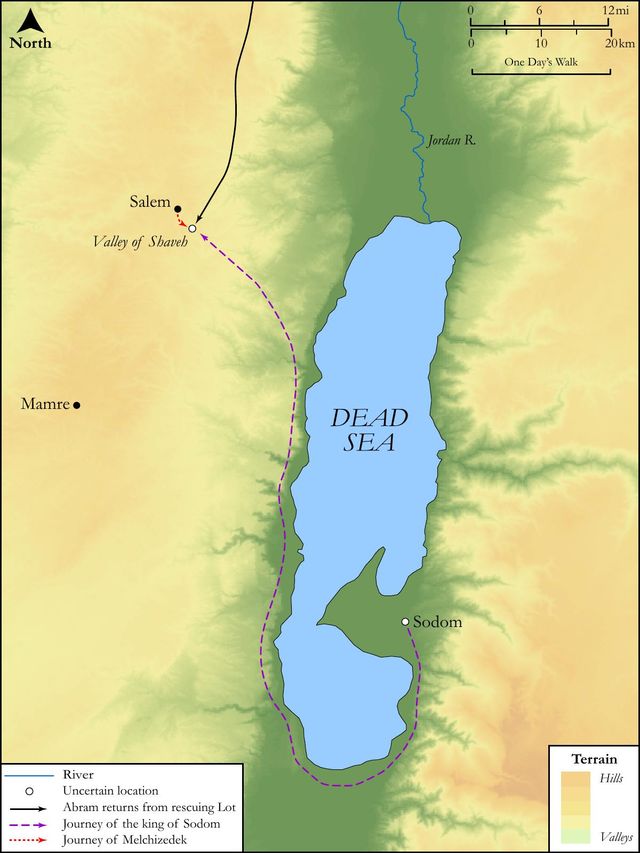
Genesis 14:18 immediately follows Abraham's (then Abram's) decisive victory over the confederate kings who had captured Lot. Having pursued and defeated Chedorlaomer and his allies, Abraham is returning from battle when he is met by two kings in the Valley of Shaveh (also known as the King's Valley): the king of Sodom and Melchizedek. The sudden, almost parenthetical, appearance of Melchizedek in the narrative is striking. He is not introduced with a genealogy or backstory, but simply emerges as a pre-existing authority. This abrupt entrance serves to highlight his unique significance, setting the stage for Abraham's tithe and Melchizedek's blessing, which are central to the theological implications of the passage. The narrative then quickly shifts back to Abraham's interaction with the king of Sodom, underscoring Melchizedek's distinct, transient, yet profound role.
Historical & Cultural Context
The events of Genesis 14 are set in the early second millennium BC, a period characterized by city-states and regional conflicts. Kings often led their armies, and treaties or tributes were common after battles. Salem, generally identified with ancient Jerusalem (meaning "peace"), would have been a significant regional center. The concept of a "priest" was widespread in the ancient Near East, with various deities having their own cultic servants. However, a king also serving as a priest, especially of a monotheistic "Most High God" (El Elyon), was highly unusual and significant. This suggests a recognition of a supreme deity even among non-Israelite peoples, or at least a unique divine appointment for Melchizedek that transcends typical regional religious structures. The act of bringing bread and wine could signify a treaty meal, a gesture of hospitality, or a priestly offering, all common practices in the ancient world.
Key Themes
ShowHideGenesis 14:18 contributes to several overarching themes within Genesis and the broader biblical narrative. It underscores God's sovereignty and provision for Abraham, demonstrating that Abraham's victory was not merely by his own strength but by divine empowerment, as Melchizedek's blessing explicitly states God's role in delivering Abraham's enemies (Genesis 14:19-20). The verse also introduces the theme of divine election and blessing, as Abraham, the recipient of God's covenant promises, is blessed by this mysterious priest-king. Crucially, it introduces the concept of a pre-Levitical priesthood, hinting at a universal divine order that predates the Mosaic Law and the Aaronic lineage. This foreshadows a priesthood that is not bound by tribal or national distinctions, a theme extensively developed in the New Testament concerning the priesthood of Christ (Hebrews 7). Finally, the mention of "bread and wine" subtly introduces elements of communion and covenant, which hold profound typological significance for future divine interactions.
Exposition and Analysis
ShowHideKey Word Analysis
ShowHideFrom an unused root meaning "to effervesce," yayin refers to fermented grape juice, often associated with celebration, banqueting, or, conversely, intoxication. In this context, its presentation alongside bread signifies an act of hospitality, sustenance, and possibly a covenantal meal, hinting at deeper symbolic meaning beyond mere physical refreshment.
An active participle meaning "one officiating," kôhên denotes a priest—a person authorized to perform sacred rites, offer sacrifices, and mediate between God and humanity. Melchizedek's designation as a kôhên of the Most High God highlights his legitimate spiritual authority and unique divine appointment, distinct from any known lineage or institutional structure.
Derived from a root meaning "to ascend" or "elevate," ʻelyôwn signifies an elevation, denoting loftiness or supremacy. As a title, it refers to the Supreme Being, El Elyon, emphasizing God's transcendence, ultimate authority, and exalted position above all other gods, powers, and earthly rulers. This title underscores the universal scope of Melchizedek's God and the supreme source of Abraham's blessing.
Verse Breakdown
ShowHide"And Melchizedek king of Salem brought forth bread and wine"
This clause introduces Melchizedek, identifying him by his name and his royal office as "king of Salem." The act of "bringing forth bread and wine" is a gesture of hospitality and provision. In the ancient world, sharing food and drink often symbolized peace, friendship, and covenantal agreement. For a king to personally bring these items to a returning warrior signifies respect and an acknowledgment of Abraham's victory, possibly as a blessing from his deity.
"and he [was] the priest of the most high God"
This crucial phrase reveals Melchizedek's second, equally significant, office: that of a priest. His deity is explicitly identified as "the most high God" (El Elyon), a title emphasizing God's supreme sovereignty and transcendence. This dual role of king and priest is highly unusual in the biblical narrative, particularly outside of the later established Levitical priesthood and Davidic monarchy. It immediately sets Melchizedek apart as a unique and divinely appointed figure, whose authority stems directly from the ultimate divine power.
Literary Devices
ShowHideThe verse employs several significant literary devices. Juxtaposition is evident in the immediate contrast between the worldly king of Sodom (mentioned in the preceding verse) and the divinely appointed Melchizedek, highlighting the spiritual significance of the latter. Symbolism is rich in the "bread and wine," elements that transcend their literal meaning to prefigure spiritual sustenance, peace, and communion, most notably in the New Covenant. The very name Melchizedek (King of Righteousness) and his city Salem (Peace) function as epithets or allusions, imbuing the character and setting with profound theological meaning that points to a future, greater King and Priest. Finally, the abrupt and unexplained appearance of Melchizedek creates a sense of mystery and divine intervention, emphasizing his extraordinary nature and the sovereign hand of God at work.
Theological and Thematic Connections
ShowHideMelchizedek's appearance in Genesis 14:18 provides a foundational theological insight into God's universal reach and the nature of true spiritual authority. His dual role as king and priest, combined with his identification as a priest of El Elyon (God Most High), suggests a divine order that transcends the later, specific Israelite institutions. This encounter highlights that God's plan of salvation and blessing is not confined to a single lineage or nation but operates through various channels, even before the formal establishment of the covenant with Israel. Melchizedek's blessing of Abraham and Abraham's subsequent tithe acknowledge a superior spiritual authority, underscoring the principle of recognizing and honoring God's appointed representatives and His ultimate sovereignty over all things, including military victories and material wealth.
Reflection and Application
ShowHideThe brief yet profound encounter with Melchizedek in Genesis 14:18 invites us to consider the mysterious ways in which God works throughout history, often through unexpected figures and outside conventional systems. This encounter challenges us to look beyond established norms and human expectations to discern God's sovereign hand. Just as Abraham recognized Melchizedek's unique authority and received spiritual sustenance and blessing, we are called to acknowledge the ultimate source of all true provision, peace, and righteousness as coming from the Most High God. This passage encourages us to cultivate a posture of humility and receptivity to divine truth, wherever and however it is revealed. It reminds us that God's redemptive plan is expansive and transcends human limitations, always pointing towards His ultimate King and Priest.
Questions for Reflection
ShowHideFAQ
ShowHideWho was Melchizedek and why is his appearance so brief yet significant?
ShowHideMelchizedek was the king of Salem (generally identified as ancient Jerusalem) and a priest of El Elyon, the Most High God. His appearance is remarkably brief, confined to just a few verses in Genesis 14, yet profoundly significant because he serves as a unique "type" or foreshadowing of Jesus Christ. His significance lies in his dual role as king and priest, his pre-Levitical priesthood that predates the Mosaic Law, and his act of blessing Abraham, which establishes his spiritual superiority and points to a greater, eternal priesthood. The New Testament book of Hebrews extensively unpacks his typological importance.
What is the significance of Melchizedek bringing bread and wine?
ShowHideThe act of Melchizedek bringing bread and wine to Abraham signifies more than simple hospitality. Theologically, it is highly significant as it prefigures the elements of the New Covenant meal (the Lord's Supper or Eucharist) instituted by Jesus Christ. In this Old Testament context, the bread and wine represent sustenance, peace, and communion, offered by a priest-king who embodies righteousness and peace. It's a priestly act of provision and blessing, setting a powerful precedent for future divine-human interactions and pointing to the ultimate spiritual nourishment provided by Christ.
Christ-Centered Fulfillment
ShowHideMelchizedek stands as one of the most compelling "types" of Christ in the Old Testament, his brief appearance rich with prophetic significance. As the "King of Righteousness" (from his name) and "King of Peace" (from his city, Salem), Melchizedek perfectly prefigures Jesus Christ, who is indeed the King of Righteousness and the Prince of Peace. The New Testament book of Hebrews dedicates an entire chapter to explaining how Jesus' priesthood is "after the order of Melchizedek" (Hebrews 7:11), not the Levitical order. This Melchizedekian priesthood is superior because it is eternal, without beginning or end, and combines both kingship and priesthood in one person, unlike the separate offices in Israel. Just as Melchizedek blessed Abraham and received tithes, Christ, our eternal High Priest and King, offers us ultimate blessing, spiritual sustenance (symbolized by the bread and wine of the New Covenant), and lasting peace through His once-for-all sacrifice. To Him, all believers owe their ultimate allegiance and worship, for He is the mediator of a better covenant and the author of eternal salvation.