


Genesis 14:19
Bible text: King James Version (1769 Blayney text) · Public domain
Bible text: Berean Standard Bible · Public domain
Bible text: American Standard Version (1901) · Public domain
Bible text: World English Bible, Messianic edition · Public domain
Bible text: Geneva Bible (1599) · Public domain
Bible text: Young's Literal Translation · Public domain
- וַיְבָרְכֵהוּvay·va·re·Khe·huand he blessed himH1288Conj-w ¦ V-Piel-ConsecImperf-3ms ¦ 3msVerb Piel Consecutive Imperfect 3rd Singular Masculineוַandיְבָרְכֵhe blessedהוּhim
- וַיֹּאמַרvai·yo·Marand he saidH559Conj-w ¦ V-Qal-ConsecImperf-3msVerb Qal Consecutive Imperfect 3rd Singular Masculineוַandיֹּאמַרhe said
- בָּרוּךְba·Rukh[be] blessedH1288V-Qal-PassPrtcpl-msVerb Qal Participle Passive Singular Masculine Absolute
- אַבְרָם'av·RamAbramH87N-proper-mNoun Proper Masculine
- לְאֵלle·'Elby GodH410Prep-l ¦ N-msNoun Singular Masculine AbsoluteלְbyאֵלGod
- עֶלְיוֹןel·YonMost HighH5945Adj-msAdjective Singular Masculine Absolute
- קֹנֵהko·Neh[the] creator ofH7069V-Qal-Prtcpl-msVerb Qal Participle Singular Masculine Construct
- שָׁמַיִםsha·Ma·yimheavenH8064N-mpNoun Plural Masculine Absolute
- וָאָרֶץva·'A·retzand earthH776Conj-w ¦ N-fsNoun Singular Feminine Absoluteוָandאָרֶץearth
English is a literal word-by-word gloss of the Hebrew, not the KJV's wording. Why?
This is the original text the KJV's translators worked from — each Hebrew word with its own literal English meaning in this verse, prepared by scholars at Tyndale House, Cambridge. The KJV translates whole sentences, not word by word, so its wording differs: one Hebrew word can become several English words, and the KJV may choose “the LORD” where the gloss reads “Yahweh”. Both are faithful — they answer different questions. For the KJV's own rendering, switch to the KJV text.
Details
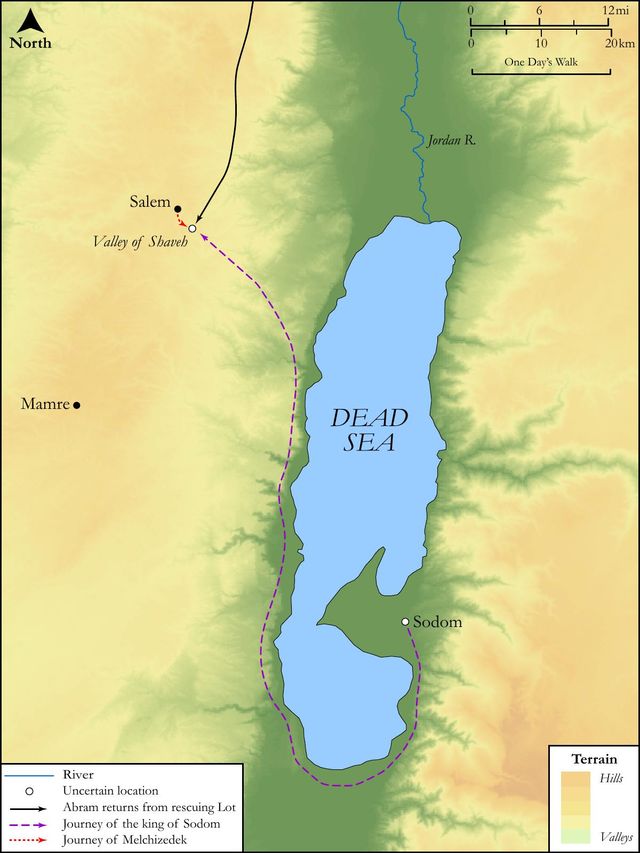
See on the biblical-era maps


Study this verse
Public-domain commentary
Matthew Henry
From his Commentary on the Whole Bible. Henry comments on passages, not single verses — this entry covers Genesis 14:17–20. His three-level outline is real structure in the source text, so it is rendered as structure.
This paragraph begins with the mention of the respect which the king of Sodom paid to Abram at his return from the slaughter of the kings; but, before a particular account is given of this, the story of Melchizedek is briefly related, concerning whom observe,
I.Who he was.
He was king of Salem and priest of the most high God; and other glorious things are said of him, Heb 7:1, etc.
1.The rabbin, and most of our rabbinical writers, conclude that Melchizedek was Shem the son of Noah, who was king and priest to those that descended from him, according to the patriarchal model. But this is not at all probable; for why should his name be changed? And how came he to settle in Canaan?
2.Many Christian writers have thought that this was an appearance of the Son of God himself, our Lord Jesus, known to Abram, at this time, by this name, as afterwards, Hagar called him by another name, Gen 16:13. He appeared to him as a righteous king, owning a righteous cause, and giving peace. It is difficult to imagine that any mere man should be said to be without father, without mother, and without descent, having neither beginning of days nor end of life, Heb 7:3. It is witnessed of Melchizedek that he liveth, and that he abideth a priest continually (Gen 14:3, Gen 14:8); nay (Gen 14:13, Gen 14:14), the apostle makes him of whom these things are spoken to be our Lord who sprang out of Judah. It is likewise difficult to think that any mere man should, at this time, be greater than Abram in the things of God, that Christ should be a priest after the order of any mere man, and that any human priesthood should so far excel that of Aaron as it is certain that Melchizedek's did.
3.The most commonly received opinion is that Melchizedek was a Canaanitish prince, that reigned in Salem, and kept up the true religion there; but, if so, why his name should occur here only in all the story of Abram, and why Abram should have altars of his own and not attend the altars of his neighbour Melchizedek who was greater than he, seem unaccountable. Mr. Gregory of Oxford tells us that the Arabic Catena, which he builds much upon the authority of, gives this account of Melchizedek, That he was the son of Heraclim, the son of Peleg, the son of Eber, and that his mother's name was Salathiel, the daughter of Gomer, the son of Japheth, the son of Noah.
II.What he did.
1.He brought forth bread and wine, for the refreshment of Abram and his soldiers, and in congratulation of their victory. This he did as a king, teaching us to do good and to communicate, and to be given to hospitality, according to our ability; and representing the spiritual provisions of strength and comfort which Christ has laid up for us in the covenant of grace for our refreshment, when we are wearied with our spiritual conflicts.
2.As priest of the most high God, he blessed Abram, which we may suppose a greater refreshment to Abram than his bread and wine were. Thus God, having raised up his Son Jesus, has sent him to bless us, as one having authority; and those whom he blesses are blessed indeed. Christ went to heaven when he was blessing his disciples (Luk 24:51); for this is what he ever lives to do.
III.What he said, Gen 14:19, Gen 14:20.
Two things were said by him: - 1. He blessed Abram from God: Blessed be Abram, blessed of the most high God, Gen 14:19. Observe the titles he here gives to God, which are very glorious. (1.) The most high God, which bespeaks his absolute perfections in himself and his sovereign dominion over all the creatures; he is King of kings. Note, It will greatly help both our faith and our reverence in prayer to eye God as the most high God, and to call him so. (2.) Possessor of heaven and earth, that is, rightful owner, and sovereign Lord, of all the creatures, because he made them. This bespeaks him a great God, and greatly to be praised (Psa 24:1), and those a happy people who have an interest in his favour and love. 2. He blessed God for Abram (Gen 14:20): and blessed be the most high God. Note, (1.) In all our prayers, we must praise God, and join hallelujahs with all our hosannahs. These are the spiritual sacrifices we must offer up daily, and upon particular occasions. (2.) God, as the most high God, must have the glory of all our victories, Exo 17:15; Sa1 7:10, Sa1 7:12; Jdg 5:1, Jdg 5:2; Ch2 20:21. In them he shows himself higher than our enemies (Exo 18:11), and higher than we; for without him we could do nothing. (3.) We ought to give thanks for others' mercies as for our own, triumphing with those that triumph. (4.) Jesus Christ, our great high priest, is the Mediator both of our prayers and praises, and not only offers up ours, but his own for us. See Luk 10:21.
IV.What was done to him:
Abram gave him tithes of all, that is, of the spoils, Heb 7:4. This may be looked upon,
1.As a gratuity presented to Melchizedek, by way of return for his tokens of respect. Note, Those that receive kindness should show kindness. Gratitude is one of nature's laws.
2.As an offering vowed and dedicated to the most high God, and therefore put into the hands of Melchizedek his priest. Note,
(1.)When we have received some signal mercy from God, it is very fit that we should express our thankfulness by some special act of pious charity. God must always have his dues out of our substance, especially when, by any particular providence, he has either preserved or increased it to us.
(2.)That the tenth of our increase is a very fit proportion to be set apart for the honour of God and the service of his sanctuary.
(3.)That Jesus Christ, our great Melchizedek, is to have homage done him, and to be humbly acknowledged by every one of us as our king and priest; and not only the tithe of all, but all we have, must be surrendered and given up to him.
Historical interpretation
Three Centuries of Reception
3 surviving comments on this verse. Each one is dated, so this reads as a timeline rather than a list.
Select a marker to jump to its quote. Markers stagger vertically where authors wrote within a few decades of each other.
He not only blessed him but also praised God. In the words “blessed be Abraham by God the most high, who created heaven and earth,” he also highlighted to us God’s power as distinguished from his creatures. If he in fact is God, Creator of heaven and earth, those worshiped by human beings would not be gods; Scripture says, remember, “Let those gods perish who did not make heaven and earth.” The text reads, “Blessed be God, who delivered your enemies into your hands.” Notice, I ask you, how he not only celebrates the just man but also acknowledges God’s assistance. After all, without grace from above he could not have prevailed over the might of those besetting him. “Who delivered your enemies,” the text says, namely, he it is who caused everything, he it is who rendered the strong powerless, he it is who brought down the armed hordes through those unarmed. From that source is the grace coming forth that provides you with such power.
Daniel told a story of another hermit who used to live in the lower parts of Egypt, and who said in his simplicity that Melchizedek was the Son of God. Now when the blessed man Theophilus, the archbishop of Alexandria, heard of it, he sent a message asking the monks to bring the hermit to him. When he saw him, he realized that he was a man of vision and that every thing that he had asked for God had given him, and that he had only said this out of simplicity. The archbishop dealt with him wisely in the following manner, saying, ‘Abba, pray to God for me, because I have begun to think that Melchizedek was the Son of God,’ and he added, ‘It cannot be true, for the high priest of God was a man. But because I had doubts in my mind about this, I sent for you to pray to God for me that He may reveal the truth of the matter to you.’ Then, because the hermit had confidence in the power of prayer, he said to him firmly, ‘Wait three days, and I will ask God about this and then I shall be able to tell you who Melchizedek was.’ So the hermit went away, and returned after three days, and said to the blessed Archbishop Theophilus, ‘Melchizedek was a man.’ The Archbishop said unto him, ‘How do you know that, abba?’ The hermit said, ‘God showed me all the Patriarchs, one by one, and they passed before me one after the other, from Adam to Melchizedek, and an angel said to me, “This is Melchizedek.” That is indeed how the truth of this matter appeared tome.’ The hermit went away, and he himself proclaimed that Melchizedek was a man, and the blessed Theophilus rejoiced greatly.
But Melchizedek, king of Salem, bringing forth bread and wine (for he was priest of the most high God), blessed him, and said: Blessed be Abram by the most high God, creator of heaven and earth, and blessed be the most high God, by whose protection your enemies are in your hands, and he gave him tithes of all. Notable first in this reading is that the patriarchs foreshadowed what the apostles proclaimed: And if one member suffers, says Paul, all the members suffer together; if one member is honored, all the members rejoice together (1 Cor. 12:25). For when Lot suffered adversities, Abraham empathized; when they rejoiced over their deliverance and victory, Melchizedek also rejoiced and, blessing the victorious one who had exposed himself to danger for the sake of his brethren's troubles, with heavenly benediction. He magnificently praised not only the human victor but also the Lord who granted the victory, according to that evangelical saying: Let your good works be seen, and glorify your Father who is in heaven (Matt. 5:16). Next, it should be noted that after the struggle and victory, Abraham was blessed; and this was done by the king and priest of the most high God: because we all, too, who belong to the promise of the heavenly homeland, await the blessing of the eternal kingdom after the labors of good works, which is prepared for us from the foundation of the world by the great king and priest, namely the Mediator between God and men, Jesus Christ; about whose kingdom, which he has coequal and coeternal with the Father, it is said in the psalm: The Lord said unto my Lord, Sit at my right hand, until I make your enemies a footstool for your feet (Psalm 110:1), etc.: concerning whose priesthood, in which he offered himself as a sacrifice to the Father for us, it is added in the same psalm saying: The Lord has sworn and will not change his mind, You are a priest forever after the order of Melchizedek (Ibid. 4). Regarding the explanation of the verse and the priesthood and kingdom of our Lord Jesus Christ, which was prefigured in Melchizedek, it is appropriate for our humble self to speak and treat briefly in this place, since the Apostle in his epistle to the Hebrews discussed and explained these topics most sublimely and comprehensively, following his lead we have considered it appropriate to insert a few points from the many he made here.
Continue studying Genesis 14:19 across the web’s major study libraries — every link below opens this exact verse, chapter, or book on the destination site.
Read & Compare
 BibleGatewayThis verse in more than 200 translations and 70 languages.
 Bible.comThe YouVersion reader — hundreds of translations, reading plans, and highlights.
 ESV.orgCrossway's official English Standard Version reader.
 NET BibleThe NET translation with 60,000+ translators' notes on every rendering decision.
 STEP BibleTyndale House's free study tool — original text, vocabulary, and scholarly resources.
 BibliaLogos Bible Software's free web reader.
 USCCBThe New American Bible (Revised Edition) with the U.S. bishops' study notes.
Commentaries
 BibleHub CommentariesDozens of classic commentaries on this verse, gathered on one page.
 StudyLightMore than 100 commentary sets — the largest collection on the web.
 BibleRefPlain-English commentary on what this verse means, verse by verse.
 Enduring WordDavid Guzik's free commentary on this chapter, widely used by Bible teachers.
 Bible Study ToolsVerse commentary alongside Greek and Hebrew study aids.
Original Language & Research
- BibleHub InterlinearThe verse word by word — original language, transliteration, and English.
- BibleHub LexiconEvery word's original-language definition and Strong's entry.
 Blue Letter BibleDeep-study tools — Strong's numbers, concordance, and word studies.
 SefariaThe Hebrew text with Rashi and centuries of Jewish commentary.
Sermons, Hymns & Audio


TrulyRandomVerse is not affiliated with these sites and doesn’t control their content. They’re linked because they’re genuinely useful.
Summary
Genesis 14:19 records the pivotal encounter between Abram and Melchizedek, King of Salem and priest of the Most High God, immediately following Abram's victorious military campaign. This verse captures Melchizedek's profound blessing upon Abram, which centrally identifies God as "El Elyon," the supreme "possessor of heaven and earth." This declaration not only underscores God's absolute sovereignty and inherent ownership over all creation but also establishes Him as the ultimate source of all true blessing and authority, setting a critical theological foundation for Abram's faith journey and the broader biblical narrative.
Context
ShowHideLiterary Context
This verse is situated within the narrative of Abram's military victory over the coalition of kings who had captured Lot and the people of Sodom. Following this triumph, Abram is met by two significant figures: the King of Sodom and Melchizedek. The encounter with Melchizedek, preceding that with the King of Sodom, is strategically placed to highlight the spiritual significance of Abram's actions and to introduce a figure of profound theological importance. Melchizedek's blessing and Abram's subsequent tithe to him (recorded in Genesis 14:20) serve as a divine affirmation of Abram's righteousness and a recognition of God's hand in his victory, contrasting sharply with the worldly offer from the King of Sodom that follows.
Historical & Cultural Context
Among the nations, military victories were often attributed to the power of their gods, as the Philistines praised Dagon for delivering Samson into their hand. Kings and priests played crucial roles in public life, often intertwined. The concept of a "most high god" was not unique to Israel, as various cultures recognized a supreme deity in their pantheons. However, Melchizedek's identification of "El Elyon" as the "possessor of heaven and earth" distinguishes the God of Abram as the singular, true, and absolute sovereign over all creation, not merely a tribal or national deity. Salem, traditionally identified with Jerusalem, was a significant city, and Melchizedek's dual role as king and priest suggests a unique and divinely ordained authority, operating outside the later established Levitical priesthood.
Key Themes
ShowHideGenesis 14:19 contributes significantly to several overarching themes within Genesis and the broader biblical narrative. It introduces and emphasizes the theme of God's absolute sovereignty and ownership through the titles "Most High God" and "Possessor of heaven and earth," a concept foundational to understanding God's covenant with Abram (as initiated in Genesis 12:1-3). The verse also highlights divine blessing, demonstrating that true favor and prosperity originate from God alone, not from human strength or material wealth. Furthermore, the mysterious figure of Melchizedek, a priest-king who blesses Abram, introduces the theme of a superior priesthood that transcends tribal lines, foreshadowing future theological developments concerning the nature of priesthood and kingship, particularly as seen in Psalm 110:4.
Exposition and Analysis
ShowHideThe King James Version text of Genesis 14:19 reads, "And he blessed him, and said, Blessed [be] Abram of the most high God, possessor of heaven and earth." This concise declaration from Melchizedek to Abram is laden with profound theological meaning, revealing crucial aspects of God's character and authority.
Key Word Analysis
ShowHideA primitive root meaning "to kneel," but by implication, "to bless God (as an act of adoration)" or "man (as a benefit)." In this context, it signifies the pronouncement of divine favor, well-being, and prosperity upon Abram. Melchizedek, as God's priest, acts as an intermediary, conveying God's approval and favor, which is a powerful affirmation of Abram's standing before the Almighty.
Derived from a root meaning "to go up" or "to ascend," this term denotes an elevation, signifying "lofty," "higher," or "highest." As a title for God, "Elyon" emphasizes His absolute transcendence, His ultimate authority, and His supreme position above all other gods, powers, or earthly rulers. It speaks to God's unparalleled preeminence and His unique status as the ultimate sovereign in the universe.
A shortened form of a word meaning "strength," this term refers to "might" or "the Mighty One." While it can be used for any deity, when combined with "Elyon" (Most High), it specifically refers to the Almighty, the one true God. It underscores God's inherent power, omnipotence, and divine nature, distinguishing Him from any created being or lesser deity.
A primitive root meaning "to erect," "create," "procure," or "own." In this context, it powerfully conveys God's absolute ownership, dominion, and inherent right over all things. It implies that God is the rightful owner by virtue of creation, having established and brought into being all that exists. This title reinforces His ultimate authority over His entire creation, from the highest heavens to the deepest parts of the earth.
Verse Breakdown
ShowHide"And he blessed him, and said,"
This opening clause establishes Melchizedek's action and role. As a priest, his blessing carries divine authority and significance, conveying God's favor directly to Abram. The act of blessing is a formal pronouncement of good, invoking divine power.
"Blessed [be] Abram"
This is the core of the blessing, directly bestowing divine favor upon Abram. It affirms Abram's righteousness and acknowledges God's approval of his recent actions, particularly his victory and his refusal of the spoils of Sodom.
"of the most high God,"
This crucial phrase identifies the source of the blessing. It is not from Melchizedek's own power, but from "El Elyon," the supreme and transcendent God. This title distinguishes the God of Abram from all other deities and emphasizes His unique, unrivaled position as the one true God worthy of worship and allegiance.
"possessor of heaven and earth:"
This concluding declaration profoundly defines the nature and scope of "El Elyon's" authority. By identifying God as the "possessor" (owner, creator) of all things, both celestial and terrestrial, Melchizedek underscores God's absolute sovereignty, His inherent right, and His ultimate control over all creation. This implies that Abram's victory was not merely by human strength but by the power and will of the God who owns and governs all.
Literary Devices
ShowHideThe verse employs several significant literary devices. Theological Naming is prominent through the composite divine name "Most High God" (El Elyon), which serves to elevate and distinguish the God of Abram as uniquely supreme and transcendent. This naming is immediately followed by a powerful Attributive Title, "possessor of heaven and earth," which functions as a declarative statement of God's absolute dominion and ownership over all creation. The structure of the blessing itself is a form of Benediction, a formal pronouncement of divine favor, which carries inherent authority. Furthermore, the entire encounter, particularly Melchizedek's unique role and blessing, serves as a profound Foreshadowing, hinting at a future, superior priesthood and kingship that will ultimately be fulfilled in Christ.
Theological and Thematic Connections
ShowHideGenesis 14:19 is a foundational verse that profoundly shapes our understanding of God's character and His relationship with humanity. It unequivocally declares God's absolute sovereignty and ownership over all creation, establishing Him as the ultimate authority from whom all true blessing flows. This truth calls believers to a posture of humility, trust, and dependence, recognizing that all good things come from His hand and that His purposes will ultimately prevail. Melchizedek's blessing, coming from a priest of "El Elyon," underscores that divine favor is not earned by human merit alone but is graciously bestowed by the Supreme Creator and Possessor of all.
Reflection and Application
ShowHideGenesis 14:19 offers timeless truths that deeply resonate with the life of faith today. The declaration of God as "Most High God, possessor of heaven and earth" invites us to cultivate a profound sense of awe and reverence for His supreme authority and boundless dominion. In a world often characterized by human striving and the pursuit of earthly possessions, this verse serves as a powerful reminder that true security and ultimate ownership reside with God alone. Recognizing Him as the "possessor of heaven and earth" should transform our perspective on our own resources, talents, and even our very lives—they are not ultimately ours, but entrusted to us by the divine Owner. This understanding fosters gratitude, encourages faithful stewardship, and frees us from the anxiety of control, knowing that our sovereign God holds all things in His hands. It also redirects our prayers and aspirations, compelling us to seek His blessing and His will above all else, trusting that genuine favor flows from the One who possesses everything.
Questions for Reflection
ShowHideFAQ
ShowHideWhy is God called "Most High God" (El Elyon) in this verse?
ShowHideThe title "Most High God" (El Elyon) emphasizes God's supreme transcendence and ultimate authority over all other gods, powers, or earthly rulers. It denotes His unique position as the highest authority in the universe, distinguishing Him as the one true God who is uniquely preeminent and sovereign. It highlights His unparalleled majesty and power.
What does it mean that God is the "possessor of heaven and earth"?
ShowHideThe phrase "possessor of heaven and earth" signifies God's absolute ownership, dominion, and inherent right over all creation. It means He created, owns, and controls all things in the heaven and the earth, from the celestial bodies to every detail on Earth. This highlights His ultimate sovereignty, His creative power, and His rightful claim over all that exists, implying that nothing is outside of His domain or His ultimate purpose.
Is Melchizedek a unique figure, and why is his blessing significant?
ShowHideYes, Melchizedek is a unique and mysterious figure in the Old Testament, appearing suddenly as both King of Salem (peace) and priest of the Most High God. His blessing of Abram is profoundly significant because it comes from a divinely appointed priest, acknowledging God's hand in Abram's victory and conferring divine favor. The New Testament later highlights his superior priesthood, which is "without father or mother, without genealogy, without beginning of days or end of life" (Hebrews 7:3), making him a prefigurement of Christ's eternal and superior priesthood.
Christ-Centered Fulfillment
ShowHideThe encounter in Genesis 14:19 finds its most profound Christ-centered fulfillment through the figure of Melchizedek. As King of Salem and priest of the Most High God, Melchizedek serves as a powerful Old Testament type of Jesus Christ, who is both our eternal King of Righteousness and Peace and our ultimate High Priest, as extensively developed in Hebrews 7. Just as Melchizedek blessed Abram, signifying God's divine favor upon the patriarch, so too does Christ, our great High Priest, continually bless His people with every spiritual blessing in the heavenly places (Ephesians 1:3). Furthermore, the declaration of God as "possessor of heaven and earth" points directly to Christ's ultimate authority and dominion, for all things were created through Him and for Him, and He is the rightful heir and ruler over all creation (Colossians 1:16-17). Through His redemptive work, Christ reclaims humanity and creation for the Father, establishing His own eternal kingdom, thereby perfectly manifesting and applying God's sovereign ownership and blessings to His redeemed people.