


2 Chronicles 20:21
- וַיִּוָּעַץvai·yi·va·'Atzand he consultedH3289Conj-w ¦ V-Niphal-ConsecImperf-3msVerb Niphal Consecutive Imperfect 3rd Singular Masculineוַandיִּוָּעַץhe consulted
- אֶל'el<to>H413PrepPreposition
- הָעָםha·'Amthe peopleH5971Art ¦ N-msNoun Singular Masculine Absoluteהָtheעָםpeople
- וַיַּעֲמֵדvai·ya·'a·Medand he appointedH5975Conj-w ¦ V-Hiphil-ConsecImperf-3msVerb Hiphil Consecutive Imperfect 3rd Singular Masculineוַandיַּעֲמֵדhe appointed
- מְשֹׁרֲרִיםme·sho·ra·Rim[those who] sangH7891V-Piel-Prtcpl-mpVerb Piel Participle Plural Masculine Absolute
- לַיהוָהla·Yah·wehto YahwehH3068Prep-l ¦ N-properNoun Proper TitleלַtoיהוָהYahweh
- וּמְהַלְלִיםu·me·ha·Limand [those who] praisedH1984Conj-w ¦ V-Piel-Prtcpl-mpVerb Piel Participle Plural Masculine Absoluteוּandמְהַלְלִים[those who] praised
- לְהַדְרַתle·had·ratto adornment ofH1927Prep-l ¦ N-fscNoun Singular Feminine Constructלְtoהַדְרַתadornment of
- קֹדֶשׁKo·deshholinessH6944N-msNoun Singular Masculine Absolute
- בְּצֵאתbe·tzeTwhen went outH3318Prep-b ¦ V-Qal-InfVerb Qal Infinitive Constructבְּwhenצֵאתwent out
- לִפְנֵיlif·Nei<to> beforeH6440Prep-l ¦ N-mpcNoun Plural Masculine Constructלִ<to>פְנֵיbefore
- הֶחָלוּץhe·cha·Lutzthe [man] equippedH2502Art ¦ V-Qal-PassPrtcpl-msVerb Qal Participle Passive Singular Masculine Absoluteהֶtheחָלוּץ[man] equipped
- וְאֹמְרִיםve·'o·me·Rimand sayingH559Conj-w ¦ V-Qal-Prtcpl-mpVerb Qal Participle Plural Masculine Absoluteוְandאֹמְרִיםsaying
- הוֹדוּho·Dugive thanksH3034V-Hiphil-Imp-2mpVerb Hiphil Imperative 2nd Plural Masculine
- לַיהוָהla·Yah·wehto YahwehH3068Prep-l ¦ N-properNoun Proper TitleלַtoיהוָהYahweh
- כִּיkiforH3588PrtParticle Conditional
- לְעוֹלָםle·'o·Lam[is] for everH5769Prep-l ¦ N-msNoun Singular Masculine Absoluteלְ[is] forעוֹלָםever
- חַסְדּוֹchas·Dohis covenant loyaltyH2617N-msc ¦ 3msNoun Singular Masculine Constructחַסְדּcovenant loyaltyוֹhis
English is a literal word-by-word gloss of the Hebrew, not the KJV's wording. Why?
This is the original text the KJV's translators worked from — each Hebrew word with its own literal English meaning in this verse, prepared by scholars at Tyndale House, Cambridge. The KJV translates whole sentences, not word by word, so its wording differs: one Hebrew word can become several English words, and the KJV may choose “the LORD” where the gloss reads “Yahweh”. Both are faithful — they answer different questions. For the KJV's own rendering, switch to the KJV text.
Details
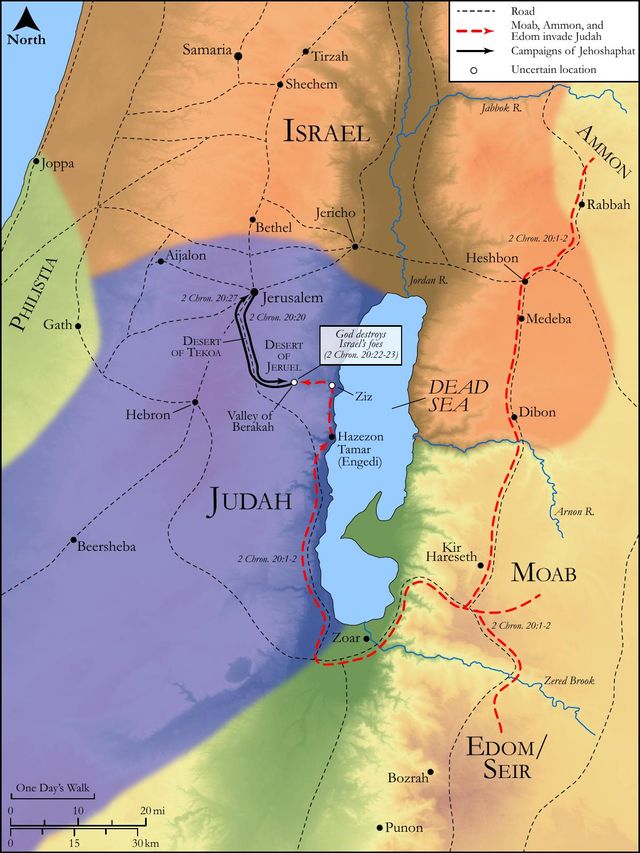
See on the biblical-era map
Study this verse
Public-domain commentary
Matthew Henry
From his Commentary on the Whole Bible. Henry comments on passages, not single verses — this entry covers 2 Chronicles 20:20–30. His three-level outline is real structure in the source text, so it is rendered as structure.
We have here the foregoing prayer answered and the foregoing promise performed, in the total overthrow of the enemies' forces and the triumph (for so it was rather than a victory) of Jehoshaphat's forces over them.
I.Never was army drawn out to the field of battle as Jehoshaphat's was.
He had soldiers ready prepared for war (Ch2 17:18), but here is no notice taken of their military equipment, their swords or spears, their shields or bows. But Jehoshaphat took care,
1.That faith should be their armour. As they went forth, instead of calling them to handle their arms, and stand to them, to keep ranks, observe orders, and fight valiantly, he bade them believe in the Lord God and give credit to his word in the mouth of his prophets, and assured them that they should prosper and be established, Ch2 20:20. That is true courage which faith inspires a man with; nor will any thing contribute more to the establishing of the heart in shaking times than a firm belief of the power, and mercy, and promise of God. The heart is fixed that thus trusteth in the Lord, and is kept in perfect peace. In our spiritual conflicts, this is the victory, this is the prosperity, even our faith.
2.That praise and thanksgiving should be their vanguard, Ch2 20:21. Jehoshaphat called a council of war, and it was resolved to appoint singers to go out before the army, to charge in the front, who had nothing else to do but to praise God, to praise his holiness, which is his beauty, to praise him as they did in the temple (that beauty of holiness) with that ancient and good doxology which eternity itself will not wear thread-bare, Praise the Lord; for his mercy endureth for ever. By this strange advance towards the field of battle, Jehoshaphat intended to express his firm reliance upon the word of God (which enabled him to triumph before the battle), to animate his own soldiers, to confound the enemy, and to engage God on their side; for praise pleases God better than all burnt offering and sacrifice.
II.Never was army so unaccountably destroyed as that of the enemy; not by thunder, or hail, or the sword of an angel, not by dint of sword, or strength of arm, or any surprising alarm, like that which Gideon gave the Midianites; but the Lord set ambushments against them, either hosts of angels, or, as bishop Patrick thinks, their own ambushments, whom God struck with such confusion that they fell upon their own friends as if they had been enemies, and every one helped to destroy another, so that none escaped. This God did when his people began to sing and to praise (Ch2 20:22), for he delights to furnish those with matter for praise that have hearts for it. We read of his being angry at the prayers of his people (Psa 80:4), but never at their praises. When they did but begin the work of praise God perfected the work of their deliverance. What ground there was for their jealousies one of another does not appear, perhaps there was none; but so it was that the Ammonites and the Moabites fell foul upon the Edomites and cut them off, and then they fell out with one another and cut one another off, Ch2 20:23. Thus God often makes wicked people instruments of destruction to one another; and what alliances can be so firm as to keep those together whom God designs to dash in pieces one against another? See the mischievous consequences of divisions which neither of the contending parties can give any good account of the reason of. Those are wretchedly infatuated, to their ruin, that fall foul upon their friends as if they were enemies.
III.Never was spoil so cheerfully divided, for Jehoshaphat's army had nothing to do besides; the rest was done for them.
When they came to the view of this vast army, instead of finding living men to fight with, they found them all dead men, and their carcases spread as dung upon the face of the earth, Ch2 20:24. See how rich God is in mercy to those that call upon him in truth, and how often he out-does him in truth, and how often he out-does the prayers and expectations of his people. Jehoshaphat and his people prayed to be delivered from being spoiled by the enemy; and God not only delivered them, but enriched them with the spoil of the enemy. The plunder of the field was very great and very rich. They found precious jewels with the dead bodies, which yet could not save them from being loathsome carcases. The spoil was more than they could carry away at once, and they were three days in gathering it, Ch2 20:25. Now it appeared what was God's end in bringing this great army against Judah; it was to humble them and prove them, that he might do them good in their latter end. It seemed at first a disturbance to their reformation, but it proved a recompence of it.
IV.Never was victory celebrated with more solemn and enlarged thanksgivings.
1.They kept a day of praise in the camp, before they drew their forces out of the field. Many thanksgivings, no doubt, were offered up to God immediately; but on the fourth day they assembled in a valley, where they blessed God with so much zeal and fervency that that day's work gave a name to the place, the valley of Berachah, that is, of blessing, Ch2 20:26. The remembrance of this work of wonder was hereby perpetuated, for the encouragement of succeeding generations to trust in God.
2.Yet they did not think this enough, but came in solemn procession, all in a body, and Jehoshaphat at the head of them, to Jerusalem, that the country, as they passed along, might join with them in their praises, and that they might give thanks for the mercy where they had by prayer obtained it, in the house of the Lord, Ch2 20:27, Ch2 20:28. Praising God must not be the work of a day only; but our praises, when we have received mercy, must be often repeated, as our prayers were when we were in the pursuit of it. Every day we must bless God; as long as we live, and while we have any being, we must praise him, spending our time in that work in which we hope to spend our eternity. Public mercies call for public acknowledgments in the courts of the Lord's house, Psa 116:19.
V.Never did victory turn to a better account than this; for,
1.Jehoshaphat's kingdom was hereby made to look very great and considerable abroad, Ch2 20:29. When they heard that God fought thus for Israel, they could not but say, There is none like unto the God of Jeshurun, and Happy art thou, O Israel! It begat in the neighbours a reverence of God and a cautious fear of doing any injury to his people. It is dangerous fighting against those who have God with them.
2.It was made very easy and quiet at home, Ch2 20:30.
(1.)They were quiet among themselves. Those that were displeased at the destroying of the images and groves were now satisfied, and obliged to own that since the God of Israel could deliver after this sort he only is to be worshipped, in that way only which he himself has appointed.
(2.)They were quiet from the fear of insults from their neighbours, God having given them rest round about. And, if he give rest, who can give disturbance?
Continue studying 2 Chronicles 20:21 across the web’s major study libraries — every link below opens this exact verse, chapter, or book on the destination site.
Read & Compare
 BibleGatewayThis verse in more than 200 translations and 70 languages.
 Bible.comThe YouVersion reader — hundreds of translations, reading plans, and highlights.
 ESV.orgCrossway's official English Standard Version reader.
 NET BibleThe NET translation with 60,000+ translators' notes on every rendering decision.
 STEP BibleTyndale House's free study tool — original text, vocabulary, and scholarly resources.
 BibliaLogos Bible Software's free web reader.
 USCCBThe New American Bible (Revised Edition) with the U.S. bishops' study notes.
Commentaries
 BibleHub CommentariesDozens of classic commentaries on this verse, gathered on one page.
 StudyLightMore than 100 commentary sets — the largest collection on the web.
 BibleRefPlain-English commentary on what this verse means, verse by verse.
 Enduring WordDavid Guzik's free commentary on this chapter, widely used by Bible teachers.
 Bible Study ToolsVerse commentary alongside Greek and Hebrew study aids.
Original Language & Research
- BibleHub InterlinearThe verse word by word — original language, transliteration, and English.
- BibleHub LexiconEvery word's original-language definition and Strong's entry.
 Blue Letter BibleDeep-study tools — Strong's numbers, concordance, and word studies.
 SefariaThe Hebrew text with Rashi and centuries of Jewish commentary.
Sermons, Hymns & Audio


TrulyRandomVerse is not affiliated with these sites and doesn’t control their content. They’re linked because they’re genuinely useful.
Summary
Second Chronicles 20:21 captures a remarkable moment in Judah's history under King Jehoshaphat, showcasing an extraordinary act of faith and worship in the face of overwhelming military threat. Instead of deploying conventional military tactics, Jehoshaphat, after consulting with the people, appointed a choir of singers to lead the army, praising the Lord for His enduring mercy and the splendor of His holiness. This audacious display of trust in divine intervention transformed worship into a powerful instrument of warfare, setting the stage for a miraculous victory.
Context
ShowHideLiterary Context
This verse is situated at a critical juncture in the narrative of 2 Chronicles 20. Immediately prior, Judah faced an immense and seemingly insurmountable invasion by the combined forces of the Moabites, Ammonites, and some Meunites, striking fear into King Jehoshaphat's heart. Rather than resorting to human strength, Jehoshaphat turned to the Lord, proclaiming a national fast and leading the people in fervent prayer at the temple, acknowledging God's sovereignty and their utter helplessness (see 2 Chronicles 20:3-12). God responded through the prophet Jahaziel, assuring them that the battle was not theirs but God's, and that they would not need to fight (see 2 Chronicles 20:15-17). It is in this context of divine promise and human vulnerability that Jehoshaphat's radical act of sending singers before the army takes place, demonstrating profound obedience and faith in the face of an impossible situation.
Historical & Cultural Context
King Jehoshaphat reigned over Judah (c. 870–848 BC) and was generally a righteous king who sought to lead his people in faithfulness to the Lord. His reign was marked by both military strength and spiritual reforms. The invasion described in this chapter was a significant geopolitical threat, as the combined forces represented a formidable enemy from the east and south, threatening the very existence of Judah. In ancient Near Eastern warfare, armies typically marched with their strongest warriors and weaponry at the forefront, designed to intimidate and break enemy lines. Jehoshaphat's decision to place unarmed singers, praising God, at the head of his army was an utterly unconventional and counter-cultural move. It defied all military logic of the time, highlighting a radical dependence on a supernatural intervention rather than human might or strategic prowess. This act would have been perceived as foolishness by any contemporary military strategist.
Key Themes
ShowHideSeveral profound themes converge in 2 Chronicles 20:21. The most prominent is Worship as Warfare, where praise and adoration become the primary weapon against a physical enemy, illustrating that spiritual battles are won through spiritual means. This act also powerfully demonstrates Faith Over Fear, as Jehoshaphat and the people chose to believe God's promise of deliverance despite overwhelming odds, moving beyond initial terror to audacious trust. The verse also underscores the theme of Divine Sovereignty and Intervention, emphasizing that ultimate victory belongs to God alone, who fights on behalf of His people. Finally, the repeated declaration, "Praise the LORD; for his mercy endureth for ever," highlights God's Enduring Mercy and Covenant Faithfulness, a foundational truth that undergirds their hope and provides the basis for their praise (a refrain also found throughout Psalm 136). This collective act of worship served not merely as a morale booster, but as a direct spiritual engagement that ushered in God's miraculous victory (as seen in 2 Chronicles 20:22-23).
Exposition and Analysis
ShowHideKey Word Analysis
ShowHideThis feminine noun derives from a root meaning "to decorate." It signifies decoration, splendor, majesty, or honor. In the context of "beauty of holiness," it refers to the inherent, majestic, and awe-inspiring nature of God's holiness. It is the radiant, glorious, and captivating aspect of God's set-apartness and purity that evokes profound reverence and adoration. To praise the "beauty of holiness" is to acknowledge and celebrate the resplendent glory that emanates from God's perfect, unblemished character.
This term denotes a sacred place or thing, or abstractly, sanctity. It speaks to the fundamental attribute of God as being utterly "other," transcendent, and morally pure, separated from all that is common, defiled, or sinful. It is the essence of His divine nature that sets Him apart as unique and worthy of worship. When coupled with "beauty," it describes the captivating and glorious nature of God's absolute purity and transcendent majesty.
This rich Hebrew term is often translated as kindness, lovingkindness, steadfast love, or covenant loyalty. It describes God's faithful, unfailing, and compassionate love for His people, particularly within the context of His covenant relationship. It is an active, loyal, and enduring love that goes beyond mere pity, demonstrating God's commitment to His promises and His people. The declaration that this mercy "endureth for ever" emphasizes its eternal, unchanging, and perpetual nature, providing an unshakeable foundation for trust and hope in the face of any adversity.
Verse Breakdown
ShowHide"And when he had consulted with the people,"
This opening clause shows King Jehoshaphat taking counsel with the people before the battle. Despite receiving a direct prophecy from God, he involved the community in the decision-making process for this radical act of faith. This consultation fostered corporate ownership and unity in their response to the divine directive, ensuring that the people were not merely passive recipients but active participants in this unconventional strategy. It underscores the importance of shared understanding and commitment in moments of national crisis.
"he appointed singers unto the LORD,"
This is the pivotal action of the verse, demonstrating Jehoshaphat's audacious obedience. Instead of deploying conventional military commanders or elite warriors at the front, he designated a choir. The phrase "unto the LORD" is crucial, emphasizing that their singing was not for human morale or display, but an act of direct worship and dedication to God. It transformed their military procession into a sacred act, making God the sole audience and object of their praise, and demonstrating a radical departure from all known military protocols.
"and that should praise the beauty of holiness,"
The specific content of their praise was the "beauty of holiness." This directs their worship not to their problem or their fear, but to the intrinsic glory, majesty, and transcendent purity of God's character. It was an act of adoration that elevated God above their overwhelming circumstances, focusing on His inherent splendor and set-apartness as the ultimate source of all power and victory. Their praise acknowledged God's perfect nature as the foundation of their hope.
"as they went out before the army,"
This detail is central to the narrative's dramatic power and theological significance. The singers were not positioned safely behind the lines but at the vanguard, leading the entire military procession. This physical positioning powerfully symbolized the spiritual truth that God, through their worship and faith, was leading the battle. It was a profound, public demonstration of trust, placing God's presence and power literally at the forefront of the conflict, ahead of all human strength and strategy.
"and to say, Praise the LORD; for his mercy [endureth] for ever."
This final clause specifies the refrain they were to sing, a declaration deeply rooted in Israelite liturgy and theology. It is a powerful affirmation of God's unchanging, steadfast love and covenant faithfulness (chesed). This repeated affirmation served as both a confession of faith in God's eternal character and a potent spiritual weapon, invoking God's promised intervention based on His enduring nature. It anchored their audacious act in the foundational truth of God's perpetual lovingkindness.
Literary Devices
ShowHideThe passage makes powerful use of several literary devices to convey its profound message. Most prominently, there is Irony, as the conventional military strategy of leading with armed warriors is completely inverted, with unarmed singers taking the vanguard. This creates a dramatic contrast, highlighting God's unconventional methods and the triumph of divine power over human strength and wisdom. Symbolism is also central, with the singers and their praise serving as a powerful symbol of faith and spiritual warfare. Their position "before the army" symbolizes placing God's presence and power at the forefront of the conflict, demonstrating a complete reliance on Him. Furthermore, the repeated phrase "Praise the LORD; for his mercy endureth for ever" employs Repetition (or refrain), which is a common feature in Hebrew poetry and worship. This repetition emphasizes the unwavering and eternal nature of God's chesed and serves as a powerful liturgical declaration, reinforcing the theological foundation of their trust and the certainty of God's intervention and victory.
Theological and Thematic Connections
ShowHideThe account in 2 Chronicles 20:21 profoundly illustrates the power of worship and faith as active components of divine strategy. It teaches that true victory is not achieved through human might or conventional wisdom alone, but through radical dependence on God's sovereign power and His unchanging character. By prioritizing praise of God's "beauty of holiness" and His "everlasting mercy," Jehoshaphat and the people shifted their focus from the overwhelming threat to the omnipotent God who fights for them. This act transforms a moment of fear into a testament of faith, demonstrating that our greatest strength in adversity lies in our surrender to God and our adoration of Him. It underscores the truth that spiritual battles require spiritual weapons, and that God often chooses the weak and foolish things of the world to shame the strong, revealing His glory.
Reflection and Application
ShowHideThe narrative of 2 Chronicles 20:21 offers profound and enduring lessons for believers navigating the complexities of life. In moments of overwhelming challenge, whether personal, communal, or global, our natural inclination is often to strategize, to fight in our own strength, or to succumb to fear. However, Jehoshaphat's example calls us to a counter-intuitive, yet profoundly spiritual, response: to lead with worship. This means intentionally shifting our focus from the magnitude of our problems to the majesty of our God. It encourages us to engage in "praise warfare," understanding that our adoration of God's "beauty of holiness" and His "mercy that endureth for ever" is not merely an emotional exercise, but a powerful act of faith that invites divine intervention. When we praise God in the face of our giants, we are not denying the reality of the threat, but declaring the greater reality of God's presence, power, and promises. This passage challenges us to ask whether our first response to adversity is prayer and praise, trusting that God's unconventional strategies often yield the most miraculous victories.
Questions for Reflection
ShowHideFAQ
ShowHideWhy did Jehoshaphat appoint singers instead of warriors to lead the army?
ShowHideJehoshaphat's decision to appoint singers to lead the army was a radical act of faith and obedience to God's specific instructions. After seeking the Lord in prayer and fasting, he received a prophetic word from Jahaziel assuring him that the battle was not theirs, but God's (see 2 Chronicles 20:15). This unconventional strategy demonstrated Jehoshaphat's complete reliance on divine intervention rather than human military might. By placing unarmed worshipers at the vanguard, he publicly declared that God was their true leader and defender, and that victory would come through His power, not their own. It was a visible testament to the principle that spiritual battles are won through spiritual means.
Was it common for singers to go before the army in ancient Israelite warfare?
ShowHideNo, it was not common practice for singers to lead an army into battle in ancient Israel or the wider Near East. Typically, the strongest warriors, chariots, or elite units would lead the charge. Jehoshaphat's action was highly unusual and counter-cultural, making it a unique and powerful example of faith. While the Ark of the Covenant sometimes went with the army (e.g., Numbers 10:33-36), and trumpets were used in battle (e.g., Joshua 6:4), the deliberate placement of a choir of worshipers as the vanguard was an unprecedented act, emphasizing the extraordinary nature of God's promised deliverance.
What was the outcome of this unconventional strategy?
ShowHideThe outcome was a miraculous and decisive victory for Judah, achieved without them having to lift a sword. As the singers began to praise, the Lord set ambushes against the Ammonites, Moabites, and Meunites who had come against Judah. The enemy armies turned on each other, resulting in their complete destruction (see 2 Chronicles 20:22-23). When Judah arrived at the watchtower of the wilderness, they saw only dead bodies strewn across the ground. This divine intervention not only saved Judah but also provided immense spoil, so much that it took three days to gather it all (see 2 Chronicles 20:25). The victory led to great rejoicing and peace throughout the land, demonstrating God's faithfulness to His promise.
Christ-Centered Fulfillment
ShowHideThe extraordinary act of worship in 2 Chronicles 20:21 finds its ultimate fulfillment and deeper meaning in Jesus Christ. Jehoshaphat's decision to lead with praise in the face of an overwhelming enemy foreshadows Christ, who, as the ultimate worship leader and the Lamb of God, secured victory over the greatest enemies of humanity: sin, death, and the devil. Just as the singers declared God's "mercy endureth for ever," Jesus's sacrificial death on the cross is the supreme demonstration of God's eternal chesed (see Romans 5:8). His victory was not achieved through conventional warfare, but through an act of self-giving love and obedience, fulfilling the divine strategy of conquering spiritual foes through spiritual means (see Colossians 2:15). Believers today are called to follow Christ's example, engaging in spiritual warfare not with carnal weapons, but with the "armor of God" and the "sword of the Spirit, which is the word of God," accompanied by prayer and praise (see Ephesians 6:10-18). Our worship, centered on the finished work of Christ, is our declaration of God's enduring mercy and our participation in His ongoing triumph, knowing that through Him, "we are more than conquerors" (see Romans 8:37).