


Ezra 3:10
- וְיִסְּדוּve·yi·se·Duand they foundedH3245Conj-w ¦ V-Piel-ConsecPerf-3cpVerb Piel Consecutive Perfect 3rd Plural common genderוְandיִסְּדוּthey founded
- הַבֹּנִיםha·bo·Nimthe buildersH1129Art ¦ V-Qal-Prtcpl-mpVerb Qal Participle Plural Masculine Absoluteהַtheבֹּנִיםbuilders
- אֶת'et<obj.>H853DirObjMParticle Object Indicator
- הֵיכַלhei·Khal[the] temple ofH1964N-mscNoun Singular Masculine Construct
- יְהוָהYah·wehYahwehH3068N-properNoun Proper Title
- וַיַּעֲמִידוּvai·ya·'a·mi·Duand they appointedH5975Conj-w ¦ V-Hiphil-ConsecImperf-3mpVerb Hiphil Consecutive Imperfect 3rd Plural Masculineוַandיַּעֲמִידוּthey appointed
- הַכֹּהֲנִיםha·ko·ha·Nimthe priestsH3548Art ¦ N-mpNoun Plural Masculine Absoluteהַtheכֹּהֲנִיםpriests
- מְלֻבָּשִׁיםme·lu·ba·Shimfully clothedH3847V-Pual-PassPrtcpl-mpVerb Pual Participle Passive Plural Masculine Absolute
- בַּחֲצֹצְרוֹתba·cha·tzo·tze·Rotwith <the> trumpetsH2689Prep-b ¦ N-fpNoun Plural Feminine Absoluteבַּwith <the>חֲצֹצְרוֹתtrumpets
- וְהַלְוִיִּםve·hal·vi·Yimand the LevitesH3881Conj-w ¦ Art ¦ N-mpNoun Gentilic Plural Masculine AbsoluteוְandהַtheלְוִיִּםLevites
- בְּנֵיbe·nei[the] sons ofH1121N-mpcNoun Plural Masculine Construct
- אָסָף'a·SafAsaphH623N-proper-mNoun Proper Masculine
- בַּמְצִלְתַּיִםbam·tzil·Ta·yimwith <the> cymbalsH4700Prep-b ¦ N-fdNoun Dual Feminine Absoluteבַּwith <the>מְצִלְתַּיִםcymbals
- לְהַלֵּלle·ha·Lelto praiseH1984Prep-l ¦ V-Piel-InfVerb Piel Infinitive Constructלְtoהַלֵּלpraise
- אֶת'et<obj.>H853DirObjMParticle Object Indicator
- יְהוָהYah·wehYahwehH3068N-properNoun Proper Title
- עַל'alonH5921PrepPreposition
- יְדֵיye·Dei[the] hands ofH3027N-cdcNoun Dual common gender Construct
- דָּוִידda·VidDavidH1732N-proper-mNoun Proper Masculine
- מֶלֶךְMe·lekh[the] king ofH4428N-mscNoun Singular Masculine Construct
- יִשְׂרָאֵלYis·ra·'ElIsraelH3478N-properNoun Proper Location
English is a literal word-by-word gloss of the Hebrew, not the KJV's wording. Why?
This is the original text the KJV's translators worked from — each Hebrew word with its own literal English meaning in this verse, prepared by scholars at Tyndale House, Cambridge. The KJV translates whole sentences, not word by word, so its wording differs: one Hebrew word can become several English words, and the KJV may choose “the LORD” where the gloss reads “Yahweh”. Both are faithful — they answer different questions. For the KJV's own rendering, switch to the KJV text.
Details
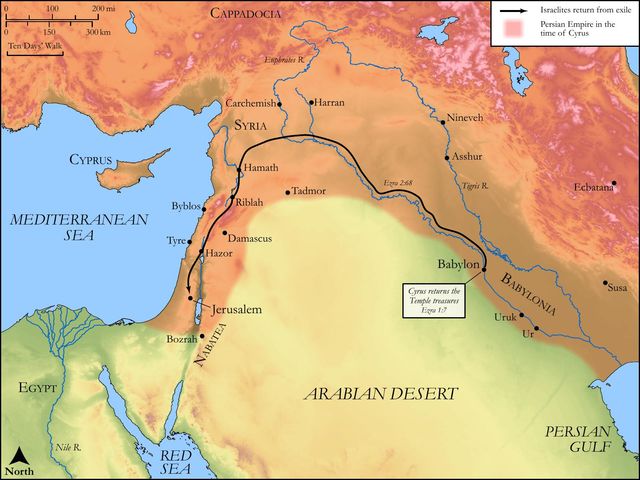
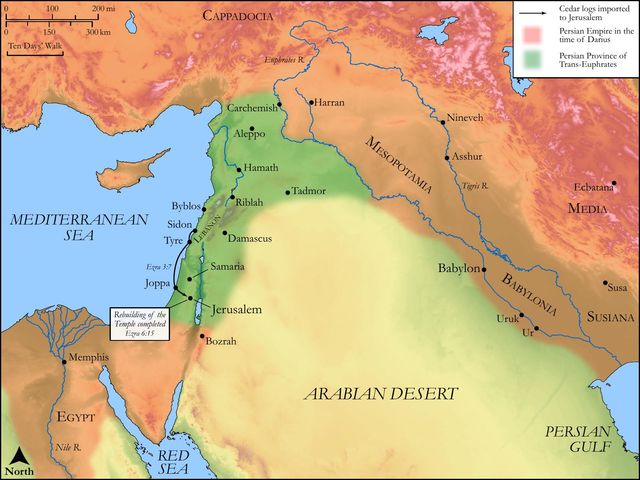
See on the biblical-era maps
Study this verse
Public-domain commentary
Matthew Henry
From his Commentary on the Whole Bible. Henry comments on passages, not single verses — this entry covers Ezra 3:8–13. His three-level outline is real structure in the source text, so it is rendered as structure.
There was no dispute among the returned Jews whether they should build the temple or no; that was immediately resolved on, and that it should be done with all speed; what comfort could they take in their own land if they had not that token of God's presence with them and the record of his name among them? We have here therefore an account of the beginning of that good work. Observe,
I.When it was begun-in the second month of the second year, as soon as ever the season of the year would permit (Ezr 3:8), and when they had ended the solemnities of the passover. They took little more than half a year for making preparation of the ground and materials; so much were their hearts upon it. Note, When any good work is to be done it will be our wisdom to set about it quickly, and not to lose time, yea, though we foresee difficulty and opposition in it. Thus we engage ourselves to it, and engage God for us. Well begun (we say) is half ended.
II.Who began it - Zerubbabel, and Jeshua, and their brethren.
Then the work of God is likely to go on well when magistrates, ministers, and people, are hearty for it, and agree in their places to promote it. It was God that gave them one heart for this service, and it boded well.
III.Who were employed to further it.
They appointed the Levites to set forward the work (Ezr 3:8), and they did it by setting forward the workmen (Ezr 3:9), and strengthening their hands with good and comfortable words. Note, Those that do not work themselves may yet do good service by quickening and encouraging those that do work.
IV.How God was praised at the laying of the foundation of the temple (Ezr 3:10, Ezr 3:11); the priests with the trumpets appointed by Moses, and the Levites with the cymbals appointed by David, made up a concert of music, not to please the ear, but to assist the singing of that everlasting hymn which will never be out of date, and to which our tongues should never be out of tune, God is good, and his mercy endureth for ever, the burden of Ps. 136. Let all the streams of mercy be traced up to the fountain. Whatever our condition is, how many soever our griefs and fears, let it be owned that God is good; and, whatever fails, that his mercy fails not. Let this be sung with application, as here; not only his mercy endures for ever, but it endures for ever towards Israel, Israel when captives in a strange land and strangers in their own land. However it be, yet God is good to Israel (Psa 73:1), good to us. Let the reviving of the church's interests, when they seemed dead, be ascribed to the continuance of God's mercy for ever, for therefore the church continues.
V.How the people were affected.
A remarkable mixture of various affections there was upon this occasion. Different sentiments there were among the people of God, and each expressed himself according to his sentiments, and yet there was no disagreement among them, their minds were not alienated from each other nor the common concern retarded by it.
1.Those that only knew the misery of having no temple at all praised the Lord with shouts of joy when they saw but the foundation of one laid, Ezr 3:11. To them even this foundation seemed great, and was as life from the dead; to their hungry souls even this was sweet. They shouted, so that the noise was heard afar off. Note, We ought to be thankful for the beginnings of mercy, though we have not yet come to the perfection of it; and the foundations of a temple, after long desolations, cannot but be fountains of joy to every faithful Israelite.
2.Those that remembered the glory of the first temple which Solomon built, and considered how far this was likely to be inferior to that, perhaps in dimensions, certainly in magnificence and sumptuousness, wept with a loud voice, Ezr 3:12. If we date the captivity with the first, from the fourth of Jehoiakim, it was about fifty-two years since the temple was burnt; if from Jeconiah's captivity, it was but fifty-nine. So that many now alive might remember it standing; and a great mercy it was to the captives that they had the lives of so many of their priests and Levites lengthened out, who could tell them what they themselves remembered of the glory of Jerusalem, to quicken them in their return. These lamented the disproportion between this temple and the former. And,
(1.)There was some reason for it; and if they turned their tears into the right channel, and bewailed the sin that was the cause of this melancholy change, they did well. Sin sullies the glory of any church or people, and, when they find themselves diminished and brought low, that must bear the blame.
(2.)Yet it was their infirmity to mingle those tears with the common joys and so to cast a damp upon them. They despised the day of small things, and were unthankful for the good they enjoyed, because it was not so much as their ancestors had, though it was much more than they deserved. In the harmony of public joys, let not us be jarring strings. It was an aggravation of the discouragement they hereby gave to the people that they were priests and Levites, who should have known and taught others how to be duly affected under various providences, and not to let the remembrance of former afflictions drown the sense of present mercies. This mixture of sorrow and joy here is a representation of this world. Some are bathing in rivers of joy, while others are drowned in floods of tears. In heaven all are singing, and none sighing; in hell all are weeping and wailing, and none rejoicing; but here on earth we can scarcely discern the shouts of joy from the noise of the weeping. Let us learn to rejoice with those that do rejoice and weep with those that weep, and ourselves to rejoice as though we rejoiced not, and weep as though we wept not.
Continue studying Ezra 3:10 across the web’s major study libraries — every link below opens this exact verse, chapter, or book on the destination site.
Read & Compare
 BibleGatewayThis verse in more than 200 translations and 70 languages.
 Bible.comThe YouVersion reader — hundreds of translations, reading plans, and highlights.
 ESV.orgCrossway's official English Standard Version reader.
 NET BibleThe NET translation with 60,000+ translators' notes on every rendering decision.
 STEP BibleTyndale House's free study tool — original text, vocabulary, and scholarly resources.
 BibliaLogos Bible Software's free web reader.
 USCCBThe New American Bible (Revised Edition) with the U.S. bishops' study notes.
Commentaries
 BibleHub CommentariesDozens of classic commentaries on this verse, gathered on one page.
 StudyLightMore than 100 commentary sets — the largest collection on the web.
 BibleRefPlain-English commentary on what this verse means, verse by verse.
 Enduring WordDavid Guzik's free commentary on this chapter, widely used by Bible teachers.
 Bible Study ToolsVerse commentary alongside Greek and Hebrew study aids.
Original Language & Research
- BibleHub InterlinearThe verse word by word — original language, transliteration, and English.
- BibleHub LexiconEvery word's original-language definition and Strong's entry.
 Blue Letter BibleDeep-study tools — Strong's numbers, concordance, and word studies.
 SefariaThe Hebrew text with Rashi and centuries of Jewish commentary.
Sermons, Hymns & Audio


TrulyRandomVerse is not affiliated with these sites and doesn’t control their content. They’re linked because they’re genuinely useful.
Summary
Ezra 3:10 vividly recounts the foundational moment of the Second Temple's construction in Jerusalem, a profound event marking the spiritual and physical restoration of the Jewish community after the Babylonian exile. This verse underscores the deep spiritual significance of the undertaking, portraying an organized and joyous act of worship as priests and Levites, adorned in their sacred vestments and equipped with musical instruments, offered praise to the Lord, meticulously adhering to the ancient, divinely established patterns of worship instituted by King David. It encapsulates a powerful expression of faith, national revival, and a renewed commitment to God's abiding presence among His people.
Context
ShowHideLiterary Context
Ezra 3:10 is strategically placed within the narrative of the Jewish return from Babylonian captivity and their initial efforts to re-establish their religious and national life in Jerusalem. The preceding verses in Chapter 3 describe the unified gathering of the returnees to rebuild the altar and resume daily sacrifices, demonstrating their immediate priority on worship and reconciliation with God, as seen in Ezra 3:1-6. Following this essential re-establishment of sacrificial worship, verse 10 marks the commencement of the actual Temple structure, a logical and necessary progression towards rebuilding God's dwelling place. The subsequent verses, Ezra 3:11-13, describe the poignant mixed reactions of joy and sorrow among the people as they witness this foundational work, foreshadowing both the triumphs and challenges that would characterize the Temple's construction and the broader post-exilic period. This verse, therefore, serves as a crucial bridge, connecting the renewed sacrificial system with the physical manifestation of God's sanctuary.
Historical & Cultural Context
After seventy years of Babylonian captivity, the Jewish people were permitted to return to their homeland by the decree of King Cyrus of Persia in 538 BC, as recorded in Ezra 1:1-4. Under the leadership of Zerubbabel, the governor, and Jeshua, the high priest, the first wave of returnees faced the immense challenge of rebuilding a desolate city and a shattered national identity. The destruction of Solomon's magnificent Temple by Nebuchadnezzar in 586 BC had left a profound spiritual, emotional, and physical void. The laying of the Second Temple's foundation was far more than a mere construction project; it was a deeply symbolic act of faith, a tangible sign of God's faithfulness to His covenant promises, and a powerful symbol of national and spiritual revival. Culturally, the meticulous organization of priests and Levites for worship, complete with their sacred vestments and instruments, underscored the enduring importance of the Mosaic law and the Davidic traditions for the identity, spiritual well-being, and communal order of the returning exiles.
Key Themes
ShowHideEzra 3:10 powerfully contributes to several overarching themes prevalent in the book of Ezra and the broader post-exilic prophetic literature. First, it profoundly illustrates the theme of Restoration and Hope, as the physical rebuilding of the Temple signifies the renewal of God's covenant with His people and the promise of a future for Israel, even amidst their diminished state. This act of laying the foundation represents a tangible step out of desolation and into divine promise. Second, the verse highlights the critical importance of Ordered Worship and Reverence. The presence of "priests in their apparel with trumpets" and "Levites the sons of Asaph with cymbals" underscores that worship, even at this foundational stage, was to be conducted with dignity, intentionality, and according to established divine patterns, reflecting God's holiness and worthiness of praise. This emphasis on proper form and consecrated personnel speaks to the sacredness of the encounter with God. Third, it showcases the theme of Praise and Thanksgiving as the immediate and collective response to God's faithfulness, setting a tone of gratitude and adoration for the entire rebuilding effort despite the monumental challenges that lay ahead. Finally, the phrase "after the ordinance of David king of Israel" underscores Continuity with Tradition and Divine Authority, linking the nascent community's worship practices directly to the divinely inspired organization of worship from Israel's golden age, particularly David's arrangements for Temple musicians and Levites, as detailed in passages like 1 Chronicles 23:5 and 1 Chronicles 25:1.
Exposition and Analysis
ShowHideKey Word Analysis
ShowHide(yâd), a primitive word, literally meaning "hand" (the open one, indicating power, means, direction, etc.). While yâd has a vast semantic range, including physical hand, power, side, and custody, in this context, "ordinance" (as listed among its applications) refers to the established pattern or authoritative direction. The phrase "after the ordinance of David" implies that the worship practices were not arbitrary but were conducted according to the prescribed, divinely guided order and arrangement that David had put in place for Temple service. This signifies adherence to a sacred blueprint, emphasizing the continuity and legitimacy of their worship.
(ʼÂçâph), meaning "collector," Asaph was a prominent Levitical musician and seer during the reign of King David, one of the three chief musicians appointed for Temple service (1 Chronicles 6:39). His descendants, the "sons of Asaph" (using H1121, bên, for "sons"), formed a distinguished guild of Temple singers and musicians, renowned for their skill in leading musical praise and even prophetic song. Their presence with cymbals at the foundation laying signifies the meticulous re-establishment of this specific, highly skilled, and divinely appointed musical ministry, ensuring that the praise offered was not only heartfelt but also professionally executed according to the highest standards of the Davidic tradition.
(hâlal), a primitive root meaning "to be clear (orig. of sound, but usually of color); to shine; hence, to make ashow, to boast; and thus to be (clamorously) foolish; to rave; causatively, to celebrate; also to stultify." In this context, it primarily means "to celebrate" or "to praise." The use of hâlal here denotes a vibrant, expressive, and even boisterous form of worship, characterized by joyful acclamation and loud musical accompaniment. It captures the enthusiastic and public nature of the exiles' thanksgiving and adoration for the Lord's faithfulness in allowing them to begin rebuilding His house.
Verse Breakdown
ShowHide"And when the builders laid the foundation of the temple of the LORD"
This clause marks the pivotal moment of the physical commencement of the Temple's reconstruction. The "builders" refer to the skilled laborers and the returning exiles who, under the leadership of Zerubbabel and Jeshua, were actively involved in the construction effort. The "foundation" is the crucial first step in any major building project, here symbolizing a new beginning, the re-establishment of God's dwelling place among His people after its prolonged absence, and a tangible sign of hope. The explicit mention "of the temple of the LORD" immediately elevates the project from a mere architectural undertaking to a sacred endeavor, dedicated to Yahweh, the covenant God of Israel.
"they set the priests in their apparel with trumpets"
As soon as the foundation was laid, the focus immediately shifted to the spiritual dimension of the event: worship. The "priests" were the descendants of Aaron, divinely appointed to mediate between God and Israel through sacrifices and intercession. Their being "in their apparel" refers to their sacred vestments, signifying their consecrated status and the holiness and solemnity of the occasion. "Trumpets" (specifically the chătsôtsᵉrâh or silver trumpets, H2689) were used in Israel for various purposes, including signaling, warfare, and, most significantly, for summoning assemblies and accompanying sacrifices and festivals, particularly in solemn and joyous acts of worship (Numbers 10:10). Their presence indicates a formal, solemn, and celebratory act of consecration and praise.
"and the Levites the sons of Asaph with cymbals, to praise the LORD"
Complementing the priests, the "Levites" were the tribe set apart for Temple service, assisting the priests in various capacities, including musical ministry. Specifically, "the sons of Asaph" were a renowned guild of Temple musicians. "Cymbals" (H4700, mᵉtsêleth) were percussive instruments used to provide rhythmic accompaniment and emphasize the joyous, celebratory nature of the praise. The explicit purpose, "to praise the LORD," highlights that the entire ceremony was an act of adoration and thanksgiving, recognizing God's faithfulness, power, and goodness in allowing them to begin this sacred work.
"after the ordinance of David king of Israel"
This crucial phrase connects the present act of worship directly to the established, divinely inspired practices of Israel's glorious past. "Ordinance" (H3027, yâd, in this context implying "order" or "pattern") signifies a prescribed, authoritative, and divinely sanctioned pattern. By consciously following David's arrangements for Temple worship, the returning exiles affirmed their continuity with their rich spiritual heritage and sought to ensure that their worship was pleasing to God, based on a precedent that God Himself had blessed and revealed to David (1 Chronicles 28:11-19). This adherence provided legitimacy and a sense of divine approval to their rebuilding efforts.
Literary Devices
ShowHideEzra 3:10 employs several potent literary devices to convey its profound message. Symbolism is paramount, as the "foundation of the temple" is not merely a physical structure but a powerful symbol of national restoration, renewed covenant, and the re-establishment of God's tangible presence among His people after the desolation of exile. The musical instruments – trumpets and cymbals – are also symbolic, representing solemnity, celebration, and the joyous outpouring of communal praise. There is a clear Allusion to the Davidic era, specifically "the ordinance of David king of Israel," which serves to legitimize and elevate the current worship by connecting it to a golden age of Israel's spiritual history and a divinely sanctioned pattern of worship. This allusion also creates a powerful sense of Continuity, bridging the historical and spiritual gap between the glorious First Temple and the nascent Second Temple, assuring the community that God's favor and established worship practices remained steadfast despite the intervening exile. The meticulous detailing of roles (priests, Levites, sons of Asaph) also highlights Order and Structure, emphasizing the divine preference for organized, intentional worship.
Theological and Thematic Connections
ShowHideEzra 3:10 profoundly illustrates the theological principle that God's faithfulness endures, even through periods of judgment, discipline, and exile. The very act of laying the Temple foundation, accompanied by organized and joyous worship, signifies the renewal of God's covenant with His people and His unwavering commitment to dwell among them. It underscores that true restoration begins not just with physical rebuilding, but with a spiritual reorientation towards God through worship and obedience. The meticulous adherence to David's "ordinance" highlights the enduring importance of ordered, intentional, and biblically-rooted worship as a core expression of faith and obedience. This event served as a powerful reminder to the returning exiles, and to us today, that God's presence is the ultimate source of hope and stability, and that praise is the appropriate and immediate response to His redemptive and restorative work in our lives and communities.
Reflection and Application
ShowHideThe scene depicted in Ezra 3:10 offers profound and enduring lessons for contemporary believers and communities of faith. It powerfully reminds us that when embarking on any significant endeavor, whether personal, communal, or spiritual, the foundational act should always be one of worship and humble acknowledgment of God's sovereignty. Just as the exiles prioritized praise and thanksgiving at the very outset of their daunting rebuilding project, we too are called to begin with God, inviting His presence, guidance, and blessing into our plans and efforts. This verse also underscores the profound value of ordered, intentional, and reverent service; God delights in worship that is not only heartfelt and spontaneous but also thoughtful, structured, and conducted with dignity, reflecting His holiness. Furthermore, the exiles' adherence to the "ordinance of David" teaches us the importance of connecting with our rich spiritual heritage, drawing wisdom, inspiration, and established patterns of faith and worship from the biblical narrative. In moments of new beginnings or when facing daunting challenges, like the exiles faced, remembering God's past faithfulness and responding with praise can transform our perspective, strengthen our resolve, and anchor our hope in His unchanging character and unfailing love.
Questions for Reflection
ShowHideFAQ
ShowHideWhat was the significance of following the "ordinance of David"?
ShowHideFollowing the "ordinance of David" was crucial for several profound reasons. Firstly, it provided legitimacy and divine approval to the worship practices of the returning exiles. David's organization of the Temple service, particularly the musical ministries, was understood to be divinely inspired and established by God's own hand (1 Chronicles 28:11-19). Secondly, it ensured continuity with the glorious worship of the First Temple era, bridging the vast gap created by the exile and reinforcing their identity as God's covenant people, maintaining a link to their spiritual heritage. Thirdly, it established a pattern of order, excellence, and reverence for worship, emphasizing that God deserves the best and that His service should be conducted with precision, dignity, and a deep sense of His holiness.
Who were the "sons of Asaph," and why were they specifically mentioned?
ShowHideThe "sons of Asaph" were a prominent family of Levites descended from Asaph, one of the three chief musicians appointed by King David for the Tabernacle and later Temple service (1 Chronicles 6:39). They constituted a renowned guild of Temple singers and musicians, celebrated for their skill in leading praise and even for prophetic utterances through music (e.g., 2 Chronicles 29:30). Their specific mention in Ezra 3:10 highlights the meticulous re-establishment of the full, divinely ordained Temple personnel and ministries. It underscores the importance of skilled, dedicated, and lineage-specific roles in the sacred worship of God, ensuring that the praise offered was not only spontaneous and heartfelt but also expertly executed according to established tradition and divine pattern.
Was this Second Temple as grand as Solomon's Temple?
ShowHideNo, the Second Temple, particularly at its foundation, was not as grand or magnificent as Solomon's original Temple. Ezra 3:12 poignantly notes that many of the older priests, Levites, and heads of families who had seen the glorious First Temple wept loudly when they saw the foundation of this new one, indicating its comparatively modest scale and splendor. However, despite its physical limitations, the Second Temple was profoundly significant. It represented God's enduring presence among His people, the fulfillment of prophetic promises regarding their return, and a tangible sign of His covenant faithfulness. Later, the prophet Haggai would declare that the glory of this latter house would be greater than the former, not necessarily in material splendor, but through the eventual presence of the Messiah within its courts (Haggai 2:9).
Christ-Centered Fulfillment
ShowHideEzra 3:10, with its profound focus on the laying of the Temple's foundation and the re-establishment of worship, finds its ultimate and glorious fulfillment in the person and work of Jesus Christ. The physical Temple, a carefully designed dwelling place for God among His people, was always a shadow pointing to a greater spiritual reality. Jesus Himself declared, "Destroy this temple, and in three days I will raise it up," referring to the temple of His own body (John 2:19-21). Christ is the true and ultimate Temple, the very dwelling place of God, in whom the fullness of God dwells bodily (Colossians 2:9). The foundation laid in Ezra 3:10, though significant, foreshadows Christ as the chief cornerstone upon whom the entire spiritual edifice of God's new covenant people, the Church, is built (Ephesians 2:20). Just as priests and Levites offered praise at the Temple's foundation, believers in Christ are now, through His redemptive work, a "spiritual house" and a "holy priesthood," empowered to offer spiritual sacrifices of praise and worship through Him (1 Peter 2:5). The "ordinance of David" for physical, ritualistic worship is superseded by the new covenant reality where worship is offered "in spirit and truth" through Christ's perfect and once-for-all sacrifice, which has opened a new and living way directly into God's presence (John 4:23-24 and Hebrews 10:19-20). Thus, the hope, restoration, and renewed worship embodied in Ezra 3:10 are fully realized in the person and finished work of Jesus, who is both the Temple and the eternal object of our worship and praise.