


Ezra 3:11
- וַיַּעֲנוּVai·ya·'a·nuand they sangH6030Conj-w ¦ V-Qal-ConsecImperf-3mpVerb Qal Consecutive Imperfect 3rd Plural Masculineוַandיַּעֲנוּthey sang
- בְּהַלֵּלbe·ha·Lelwith praisingH1984Prep-b ¦ V-Piel-InfVerb Piel Infinitive Constructבְּwithהַלֵּלpraising
- וּבְהוֹדֹתu·ve·ho·Dotand with giving thanksH3034Conj-w ¦ Prep-b ¦ V-Hiphil-InfVerb Hiphil Infinitive Constructוּandבְwithהוֹדֹתgiving thanks
- לַיהוָהla·Yah·wehto YahwehH3068Prep-l ¦ N-properNoun Proper TitleלַtoיהוָהYahweh
- כִּיkiforH3588PrtParticle Conditional
- טוֹבTov[he is] goodH2896Adj-msAdjective Singular Masculine Absolute
- כִּיkiforH3588PrtParticle Conditional
- לְעוֹלָםle·'o·Lamfor everH5769Prep-l ¦ N-msNoun Singular Masculine Absoluteלְforעוֹלָםever
- חַסְדּוֹchas·Dohis covenant loyaltyH2617N-msc ¦ 3msNoun Singular Masculine Constructחַסְדּcovenant loyaltyוֹhis
- עַל'al[is] towardsH5921PrepPreposition
- יִשְׂרָאֵלYis·ra·'ElIsraelH3478N-properNoun Proper Location
- וְכָלve·kholand allH3605Conj-w ¦ N-mscNoun Singular Masculine Constructוְandכָלall
- הָעָםha·'Amthe peopleH5971Art ¦ N-msNoun Singular Masculine Absoluteהָtheעָםpeople
- הֵרִיעוּhe·ri·'Uthey shoutedH7321V-Hiphil-Perf-3cpVerb Hiphil Perfect 3rd Plural common gender
- תְרוּעָהte·ru·'Aha shout of joyH8643N-fsNoun Singular Feminine Absolute
- גְדוֹלָהge·do·LahgreatH1419Adj-fsAdjective Singular Feminine Absolute
- בְהַלֵּלve·ha·Lelwith praisingH1984Prep-b ¦ V-Piel-InfVerb Piel Infinitive Constructבְwithהַלֵּלpraising
- לַיהוָהla·Yah·weh<to> YahwehH3068Prep-l ¦ N-properNoun Proper Titleלַ<to>יהוָהYahweh
- עַל'albecauseH5921PrepPreposition
- הוּסַדhu·Sadit was foundedH3245V-Hophal-Perf-3msVerb Hophal Perfect 3rd Singular Masculine
- בֵּיתbeit[the] house ofH1004N-mscNoun Singular Masculine Construct
- יְהוָהYah·wehYahwehH3068N-properNoun Proper Title
English is a literal word-by-word gloss of the Hebrew, not the KJV's wording. Why?
This is the original text the KJV's translators worked from — each Hebrew word with its own literal English meaning in this verse, prepared by scholars at Tyndale House, Cambridge. The KJV translates whole sentences, not word by word, so its wording differs: one Hebrew word can become several English words, and the KJV may choose “the LORD” where the gloss reads “Yahweh”. Both are faithful — they answer different questions. For the KJV's own rendering, switch to the KJV text.
Details
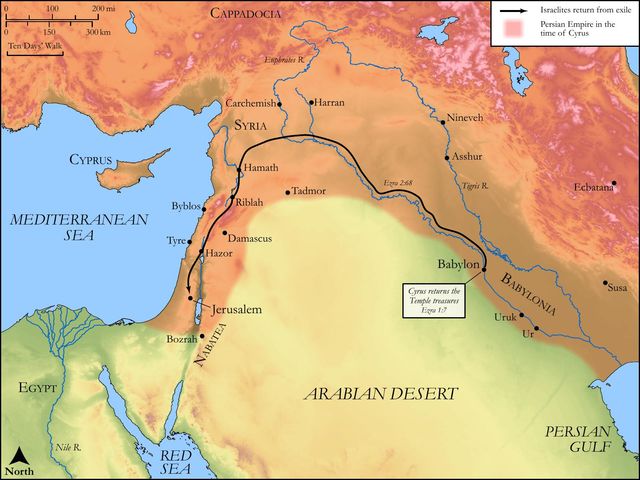
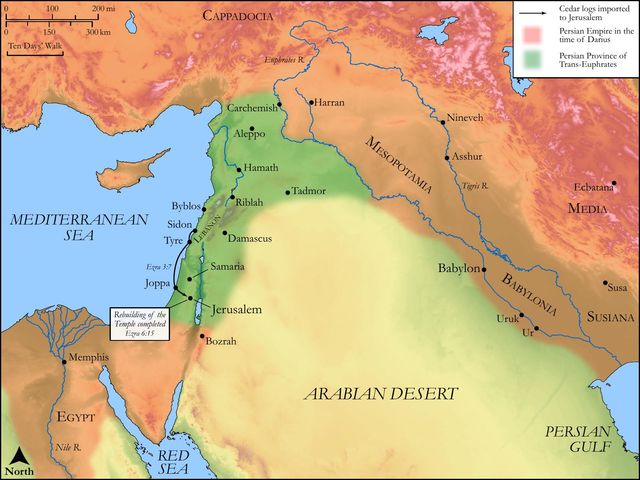
See on the biblical-era maps
Study this verse
Public-domain commentary
Matthew Henry
From his Commentary on the Whole Bible. Henry comments on passages, not single verses — this entry covers Ezra 3:8–13. His three-level outline is real structure in the source text, so it is rendered as structure.
There was no dispute among the returned Jews whether they should build the temple or no; that was immediately resolved on, and that it should be done with all speed; what comfort could they take in their own land if they had not that token of God's presence with them and the record of his name among them? We have here therefore an account of the beginning of that good work. Observe,
I.When it was begun-in the second month of the second year, as soon as ever the season of the year would permit (Ezr 3:8), and when they had ended the solemnities of the passover. They took little more than half a year for making preparation of the ground and materials; so much were their hearts upon it. Note, When any good work is to be done it will be our wisdom to set about it quickly, and not to lose time, yea, though we foresee difficulty and opposition in it. Thus we engage ourselves to it, and engage God for us. Well begun (we say) is half ended.
II.Who began it - Zerubbabel, and Jeshua, and their brethren.
Then the work of God is likely to go on well when magistrates, ministers, and people, are hearty for it, and agree in their places to promote it. It was God that gave them one heart for this service, and it boded well.
III.Who were employed to further it.
They appointed the Levites to set forward the work (Ezr 3:8), and they did it by setting forward the workmen (Ezr 3:9), and strengthening their hands with good and comfortable words. Note, Those that do not work themselves may yet do good service by quickening and encouraging those that do work.
IV.How God was praised at the laying of the foundation of the temple (Ezr 3:10, Ezr 3:11); the priests with the trumpets appointed by Moses, and the Levites with the cymbals appointed by David, made up a concert of music, not to please the ear, but to assist the singing of that everlasting hymn which will never be out of date, and to which our tongues should never be out of tune, God is good, and his mercy endureth for ever, the burden of Ps. 136. Let all the streams of mercy be traced up to the fountain. Whatever our condition is, how many soever our griefs and fears, let it be owned that God is good; and, whatever fails, that his mercy fails not. Let this be sung with application, as here; not only his mercy endures for ever, but it endures for ever towards Israel, Israel when captives in a strange land and strangers in their own land. However it be, yet God is good to Israel (Psa 73:1), good to us. Let the reviving of the church's interests, when they seemed dead, be ascribed to the continuance of God's mercy for ever, for therefore the church continues.
V.How the people were affected.
A remarkable mixture of various affections there was upon this occasion. Different sentiments there were among the people of God, and each expressed himself according to his sentiments, and yet there was no disagreement among them, their minds were not alienated from each other nor the common concern retarded by it.
1.Those that only knew the misery of having no temple at all praised the Lord with shouts of joy when they saw but the foundation of one laid, Ezr 3:11. To them even this foundation seemed great, and was as life from the dead; to their hungry souls even this was sweet. They shouted, so that the noise was heard afar off. Note, We ought to be thankful for the beginnings of mercy, though we have not yet come to the perfection of it; and the foundations of a temple, after long desolations, cannot but be fountains of joy to every faithful Israelite.
2.Those that remembered the glory of the first temple which Solomon built, and considered how far this was likely to be inferior to that, perhaps in dimensions, certainly in magnificence and sumptuousness, wept with a loud voice, Ezr 3:12. If we date the captivity with the first, from the fourth of Jehoiakim, it was about fifty-two years since the temple was burnt; if from Jeconiah's captivity, it was but fifty-nine. So that many now alive might remember it standing; and a great mercy it was to the captives that they had the lives of so many of their priests and Levites lengthened out, who could tell them what they themselves remembered of the glory of Jerusalem, to quicken them in their return. These lamented the disproportion between this temple and the former. And,
(1.)There was some reason for it; and if they turned their tears into the right channel, and bewailed the sin that was the cause of this melancholy change, they did well. Sin sullies the glory of any church or people, and, when they find themselves diminished and brought low, that must bear the blame.
(2.)Yet it was their infirmity to mingle those tears with the common joys and so to cast a damp upon them. They despised the day of small things, and were unthankful for the good they enjoyed, because it was not so much as their ancestors had, though it was much more than they deserved. In the harmony of public joys, let not us be jarring strings. It was an aggravation of the discouragement they hereby gave to the people that they were priests and Levites, who should have known and taught others how to be duly affected under various providences, and not to let the remembrance of former afflictions drown the sense of present mercies. This mixture of sorrow and joy here is a representation of this world. Some are bathing in rivers of joy, while others are drowned in floods of tears. In heaven all are singing, and none sighing; in hell all are weeping and wailing, and none rejoicing; but here on earth we can scarcely discern the shouts of joy from the noise of the weeping. Let us learn to rejoice with those that do rejoice and weep with those that weep, and ourselves to rejoice as though we rejoiced not, and weep as though we wept not.
Historical interpretation
Historical reception
1 surviving comment on this verse from the historical church.
So, with the foundation of the temple of the Lord laid by the masons, etc., great devotion of all persons is shown. With the foundation of the temple of the Lord laid, both priests and Levites and all the people, according to their respective statuses, praised the mercy of the Lord. The priests, indeed, adorned with holy garments as they were accustomed while the temple still stood, sounding the trumpets and stirring the hearts of the people to the sweetness of the heavenly praise; the Levites, strumming well on cymbals, singing hymns to the Lord; and the people, exhibiting their hearts' affection in common clamor in praising the Lord. The Levites also praised the Lord by the hand of David, either on the instruments which he made or the psalms which he established, or because David, in the placing of the ark, appointed Asaph and his brethren to give thanks to the Lord, as the words of the days testify, concerning whom it is again said: "Because his sons were under his hand, prophesying according to the king." (1 Chronicles VI). Rightly, also in this place, when the sons of Asaph praised and gave thanks to the Lord by the hand of David, that is, they are to be understood to have done this according to his arrangement. According to the mystical sense, indeed, with the temple of the Lord founded by masons, the priests stand in their attire with trumpets, when converted sinners from the error of sins, and with faith and love of Christ established in their hearts, all who hear the masters of the churches rejoice. They themselves, moreover, decorating themselves more diligently with good works, sound the trumpets of saving doctrine, so that both by the example of virtues and by the exhortation of sermons, they might aid the good beginnings of those who either recently by repenting have come to the grace of Christ or have recently taught others to turn to the grace of Christ. The Levites also stand to praise God with cymbals when even ministers of the second order serve their Creator with pious deeds for the instruction of neophytes, and this in the mutual sweetness of charity. For cymbals, which strike each other to sound, most fittingly express the works of charity, with which the holy ones excite each other to the praise of their author. They also praise Him through the hand of David, the King of Israel, when they diligently consider and strive as much as they can to imitate the works that the Lord and Savior carried out in the flesh.
Continue studying Ezra 3:11 across the web’s major study libraries — every link below opens this exact verse, chapter, or book on the destination site.
Read & Compare
 BibleGatewayThis verse in more than 200 translations and 70 languages.
 Bible.comThe YouVersion reader — hundreds of translations, reading plans, and highlights.
 ESV.orgCrossway's official English Standard Version reader.
 NET BibleThe NET translation with 60,000+ translators' notes on every rendering decision.
 STEP BibleTyndale House's free study tool — original text, vocabulary, and scholarly resources.
 BibliaLogos Bible Software's free web reader.
 USCCBThe New American Bible (Revised Edition) with the U.S. bishops' study notes.
Commentaries
 BibleHub CommentariesDozens of classic commentaries on this verse, gathered on one page.
 StudyLightMore than 100 commentary sets — the largest collection on the web.
 BibleRefPlain-English commentary on what this verse means, verse by verse.
 Enduring WordDavid Guzik's free commentary on this chapter, widely used by Bible teachers.
 Bible Study ToolsVerse commentary alongside Greek and Hebrew study aids.
Original Language & Research
- BibleHub InterlinearThe verse word by word — original language, transliteration, and English.
- BibleHub LexiconEvery word's original-language definition and Strong's entry.
 Blue Letter BibleDeep-study tools — Strong's numbers, concordance, and word studies.
 SefariaThe Hebrew text with Rashi and centuries of Jewish commentary.
Sermons, Hymns & Audio


TrulyRandomVerse is not affiliated with these sites and doesn’t control their content. They’re linked because they’re genuinely useful.
Summary
Ezra 3:11 powerfully captures the overwhelming joy and corporate worship of the returning Jewish exiles in Jerusalem as they witnessed the pivotal moment of laying the foundation for the Second Temple. Their praise, expressed through antiphonal singing, centered on a profound theological confession of God's inherent goodness and His eternal, covenantal mercy toward Israel, culminating in a resounding shout of thanksgiving that marked a tangible step in their spiritual and national restoration after generations of exile.
Context
ShowHideLiterary Context
Ezra 3 details the initial steps of the returning exiles under Zerubbabel and Jeshua to re-establish worship in Jerusalem. Following their arrival in Ezra 2, chapter 3 opens with the rebuilding of the altar and the re-institution of daily sacrifices during the Feast of Booths, demonstrating their immediate commitment to covenant faithfulness even before the Temple structure was begun. Verses 8-10 describe the meticulous organization of the Levites and priests for the work, culminating in the laying of the Temple's foundation. Verse 11, therefore, serves as the emotional and spiritual climax of this foundational work, capturing the collective response of the people, which is then contrasted in Ezra 3:12 with the tears of the older generation who remembered the glory of the First Temple. This verse is the crescendo of joy before the mixed emotions of the following verse.
Historical & Cultural Context
The setting is post-exilic Jerusalem, around 536 BC, shortly after Cyrus the Great's decree in 538 BC allowed the Jews to return and rebuild their Temple (as recorded in Ezra 1). The First Temple, Solomon's magnificent edifice, had been utterly destroyed by Nebuchadnezzar in 586 BC, leading to seventy years of Babylonian captivity (2 Kings 25). For generations, the Temple, the physical dwelling place of God's presence among His people, had been absent. Its rebuilding was not merely a construction project but a profound theological and national restoration, signifying God's renewed favor and the re-establishment of their identity as a covenant people in their land. The "singing by course" reflects ancient antiphonal worship practices, common in Israelite liturgy, where groups (e.g., priests and Levites) would respond to each other in praise, a tradition deeply embedded in their cultural and religious heritage.
Key Themes
ShowHideThis verse powerfully encapsulates several key themes central to the book of Ezra and the broader post-exilic narrative. It highlights the theme of Divine Faithfulness and Restoration, as God fulfills His promise to bring His people back to the land and enable the rebuilding of His house, echoing prophecies like those in Jeremiah 29:10-14. The Centrality of Worship is evident in the immediate priority given to rebuilding the altar and then the Temple, emphasizing that the physical structure was for the very purpose of worship and communion with God, reflecting the commands of the Pentateuch. Furthermore, the Corporate Nature of Faith is underscored by the communal singing and shouting, illustrating that the spiritual journey and acts of praise are often shared experiences within the community of faith, reflecting the unity and shared purpose of God's people as seen in passages like Psalm 133:1.
Exposition and Analysis
ShowHideKey Word Analysis
ShowHideThis primitive root means "to be clear (originally of sound, but usually of color); to shine; hence, to make a show, to boast; and thus to be (clamorously) foolish; to rave; causatively, to celebrate." In this context, it refers to a fervent, often boisterous, expression of commendation and honor directed towards God. It signifies a public and enthusiastic acknowledgment of His greatness and worth, a deep and outward manifestation of adoration.
This adjective describes God's inherent nature and character, signifying His benevolence, kindness, and moral perfection. In the context of the exiles' return and the Temple's foundation, it affirms God's active, positive, and benevolent disposition towards His people, even after a period of judgment. Their praise acknowledges God's intrinsic perfection and His active goodness toward them, which is the foundation of their hope.
This rich theological term denotes God's steadfast love, covenant loyalty, unfailing kindness, and enduring faithfulness. It is a love that is active, committed, and persistent, especially in the face of human unfaithfulness. The declaration "his mercy endureth for ever" (Hebrew: ki le'olam ḥasdō) is a recurring liturgical refrain throughout the Old Testament, particularly prominent in the Psalms (Psalm 136) and Chronicles, affirming God's everlasting covenant loyalty to Israel despite their past failures.
Verse Breakdown
ShowHide"And they sang together by course in praising and giving thanks unto the LORD"
This opening clause establishes the corporate and liturgical nature of the event. The "singing by course" (antiphonal, from H6030 'ânâh) implies a well-organized and deeply communal act of worship, demonstrating unity and shared purpose in their gratitude towards Yahweh, the covenant God of Israel. This was a deliberate, structured act of adoration.
"because [he is] good, for his mercy [endureth] for ever toward Israel"
This is the profound theological content of their song, a confession of God's unchanging character. Their praise is rooted not in their circumstances, but in God's inherent goodness (ṭôwb) and His eternal, covenantal steadfast love (ḥesed) specifically directed towards His chosen people, Israel, despite their past failures and the recent exile. This refrain echoes ancient liturgical declarations of God's enduring faithfulness, particularly as seen in the Psalms.
"And all the people shouted with a great shout, when they praised the LORD, because the foundation of the house of the LORD was laid"
This describes the overwhelming, visceral response of the entire assembly. The "great shout" (from H7321 rûwaʻ and H8643 tᵉrûwʻâh) signifies immense joy, relief, and elation, a spontaneous outburst of communal celebration. The cause of this outburst is explicitly stated: the laying of the Temple's foundation. This tangible milestone represented the visible beginning of God's dwelling place among them once more, a sign of His faithfulness and the renewal of their spiritual and national identity.
Literary Devices
ShowHideEzra 3:11 employs several powerful literary devices to convey the depth of emotion and theological significance of the moment. Antiphony is implied in the phrase "sang together by course," creating a dynamic, participatory worship scene that highlights the unity and collective voice of the community. The repetition of the phrase "because [he is] good, for his mercy [endureth] for ever" functions as a refrain, a common liturgical element in Israelite worship, emphasizing a core theological truth and linking this moment to a long tradition of praise (e.g., 1 Chronicles 16:34). The "great shout" serves as both hyperbole and vivid auditory imagery, conveying the overwhelming emotional intensity and collective exuberance of the people. Finally, the Temple foundation itself acts as a potent symbol of God's faithfulness, the restoration of the covenant, and the renewed hope for Israel's future, a physical manifestation of divine promise.
Theological and Thematic Connections
ShowHideThe celebration in Ezra 3:11 is a profound theological statement about God's unwavering faithfulness despite human failure. It underscores that God's covenant promises are ultimately fulfilled, even after periods of judgment and desolation. The people's praise is not based on their merit or the completion of the project, but on God's inherent goodness and eternal mercy, a foundational truth for all believers. This event highlights the importance of corporate worship as a communal expression of gratitude and recognition of God's redemptive work, and the joy that accompanies the visible manifestation of His presence and purposes among His people. It reminds us that even small, foundational steps in God's plan are worthy of immense celebration, for they are signs of His ongoing commitment to His people.
Reflection and Application
ShowHideEzra 3:11 offers a powerful model for contemporary believers, reminding us to cultivate hearts of profound gratitude and to actively participate in corporate worship. Just as the exiles celebrated the foundational step of Temple rebuilding, we are called to recognize and rejoice in God's faithfulness in our own lives and communities, even in the initial, seemingly small stages of His work. This verse encourages us to anchor our praise in God's unchanging character—His goodness and enduring mercy—especially when emerging from periods of difficulty or brokenness, or when facing daunting tasks. It challenges us to embrace communal expressions of faith, understanding that our collective worship not only honors God but also strengthens the bonds within the body of Christ, providing a powerful witness to His restorative power and unfailing love in a world that desperately needs to see it. Our joy, like theirs, should be rooted in God's character, not merely in the completion of a task.
Questions for Reflection
ShowHideFAQ
ShowHideWhy was the laying of the foundation such a significant event?
ShowHideThe laying of the Temple's foundation was profoundly significant because it marked the tangible beginning of God's dwelling place being re-established in Jerusalem after decades of desolation following the Babylonian exile. The Temple was the center of Israelite worship, national identity, and the place where God's presence was uniquely manifested. Its destruction had symbolized God's judgment and the brokenness of the covenant. Therefore, its rebuilding, even just the foundation, was a visible sign of God's faithfulness, the renewal of His covenant with His people, and the fulfillment of prophecies concerning their return and restoration (Jeremiah 29:10). It signified hope, a new beginning, and the return of divine favor to Israel, sparking immense joy and praise as recorded in Ezra 3:11.
What does "sang together by course" mean?
ShowHideThe phrase "sang together by course" (Hebrew: 'al yād, referring to the practice indicated by H6030 'ânâh) indicates an antiphonal or responsive style of singing. This was a common practice in ancient Israelite worship, where different groups, often choirs of Levites or sections of the congregation, would sing in alternation or in response to one another. This method created a dynamic and powerful communal expression of praise, allowing for widespread participation and a unified, resounding sound. It emphasized the corporate nature of their worship and their shared dedication to the LORD. This style of worship is also seen in other parts of the Old Testament, such as in the Psalms and during the dedication of Solomon's Temple.
Why did some people weep while others shouted for joy (Ezra 3:12)?
ShowHideEzra 3:12 explains that while the younger generation and many others shouted for joy, the older priests, Levites, and heads of families who had seen the glory of the First Temple (Solomon's Temple) wept loudly. Their tears were likely a complex mix of joy and sorrow. Joy, because they were witnessing the beginning of the Temple's restoration, a long-awaited event and a sign of God's faithfulness. Sorrow, because the new foundation, though a blessing, likely appeared humble and less glorious in comparison to the magnificent and grand original Temple they remembered. This contrast highlights the bittersweet nature of restoration, where present blessings are received with gratitude but also with a poignant awareness of past glories or losses, reflecting the profound emotional weight of their history.
Christ-Centered Fulfillment
ShowHideThe joyous celebration of the Temple's foundation in Ezra 3:11, rooted in God's enduring goodness and mercy, finds its ultimate and profound fulfillment in Jesus Christ. While the physical Temple was a vital symbol of God's presence among His people, it was always a foreshadowing of a greater reality. Jesus Himself declared that He was the true Temple, stating, "Destroy this temple, and in three days I will raise it up," referring to His own body and His resurrection. Through His sacrificial death and glorious resurrection, Christ not only laid the foundation for a new covenant but became the very dwelling place of God, reconciling humanity to the Father. The "mercy [endureth] for ever" sung by the exiles is fully realized in the boundless grace extended through Christ, whose steadfast love endures eternally for all who believe (Ephesians 2:4-5). Furthermore, in the New Testament, believers are now collectively the "temple of the Holy Spirit" (1 Corinthians 6:19) and are being built together into a "holy temple in the Lord" (Ephesians 2:21-22), with Christ Jesus Himself as the cornerstone (Ephesians 2:20). Thus, the shout of joy in Ezra 3:11 anticipates the even greater, eternal joy of salvation and spiritual communion made possible through Christ, the ultimate foundation and fulfillment of God's redemptive plan, establishing a spiritual house far surpassing any physical edifice (1 Peter 2:5).