


1 Chronicles 15:24
Bible text: King James Version (1769 Blayney text) · Public domain
Bible text: King James Version with Strong's numbers · Public domain
Bible text: Berean Standard Bible · Public domain
Bible text: American Standard Version (1901) · Public domain
Bible text: World English Bible, Messianic edition · Public domain
Bible text: Geneva Bible (1599) · Public domain
Bible text: Young's Literal Translation · Public domain
- וּשְׁבַנְיָהוּu·she·van·Ya·huand ShebaniahH7645Conj-w ¦ N-proper-mNoun Proper MasculineוּandשְׁבַנְיָהוּShebaniah
- וְיוֹשָׁפָטve·yo·sha·Fatand JoshaphatH3146Conj-w ¦ N-proper-mNoun Proper MasculineוְandיוֹשָׁפָטJoshaphat
- וּנְתַנְאֵלu·ne·tan·'Eland NethanelH5417Conj-w ¦ N-proper-mNoun Proper MasculineוּandנְתַנְאֵלNethanel
- וַעֲמָשַׂיva·'a·ma·Saiand AmasaiH6022Conj-w ¦ N-proper-mNoun Proper MasculineוַandעֲמָשַׂיAmasai
- וּזְכַרְיָהוּU·ze·khar·ya·huand ZechariahH2148Conj-w ¦ N-proper-mNoun Proper MasculineוּandזְכַרְיָהוּZechariah
- וּבְנָיָהוּu·ve·na·Ya·huand BenaiahH1141Conj-w ¦ N-proper-mNoun Proper MasculineוּandבְנָיָהוּBenaiah
- וֶאֱלִיעֶזֶרve·'e·li·'E·zerand EliezerH461Conj-w ¦ N-proper-mNoun Proper MasculineוֶandאֱלִיעֶזֶרEliezer
- הַכֹּהֲנִיםha·Ko·ha·Nimthe priestsH3548Art ¦ N-mpNoun Plural Masculine Absoluteהַtheכֹּהֲנִיםpriests
- מַחְצְרִיםma·cha·tzo·tze·rim[were] blowing a trumpetH2690V-Hiphil-Prtcpl-mpVerb Hiphil Participle Plural Masculine Absolute
- בַּחֲצֹצְרוֹתba·cha·Tzo·tze·Roton trumpetsH2689Prep-b ¦ N-fpNoun Plural Feminine Absoluteבַּonחֲצֹצְרוֹתtrumpets
- לִפְנֵיlif·Nei<to> beforeH6440Prep-l ¦ N-mpcNoun Plural Masculine Constructלִ<to>פְנֵיbefore
- אֲרוֹן'a·Ron[the] ark ofH727N-mscNoun Singular Masculine Construct
- הָאֱלֹהִיםha·'E·lo·Him<the> GodH430Art ¦ N-mpNoun Plural Masculine Absoluteהָ<the>אֱלֹהִיםGod
- וְעֹבֵדve·'o·Vedand Obed-H5654Conj-w ¦ N-proper-mNoun Proper MasculineוְandעֹבֵדObed-
- אֱדֹם'e·DomEdomH5654N-proper-mNoun Proper Masculine
- וִיחִיָּהvi·chi·Yahand JehiahH3174Conj-w ¦ N-proper-mNoun Proper MasculineוִandיחִיָּהJehiah
- שֹׁעֲרִיםsho·'a·Rim[were] gatekeepersH7778N-mpNoun Plural Masculine Absolute
- לָאָרוֹןla·'a·Ronfor the arkH727Prep-l ¦ N-msNoun Singular Masculine Absoluteלָfor theאָרוֹןark
English is a literal word-by-word gloss of the Hebrew, not the KJV's wording. Why?
This is the original text the KJV's translators worked from — each Hebrew word with its own literal English meaning in this verse, prepared by scholars at Tyndale House, Cambridge. The KJV translates whole sentences, not word by word, so its wording differs: one Hebrew word can become several English words, and the KJV may choose “the LORD” where the gloss reads “Yahweh”. Both are faithful — they answer different questions. For the KJV's own rendering, switch to the KJV text.
Details
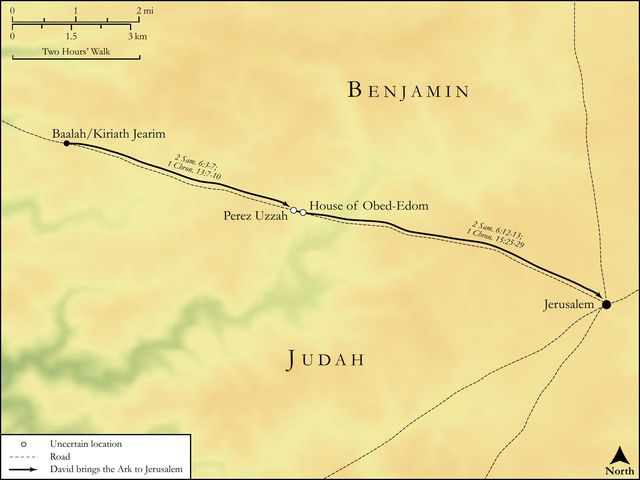
See on the biblical-era map
Study this verse
Public-domain commentary
Matthew Henry
From his Commentary on the Whole Bible. Henry comments on passages, not single verses — this entry covers 1 Chronicles 15:1–24.
Preparation is here made for the bringing of the ark home to the city of David from the house of Obed-edom. It is here owned that in the former attempt, though it was a very good work and in it they sought God, yet they sought him, not after the due order, Ch1 15:13. "We did not go about our work considerately; and therefore we sped so ill." Note, It is not enough that we do that which is good, but we must do it well - not enough that we seek God in a due ordinance, but we must seek after him, in a due order. Note, also, When we have suffered for our irregularities we must learn thereby to be more regular; then we answer the end of chastisement. Let us see how the matter was mended. 1. David now prepared a place for the reception of the ark, before he brought it to him; and thus he sought in the due order. He had not time to build a house, but he pitched a tent for it (Ch1 15:1), probably according to the pattern shown to Moses in the mount, or as near it as might be, of curtains and boards. Observe, When he made houses for himself in the city of David he prepared a place for the ark. Note, Wherever we build for ourselves, we must be sure to make room for God's ark, for a church in the house. 2. David now ordered that the Levites or priests should carry the ark upon their shoulders. Now he bethought himself of that which he could not but know before, that, none ought to carry the ark but the Levites, Ch1 15:2. The Kohathites carried it in their ordinary marches, and therefore had no wagons allotted them, because their work was to bear upon their shoulders, Num 7:9. But upon extraordinary occasions, as when they passed Jordan and compassed Jericho, the priests carried it. This rule was express, and yet David himself forgot it, and put the ark upon a cart. Note, Even those that are very knowing in the word of God, yet have it not always so ready to them as were to be wished when they have occasion to use it. Wise and good men may be guilty of an oversight, which, as soon as they are aware of, they will correct. David did not go about to justify what had been done amiss, nor to lay the blame on others, but owned himself guilty, with others, of not seeking God in a due order, and now took care not only to summon the Levites to the solemnity, as he did all Israel (Ch1 15:3), and had done before (Ch1 13:2), but to see that they assembled (Ch1 15:4), especially the sons of Aaron, Ch1 15:11. To them he gives the solemn charge (Ch1 15:12): You are the chief of the fathers of the Levites, therefore do you bring up the ark of the Lord. It is expected that those who are advanced above others in dignity should go before others in duty. "You are the chief, and therefore more is expected from you than from others, both by way of service yourselves and influence on the rest. You did it not at first, neither did your duty yourselves nor took care to instruct us, and we smarted for it: The Lord made a breach upon us; we have all smarted for your neglect; this has been by your means (see Mal 1:9): therefore sanctify yourselves, and mind your business." When those that have suffered for doing ill thus learn to do better the correction is well bestowed. 3. The Levites and priests sanctified themselves (Ch1 15:14) and were ready to carry the ark on their shoulders, according to the law, Ch1 15:15. Note, Many that are very remiss in their duty, if they were but faithfully told of it, would reform and do better. The breach upon Uzza made the priests more careful to sanctify themselves, that is, to cleanse themselves from all ceremonial pollution and to compose themselves for the solemn service of God, so as to strike a reverence upon the people. Some are made examples, that others may be made exemplary and very cautious. 4. Officers were appointed to be ready to bid the ark welcome, with every possible expression of joy, Ch1 15:16. David ordered the chief of the Levites to nominate those that they knew to be proficients for this service. Heman, Asaph, and Ethan, were now first appointed, Ch1 15:17. They undertook to sound with symbols (Ch1 15:19), others with psalteries (Ch1 15:20), others with harps, on the Sheminith, or eighth, eight notes higher or lower than the rest, according to the rules of the concert, Ch1 15:21. Some that were priests blew with the trumpet (Ch1 15:24), as was usual at the removal of the ark (Num 10:8) and at solemn feasts, Psa 81:3. And one was appointed for song (Ch1 15:22), for he was skilful in it, could sing well himself and instruct others. Note, As every man has received the gift, so he ought to minister the same, Pe1 4:10. And those that excel in any endowment should not only use it for the common good themselves, but teach others also, and not grudge to make others as wise as themselves. This way of praising God by musical instruments had not hitherto been in use. But David, being a prophet, instituted it by divine direction, and added it to the other carnal ordinances of that dispensation, as the apostle calls them, Heb 9:10. The New Testament keeps up singing of psalms, but has not appointed church-music. Some were appointed to be porters (Ch1 15:18), others door-keepers for the ark (Ch1 15:23, Ch1 15:24), and one of these was Obed-edom, who reckoned it no doubt a place of honour, and accepted it as recompence for the entertainment he had given to the ark. He had been for three months housekeeper to the ark, and indeed its landlord. But, when he might not be so any longer, such an affection had he for it that he was glad to be its door-keeper.
Continue studying 1 Chronicles 15:24 across the web’s major study libraries — every link below opens this exact verse, chapter, or book on the destination site.
Read & Compare
 BibleGatewayThis verse in more than 200 translations and 70 languages.
 Bible.comThe YouVersion reader — hundreds of translations, reading plans, and highlights.
 ESV.orgCrossway's official English Standard Version reader.
 NET BibleThe NET translation with 60,000+ translators' notes on every rendering decision.
 STEP BibleTyndale House's free study tool — original text, vocabulary, and scholarly resources.
 BibliaLogos Bible Software's free web reader.
 USCCBThe New American Bible (Revised Edition) with the U.S. bishops' study notes.
Commentaries
 BibleHub CommentariesDozens of classic commentaries on this verse, gathered on one page.
 StudyLightMore than 100 commentary sets — the largest collection on the web.
 BibleRefPlain-English commentary on what this verse means, verse by verse.
 Enduring WordDavid Guzik's free commentary on this chapter, widely used by Bible teachers.
 Bible Study ToolsVerse commentary alongside Greek and Hebrew study aids.
Original Language & Research
- BibleHub InterlinearThe verse word by word — original language, transliteration, and English.
- BibleHub LexiconEvery word's original-language definition and Strong's entry.
 Blue Letter BibleDeep-study tools — Strong's numbers, concordance, and word studies.
 SefariaThe Hebrew text with Rashi and centuries of Jewish commentary.
Sermons, Hymns & Audio


TrulyRandomVerse is not affiliated with these sites and doesn’t control their content. They’re linked because they’re genuinely useful.
Summary
1 Chronicles 15:24 meticulously details the specific roles of priests and Levites during King David's successful second attempt to transfer the Ark of the Covenant to Jerusalem. This verse highlights seven priests who blew trumpets, symbolizing reverence and celebration, alongside Obed-Edom and Jehiah, who served as doorkeepers. It underscores the vital importance of all roles in sacred service and David's commitment to proper worship protocols, demonstrating profound respect for God's holiness and the necessity of ordered, joyful participation in His presence.
Context
ShowHideLiterary Context
1 Chronicles 15:24 is situated within the Chronicler's detailed account of King David's second, successful endeavor to bring the Ark of the Covenant into Jerusalem. This narrative follows the disastrous initial attempt described in 1 Chronicles 13, where Uzzah's death underscored the severe consequences of improper handling of sacred objects. Chapter 15 meticulously outlines David's careful preparations, emphasizing the consecration of the Levites and priests, their specific instruction to carry the Ark on poles (in accordance with Mosaic Law, as seen in Numbers 4:15), and the subsequent joyous procession. This particular verse describes a key moment within that procession, immediately following the appointment of Levites for musical accompaniment (1 Chronicles 15:16-23). It precedes the Ark's arrival in Jerusalem and David's subsequent acts of worship and sacrifice (1 Chronicles 16:1-3). The Chronicler's emphasis on specific names and roles throughout this chapter highlights the ordered, intentional, and reverent nature of this sacred event, starkly contrasting with the impulsive and unauthorized actions that led to the previous failure.
Historical & Cultural Context
The Ark of the Covenant held unparalleled significance in ancient Israel, serving as the tangible representation of God's throne and His covenant presence among His people. Its handling was strictly governed by Mosaic law, particularly concerning its transport by the Kohathite Levites (Numbers 3:30-31). After its capture by the Philistines and eventual return, the Ark had resided in various locations, including Kirjath-jearim for two decades (1 Samuel 7:1-2) and then in the house of Obed-Edom for three months (1 Chronicles 13:14). David's earnest desire to bring the Ark to Jerusalem was central to his vision of establishing a unified religious and political capital for Israel. The act of blowing trumpets, specifically the chatzozerah (silver trumpets), was a distinct priestly function, employed for signaling, assembling the congregation, declaring war, and most notably, for solemn feasts and times of joy (Numbers 10:1-10). Doorkeepers, though seemingly occupying a less prominent role than priests, bore significant responsibility for guarding the sanctity and security of sacred spaces, ensuring that only authorized personnel entered and that the sanctity of God's dwelling place was preserved.
Key Themes
ShowHideThis verse powerfully contributes to several overarching themes emphasized by the Chronicler. Firstly, it underscores the theme of proper worship and rigorous obedience to divine instruction. David's meticulous adherence to the Law, in stark contrast to the previous failure, profoundly illustrates that God's holiness demands reverence, precision, and obedience, rather than human innovation or shortcuts. Secondly, the detailed enumeration of priests and doorkeepers reinforces the theme of ordered service and the indispensable importance of every role within the community of faith. Whether one's duty involved the prominent act of blowing trumpets or the seemingly humble task of guarding entrances, each function was presented as vital for the integrity and sanctity of worship. Thirdly, the joyful celebration accompanying the Ark's movement highlights the theme of God's presence as the ultimate source of blessing and profound joy. The Ark's arrival in Jerusalem was not merely a logistical relocation but a deeply theological event, signifying God's dwelling among His people and the establishment of His kingdom. The Chronicler consistently emphasizes the centrality of the temple and its worship, framing David's actions as foundational for Israel's spiritual life, a theme further developed in the subsequent preparations for the temple described in 1 Chronicles 22.
Exposition and Analysis
ShowHideKey Word Analysis
ShowHideRefers to the descendants of Aaron, consecrated by God to perform sacred duties within the tabernacle and later the temple. Their roles encompassed offering sacrifices, teaching God's Law, and mediating between God and His people. In this context, their function of blowing trumpets was a distinct priestly prerogative, signifying a sacred announcement, leading the people in worship, and marking the solemnity and joy of the procession before the Ark.
A primitive root meaning "to surround with a stockade," but in its reduplicated form, it specifically refers to the act of trumpeting or blowing on a trumpet. When used in conjunction with trumpets, it denotes sounding them, often for a specific purpose such as signaling an alarm, calling an assembly, or, as here, for ceremonial and celebratory purposes in worship. The act of blowing trumpets before the Ark was a powerful, audible declaration of God's presence and the joyous, yet solemn, nature of the procession.
These were Levites specifically appointed to guard the gates and entrances of the tabernacle, and subsequently the temple. Their duties included maintaining security, regulating access, and ensuring the sanctity of the holy areas. While their role might appear less outwardly prominent than that of the trumpet-blowing priests, it was absolutely crucial for maintaining the order, purity, and holiness of divine service, underscoring that even seemingly mundane tasks are vital and honored in God's economy.
Verse Breakdown
ShowHide"And Shebaniah, and Jehoshaphat, and Nethaneel, and Amasai, and Zechariah, and Benaiah, and Eliezer, the priests,"
This precise enumeration of seven specific priests underscores the meticulous planning and strict adherence to divine instruction that characterized this second, successful attempt to bring the Ark to Jerusalem. It highlights the principle of divinely appointed roles and the profound importance of individuals faithfully fulfilling their consecrated duties within the worship of God. The Chronicler's detailed naming of these figures reinforces the historical accuracy of the account and emphasizes the personal involvement of key individuals in this sacred undertaking.
"did blow with the trumpets before the ark of God:"
This clause describes a central and highly symbolic act within the procession. The blowing of trumpets by the priests was a solemn and celebratory sound, serving to announce the Ark's movement, signify the palpable presence of God, and lead the people in praise and adoration. It added a majestic and ceremonial element to the event, emphasizing the profound awe and reverence due to the Ark, which represented the very presence and covenant of God among His people.
"and Obededom and Jehiah [were] doorkeepers for the ark."
This final clause identifies two specific individuals, Obed-Edom and Jehiah, and their essential role in the procession. Obed-Edom's inclusion is particularly significant given that the Ark had previously brought immense blessing to his household during its three-month stay (1 Chronicles 13:14), and his continued service as a doorkeeper demonstrates his sustained faithfulness and dedication. Their function, though less visible than the trumpet-blowing, was indispensable for maintaining the security, sanctity, and proper order of the Ark's immediate vicinity, illustrating the profound truth that all roles, whether prominent or behind-the-scenes, are vital and valued in God's service.
Literary Devices
ShowHideThe Chronicler employs several literary devices in 1 Chronicles 15:24 to effectively convey its profound message. Enumeration is prominently featured, with the explicit listing of seven priests and two doorkeepers by name. This detailed naming not only provides historical specificity and verisimilitude but also powerfully underscores the meticulous organization and the individual accountability inherent in this sacred procession. The act of listing reinforces the theological concept that every participant, regardless of their specific role, was essential to the proper and reverent execution of God's command. There is also a subtle element of Parallelism in the verse's structure, contrasting the active, audible, and leading role of the trumpet-blowing priests with the more stationary, guardianship, and supportive role of the doorkeepers. Both groups are presented as equally vital to the Ark's procession, highlighting the diverse yet complementary functions necessary within divine service. Finally, Symbolism is deeply embedded in the objects and actions described: the trumpets symbolize divine announcement, triumphant celebration, and the manifest presence of God, while the Ark itself is the ultimate symbol of God's covenant, His dwelling among His people, and His sovereign authority. The doorkeepers, in turn, symbolize the necessary boundaries, order, and reverence required in approaching and maintaining the sanctity of the holy.
Theological and Thematic Connections
ShowHide1 Chronicles 15:24 profoundly illustrates the Old Testament emphasis on proper worship, divine order, and the sanctity of God's presence. It teaches that approaching God requires not only sincere devotion but also meticulous adherence to His revealed will, a crucial lesson David learned painfully from the first, failed attempt to move the Ark. The detailed roles of both the trumpet-blowing priests and the doorkeepers underscore that every function in God's service, from the most prominent and visible to the seemingly humble and behind-the-scenes, is essential and contributes integrally to the integrity and beauty of worship. This passage powerfully prefigures the New Testament understanding of the church as a unified body with diverse members, each uniquely gifted and called to serve for the common good, all contributing harmoniously to the worship and mission of God. It highlights that true worship involves both joyful, celebratory praise and reverent, obedient awe, acknowledging God's supreme majesty and holiness.
Reflection and Application
ShowHideThis passage from 1 Chronicles 15:24 offers timeless and profound lessons for contemporary believers, guiding our approach to faith and service. It powerfully reminds us that our engagement with God, whether in personal devotion or corporate worship, should be characterized by both exuberant, joyful celebration and profound, reverent obedience. Just as King David meticulously learned the critical importance of following God's specific instructions for the Ark's transfer, we too are called to diligently seek God's will and align our lives, our worship, and our ministries with His revealed Word, humbly learning from past mistakes and growing in spiritual maturity. Furthermore, the detailed mention of various roles—from the high-profile trumpet-blowing priests to the steadfast doorkeepers—underscores the profound and liberating truth that every function within the body of Christ is inherently valuable, necessary, and esteemed by God. No role is too small, too mundane, or too insignificant in the grand tapestry of God's kingdom. Whether we are called to lead in visible, public ways or to serve faithfully and diligently behind the scenes, our dedication, faithfulness, and excellence in our assigned tasks contribute immeasurably to the overall health, vitality, and effectiveness of the church, ultimately bringing abundant glory to God.
Questions for Reflection
ShowHideFAQ
ShowHideWhy was it so important for the priests to blow trumpets before the Ark?
ShowHideThe blowing of trumpets by priests was a highly significant and divinely ordained act in ancient Israel, as meticulously outlined in Numbers 10:1-10. It served multiple crucial purposes: to signal the assembly of the congregation, to announce solemn feasts and new moons, to sound an alarm for war, and most importantly, to commemorate joyful occasions and acts of worship before the Lord. In the specific context of 1 Chronicles 15:24, the trumpets served as a majestic and ceremonial announcement of the Ark's procession, underscoring the profound importance and sacredness of God's presence. It was a powerful, audible expression of praise, celebration, and reverence, adding immense solemnity and joy to the event. This priestly act also served to distinguish this divinely ordained procession from any ordinary movement, signifying that God Himself was being honored, welcomed, and revered in the most fitting manner.
What was the significance of Obed-Edom and Jehiah being "doorkeepers for the ark"?
ShowHideWhile perhaps less outwardly prominent than the trumpet-blowing priests, the role of "doorkeepers" (or gatekeepers) was profoundly crucial and highly respected in ancient Israelite worship. These Levites were specifically responsible for guarding the entrances to the sacred spaces, ensuring security, maintaining order, and regulating access to the holy areas of the tabernacle and later the temple. Their presence underscored the inherent sanctity of the Ark and the absolute necessity for proper protocol and reverence in approaching God's holy presence. Obed-Edom's inclusion in this role is particularly significant because the Ark had previously resided in his house for three months, bringing immense and undeniable blessing upon him and his entire household (1 Chronicles 13:14). His continued service, even in a seemingly less visible role, highlights his unwavering faithfulness, deep commitment, and the lasting impact of God's blessing in his life. It powerfully teaches believers that every role within God's service, no matter how humble or behind-the-scenes, is vital for the proper functioning, order, and reverence of God's house and His sacred service.
Christ-Centered Fulfillment
ShowHide1 Chronicles 15:24, with its vivid depiction of the Ark's solemn and joyful procession, finds its ultimate and glorious fulfillment in the person and work of Jesus Christ. The Ark, serving as the tangible representation of God's presence dwelling among His people, powerfully foreshadows Christ as Immanuel, "God with us". Through His miraculous incarnation, His atoning death, and His triumphant resurrection, Jesus became the true and ultimate dwelling place of God, the perfect tabernacle where God's glory resides in its fullness (John 1:14). The meticulous order, specific consecrated roles, and reverent actions of the priests and Levites in handling the Ark perfectly point to the perfect, singular, and eternal priesthood of Christ, who, unlike the Levitical priests, offered a single, perfect sacrifice for sins forever, thereby perfecting those who are being sanctified. He is not merely a doorkeeper, but He is the door itself, the exclusive means through whom all believers gain direct and unhindered access to God's presence. The joyful celebration, accompanied by the resounding trumpets, anticipates the ultimate and eternal rejoicing at Christ's triumph over all things and the future glorious consummation of His kingdom, when every knee will bow and every tongue will confess His Lordship (Philippians 2:10-11). In Christ, the need for a physical Ark is eternally transcended, as believers are now indwelt by the Holy Spirit, becoming temples of the living God, called to offer spiritual sacrifices of praise, worship, and dedicated service (1 Peter 2:5).