


1 Chronicles 15:19
Bible text: King James Version (1769 Blayney text) · Public domain
Bible text: Berean Standard Bible · Public domain
Bible text: American Standard Version (1901) · Public domain
Bible text: World English Bible, Messianic edition · Public domain
Bible text: Geneva Bible (1599) · Public domain
Bible text: Young's Literal Translation · Public domain
- וְהַמְשֹׁרְרִיםve·ham·Sho·re·Rimand the singersH7891Conj-w ¦ Art ¦ V-Piel-Prtcpl-mpVerb Piel Participle Plural Masculine Absoluteוְandהַtheמְשֹׁרְרִיםsingers
- הֵימָןhei·ManHemanH1968N-proper-mNoun Proper Masculine
- אָסָף'a·SafAsaphH623N-proper-mNoun Proper Masculine
- וְאֵיתָןve·'ei·Tanand EthanH387Conj-w ¦ N-proper-mNoun Proper MasculineוְandאֵיתָןEthan
- בִּמְצִלְתַּיִםbim·tzil·Ta·yimwith cymbalsH4700Prep-b ¦ N-fdNoun Dual Feminine Absoluteבִּwithמְצִלְתַּיִםcymbals
- נְחֹשֶׁתne·Cho·shetbronzeH5178N-fsNoun Singular Feminine Absolute
- לְהַשְׁמִיעַle·hash·Mi·a'[were] to sound aloudH8085Prep-l ¦ V-Hiphil-InfVerb Hiphil Infinitive Constructלְ[were] toהַשְׁמִיעַsound aloud
English is a literal word-by-word gloss of the Hebrew, not the KJV's wording. Why?
This is the original text the KJV's translators worked from — each Hebrew word with its own literal English meaning in this verse, prepared by scholars at Tyndale House, Cambridge. The KJV translates whole sentences, not word by word, so its wording differs: one Hebrew word can become several English words, and the KJV may choose “the LORD” where the gloss reads “Yahweh”. Both are faithful — they answer different questions. For the KJV's own rendering, switch to the KJV text.
Details
See on the biblical-era map
Study this verse
Public-domain commentary
Matthew Henry
From his Commentary on the Whole Bible. Henry comments on passages, not single verses — this entry covers 1 Chronicles 15:1–24.
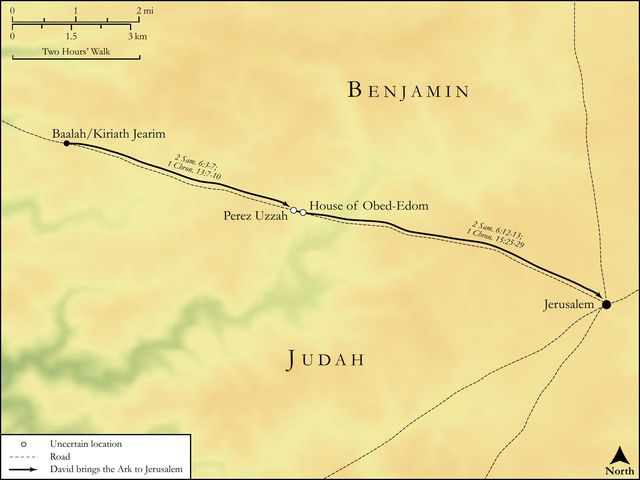
Preparation is here made for the bringing of the ark home to the city of David from the house of Obed-edom. It is here owned that in the former attempt, though it was a very good work and in it they sought God, yet they sought him, not after the due order, Ch1 15:13. "We did not go about our work considerately; and therefore we sped so ill." Note, It is not enough that we do that which is good, but we must do it well - not enough that we seek God in a due ordinance, but we must seek after him, in a due order. Note, also, When we have suffered for our irregularities we must learn thereby to be more regular; then we answer the end of chastisement. Let us see how the matter was mended. 1. David now prepared a place for the reception of the ark, before he brought it to him; and thus he sought in the due order. He had not time to build a house, but he pitched a tent for it (Ch1 15:1), probably according to the pattern shown to Moses in the mount, or as near it as might be, of curtains and boards. Observe, When he made houses for himself in the city of David he prepared a place for the ark. Note, Wherever we build for ourselves, we must be sure to make room for God's ark, for a church in the house. 2. David now ordered that the Levites or priests should carry the ark upon their shoulders. Now he bethought himself of that which he could not but know before, that, none ought to carry the ark but the Levites, Ch1 15:2. The Kohathites carried it in their ordinary marches, and therefore had no wagons allotted them, because their work was to bear upon their shoulders, Num 7:9. But upon extraordinary occasions, as when they passed Jordan and compassed Jericho, the priests carried it. This rule was express, and yet David himself forgot it, and put the ark upon a cart. Note, Even those that are very knowing in the word of God, yet have it not always so ready to them as were to be wished when they have occasion to use it. Wise and good men may be guilty of an oversight, which, as soon as they are aware of, they will correct. David did not go about to justify what had been done amiss, nor to lay the blame on others, but owned himself guilty, with others, of not seeking God in a due order, and now took care not only to summon the Levites to the solemnity, as he did all Israel (Ch1 15:3), and had done before (Ch1 13:2), but to see that they assembled (Ch1 15:4), especially the sons of Aaron, Ch1 15:11. To them he gives the solemn charge (Ch1 15:12): You are the chief of the fathers of the Levites, therefore do you bring up the ark of the Lord. It is expected that those who are advanced above others in dignity should go before others in duty. "You are the chief, and therefore more is expected from you than from others, both by way of service yourselves and influence on the rest. You did it not at first, neither did your duty yourselves nor took care to instruct us, and we smarted for it: The Lord made a breach upon us; we have all smarted for your neglect; this has been by your means (see Mal 1:9): therefore sanctify yourselves, and mind your business." When those that have suffered for doing ill thus learn to do better the correction is well bestowed. 3. The Levites and priests sanctified themselves (Ch1 15:14) and were ready to carry the ark on their shoulders, according to the law, Ch1 15:15. Note, Many that are very remiss in their duty, if they were but faithfully told of it, would reform and do better. The breach upon Uzza made the priests more careful to sanctify themselves, that is, to cleanse themselves from all ceremonial pollution and to compose themselves for the solemn service of God, so as to strike a reverence upon the people. Some are made examples, that others may be made exemplary and very cautious. 4. Officers were appointed to be ready to bid the ark welcome, with every possible expression of joy, Ch1 15:16. David ordered the chief of the Levites to nominate those that they knew to be proficients for this service. Heman, Asaph, and Ethan, were now first appointed, Ch1 15:17. They undertook to sound with symbols (Ch1 15:19), others with psalteries (Ch1 15:20), others with harps, on the Sheminith, or eighth, eight notes higher or lower than the rest, according to the rules of the concert, Ch1 15:21. Some that were priests blew with the trumpet (Ch1 15:24), as was usual at the removal of the ark (Num 10:8) and at solemn feasts, Psa 81:3. And one was appointed for song (Ch1 15:22), for he was skilful in it, could sing well himself and instruct others. Note, As every man has received the gift, so he ought to minister the same, Pe1 4:10. And those that excel in any endowment should not only use it for the common good themselves, but teach others also, and not grudge to make others as wise as themselves. This way of praising God by musical instruments had not hitherto been in use. But David, being a prophet, instituted it by divine direction, and added it to the other carnal ordinances of that dispensation, as the apostle calls them, Heb 9:10. The New Testament keeps up singing of psalms, but has not appointed church-music. Some were appointed to be porters (Ch1 15:18), others door-keepers for the ark (Ch1 15:23, Ch1 15:24), and one of these was Obed-edom, who reckoned it no doubt a place of honour, and accepted it as recompence for the entertainment he had given to the ark. He had been for three months housekeeper to the ark, and indeed its landlord. But, when he might not be so any longer, such an affection had he for it that he was glad to be its door-keeper.
Continue studying 1 Chronicles 15:19 across the web’s major study libraries — every link below opens this exact verse, chapter, or book on the destination site.
Read & Compare
 BibleGatewayThis verse in more than 200 translations and 70 languages.
 Bible.comThe YouVersion reader — hundreds of translations, reading plans, and highlights.
 ESV.orgCrossway's official English Standard Version reader.
 NET BibleThe NET translation with 60,000+ translators' notes on every rendering decision.
 STEP BibleTyndale House's free study tool — original text, vocabulary, and scholarly resources.
 BibliaLogos Bible Software's free web reader.
 USCCBThe New American Bible (Revised Edition) with the U.S. bishops' study notes.
Commentaries
 BibleHub CommentariesDozens of classic commentaries on this verse, gathered on one page.
 StudyLightMore than 100 commentary sets — the largest collection on the web.
 BibleRefPlain-English commentary on what this verse means, verse by verse.
 Enduring WordDavid Guzik's free commentary on this chapter, widely used by Bible teachers.
 Bible Study ToolsVerse commentary alongside Greek and Hebrew study aids.
Original Language & Research
- BibleHub InterlinearThe verse word by word — original language, transliteration, and English.
- BibleHub LexiconEvery word's original-language definition and Strong's entry.
 Blue Letter BibleDeep-study tools — Strong's numbers, concordance, and word studies.
 SefariaThe Hebrew text with Rashi and centuries of Jewish commentary.
Sermons, Hymns & Audio


TrulyRandomVerse is not affiliated with these sites and doesn’t control their content. They’re linked because they’re genuinely useful.
Summary
1 Chronicles 15:19 meticulously details the specific appointment of Heman, Asaph, and Ethan, three preeminent Levitical musicians, to play cymbals of brass during King David's carefully organized and reverent procession to bring the Ark of the Covenant into Jerusalem. This verse underscores the crucial role of skilled musical leadership and the intentional use of powerful percussive instruments in the sacred worship of ancient Israel, highlighting the solemnity, joy, and divine order that characterized this pivotal moment in the nation's spiritual and political life.
Context
ShowHideLiterary Context
This verse is strategically placed within the narrative of King David's second, successful attempt to transport the Ark of the Covenant to Jerusalem. The preceding chapters recount the disastrous first endeavor in 1 Chronicles 13, where Uzzah's death resulted from a disregard for God's explicit instructions regarding the Ark's handling. Learning from this tragic error, David undertakes meticulous preparations in 1 Chronicles 15, ensuring that only the sanctified Levites carry the Ark on their shoulders, as divinely commanded (1 Chronicles 15:2). The chapter elaborates on David's careful organization of the Levites into various roles—priests, gatekeepers, and musicians—for the grand procession and subsequent worship. Verse 19 specifically names three chief musicians, emphasizing their prominence and the precise nature of their roles in this sacred and joyous event.
Historical & Cultural Context
The era of King David marks a profound transformation in Israelite history, transitioning from a decentralized tribal confederacy to a unified monarchy with Jerusalem established as its spiritual and political heart. The Ark of the Covenant, symbolizing God's tangible presence among His people, was utterly central to Israel's national identity and worship. Its proper handling, transport, and eventual placement were matters of paramount importance, reflecting the nation's covenant relationship with Yahweh. Culturally, ancient Israelite worship was rich and multi-faceted, incorporating a diverse array of instruments and vocal expressions. The Levites, as the tribe consecrated for sacred service, were frequently entrusted with the musical elements of worship. The mention of "cymbals of brass" points to the use of durable, resonant instruments capable of producing a loud, impactful sound, perfectly suited for a large public procession and solemn ceremony, designed to evoke awe and celebration.
Key Themes
ShowHideThis verse significantly contributes to several overarching themes within the book of 1 Chronicles. Firstly, it powerfully illustrates the theme of Organized and Intentional Worship. David's careful arrangement of the Levites and their specific duties, including their precise musical roles, underscores the critical importance of order, intentionality, and thorough preparation in approaching God in worship. This stands in stark contrast to the haphazard and ultimately tragic first attempt to move the Ark. Secondly, the verse highlights The Centrality of Music in Worship. Music was not merely an ancillary accompaniment but a vital, active, and indispensable component of Israelite worship, serving as a profound expression of praise, reverence, and exuberant joy. The cymbals, with their distinct percussive sound, provided a strong, rhythmic element designed to punctuate and emphasize the sacredness of the occasion, echoing the call to "make a joyful noise" found throughout the Psalms, such as in Psalm 100:1. Thirdly, the specific naming of Heman, Asaph, and Ethan underscores the theme of Dedicated and Skilled Leadership. These individuals were not merely ordinary musicians but preeminent Levitical leaders and chief musicians, whose names are intrinsically linked with many Psalms (e.g., Psalm 50 and Psalm 88) and the enduring musical tradition within the Temple. Their specific appointment emphasizes the profound value of skilled, consecrated, and Spirit-led leaders in facilitating communal worship and spiritual service.
Exposition and Analysis
ShowHideKey Word Analysis
ShowHideFrom the root צָלַל (tsalal), meaning "to tinkle" or "to clatter," this term refers specifically to a pair of double tinklers, i.e., cymbals. These percussive instruments, typically made of metal, produce a sharp, clashing sound when struck together. Among the nations, cymbals were employed in both secular and sacred settings, often to mark rhythm, emphasize musical phrases, or create a loud, attention-grabbing effect. The use of mᵉtsêleth in this context indicates a deliberate choice for a prominent and impactful sound, suitable for a grand and solemn procession involving the Ark of the Covenant.
This primitive root means "to hear intelligently," often implying attention, obedience, or causing something to be heard. In this causative form, it signifies "to cause to hear" or "to make a sound audible." It implies a deliberate and intentional act of producing a loud and clear sound, ensuring that the music was not merely background but a significant, heard element of the procession. This emphasizes the active, declarative, and public nature of their musical ministry, contributing powerfully to the atmosphere of reverence and celebration.
This term refers to copper, and by extension, something made of that metal, including brass. Brass instruments are renowned for their resonant, bright, and powerful sound. The specification of "brass" for the cymbals indicates the material, suggesting a desire for a full, impactful, and durable sound. This choice of material was fitting for a grand and solemn occasion like the procession of the Ark, where the music was intended to be heard by a large assembly and contribute significantly to the awe and majesty of the moment.
Verse Breakdown
ShowHide"So the singers, Heman, Asaph, and Ethan,"
This clause precisely identifies the individuals appointed for this specific task. While the KJV translates "singers," the immediate context of "to sound with cymbals" clarifies their instrumental role here. Heman, Asaph, and Ethan were not merely ordinary musicians; they were the chief Levitical musicians, heads of the three prominent musical guilds established by King David. Their specific naming underscores their unparalleled prominence, exceptional skill, and pivotal leadership in the musical dimension of Israel's sacred worship.
"[were appointed] to sound"
The bracketed phrase, supplied by the translators for clarity, accurately conveys the implied action: these individuals were formally designated, commissioned, or set apart for this specific task. The verb "to sound" (as detailed above) emphasizes the deliberate, audible, and impactful nature of their musical ministry, ensuring that the music was not only heard but contributed profoundly to the atmosphere of the event. This was not a casual or spontaneous act but a divinely ordained and meticulously executed component of the worship.
"with cymbals of brass;"
This final phrase specifies both the instrument and its material. The cymbals, known for their loud, distinct, and percussive sound, would have provided a powerful rhythmic foundation, marking key moments, and significantly enhancing the overall grandeur and solemnity of the procession. The material, brass, further denotes a high-quality, resonant instrument capable of producing a powerful and far-reaching sound, perfectly befitting the sacredness and public nature of the Ark's journey.
Literary Devices
ShowHideThe verse employs Specificity by meticulously naming the three chief musicians—Heman, Asaph, and Ethan—which profoundly underscores their importance and the meticulous organization inherent in David's worship reforms. This precise naming also functions as a form of Historical Record, documenting the exact roles and individuals involved in this pivotal event for future generations. The mention of "cymbals of brass" utilizes vivid Sensory Language, immediately evoking the loud, resonant, and attention-grabbing sound that would have filled the air, thereby creating an atmosphere of profound awe and jubilant celebration. This specific detail also functions as Symbolism, where the loud, clear, and pervasive sound of the cymbals could symbolize the clear and joyful proclamation of God's manifest presence and the triumph of His covenant with Israel. The overall passage, by focusing on the detailed preparations for the Ark's movement, uses Emphasis to highlight the profound reverence, divine order, and dedicated commitment required in approaching the holy God.
Theological and Thematic Connections
ShowHide1 Chronicles 15:19 offers a profound glimpse into the rich, vibrant, and highly organized worship life of ancient Israel under the visionary leadership of King David. The specific appointment of Heman, Asaph, and Ethan, renowned musical leaders, to play the loud cymbals signifies the preeminence and integral significance of music in their devotion. These cymbals likely served to punctuate moments of praise, reverence, or procession, powerfully reminding all present of the sacredness and overwhelming joy of bringing the Ark of the Covenant into Jerusalem. Theologically, this passage powerfully underscores that worship is never a haphazard activity but a deliberate, ordered, and communal offering, engaging all senses and demanding skilled dedication. It reflects a deep understanding that God is supremely worthy of our very best, and our approach to Him should be marked by profound reverence, exuberant joy, and careful adherence to His revealed will.
Reflection and Application
ShowHideThis verse, though concise, offers profound and enduring insights for contemporary believers. It serves as a powerful reminder that worship, whether expressed personally in quiet devotion or communally in vibrant assembly, should always be intentional, marked by excellence, and engage the entirety of our being. Just as King David meticulously ensured the Ark was moved according to God's precise instructions and accompanied by appropriate musical fanfare, we too are called to offer our utmost in service and praise to God. The commitment to ordered and passionate worship, so vividly exemplified by these Levitical musicians, reflects a heart wholly devoted to God. Our worship should be a deliberate act of profound adoration, contributing to an atmosphere where God's holy presence is honored, celebrated, and reverenced. This passage challenges us to deeply consider the quality of our offering, not merely in terms of musical skill or external performance, but more importantly, in the sincerity of our hearts and the diligence of our preparation, recognizing that we are approaching a holy God who justly deserves our utmost reverence, joyful devotion, and wholehearted commitment.
Questions for Reflection
ShowHideFAQ
ShowHideWho were Heman, Asaph, and Ethan, and why were they specifically mentioned?
ShowHideHeman, Asaph, and Ethan were not merely ordinary musicians; they were the chief Levitical musicians, heads of the three great musical guilds or families established by King David for the sacred service of the tabernacle and, later, the Temple. Their names are prominently featured throughout the book of Psalms, with many psalms explicitly attributed to Asaph (e.g., Psalm 73) and others to Heman (e.g., Psalm 88). Ethan is also associated with a significant psalm (Psalm 89). Their specific mention in 1 Chronicles 15:19 highlights their preeminent skill, their established leadership roles, and the crucial part they played in organizing and leading the musical aspects of Israel's corporate worship. Their appointment by David underscored the profound importance of skilled, dedicated, and consecrated leadership in facilitating communal worship and honoring God.
What was the significance of using cymbals of brass in this procession?
ShowHideThe use of "cymbals of brass" was highly significant for several reasons. Cymbals, known for their loud, distinct, and often clashing sound, provided a powerful percussive element that would have been clearly heard amidst a large crowd and a grand procession. The material, brass (or copper), ensured a resonant, bright, and durable instrument capable of producing a full, impactful, and far-reaching sound. This deliberate choice of instrument and material indicates a desire for a prominent and emphatic musical contribution to the event. The loud sound of the cymbals would have served multiple purposes: to mark rhythm, to emphasize key moments of the procession, and to contribute powerfully to the overall atmosphere of awe, solemnity, and jubilant celebration as the Ark, representing God's tangible presence, was brought into Jerusalem. It was a sound designed to capture widespread attention and underscore the grandeur and sacredness of the occasion, much like the trumpet blasts mentioned in Psalm 98:6.
Christ-Centered Fulfillment
ShowHideThe meticulous organization of worship under King David, culminating in the joyful procession of the Ark with its appointed musicians, powerfully foreshadows the ultimate and perfect worship established through Christ. The Ark symbolized God's dwelling presence among His people, and the elaborate musical accompaniment was a fervent response to that divine presence. In the New Covenant, Christ Himself is the ultimate dwelling place of God among humanity, the true "Ark" in whom all the fullness of the Deity dwells in bodily form (Colossians 2:9). The loud, celebratory sound of the cymbals in 1 Chronicles 15:19 can be seen as a vibrant precursor to the "sound" of the gospel, which resoundingly proclaims the good news of God's presence fully revealed in Jesus Christ to all nations (Romans 10:18). Just as the Levites were specifically appointed to facilitate worship, Christ, our great High Priest, has opened the way for all believers to approach God directly and confidently through His blood (Hebrews 4:14-16 and Hebrews 10:19-22). Our worship now is not merely an external ritual but a spiritual offering, empowered by the Holy Spirit, as we sing and make melody in our hearts to the Lord (Ephesians 5:19 and Colossians 3:16). The order, excellence, and joyful devotion seen in David's worship find their complete and eternal perfection in the new creation, where every knee will ultimately bow and every tongue confess that Jesus Christ is Lord, to the eternal glory of God the Father (Philippians 2:10-11).