


1 Chronicles 13:2
Bible text: King James Version (1769 Blayney text) · Public domain
Bible text: King James Version with Strong's numbers · Public domain
Bible text: Berean Standard Bible · Public domain
Bible text: American Standard Version (1901) · Public domain
Bible text: World English Bible, Messianic edition · Public domain
Bible text: Geneva Bible (1599) · Public domain
Bible text: Young's Literal Translation · Public domain
- וַיֹּאמֶרvai·Yo·merand he saidH559Conj-w ¦ V-Qal-ConsecImperf-3msVerb Qal Consecutive Imperfect 3rd Singular Masculineוַandיֹּאמֶרhe said
- דָּוִידda·VidDavidH1732N-proper-mNoun Proper Masculine
- לְכֹלle·Kholto allH3605Prep-l ¦ N-mscNoun Singular Masculine Constructלְtoכֹלall
- קְהַלke·Hal[the] assembly ofH6951N-mscNoun Singular Masculine Construct
- יִשְׂרָאֵלYis·ra·'ElIsraelH3478N-properNoun Proper Location
- אִם'imifH518PrtParticle Conditional
- עֲלֵיכֶם'a·lei·Khem[is] on youH5921Prep ¦ 2mpPrepositionעֲלֵי[is] onכֶםyou
- טוֹבTovgoodH2896Adj-msAdjective Singular Masculine Absolute
- וּמִןu·minand fromH4480Conj-w ¦ PrepPrepositionוּandמִןfrom
- יְהוָהYah·wehYahwehH3068N-properNoun Proper Title
- אֱלֹהֵינוּ'e·lo·Hei·nuour GodH430N-mpc ¦ 1cpNoun Plural Masculine ConstructאֱלֹהֵיGodנוּour
- נִפְרְצָהnif·re·Tzahlet us spread outH6555V-Qal-Imperf-1cpVerb Qal Imperfect 1st Plural common gender
- נִשְׁלְחָהnish·le·Chahlet us sendH7971V-Qal-Imperf-1cpVerb Qal Imperfect 1st Plural common gender
- עַל'altoH5921PrepPreposition
- אַחֵינוּ'a·Chei·nuour countrymenH251N-mpc ¦ 1cpNoun Plural Masculine Constructאַחֵיcountrymenנוּour
- הַנִּשְׁאָרִיםha·nish·'a·Rimwho remainH7604Art ¦ V-Niphal-Prtcpl-mpVerb Niphal Participle Plural Masculine Absoluteהַwhoנִּשְׁאָרִיםremain
- בְּכֹלbe·Kholin allH3605Prep-b ¦ N-mscNoun Singular Masculine Constructבְּinכֹלall
- אַרְצוֹת'ar·Tzot[the] lands ofH776N-fpcNoun Plural Feminine Construct
- יִשְׂרָאֵלYis·ra·'ElIsraelH3478N-properNoun Proper Location
- וְעִמָּהֶםve·'i·ma·Hemand with themH5973Conj-w ¦ Prep ¦ 3mpPrepositionוְandעִמָּwithהֶםthem
- הַכֹּהֲנִיםha·ko·ha·Nimthe priestsH3548Art ¦ N-mpNoun Plural Masculine Absoluteהַtheכֹּהֲנִיםpriests
- וְהַלְוִיִּםve·hal·vi·Yimand the LevitesH3881Conj-w ¦ Art ¦ N-mpNoun Gentilic Plural Masculine AbsoluteוְandהַtheלְוִיִּםLevites
- בְּעָרֵיbe·'a·Reiin [the] cities ofH5892Prep-b ¦ N-mpcNoun Plural Masculine Constructבְּinעָרֵי[the] cities of
- מִגְרְשֵׁיהֶםmig·re·shei·Hemtheir pasture landsH4054N-mpc ¦ 3mpNoun Plural Masculine Constructמִגְרְשֵׁיpasture landsהֶםtheir
- וְיִקָּבְצוּve·yi·ka·ve·Tzuso they may gather togetherH6908Conj-w ¦ V-Niphal-ConjImperf-3mpVerb Niphal Conjunction+Imperfect 3rd Plural Masculineוְsoיִקָּבְצוּthey may gather together
- אֵלֵינוּ'e·Lei·nuto usH413Prep ¦ 1cpPrepositionאֵלֵיtoנוּus
English is a literal word-by-word gloss of the Hebrew, not the KJV's wording. Why?
This is the original text the KJV's translators worked from — each Hebrew word with its own literal English meaning in this verse, prepared by scholars at Tyndale House, Cambridge. The KJV translates whole sentences, not word by word, so its wording differs: one Hebrew word can become several English words, and the KJV may choose “the LORD” where the gloss reads “Yahweh”. Both are faithful — they answer different questions. For the KJV's own rendering, switch to the KJV text.
Details
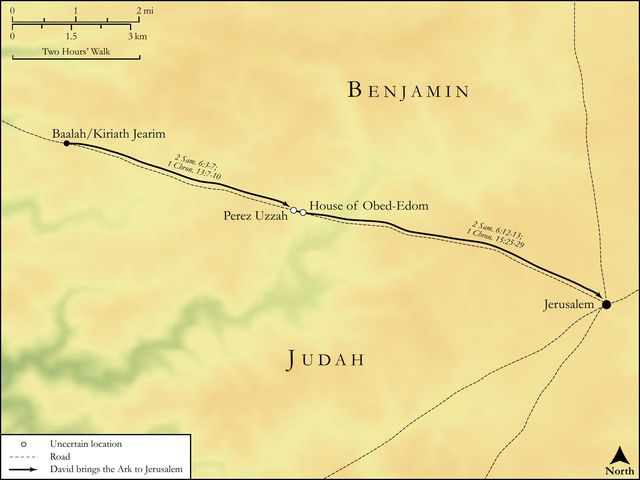
See on the biblical-era map
Study this verse
Public-domain commentary
Matthew Henry
From his Commentary on the Whole Bible. Henry comments on passages, not single verses — this entry covers 1 Chronicles 13:1–8. His three-level outline is real structure in the source text, so it is rendered as structure.
Here is, I. David's pious proposal to bring up the ark of God to Jerusalem, that the royal city might be the holy city, Ch1 13:1-3. This part of the story we had not in Samuel. We may observe in this proposal,
1.That as soon as David was well seated on his throne he had thoughts concerning the ark of God: Let us bring the ark to us, Ch1 13:3. Two things he aimed at herein: - (1.) To do honour to God, by showing respect to his ark, the token of his presence. As soon as he had power in his hand he would use it for the advancement and encouragement of religion. Note, It ought to be the first and great care of those that are enriched and preferred to honour God with their honours, and to serve him, and the interests of his kingdom among men, with their wealth and power. David said not, "What pompous thing shall I do now?" or, "What pleasant thing?" but, "What pious thing?" (2.) To have the comfort and benefit of that sacred oracle. "Let us bring it to us, not only that we may be a credit to it, but that it may be a blessing to us." Those that honour God profit themselves. Note, It is the wisdom of those who are setting out in the world to take God's ark with them, to make his oracles their counsellors and his laws their rule. Those are likely to proceed in the favour of God who thus begin in the fear of God.
2.That he consulted with the leaders of the people about it, Ch1 13:1. Though it was without doubt a very good work, and being king, he had the authority to command the doing of it, yet he chose rather to do it by consultation, (1.) That he might show respect to the great men of the kingdom and put honour upon them. Though they made him king, yet he would not rule with a high hand. He did not say, "We will and command, and it is our royal pleasure, that you do so and so; and we will be obeyed," but, "If it seem good to you, and you think that the motion comes from the Lord our God, let us send out orders for this purpose." No prince that is wise will covet to be absolute. The people's allegiance is best secured by taking their concurrence in their representatives. Happy then art thou, O Britain! (2.). That he might be advised by them in the manner of doing it, whether just now, whether publicly. David was a very intelligent man himself, and yet consulted with his captains; for in the multitude of counsellors there is safety. It is wisdom to make use of the wisdom of others. (3.) That, they joining in it, it might pass the better for a national act and so might procure a national blessing.
3.That he would have all the people summoned to attend on this occasion, both for the honour of the ark and for the people's satisfaction and edification, Ch1 13:2. Observe,
(1.)He calls the common people brethren, which bespeaks his humility and condescension (notwithstanding his advancement), and the tender concern he had for them. Thus our Lord Jesus is not ashamed to call his people brethren, Heb 2:11.
(2.)He speaks of the people as a remnant that had escaped: Our brethren that are left in all the land of Israel. They had been under scattering providences. Their wars with the Philistines, and with the house of Saul, had wasted the country and cut off many. We now hope to see an end of these troubles. Let those that are left be quickened by late judgments, and present mercies, to seek unto God.
(3.)He takes care that the priests and Levites especially should be summoned to attend the ark; for it was their province in a particular manner. Thus Christian magistrates should stir up ministers to do their duty when they see them remiss.
4.That all this is upon supposition that it is of the Lord their God. "Though it should seem good to you and me, yet if it be not of the Lord our God, we will not do it." What ever we undertake, this must be our enquiry, "Is it of the Lord? Is it agreeable to his mind? Can we approve ourselves to him in it? May we expect that he will own us?"
5.That thus it was requisite they should amend what has been amiss in the last reign, and, as it were, atone for their neglect: "For we enquired not at it in the days of Saul, and this was the reason why things went so ill with us: let that original error be amended, and then we may hope to see our affairs in a better posture." Observe, David makes no peevish reflections upon Saul. He does not say, "Saul never cared for the ark, at least in the latter end of this reign;" but, in general, We enquired not at it, making himself with others guilty of this neglect. It better becomes us to judge ourselves than others. Humble good men lament their own share in national guilt, and take shame to themselves, Dan 9:5, etc.
II.The people's ready agreement to this proposal (Ch1 13:4):
The thing was right in the eyes of all the people. Nobody could say to the contrary, but that it was a very good work and very seasonable; so that it was resolved, nemine contradicente - unanimously, that they would do so. Those that prudently proposed a good work, and lead in it, will perhaps find a more ready concurrence in it than they expected. Great men know not what a great deal of good they are capable of doing by their influence on others.
III.The solemnity of bringing up the ark, Ch1 13:5, etc., which we read before, Sa2 6:1, etc. Here therefore we shall only observe,
1.That it is worth while to travel far to attend the ark of God. They came out of all parts of the country, from the river of Egypt, the utmost part south, to the entering of Hemath, which lay furthest north, (Ch1 13:5), to grace this solemnity.
2.That we have reason greatly to rejoice in the revival of neglected ordinances and the return of the tokens of God's presence. When the light of religion shines out of obscurity, when it is openly and freely professed, is brought into reputation, and countenanced by princes and great ones, it is such a happy omen to a people as is worthy to be welcomed with all possible expressions of joy.
3.When, after long disuse, ordinances come to be revived, it is too common for even wise and good men to make some mistakes. Who would have thought that David would commit such an error as this, to carry the ark upon a cart? Ch1 13:7. because the Philistines so carried it, and a special providence drove the cart (Sa1 6:12), he thought they might do so too. But we must walk by rule, not by example when it varies from the rule, no, not even by those examples which Providence has owned.
Continue studying 1 Chronicles 13:2 across the web’s major study libraries — every link below opens this exact verse, chapter, or book on the destination site.
Read & Compare
 BibleGatewayThis verse in more than 200 translations and 70 languages.
 Bible.comThe YouVersion reader — hundreds of translations, reading plans, and highlights.
 ESV.orgCrossway's official English Standard Version reader.
 NET BibleThe NET translation with 60,000+ translators' notes on every rendering decision.
 STEP BibleTyndale House's free study tool — original text, vocabulary, and scholarly resources.
 BibliaLogos Bible Software's free web reader.
 USCCBThe New American Bible (Revised Edition) with the U.S. bishops' study notes.
Commentaries
 BibleHub CommentariesDozens of classic commentaries on this verse, gathered on one page.
 StudyLightMore than 100 commentary sets — the largest collection on the web.
 BibleRefPlain-English commentary on what this verse means, verse by verse.
 Enduring WordDavid Guzik's free commentary on this chapter, widely used by Bible teachers.
 Bible Study ToolsVerse commentary alongside Greek and Hebrew study aids.
Original Language & Research
- BibleHub InterlinearThe verse word by word — original language, transliteration, and English.
- BibleHub LexiconEvery word's original-language definition and Strong's entry.
 Blue Letter BibleDeep-study tools — Strong's numbers, concordance, and word studies.
 SefariaThe Hebrew text with Rashi and centuries of Jewish commentary.
Sermons, Hymns & Audio


TrulyRandomVerse is not affiliated with these sites and doesn’t control their content. They’re linked because they’re genuinely useful.
Summary
1 Chronicles 13:2 records King David's pivotal proposal to the entire congregation of Israel, outlining his intention to bring the Ark of God back to Jerusalem. This verse reveals David's dual commitment to both national consensus and divine approval, emphasizing that such a significant undertaking, designed to restore God's central presence among His people, must align with the will of the Lord and involve the unified participation of all Israel, including the indispensable priests and Levites.
Context
ShowHideLiterary Context
This verse immediately follows David's successful establishment as king over all Israel and his capture of Jerusalem, which he renamed the City of David (1 Chronicles 11-1 Chronicles 12). Having consolidated his political power and secured a central capital, David's next major initiative, as recorded here, shifts from military and administrative concerns to spiritual ones. The narrative flow demonstrates David's understanding that true national stability and blessing depended not just on human leadership but on the manifest presence of God. This account in 1 Chronicles 13 serves as the Chronicler's primary focus on David's attempt to retrieve the Ark, paralleling the narrative found in 2 Samuel 6:1-2. The Chronicler, writing for a post-exilic audience, emphasizes the importance of proper worship and adherence to God's commands, setting the stage for the subsequent narrative of the Ark's journey and David's desire to build a temple.
Historical & Cultural Context
The Ark of the Covenant, symbolizing God's presence, throne, and covenant with Israel, had been largely neglected and out of its proper place for approximately 70 years, residing in Kirjath-jearim (1 Samuel 7:2) since its capture by the Philistines and subsequent return. During this period, Israel's worship was decentralized, and the Ark's absence from a central sanctuary reflected a spiritual malaise. David's initiative to bring the Ark to Jerusalem was a profound act of spiritual restoration, aiming to re-establish the spiritual heart of the nation and centralize worship. Culturally, the Ark was not merely a religious artifact but the very emblem of Israel's unique relationship with Yahweh, their covenant God. Its proper handling and placement were governed by Mosaic Law, specifically concerning the role of the priests and Levites, underscoring the necessity of their involvement as stipulated in the verse.
Key Themes
ShowHide1 Chronicles 13:2 introduces several foundational themes that resonate throughout the book of Chronicles and the broader biblical narrative. Firstly, the theme of Divine Approval and Sovereignty is paramount, as David explicitly states, "If... it be of the LORD our God." This highlights the necessity of seeking God's will in all major undertakings, a principle echoed in Proverbs 3:6. Secondly, National Unity and Consensus are emphasized by David's address to "all the congregation of Israel" and his invitation for their agreement, fostering collective ownership of this sacred task. Thirdly, the theme of Proper Worship and Reverence for God's Presence is central, as the entire endeavor revolves around restoring the Ark, the symbol of God's dwelling among His people, to its rightful place. This also implicitly touches upon the theme of Adherence to God's Law, particularly concerning the specific roles of the priests and Levites in handling sacred objects, which becomes critically important later in the chapter.
Exposition and Analysis
ShowHideKey Word Analysis
ShowHideThis term refers to a formally summoned assembly or community, often with a religious or national purpose. David's address to the "congregation of Israel" signifies that this was not a private decision or a command issued to a select few, but a proposal put before the entire body of the nation, emphasizing the communal and covenantal nature of the undertaking. It underscores the idea of a unified people responding to a divine call.
This is God's personal, covenant name, "Jehovah" or "Yahweh," emphasizing His self-existent and eternal nature, and His unique, intimate relationship with Israel. David's insistence that the plan be "of the LORD our God" demonstrates his understanding that any national endeavor, especially one concerning the Ark, must originate from and be sanctioned by divine will, not merely human desire or political expediency. This sets a crucial theological precedent for all subsequent actions.
This word signifies something that is pleasing, agreeable, or morally right. When David states, "If it seem good unto you," he is seeking the consensus and approval of the people. This highlights his desire for a unified national will, demonstrating a leadership style that values the people's agreement alongside, and subordinate to, divine approval.
Verse Breakdown
ShowHide"And David said unto all the congregation of Israel"
This opening clause establishes David's leadership and his commitment to involving the entire nation in this significant spiritual initiative. It highlights a consultative approach, seeking national consensus rather than simply issuing a royal decree.
"If [it seem] good unto you, and [that it be] of the LORD our God"
This is the core condition of David's proposal. It presents a dual requirement: human agreement ("good unto you") coupled with divine sanction ("of the LORD our God"). This demonstrates David's wisdom in seeking both popular support and, more importantly, God's explicit approval, prioritizing the divine will above all else.
"let us send abroad unto our brethren every where, [that are] left in all the land of Israel, and with them [also] to the priests and Levites [which are] in their cities [and] suburbs"
This outlines the comprehensive scope of the invitation. "Our brethren every where" signifies a desire for full national participation, encompassing all tribes. The specific inclusion of "priests and Levites" underscores their unique and indispensable role in handling the sacred Ark, indicating David's initial intention to adhere to the Mosaic Law regarding the Ark's transport.
"that they may gather themselves unto us"
The ultimate purpose of this broad invitation is to convene a national assembly. The goal is a unified gathering of the people, led by their king and spiritual authorities, to collectively undertake the sacred task of bringing the Ark back to its rightful place, symbolizing a national spiritual revival and centralization of worship.
Literary Devices
ShowHide1 Chronicles 13:2 employs several key literary devices. Consensus-building is evident in David's direct address to "all the congregation of Israel" and his framing of the initiative as a proposal ("If it seem good unto you"), indicating a desire for national unity and shared ownership rather than autocratic command. This approach contrasts with typical royal decrees and highlights David's pastoral heart. Theological Framing is paramount through the phrase "and that it be of the LORD our God," which immediately places the entire undertaking under divine authority and scrutiny, establishing a critical theological lens through which the subsequent events should be understood. The verse also exhibits Universal Reach, as David explicitly calls for all "brethren" throughout the land and specifically mentions the "priests and Levites," emphasizing that this was a national, unified effort involving both civil and religious leadership. Finally, the verse serves as an element of Foreshadowing, subtly hinting at the importance of proper procedure and divine will, which becomes tragically significant when Uzzah dies in the subsequent verses due to a deviation from God's prescribed method for transporting the Ark.
Theological and Thematic Connections
ShowHide1 Chronicles 13:2 stands as a testament to the profound importance of God's presence in the life of His people and the necessity of seeking His will in all endeavors, particularly those of national or spiritual significance. David's proposal demonstrates a leadership model that balances human consultation with divine authority, recognizing that true success and blessing flow from alignment with God's purposes. The initiative to bring the Ark back to Jerusalem was not merely a political move to centralize power but a deeply theological act to restore the visible symbol of God's covenant presence among His people. This act underscores the biblical theme that God desires to dwell with His people, and that proper reverence and obedience are required in approaching His holiness. The tragic events that follow this verse (Uzzah's death) further emphasize that even good intentions must be accompanied by strict adherence to God's revealed commands regarding sacred things.
Reflection and Application
ShowHideDavid's approach in 1 Chronicles 13:2 offers profound lessons for contemporary leadership, community engagement, and personal spiritual disciplines. His desire to involve "all the congregation of Israel" and, crucially, to ensure the endeavor was "of the LORD our God," models a balanced and godly leadership style. It teaches us that significant undertakings, whether in the church, family, or workplace, benefit immensely from both collaborative input and, more importantly, a deep discernment of God's will. We are called to seek God's direction through prayer, Scripture, and wise counsel, ensuring that our plans align with His purposes rather than merely our own ambitions or human consensus. Furthermore, David's zeal to restore God's presence reminds us of the priority believers should place on cultivating a vibrant relationship with God, both individually and corporately, recognizing that His presence is the ultimate source of life, guidance, and blessing. This verse challenges us to consider if our collective and individual pursuits are truly "of the Lord our God" and if we are inviting His full participation and guidance.
Questions for Reflection
ShowHideFAQ
ShowHideWhy did David consult the entire congregation of Israel and emphasize divine approval?
ShowHideDavid's decision to consult the entire congregation of Israel reflects wise leadership that takes counsel. While he was king, he understood that a national spiritual undertaking of this magnitude required the unity and buy-in of the people. It fostered a sense of shared ownership and responsibility. More profoundly, his emphasis on "if it be of the LORD our God" reveals his deep theological conviction that any significant endeavor, especially one concerning the sacred Ark, must originate from and be sanctioned by God's will. This was not merely a democratic gesture but a spiritual imperative, acknowledging God's ultimate sovereignty over Israel. David recognized that human effort, however well-intentioned, would be futile or even disastrous without divine blessing and direction, a lesson tragically underscored later in the chapter.
What was the significance of the Ark of God, and why was its return so important?
ShowHideThe Ark of God, or Ark of the Covenant, was the most sacred object in ancient Israel. It symbolized several critical aspects of God's relationship with His people:
Its return was crucial because it signified a spiritual renewal and the re-establishment of God's central presence in the nation. For 70 years, the Ark had been neglected and out of place (1 Samuel 7:2), reflecting a period of spiritual decline. David's initiative was a strategic move to restore proper worship, centralize the spiritual life of the nation in Jerusalem, and bring Israel back into a right relationship with their covenant God.
Christ-Centered Fulfillment
ShowHide1 Chronicles 13:2, with its focus on bringing God's presence (symbolized by the Ark) back to the center of national life, powerfully foreshadows the ultimate and perfect dwelling of God among His people in Jesus Christ. David's earnest desire for the Ark to be "of the LORD our God" and his meticulous planning, though initially flawed in execution, point to the profound truth that God's presence cannot be approached on human terms alone. This yearning for God's manifest dwelling finds its complete fulfillment in the incarnation of Jesus, who is Immanuel, "God with us". Just as the Ark was the physical representation of God's covenant, Jesus is the living embodiment of God's new covenant, the very Word made flesh who dwelt among us. The national gathering to bring the Ark, meant to unify Israel around God's presence, prefigures the new spiritual assembly, the Church, which is unified by the indwelling Holy Spirit and gathered around Christ, our true Ark of the New Covenant. Through Christ, we have direct access to God's presence, not through a physical object, but through the new and living way opened by His sacrifice, fulfilling David's longing for God's dwelling in a way far beyond any earthly tabernacle or temple.