


1 Samuel 31:1
Bible text: King James Version (1769 Blayney text) · Public domain
Bible text: Berean Standard Bible · Public domain
Bible text: American Standard Version (1901) · Public domain
Bible text: World English Bible, Messianic edition · Public domain
Bible text: Geneva Bible (1599) · Public domain
Bible text: Young's Literal Translation · Public domain
- וּפְלִשְׁתִּיםu·fe·lish·Timand [the] PhilistinesH6430Conj-w ¦ N-mpNoun Gentilic Plural Masculine Absoluteוּandפְלִשְׁתִּים[the] Philistines
- נִלְחָמִיםnil·cha·Mim[were] fightingH3898V-Niphal-Prtcpl-mpVerb Niphal Participle Plural Masculine Absolute
- בְּיִשְׂרָאֵלbe·Yis·ra·'Elagainst IsraelH3478Prep-b ¦ N-properNoun Proper LocationבְּagainstיִשְׂרָאֵלIsrael
- וַיָּנֻסוּvai·ya·Nu·suand they fledH5127Conj-w ¦ V-Qal-ConsecImperf-3mpVerb Qal Consecutive Imperfect 3rd Plural Masculineוַandיָּנֻסוּthey fled
- אַנְשֵׁי'an·Shei[the] men ofH582N-mpcNoun Plural Masculine Construct
- יִשְׂרָאֵלYis·ra·'ElIsraelH3478N-properNoun Proper Location
- מִפְּנֵיmi·pe·Neifrom beforeH6440Prep-m ¦ N-mpcNoun Plural Masculine Constructמִfromפְּנֵיbefore
- פְלִשְׁתִּיםfe·lish·Tim[the] PhilistinesH6430N-mpNoun Gentilic Plural Masculine Absolute
- וַיִּפְּלוּvai·yi·pe·Luand they fellH5307Conj-w ¦ V-Qal-ConsecImperf-3mpVerb Qal Consecutive Imperfect 3rd Plural Masculineוַandיִּפְּלוּthey fell
- חֲלָלִיםcha·la·LimslainH2491Adj-mpAdjective Plural Masculine Absolute
- בְּהַרbe·Haron [the] mountain ofH2022Prep-b ¦ N-mscNoun Singular Masculine Constructבְּonהַר[the] mountain of
- הַגִּלְבֹּעַha·gil·Bo·a'<the> GilboaH1533Art ¦ N-properNoun Proper Locationהַ<the>גִּלְבֹּעַGilboa
English is a literal word-by-word gloss of the Hebrew, not the KJV's wording. Why?
This is the original text the KJV's translators worked from — each Hebrew word with its own literal English meaning in this verse, prepared by scholars at Tyndale House, Cambridge. The KJV translates whole sentences, not word by word, so its wording differs: one Hebrew word can become several English words, and the KJV may choose “the LORD” where the gloss reads “Yahweh”. Both are faithful — they answer different questions. For the KJV's own rendering, switch to the KJV text.
Details
See on the biblical-era map
Study this verse
Public-domain commentary
Matthew Henry
From his Commentary on the Whole Bible. Henry comments on passages, not single verses — this entry covers 1 Samuel 31:1–7. His two-level outline is real structure in the source text, so it is rendered as structure.
The day of recompence has now come, in which Saul must account for the blood of the Amalekites which he had sinfully spared, and that of the priests which he had more sinfully spilt; that of David too, which he would have spilt, must come into the account. Now his day has come to fall, as David foresaw, when he should descend into battle and perish, Sa1 26:10. Come and see the righteous judgments of God.
I.He sees his soldiers fall about him, Sa1 31:1.
Whether the Philistines were more numerous, better posted, and better led on, or what other advantages they had, we are not told; but it seems they were more vigorous, for they made the onset; they fought against Israel, and the Israelites fled and fell. The best of the troops were put into disorder, and multitudes slain, probably those whom Saul had employed in pursuing David. Thus those who had followed him and served him in his sin went before him in his fall and shared with him in his plagues.
II.He sees his sons fall before him.
The victorious Philistines pressed most forcibly upon the king of Israel and those about him. His three sons were next him, it is probable, and they were all three slain before his face, to his great grief (for they were the hopes of his family) and to his great terror, for they were now the guard of his person, and he could conclude no other than that his own turn would come next. His sons are named (Sa1 31:2), and it grieves us to find Jonathan among them: that wise, valiant, good man, who was as much David's friend as Saul was his enemy, yet falls with the rest. Duty to his father would not permit him to stay at home, or to retire when the armies engaged; and Providence so orders it that he falls in the common fate of his family, though he never involved himself in the guilt of it; so that the observation of Eliphaz does not hold (Job 4:7), Who ever perished being innocent? For here was one. What shall we say to it?
1.God would hereby complete the vexation of Saul in his dying moments, and the judgment that was to be executed upon his house. If the family must fall, Jonathan, that is one of it, must fall with it.
2.He would hereby make David's way to the crown the more clear and open. For, though Jonathan himself would have cheerfully resigned all his title and interest to him (we have no reason to suspect any other), yet it is very probable that many of the people would have made use of his name for the support of the house of Saul, or at least would have come in but slowly to David. If Ishbosheth (who was now left at home as one unfit for action, and so escaped) had so many friends, what would Jonathan have had, who had been the darling of the people and had never forfeited their favour? Those that were so anxious to have a king like the nations would be zealous for the right line, especially if that threw the crown upon such a head as Jonathan's. This would have embarrassed David; and, if Jonathan could have prevailed to bring in all his interest to David, then it would have been said that Jonathan had made him king, whereas God was to have all the glory. This is the Lord's doing. So that though the death of Jonathan would be a great affliction to David, yet, by making him mindful of his own frailty, as well as by facilitating his accession to the throne, it would be an advantage to him.
3.God would hereby show us that the difference between good and bad is to be made in the other world, not in this. All things come alike to all. We cannot judge of the spiritual or eternal state of any by the manner of their death; for in that there is one event to the righteous and to the wicked.
III.He himself is sorely wounded by the Philistines and then slain by his own hand.
The archers hit him (Sa1 31:3), so that he could neither fight nor fly, and therefore must inevitably fall into their hands. Thus, to make him the more miserable, destruction comes gradually upon him, and he dies so as to feel himself die. To such an extremity was he now reduced that,
1.He was desirous to die by the hand of his own servant rather than by the hand of the Philistines, lest they should abuse him as they had abused Samson. Miserable man! He finds himself dying, and all his care is to keep his body out of the hands of the Philistines, instead of being solicitous to resign his soul into the hands of God who gave it, Ecc 12:7. As he lived, so he died, proud and jealous, and a terror to himself and all about him. Those who rightly understand the matter think it of small account, in comparison, how it is with them in death, so it may but be well with them after death. Those are in a deplorable condition indeed who, being bitter in soul, long for death, but it cometh not (Job 3:20, Job 3:21), especially those who, despairing of the mercy of god, like Judas, leap into a hell before them, to escape a hell within them.
2.When he could not obtain that favour he became his own executioner, thinking hereby to avoid shame, but running upon a heinous sin, and with it entailing upon his own name a mark of perpetual infamy, as felo de se - a self-murderer. Jonathan, who received his death-wound from the hand of the Philistines and bravely yielded to the fate of war, died on the bed of honour; but Saul died as a fool dieth, as a coward dieth - a proud fool, a sneaking coward; he died as a man that had neither the fear of God nor hope in God, neither the reason of a man nor the religion of an Israelite, much less the dignity of a prince or the resolution of a soldier. Let us all pray, Lord, lead us not into temptation, this temptation. His armour-bearer would not run him through, and he did well to refuse it; for no man's servant ought to be a slave to his master's lusts or passions of any kind. The reason given is that he was sorely afraid, not of death, for he himself ran wilfully upon that immediately; but, having a profound reverence for the king his master, he could not conquer that so far as to do him any hurt; or perhaps he feared lest his trembling hand should give him but half a blow, and so put him to the greater misery.
IV.His armour-bearer who refused to kill him refused not to die with him, but fell likewise upon his sword, Sa1 31:5.
This was an aggravating circumstance of the death of Saul, that, by the example of his wickedness in murdering himself, he drew in his servant to be guilty of the same wickedness, and perished not alone in his iniquity. The Jews say that Saul's armour-bearer was Doeg, whom he preferred to that dignity for killing the priests, and, if so, justly does his violent dealing return on his own head. David had foretold concerning him that God would destroy him for ever, Psa 52:5.
V.The country was put into such confusion by the rout of Saul's army that the inhabitants of the neighbouring cities (on that side Jordan, as it might be read) quitted them, and the Philistines, for a time, had possession of them, till things were settled in Israel (Sa1 31:7), to such a sad pass had Saul by his wickedness brought his country, which might have remained in the hands of the uncircumcised if David had not been raised up to repair the breaches of it. See what a king he proved for whom they rejected God and Samuel. They had still done wickedly (it is to be feared) as well as he, and therefore were consumed both they and their king, as the prophet had foretold concerning them, Sa1 12:25. And to this reference is had long after. Hos 13:10, Hos 13:11, "Where are thy saviours in all thy cities, of whom thou saidst, Give me a king and princes? I gave thee a king in my anger, and took him away in my wrath; that is, he was a plague to thee living and dying; thou couldst expect no other."
Historical interpretation
Historical reception
1 surviving comment on this verse from the historical church.
And the men of Israel fled before the face of the Philistines, etc. They who seemed strong in contemplating the will of God, which the name Israel signifies, were deceived when they imprudently followed the works and teachings of the Gentiles, and they perished corrupted in the luxurious pride, which the name of Mount Gilboa, meaning slippery, signifies. But the downfall of heretics was also helped greatly by secular wisdom. Hence, one of our own beautifully said, Philosophers, the patriarchs of heretics, stained the purity of the Church with perverse doctrine.
Continue studying 1 Samuel 31:1 across the web’s major study libraries — every link below opens this exact verse, chapter, or book on the destination site.
Read & Compare
 BibleGatewayThis verse in more than 200 translations and 70 languages.
 Bible.comThe YouVersion reader — hundreds of translations, reading plans, and highlights.
 ESV.orgCrossway's official English Standard Version reader.
 NET BibleThe NET translation with 60,000+ translators' notes on every rendering decision.
 STEP BibleTyndale House's free study tool — original text, vocabulary, and scholarly resources.
 BibliaLogos Bible Software's free web reader.
 USCCBThe New American Bible (Revised Edition) with the U.S. bishops' study notes.
Commentaries
 BibleHub CommentariesDozens of classic commentaries on this verse, gathered on one page.
 StudyLightMore than 100 commentary sets — the largest collection on the web.
 BibleRefPlain-English commentary on what this verse means, verse by verse.
 Enduring WordDavid Guzik's free commentary on this chapter, widely used by Bible teachers.
 Bible Study ToolsVerse commentary alongside Greek and Hebrew study aids.
Original Language & Research
- BibleHub InterlinearThe verse word by word — original language, transliteration, and English.
- BibleHub LexiconEvery word's original-language definition and Strong's entry.
 Blue Letter BibleDeep-study tools — Strong's numbers, concordance, and word studies.
 SefariaThe Hebrew text with Rashi and centuries of Jewish commentary.
Sermons, Hymns & Audio


TrulyRandomVerse is not affiliated with these sites and doesn’t control their content. They’re linked because they’re genuinely useful.
Summary
1 Samuel 31:1 inaugurates the tragic culmination of King Saul's reign, presenting a stark and devastating defeat for Israel at the hands of their long-standing adversaries, the Philistines. This verse vividly depicts the Israelite army's panicked flight and heavy casualties on Mount Gilboa, grimly setting the stage for the deaths of Saul and his sons. It marks a catastrophic turning point in Israelite history, signifying the end of Saul's disobedient monarchy and providentially paving the way for the ascendance of David, God's chosen king.
Context
ShowHideLiterary Context
This opening verse of 1 Samuel 31 immediately follows a period of profound narrative contrast, highlighting the divergent destinies of Israel's first king, Saul, and God's anointed successor, David. While Saul spirals into spiritual and political isolation, culminating in his desperate and forbidden consultation with the medium of Endor in 1 Samuel 28, David, despite living among the Philistines, is providentially protected and prepared for his future role. Just prior to this battle, David was remarkably dismissed from fighting alongside the Philistines against Israel in 1 Samuel 29, allowing him to return to Ziklag and achieve a decisive victory over the Amalekites in 1 Samuel 30. This stark juxtaposition underscores the divine favor resting on David versus the impending judgment on Saul, making 1 Samuel 31 the climactic and tragic conclusion of Saul's era and the definitive transition point in Israelite leadership.
Historical & Cultural Context
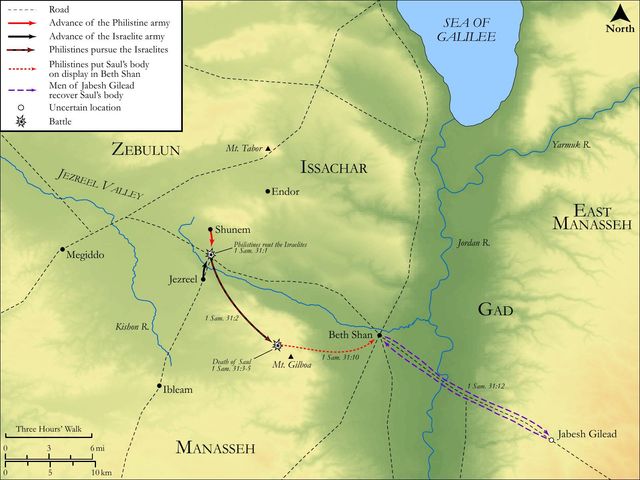
The battle described takes place on Mount Gilboa, a prominent ridge forming the southeastern boundary of the Jezreel Valley, a strategically crucial area controlling major trade routes and access to the Jordan Valley. The Philistines, a technologically advanced and militarily superior people, had long exerted significant influence over Israel, notably possessing a monopoly on iron weaponry that initially left Israel at a disadvantage (1 Samuel 13:19-22). This engagement was not a mere skirmish but a decisive confrontation aimed at solidifying Philistine control over Israelite territory. In the warfare of that day, a "rout" like the one depicted in this verse often resulted in heavy casualties during the pursuit of fleeing soldiers, who were highly vulnerable. For ancient Israel, military success was frequently interpreted as a sign of divine blessing and covenant faithfulness, whereas a devastating defeat like this would have been understood as a clear indication of God's judgment and the withdrawal of His protective hand from Saul's kingdom.
Key Themes
ShowHideThe events of 1 Samuel 31, particularly this opening verse, powerfully articulate several critical themes. First, it serves as a stark illustration of the consequences of disobedience, especially for those in leadership. Saul's repeated rejection of God's commands, notably his failure to fully obey in 1 Samuel 15:23, led to the departure of God's Spirit and the eventual unraveling of his kingdom, culminating in this military catastrophe. Second, the verse signifies the end of an era, marking the definitive close of Saul's monarchy and the inevitable transition to David's reign, which God had ordained much earlier in 1 Samuel 16. Third, it highlights the vulnerability of Israel when its leadership is not aligned with divine will; despite being God's chosen people, they were not immune to defeat when spiritual integrity was compromised. Finally, even amidst such tragedy, the verse subtly emphasizes divine sovereignty, as this devastating defeat ultimately served God's overarching plan to establish the Davidic dynasty, a promise that would find its initial fulfillment in 2 Samuel 5:4.
Exposition and Analysis
ShowHideKey Word Analysis
ShowHideThis verb signifies "to battle," often implying a destructive or consuming conflict. In this context, it emphasizes the aggressive and decisive nature of the Philistine engagement, portraying them not merely as participants but as the dominant force initiating a war intended to overpower and consume Israel. The choice of this word highlights the severity and finality of the confrontation.
This term denotes a panicked, disorderly flight or retreat, indicating a complete rout rather than an organized withdrawal. It suggests the Israelite army's morale collapsed, and they were overwhelmed by fear, abandoning their positions and running in terror. This word vividly conveys the utter disarray and lack of resistance that characterized Israel's response to the Philistine assault.
Derived from a root meaning "to pierce" or "to pollute," this word specifically refers to those who are mortally wounded or killed, often by piercing weapons. When used in conjunction with "fell down" (nâphal), it paints a grim picture of widespread death on the battlefield. It emphasizes that the fallen were not merely injured but definitively dead, highlighting the heavy casualties and the devastating, final outcome for the Israelite forces.
Verse Breakdown
ShowHide"Now the Philistines fought against Israel"
This opening clause immediately establishes the primary antagonists and protagonists, setting the scene for a direct and hostile confrontation. The Philistines are presented as the aggressors, initiating the battle that will prove catastrophic for Saul and his kingdom. The "Now" signals a continuation of the long-standing and often violent enmity between these two peoples, bringing their conflict to a decisive head.
"and the men of Israel fled from before the Philistines"
This clause describes the immediate and disastrous reaction of the Israelite army. Their "flight" indicates a complete breakdown of their battle lines, discipline, and courage. To "flee from before" someone implies an overwhelming force or a profound fear that compels retreat, signifying the Philistines' clear military superiority and Israel's utter inability to withstand their assault, leading to a disorganized rout.
"and fell down slain in mount Gilboa"
This final clause grimly reveals the tragic consequence of the flight. The phrase "fell down slain" vividly portrays the heavy casualties suffered by the Israelite forces as they were pursued and cut down by the Philistines. The specific mention of "Mount Gilboa" not only provides crucial geographical context for the battle but also becomes forever etched in Israel's collective memory as the somber site of this catastrophic defeat and the demise of their first king, adding a layer of poignant historical and theological significance.
Literary Devices
ShowHide1 Samuel 31:1 masterfully employs several literary devices to convey its profound impact and set the tone for the chapter. Foreshadowing is prominent, as the immediate description of Israel's rout and heavy casualties grimly anticipates the deaths of King Saul and his sons in the subsequent verses, establishing a pervasive sense of impending doom and tragedy. The verse also utilizes contrast, especially when read in light of the preceding chapter where David achieves a decisive victory against the Amalekites; this juxtaposition starkly highlights the divergent destinies of the two leaders and the profound consequences of divine favor versus disfavor. The narrative evokes powerful pathos through its stark depiction of the "men of Israel" fleeing and "fell down slain," eliciting a deep sense of tragedy, immense loss, and national sorrow for the Israelite people. Furthermore, the specific mention of "Mount Gilboa" serves as potent symbolism, transforming a geographical location into a poignant emblem of national defeat, divine judgment, and the definitive end of an era. The concise, declarative sentences contribute to a sense of grim inevitability and direct, unvarnished reporting of the catastrophe.
Theological and Thematic Connections
ShowHideThe devastating defeat of Israel on Mount Gilboa, as vividly described in 1 Samuel 31:1, serves as a stark theological commentary on the dire consequences of disobedience and the foundational principle that divine favor is conditional upon covenant faithfulness. Saul's repeated rejection of God's commands, particularly his failure to utterly destroy the Amalekites as commanded (1 Samuel 15), led to the withdrawal of God's Spirit and ultimately to this catastrophic military failure. This event underscores that God's people are not immune to judgment when they stray from His will, and that even a divinely appointed king can forfeit his anointing and protection. Yet, even in this profound defeat, God's sovereign plan for the establishment of the Davidic dynasty was being unfolded, demonstrating His ability to work through human failure and tragedy to achieve His ultimate, redemptive purposes.
Reflection and Application
ShowHideThe grim scene on Mount Gilboa in 1 Samuel 31:1 offers profound and enduring lessons for contemporary believers, both individually and communally. It serves as a powerful reminder that choices, especially those made by leaders, carry far-reaching consequences that extend beyond the individual to impact entire communities and generations. Saul's story stands as a cautionary tale about the insidious dangers of spiritual drift, self-reliance, and persistent disobedience to God's clear commands. When we, like Saul, prioritize our own will, succumb to the fear of man, or choose perceived expediency over faithful obedience to God, we open ourselves and those under our influence to vulnerability, spiritual defeat, and potential catastrophe. This narrative compels us to engage in deep introspection: are we truly relying on God's guidance and strength in all our endeavors, or are we operating primarily in our own wisdom and power? It underscores the critical importance of maintaining spiritual integrity, cultivating genuine humility, and fostering unwavering reliance on God's Word as the foundational pillars for all our pursuits, recognizing that true success, security, and flourishing ultimately flow from His divine favor, not merely from human strength or strategic prowess. Even in the face of overwhelming odds, our ultimate victory is found in faithful alignment with God's purposes and His unfailing character.
Questions for Reflection
ShowHideFAQ
ShowHideWhat was the significance of the Philistine victory described in 1 Samuel 31:1?
ShowHideThe Philistine victory at Mount Gilboa was profoundly significant for several reasons. Militarily, it represented a major triumph for the Philistines, solidifying their dominance over Israelite territory and demonstrating their superior military organization and weaponry. Politically, it marked the catastrophic end of King Saul's reign and the first unified monarchy of Israel. The defeat, and the subsequent deaths of Saul and his sons, created a power vacuum and plunged Israel into a period of mourning and instability. Theologically, it was understood as a direct consequence of Saul's repeated disobedience and rejection of God's commands, signaling God's withdrawal of favor from him and his house. This pivotal battle paved the way for the ascension of David, God's chosen king, to the throne, as chronicled in 2 Samuel 1 and 2 Samuel 2.
What was Saul's state of mind leading up to this final battle?
ShowHideLeading up to the battle on Mount Gilboa, Saul was in a state of profound despair, fear, and spiritual desolation. He had been abandoned by God's Spirit (1 Samuel 16:14), tormented by an evil spirit, and had lost the counsel of the prophet Samuel (who had died in 1 Samuel 25:1). In his desperation, and after God refused to answer him through traditional means, Saul resorted to consulting a medium at Endor (1 Samuel 28:7-25), a practice strictly forbidden by God. Through the medium, the spirit of Samuel confirmed that God had turned away from Saul and would deliver Israel and Saul himself into the hands of the Philistines. This prophecy left Saul utterly terrified and physically weakened, setting the stage for his final, doomed confrontation.
Where does David fit into the narrative of the battle on Mount Gilboa?
ShowHideDavid's position relative to the battle on Mount Gilboa is a remarkable example of divine providence. At the very time Saul was preparing for his final, tragic battle against the Philistines, David was providentially prevented from participating. He had been living among the Philistines and was expected to fight alongside them against Israel. However, the Philistine commanders, distrusting David's loyalty, insisted that he be sent away (1 Samuel 29). This allowed David to return to Ziklag, where he discovered it had been raided by the Amalekites. David pursued and decisively defeated the Amalekites, recovering all that was lost (1 Samuel 30). Thus, while Saul met his end in defeat, David was simultaneously experiencing a victory, positioning him to receive the news of Saul's death and eventually ascend to the throne, fulfilling God's plan for Israel's next king.
Christ-Centered Fulfillment
ShowHideThe tragic defeat of Israel on Mount Gilboa and the subsequent death of King Saul, as introduced in 1 Samuel 31:1, powerfully foreshadow the ultimate need for a perfect King and a definitive victory over the forces of sin and death. Saul's kingship, marked by disobedience and culminating in a catastrophic rout, highlights the inherent limitations and failures of human leadership. He was chosen to deliver Israel from its enemies, yet he himself falls to them, a poignant testament to the inability of any human king to secure lasting salvation or true peace. This brokenness points directly to Jesus Christ, the true and eternal King, who does not flee from His enemies but confronts them head-on. Unlike Saul, who was rejected for his disobedience, Christ perfectly obeyed His Father, even to the point of death on a cross (Philippians 2:8). His death, far from being a defeat like that on Gilboa, was the ultimate victory over sin, death, and the spiritual powers that held humanity captive (Colossians 2:15). The "slain" on Mount Gilboa represent the futility of human strength against spiritual forces and the wages of sin, whereas Christ, the Lamb of God who takes away the sin of the world, became the ultimate sacrifice, rising victorious to establish an eternal kingdom that will never be defeated (Luke 1:32-33). The failure of Saul's earthly kingdom thus magnifies the glory and necessity of Christ's heavenly, triumphant reign, demonstrating that true deliverance comes only through God's perfect King.