


1 Samuel 28:15
Bible text: King James Version (1769 Blayney text) · Public domain
Bible text: King James Version with Strong's numbers · Public domain
Bible text: Berean Standard Bible · Public domain
Bible text: American Standard Version (1901) · Public domain
Bible text: World English Bible, Messianic edition · Public domain
Bible text: Geneva Bible (1599) · Public domain
Bible text: Young's Literal Translation · Public domain
- וַיֹּאמֶרvai·Yo·merand he saidH559Conj-w ¦ V-Qal-ConsecImperf-3msVerb Qal Consecutive Imperfect 3rd Singular Masculineוַandיֹּאמֶרhe said
- שְׁמוּאֵלshe·mu·'ElSamuelH8050N-proper-mNoun Proper Masculine
- אֶל'eltoH413PrepPreposition
- שָׁאוּלsha·'UlSaulH7586N-proper-mNoun Proper Masculine
- לָמָּהLa·mah<to> why?H4100Prep-l ¦ InterrogPronoun Interrogativeלָ<to>מָּהwhy?
- הִרְגַּזְתַּנִיhir·gaz·Ta·nihave you disturbed meH7264V-Hiphil-Perf-2ms ¦ 1csVerb Hiphil Perfect 2nd Singular Masculineהִרְגַּזְתַּhave you disturbedנִיme
- לְהַעֲלוֹתle·ha·'a·Lotby bringing upH5927Prep-l ¦ V-Hiphil-InfVerb Hiphil Infinitive Constructלְbyהַעֲלוֹתbringing up
- אֹתִי'o·Ti<obj.> meH853DirObjM ¦ 1csParticle Object Indicatorאֹתִ<obj.>יme
- וַיֹּאמֶרvai·Yo·merand he saidH559Conj-w ¦ V-Qal-ConsecImperf-3msVerb Qal Consecutive Imperfect 3rd Singular Masculineוַandיֹּאמֶרhe said
- שָׁאוּלSha·'ulSaulH7586N-proper-mNoun Proper Masculine
- צַרtzarit is distressH6887V-Qal-Perf-3msVerb Qal Perfect 3rd Singular Masculine
- לִיlito <the> mePrep-l ¦ 1csSuffix Personal 1st Singular common genderלִto <the>יme
- מְאֹדme·'OdexceedinglyH3966Adj-msAdjective Numerical Singular Masculine Absolute
- וּפְלִשְׁתִּיםu·fe·lish·Timand [the] PhilistinesH6430Conj-w ¦ N-mpNoun Gentilic Plural Masculine Absoluteוּandפְלִשְׁתִּים[the] Philistines
- נִלְחָמִיםnil·cha·Mim[are] fightingH3898V-Niphal-Prtcpl-mpVerb Niphal Participle Plural Masculine Absolute
- בִּיBiagainst <the> mePrep-b ¦ 1csSuffix Personal 1st Singular common genderבִּagainst <the>יme
- וֵאלֹהִיםve·lo·Himand GodH430Conj-w ¦ N-mpNoun Plural Masculine AbsoluteוֵandאלֹהִיםGod
- סָרsarhe has turned asideH5493V-Qal-Perf-3msVerb Qal Perfect 3rd Singular Masculine
- מֵעָלַיme·'a·Laifrom with <the> meH5921Prep-m ¦ Prep ¦ 1csPreposition Definiteמֵfromעָלַwith <the>יme
- וְלֹאve·lo'and notH3808Conj-w ¦ NegParticle Negativeוְandלֹאnot
- עָנָנִי'a·Na·nihe has answered meH6030V-Qal-Perf-3ms ¦ 1csVerb Qal Perfect 3rd Singular Masculineעָנָhe has answeredנִיme
- עוֹדodyetH5750Adj-msAdjective Numerical Singular Masculine Absolute
- גַּםgamneitherH1571AdvAdverb
- בְּיַדbe·yadby [the] hand ofH3027Prep-b ¦ N-cscNoun Singular common gender Constructבְּbyיַד[the] hand of
- הַנְּבִיאִםha·ne·vi·'Im<the> prophetsH5030Art ¦ N-mpNoun Plural Masculine Absoluteהַ<the>נְּבִיאִםprophets
- גַּםgamnorH1571AdvAdverb
- בַּחֲלֹמוֹתba·cha·lo·Motby <the> dreamsH2472Prep-b ¦ N-fpNoun Plural Feminine Absoluteבַּby <the>חֲלֹמוֹתdreams
- וָאֶקְרָאֶהva·'ek·ra·'Ehand I have summoned !H7121Conj-w ¦ V-Qal-ConsecImperf-1cs ¦ SfxVerb Qal Consecutive Imperfect 1st Singular common genderוָandאֶקְרָאֶI have summonedה!
- לְךָle·Kha<to> <the> youPrep-l ¦ 2msSuffix Personal 2nd Singular Masculineלְ<to> <the>ךָyou
- לְהוֹדִיעֵנִיle·ho·di·'E·nito make known to meH3045Prep-l ¦ V-Hiphil-Inf ¦ 1csVerb Hiphil Infinitive Constructלְtoהוֹדִיעֵmake known toנִיme
- מָהmahwhat?H4100InterrogPronoun Interrogative
- אֶעֱשֶׂה'e·'e·Sehwill I doH6213V-Qal-Imperf-1csVerb Qal Imperfect 1st Singular common gender
English is a literal word-by-word gloss of the Hebrew, not the KJV's wording. Why?
This is the original text the KJV's translators worked from — each Hebrew word with its own literal English meaning in this verse, prepared by scholars at Tyndale House, Cambridge. The KJV translates whole sentences, not word by word, so its wording differs: one Hebrew word can become several English words, and the KJV may choose “the LORD” where the gloss reads “Yahweh”. Both are faithful — they answer different questions. For the KJV's own rendering, switch to the KJV text.
Details
See on the biblical-era map
Study this verse
Public-domain commentary
Matthew Henry
From his Commentary on the Whole Bible. Henry comments on passages, not single verses — this entry covers 1 Samuel 28:15–19.
We have here the conference between Saul and Satan. Saul came in disguise (Sa1 28:8), but Satan soon discovered him, Sa1 28:12. Satan comes in disguise, in the disguise of Samuel's mantle, and Saul cannot discover him. Such is the disadvantage we labour under, in wrestling with the rulers of the darkness of this world, that they know us, while we are ignorant of their wiles and devices.
I.The spectre, or apparition, personating Samuel, asks why he is sent for (Sa1 28:15):
Why hast thou disquieted me to bring me up? To us this discovers that it was an evil spirit that personated Samuel; for (as bishop Patrick observes) it is not in the power of witches to disturb the rest of good men and to bring them back into the world when they please; nor would the true Samuel have acknowledged such a power in magical arts: but to Saul this was a proper device of Satan's, to draw veneration from him, to possess him with an opinion of the power of divination, and so to rivet him in the devil's interests.
II.Saul makes his complaint to this counterfeit Samuel, mistaking him for the true; and a most doleful complaint it is:
"I am sorely distressed, and know not what to do, for the Philistines make war against me; yet I should do well enough with them if I had but the tokens of God's presence with me; but, alas! God has departed from me." He complained not of God's withdrawings till he fell into trouble, till the Philistines made war against him, and then he began to lament God's departure. He that in his prosperity enquired not after God in his adversity thought it hard that God answered him not, nor took any notice of his enquiries, either by dreams or prophets, neither gave answers immediately himself nor sent them by any of his messengers. He does not, like a penitent, own the righteousness of God in this; but, like a man enraged, flies out against God as unkind and flies off from him: Therefore I have called thee; as if Samuel, a servant of God, would favour those whom God frowned upon, or as if a dead prophet could do him more service than the living ones. One would think, from this, that he really desired to meet with the devil, and expected no other (though under the covert of Samuel's name), for he desires advice otherwise than from God, therefore from the devil, who is a rival with God. "God denies me, therefore I come to thee. Flectere si nequeo superos, Acheronta movebo." - If I fail with heaven, I will move hell.
III.It is cold comfort which this evil spirit in Samuel's mantle gives to Saul, and is manifestly intended to drive him to despair and self-murder. Had it been the true Samuel, when Saul desired to be told what he should do he would have told him to repent and make his peace with God, and recall David from his banishment, and would then have told him that he might hope in this way to find mercy with God; but, instead of that, he represents his case as helpless and hopeless, serving him as he did Judas, to whom he was first a tempter and then a tormentor, persuading him first to sell his master and then to hang himself. 1. He upbraids him with his present distress (Sa1 28:16), tells him, not only that God had departed from him, but that he had become his enemy, and therefore he must expect no comfortable answer from him: "Wherefore dost thou ask me? How can I be thy friend when God is thy enemy, or thy counsellor when he has left thee?" 2. He upbraids him with the anointing of David to the kingdom, Sa1 28:17. He could not have touched upon a string that sounded more unpleasant in the ear of Saul than this. Nothing is said to reconcile him to David, but all tends rather to exasperate him against David and widen the breach. Yet, to make him believe that he was Samuel, the apparition affirmed that it was God who spoke by him. The devil knows how to speak with an air of religion, and can teach false apostles to transform themselves into the apostles of Christ and imitate their language. Those who use spells and charms, and plead, in defence of them, that they find nothing in them but what is good, may remember what good words the devil here spoke, and yet with what a malicious design. 3. He upbraids him with his disobedience to the command of God in not destroying the Amalekites, Sa1 28:18. Satan had helped him to palliate and excuse that sin when Samuel was dealing with him to bring him to repentance, but now he aggravates it, to make him despair of God's mercy. See what those get that hearken to Satan's temptations. He himself will be their accuser, and insult over them. And see whom those resemble that allure others to that which is evil and reproach them for it when they have done. 4. He foretels his approaching ruin, Sa1 28:19. (1.) That his army should be routed by the Philistines. This is twice mentioned: The Lord shall deliver Israel into the hand of the Philistines. This he might foresee, by considering the superior strength and number of the Philistines, the weakness of the armies of Israel, Saul's terror, and especially God's departure from them. Yet, to personate a prophet, he very gravely ascribes it once and again to God: The Lord shall do it. (2.) That he and his sons should be slain in the battle: Tomorrow, that is, in a little time (and, supposing that it was now after midnight, I see not but it may be taken strictly for the very next day after that which had now begun), thou and thy sons shall be with me, that is, in the state of the dead, separate from the body. Had this been the true Samuel, he could not have foretold the event unless God had revealed it to him; and, though it were an evil spirit, God might by him foretel it; as we read of an evil spirit that foresaw Ahab's fall at Ramoth-Gilead and was instrumental in it (Kg1 22:20, etc.), as perhaps this evil spirit was, by the divine permission, in Saul's destruction. That evil spirit flattered Ahab, this frightened Saul, and both that they might fall; so miserable are those that are under the power of Satan; for, whether he rage or laugh, there is no rest, Pro 29:9.
Historical interpretation
Five Centuries of Reception
3 surviving comments on this verse. Each one is dated, so this reads as a timeline rather than a list.
Select a marker to jump to its quote. Markers stagger vertically where authors wrote within a few decades of each other.
If the prophets, the forerunners of Christ, all went down into hades before the Christ, so too Samuel has gone down there. For he does not merely go down, but he goes down as a holy man. Wherever the holy man may be, he is holy. Is Christ no longer Christ, since he was once in hades? Was he no longer Son of God, since he existed in an underworld place, “that every knee should bow in the name of Jesus Christ in heaven and on earth and under the earth”? So, Christ was Christ even when he was below; that is to say, while he was in the place below, he was above in purpose. So too, the prophets and Samuel, even if they go down below where the souls are, they are able to be in a place below, but they are not below in purpose.
But Samuel said to Saul: Why have you disturbed me? etc. And the books of the Old Testament, very full of the grace of prophecy, openly testify to readers that after the passion of the Lord they should not be raised again to the symbolic observance of the letter, but rather that the very ministers of prophecy are disturbed when they see what they wrote understood differently than they themselves sensed.
And Saul said: I am greatly distressed, etc. The Jews, abandoned by God, possess the gift of prophecy not by merit, attacked by all nations, follow, so to speak, a dead shadow of the law and the prophets under blind night. This, beset by miseries, they think should be consulted as to what should be done with them. Indeed, those same legal ceremonies, now celebrated in vain and in corners, signify that which was once shown publicly by the command and gracious acceptance of God, namely that the old things were to pass away, and all things were to be made new, that the kingdom of the Jews was to be utterly destroyed and the kingdom of Christians to be spread throughout the whole world, just as Samuel, though dead, but raised through impious art, revealed everything about the change of kingdom which he had foretold while alive. If anyone is indeed troubled by how a woman with demonic art could disturb and raise a prophet after death, let him know for certain either that the devil showed then a false shade to those seeking it, or if Samuel truly appeared, that the devil could only do as much as the Lord permitted. Nor is it surprising that such things are allowed to a malign spirit for certain secret reasons, since he set the Savior on the pinnacle of the temple, and asked for and received Job to tempt. But if we believe that it was rather the fantasy of an unclean spirit that appeared, this should not disturb as to how such a one could speak true and prophetic things. For we know that the devil often can foretell many future things which he has learned from holy angels, but thereby one ought to listen to his words the less, because all that he speaks or does among men, he does with the intention of deceiving. And what was said among other things:
Continue studying 1 Samuel 28:15 across the web’s major study libraries — every link below opens this exact verse, chapter, or book on the destination site.
Read & Compare
 BibleGatewayThis verse in more than 200 translations and 70 languages.
 Bible.comThe YouVersion reader — hundreds of translations, reading plans, and highlights.
 ESV.orgCrossway's official English Standard Version reader.
 NET BibleThe NET translation with 60,000+ translators' notes on every rendering decision.
 STEP BibleTyndale House's free study tool — original text, vocabulary, and scholarly resources.
 BibliaLogos Bible Software's free web reader.
 USCCBThe New American Bible (Revised Edition) with the U.S. bishops' study notes.
Commentaries
 BibleHub CommentariesDozens of classic commentaries on this verse, gathered on one page.
 StudyLightMore than 100 commentary sets — the largest collection on the web.
 BibleRefPlain-English commentary on what this verse means, verse by verse.
 Enduring WordDavid Guzik's free commentary on this chapter, widely used by Bible teachers.
 Bible Study ToolsVerse commentary alongside Greek and Hebrew study aids.
Original Language & Research
- BibleHub InterlinearThe verse word by word — original language, transliteration, and English.
- BibleHub LexiconEvery word's original-language definition and Strong's entry.
 Blue Letter BibleDeep-study tools — Strong's numbers, concordance, and word studies.
 SefariaThe Hebrew text with Rashi and centuries of Jewish commentary.
Sermons, Hymns & Audio


TrulyRandomVerse is not affiliated with these sites and doesn’t control their content. They’re linked because they’re genuinely useful.
Summary
1 Samuel 28:15 vividly portrays King Saul's profound desperation as he confronts the prophet Samuel, seemingly summoned from the dead through the forbidden practice of necromancy. In this climactic and tragic encounter, Saul articulates his utter spiritual abandonment, confessing that God has withdrawn His presence and no longer offers guidance through traditional means like prophets or dreams. This desperate act, driven by fear of the Philistines, underscores the devastating consequences of persistent disobedience and divine rejection, revealing a king at the precipice of his downfall, seeking illicit counsel in his dire straits.
Context
ShowHideLiterary Context
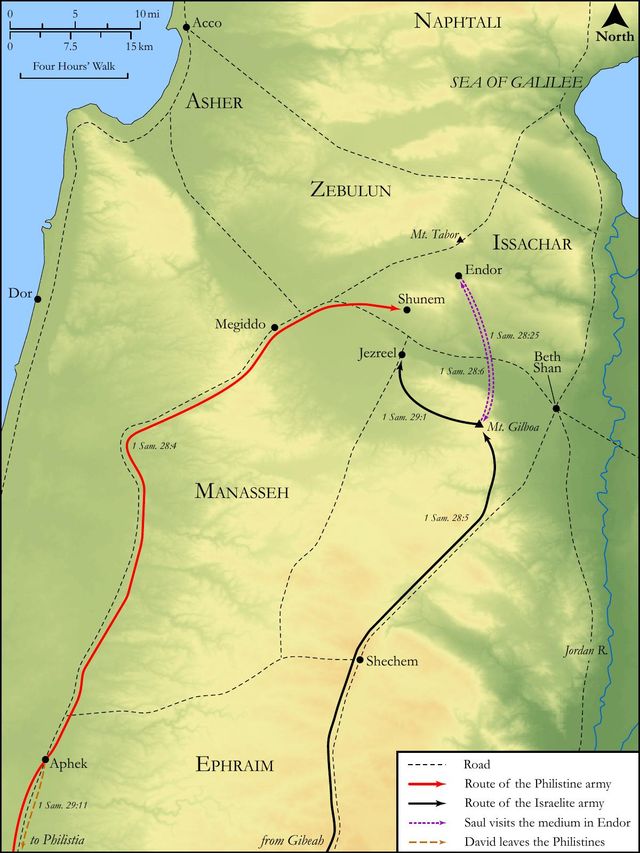
This verse forms the emotional and theological core of the highly dramatic and controversial account in 1 Samuel 28. Immediately preceding this encounter, Saul is facing an overwhelming Philistine army at Shunem, poised for a decisive battle at Gilboa. His attempts to seek legitimate divine guidance through dreams, the Urim (priestly oracle), and prophets have met with God's complete silence and withdrawal (1 Samuel 28:6). Driven by overwhelming fear and desperation, and despite having previously purged mediums and necromancers from the land (1 Samuel 28:3), Saul disguises himself and seeks out a medium at Endor. The appearance of Samuel, whether a true divine allowance or a demonic manifestation, serves as God's final, damning word to Saul, confirming his rejection and foretelling his imminent demise. This entire chapter tragically culminates Saul's spiritual decline, setting the stage for the rise of David, God's chosen king.
Historical & Cultural Context
The Philistines were a formidable and technologically superior adversary to Israel during the early monarchy, particularly due to their monopoly on iron weaponry. The battle at Gilboa represented a critical juncture for Israel's nascent kingdom, threatening its very existence. Culturally, the nations whom the LORD drove out before Israel were saturated with practices of necromancy, divination, and consulting spirits of the dead, often intertwined with pagan religious systems. However, the Mosaic Law explicitly and repeatedly condemned such practices as an abomination to Yahweh, strictly prohibiting any attempt to communicate with the dead or engage in divination (Deuteronomy 18:10-12). Saul's act of consulting the medium is therefore not merely a desperate measure but a direct and egregious violation of God's covenant, highlighting his complete spiritual bankruptcy and disregard for divine law in his moment of ultimate crisis.
Key Themes
ShowHideThe passage powerfully illustrates several key themes prevalent throughout the book of 1 Samuel. Foremost is the theme of Divine Sovereignty and Judgment, as God's withdrawal of communication from Saul is a direct consequence of his persistent disobedience, particularly his failure to fully obey God's command concerning the Amalekites (1 Samuel 15:9) and his presumptuous sacrifice (1 Samuel 13:13). This leads directly to Spiritual Abandonment and Desperation, where Saul, cut off from legitimate divine counsel, resorts to forbidden means, demonstrating the futility and danger of seeking guidance outside of God's revealed will. The theme of Consequences of Disobedience is starkly presented, showing that rebellion against God leads to isolation, fear, and ultimate downfall, as Samuel himself had previously declared that "rebellion is as the sin of witchcraft" (1 Samuel 15:23). Finally, the passage highlights the Danger of Forbidden Practices, emphasizing that even in extreme distress, turning to illicit spiritual sources only compounds one's problems and alienates one further from God.
Exposition and Analysis
ShowHideKey Word Analysis
ShowHideMeaning "to quiver (with any violent emotion, especially anger or fear); be afraid, stand in awe, disquiet, fall out, fret, move, provoke, quake, rage, shake, tremble, trouble, be wroth." Samuel's question, "Why hast thou disquieted me, to bring me up?" implies an unwelcome and profound disturbance of his peaceful rest in the realm of the dead. This highlights the unnatural and illicit nature of Saul's summoning, emphasizing the gravity of his transgression and the significant agitation caused by his desperate act.
Meaning "to cramp, literally or figuratively, transitive or intransitive; adversary, (be in) afflict(-ion), beseige, bind (up), (be in, bring) distress, enemy, narrower, oppress, pangs, shut up, be in a strait (trouble), vex." When Saul says "I am sore distressed" (using H3966 mᵉʼôd as an intensifier), he conveys a profound sense of being hemmed in, constricted, and overwhelmed by his circumstances. This speaks to his extreme anguish, psychological torment, and the feeling of being trapped with no legitimate way out, underscoring the depth of his internal and external crisis.
Meaning "to turn off (literal or figurative); be(-head), bring, call back, decline, depart, eschew, get (you), go (aside), [idiom] grievous, lay away (by), leave undone, be past, pluck away, put (away, down), rebel, remove (to and fro), revolt, [idiom] be sour, take (away, off), turn (aside, away, in), withdraw, be without." This word powerfully expresses Saul's perception of God's complete withdrawal of His presence, favor, and communication. It signifies a painful severing of the divine relationship, a direct consequence of Saul's persistent rebellion, leaving him feeling utterly isolated, without divine guidance or protection, and facing an existential void.
Verse Breakdown
ShowHide"And Samuel said to Saul, Why hast thou disquieted me, to bring me up?"
This opening statement from the resurrected Samuel immediately establishes the supernatural and disturbing nature of the encounter. Samuel's question is rhetorical, conveying his displeasure and the unnaturalness of being summoned from the dead. It underscores the gravity of Saul's action, which violates divine law and intrudes upon the peace of the deceased, highlighting the profound disturbance caused by his desperate and illicit act.
"And Saul answered, I am sore distressed"
Saul's immediate response reveals the depth of his anguish and desperation. The phrase "sore distressed" (intensified by "sore," meaning "very much" or "exceedingly") vividly portrays his immense psychological and spiritual agony, indicating he is at the end of his tether, overwhelmed by his circumstances and feeling utterly without hope or recourse. This is a cry from a man at his breaking point.
"for the Philistines make war against me"
This clause provides the immediate external pressure driving Saul's desperation. The Philistine threat is not merely a military challenge but an existential crisis for the kingdom, intensifying Saul's fear and sense of impending doom. It is the practical, immediate cause of his seeking extraordinary, and ultimately forbidden, counsel.
"and God is departed from me, and answereth me no more, neither by prophets, nor by dreams"
This is the core of Saul's confession and the spiritual crisis he faces. He explicitly acknowledges God's withdrawal of favor and communication. The mention of "prophets" (like Samuel himself, and later Gad or Nathan) and "dreams" (a common method of divine revelation, as seen in Numbers 12:6) highlights that all legitimate avenues of divine guidance have been closed to him, signifying God's judgment and abandonment due to his persistent disobedience. This is the ultimate spiritual void.
"therefore I have called thee, that thou mayest make known unto me what I shall do."
This final clause reveals the desperate and illicit purpose of Saul's summoning of Samuel. Having exhausted all legitimate means and feeling utterly abandoned by God, Saul resorts to the forbidden practice of necromancy, seeking counsel from the dead prophet. This underscores his spiritual bankruptcy and his willingness to transgress divine law in his ultimate moment of crisis, hoping for a solution where none seems available from God.
Literary Devices
ShowHideThe passage is rich in literary devices that amplify its dramatic and tragic impact. Irony is profoundly evident, as Saul, who once purged mediums and necromancers from the land (1 Samuel 28:3), now desperately seeks one out. This highlights his hypocrisy and the depth of his spiritual decline. The scene also employs Pathos, evoking a complex mix of pity and condemnation for Saul's profound distress and spiritual abandonment, even as his predicament is a direct result of his own choices. The dialogue itself functions as a form of Dramatic Monologue from Saul's perspective, where his confession reveals his inner turmoil and the complete severing of his relationship with God. Furthermore, the encounter serves as a powerful instance of Foreshadowing, as Samuel's subsequent prophecy (not in this verse, but immediately following in 1 Samuel 28:17-19) explicitly foretells Saul's death and the transfer of the kingdom to David, sealing Saul's tragic fate. The very appearance of Samuel, whether genuine or a divine allowance, functions as a Supernatural Intervention, underscoring the gravity of the moment and the finality of God's judgment on Saul.
Theological and Thematic Connections
ShowHide1 Samuel 28:15 stands as a profound theological statement on the devastating consequences of persistent disobedience and divine rejection. It powerfully illustrates that God's silence is not always an absence, but often a form of active judgment—a deliberate withdrawal of His presence, favor, and guidance from those who stubbornly rebel against His revealed will. Saul's desperate plea underscores the terrifying reality of being cut off from the source of all wisdom, life, and true counsel, leading to a spiritual void that illicit practices can never genuinely fill. This passage serves as a stark warning against spiritual presumption and the futility of seeking answers outside of God's prescribed ways, even in the direst circumstances. It emphasizes that true guidance, peace, and security come only from a right relationship with God, characterized by humble obedience and unwavering trust, not from forbidden shortcuts or desperate measures.
Reflection and Application
ShowHide1 Samuel 28:15 offers a sobering reflection on the human tendency to seek answers in forbidden places when legitimate avenues seem closed or God appears silent. Saul's desperation, while understandable from a purely human perspective, led him to a profound act of disobedience that only deepened his crisis and sealed his doom. For us, this passage serves as a powerful reminder that God's silence or apparent absence is often an invitation to deeper introspection, repentance, and a re-evaluation of our relationship with Him. When we feel distressed or cut off from divine guidance, the answer is never to resort to ungodly counsel, illicit practices, or shortcuts that violate God's clear commands. Instead, it is a call to humble ourselves, confess our sins, return to the foundational truths of Scripture, and seek God through prayer, diligent study of His Word, and wise counsel from godly community, trusting in His sovereignty and His perfect timing even when His ways are not immediately clear. Saul's tragic end, foreshadowed in this desperate plea, underscores the profound importance of cultivating and maintaining a consistent, obedient, and trusting relationship with God, even in the face of immense pressure and fear, for He is our only true source of hope and guidance.
Questions for Reflection
ShowHideFAQ
ShowHideWas the figure Samuel truly Samuel, or was it a demonic deception, or merely the medium's trickery?
ShowHideThe biblical text of 1 Samuel 28 strongly implies that it was indeed Samuel, supernaturally brought forth by God's allowance, rather than a mere trick by the medium or a demonic entity. The medium herself is terrified by the appearance, suggesting something beyond her control or expectation. Furthermore, the message delivered is accurate, prophetic, and consistent with Samuel's previous pronouncements to Saul, confirming God's judgment and Saul's impending death (1 Samuel 28:17-19). While God strictly forbids necromancy, He is sovereign and can override human actions to achieve His purposes, even using a forbidden act to deliver a final, undeniable word of judgment to a rebellious king.
Why did God not answer Saul through "prophets, nor by dreams" as Saul claimed?
ShowHideGod's silence was a direct and severe consequence of Saul's persistent disobedience and rebellion against His commands. Throughout his reign, Saul repeatedly defied God's explicit instructions, culminating in God's explicit rejection of him as king (1 Samuel 15:23). God's communication is not guaranteed to those who willfully and continually turn away from Him. His silence was a form of judgment, indicating that the covenant relationship had been severely broken from Saul's side. It was not that God couldn't answer, but that He wouldn't answer a king who had so thoroughly rejected His authority and Word, thereby demonstrating the profound gravity of Saul's spiritual state.
Christ-Centered Fulfillment
ShowHide1 Samuel 28:15, with Saul's desperate cry of divine abandonment and his futile search for guidance through forbidden means, powerfully foreshadows the ultimate human need for a perfect Mediator and the complete fulfillment found in Jesus Christ. Saul's lament, "God is departed from me, and answereth me no more," echoes the profound spiritual alienation of humanity due to sin, a chasm that no human effort or illicit practice can bridge. Unlike Saul, who sought forbidden counsel and faced divine judgment, humanity finds its true, legitimate, and eternal access to God through the Lamb of God who takes away the sin of the world. Jesus is the ultimate Prophet, through whom God has spoken His final and complete word (Hebrews 1:1-2). He is the one who experienced true divine abandonment on the cross, crying out, "My God, My God, why have you forsaken me?" so that those who believe in Him might never be truly forsaken (Hebrews 13:5). Through Christ's atoning sacrifice, the chasm of sin is bridged, and believers are reconciled to God, receiving the indwelling Holy Spirit as their constant guide and comforter (John 14:26). Thus, where Saul found only judgment and silence, believers in Christ find grace, forgiveness, and an eternal, open line of communication with their Heavenly Father, never needing to resort to forbidden means for guidance, for in Christ, all the promises of God are "Yes" and "Amen" (2 Corinthians 1:20).