


1 Samuel 31:2
Bible text: King James Version (1769 Blayney text) · Public domain
Bible text: King James Version with Strong's numbers · Public domain
Bible text: Berean Standard Bible · Public domain
Bible text: American Standard Version (1901) · Public domain
Bible text: World English Bible, Messianic edition · Public domain
Bible text: Geneva Bible (1599) · Public domain
Bible text: Young's Literal Translation · Public domain
- וַיַּדְבְּקוּvai·yad·be·Kuand they pursued closelyH1692Conj-w ¦ V-Hiphil-ConsecImperf-3mpVerb Hiphil Consecutive Imperfect 3rd Plural Masculineוַandיַּדְבְּקוּthey pursued closely
- פְלִשְׁתִּיםfe·lish·Tim[the] PhilistinesH6430N-mpNoun Gentilic Plural Masculine Absolute
- אֶת'et<obj.>H853DirObjMParticle Object Indicator
- שָׁאוּלsha·'UlSaulH7586N-proper-mNoun Proper Masculine
- וְאֶתve·'Etand <obj.>H853Conj-w ¦ DirObjMParticle Object Indicatorוְandאֶת<obj.>
- בָּנָיוba·Navhis sonsH1121N-mpc ¦ 3msNoun Plural Masculine Constructבָּנָיsonsוhis
- וַיַּכּוּvai·ya·Kuand they struck downH5221Conj-w ¦ V-Hiphil-ConsecImperf-3mpVerb Hiphil Consecutive Imperfect 3rd Plural Masculineוַandיַּכּוּthey struck down
- פְלִשְׁתִּיםfe·lish·Tim[the] PhilistinesH6430N-mpNoun Gentilic Plural Masculine Absolute
- אֶת'et<obj.>H853DirObjMParticle Object Indicator
- יְהוֹנָתָןye·ho·na·TanJonathanH3083N-proper-mNoun Proper Masculine
- וְאֶתve·'Etand <obj.>H853Conj-w ¦ DirObjMParticle Object Indicatorוְandאֶת<obj.>
- אֲבִינָדָב'a·vi·na·DavAbinadabH41N-proper-mNoun Proper Masculine
- וְאֶתve·'Etand <obj.>H853Conj-w ¦ DirObjMParticle Object Indicatorוְandאֶת<obj.>
- מַלְכִּיmal·kiMalki-H4444N-proper-mNoun Proper Masculine
- שׁוּעַShu·a'ShuaH4444N-proper-mNoun Proper Masculine
- בְּנֵיbe·Nei[the] sons ofH1121N-mpcNoun Plural Masculine Construct
- שָׁאוּלsha·'UlSaulH7586N-proper-mNoun Proper Masculine
English is a literal word-by-word gloss of the Hebrew, not the KJV's wording. Why?
This is the original text the KJV's translators worked from — each Hebrew word with its own literal English meaning in this verse, prepared by scholars at Tyndale House, Cambridge. The KJV translates whole sentences, not word by word, so its wording differs: one Hebrew word can become several English words, and the KJV may choose “the LORD” where the gloss reads “Yahweh”. Both are faithful — they answer different questions. For the KJV's own rendering, switch to the KJV text.
Details
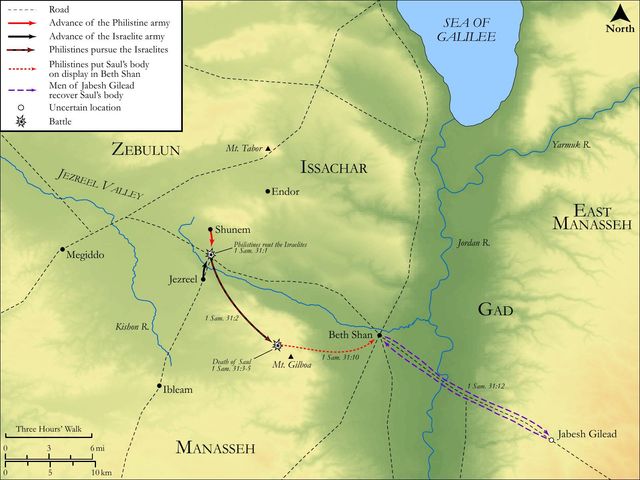
See on the biblical-era map
Study this verse
Public-domain commentary
Matthew Henry
From his Commentary on the Whole Bible. Henry comments on passages, not single verses — this entry covers 1 Samuel 31:1–7. His two-level outline is real structure in the source text, so it is rendered as structure.
The day of recompence has now come, in which Saul must account for the blood of the Amalekites which he had sinfully spared, and that of the priests which he had more sinfully spilt; that of David too, which he would have spilt, must come into the account. Now his day has come to fall, as David foresaw, when he should descend into battle and perish, Sa1 26:10. Come and see the righteous judgments of God.
I.He sees his soldiers fall about him, Sa1 31:1.
Whether the Philistines were more numerous, better posted, and better led on, or what other advantages they had, we are not told; but it seems they were more vigorous, for they made the onset; they fought against Israel, and the Israelites fled and fell. The best of the troops were put into disorder, and multitudes slain, probably those whom Saul had employed in pursuing David. Thus those who had followed him and served him in his sin went before him in his fall and shared with him in his plagues.
II.He sees his sons fall before him.
The victorious Philistines pressed most forcibly upon the king of Israel and those about him. His three sons were next him, it is probable, and they were all three slain before his face, to his great grief (for they were the hopes of his family) and to his great terror, for they were now the guard of his person, and he could conclude no other than that his own turn would come next. His sons are named (Sa1 31:2), and it grieves us to find Jonathan among them: that wise, valiant, good man, who was as much David's friend as Saul was his enemy, yet falls with the rest. Duty to his father would not permit him to stay at home, or to retire when the armies engaged; and Providence so orders it that he falls in the common fate of his family, though he never involved himself in the guilt of it; so that the observation of Eliphaz does not hold (Job 4:7), Who ever perished being innocent? For here was one. What shall we say to it?
1.God would hereby complete the vexation of Saul in his dying moments, and the judgment that was to be executed upon his house. If the family must fall, Jonathan, that is one of it, must fall with it.
2.He would hereby make David's way to the crown the more clear and open. For, though Jonathan himself would have cheerfully resigned all his title and interest to him (we have no reason to suspect any other), yet it is very probable that many of the people would have made use of his name for the support of the house of Saul, or at least would have come in but slowly to David. If Ishbosheth (who was now left at home as one unfit for action, and so escaped) had so many friends, what would Jonathan have had, who had been the darling of the people and had never forfeited their favour? Those that were so anxious to have a king like the nations would be zealous for the right line, especially if that threw the crown upon such a head as Jonathan's. This would have embarrassed David; and, if Jonathan could have prevailed to bring in all his interest to David, then it would have been said that Jonathan had made him king, whereas God was to have all the glory. This is the Lord's doing. So that though the death of Jonathan would be a great affliction to David, yet, by making him mindful of his own frailty, as well as by facilitating his accession to the throne, it would be an advantage to him.
3.God would hereby show us that the difference between good and bad is to be made in the other world, not in this. All things come alike to all. We cannot judge of the spiritual or eternal state of any by the manner of their death; for in that there is one event to the righteous and to the wicked.
III.He himself is sorely wounded by the Philistines and then slain by his own hand.
The archers hit him (Sa1 31:3), so that he could neither fight nor fly, and therefore must inevitably fall into their hands. Thus, to make him the more miserable, destruction comes gradually upon him, and he dies so as to feel himself die. To such an extremity was he now reduced that,
1.He was desirous to die by the hand of his own servant rather than by the hand of the Philistines, lest they should abuse him as they had abused Samson. Miserable man! He finds himself dying, and all his care is to keep his body out of the hands of the Philistines, instead of being solicitous to resign his soul into the hands of God who gave it, Ecc 12:7. As he lived, so he died, proud and jealous, and a terror to himself and all about him. Those who rightly understand the matter think it of small account, in comparison, how it is with them in death, so it may but be well with them after death. Those are in a deplorable condition indeed who, being bitter in soul, long for death, but it cometh not (Job 3:20, Job 3:21), especially those who, despairing of the mercy of god, like Judas, leap into a hell before them, to escape a hell within them.
2.When he could not obtain that favour he became his own executioner, thinking hereby to avoid shame, but running upon a heinous sin, and with it entailing upon his own name a mark of perpetual infamy, as felo de se - a self-murderer. Jonathan, who received his death-wound from the hand of the Philistines and bravely yielded to the fate of war, died on the bed of honour; but Saul died as a fool dieth, as a coward dieth - a proud fool, a sneaking coward; he died as a man that had neither the fear of God nor hope in God, neither the reason of a man nor the religion of an Israelite, much less the dignity of a prince or the resolution of a soldier. Let us all pray, Lord, lead us not into temptation, this temptation. His armour-bearer would not run him through, and he did well to refuse it; for no man's servant ought to be a slave to his master's lusts or passions of any kind. The reason given is that he was sorely afraid, not of death, for he himself ran wilfully upon that immediately; but, having a profound reverence for the king his master, he could not conquer that so far as to do him any hurt; or perhaps he feared lest his trembling hand should give him but half a blow, and so put him to the greater misery.
IV.His armour-bearer who refused to kill him refused not to die with him, but fell likewise upon his sword, Sa1 31:5.
This was an aggravating circumstance of the death of Saul, that, by the example of his wickedness in murdering himself, he drew in his servant to be guilty of the same wickedness, and perished not alone in his iniquity. The Jews say that Saul's armour-bearer was Doeg, whom he preferred to that dignity for killing the priests, and, if so, justly does his violent dealing return on his own head. David had foretold concerning him that God would destroy him for ever, Psa 52:5.
V.The country was put into such confusion by the rout of Saul's army that the inhabitants of the neighbouring cities (on that side Jordan, as it might be read) quitted them, and the Philistines, for a time, had possession of them, till things were settled in Israel (Sa1 31:7), to such a sad pass had Saul by his wickedness brought his country, which might have remained in the hands of the uncircumcised if David had not been raised up to repair the breaches of it. See what a king he proved for whom they rejected God and Samuel. They had still done wickedly (it is to be feared) as well as he, and therefore were consumed both they and their king, as the prophet had foretold concerning them, Sa1 12:25. And to this reference is had long after. Hos 13:10, Hos 13:11, "Where are thy saviours in all thy cities, of whom thou saidst, Give me a king and princes? I gave thee a king in my anger, and took him away in my wrath; that is, he was a plague to thee living and dying; thou couldst expect no other."
Historical interpretation
Historical reception
1 surviving comment on this verse from the historical church.
The Philistines attacked Saul and his sons, etc. The surrounding nations attacked with full intention to destroy the kingdom of Judea and to remove the sons of that kingdom from their midst, and they corrupted the priests, Scribes, and Pharisees with their corruption, namely the sons and teachers of that kingdom. They even prevented the heretics from preaching or worshiping the grace of the Holy Spirit with a simple heart, which is to strike Jonathan, that is, the gift of the dove. They forbade praising the Father, who made us his sons not by nature but by adoption, with worthy confession; which signifies the killing of Abinadab, that is, my voluntary Father. They opposed believing that salvation would come to the world in the kingdom of Christ; which indicates the killing of Melchisue, who is called My King Salvation, I believe. A philosopher, who seduced Arius, killed Melchisue as if; who Macedonius, Jonathan; who Manichae, Abinadab, because namely that one taught to deny the omnipotence of the true king Christ, that one to derogate from the gifts of the Holy Spirit, this one to blaspheme the goodness of the highest Father, master of corruption.
Continue studying 1 Samuel 31:2 across the web’s major study libraries — every link below opens this exact verse, chapter, or book on the destination site.
Read & Compare
 BibleGatewayThis verse in more than 200 translations and 70 languages.
 Bible.comThe YouVersion reader — hundreds of translations, reading plans, and highlights.
 ESV.orgCrossway's official English Standard Version reader.
 NET BibleThe NET translation with 60,000+ translators' notes on every rendering decision.
 STEP BibleTyndale House's free study tool — original text, vocabulary, and scholarly resources.
 BibliaLogos Bible Software's free web reader.
 USCCBThe New American Bible (Revised Edition) with the U.S. bishops' study notes.
Commentaries
 BibleHub CommentariesDozens of classic commentaries on this verse, gathered on one page.
 StudyLightMore than 100 commentary sets — the largest collection on the web.
 BibleRefPlain-English commentary on what this verse means, verse by verse.
 Enduring WordDavid Guzik's free commentary on this chapter, widely used by Bible teachers.
 Bible Study ToolsVerse commentary alongside Greek and Hebrew study aids.
Original Language & Research
- BibleHub InterlinearThe verse word by word — original language, transliteration, and English.
- BibleHub LexiconEvery word's original-language definition and Strong's entry.
 Blue Letter BibleDeep-study tools — Strong's numbers, concordance, and word studies.
 SefariaThe Hebrew text with Rashi and centuries of Jewish commentary.
Sermons, Hymns & Audio


TrulyRandomVerse is not affiliated with these sites and doesn’t control their content. They’re linked because they’re genuinely useful.
Summary
1 Samuel 31:2 presents the devastating and tragic climax of King Saul's reign, recounting the relentless and fatal pursuit of Saul and his sons by the Philistines during the decisive Battle of Mount Gilboa. This somber verse explicitly details the deaths of three of Saul's direct heirs—Jonathan, Abinadab, and Malchishua—at the hands of their long-standing enemies, marking an irreparable loss for Israel and directly preceding Saul's own demise. This pivotal moment not only signifies the complete collapse of Saul's dynasty but also profoundly sets the stage for the divinely ordained transition of kingship to David, ushering in a new era for the nation.
Context
ShowHideLiterary Context
This verse is strategically placed at the grim culmination of the book of 1 Samuel, forming a critical part of the Battle of Mount Gilboa narrative (found in 1 Samuel 31:1-6). It immediately follows the initial description of the fierce Philistine assault and precedes Saul's desperate act of suicide and the subsequent desecration of his body. The deaths of Saul's sons, particularly Jonathan, serve as a poignant and necessary narrative bridge to the book of 2 Samuel, which opens with David's heartfelt lament over their demise and his eventual ascension to the throne. This event brings to a painful and decisive end the protracted conflict between Israel and the Philistines, a central theme that has permeated Saul's entire kingship, demonstrating the tragic consequences of his repeated failures and God's sovereign hand in the succession.
Historical & Cultural Context
The Philistines, a powerful and technologically advanced maritime people, represented the primary existential threat to Israel throughout the period of the judges and the early monarchy. Their military superiority, particularly their mastery of iron weaponry, gave them a significant advantage over Israel's more rudimentary armaments. The Battle of Mount Gilboa was fought in a strategically vital mountain range within the Jezreel Valley, a crucial corridor for ancient trade routes and military movements, making control of this area paramount. Among the kings of that day, the defeat and death of a king and his royal heirs in battle were not merely military losses but profound humiliations that often signaled the complete collapse of a dynasty and the subjugation of the defeated nation. The subsequent desecration of the bodies of slain enemies, especially kings and their successors, as described in later verses, was a common practice intended to display absolute triumph and psychological dominance over the vanquished. Saul's defeat thus underscored his ultimate failure as a divinely appointed leader in the eyes of his people and the surrounding nations.
Key Themes
ShowHideThe verse profoundly contributes to several overarching themes within 1 Samuel and the broader biblical narrative. Firstly, it powerfully underscores the theme of Tragedy and Loss, highlighting the immense personal cost to Saul and the national devastation for Israel. The death of Jonathan is especially heartbreaking, given his unwavering loyalty to David and his exemplary character, as vividly portrayed in their covenant of friendship (see 1 Samuel 18:1-4). His death, alongside his brothers, unequivocally marks the end of a kingly line that began with great promise but ended in despair. Secondly, this catastrophic event serves as a stark illustration of the Consequences of Disobedience. While not explicitly stated in this verse, the entire narrative arc of Saul's reign, characterized by his repeated acts of rebellion against God's commands (e.g., 1 Samuel 13:8-14 and 1 Samuel 15:10-23), culminates in this devastating defeat, underscoring the divine judgment upon his house. Finally, the battle at Gilboa marks The End of an Era and the providential beginning of a new one, demonstrating God's Divine Sovereignty and Transition. This painful event, though wrought by human failure and sin, is a necessary and sovereign step in God's larger plan to remove Saul and establish the Davidic dynasty, a kingdom founded on God's chosen king, a man after His own heart.
Exposition and Analysis
ShowHideKey Word Analysis
ShowHideThis verb, derived from a primitive root, literally means "to impinge," "to cling," or "to adhere." In the context of warfare and pursuit, it conveys an intense, relentless, and unyielding chase. It suggests that the Philistines were not merely pursuing from a distance but were pressing in closely, giving Saul and his sons no opportunity to escape, regroup, or mount an effective defense. The pursuit was not casual but a determined, overwhelming force that left no room for evasion, highlighting the dire and inescapable nature of their predicament.
A primitive root, this verb means "to strike" (either lightly or severely, literally or figuratively), and by extension, "to kill" or "to slaughter," particularly in the context of battle or violent death. Its use here emphasizes the decisive and fatal outcome of the Philistine pursuit. It is a stark, unambiguous declaration of the deaths of Saul's sons, leaving no doubt about their demise in battle and underscoring the brutal finality of their encounter with the enemy.
Verse Breakdown
ShowHide"And the Philistines followed hard upon Saul and upon his sons"
This opening clause immediately establishes the dire and overwhelming threat faced by the Israelite leadership. It paints a vivid picture of a desperate and perhaps disorganized retreat, with the Philistines in close, relentless pursuit. The phrase "followed hard upon" powerfully conveys the intense pressure and the lack of escape for the king and his direct heirs, highlighting the ferocity of the battle and the Philistines' unwavering determination to crush the Israelite leadership. This pursuit is not merely tactical but signifies the complete routing of Saul's forces.
"and the Philistines slew Jonathan, and Abinadab, and Malchishua, Saul's sons"
This second clause delivers the devastating and tragic blow of the narrative. It specifies the catastrophic casualties: three of Saul's sons, directly linking their deaths to the relentless Philistine pursuit. The explicit inclusion of Jonathan's name is particularly significant, given his prominence throughout 1 Samuel as David's loyal friend, a man of great courage, and a figure of integrity. The listing of the names personalizes the tragedy, emphasizing the direct and profound impact on Saul's family and the royal line. Their deaths signify not just individual losses but the definitive end of Saul's dynasty and the beginning of a new, albeit painful, chapter for Israel.
Literary Devices
ShowHideThe verse employs several potent literary devices to convey its tragic and pivotal message. Climax is powerfully evident, as this verse represents the narrative peak of Saul's downfall, directly preceding his own death and the complete collapse of his kingdom. The relentless pursuit and subsequent brutal deaths of his sons bring the long-standing conflict with the Philistines and Saul's personal tragedy to a devastating head. There is a strong sense of Pathos, evoking deep sorrow and pity for the fallen, especially Jonathan, whose noble character and unwavering loyalty have been meticulously established throughout the preceding narrative. The abrupt and direct listing of the slain sons' names underscores the sudden and brutal reality of death in battle, stripping away any romanticized notions of warfare. Furthermore, a subtle yet profound Irony is present: Saul, initially chosen by God to deliver Israel from the Philistines, ultimately falls at their hands, and his sons with him, highlighting the tragic trajectory of a disobedient king whose reign ends in utter defeat by the very enemy he was meant to subdue. The entire narrative of Saul's reign, marked by disobedience and leading to this precise moment, functions as Foreshadowing, where earlier prophecies and Saul's own acts of rebellion predict this ultimate defeat and the demise of his kingdom.
Theological and Thematic Connections
ShowHideThe tragic events of 1 Samuel 31:2 serve as a profound theological statement on the severe consequences of rebellion against divine authority and the unwavering, sovereign nature of God's redemptive plan. While the immediate cause of death is the Philistine army, the broader biblical narrative consistently frames Saul's downfall as a direct result of his persistent disobedience and spiritual rebellion against God's explicit commands (e.g., his unlawful sacrifice in 1 Samuel 13 and his failure to utterly destroy the Amalekites in 1 Samuel 15). The death of his sons, including the righteous Jonathan, underscores the corporate dimension of judgment prevalent in ancient Israel, where the consequences of a leader's sin could tragically extend to his household and the entire nation. Yet, even amidst such profound loss and human failure, God's overarching purpose is unmistakably evident: the removal of Saul's failed kingship is a necessary, albeit painful, step that paves the way for the establishment of the Davidic covenant, a kingdom founded on God's chosen king, a man after His own heart. This painful transition, therefore, is ultimately a powerful testament to God's faithfulness to His promises, even when achieved through human suffering and the apparent triumph of enemies.
Reflection and Application
ShowHideThe stark reality presented in 1 Samuel 31:2 offers a sobering and profound reflection on the gravity of choices, especially those made in positions of authority, and the far-reaching consequences of disobedience. Saul's tragic end, culminating in the death of his sons, serves as a powerful and timeless reminder that spiritual rebellion, persistent self-will, and a refusal to submit to God's commands can lead to devastating outcomes, not only for the individual but also for those intimately connected to them. This passage calls us to a deep self-examination: are we faithfully seeking God's guidance and diligently obeying His commands, or are we, like Saul, prone to relying on our own strength, wisdom, or perceived expediency? It underscores the critical importance of humility, genuine repentance, and unwavering faithfulness to God, particularly when the path is difficult or unpopular. Yet, even amidst such profound loss and human failure, the narrative subtly but powerfully points to God's unwavering sovereignty. His larger redemptive plan continues to unfold, ensuring that His ultimate purposes will be accomplished, even if it means navigating through painful transitions and human suffering. This encourages us to cultivate a deep trust in God's ultimate control, finding hope and resilience even in the midst of life's most challenging and seemingly tragic circumstances, knowing that His kingdom will ultimately prevail and His will be done.
Questions for Reflection
ShowHideFAQ
ShowHideWhy was Jonathan, a seemingly righteous man, killed alongside his disobedient father?
ShowHideJonathan's death alongside Saul is a deeply poignant and often perplexing aspect of this tragedy. While Jonathan consistently demonstrated remarkable faithfulness to God and unwavering loyalty to David (as seen in their covenant of friendship in 1 Samuel 20), he was inextricably linked to Saul's household and army. In ancient Israel, there was often a corporate dimension to judgment, where the consequences of a leader's or family's sin could extend to those associated with them, even if individually righteous. Jonathan, as a prince and a warrior, was engaged in the battle that was a direct outcome of his father's failed reign and God's judgment upon it. His death underscores the devastating reach of sin's consequences and the mystery of suffering, even for those who walk righteously. It also highlights God's sovereign plan to completely remove Saul's line to make way for David's divinely appointed kingdom, demonstrating that even the most beloved figures can be caught in the sweep of divine judgment against a rebellious house, ultimately serving a larger redemptive purpose.
What was the significance of the Philistines slaying Saul's sons before Saul himself?
ShowHideThe slaying of Saul's sons before his own death carried immense and multi-layered significance. Primarily, it emphasized the complete and utter destruction of Saul's royal lineage and the definitive end of his dynasty. For Saul, witnessing the demise of his heirs would have been a profound humiliation and a deeper personal tragedy than his own death, ensuring that his legacy would not continue through his direct descendants. This act also served the Philistines' strategic purpose of completely neutralizing any immediate threat of a successor from Saul's house, thereby solidifying their victory and control over Israel. From a theological perspective, it underscored the finality of God's judgment against Saul's kingdom, ensuring that the path was decisively cleared for the divinely appointed Davidic line to begin its reign, fulfilling God's prophetic word.
Christ-Centered Fulfillment
ShowHideThe tragic collapse of Saul's kingdom and the demise of his sons at Mount Gilboa, as vividly depicted in 1 Samuel 31:2, serves as a profound and sobering foreshadowing of humanity's ultimate need for a perfect, eternal, and righteous King—Jesus Christ. Saul's catastrophic failure, marked by disobedience, self-reliance, and a reign that culminated in utter ruin, powerfully highlights the inherent limitations, sinfulness, and transience of all earthly rulers and human institutions. Unlike Saul, whose kingdom ended in defeat and death, Jesus Christ, the true King of Israel and of all creation, established a kingdom that is eternal, unshakeable, and ever-expanding (as promised in Isaiah 9:6-7). The death of Saul's sons, intended to secure his lineage, stands in stark contrast to Christ, who, though He willingly died on the cross, conquered death definitively and now lives forever, holding an unchangeable priesthood and an eternal kingship (as affirmed in Hebrews 7:24). The Philistine victory at Gilboa, a moment of deep despair and national humiliation for Israel, is ultimately reversed and swallowed up in Christ's glorious triumph over sin, death, and all spiritual enemies (as powerfully declared in Colossians 2:15). Jonathan's noble character, his unwavering loyalty to David despite his father's failings, and his willingness to sacrifice can be seen as a faint yet poignant shadow of those who, by faith, abandon allegiance to the fleeting powers of this world to pledge their ultimate loyalty to the true King, Jesus, who is "the faithful witness, the firstborn of the dead, and the ruler of the kings of the earth" (Revelation 1:5). Thus, the tragedy of Gilboa ultimately points beyond itself to the glorious, enduring, and victorious reign of the Messiah, whose kingdom will never end.