


1 Samuel 23:17
Bible text: King James Version (1769 Blayney text) · Public domain
Bible text: King James Version with Strong's numbers · Public domain
Bible text: Berean Standard Bible · Public domain
Bible text: American Standard Version (1901) · Public domain
Bible text: World English Bible, Messianic edition · Public domain
Bible text: Geneva Bible (1599) · Public domain
Bible text: Young's Literal Translation · Public domain
- וַיֹּאמֶרvai·Yo·merand he saidH559Conj-w ¦ V-Qal-ConsecImperf-3msVerb Qal Consecutive Imperfect 3rd Singular Masculineוַandיֹּאמֶרhe said
- אֵלָיו'e·Lavto himH413Prep ¦ 3msPreposition Definiteאֵלָיtoוhim
- אַל'almay notH408NegParticle Negative
- תִּירָאti·Ra'you be afraidH3372V-Qal-Imperf-2msVerb Qal Imperfect 2nd Singular Masculine
- כִּיkiforH3588PrtParticle Conditional
- לֹאlo'notH3808NegParticle Negative
- תִמְצָאֲךָtim·tza·'a·Khait will find youH4672V-Qal-Imperf-3fs ¦ 2msVerb Qal Imperfect 3rd Singular Feminineתִמְצָאֲit will findךָyou
- יַדyad[the] hand ofH3027N-cscNoun Singular common gender Construct
- שָׁאוּלsha·'UlSaulH7586N-proper-mNoun Proper Masculine
- אָבִי'a·Vimy fatherH1N-msc ¦ 1csNoun Singular Masculine Constructאָבִfatherיmy
- וְאַתָּהve·'a·Tahand youH859Conj-w ¦ Pro-2msPronoun Personal 2nd Singular Masculineוְandאַתָּהyou
- תִּמְלֹךְtim·Lokhyou will reignH4427V-Qal-Imperf-2msVerb Qal Imperfect 2nd Singular Masculine
- עַל'aloverH5921PrepPreposition
- יִשְׂרָאֵלYis·ra·'ElIsraelH3478N-properNoun Proper Location
- וְאָנֹכִיve·'a·no·Khiand IH595Conj-w ¦ Pro-1csPronoun Personal 1st Singular common genderוְandאָנֹכִיI
- אֶהְיֶה'eh·yehI will becomeH1961V-Qal-Imperf-1csVerb Qal Imperfect 1st Singular common gender
- לְּךָle·Khato <the> youPrep-l ¦ 2msSuffix Personal 2nd Singular Masculineלְּto <the>ךָyou
- לְמִשְׁנֶהle·mish·Neh<into> second in rankH4932Prep-l ¦ N-msNoun Singular Masculine Absoluteלְ<into>מִשְׁנֶהsecond in rank
- וְגַםve·gamand alsoH1571Conj-w ¦ AdvAdverbוְandגַםalso
- שָׁאוּלsha·'UlSaulH7586N-proper-mNoun Proper Masculine
- אָבִי'a·Vimy fatherH1N-msc ¦ 1csNoun Singular Masculine Constructאָבִfatherיmy
- יֹדֵעַyo·De·a'[is] knowingH3045V-Qal-Prtcpl-msVerb Qal Participle Singular Masculine Absolute
- כֵּןKen[it is] thusH3651AdvAdverb
English is a literal word-by-word gloss of the Hebrew, not the KJV's wording. Why?
This is the original text the KJV's translators worked from — each Hebrew word with its own literal English meaning in this verse, prepared by scholars at Tyndale House, Cambridge. The KJV translates whole sentences, not word by word, so its wording differs: one Hebrew word can become several English words, and the KJV may choose “the LORD” where the gloss reads “Yahweh”. Both are faithful — they answer different questions. For the KJV's own rendering, switch to the KJV text.
Details
See on the biblical-era map
Study this verse
Public-domain commentary
Matthew Henry
From his Commentary on the Whole Bible. Henry comments on passages, not single verses — this entry covers 1 Samuel 23:14–18. His two-level outline is real structure in the source text, so it is rendered as structure.
Here is, I. David absconding. He abode in a wilderness, in a mountain (Sa1 23:14), in a wood, Sa1 23:15. We must here, 1. Commend his eminent virtues, his humility, modesty, fidelity to his prince, and patient attendance on the providence of his God, that he did not draw up his forces against Saul, fight him in the field, or surprise him by some stratagem or other, and so avenge his own quarrel and that of the Lord's priests upon him, and put an end to his own troubles and the calamities of the country under Saul's tyrannical government. No, he makes no such attempt; he keeps God's way, waits God's time, and is content to secure himself in woods and wildernesses, though with some it might seem a reproach to that courage for which he had been famous. But, 2. We must also lament his hard fate, that an innocent man should be thus terrified and put in fear of his life, that a man of honour should be thus disgraced, a man of merit thus recompensed for his services, and a man that delighted in the service both of God and his country should be debarred from both and wrapped up in obscurity. What shall we say to this? Let it make us think the worse of this world, which often gives such bad treatment to its best men; let it reconcile even great and active men to privacy and restraint, if Providence make these their lot, for they were David's; and let it make us long for that kingdom where goodness shall for ever be in glory and holiness in honour, and the righteous shall shine as the sun, which cannot be put under a bushel.
II.Saul hunting him, as his implacable enemy.
He sought him every day, so restless was his malice, Sa1 23:14. He sought no less than his life, so cruel was his malice, Sa1 23:15. As it had been from the beginning, so it was now, and will be, he that is born after the flesh persecuteth him that is born after the spirit, Gal 4:29.
III.God defending him, as his powerful protector.
God delivered him not into Saul's hand, as Saul hoped (Sa1 23:7); and, unless God delivered him into his hand, he could not prevail against him, Joh 19:11.
IV.Jonathan comforting him as his faithful and constant friend.
True friends will find out means to get together. David, it is likely, appointed time and place for this interview, and Jonathan observed the appointment, though he exposed himself thereby to his father's displeasure, and, had it been discovered, it might have cost him his life. True friendship will not shrink from danger, but can easily venture, will not shrink from condescension, but can easily stoop, and exchange a palace for a wood, to serve a friend. The very sight of Jonathan was reviving to David; but, besides this, he said that to him which was very encouraging.
1.As a pious friend, he directed him to God, the foundation of his confidence and the fountain of his comfort: He strengthened his hand in God. David, though a strong believer, needed the help of his friends for the perfecting of what was lacking in his faith; and herein Jonathan was helpful to him, by reminding him of the promise of God, the holy oil wherewith he was anointed, the presence of God with him hitherto, and the many experiences he had had of God's goodness to him. Thus he strengthened his hands for action, by encouraging his heart, not in the creature, but in God. Jonathan was not in a capacity of doing any thing to strengthen him, but he assured him God would.
2.As a self-denying friend, he took a pleasure in the prospect of David's advancement to that honour which was his own birthright, Sa1 23:17. "Thou shalt live to be king, and I shall think it preferment enough to be next thee, near thee, though under thee, and will never pretend to be a rival with thee." This resignation which Jonathan made to David of his title would be a great satisfaction to him, and make his way much the more clear. This, he tells him, Saul knew very well, Jonathan having sometimes heard him say as much, whence it appears what a wicked man Saul was, to persecute one whom God favoured, and what a foolish man he was, in thinking to prevent that which God had determined and which would certainly come to pass. How could he disannul what God had purposed?
3.As a constant friend, he renewed his league of friendship with him. They made a covenant now, this third time, before the Lord, calling him to witness to it, Sa1 23:18. True love takes delight in repeating its engagements, giving and receiving fresh assurances of the firmness of the friendship. Our covenant with God should be often renewed, and therein our communion with him kept up. David and Jonathan now parted, and never came together again, that we find, in this world; for Jonathan said what he wished, not what he had ground to expect, when he promised himself that he should be next to David in his kingdom.
Historical interpretation
Historical reception
1 surviving comment on this verse from the historical church.
And he said to him: Fear not, etc. Although Jonathan, unaware of the fate and future destiny, as a man, made a false statement about himself under David's reign, yet according to the mystical meanings, he reveals the joys of Christ and the Church. Truly, he bore witness to that inviolable kingdom, to which he himself belongs, by asserting that the enemies are not to be feared, for they can never reach to extinguish the dominion of faith and truth; indeed, that he whose dominion was to be multiplied, and whose peace would have no end, would reign perpetually over the chosen angels and men; and that those who loved him faithfully and with their whole heart would be closest to him in all the heights of this same kingdom. With their enemies prostrate and defeated, and subjected entirely to the feet and dominion of Christ, as Paul says: "He must reign until he has put all his enemies under his feet; the last enemy to be destroyed is death. For he has put all things in subjection under his feet" (I Cor. XV; Psalm CIX); and when he says: "All things are put in subjection under him," undoubtedly except him who subjected all things to him (Psalm VIII), hence it is clear that the powers that have deserted him, empty and void, Christ will render, setting victory trophies against the rivals of our salvation, whom he had long since defeated by his own death, as it is written: "Because the children have shared in flesh and blood, he himself likewise partook of the same things, that through his death he might destroy the one who has the power of death" (Hebrews II), that is, the devil. Text: Thus he struck, and the rest.
Continue studying 1 Samuel 23:17 across the web’s major study libraries — every link below opens this exact verse, chapter, or book on the destination site.
Read & Compare
 BibleGatewayThis verse in more than 200 translations and 70 languages.
 Bible.comThe YouVersion reader — hundreds of translations, reading plans, and highlights.
 ESV.orgCrossway's official English Standard Version reader.
 NET BibleThe NET translation with 60,000+ translators' notes on every rendering decision.
 STEP BibleTyndale House's free study tool — original text, vocabulary, and scholarly resources.
 BibliaLogos Bible Software's free web reader.
 USCCBThe New American Bible (Revised Edition) with the U.S. bishops' study notes.
Commentaries
 BibleHub CommentariesDozens of classic commentaries on this verse, gathered on one page.
 StudyLightMore than 100 commentary sets — the largest collection on the web.
 BibleRefPlain-English commentary on what this verse means, verse by verse.
 Enduring WordDavid Guzik's free commentary on this chapter, widely used by Bible teachers.
 Bible Study ToolsVerse commentary alongside Greek and Hebrew study aids.
Original Language & Research
- BibleHub InterlinearThe verse word by word — original language, transliteration, and English.
- BibleHub LexiconEvery word's original-language definition and Strong's entry.
 Blue Letter BibleDeep-study tools — Strong's numbers, concordance, and word studies.
 SefariaThe Hebrew text with Rashi and centuries of Jewish commentary.
Sermons, Hymns & Audio


TrulyRandomVerse is not affiliated with these sites and doesn’t control their content. They’re linked because they’re genuinely useful.
Summary
1 Samuel 23:17 records a deeply significant and tender moment in the tumultuous life of David, who is fleeing the relentless persecution of King Saul. In this verse, Jonathan, Saul's son and the rightful heir to the throne, seeks out David in the wilderness of Ziph. He offers not only profound encouragement and unwavering loyalty but also a divinely inspired prophetic assurance that David will indeed become king over Israel, and that Saul's desperate pursuit will ultimately fail. This encounter powerfully underscores the depth of their covenant friendship and the unshakeable certainty of God's sovereign plan amidst intense human opposition and despair.
Context
ShowHideLiterary Context
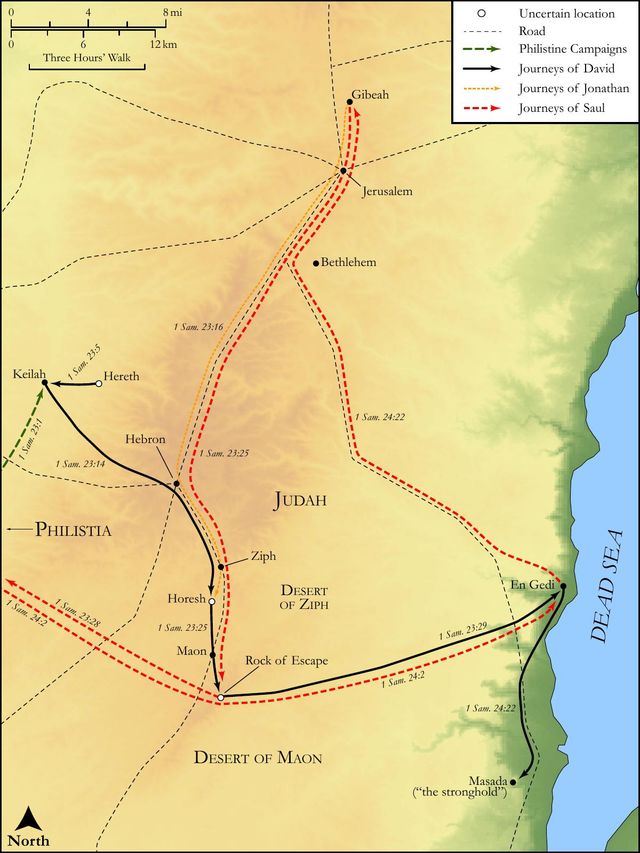
This pivotal verse is situated within a period of acute danger and isolation for David, as King Saul's paranoia and jealousy have escalated into a relentless hunt. David has recently escaped the treachery of the men of Keilah, who nearly betrayed him to Saul, and is now a fugitive hiding in the desolate wilderness. Jonathan's visit, described here, is a rare and precious interlude of profound encouragement and divine affirmation. It serves as a powerful reinforcement of the deep covenant of friendship established between Jonathan and David earlier in 1 Samuel 18:3. This encounter highlights Jonathan's consistent character as a man of unwavering loyalty and submission to God's will, even as his own father descends further into spiritual and mental decline, marked by defiance against God's decree.
Historical & Cultural Context
The narrative unfolds in the nascent stages of the Israelite monarchy, a period where the concept of divine anointing and succession was paramount. Saul, the first king, had been rejected by God due to his disobedience, and David had been divinely chosen and anointed by Samuel in 1 Samuel 16:13. Despite this divine decree, Saul clung desperately to power, viewing David as a direct existential threat to his dynasty. Culturally, the expectation would be for Jonathan, as the crown prince, to fiercely oppose any rival to his succession. However, Jonathan consistently defies this norm, demonstrating a profound understanding of God's sovereignty over human succession. The wilderness of Ziph, a rugged and remote region in Judah, provides a stark backdrop, emphasizing David's vulnerable and exposed state, and highlighting the providential nature of Jonathan's timely and courageous visit.
Key Themes
ShowHide1 Samuel 23:17 powerfully contributes to several overarching themes within the book of 1 Samuel. Firstly, it epitomizes Unwavering Loyalty and Selfless Friendship, showcasing Jonathan's extraordinary commitment to David, which transcends personal ambition, familial ties, and the political expectations of his position. His actions consistently demonstrate a covenant love that prioritizes God's will above his own claim to the throne, as seen from their initial bond in 1 Samuel 18:1-4. Secondly, it highlights Divine Providence and Assurance, as Jonathan's words are not merely human comfort but a divinely inspired prophecy, assuring David of God's protective hand and the certainty of his future kingship despite the immediate dangers. Thirdly, it serves as a Confirmation of David's Kingship, as Jonathan, the legitimate heir, explicitly affirms David's destiny, reinforcing the divine anointing and demonstrating that God's plan will ultimately prevail. Finally, the verse subtly reveals Saul's Deliberate Rebellion, indicating that Saul was fully aware of God's decree concerning David's future reign, yet chose to defy it, adding a tragic dimension to his relentless pursuit, consistent with Samuel's earlier pronouncement in 1 Samuel 15:28.
Exposition and Analysis
ShowHideKey Word Analysis
ShowHideA primitive root meaning "to fear," but also "to revere." In this context, Jonathan's imperative "Fear not" is not merely a comforting reassurance but carries a deeper theological weight, often used in scripture to accompany a divine promise or declaration of God's immutable plan. It implies that David's fear is unfounded because God's protective hand and sovereign purpose are at work, making Saul's efforts ultimately futile.
This primitive word, distinct from the closed fist, refers to the open hand, signifying power, control, means, or direction. Jonathan's declaration that "the hand of Saul my father shall not find thee" is a direct assertion that Saul's power and grasp will be ineffective against David. It emphasizes the ultimate futility of human opposition when God's sovereign hand is preventing success, implying divine intervention to protect His chosen one.
Derived from a root meaning "to repeat" or "to double," this term properly denotes a repetition, a duplicate, or a second in order, rank, age, quality, or location. Jonathan's willingness to be "next unto" David reveals his extraordinary humility and acceptance of God's sovereign choice. It signifies his desire to serve David in a subordinate yet honorable and trusted position, contrasting sharply with the typical ambition for the throne and demonstrating a profound submission to divine order.
Verse Breakdown
ShowHide"And he said unto him, Fear not:"
Jonathan initiates this crucial encounter with a powerful, divinely-backed exhortation. This imperative, common in biblical narratives where God's messengers bring assurance, is designed to dispel David's anxiety and fear, setting a tone of comfort and preparing David to receive the profound truths that follow. It highlights Jonathan's pastoral heart and his role as a conduit of God's peace and certainty.
"for the hand of Saul my father shall not find thee;"
This clause delivers a direct, prophetic promise of divine protection. Despite Saul's relentless and increasingly desperate pursuit, Jonathan assures David that God's sovereign hand will prevent Saul from ever capturing or harming him. It is a declaration of the ultimate futility of human opposition when it stands against God's protective sovereignty over His chosen vessel.
"and thou shalt be king over Israel,"
Jonathan explicitly affirms David's divinely appointed destiny. This is a momentous declaration, made by the very person who stands to lose the most from David's ascension to the throne. It underscores Jonathan's complete submission to God's will and his recognition of David's legitimate claim, not by human right or conquest, but by divine decree and anointing.
"and I shall be next unto thee;"
This clause reveals the extraordinary depth of Jonathan's humility, selfless loyalty, and profound faith. He envisions himself not as a rival, but as David's faithful second-in-command, willingly relinquishing his birthright for the sake of God's plan and his covenant friendship with David. It is a profound act of self-denial and trust in God's perfect and sovereign order.
"and that also Saul my father knoweth."
This poignant revelation adds a tragic and morally weighty dimension to Saul's actions. It indicates that Saul's persecution of David is not born of ignorance, misunderstanding, or a lack of information concerning God's will. Instead, it signifies that Saul's continued, relentless pursuit is a deliberate and defiant rebellion against God's revealed decree, highlighting his hardened heart and contributing to his tragic downfall.
Literary Devices
ShowHideThe passage in 1 Samuel 23:17 is rich with literary devices that amplify its meaning and emotional impact. Foreshadowing is prominently featured, as Jonathan's prophetic words explicitly predict David's future kingship, assuring both David and the reader of God's ultimate triumph despite the present adversity. There is profound Irony in the fact that Jonathan, King Saul's son and the legitimate heir to the throne, is the one who confirms David's divine appointment to the kingship, while Saul himself is desperately trying to prevent it. This creates a powerful Contrast between Jonathan's selfless loyalty and Saul's paranoid ambition and defiant rebellion against God's will. The direct Dialogue between Jonathan and David emphasizes the personal and intimate nature of their bond, allowing the reader to witness the profound depth of their friendship and Jonathan's unwavering support. Furthermore, the use of the phrase "Fear not" employs Exhortation, a common biblical rhetorical device, which serves to both comfort David in his distress and underscore the divine authority and certainty behind Jonathan's message.
Theological and Thematic Connections
ShowHide1 Samuel 23:17 stands as a powerful testament to God's unwavering faithfulness to His promises, even when circumstances appear dire and human opposition is fierce. It illustrates that God's sovereign plan for His chosen ones will ultimately prevail, irrespective of the machinations of those who resist His will. Jonathan's profound humility and selfless loyalty serve as a theological model for true leadership and friendship—one that prioritizes God's purposes above personal ambition or earthly gain. The verse also underscores the tragic consequences of defying God's revealed will, as seen in Saul's hardened heart, which, despite knowing God's decree, persists in rebellion. It challenges believers to trust in God's timing and methods, even when the path is fraught with danger and uncertainty, and to cultivate relationships marked by godly love and support, reflecting the covenant faithfulness of God Himself.
Reflection and Application
ShowHideThe profound encounter between Jonathan and David in 1 Samuel 23:17 offers timeless lessons for our spiritual journey, particularly in moments of intense trial and uncertainty. Like David, who was a fugitive facing relentless persecution, we are called to remember that God's promises are immutable, and His sovereign hand is always at work, even when circumstances seem to contradict His word or when His presence feels distant. Jonathan's selfless declaration, acknowledging David's future kingship and his own willingness to be "next unto" him, challenges us to examine our own hearts regarding ambition, humility, and submission to God's will. Do we truly trust God's plan for our lives and the lives of others, even when it means relinquishing our own desires, perceived rights, or positions of prominence? This verse also highlights the invaluable role of faithful friends and spiritual mentors who, like Jonathan, can speak words of divine encouragement and truth into our lives, reminding us of God's faithfulness when our own faith falters. It calls us to be such friends to others, offering support and affirmation rooted in God's purposes, even at personal cost, knowing that genuine love seeks the good and the God-ordained destiny of the other.
Questions for Reflection
ShowHideFAQ
ShowHideWhy did Jonathan, the rightful heir, so readily accept David's kingship?
ShowHideJonathan's acceptance of David's kingship stemmed from a profound understanding and submission to God's divine appointment. Unlike his father, Saul, Jonathan recognized God's sovereign hand at work in David's life. Their covenant friendship, first established in 1 Samuel 18:1-4, was rooted in mutual respect and a shared reverence for God's will. Jonathan prioritized God's plan over his own birthright and personal ambition, demonstrating extraordinary humility and faith. He genuinely loved David and believed that God had chosen him, a conviction reinforced by the Spirit of the Lord coming powerfully upon David and the Lord's departure from Saul. This selfless posture is further evidenced in 1 Samuel 20:42, where they reaffirm their covenant before parting ways, trusting in God's faithfulness to their descendants.
What does "and that also Saul my father knoweth" imply about Saul's actions?
ShowHideThis poignant phrase reveals the tragic and deliberate nature of Saul's rebellion against God. It implies that Saul was not acting out of ignorance or a misunderstanding of David's divine anointing. Rather, he was fully aware that God had chosen David to succeed him as king, a truth that Samuel had explicitly declared to him in 1 Samuel 15:28. Saul's continued, relentless pursuit of David, despite this undeniable knowledge, demonstrates a hardened heart and a conscious defiance of God's revealed will. His actions are thus portrayed not merely as political maneuvering or personal vendetta but as a tragic spiritual rebellion against the divine order, ultimately leading to his downfall and the loss of his dynasty.
Christ-Centered Fulfillment
ShowHideThe profound narrative of 1 Samuel 23:17, particularly Jonathan's selfless act and prophetic assurance, deeply foreshadows the Person and work of Jesus Christ, the ultimate King. Jonathan, the "rightful" heir to an earthly throne, willingly steps aside and affirms the divinely appointed king, David, even desiring to serve "next unto" him. This mirrors Christ, who, though "in the form of God, did not count equality with God a thing to be grasped, but emptied himself, by taking the form of a servant" (Philippians 2:6-7). Jesus, the true King of Kings, did not cling to His divine prerogatives but humbly submitted to the Father's will, even to the point of death on a cross (Philippians 2:8). Jonathan's prophetic assurance to David—"Fear not: for the hand of Saul my father shall not find thee; and thou shalt be king over Israel"—finds its ultimate fulfillment in Christ's victory over sin, death, and the powers of darkness. Just as David's kingship was assured despite relentless persecution, Christ's eternal reign is guaranteed through His resurrection, conquering every foe that sought to "find" or defeat Him (Colossians 2:15). Jonathan's loyalty to God's chosen one mirrors the Father's unwavering affirmation of the Son, "This is my beloved Son, with whom I am well pleased" (Matthew 3:17), establishing Jesus as the rightful and eternal King over all creation (Revelation 19:16). Indeed, in Christ, we see the perfect King and the ultimate example of self-sacrificial love, securing a kingdom that "shall have no end" (Luke 1:33).