


Acts 28:16
Bible text: King James Version (1769 Blayney text) · Public domain
Bible text: King James Version with Strong's numbers · Public domain
Bible text: Berean Standard Bible · Public domain
Bible text: American Standard Version (1901) · Public domain
Bible text: World English Bible, Messianic edition · Public domain
Bible text: Geneva Bible (1599) · Public domain
Bible text: Young's Literal Translation · Public domain
- ὍτεHoteWhenG3753CONJConjunction
- δὲdenowG1161CONJConjunction
- εἰσήλθομενeisēlthomenwe cameG1525V-2AAI-1PVerb 2nd Aorist Active Indicative 1st Plural
- εἰςeistoG1519PREPPreposition
- ῬώμηνRhōmēnRomeG4516N-ASF-LNoun Accusative Singular Feminine Location
- ὁhotheG3588T-NSMDefinite article Nominative Singular Masculine
- ἑκατόνταρχοςhekatontarchoscenturionG1543N-NSMNoun Nominative Singular Masculine
- παρέδωκενparedōkendeliveredG3860V-AAI-3SVerb Aorist Active Indicative 3rd Singular
- τοὺςtous<the>G3588T-APMDefinite article Accusative Plural Masculine
- δεσμίουςdesmiousprisonersG1198N-APMNoun Accusative Plural Masculine
- τῷtōto theG3588T-DSMDefinite article Dative Singular Masculine
- στρατοπεδάρχῃstratopedarchēcommandersG4759N-DSMNoun Dative Singular Masculine
- ἐπετράπηepetrapēwas allowedG2010V-API-3SVerb Aorist Passive Indicative 3rd Singular
- τῷtō<the>G3588T-DSMDefinite article Dative Singular Masculine
- δὲdeNowG1161CONJConjunction
- ΠαύλῳPaulōPaulG3972N-DSM-PNoun Dative Singular Masculine Individual
- μένεινmeneinto stayG3306V-PANVerb Present Active Infinitive
- καθ᾽kath᾽byG2596PREPPreposition
- ἑαυτὸνhe'autonhimselfG1438F-3ASMReflexive pronoun Accusative 3rd Singular Masculine
- σὺνsunwithG4862PREPPreposition
- τῷtōwhoG3588T-DSMDefinite article Dative Singular Masculine
- φυλάσσοντιphulassontiis guardingG5442V-PAP-DSMVerb Present Active Participle Dative Singular Masculine
- αὐτὸνautonhimG846P-ASMPersonal pronoun Accusative Singular Masculine
- στρατιώτῃstratiōtēsoldierG4757N-DSMNoun Dative Singular Masculine
English is a literal word-by-word gloss of the Greek, not the KJV's wording. Why?
This is the original text the KJV's translators worked from — each Greek word with its own literal English meaning in this verse, prepared by scholars at Tyndale House, Cambridge. The KJV translates whole sentences, not word by word, so its wording differs: one Greek word can become several English words, and the KJV may choose “charity” where the gloss reads “love”. Both are faithful — they answer different questions. For the KJV's own rendering, switch to the KJV text.
Details
See on the biblical-era maps
Study this verse
Public-domain commentary
Matthew Henry
From his Commentary on the Whole Bible. Henry comments on passages, not single verses — this entry covers Acts 28:11–16. His three-level outline is real structure in the source text, so it is rendered as structure.
We have here the progress of Paul's voyage towards Rome, and his arrival there at length. A rough and dangerous voyage he had hitherto had, and narrowly escaped with his life; but after a storm comes a calm: the latter part of his voyage was easy and quiet.
Per varios casus, per tot discrimina rerum,
Tendimus ad Latium -
Through various hazards and events we move
To Latium.
Tendimus ad coelum.
We make for heaven.
- Dabit Deus his quoque finem.
To these a period will be fixed by Heaven.
We have here,
I.Their leaving Malta.
That island was a happy shelter to them, but it was not their home; when they are refreshed they must put to sea again. The difficulties and discouragements we have met with in our Christian course must not hinder us from pressing forward. Notice is here taken,
1.Of the time of their departure: After three months, the three winter months. Better lie by, though they lay upon charges, than go forward while the season was dangerous. Paul had warned them against venturing to sea in winter weather, and they would not take the warning; but, now that they had learned it by the difficulties and dangers they had gone through, he needed not to warn them: their learning did them good when they had paid dearly for it. Experience is therefore called the mistress of fools, because those are fools that will not learn till experience has taught them.
2.Of the ship in which they departed. It was in a ship of Alexandria; so was that which was cast away, Act 27:6. This ship had wintered in that isle, and was safe. See what different issues there are of men's undertakings in this world. Here were two ships, both of Alexandria, both bound for Italy, both thrown upon the same island, but one is wrecked there and the other is saved. Such occurrences may often be observed. Providence sometimes favours those that deal in the world, and prospers them, that people may be encouraged to set their hands to worldly business; at other times Providence crosses them, that people may be warned not to set their hearts upon it. Events are thus varied, that we may learn both how to want and how to abound. The historian takes notice of the sign of the ship, which probably gave it its name: it was Castor and Pollux. Those little foolish pagan deities, which the poets had made to preside over storms and to protect seafaring men, as gods of the sea, were painted or graven upon the fore-part of the ship, and thence the ship took its name. I suppose this is observed for no other reason than for the better ascertaining of the story, that ship being well known by that name and sign by all that dealt between Egypt and Italy. Dr. Lightfoot thinks that Luke mentions this circumstance to intimate the men's superstition, that they hoped they should have better sailing under this badge than they had had before.
II.Their landing in or about Italy, and the pursuing of their journey towards Rome.
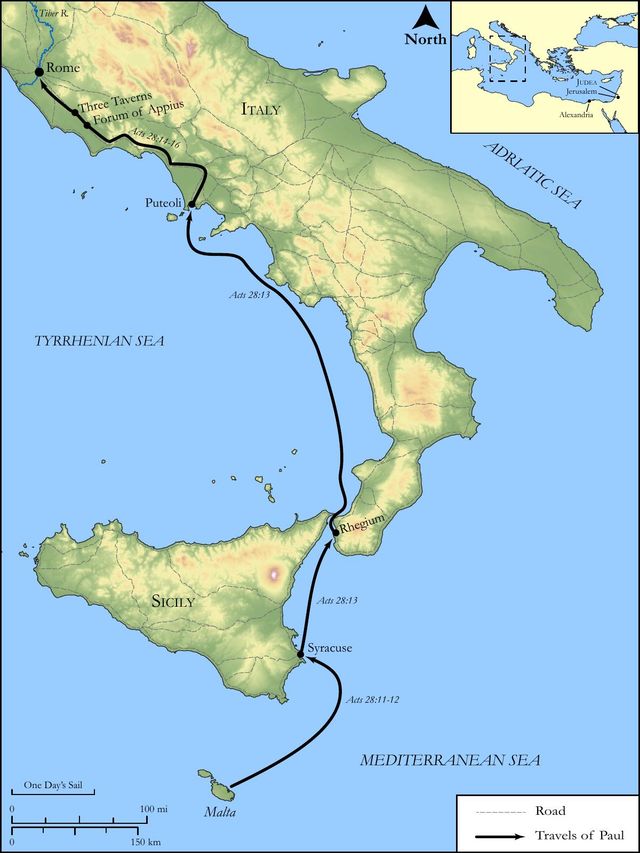
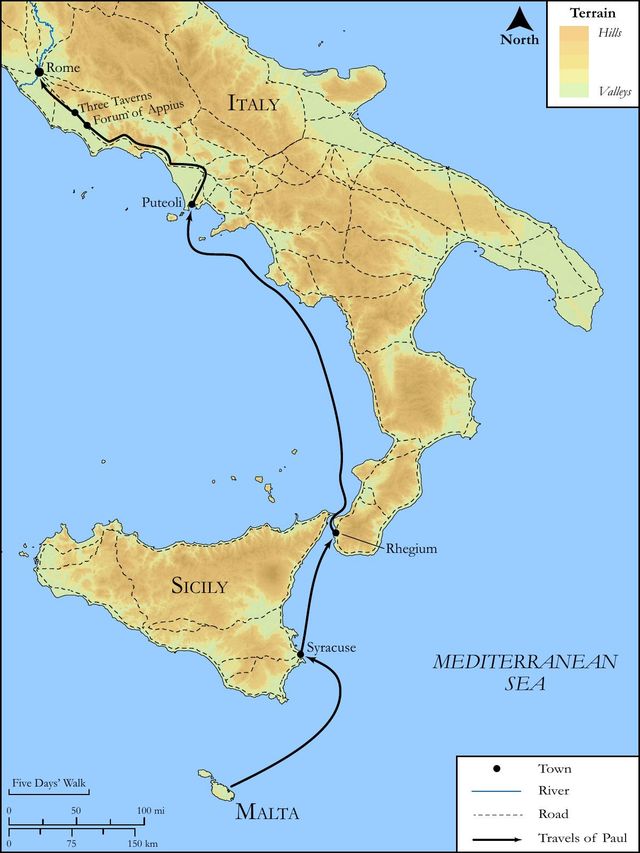
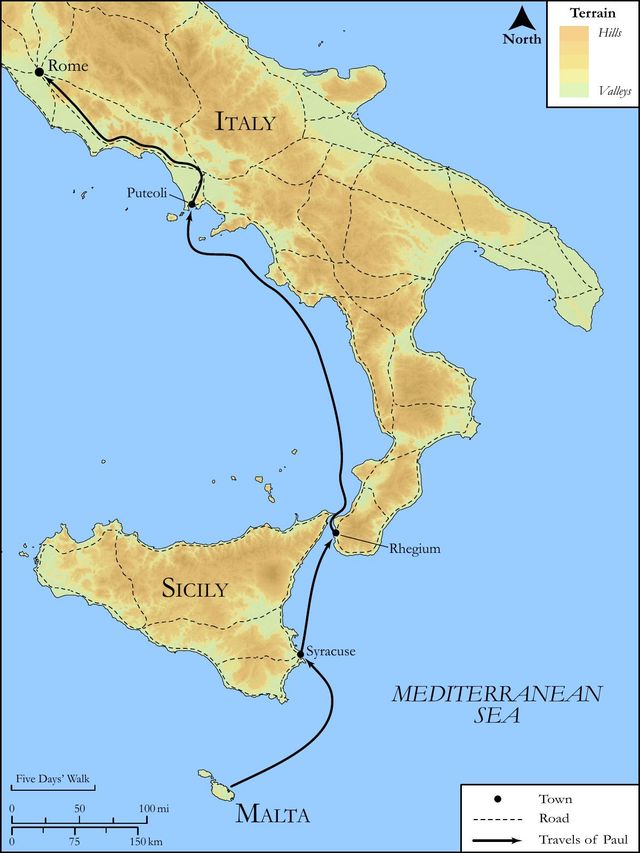
1.They landed first at Syracuse in Sicily, the chief city of that island. There they tarried three days, probably having some goods to put ashore, or some merchandise to make there; for it seems to have been a trading voyage that this ship made. Paul had now his curiosity gratified with the sight of places he had often heard of and wished to see, particularly Syracuse, a place of great antiquity and note; and yet, it should seem, there were no Christians there.
2.From Syracuse they came to Rhegium, a city in Italy, directly opposite to Messina in Sicily, belonging to the kingdom of Calabria or Naples. There, it seems they staid one day; and a very formal story the Romish legends tell of Paul's preaching here at this time, and the fish coming to the shore to hear him, - that with a candle he set a stone pillar on fire, and by that miracle convinced the people of the truth of his doctrine, and they were many of them baptized, and he ordained Stephen, one of his companions in this voyage, to be their bishop, - and all this, they tell you, was done in this one day; whereas it does not appear that they did so much as go ashore, but only came to an anchor in the road.
3.From Rhegium they came to Puteoli, a sea-port town not far from Naples, now called Pozzolana. The ship of Alexandria was bound for that port, and therefore there Paul, and the rest that were bound for Rome, were put ashore, and went the remainder of their way by land. At Puteoli they found brethren, Christians. Who brought the knowledge of Christ hither we are not told, but here it was, so wonderfully did the leaven of the gospel diffuse itself. God has many that serve and worship him in places where we little think he has. And observe,
(1.)Though it is probable there were but few brethren in Puteoli, yet Paul found them out; either they heard of him, or he enquired them out, but as it were by instinct they got together. Brethren in Christ should find out one another, and keep up communion with each other, as those of the same country do in a foreign land.
(2.)They desired Paul and his companions to tarry with them seven days, that is, to forecast to stay at least one Lord's day with them, and to assist them in their public worship that day. They knew not whether ever they should see Paul at Puteoli again, and therefore he must not go without giving them a sermon or two, or more. And Paul was willing to allow them so much of his time; and the centurion under whose command Paul now was, perhaps having himself friends or business at Puteoli, agreed to stay one week there, to oblige Paul.
4.From Puteoli they went forward towards Rome; whether they travelled on foot, or whether they had beasts provided for them to ride on (as Act 23:24), does not appear; but to Rome they must go, and this was their last stage.
III.The meeting which the Christians at Rome gave to Paul.
It is probable that notice was sent to them by the Christians at Puteoli, as soon as ever Paul had come thither, how long he intended to stay there, and when he would set forward for Rome, which gave an opportunity for this interview. Observe,
1.The great honour they did to Paul. They had heard much of his fame, what use God had made of him, and what eminent service he had done to the kingdom of Christ in the world, and to what multitudes of souls he had been a spiritual father. They had heard of his sufferings, and how God had owned him in them, and therefore they not only longed to see him, but thought themselves obliged to show him all possible respect, as a glorious advocate for the cause of Christ. He had some time ago written a long epistle to them, and a most excellent one, the epistle to the Romans, in which he had not only expressed his great kindness for them, but had given them a great many useful instructions, in return for which they show him this respect. They went to meet him, that they might bring him in state, as ambassadors and judges make their public entry, though he was a prisoner. Some of them went as far as Appiiforum, which was fifty-one miles from Rome; others to a place called the Three Taverns, which was twenty-eight miles (some reckon it thirty-three miles) from Rome. They are to be commended for it, that they were so far from being ashamed of him, or afraid of owning him, because he was a prisoner, that for that very reason they counted him worthy of double honour, and were the more careful to show him respect.
2.The great comfort Paul had in this. Now that he was drawing near to Rome, and perhaps heard at Puteoli what character the emperor Nero now had, and what a tyrant he had of late become, he began to have some melancholy thoughts about his appeal to Caesar, and the consequences of it. He was drawing near to Rome, where he had never been, where there were few that knew him or that he knew, and what things might befall him here he could not tell; but he began to grow dull upon it, till he met with these good people that came from Rome to show him respect; and when he saw them,
(1.)He thanked God. We may suppose he thanked them for their civility, told them again and again how kindly he took it; but this was not all: he thanked God. Note, If our friends be kind to us, it is God that makes them so, that puts it into their hearts, and into the power of their hands, to be so, and we must give him the glory of it. He thanked God, no doubt, for the civility and generosity of the barbarous people at Melita, but much more for the pious care of the Christian people at Rome for him. When he saw so many Christians that were of Rome, he thanked God that the gospel of Christ had had such wonderful success there in the metropolis of the empire. When we go abroad, or but look abroad, into the world, and meet with those, even in strange places, that bear up Christ's name, and fear God, and serve him, we should lift up our hearts to heaven in thanksgiving; blessed be God that there are so many excellent ones on this earth, bad as it is. Paul had thanked God for the Christians at Rome before he had ever seen them, upon the report he had heard concerning them (Rom 1:8): I thank my God for you all. But now that he saw them (and perhaps they appeared more fashionable and genteel people than most he had conversed with, or more grave, serious, and intelligent, than most) he thanked God. But this was not all:
(2.)He took courage. It put new life into him, cheered up his spirits, and banished his melancholy, and now he can enter Rome a prisoner as cheerfully as ever he had entered Jerusalem at liberty. he finds there are those there who love and value him, and whom he may both converse with and consult with as his friends, which will take off much of the tediousness of his imprisonment, and the terror of his appearing before Nero. Note, it is an encouragement to those who are travelling towards heaven to meet with their fellow travellers, who are their companions in the kingdom and patience of Jesus Christ. When we see the numerous and serious assemblies of good Christians, we should not only give thanks to God, but take courage to ourselves. And this is a good reason why respect should be shown to good ministers, especially when they are in sufferings, and have contempt put upon them, that it encourages them, and makes both their sufferings and their services more easy. Yet it is observable that though the Christians at Rome were now so respectful to Paul, and he had promised himself so much from their respect, yet they failed him when he most needed them; for he says (Ti2 4:16), At my first answer, no man stood with me, but all men forsook me. They could easily take a ride of forty or fifty miles to go and meet Paul, for the pleasantness of the journey; but to venture the displeasure of the emperor and the disobliging of other great men, by appearing in defence of Paul and giving evidence for him, here they desire to be excused; when it comes to this, they will rather ride as far out of town to miss him as now they did to meet him, which is an intimation to us to cease from man, and to encourage ourselves in the Lord our God. The courage we take from his promises will never fail us, when we shall be ashamed of that which we took from men's compliments. Let God be true, but every man a liar.
IV.The delivering of Paul into custody at Rome, Act 28:16. He is now come to his journey's end. And,
1.He is still a prisoner. He had longed to see Rome, but, when he comes there, he is delivered, with other prisoners, to the captain of the guard, and can see no more of Rome than he will permit him. How many great men had made their entry into Rome, crowned and in triumph, who really were the plagues of their generation! But here a good man makes his entry into Rome, chained and triumphed over as a poor captive, who was really the greatest blessing to his generation. This thought is enough to put one for ever out of conceit with this world.
2.Yet he has some favour shown him. He is a prisoner, but not a close prisoner, not in the common jail: Paul was suffered to dwell by himself, in some convenient private lodgings which his friends there provided for him, and a soldier was appointed to be his guard, who, we hope, was civil to him, and let him take all the liberty that could be allowed to a prisoner, for he must be very ill-natured indeed that could be so to such a courteous obliging man as Paul. Paul, being suffered to dwell by himself, could the better enjoy himself, and his friends, and his God, than if he had been lodged with the other prisoners. Note, This may encourage God's prisoners, that he can give them favour in the eyes of those that carry them captive (Psa 106:46), as Joseph in the eyes of his keeper (Gen 39:21), and Jehoiachin in the eyes of the king of Babylon, Kg2 25:27, Kg2 25:28. When God does not deliver his people presently out of bondage, yet, if he either make it easy to them or them easy under it, they have reason to be thankful.
Historical interpretation
Historical reception
2 surviving comments on this verse. Each one is dated, so this reads as a timeline rather than a list.
"And when we came to Rome, Paul was suffered to dwell by himself with a soldier that kept him." Leave was given him to dwell by himself. No slight proof this also of his being held in much admiration: it is clear they did not number him among the rest.
Paul therefore was now so much respected, that he was even permitted to be by himself: for if even before this they used him kindly, much more would they now. "He was suffered," it says, "to dwell by himself, with a soldier that kept him." That it might not be possible for any plot to be laid against him there either - for there could be no raising of sedition now. So that in fact they were not keeping Paul in custody, but guarding him, so that nothing unpleasant should happen: for it was not possible now, in so great a city, and with the Emperor there, and with Paul's appeal, for anything to be done contrary to order. So surely is it the case, that always through the things which seem to be against us, all things turn out for us. "With the soldier" - for he was Paul's guard.
Continue studying Acts 28:16 across the web’s major study libraries — every link below opens this exact verse, chapter, or book on the destination site.
Read & Compare
 BibleGatewayThis verse in more than 200 translations and 70 languages.
 Bible.comThe YouVersion reader — hundreds of translations, reading plans, and highlights.
 ESV.orgCrossway's official English Standard Version reader.
 NET BibleThe NET translation with 60,000+ translators' notes on every rendering decision.
 STEP BibleTyndale House's free study tool — original text, vocabulary, and scholarly resources.
 BibliaLogos Bible Software's free web reader.
 USCCBThe New American Bible (Revised Edition) with the U.S. bishops' study notes.
Commentaries
 BibleHub CommentariesDozens of classic commentaries on this verse, gathered on one page.
 StudyLightMore than 100 commentary sets — the largest collection on the web.
 BibleRefPlain-English commentary on what this verse means, verse by verse.
 Enduring WordDavid Guzik's free commentary on this chapter, widely used by Bible teachers.
 Bible Study ToolsVerse commentary alongside Greek and Hebrew study aids.
Original Language & Research
- BibleHub InterlinearThe verse word by word — original language, transliteration, and English.
- BibleHub LexiconEvery word's original-language definition and Strong's entry.
 Blue Letter BibleDeep-study tools — Strong's numbers, concordance, and word studies.
 CNTR CollationThe earliest Greek manuscripts of this verse, collated letter by letter.
Sermons, Hymns & Audio


TrulyRandomVerse is not affiliated with these sites and doesn’t control their content. They’re linked because they’re genuinely useful.
Summary
Acts 28:16 marks the climactic arrival of the Apostle Paul in Rome, the imperial capital, after a long and perilous journey. Though he arrives as a prisoner, the verse highlights a remarkable divine intervention: while other prisoners were handed over to the Praetorian Prefect for standard confinement, Paul was granted the exceptional privilege of dwelling under house arrest, accompanied by a single soldier. This unique arrangement, far from hindering his mission, strategically positioned him to continue proclaiming the Gospel in the very heart of the Roman Empire, demonstrating God's sovereign hand in advancing His purposes even through adversity.
Context
ShowHideLiterary Context
Acts 28:16 serves as the culmination of Paul's arduous journey to Rome, which began with his appeal to Caesar in Acts 25:11. The preceding chapters detail his arrest in Jerusalem, various trials before Roman governors Felix and Festus, his appearance before King Agrippa II, and a harrowing shipwreck on the voyage to Italy, meticulously recounted in Acts 27. This verse signals the fulfillment of God's promise that Paul would bear witness in Rome, as prophesied in Acts 23:11. It sets the stage for the final scenes of Acts, where Paul's ministry continues unhindered, even under house arrest, demonstrating the unstoppable spread of the Gospel to the ends of the earth.
Historical & Cultural Context
Upon arrival in Rome, prisoners were typically handed over to the Praefectus Praetorio, or Praetorian Prefect, who was the commander of the Praetorian Guard and a key judicial authority. This official's barracks, the Castra Praetoria, often served as a high-security prison for imperial prisoners. Paul's exceptional treatment – being "suffered to dwell by himself with a soldier" – indicates a form of custodia libera or custodia militaris, a lenient house arrest often granted to Roman citizens of status or those whose cases were awaiting imperial review. This privilege likely stemmed from his Roman citizenship, the inconclusive nature of his previous trials, and perhaps the centurion's favorable report (as suggested by his actions in Acts 27:43). This arrangement allowed Paul a degree of freedom to receive visitors and engage in ministry, a stark contrast to the harsh conditions of a common Roman prison.
Key Themes
ShowHideThis verse powerfully underscores several overarching themes within the book of Acts. Firstly, it highlights Divine Providence and Sovereignty, demonstrating how God orchestrates events, even adverse ones like imprisonment, to fulfill His purposes. Paul's arrival in Rome, though in chains, was precisely where God intended him to be, as indicated by the Lord's words in Acts 23:11. Secondly, it emphasizes the Unstoppable Advance of the Gospel. Despite opposition, trials, and physical dangers, the message of Christ continues its relentless march from Jerusalem to Judea, Samaria, and now to the very capital of the Roman Empire, fulfilling the mandate of Acts 1:8. Finally, Paul's experience here exemplifies the theme of Witness Through Suffering, showing that faithfulness to Christ can transform even confinement into an opportunity for powerful testimony and ministry, as Paul himself later reflected in Philippians 1:12-14.
Exposition and Analysis
ShowHideKey Word Analysis
ShowHideThis word (G2010) signifies permission or allowance. It indicates that Paul's unique arrangement was not an accident or a default prison policy, but a deliberate concession granted by an authority. This "suffering" or allowing highlights the leniency and special privilege Paul received compared to other prisoners, likely due to his Roman citizenship and the nature of his appeal to Caesar, which allowed for a more favorable detention while awaiting trial.
The term (G3306) means to stay, abide, or remain in a given place or state. It suggests a more settled and prolonged residence than a temporary confinement. This wasn't just a brief stop; it was an established dwelling, indicating the potential for sustained ministry and interaction, which indeed unfolds in the subsequent verses of Acts. This "dwelling" contrasts sharply with the typical harsh and temporary conditions of Roman prisons.
This title (G4759) refers to the Praetorian Prefect, a highly influential Roman official responsible for the emperor's personal guard and, crucially, for judicial oversight of prisoners awaiting imperial judgment. The fact that the centurion delivered the prisoners directly to this official underscores the seriousness of their case and Paul's eventual direct access to the highest Roman legal authority, even if only indirectly through the Prefect.
Verse Breakdown
ShowHide"And when we came to Rome"
This phrase marks the successful conclusion of Paul's arduous journey, fulfilling both his personal desire to visit Rome (Romans 1:10) and God's prophetic word concerning his witness there (Acts 23:11). The "we" indicates Luke, the author of Acts, was still with Paul, providing an eyewitness account.
"the centurion delivered the prisoners to the captain of the guard"
This describes the standard procedure for prisoners arriving in Rome. The centurion, Julius, who had been responsible for Paul's transport, formally transferred custody of all prisoners to the Praetorian Prefect. This official was the highest military and judicial authority in Rome, second only to the emperor, and was responsible for the final disposition of such cases.
"but Paul was suffered to dwell by himself with a soldier that kept him"
This clause highlights Paul's unique and privileged treatment. The conjunction "but" (G1161, dé) emphasizes the contrast between Paul's fate and that of the other prisoners. Instead of being thrown into a common dungeon, Paul was granted custodia militaris, a form of house arrest. This meant he could live in his own rented lodging, albeit under constant guard by a single soldier to whom he was likely chained, ensuring he could not escape while awaiting his trial before Caesar. This arrangement was crucial for his continued ministry.
Literary Devices
ShowHideThe verse employs several significant literary devices. Contrast is immediately evident in the use of "but," sharply distinguishing Paul's lenient house arrest from the harsher fate of the other prisoners delivered to the captain of the guard. This highlights Paul's unique status and the divine favor he enjoyed. There is also a strong element of Irony: Paul arrives in Rome as a prisoner, yet this very imprisonment becomes the means by which he gains unprecedented access and opportunity to preach the Gospel in the heart of the empire, fulfilling his mission in a way that conventional freedom might not have allowed. This situation also serves as Foreshadowing, hinting at the extensive and fruitful ministry Paul would conduct from his Roman dwelling, as detailed in the remainder of Acts and in his "Prison Epistles" (Ephesians, Philippians, Colossians, Philemon).
Theological and Thematic Connections
ShowHideActs 28:16 profoundly illustrates God's sovereign control over all circumstances, even those seemingly adverse. Paul's arrival in Rome as a chained prisoner, yet granted a unique form of house arrest, demonstrates that human limitations and opposition cannot thwart divine purposes. God's plan for the spread of the Gospel is not dependent on human freedom or ideal conditions, but often works most powerfully through apparent weakness or restriction. This verse serves as a powerful testament to God's faithfulness in bringing His servants to their appointed places for His glory, transforming what might appear to be a setback into a strategic advantage for the kingdom. It reminds us that God's ways are higher than our ways, and His wisdom often unfolds in unexpected and counter-intuitive manners.
Reflection and Application
ShowHideActs 28:16 offers profound encouragement for believers facing limitations, unexpected detours, or even imprisonment in various forms. Paul's experience demonstrates that God's work is not confined by our circumstances; rather, He often uses our very restrictions to open new doors for His kingdom. This verse challenges us to adopt a perspective of faith, recognizing that what appears to be a setback from a human viewpoint can be a strategic positioning by divine design. We are called to be faithful witnesses wherever we are, understanding that our "chains" – whether physical, professional, or personal limitations – can become platforms for God's glory and the advancement of the Gospel. Just as Paul's house arrest allowed him to reach the Praetorian Guard and write influential epistles, our current situations, no matter how restrictive, can be transformed into opportunities for impactful ministry if we remain obedient and surrendered to God's will.
Questions for Reflection
ShowHideFAQ
ShowHideWhy was Paul given special treatment compared to the other prisoners?
ShowHidePaul's exceptional treatment, allowing him to dwell under house arrest rather than in a common prison, was likely due to several factors. Firstly, he was a Roman citizen, which afforded him certain legal rights and privileges, including the right to appeal to Caesar and often more lenient detention conditions while awaiting trial. Secondly, the charges against him were primarily religious in nature, brought by Jewish leaders, and did not involve common criminal offenses against the Roman state, making him less of a public security risk. Thirdly, the centurion Julius, who transported Paul, seems to have developed a favorable view of him during the perilous voyage, as evidenced by his actions in Acts 27:43, and may have given a positive report upon arrival. This combination of factors likely led the Praetorian Prefect to grant him custodia militaris, a form of house arrest under guard.
Who was the "captain of the guard" and what was his significance?
ShowHideThe "captain of the guard" (Greek: stratopedárchēs) refers to the Praetorian Prefect (Praefectus Praetorio). This was a highly influential and powerful position in the Roman Empire, second only to the emperor himself. The Prefect commanded the elite Praetorian Guard, the emperor's personal bodyguard, and also held significant judicial authority, particularly over prisoners whose cases were to be heard by the emperor. Delivering the prisoners to this official meant they were now under imperial jurisdiction. While the text doesn't explicitly state Paul met the Prefect directly at this point, his subsequent house arrest and the eventual outcome of his trial would have been under this official's purview, underscoring the high-level attention his case received.
Christ-Centered Fulfillment
ShowHideActs 28:16, though focusing on Paul's arrival in Rome, ultimately points to the supreme sovereignty of Christ over all earthly powers and circumstances. Paul's journey to Rome, culminating in a seemingly restrictive house arrest, is a powerful echo of Christ's own mission, which involved suffering and apparent weakness that ultimately led to the triumph of the cross and resurrection. Just as Christ's "imprisonment" in death led to the ultimate liberation for humanity, Paul's chains became a conduit for the Gospel's advance, demonstrating that no human authority or physical barrier can contain the kingdom of God. Paul, as an ambassador in chains (Ephesians 6:20), mirrors Christ, who emptied Himself to take on the form of a servant (Philippians 2:7), yet through this humility, achieved an eternal victory. The "captain of the guard" and the Roman Empire, though powerful, were ultimately instruments in God's hands to position Paul for a strategic ministry that would impact the known world, fulfilling Christ's commission to take the Gospel to the "uttermost part of the earth" (Acts 1:8). Thus, Paul's experience in Rome is a vivid illustration of how Christ's reign extends even into the most formidable human institutions, turning what appears to be defeat into a platform for His glorious and unstoppable kingdom.