


Acts 28:31
Bible text: King James Version (1769 Blayney text) · Public domain
Bible text: King James Version with Strong's numbers · Public domain
Bible text: Berean Standard Bible · Public domain
Bible text: American Standard Version (1901) · Public domain
Bible text: World English Bible, Messianic edition · Public domain
Bible text: Geneva Bible (1599) · Public domain
Bible text: Young's Literal Translation · Public domain
- κηρύσσωνkērussōnproclaimingG2784V-PAP-NSMVerb Present Active Participle Nominative Singular Masculine
- τὴνtēntheG3588T-ASFDefinite article Accusative Singular Feminine
- βασιλείανbasileiankingdomG932N-ASFNoun Accusative Singular Feminine
- τοῦtou<the>G3588T-GSMDefinite article Genitive Singular Masculine
- θεοῦtheouof GodG2316N-GSM-TNoun Genitive Singular Masculine Title
- καὶkaiandG2532CONJConjunction
- διδάσκωνdidaskōnteachingG1321V-PAP-NSMVerb Present Active Participle Nominative Singular Masculine
- τὰtathe [things]G3588T-APNDefinite article Accusative Plural Neuter
- περὶpericoncerningG4012PREPPreposition
- τοῦtoutheG3588T-GSMDefinite article Genitive Singular Masculine
- κυρίουkuriouLordG2962N-GSM-TNoun Genitive Singular Masculine Title
- ἸησοῦIēsouJesusG2424N-GSM-PNoun Genitive Singular Masculine Individual
- ΧριστοῦChristouChristG5547N-GSM-TNoun Genitive Singular Masculine Title
- μετὰmetawithG3326PREPPreposition
- πάσηςpasēsallG3956A-GSFAdjective Genitive Singular Feminine
- παρρησίαςparrēsiasboldnessG3954N-GSFNoun Genitive Singular Feminine
- ἀκωλύτωςakōlutōsunhinderedlyG209ADVAdverb
English is a literal word-by-word gloss of the Greek, not the KJV's wording. Why?
This is the original text the KJV's translators worked from — each Greek word with its own literal English meaning in this verse, prepared by scholars at Tyndale House, Cambridge. The KJV translates whole sentences, not word by word, so its wording differs: one Greek word can become several English words, and the KJV may choose “charity” where the gloss reads “love”. Both are faithful — they answer different questions. For the KJV's own rendering, switch to the KJV text.
Details
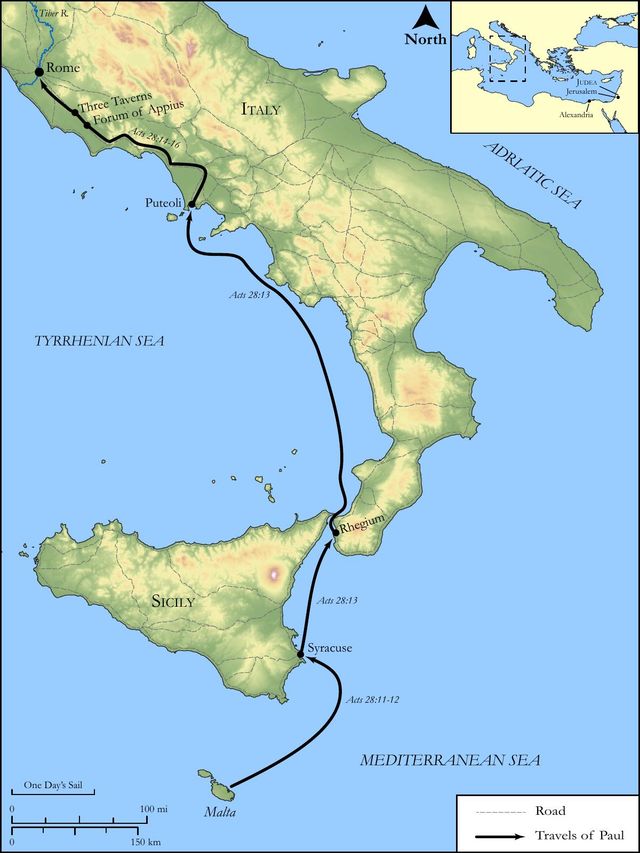
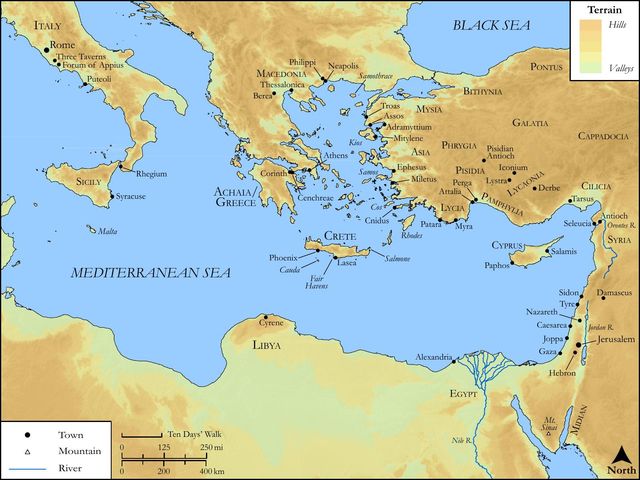
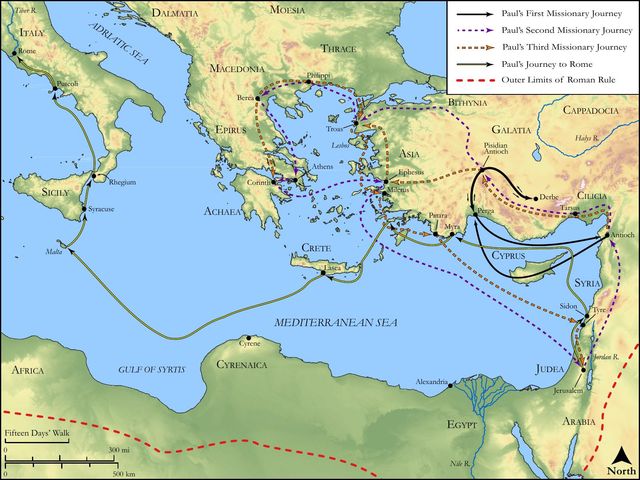
See on the biblical-era maps
Study this verse
Public-domain commentary
Matthew Henry
From his Commentary on the Whole Bible. Henry comments on passages, not single verses — this entry covers Acts 28:30–31. His four-level outline is real structure in the source text, so it is rendered as structure.
We are here taking our leave of the history of blessed Paul; and therefore, since God saw it not fit that we should know any more of him, we should carefully take notice of every particular of the circumstances in which we must here leave him.
I.It cannot but be a trouble to us that we must leave him in bonds for Christ, nay, and that we have no prospect given us of his being set at liberty. Two whole years of that good man's life are here spent in confinement, and, for aught that appears, he was never enquired after, all that time, by those whose prisoner he was. He appealed to Caesar, in hope of a speedy discharge from his imprisonment, the governors having signified to his imperial majesty concerning the prisoner that he had done nothing worthy of death or bonds, and yet he is detained a prisoner. So little reason have we to trust in men, especially despised prisoners in great men; witness the case of Joseph, whom the chief butler remembered not, but forgot, Gen 40:23. Yet some think that though it be not mentioned here, yet it was in the former of these two years, and early too in that year, that he was first brought before Nero, and then his bonds in Christ were manifest in Caesar's court, as he says, Phi 1:13. And at this first answer it was that no man stood by him, Ti2 4:16. But it seems, instead of being set at liberty upon this appeal, as he expected, he hardly escaped out of the emperor's hands with his life; he calls it a deliverance out of the mouth of the lion, Ti2 4:17, and his speaking there of his first answer intimates that since that he had a second, in which he had come off better, and yet was not discharged. During these two years' imprisonment he wrote his epistle to the Galatians, then his second epistle to Timothy, then those to the Ephesians, Philippians, Colossians, and to Philemon, in which he mentions several things particularly concerning his imprisonment; and, lastly, his epistle to the Hebrews just after he was set at liberty, as Timothy also was, who, coming to visit him, was upon some account or other made his fellow-prisoner (with whom, writes Paul to the Hebrews, Plm 1:13 :23, if he come shortly, I will see you), but how or by what means he obtained his liberty we are not told, only that two years he was a prisoner. Tradition says that after his discharge he went from Italy to Spain, thence to Crete, and so with Timothy into Judea, and thence went to visit the churches in Asia, and at length came a second time to Rome, and there was beheaded in the last year of Nero. But Baronius himself owns that there is no certainty of any thing concerning him betwixt his release from this imprisonment and his martyrdom; but it is said by some that Nero, having, when he began to play the tyrant, set himself against the Christians, and persecuted them (and he was the first of the emperors that made a law against them, as Tertullian says, Apol. cap. 5), the church at Rome was much weakened by that persecution, and this brought Paul the second time to Rome, to re-establish the church there, and to comfort the souls of the disciples that were left, and so he fell a second time into Nero's hand. And Chrysostom relates that a young woman that was one of Nero's misses (to speak modishly) being converted, by Paul's preaching, to the Christian faith, and so brought off from the lewd course of life she had lived, Nero was incensed against Paul for it, and ordered him first to be imprisoned, and then put to death. But to keep to this short account here given of it,
1.It would grieve one to think that such a useful man as Paul was should be so long in restraint. Two years he was a prisoner under Felix (Act 24:27), and, besides all the time that passed between that and his coming to Rome, he is here two years more a prisoner under Nero. How many churches might Paul have planted, how many cities and nations might he have brought over to Christ, in these five years' time (for so much it was at least), if he had been at liberty! But God is wise, and will show that he is not debtor to the most useful instruments he employs, but can and will carry on his own interest, both without their services and by their sufferings. Even Paul's bonds fell out to the furtherance of the gospel, Phi 1:12-14.
2.Yet even Paul's imprisonment was in some respects a kindness to him, for these two years he dwelt in his own hired house, and that was more, for aught I know, than ever he had done before. He had always been accustomed to sojourn in the houses of others, now he has a house of his own - his own while he pays the rent of it; and such a retirement as this would be a refreshment to one who had been all his days an itinerant. He had been accustomed to be always upon the remove, seldom staid long at a place, but now he lived for two years in the same house; so that the bringing of him into this prison was like Christ's call to his disciples to come into a desert place, and rest awhile, Mar 6:31. When he was at liberty, he was in continual fear by reason of the lying in wait of the Jews (Act 20:19), but now his prison was his castle. Thus out of the eater came forth meat, and out of the strong sweetness.
II.Yet it is a pleasure to us (for we are sure it was to him) that, though we leave him in bonds for Christ, yet we leave him at work for Christ, and this made his bonds easy that he was not by them bound out from serving God and doing good. His prison becomes a temple, a church, and then it is to him a palace. His hands are tied, but, thanks be to God, his mouth is not stopped; a faithful zealous minister can better bear any hardship than being silenced. Here is Paul a prisoner, and yet a preacher; he is bound, but the word of the Lord is not bound. When he wrote his epistle to the Romans, he said he longed to see them, that he might impart unto them some spiritual gift (Rom 1:11); he was glad to see some of them (Act 28:15), but it would not be half his joy unless he could impart to them some spiritual gift, which here he has an opportunity to do, and then he will not complain of his confinement. Observe,
1.To whom he preached: to all that had a mind to hear him, whether Jews or Gentiles. Whether he had liberty to go to other houses to preach does not appear; it is likely not; but whoever would had liberty to come to his house to hear, and they were welcome: He received all that came to him. Note, Ministers' doors should be open to such as desire to receive instruction from them, and they should be glad of an opportunity to advise those that are in care about their souls. Paul could not preach in a synagogue, or any public place of meeting that was sumptuous and capacious, but he preached in a poor cottage of his own. Note, When we cannot do what we would in the service of God we must do what we can. Those ministers that have but little hired houses should rather preach in them, if they may be allowed to do that, than be silent. He received all that came to him, and was not afraid of the greatest, nor ashamed of the meanest. He was ready to preach on the first day of the week to Christians, on the seventh day to Jews, and to all who would come on any day of the week; and he might hope the better to speed because they came in unto him, which supposed a desire to be instructed and a willingness to learn, and where these are it is probable that some good may be done.
2.What he preached. He does not fill their heads with curious speculations, nor with matters of state and politics, but he keeps to his text, minds his business as an apostle.
(1.)He is God's ambassador, and therefore preaches the kingdom of God, does all he can to preach it up, negotiates the affairs of it, in order to the advancing of all its true interests. He meddles not with the affairs of the kingdoms of men; let those treat of them whose work it is. He preaches the kingdom of God among men, and the word of that kingdom; the same that he defended in his public disputes, testifying the kingdom of God (Act 28:23), he enforced in his public preaching, as that which, if received aright, will make us all wise and good, wiser and better, which is the end of preaching.
(2.)He is an agent for Christ, a friend of the bridegroom, and therefore teaches those things which concern the Lord Jesus Christ - the whole history of Christ, his incarnation, doctrine, life, miracles, death, resurrection, ascension; all that relates to the mystery of godliness. Paul stuck still to his principle - to know and preach nothing but Christ, and him crucified. Ministers, when in their preaching they are tempted to diverge from that which is their main business, should reduce themselves with this question, What does this concern the Lord Jesus Christ? What tendency has it to bring us to him, and to keep us walking in him? For we preach not ourselves, but Christ.
3.With what liberty he preached.
(1.)Divine grace gave him a liberty of spirit. He preached with all confidence, as one that was himself well assured of the truth of what he preached - that it was what he durst stand by; and of the worth of it - that it was what he durst suffer for. He was not ashamed of the gospel of Christ.
(2.)Divine Providence gave him a liberty of speech: No man forbidding him, giving him any check for what he did or laying any restraint upon him. The Jews that used to forbid him to speak to the Gentiles had no authority here; and the Roman government as yet took no cognizance of the profession of Christianity as a crime. Herein we must acknowledge the hand of God,
[1.]Setting bounds to the rage of persecutors; where he does not turn the heart, yet he can tie the hand and bridle the tongue. Nero was a bloody man, and there were many, both Jews and Gentiles, in Rome, that hated Christianity; and yet so it was, unaccountably, that Paul though a prisoner was connived at in preaching the gospel, and it was not construed a breach of the peace. Thus God makes the wrath of men to praise him, and restrains the remainder of it, Psa 76:10. Though there were so many that had it in their power to forbid Paul's preaching (even the common soldier that kept him might have done it), yet God so ordered it, that no man did forbid him.
[2.]See God here providing comfort for the relief of the persecuted. Though it was a very low and narrow sphere of opportunity that Paul was here placed in, compared with what he had been in, yet, such as it was, he was not molested nor disturbed in it. Though it was not a wide door that was opened to him, yet it was kept open, and no man was suffered to shut it; and it was to many an effectual door, so that there were saints even in Caesar's household, Phi 4:22. When the city of our solemnities is thus made a quiet habitation at any time, and we are fed from day to day with the bread of life, no man forbidding us, we must give thanks to God for it and prepare for changes, still longing for that holy mountain in which there shall never be any pricking brier nor grieving thorn.
Historical interpretation
Four Centuries of Reception
6 surviving comments on this verse. Each one is dated, so this reads as a timeline rather than a list.
Select a marker to jump to its quote. Markers stagger vertically where authors wrote within a few decades of each other.
And Luke, who wrote the Acts of the Apostles, brought his history to a close at this point, after stating that Paul spent two whole years at Rome as a prisoner at large and preached the word of God without restraint. Thus after he had made his defense it is said that the apostle was sent again upon the ministry of preaching and that upon coming to the same city a second time he suffered martyrdom. In this imprisonment [Paul] wrote his second epistle to Timothy, in which he mentions his first defense and his impending death. But hear his testimony on these matters. “At my first answer,” he says, “no one stood with me, but all forsook me: I pray God that it may not be laid to their charge. Notwithstanding the Lord stood with me and strengthened me, that by me the preaching might be fully known and that all the Gentiles might hear; and I was delivered out of the mouth of the lion.” He plainly indicates in these words that on the former occasion, in order that the preaching might be fulfilled by him, he was rescued from the mouth of the lion, referring, in this expression, to Nero, as is probable on account of the latter’s cruelty. He did not therefore afterward add the similar statement, “He will rescue me from the mouth of the lion”; for he saw in the Spirit that his end would not be long delayed. Wherefore he adds to the words “and he delivered me from the mouth of the lion” this sentence, “The Lord shall deliver me from every evil work and will preserve me to his heavenly kingdom,” indicating his speedy martyrdom; which he also foretells still more clearly in the same epistle, when he writes, “For I am now ready to be offered, and the time of my departure is at hand.” In his second epistle to Timothy, moreover, he indicates that Luke was with him when he wrote that at his first defense not even Luke was there. So it is probable that Luke wrote the Acts of the Apostles at that time, continuing his history down to the period when he was with Paul. But these things have been adduced by us to show that Paul’s martyrdom did not take place at the time of that Roman sojourn that Luke records. It is probable indeed that as Nero was more disposed to mildness in the beginning, Paul’s defense of his doctrine was more easily received; but that when he [Nero] had advanced to the commission of lawless deeds of daring, he made the apostles as well as others the subjects of his attacks.
"And Paul dwelt two whole years in his own hired house, and received all that came in unto him, preaching the kingdom of God, and teaching those things which concern the Lord Jesus Christ, with all confidence, no man forbidding him. Amen." It shows the freedom he had now: without hindrance in Rome, he who had been hindered in Judea; and he remained teaching there for two years.
"Discoursed," it says, "the things concerning the kingdom of God:" mark, nothing of the things of sense, nothing of the things present.
And teaching about the Lord Jesus Christ with boldness without hindrance. He was not only not prohibited from preaching in Rome, but also, with Nero's empire not yet firmly established, and with crimes not yet erupting as much as the histories tell about him, he was sent to preach the Gospel of Christ also in the regions of the West, as he himself says to the Romans: Now therefore I am going to Jerusalem to minister to the saints. And shortly after: Therefore, when I have completed this, I will pass through you into Spain. Later, that is, in the last year of Nero, he was detained by him, and was crowned with martyrdom. He explains both these things in the second Epistle to Timothy, which he dictates while being in chains: At my first defense, no one came to my support, but all deserted me. But the Lord stood by me and gave me strength, so that through me the message might be fully proclaimed and all the Gentiles might hear it, and I was rescued from the lion's mouth (II Timothy 4). Very clearly indicating that Nero is the lion because of his cruelty. And in the following: And he saved me, and will save me for his heavenly kingdom (Ibid.), which evidently indicated that he felt his impending martyrdom. Hence, in the same Epistle, he had prefaced by saying: For I am already being poured out like a drink offering, and the time for my departure is near. I have fought the good fight, I have finished the race, I have kept the faith (Ibid.).
However, he remained for two whole years in his own hired house, that is, in the lodgings he had rented for himself, preaching Christ to all, not only to the Jews but also to the Gentiles, who he said were to be saved, those who were rejected.
He remained in his lodging for a full two years and welcomed all who came to him, preaching the kingdom of God. Jerome makes mention of this place in a letter to Lucinius: “Paul enters Rome in chains, to free those chained by errors of superstition; he remains in his rented lodging for two years, to render to us the eternal gift of both instruments.” By this exposition, he taught that all other things that are written in this volume, either about Paul the apostle himself or about others, do not only present the fruits of ecclesiastical doctrine on the surface of the letter: but truly also if anyone has perfectly understood, they possess the essence of spiritual sense, pregnant with virtue.
Continue studying Acts 28:31 across the web’s major study libraries — every link below opens this exact verse, chapter, or book on the destination site.
Read & Compare
 BibleGatewayThis verse in more than 200 translations and 70 languages.
 Bible.comThe YouVersion reader — hundreds of translations, reading plans, and highlights.
 ESV.orgCrossway's official English Standard Version reader.
 NET BibleThe NET translation with 60,000+ translators' notes on every rendering decision.
 STEP BibleTyndale House's free study tool — original text, vocabulary, and scholarly resources.
 BibliaLogos Bible Software's free web reader.
 USCCBThe New American Bible (Revised Edition) with the U.S. bishops' study notes.
Commentaries
 BibleHub CommentariesDozens of classic commentaries on this verse, gathered on one page.
 StudyLightMore than 100 commentary sets — the largest collection on the web.
 BibleRefPlain-English commentary on what this verse means, verse by verse.
 Enduring WordDavid Guzik's free commentary on this chapter, widely used by Bible teachers.
 Bible Study ToolsVerse commentary alongside Greek and Hebrew study aids.
Original Language & Research
- BibleHub InterlinearThe verse word by word — original language, transliteration, and English.
- BibleHub LexiconEvery word's original-language definition and Strong's entry.
 Blue Letter BibleDeep-study tools — Strong's numbers, concordance, and word studies.
 CNTR CollationThe earliest Greek manuscripts of this verse, collated letter by letter.
Sermons, Hymns & Audio


TrulyRandomVerse is not affiliated with these sites and doesn’t control their content. They’re linked because they’re genuinely useful.
Summary
Acts 28:31 stands as the final verse of the entire book of Acts, concluding Luke's sweeping two-volume narrative that began with the birth of Christ and ends with the gospel reaching the heart of the Roman Empire. Paul, under house arrest in Rome, spends his days preaching the kingdom of God and teaching about the Lord Jesus Christ with bold, unhindered freedom. The verse is remarkable not for what it resolves but for what it leaves gloriously open — the unstoppable advance of the gospel message. Luke does not end with Paul's trial verdict, his release, or his death; instead, he ends with the word "unhindered" (akōlytōs), a ringing declaration that no chains, no empire, and no human authority can silence the proclamation of Christ's lordship. This is not a loose end but a theological crescendo: the mission that Jesus inaugurated in Luke 4:18-19 and commissioned in Acts 1:8 has now reached Rome, the symbolic ends of the earth, and it continues without obstacle.
Context
ShowHideLiterary Context
This verse is the capstone of the book of Acts and, by extension, the conclusion of Luke's entire literary project spanning the Gospel of Luke and the Acts of the Apostles. Luke has carefully traced the gospel's geographic and ethnic expansion — from Jerusalem to Judea, from Samaria to the Gentile world, and finally to Rome itself. The preceding verses (Acts 28:26-29) record Paul's confrontation with unbelieving Jews in Rome, citing Isaiah 6:9-10, and his declaration that salvation has been sent to the Gentiles. Verse 31 then closes the entire narrative not with resolution of Paul's legal case but with an image of ongoing, fearless proclamation — a deliberately open ending that signals the story of the church is far from over.
Historical & Cultural Context
Paul arrived in Rome as a prisoner appealing to Caesar (circa AD 60-62), yet Roman law permitted him to live in his own rented quarters under guard, receiving visitors freely. This arrangement, known as custodia libera, was a relatively lenient form of detention for those awaiting trial. Rome was the political and cultural center of the known world, home to a diverse population including a significant Jewish community. Paul's ability to preach openly in the imperial capital — despite being in chains — would have struck Luke's original audience as deeply ironic and theologically significant: the gospel has penetrated the very seat of worldly power, and no earthly authority has managed to silence it.
Key Themes
ShowHideThe dominant themes converging in this final verse include the unstoppable progress of the gospel, the sovereignty of God over human institutions, and the continuity between the kingdom of God and the lordship of Jesus Christ. Luke ties together his emphasis on bold witness (parrhēsia), a theme that runs from Acts 4:13 through the entire narrative, with the theological reality that God's kingdom advances through faithful proclamation regardless of circumstance. The open ending also reinforces the theme of the Gentile mission as the fulfillment of God's redemptive plan announced throughout the Old Testament.
Exposition and Analysis
ShowHideThe final verse of Acts is one of the most carefully crafted conclusions in all of Scripture. Every word carries theological weight, and Luke's decision to end here — rather than with the outcome of Paul's trial — reveals his true purpose: Acts is not a biography of Paul but a record of the gospel's triumphant, unstoppable march from Jerusalem to the ends of the earth. The verse presents two parallel activities (preaching and teaching), two objects of proclamation (the kingdom of God and the things concerning Jesus Christ), and two qualifying descriptions (with all boldness and without hindrance). This careful parallelism encapsulates the entire message of Acts in a single sentence.
Key Word Analysis
ShowHideFrom Strong's G2784, meaning to herald as a public crier, especially divine truth. The word carries the force of an official, authoritative proclamation — not a private conversation but a public announcement of royal decree. Paul is functioning as a herald of the King, declaring the arrival of God's kingdom in the very capital of the world's most powerful human kingdom. This same word describes the core apostolic activity throughout Acts, from Acts 8:5 to Acts 20:25.
From Strong's G3954, derived from pâs (all) and a derivative of rhēō (to speak), literally meaning all-out-spokenness — complete frankness, bluntness, and openness without reservation. This word has been a programmatic theme throughout Acts, describing the Spirit-empowered boldness that characterized the early church's witness in the face of opposition. It is the very quality the apostles prayed for in Acts 4:29, and Luke places it here at the climax of his narrative to show that God answered that prayer abundantly.
From Strong's G209, an adverb meaning in an unhindered manner, freely, without obstruction. This is the final word in the Greek text of Acts, and its placement is emphatic and deliberate. Compounded from a negative particle and a derivative of kōlyō (to hinder or forbid), it declares that nothing has succeeded in blocking the gospel's advance. Luke ends his entire two-volume work with this single, resounding adverb — the message cannot be stopped.
Verse Breakdown
ShowHide"Preaching the kingdom of God"
Paul's proclamation centers on the basileía — the sovereign rule and reign of God. This phrase connects the end of Acts directly back to its beginning, where the risen Jesus spent forty days teaching about the kingdom of God (Acts 1:3). The kingdom of God was also the heart of Jesus' own preaching ministry in Luke's Gospel, creating a seamless theological arc across both volumes. That Paul preaches this kingdom in Rome, the seat of Caesar's kingdom, is rich with irony — a prisoner announces a reign that supersedes all earthly empires.
"and teaching those things which concern the Lord Jesus Christ"
The shift from "preaching" (kēryssō) to "teaching" (didaskō, G1321) indicates two complementary modes of ministry — public proclamation of the gospel to those who have not heard, and systematic instruction about Jesus for those seeking deeper understanding. The full title "Lord Jesus Christ" gathers three profound claims: kýrios (G2962, supreme authority), Iēsoûs (G2424, the human name meaning "Yahweh saves"), and Christós (G5547, the anointed Messiah). Luke uses this complete title to declare that the kingdom of God is not an abstraction — it is embodied and inaugurated in the person of Jesus, who is simultaneously the promised Messiah of Israel and the Lord of all creation.
"with all confidence, no man forbidding him"
These two phrases form the theological climax of the entire book. "With all confidence" (metá pásēs parrhēsías) describes Paul's inner disposition — total, fearless openness empowered by the Holy Spirit. "No man forbidding him" (akōlytōs) describes the external reality — despite imprisonment, opposition, shipwreck, and hostility, no force has succeeded in silencing the gospel. Together they proclaim that the advance of God's word depends not on human freedom or favorable circumstances but on divine sovereignty. The chains are on Paul, but the word of God is not chained (2 Timothy 2:9).
Literary Devices
ShowHideLuke employs a masterful open ending (or narrative aperture) that transforms what might seem like an incomplete story into a powerful theological statement — the mission continues beyond the page, inviting every subsequent generation of readers into the ongoing story of the church. The verse features striking irony: a chained prisoner preaches with more freedom than the empire that holds him, and the word "unhindered" describes someone under Roman guard. There is deliberate inclusio at work, as Acts begins with Jesus teaching about the kingdom of God (Acts 1:3) and ends with Paul doing the same in Rome, framing the entire narrative as the story of the kingdom's expansion. Luke also uses parallelism in the twin activities of preaching and teaching, and in the twin objects of the kingdom of God and the Lord Jesus Christ, binding together the theocentric and Christocentric dimensions of the gospel into a unified proclamation.
Theological and Thematic Connections
ShowHideActs 28:31 gathers the major theological threads of Luke-Acts into a single, luminous conclusion. The kingdom of God, which Jesus announced at the start of his ministry and explained to his disciples after the resurrection, is now being proclaimed at the center of the Gentile world — fulfilling the promise of Acts 1:8 that the gospel would reach the ends of the earth. The sovereignty of God over all human institutions is on full display: Rome intended Paul as a prisoner, but God positioned him as an ambassador. The theme of bold witness, which has been the heartbeat of Acts since Pentecost, reaches its apex here — the Spirit who empowered Peter in Jerusalem now empowers Paul in Rome with the same fearless confidence. The pairing of "kingdom of God" with "Lord Jesus Christ" makes an implicit but unmistakable theological claim: Jesus is the King through whom God's reign is established, and to preach the kingdom is to preach Christ. This verse also carries profound eschatological significance — the kingdom is both present reality and future hope, already breaking into the world through proclamation even as it awaits final consummation.
Reflection and Application
ShowHideThe ending of Acts challenges every reader to reconsider what it means for the gospel to be "unhindered." Paul was not free in any conventional sense — he was chained to a Roman soldier, confined to rented quarters, awaiting a trial that could end in his execution. Yet Luke describes his ministry with the most triumphant language possible. This forces us to confront a profound truth: the power of the gospel does not depend on the comfort, freedom, or social standing of those who proclaim it. Throughout history, the church has often grown most vigorously under persecution and constraint, precisely because the word of God is not bound by the circumstances of its messengers. For contemporary believers, this verse is both a comfort and a challenge. It comforts because it assures us that God's purposes will not be thwarted by any opposition — political, cultural, or personal. It challenges because it asks whether we proclaim Christ with the same "all boldness" that characterized Paul, or whether we allow far lesser obstacles than imprisonment to silence our witness. The open ending of Acts is also an invitation: the story is not finished. Every generation of believers writes the next chapter through faithful, confident proclamation of the kingdom of God and the lordship of Jesus Christ.
Questions for Reflection
ShowHideFAQ
ShowHideWhy does the book of Acts end so abruptly without telling us what happened to Paul?
ShowHideLuke's purpose in writing Acts was not to provide a biography of Paul but to trace the unstoppable advance of the gospel from Jerusalem to Rome. By ending with Paul preaching "unhindered" in the imperial capital, Luke achieves his theological goal — the word of God has reached the center of the known world and nothing can stop it. The "abrupt" ending is actually a carefully crafted literary and theological statement: the story of the church does not end with any one person's fate but continues as long as the gospel is proclaimed. Luke leaves Paul's trial unresolved because the resolution that matters — the triumph of God's kingdom — is already on full display.
What is the significance of the word "unhindered" (akōlytōs) being the last word of Acts?
ShowHideIn the original Greek text, akōlytōs (unhindered, without obstruction) is indeed the final word of the entire book, and its placement is widely regarded as deliberate and emphatic. Throughout Acts, various forces have attempted to hinder the gospel — the Sanhedrin, mob violence, imprisonment, shipwreck, and religious opposition — yet none have succeeded. By making "unhindered" his last word, Luke delivers the definitive verdict on the entire narrative: the gospel cannot be stopped. This single adverb encapsulates the triumphant theology of the book and sends the reader forward with confidence that the same unstoppable power continues in the ongoing mission of the church.
How does Acts 28:31 connect the "kingdom of God" with "the Lord Jesus Christ"?
ShowHideBy placing these two phrases in parallel — preaching the kingdom of God and teaching about the Lord Jesus Christ — Luke makes an essential theological identification: the kingdom of God and the lordship of Christ are inseparable realities. The kingdom is not an abstract concept or a distant future hope; it is the reign of God made concrete and accessible through the person, work, death, and resurrection of Jesus the Messiah. This pairing reflects the consistent teaching of the apostles throughout Acts, where proclaiming the kingdom always involved proclaiming Jesus as Lord and Christ (Acts 8:12, Acts 19:8, Acts 28:23). To enter the kingdom is to submit to Christ's lordship, and to acknowledge Christ as Lord is to live under God's sovereign reign.
Christ-Centered Fulfillment
ShowHideActs 28:31 is the crescendo of a symphony that began with the angel's announcement to Mary that her son would receive "the throne of his father David" and reign over a kingdom without end (Luke 1:32-33). Everything Luke has written across two volumes converges here: Jesus, who proclaimed the kingdom of God throughout his earthly ministry, who was crucified under the title "King of the Jews," and who rose from the dead as vindicated Lord and Messiah, is now being heralded in the capital of the greatest empire on earth. The full title "Lord Jesus Christ" captures the totality of his identity — he is kýrios, the sovereign Lord before whom every knee will bow (Philippians 2:10-11); he is Iēsoûs, the one who saves his people from their sins (Matthew 1:21); and he is Christós, the anointed one who fulfills every messianic promise of the Old Testament. That this proclamation goes forth "unhindered" is itself a fulfillment of Christ's own promise that the gates of hell would not prevail against his church (Matthew 16:18), and that his witnesses would carry his name before Gentiles and kings and the children of Israel (Acts 9:15). The open ending of Acts proclaims that the risen Christ continues his work through his Spirit-empowered church, and that his kingdom — unlike Rome's — will never fall.