


Acts 19:8
Bible text: King James Version (1769 Blayney text) · Public domain
Bible text: King James Version with Strong's numbers · Public domain
Bible text: Berean Standard Bible · Public domain
Bible text: American Standard Version (1901) · Public domain
Bible text: World English Bible, Messianic edition · Public domain
Bible text: Geneva Bible (1599) · Public domain
Bible text: Young's Literal Translation · Public domain
- ΕἰσελθὼνEiselthōnHaving enteredG1525V-2AAP-NSMVerb 2nd Aorist Active Participle Nominative Singular Masculine
- δὲdethenG1161CONJConjunction
- εἰςeisintoG1519PREPPreposition
- τὴνtēntheG3588T-ASFDefinite article Accusative Singular Feminine
- συναγωγὴνsunagōgēnsynagogueG4864N-ASFNoun Accusative Singular Feminine
- ἐπαρρησιάζετοeparrēsiazetohe was speaking boldlyG3955V-INI-3SVerb Imperfect Middle Or Passive Deponent Indicative 3rd Singular
- ἐπὶepiforG1909PREPPreposition
- μῆναςmēnasmonthsG3376N-APMNoun Accusative Plural Masculine
- τρεῖςtreisthreeG5140A-APMAdjective Accusative Plural Masculine
- διαλεγόμενοςdialegomenosreasoningG1256V-PNP-NSMVerb Present Middle Or Passive Deponent Participle Nominative Singular Masculine
- καὶkaiandG2532CONJConjunction
- πείθωνpeithōnpersuadingG3982V-PAP-NSMVerb Present Active Participle Nominative Singular Masculine
- τὰta<the>G3588T-APNDefinite article Accusative Plural Neuter
- περὶpericoncerningG4012PREPPreposition
- τῆςtēstheG3588T-GSFDefinite article Genitive Singular Feminine
- βασιλείαςbasileiaskingdomG932N-GSFNoun Genitive Singular Feminine
- τοῦtou<the>G3588T-GSMDefinite article Genitive Singular Masculine
- θεοῦtheouof GodG2316N-GSM-TNoun Genitive Singular Masculine Title
English is a literal word-by-word gloss of the Greek, not the KJV's wording. Why?
This is the original text the KJV's translators worked from — each Greek word with its own literal English meaning in this verse, prepared by scholars at Tyndale House, Cambridge. The KJV translates whole sentences, not word by word, so its wording differs: one Greek word can become several English words, and the KJV may choose “charity” where the gloss reads “love”. Both are faithful — they answer different questions. For the KJV's own rendering, switch to the KJV text.
Details
See on the biblical-era maps
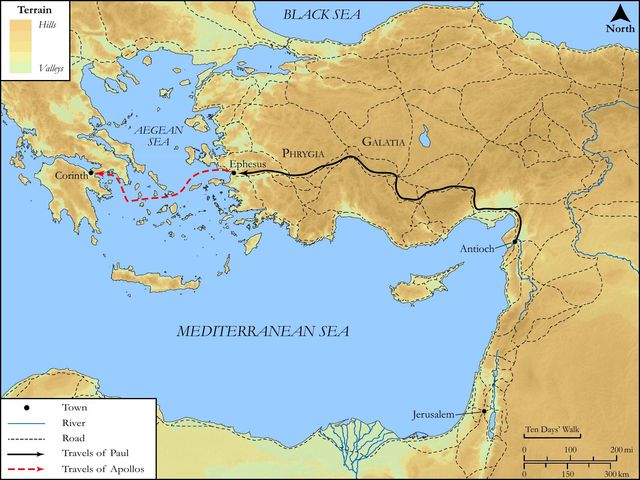
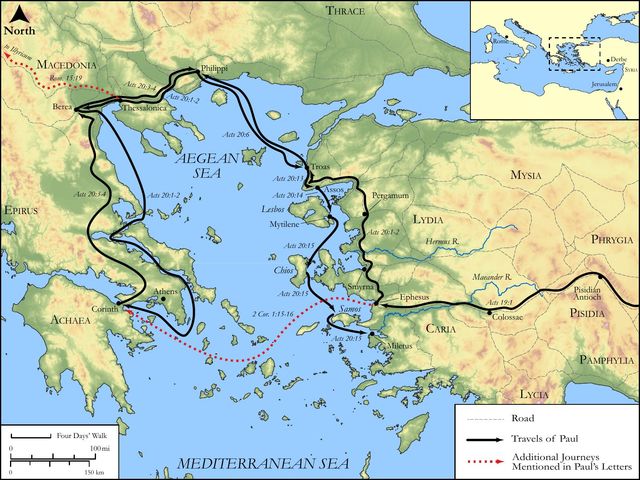
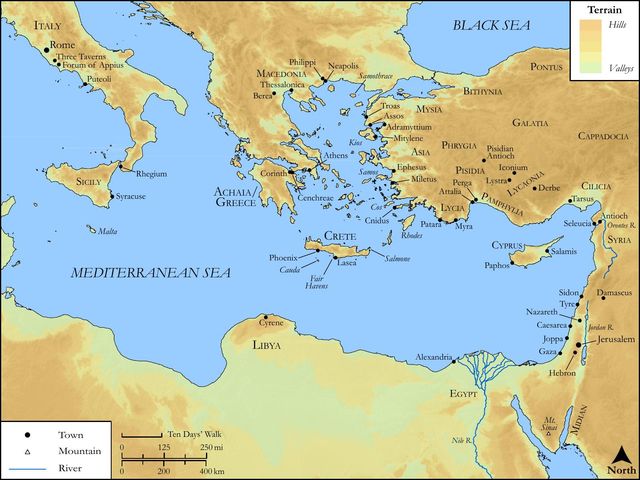
Study this verse
Public-domain commentary
Matthew Henry
From his Commentary on the Whole Bible. Henry comments on passages, not single verses — this entry covers Acts 19:8–12. His four-level outline is real structure in the source text, so it is rendered as structure.
Paul is here very busy at Ephesus to do good.
I.He begins, as usual, in the Jews' synagogue, and makes the first offer of the gospel to them, that he might gather in the lost sheep of the house of Israel, who were now scattered upon the mountains. Observe,
1.Where he preached to them: in their synagogue (Act 19:8), as Christ used to do. He went and joined them in their synagogue-worship, to take off their prejudices against him, and to ingratiate himself with them, while there was any hope of winning upon them. Thus he would bear his testimony to public worship on sabbath days. Where there were no Christian assemblies yet formed, he frequented the Jewish assemblies, while the Jews were not as yet wholly cast off. Paul went into the synagogue, because there he had them together, and had them, it might be hoped, in a good frame.
2.What he preached to them: The things concerning the kingdom of God among men, the great things which concerned God's dominion over all men and favour to them, and men's subjection to God and happiness in God. He showed them their obligations to God and interest in him, as the Creator, by which the kingdom of God was set up, - the violation of those obligations, and the forfeiture of that interest, by sin, by which the kingdom of God was pulled down, - and the renewing of those obligations and the restoration of man to that interest again, by the Redeemer, whereby the kingdom of God was again set up. Or, more particularly, the things concerning the kingdom of the Messiah, which the Jews were in expectation of, and promised themselves great matters from; he opened the scriptures which spoke concerning this, gave them a right notion of this kingdom, and showeth them their mistakes about it.
3.How he preached to them.
(1.)He preached argumentatively: he disputed; gave reasons, scripture-reasons, for what he preached, and answered objections, for the convincing of men's judgments and consciences, that they might not only believe, but might see cause to believe. He preached dialegomenos - dialogue-wise; he put questions to them and received their answers, gave them leave to put questions to him and answered them.
(2.)He preached affectionately: he persuaded; he used not only logical arguments, to enforce what he said upon their understandings, but rhetorical motives, to impress what he said upon their affections, showing them that the things he preached concerning the kingdom of God were things concerning themselves, which they were nearly concerned in, and therefore ought to concern themselves about, Co2 5:11, We persuade men. Paul was a moving preacher, and was a master of the art of persuasion.
(3.)He preached undauntedly, and with a holy resolution: he spoke boldly, as one that had not the least doubt of the things he spoke of, nor the least distrust of him he spoke fRom. nor the least dread of those he spoke to.
4.How long he preached to them: For the space of three months, which was a competent time allowed them to consider of it; in that time among them that belonged to the election of grace were called in, and the rest were left inexcusable. Thus long Paul preached the gospel with much contention (Th1 2:2), yet he did not fail, nor was discouraged.
5.What success his preaching had among them.
(1.)There were some that were persuaded to believe in Christ; some think this is intimated in the word persuading - he prevailed with them. But,
(2.)Many continued in their infidelity, and were confirmed in their prejudices against Christianity. When Paul called on them before, and preached only some general things to them, they courted his stay among them (Act 18:20); but now that he settled among them, and his word came more closely to their consciences, they were soon weary of him.
[1.]They had an invincible aversion to the gospel of Christ themselves: they were hardened, and believed not; they were resolved they would not believe, though the truth shone in their faces with ever such a convincing light and evidence. Therefore they believed not, because they were hardened.
[2.]They did their utmost to raise and keep up in others an aversion to the gospel; they not only entered not into the kingdom of God themselves, but neither did they suffer those that were entering to go in; for they spoke evil of that way before the multitude, to prejudice them against it. Though they could not show any manner of evil in it, yet they said all manner of evil concerning it. These sinners, like the angels that sinned, became Satans, adversaries and devils, false accusers.
II.When he had carried the matter as far as it would go in the synagogue of the Jews, and found that their opposition grew more obstinate, he left the synagogue, because he could not safely, or rather because he could not comfortably and successfully, continue in communion with them. Though their worship was such as he could join in, and they had not silenced him, nor forbidden him to preach among them, yet they drove him from them by their railing at those things which he spoke concerning the kingdom of God: they hated to be reformed, hated to be instructed, and therefore he departed from them. Here we are sure there was a separation and no schism; for there was a just cause for it and a clear call to it. Now observe,
1.When Paul departed from the Jews he took the disciples with him, and separated them, to save them from that untoward generation (according to the charge Peter gave to his new converts, Act 2:40); lest they should be infected with the poisonous tongues of those blasphemers, he separated those who believed, to be the foundation of a Christian church, now that they were a competent number to be incorporated, that others might attend with them upon the preaching of the gospel, and might, upon their believing, be added to them. When Paul departed there needed no more to separate the disciples; let him go where he will, they will follow him.
2.When Paul separated from the synagogue he set up a meeting of his own, he disputed daily in the school of one Tyrannus. He left the synagogue of the Jews, that he might go on with the more freedom in his work; still he disputed for Christ and Christianity, and was ready to answer all opponents whatsoever in defence of them; and he had by this separation a double advantage.
(1.)That now his opportunities were more frequent. In the synagogue he could only preach every sabbath day (Act 13:42), but now he disputed daily, he set up a lecture every day, and thus redeemed time: those whose business would not permit them to come one day might come another day; and those were welcome who watched daily at these gates of wisdom, and waited daily at the posts of her doors.
(2.)That now they were more open. To the synagogue of the Jews none might come, nor could come, but Jews or proselytes; Gentiles were excluded; but, when he set up a meeting in the school of Tyrannus, both Jews and Greeks attended his ministry, v. 10. Thus, as he describes this gate of opportunity at Ephesus (Co1 16:8, Co1 16:9), a wide door and an effectual was opened to him, though there were many adversaries. Some think this school of Tyrannus was a divinity-school of the Jews, and such a one they commonly had in their great cities besides their synagogue; they called it Bethmidrash, the house of enquiry, or of repetition; and they went to that on the sabbath day, after they had been in the synagogue. They go from strength to strength, from the house of the sanctuary to the house of doctrine. If this was such a school, it shows that though Paul left the synagogue he left it gradually, and still kept as near it as he could, as he had done, Act 18:7. But others think it was a philosophy-school of the Gentiles, belonging to one Tyrannus, or a retiring place (for so the word scholē sometimes signifies) belonging to a principal man or governor of the city; some convenient place it was, which Paul and the disciples had the use of, either for love or money.
3.Here he continued his labours for two years, read his lectures and disputed daily. These two years commence from the end of the three months which he spent in the synagogue (Act 19:8); after they were ended, he continued for some time in the country about, preaching; therefore he might justly reckon it in all three years, as he does, Act 20:31.
4.The gospel hereby spread far and near (Act 19:10): All those that dwelt in Asia heard the word of the Lord Jesus; not only all that dwelt in Ephesus, but all that dwelt in that large province called Asia, of which Ephesus was the head city - Asia the Less it was called. There was great resort to Ephesus from all parts of the country, for law, traffic, religion, and education, which gave Paul an opportunity of sending the report of the gospel to all the towns and villages of that country. They all heard the word of the Lord Jesus. The gospel is Christ's word, it is a word concerning Christ. This they heard, or at least heard of it. Some of all sects, some out of all parts both in city and country, embraced this gospel, and entertained it, and by them it was communicated to others; and so they all heard the word of the Lord Jesus, or might have heard it. Probably Paul sometimes made excursions himself into the country, to preach the gospel, or sent his missionaries or assistants that attended him, and thus the word of the Lord was heard throughout that region. Now those that sat in darkness saw a great light.
III.God confirmed Paul's doctrine by miracles, which awakened people's enquiries after it, fixed their affection to it, and engaged their belief of it, Act 19:11, Act 19:12. I wonder we have not read of any miracle wrought by Paul since the casting of the evil spirit out of the damsel at Philippi; why did he not work miracles at Thessalonica, Berea, and Athens? Or, if he did, why are they not recorded? Was the success of the gospel, without miracles in the kingdom of nature, itself such a miracle in the kingdom of grace, and the divine power which went along with it such a proof of its divine original, that there needed no other? It is certain that at Corinth he wrought many miracles, though Luke has recorded none, for he tells them (Co2 12:12) that the signs of his apostleship were among them, in wonders and mighty deeds. But here at Ephesus we have a general account of the proofs of this kind which he gave his divine mission.
1.They were special miracles - Dunameis ou tuchousas. God exerted powers that were not according to the common course of nature: Virtutes non vulgares. Things were done which could by no means be ascribed either to chance or second causes. Or, they were not only (as all miracles are) out of the common road, but they were even uncommon miracles, such miracles as had not been wrought by the hands of any other of the apostles. The opposers of the gospel were so prejudiced that any miracles would not serve their turn; therefore God wrought virtutes non quaslibet (so they render it), something above the common road of miracles.
2.It was not Paul that wrought them (What is Paul, and what is Apollos?) but it was God that wrought them by the hand of Paul. He was but the instrument, God was the principal agent.
3.He not only cured the sick that were brought to him, or to whom he was brought, but from his body were brought to the sick handkerchiefs or aprons; they got Paul's handkerchiefs, or his aprons, that is, say some, the aprons he wore when he worked at his trade, and the application of them to the sick cured them immediately. Or, they brought the sick people's handkerchiefs, or their girdles, or caps, or head-dresses, and laid them for awhile to Paul's body, and then took them to the sick. The former is more probable. Now was fulfilled that word of Christ to his disciples, Greater works than these shall you do. We read of one that was cured by the touch of Christ's garment when it was upon him, and he perceived that virtue went out of him; but here were people cured by Paul's garments when they were taken from him. Christ gave his apostles power against unclean spirits and against all manner of sickness (Mat 10:1), and accordingly we find here that those to whom Paul sent relief had it in both those cases: for the diseases departed from them and the evil spirits went out of them, which were both significant of the great design and blessed effect of the gospel, and the healing of spiritual disease, and freeing the souls of men from the power and dominion of Satan.
Historical interpretation
Historical reception
2 surviving comments on this verse. Each one is dated, so this reads as a timeline rather than a list.
See him in every place forcing his way into the synagogue, and in this manner departing thence. For in every place, he wished to have the occasion given him by them. He wished to separate the disciples thence, and to have the beginning for ceasing to assemble with them, given by the Jews themselves. He was henceforth "provoking them to jealousy." For both the Gentiles readily received him, and the Jews, upon the Gentiles receiving him, repented. This is why he continually made a stir among them, "for three months arguing and persuading concerning the kingdom of God": for you must not suppose because you hear of his "speaking boldly," that there was any harshness: it was of good things that he discoursed, of a kingdom: who would not have heard him?
"And having entered in to the synagogue," etc. But why did he speak boldly? It means, he was ready to confront dangers, and disputed more openly, not veiling the doctrines. "But when some were hardened, and spake evil of the way, having departed from them, he separated the disciples." He put a stop, it means, to their evil-speaking: he did not wish to kindle their envy, nor to bring them into more contention. Hence let us also learn not to put ourselves in the way of evil-speaking men, but to depart from them: he did not speak evil, when himself evil spoken of. "He disputed daily," and by this gained the many, that, being evil intreated and evil spoken of, he did not utterly break away from them, and keep aloof. The evil-speakers are defeated. They calumniated the doctrine itself; therefore so as neither to rouse the disciples to wrath, nor disturb them, he withdrew, showing that everywhere alike they repel salvation from them.
Continue studying Acts 19:8 across the web’s major study libraries — every link below opens this exact verse, chapter, or book on the destination site.
Read & Compare
 BibleGatewayThis verse in more than 200 translations and 70 languages.
 Bible.comThe YouVersion reader — hundreds of translations, reading plans, and highlights.
 ESV.orgCrossway's official English Standard Version reader.
 NET BibleThe NET translation with 60,000+ translators' notes on every rendering decision.
 STEP BibleTyndale House's free study tool — original text, vocabulary, and scholarly resources.
 BibliaLogos Bible Software's free web reader.
 USCCBThe New American Bible (Revised Edition) with the U.S. bishops' study notes.
Commentaries
 BibleHub CommentariesDozens of classic commentaries on this verse, gathered on one page.
 StudyLightMore than 100 commentary sets — the largest collection on the web.
 BibleRefPlain-English commentary on what this verse means, verse by verse.
 Enduring WordDavid Guzik's free commentary on this chapter, widely used by Bible teachers.
 Bible Study ToolsVerse commentary alongside Greek and Hebrew study aids.
Original Language & Research
- BibleHub InterlinearThe verse word by word — original language, transliteration, and English.
- BibleHub LexiconEvery word's original-language definition and Strong's entry.
 Blue Letter BibleDeep-study tools — Strong's numbers, concordance, and word studies.
 CNTR CollationThe earliest Greek manuscripts of this verse, collated letter by letter.
Sermons, Hymns & Audio


TrulyRandomVerse is not affiliated with these sites and doesn’t control their content. They’re linked because they’re genuinely useful.
Summary
Acts 19:8 details the commencement of Paul's significant ministry in Ephesus, a pivotal city in the Roman province of Asia. Consistent with his established evangelistic pattern, Paul initiated his efforts within the local Jewish synagogue, where he fearlessly and persistently proclaimed the message of God's kingdom for three months, engaging in rigorous debate and seeking to convince his hearers of its profound truths. This verse sets the stage for a period of intense spiritual activity and opposition in Ephesus.
Context
ShowHideLiterary Context
This verse marks the beginning of Paul's extended and impactful ministry in Ephesus, as described in Acts 19. Having arrived after traversing the "upper coasts" (likely referring to the highlands of Anatolia), Paul immediately sought out the Jewish community, a consistent pattern in his missionary journeys. The preceding verses (Acts 19:1-7) recount Paul's encounter with twelve disciples of John the Baptist in Ephesus, who subsequently received the Holy Spirit, highlighting the transition from preparatory ministries to the full outpouring of the Spirit in the early church. Acts 19:8 then pivots to Paul's public engagement, setting the stage for both widespread conversion and significant opposition that would characterize his time in the city, culminating in the riot described later in the chapter.
Historical & Cultural Context
Ephesus was a prominent and wealthy port city, a major commercial and religious center in the Roman Empire. It was the capital of the Roman province of Asia and home to the Temple of Artemis (Diana), famed throughout all Asia, which dominated the city's religious and economic life. This made Ephesus a strategic location for Gospel proclamation, but also a stronghold of paganism and idolatry. Paul's practice of beginning in the synagogue was a common and culturally sensitive strategy. Synagogues served not only as places of worship but also as community centers where Jews and God-fearing Gentiles gathered to discuss Scripture and philosophy. This provided Paul with a ready audience and a familiar framework for presenting Jesus as the Messiah, fulfilling Old Testament prophecies.
Key Themes
ShowHideActs 19:8 powerfully illustrates several recurring themes in the book of Acts and Paul's ministry. Firstly, it underscores Paul's Evangelistic Strategy, which consistently prioritized reaching the Jewish people first, often through the synagogue. This approach reflected God's covenant faithfulness to Israel, even as the Gospel extended to the Gentiles. Secondly, the verse highlights the Bold Proclamation of the Gospel, a characteristic of the Spirit-empowered early church, as seen when the disciples prayed for and received boldness in Acts 4:31. Paul's "disputing and persuading" points to the Intellectual and Spiritual Engagement inherent in early Christian apologetics, where reasoned argument and scriptural exposition were used to convince hearers. Finally, the central message of "the things concerning the kingdom of God" reveals the Primacy of God's Reign and Redemptive Plan in Paul's preaching, a theme central to Jesus's own ministry, as recorded in the Gospels (e.g., Mark 1:15). Paul continued to preach this message throughout his ministry, even to the very end of the book of Acts, as seen in Acts 28:31.
Exposition and Analysis
ShowHideKey Word Analysis
ShowHideThis word describes Paul's manner of speaking. It means to be frank in utterance, or confident in spirit and demeanor. Paul spoke with freedom, openness, and courage, unafraid to declare the truth of the Gospel, even in potentially hostile environments. This boldness was a hallmark of apostolic ministry, empowered by the Holy Spirit.
This term indicates Paul's method of engagement. It means to say thoroughly, to discuss (in argument or exhortation). Paul was not merely lecturing; he was engaging in dialogue, debate, and reasoned discourse, presenting arguments and evidence to support his claims about the kingdom of God.
This word highlights the goal of Paul's disputation. It means to convince (by argument, true or false); by analogy, to pacify or conciliate (by other fair means); reflexively or passively, to assent (to evidence or authority), to rely (by inward certainty). Paul aimed to convince his listeners of the truth of the Gospel, leading them to assent to its message and trust in Christ.
Verse Breakdown
ShowHide"And he went into the synagogue"
This phrase establishes Paul's immediate action upon arriving in Ephesus and highlights his consistent evangelistic strategy. The synagogue served as the primary gathering place for the Jewish community and God-fearing Gentiles, providing a ready audience familiar with the Old Testament scriptures, which Paul would then use to present Jesus as the Messiah.
"and spake boldly for the space of three months"
This clause describes the duration and character of Paul's initial ministry within the synagogue. For a significant period of three months, Paul fearlessly and openly proclaimed the Gospel. His boldness (Greek: parrēsiázomai) indicates a confident and unreserved declaration of truth, undeterred by potential opposition or skepticism from his audience.
"disputing and persuading the things concerning the kingdom of God"
This final clause details the content and method of Paul's preaching. "Disputing" (Greek: dialégomai) signifies intellectual engagement, debate, and reasoned discussion, while "persuading" (Greek: peíthō) indicates his aim to convince his hearers of the truth. The core subject of his message was "the kingdom of God," encompassing God's sovereign rule, His redemptive plan through Christ, and the spiritual realities inaugurated by the Messiah.
Literary Devices
ShowHideThe verse effectively employs Narrative Progression by immediately placing Paul in a familiar setting (the synagogue) and describing his characteristic actions, thereby advancing the story of his ministry in Ephesus. The pairing of "disputing and persuading" forms a Hendiatris, where two distinct words are used to express a single, complex idea—Paul's comprehensive method of engaging his audience through both rational argument and an appeal to their will and belief. This also demonstrates Verbal Irony in a subtle way, as Paul's "persuading" often led to division rather than universal agreement, foreshadowing the eventual split from the synagogue mentioned in the next verse. The phrase "spake boldly" is an example of Characterization, revealing Paul's unwavering courage and conviction, a recurring trait throughout the book of Acts.
Theological and Thematic Connections
ShowHideActs 19:8 underscores the profound theological truth that the Gospel is not merely an emotional appeal but a message grounded in truth that invites rational consideration and conviction. Paul's method of "disputing and persuading" reflects a belief in the inherent power of God's Word to transform minds and hearts, even amidst intellectual or spiritual resistance. The central theme of "the kingdom of God" connects Paul's ministry directly to the core message of Jesus Himself, emphasizing that salvation is not just individual deliverance but participation in God's sovereign reign and the new order inaugurated by Christ. This kingdom is both a present reality experienced by believers and a future hope, calling for a life of submission to God's will and active participation in His redemptive purposes.
Reflection and Application
ShowHideActs 19:8 offers a powerful blueprint for contemporary Christian witness. Paul's example challenges believers to engage with the world around them with both courage and conviction, speaking the truth of God's kingdom without reservation. His willingness to enter the synagogue, a place of potential opposition, and to "dispute and persuade" for an extended period, highlights the importance of patient, reasoned, and Spirit-led evangelism. We are called not merely to declare truths but to thoughtfully articulate them, addressing questions and objections with grace and wisdom. Furthermore, the focus on "the kingdom of God" reminds us that our message is holistic, encompassing God's sovereign rule over all of life, not just individual salvation. Our lives should reflect the values and priorities of this kingdom, demonstrating its transformative power and inviting others to submit to Christ's reign.
Questions for Reflection
ShowHideFAQ
ShowHideWhy did Paul always start his ministry in the synagogue?
ShowHidePaul consistently began his ministry in the Jewish synagogues for several strategic and theological reasons. Firstly, it provided a ready audience that was already familiar with the Old Testament Scriptures, which formed the foundation for understanding Jesus as the Messiah. This allowed Paul to build upon existing knowledge and present the Gospel as the fulfillment of God's promises to Israel, as seen in Acts 17:2-3. Secondly, the synagogue served as a community hub where God-fearing Gentiles also gathered, offering a natural bridge for the Gospel to extend beyond the Jewish community. Theologically, Paul's approach honored God's covenant with Israel, demonstrating that salvation was "to the Jew first and also to the Greek" (Romans 1:16).
Christ-Centered Fulfillment
ShowHideActs 19:8, with its emphasis on Paul's bold proclamation of "the things concerning the kingdom of God," finds its ultimate fulfillment and meaning in Jesus Christ. The "kingdom of God" was the central theme of Jesus's own ministry, from His inaugural sermon in Mark 1:15 to His post-resurrection teachings in Acts 1:3. Paul, as an apostle of Christ, was not introducing a new concept but faithfully extending the message that Jesus Himself inaugurated. Jesus is the King of this kingdom, its embodiment, and its ultimate expression. His life, death, and resurrection established the kingdom, breaking the power of sin and death and offering entrance into God's reign through faith. Paul's "disputing and persuading" was ultimately aimed at convincing people of the truth about Jesus—that He is the promised Messiah, the Lord who reigns, and the one through whom God's kingdom has drawn near. Thus, Paul's ministry in Ephesus, as elsewhere, was a Christ-centered endeavor, inviting people to submit to the Lordship of Jesus and experience the transformative power of His kingdom, a kingdom that is "righteousness, peace and joy in the Holy Spirit" (Romans 14:17).