


Acts 19:7
Bible text: King James Version (1769 Blayney text) · Public domain
Bible text: Berean Standard Bible · Public domain
Bible text: American Standard Version (1901) · Public domain
Bible text: World English Bible, Messianic edition · Public domain
Bible text: Geneva Bible (1599) · Public domain
Bible text: Young's Literal Translation · Public domain
- ἦσανēsanThere wereG1510V-IAI-3PVerb Imperfect Active Indicative 3rd Plural
- δὲdethenG1161CONJConjunction
- οἱhoitheG3588T-NPMDefinite article Nominative Plural Masculine
- πάντεςpantesin allG3956A-NPMAdjective Nominative Plural Masculine
- ἄνδρεςandresmenG435N-NPMNoun Nominative Plural Masculine
- ὡσεὶhōseiaboutG5616PREPPreposition
- δώδεκαdōdekatwelveG1427A-NUIAdjective
English is a literal word-by-word gloss of the Greek, not the KJV's wording. Why?
This is the original text the KJV's translators worked from — each Greek word with its own literal English meaning in this verse, prepared by scholars at Tyndale House, Cambridge. The KJV translates whole sentences, not word by word, so its wording differs: one Greek word can become several English words, and the KJV may choose “charity” where the gloss reads “love”. Both are faithful — they answer different questions. For the KJV's own rendering, switch to the KJV text.
Details
See on the biblical-era maps
Study this verse
Public-domain commentary
Matthew Henry
From his Commentary on the Whole Bible. Henry comments on passages, not single verses — this entry covers Acts 19:1–7. His three-level outline is real structure in the source text, so it is rendered as structure.
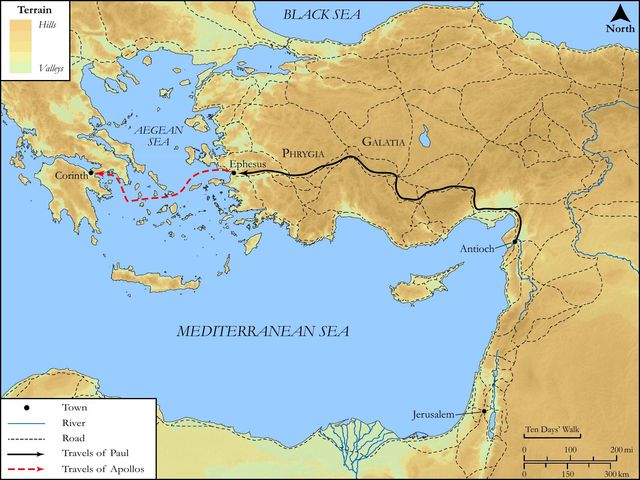
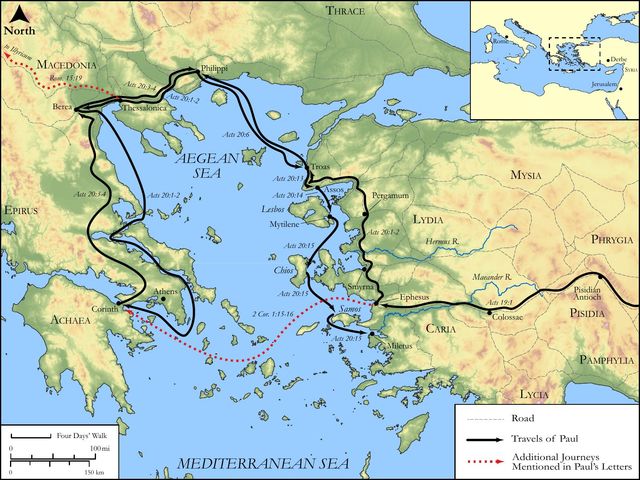
Ephesus was a city of great note in Asia, famous for a temple built there to Diana, which was one of the wonders of the world: thither Paul came to preach the gospel while Apollos was at Corinth (Act 19:1); while he was watering there, Paul was planting here, and grudged not that Apollos entered into his labours and was building upon his foundation, but rejoiced in it, and went on in the new work that was cut out for him at Ephesus with the more cheerfulness and satisfaction, because he knew that such an able minister of the New Testament as Apollos was now at Corinth, carrying on the good work there. Though there were those that made him the head of a party against Paul (Co1 1:12), yet Paul had no jealousy of him, nor any way disliked the affection the people had for him. Paul having gone through the country of Galatia and Phrygia, having passed through the upper coasts, Pontus and Bithynia, that lay north, at length came to Ephesus, where he had left Aquila and Priscilla, and there found them. At his first coming, he met with some disciples there, who professed faith in Christ as the true Messiah, but were as yet in the first and lowest form in the school of Christ, under his usher John the Baptist. They were in number about twelve (Act 19:7); they were much of the standing that Apollos was of when he came to Ephesus (for he knew only the baptism of John, Act 18:25), but they had not opportunity of being acquainted with Aquila and Priscilla, or had not been so long in Ephesus or were not so willing to receive instruction as Apollos was, otherwise they might have had the way of God expounded to them more perfectly, as Apollos had. Observe here,
I.How Paul catechised them.
He was told, probably by Aquila and Priscilla, that they were believers, that they did own Christ, and had given up their names to him; now Paul hereupon takes them under examination.
1.They did believe in the Son of God; but Paul enquires whether they had received the Holy Ghost, - whether they believed in the spirit, whose operations on the minds of men, for conviction, conversion, and comfort, were revealed some time after the doctrine of Jesus being the Christ, - whether they had been acquainted with, and had admitted, this revelation? This was not all; extraordinary gifts of the Holy Ghost were conferred upon the apostles and other disciples presently after Christ's ascension, which was frequently repeated upon occasion; had they participated in these gifts? "Have you received the Holy Ghost since you believed? Have you had that seal of the truth of Christ's doctrine in yourselves?" We are not now to expect any such extraordinary gifts as they had then. The canon of the New Testament being long since completed and ratified, we depend upon that as the most sure word of prophecy. But there are graces of the Spirit given to all believers, which are as earnests to them, Co2 1:22; Co2 5:5; Eph 1:13, Eph 1:14. Now it concerns us all who profess the Christian faith seriously to enquire whether we have received the Holy Ghost or not. The Holy Ghost is promised to all believers, to all petitioners (Luk 11:13); but many are deceived in this matter, thinking they have received the Holy Ghost when really they have not. As there are pretenders to the gifts of the Holy Ghost, so there are to his graces and comforts; we should therefore strictly examine ourselves, Have we received the Holy Ghost since we believed? The tree will be known by its fruits. Do we bring forth the fruits of the Spirit? Are we led by the Spirit? Do we walk in the Spirit? Are we under the government of the Spirit?
2.They owned their ignorance in this matter: "Whether there be a Holy Ghost is more than we know. That there is a promise of the Holy Ghost we know from the scriptures of the Old Testament, and that this promise will be fulfilled in its season we doubt not; but so much have we been out of the way of intelligence in this matter that we have not so much as heard whether the Holy Ghost be indeed yet given as a spirit of prophecy." They knew (as Dr. Lightfoot observes) that, according to the tradition of their nation, after the death of Ezra, Haggai, Zechariah, and Malachi, the Holy Ghost departed from Israel, and went up; and they professed that they had never heard of his return. They spoke as if they expected it, and wondered they did not hear of it, and were ready to welcome the notice of it. The gospel light, like that of the morning, shone more and more, gradually; not only clearer and clearer, in the discovery of truths not before heard of, but further and further, in the discovery of them to persons that had not before heard of them.
3.Paul enquired how they came to be baptized, if they knew nothing of the Holy Ghost; for, if they were baptized by any of Christ's ministers, they were instructed concerning the Holy Ghost, and were baptized in his name. "Know you not that Jesus being glorified, consequently the Holy Ghost is given? unto what then were you baptized? This is strange and unaccountable. What! baptized, and yet know nothing of the Holy Ghost? Surely your baptism was a nullity, if you know nothing of the Holy Ghost; for it is the receiving of the Holy Ghost that is signified and sealed by that washing of regeneration. Ignorance of the Holy Ghost is as inconsistent with a sincere profession of Christianity as ignorance of Christ is." Applying it to ourselves, it intimates that those are baptized to no purpose, and have received the grace of God therein in vain, that do not receive and submit to the Holy Ghost. It is also an enquiry we should often make, not only to whose honour we were born, but into whose service we were baptized, that we may study to answer the ends both of our birth and of our baptism. Let us often consider unto what we were baptized, that we may live up to our baptism.
4.They own that they were baptized unto John's baptism - eis to Iōannou baptisma that is, as I take it, they were baptized in the name of John, not by John himself (he was far enough from any such thought), but by some weak, well-meaning disciple of his, that ignorantly kept up his name as the head of a party, retaining the spirit and notion of those disciples of his that were jealous of the growth of Christ's interest, and complained to him of it, Joh 3:26. Some one or more of these, that found themselves much edified by John's baptism of repentance for the remission of sins, not thinking that the kingdom of heaven, which he spoke of as at hand, was so very near as it proved, ran away with that notion, rested in what they had, and thought they could not do better than to persuade others to do so too; and so, ignorantly, in a blind zeal for John's doctrine, they baptized here and there one in John's name, or, as it is here expressed, unto John's baptism, looking no further themselves, nor directing those that they baptized any further.
5.Paul explains to them the true intent and meaning of John's baptism, as principally referring to Jesus Christ, and so rectifies the mistake of those who had baptized them into the baptism of John, and had not directed them to look any further, but to rest in that. Those that have been left in ignorance, or led into error, by any infelicities of their education, should not therefore be despised nor rejected by those who are more knowing and orthodox, but should be compassionately instructed, and better taught, as these disciples were by Paul.
(1.)He owns that John's baptism was a very good thing, as far as it went: John verily baptized with the baptism of repentance. By this baptism he required people to be sorry for their sins, and to confess them and turn from them; and to bring any to this is a great point gained. But,
(2.)He shows them that John's baptism had a further reference, and he never designed that those he baptized should rest there, but told them that they should believe on him who should come after him, that is, on Christ Jesus, - that his baptism of repentance was designed only to prepare the way of the Lord, and to dispose them to receive and entertain Christ, whom he left them big with expectations of; nay, whom he directed them to: Behold the Lamb of God. "John was a great and good man; but he was only the harbinger, - Christ is the Prince. His baptism was the porch which you were to pass through, not the house you were to rest in; and therefore it was all wrong for you to be baptized into the baptism of John."
6.When they were thus shown the error they were led into, they thankfully accepted the discovery, and were baptized in the name of the Lord Jesus, Act 19:5. As for Apollos, of whom it was said (Act 18:25) that he knew the baptism of John - that he rightly understood the meaning of it when he was baptized with it, though he knew that only - yet, when he understood the way of God more perfectly, he was no again baptized, any more than Christ's first disciples that had been baptized with John's baptism and knew it referred to the Messiah at the door (and, with an eye to this, submitted to it), were baptized again. But to these disciples, who received it only with an eye to John and looked no further, as if he were their saviour, it was such a fundamental error as was as fatal to it as it would have been for any to be baptized in the name of Paul (Co1 1:13); and therefore, when they came to understand things better, they desired to be baptized in the name of the Lord Jesus, and were so: not by Paul himself, as we have reason to think, but by some of those who attended him. It does not therefore follow hence that there was not an agreement between John's baptism and Christ's, or that they were not for substance the same; much less does it follow that those who have been once baptized in the name of the Father, Son, and Holy Ghost (which is the appointed form of Christ's baptism), may be again baptized in the same name; for those that were baptized in the name of the Lord Jesus had never been so baptized before.
II.How Paul conferred the extraordinary gifts of the Holy Ghost upon them, Act 19:6.
1.Paul solemnly prayed to God to give them those gifts, signified by his laying his hands on them, which was a gesture used in blessing by the patriarchs, especially in conveying the great trust of the promise, as Gen 48:14. The Spirit being the great promise of the New Testament, the apostles conveyed it by the imposition of hands: "The Lord bless thee with that blessing, that blessing of blessings," Isa 44:3.
2.God granted the thing he prayed for: The Holy Ghost came upon them in a surprising overpowering manner, and they spoke with tongues and prophesied, as the apostles did and the first Gentile converts, Act 10:44. This was intended to introduce the gospel at Ephesus, and to awaken in the minds of men an expectation of some great things from it; and some think that it was further designed to qualify these twelve men for the work of the ministry, and that these twelve were the elders of Ephesus, to whom Paul committed the care and government of that church. They had the Spirit of prophesy, that they might understand the mysteries of the kingdom of God themselves, and the gift of tongues, that they might preach them to every nation and language. Oh, what a wonderful change was here made on a sudden in these men! those that but just now had not so much as heard that there was any Holy Ghost are now themselves filled with the Holy Ghost; for the Spirit, like the wind, blows where and when he listeth.
Historical interpretation
Three Centuries of Reception
2 surviving comments on this verse. Each one is dated, so this reads as a timeline rather than a list.
Select a marker to jump to its quote. Markers stagger vertically where authors wrote within a few decades of each other.
"When they heard this, they were baptized in the name of the Lord Jesus. And when Paul had laid his hands upon them, the Holy Ghost came on them; and they spake with tongues, and prophesied. And all the men were about twelve." The gift is twofold: tongues and prophesyings. Hence is shown an important doctrine, that the baptism of John is incomplete. And he does not say, "Baptism" of forgiveness, but, "of repentance." So that it was likely they had the Spirit, but it did not appear until Paul had laid his hands upon them: then they spake with tongues, etc.
All the men were about twelve, etc. But the judgments of God are a great abyss. Behold, recently deemed unworthy of the visitation of the apostles, Asia is now consecrated by the Apostolic number and elevated by the prophetic gift. And it should be noted that the Holy Spirit also here showed the signs of his coming upon the twelve disciples, and above upon the one hundred and twenty, which is the number twelve multiplied by ten, that sign in Jerusalem, this in Ephesus, which is a city of the Greeks. I believe to show that whether a person believes from among the Jews or the Gentiles, they only who communicate with the unity of the Catholic and Apostolic Church are fulfilled.
Continue studying Acts 19:7 across the web’s major study libraries — every link below opens this exact verse, chapter, or book on the destination site.
Read & Compare
 BibleGatewayThis verse in more than 200 translations and 70 languages.
 Bible.comThe YouVersion reader — hundreds of translations, reading plans, and highlights.
 ESV.orgCrossway's official English Standard Version reader.
 NET BibleThe NET translation with 60,000+ translators' notes on every rendering decision.
 STEP BibleTyndale House's free study tool — original text, vocabulary, and scholarly resources.
 BibliaLogos Bible Software's free web reader.
 USCCBThe New American Bible (Revised Edition) with the U.S. bishops' study notes.
Commentaries
 BibleHub CommentariesDozens of classic commentaries on this verse, gathered on one page.
 StudyLightMore than 100 commentary sets — the largest collection on the web.
 BibleRefPlain-English commentary on what this verse means, verse by verse.
 Enduring WordDavid Guzik's free commentary on this chapter, widely used by Bible teachers.
 Bible Study ToolsVerse commentary alongside Greek and Hebrew study aids.
Original Language & Research
- BibleHub InterlinearThe verse word by word — original language, transliteration, and English.
- BibleHub LexiconEvery word's original-language definition and Strong's entry.
 Blue Letter BibleDeep-study tools — Strong's numbers, concordance, and word studies.
 CNTR CollationThe earliest Greek manuscripts of this verse, collated letter by letter.
Sermons, Hymns & Audio


TrulyRandomVerse is not affiliated with these sites and doesn’t control their content. They’re linked because they’re genuinely useful.
Summary
Acts 19:7 concludes a pivotal narrative in Ephesus, succinctly stating the number of disciples Paul encountered who had only received John's baptism. Following their re-baptism into the name of Jesus and Paul's laying on of hands, they received the Holy Spirit, evidenced by speaking in tongues and prophesying. This verse, though brief, provides a precise detail about the initial size of this foundational group of believers, highlighting the immediate outcome of their spiritual transformation and the nascent growth of the Ephesian church.
Context
ShowHideLiterary Context
Acts 19:7 serves as the conclusion to the opening pericope of Acts 19, which details Paul's arrival in Ephesus and his encounter with a group of disciples (Acts 19:1-7). Paul immediately discerned that these individuals lacked the full understanding of Christian baptism and the Holy Spirit, having only experienced the preparatory baptism of John the Baptist. Their subsequent re-baptism "into the name of the Lord Jesus" (Acts 19:5) and the miraculous reception of the Holy Spirit, accompanied by glossolalia and prophecy (Acts 19:6), mark a significant spiritual milestone. Verse 7 then provides a concise numerical summary, indicating the size of this specific group that experienced this profound spiritual outpouring, thus setting the stage for Paul's extensive and impactful ministry in Ephesus, which would last for over two years (Acts 19:8-10).
Historical & Cultural Context
Ephesus was a prominent city in the Roman province of Asia, known for its immense temple dedicated to Artemis (Diana), famed throughout all Asia. It was a hub of commerce, culture, and diverse religious practices, making it a strategic location for the spread of the gospel. The presence of disciples who had only received John's baptism indicates the lingering influence of John's ministry, which was widespread among Jewish communities and proselytes, even years after his death. This encounter highlights the critical distinction between John's baptism of repentance and Christian baptism, which signifies identification with Christ's death and resurrection and is intrinsically linked to the reception of the Holy Spirit. The events in Acts 19:1-7 underscore the early church's understanding that true Christian conversion involved not just repentance but also faith in Jesus Christ and the empowering presence of the Spirit.
Key Themes
ShowHideThis concise verse, within its broader context, contributes to several significant themes in the book of Acts. Firstly, it powerfully illustrates The Essential Role of the Holy Spirit in the life of a believer and the early church. The Spirit's reception is portrayed as a distinct and empowering experience, often accompanied by visible manifestations, as seen in Acts 19:6. Secondly, it highlights the Transition from the Old Covenant to the New Covenant, specifically from John's preparatory ministry to the full revelation of salvation and empowerment available through Jesus Christ and the Holy Spirit. John's baptism was a call to repentance, but it did not confer the Spirit in the same way Christian baptism did (compare Acts 18:24-28). Thirdly, Paul's act of laying on hands underscores Apostolic Authority in the early church for the impartation of the Holy Spirit, a pattern seen elsewhere, such as with Peter and John in Samaria (see Acts 8:17). Finally, this small group of twelve men represents another foundational step in the Growth and Establishment of the Early Church in a significant pagan city, paving the way for Paul's extensive and impactful ministry in Ephesus (as detailed in Acts 19:10).
Exposition and Analysis
ShowHideKey Word Analysis
ShowHideThis term specifically refers to adult males, distinguishing them from a mixed group of men and women, or children. Luke's use of anḗr here emphasizes that this particular group consisted entirely of adult males, providing a precise demographic detail for this foundational moment in the Ephesian church.
This particle indicates approximation, suggesting that the number twelve is not necessarily an exact count but rather a close estimate. While precise, it allows for a slight margin of error, conveying that the number was around, or approximately, twelve.
This is a compound numeral meaning "two and ten." It denotes the specific quantity of individuals in this group. While the number twelve holds significant symbolic weight in biblical contexts (e.g., the twelve tribes of Israel, the twelve apostles), here it functions primarily as a factual enumeration of the men who received the Holy Spirit.
Verse Breakdown
ShowHide"And all the men"
This clause introduces the subject of the verse, referring back to the "certain disciples" mentioned in Acts 19:1. The use of "all" (G3956, pâs) emphasizes that the entire group of disciples encountered by Paul underwent this transformative experience. The specification of "men" (G435, anḗr) highlights the gender composition of this particular group, indicating that they were adult males.
"were about twelve."
This clause provides the numerical detail regarding the size of the group. The phrase "about twelve" (G5616, hōseí G1177, dekadýo) indicates an approximate count, yet one that is specific enough to be noted by Luke. This number signifies the modest but significant beginning of the Spirit-filled community in Ephesus, a city where the gospel would subsequently take deep root and flourish through Paul's extended ministry.
Literary Devices
ShowHideThe brevity and precision of Acts 19:7 employ several literary devices. Primarily, it demonstrates Conciseness and Numerical Specificity. Luke, as the author, often provides precise details, and here, he offers a succinct summary of the number of individuals involved in this significant spiritual event. While the number "twelve" carries profound Symbolism in biblical tradition, often representing completeness, divine order, or the people of God (e.g., the twelve tribes of Israel, the twelve apostles), in this immediate context, it functions primarily as a factual report of the group's size. Luke does not explicitly draw symbolic connections here, but the number's resonance with foundational groups in God's redemptive history (like the apostles themselves) subtly underscores the importance of this new, Spirit-empowered community in Ephesus. The verse also serves as a concise Summary Statement, bringing the preceding narrative of Paul's encounter and the Spirit's outpouring to a clear numerical close before the narrative shifts to Paul's broader ministry in the synagogue and lecture hall.
Theological and Thematic Connections
ShowHideActs 19:7, though brief, underscores profound theological truths. It highlights the indispensable nature of the Holy Spirit for genuine Christian experience and empowerment, distinguishing the full Christian walk from mere repentance or an incomplete understanding of God's plan. The reception of the Spirit, evidenced by miraculous signs, affirms the divine authentication of the gospel preached by Paul and the new covenant inaugurated by Christ. This event serves as a microcosm of the church's expansion, demonstrating how individuals, once brought to a full understanding of Jesus and baptized, were immediately empowered for witness and service, laying the groundwork for a robust Christian community in a pagan stronghold. It emphasizes that true faith is not merely intellectual assent but a dynamic relationship marked by the indwelling and transforming power of the Holy Spirit.
Reflection and Application
ShowHideActs 19:7, situated within its powerful context, offers profound lessons for contemporary believers. It challenges us to examine the depth of our own understanding and experience of the gospel. Are we merely "disciples of John," having received some truth but not yet fully embraced the transformative power of Jesus Christ and the Holy Spirit? The narrative reminds us that genuine Christian life is not just about intellectual assent or moral reform, but about a dynamic, Spirit-empowered relationship with God. It calls us to earnestly seek the fullness of the Holy Spirit's presence and power, recognizing that He equips us for witness, service, and a life that truly reflects Christ. Just as these Ephesian men moved from an incomplete understanding to a vibrant, empowered faith, we too are invited to embrace the entirety of God's grace and truth, allowing the Holy Spirit to lead, guide, and empower us in every aspect of our lives.
Questions for Reflection
ShowHideFAQ
ShowHideWhy is the number "twelve" specifically mentioned, and does it hold symbolic significance here?
ShowHideThe mention of "about twelve" (G1177, dekadýo) in Acts 19:7 is primarily a factual detail, providing a numerical summary of the group of men who received the Holy Spirit. Luke often includes precise numbers in Acts to convey historical accuracy and the tangible growth of the early church. While the number twelve carries profound symbolic weight in biblical tradition—representing the twelve tribes of Israel and the twelve apostles, signifying completeness and divine order—the text itself does not explicitly draw a symbolic connection in this immediate context. It appears to be a straightforward report of the group's size. However, the resonance of this number with other foundational groups in God's redemptive history subtly underscores the significance of this new, Spirit-empowered community in Ephesus, suggesting a new "foundational" group for the burgeoning church in that strategic city.
Does this passage imply that all believers must speak in tongues or prophesy to prove they have received the Holy Spirit?
ShowHideActs 19:6 describes these specific manifestations (speaking in tongues and prophesying) as accompanying the reception of the Holy Spirit for this group of Ephesian disciples. While these were evident signs in certain instances in Acts, such as at Pentecost (see Acts 2:4), and in Samaria (implied in Acts 8:18), the book of Acts presents a variety of ways the Holy Spirit is received and manifested. Not every instance of conversion or Spirit reception in Acts explicitly mentions these signs. The New Testament teaches that the Holy Spirit indwells all believers at the moment of salvation (see Romans 8:9 and Ephesians 1:13-14), and He distributes various gifts "individually as He wills" (as described in 1 Corinthians 12:7-11). Therefore, while spiritual gifts like tongues and prophecy are valid and active, this passage does not establish them as universal, mandatory evidence for the reception of the Holy Spirit for all believers across all times.
Christ-Centered Fulfillment
ShowHideActs 19:7, in its context, beautifully points to Christ's ongoing redemptive work and the fulfillment of His promises. The reception of the Holy Spirit by these "about twelve" men in Ephesus is a direct consequence of Christ's ascension and His sending of the Spirit, as promised in passages like John 14:26 and Acts 1:8. These men, having moved from an incomplete understanding based on John's baptism to a full embrace of faith in Jesus, now experienced the empowering presence of the Spirit, which is the very Spirit of Christ (see Romans 8:9-10). Their transformation from mere disciples of John to Spirit-filled followers of Jesus demonstrates the new covenant reality inaugurated by Christ's death and resurrection, where believers are not only forgiven but also indwelt and empowered by God Himself. This event in Ephesus, therefore, is a powerful illustration of the church being built by Christ through His Spirit, equipping His people to carry forward His mission to the ends of the earth, just as He commanded in Matthew 28:18-20. The Spirit's work, as seen here, is always to glorify Christ and empower His body, the church, to bear witness to His saving power (see John 15:26).