


Acts 19:6
Bible text: King James Version (1769 Blayney text) · Public domain
Bible text: Berean Standard Bible · Public domain
Bible text: American Standard Version (1901) · Public domain
Bible text: World English Bible, Messianic edition · Public domain
Bible text: Geneva Bible (1599) · Public domain
Bible text: Young's Literal Translation · Public domain
- καὶkaiAndG2532CONJConjunction
- ἐπιθέντοςepithentoswhen was layingG2007V-2AAP-GSMVerb 2nd Aorist Active Participle Genitive Singular Masculine
- αὐτοῖςautoison themG846P-DPMPersonal pronoun Dative Plural Masculine
- τοῦtou<the>G3588T-GSMDefinite article Genitive Singular Masculine
- ΠαύλουPaulouPaulG3972N-GSM-PNoun Genitive Singular Masculine Individual
- τὰςtastheG3588T-APFDefinite article Accusative Plural Feminine
- χεῖραςcheirashandsG5495N-APFNoun Accusative Plural Feminine
- ἦλθενēlthencameG2064V-2AAI-3SVerb 2nd Aorist Active Indicative 3rd Singular
- τὸtotheG3588T-NSNDefinite article Nominative Singular Neuter
- πνεῦμαpneumaSpiritG4151N-NSNNoun Nominative Singular Neuter
- τὸto<the>G3588T-NSNDefinite article Nominative Singular Neuter
- ἅγιονhagionHolyG40A-NSNAdjective Nominative Singular Neuter
- ἐπ᾽ep᾽uponG1909PREPPreposition
- αὐτούςautousthemG846P-APMPersonal pronoun Accusative Plural Masculine
- ἐλάλουνelalounthey were speakingG2980V-IAI-3PVerb Imperfect Active Indicative 3rd Plural
- τεtethenG5037CONJConjunction
- γλώσσαιςglōssaisin tonguesG1100N-DPFNoun Dative Plural Feminine
- καὶkaiandG2532CONJConjunction
- ἐπροφήτευονeprophēteuonwere prophesyingG4395V-IAI-3PVerb Imperfect Active Indicative 3rd Plural
English is a literal word-by-word gloss of the Greek, not the KJV's wording. Why?
This is the original text the KJV's translators worked from — each Greek word with its own literal English meaning in this verse, prepared by scholars at Tyndale House, Cambridge. The KJV translates whole sentences, not word by word, so its wording differs: one Greek word can become several English words, and the KJV may choose “charity” where the gloss reads “love”. Both are faithful — they answer different questions. For the KJV's own rendering, switch to the KJV text.
Details
See on the biblical-era maps
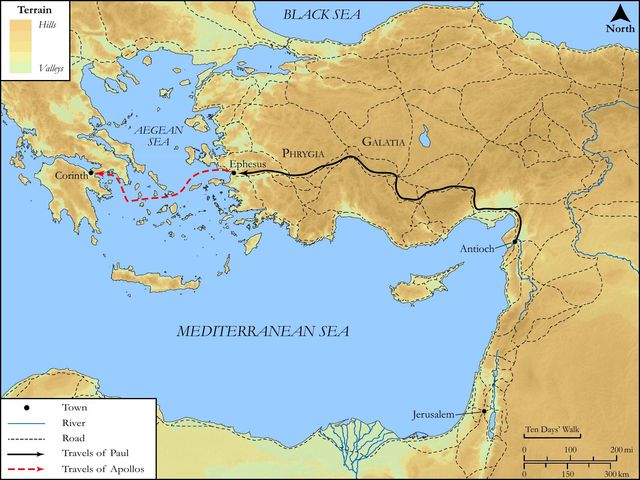
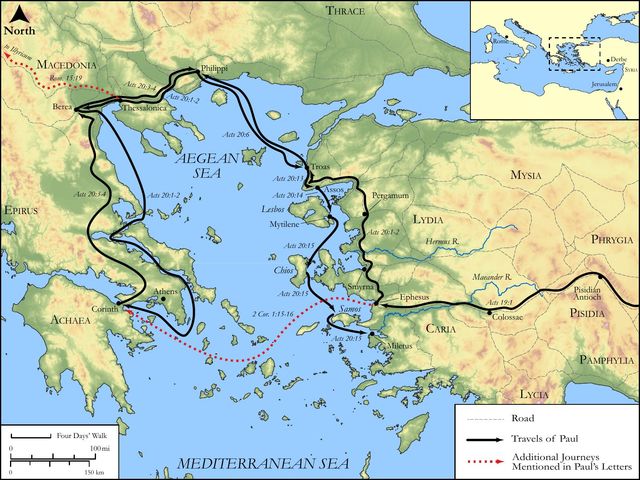
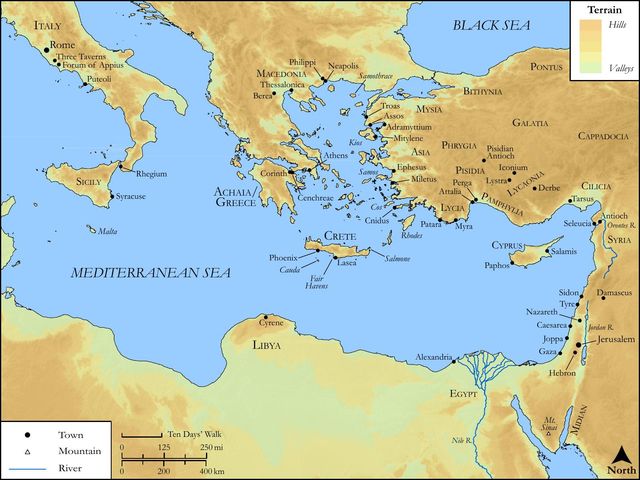
Study this verse
Public-domain commentary
Matthew Henry
From his Commentary on the Whole Bible. Henry comments on passages, not single verses — this entry covers Acts 19:1–7. His three-level outline is real structure in the source text, so it is rendered as structure.
Ephesus was a city of great note in Asia, famous for a temple built there to Diana, which was one of the wonders of the world: thither Paul came to preach the gospel while Apollos was at Corinth (Act 19:1); while he was watering there, Paul was planting here, and grudged not that Apollos entered into his labours and was building upon his foundation, but rejoiced in it, and went on in the new work that was cut out for him at Ephesus with the more cheerfulness and satisfaction, because he knew that such an able minister of the New Testament as Apollos was now at Corinth, carrying on the good work there. Though there were those that made him the head of a party against Paul (Co1 1:12), yet Paul had no jealousy of him, nor any way disliked the affection the people had for him. Paul having gone through the country of Galatia and Phrygia, having passed through the upper coasts, Pontus and Bithynia, that lay north, at length came to Ephesus, where he had left Aquila and Priscilla, and there found them. At his first coming, he met with some disciples there, who professed faith in Christ as the true Messiah, but were as yet in the first and lowest form in the school of Christ, under his usher John the Baptist. They were in number about twelve (Act 19:7); they were much of the standing that Apollos was of when he came to Ephesus (for he knew only the baptism of John, Act 18:25), but they had not opportunity of being acquainted with Aquila and Priscilla, or had not been so long in Ephesus or were not so willing to receive instruction as Apollos was, otherwise they might have had the way of God expounded to them more perfectly, as Apollos had. Observe here,
I.How Paul catechised them.
He was told, probably by Aquila and Priscilla, that they were believers, that they did own Christ, and had given up their names to him; now Paul hereupon takes them under examination.
1.They did believe in the Son of God; but Paul enquires whether they had received the Holy Ghost, - whether they believed in the spirit, whose operations on the minds of men, for conviction, conversion, and comfort, were revealed some time after the doctrine of Jesus being the Christ, - whether they had been acquainted with, and had admitted, this revelation? This was not all; extraordinary gifts of the Holy Ghost were conferred upon the apostles and other disciples presently after Christ's ascension, which was frequently repeated upon occasion; had they participated in these gifts? "Have you received the Holy Ghost since you believed? Have you had that seal of the truth of Christ's doctrine in yourselves?" We are not now to expect any such extraordinary gifts as they had then. The canon of the New Testament being long since completed and ratified, we depend upon that as the most sure word of prophecy. But there are graces of the Spirit given to all believers, which are as earnests to them, Co2 1:22; Co2 5:5; Eph 1:13, Eph 1:14. Now it concerns us all who profess the Christian faith seriously to enquire whether we have received the Holy Ghost or not. The Holy Ghost is promised to all believers, to all petitioners (Luk 11:13); but many are deceived in this matter, thinking they have received the Holy Ghost when really they have not. As there are pretenders to the gifts of the Holy Ghost, so there are to his graces and comforts; we should therefore strictly examine ourselves, Have we received the Holy Ghost since we believed? The tree will be known by its fruits. Do we bring forth the fruits of the Spirit? Are we led by the Spirit? Do we walk in the Spirit? Are we under the government of the Spirit?
2.They owned their ignorance in this matter: "Whether there be a Holy Ghost is more than we know. That there is a promise of the Holy Ghost we know from the scriptures of the Old Testament, and that this promise will be fulfilled in its season we doubt not; but so much have we been out of the way of intelligence in this matter that we have not so much as heard whether the Holy Ghost be indeed yet given as a spirit of prophecy." They knew (as Dr. Lightfoot observes) that, according to the tradition of their nation, after the death of Ezra, Haggai, Zechariah, and Malachi, the Holy Ghost departed from Israel, and went up; and they professed that they had never heard of his return. They spoke as if they expected it, and wondered they did not hear of it, and were ready to welcome the notice of it. The gospel light, like that of the morning, shone more and more, gradually; not only clearer and clearer, in the discovery of truths not before heard of, but further and further, in the discovery of them to persons that had not before heard of them.
3.Paul enquired how they came to be baptized, if they knew nothing of the Holy Ghost; for, if they were baptized by any of Christ's ministers, they were instructed concerning the Holy Ghost, and were baptized in his name. "Know you not that Jesus being glorified, consequently the Holy Ghost is given? unto what then were you baptized? This is strange and unaccountable. What! baptized, and yet know nothing of the Holy Ghost? Surely your baptism was a nullity, if you know nothing of the Holy Ghost; for it is the receiving of the Holy Ghost that is signified and sealed by that washing of regeneration. Ignorance of the Holy Ghost is as inconsistent with a sincere profession of Christianity as ignorance of Christ is." Applying it to ourselves, it intimates that those are baptized to no purpose, and have received the grace of God therein in vain, that do not receive and submit to the Holy Ghost. It is also an enquiry we should often make, not only to whose honour we were born, but into whose service we were baptized, that we may study to answer the ends both of our birth and of our baptism. Let us often consider unto what we were baptized, that we may live up to our baptism.
4.They own that they were baptized unto John's baptism - eis to Iōannou baptisma that is, as I take it, they were baptized in the name of John, not by John himself (he was far enough from any such thought), but by some weak, well-meaning disciple of his, that ignorantly kept up his name as the head of a party, retaining the spirit and notion of those disciples of his that were jealous of the growth of Christ's interest, and complained to him of it, Joh 3:26. Some one or more of these, that found themselves much edified by John's baptism of repentance for the remission of sins, not thinking that the kingdom of heaven, which he spoke of as at hand, was so very near as it proved, ran away with that notion, rested in what they had, and thought they could not do better than to persuade others to do so too; and so, ignorantly, in a blind zeal for John's doctrine, they baptized here and there one in John's name, or, as it is here expressed, unto John's baptism, looking no further themselves, nor directing those that they baptized any further.
5.Paul explains to them the true intent and meaning of John's baptism, as principally referring to Jesus Christ, and so rectifies the mistake of those who had baptized them into the baptism of John, and had not directed them to look any further, but to rest in that. Those that have been left in ignorance, or led into error, by any infelicities of their education, should not therefore be despised nor rejected by those who are more knowing and orthodox, but should be compassionately instructed, and better taught, as these disciples were by Paul.
(1.)He owns that John's baptism was a very good thing, as far as it went: John verily baptized with the baptism of repentance. By this baptism he required people to be sorry for their sins, and to confess them and turn from them; and to bring any to this is a great point gained. But,
(2.)He shows them that John's baptism had a further reference, and he never designed that those he baptized should rest there, but told them that they should believe on him who should come after him, that is, on Christ Jesus, - that his baptism of repentance was designed only to prepare the way of the Lord, and to dispose them to receive and entertain Christ, whom he left them big with expectations of; nay, whom he directed them to: Behold the Lamb of God. "John was a great and good man; but he was only the harbinger, - Christ is the Prince. His baptism was the porch which you were to pass through, not the house you were to rest in; and therefore it was all wrong for you to be baptized into the baptism of John."
6.When they were thus shown the error they were led into, they thankfully accepted the discovery, and were baptized in the name of the Lord Jesus, Act 19:5. As for Apollos, of whom it was said (Act 18:25) that he knew the baptism of John - that he rightly understood the meaning of it when he was baptized with it, though he knew that only - yet, when he understood the way of God more perfectly, he was no again baptized, any more than Christ's first disciples that had been baptized with John's baptism and knew it referred to the Messiah at the door (and, with an eye to this, submitted to it), were baptized again. But to these disciples, who received it only with an eye to John and looked no further, as if he were their saviour, it was such a fundamental error as was as fatal to it as it would have been for any to be baptized in the name of Paul (Co1 1:13); and therefore, when they came to understand things better, they desired to be baptized in the name of the Lord Jesus, and were so: not by Paul himself, as we have reason to think, but by some of those who attended him. It does not therefore follow hence that there was not an agreement between John's baptism and Christ's, or that they were not for substance the same; much less does it follow that those who have been once baptized in the name of the Father, Son, and Holy Ghost (which is the appointed form of Christ's baptism), may be again baptized in the same name; for those that were baptized in the name of the Lord Jesus had never been so baptized before.
II.How Paul conferred the extraordinary gifts of the Holy Ghost upon them, Act 19:6.
1.Paul solemnly prayed to God to give them those gifts, signified by his laying his hands on them, which was a gesture used in blessing by the patriarchs, especially in conveying the great trust of the promise, as Gen 48:14. The Spirit being the great promise of the New Testament, the apostles conveyed it by the imposition of hands: "The Lord bless thee with that blessing, that blessing of blessings," Isa 44:3.
2.God granted the thing he prayed for: The Holy Ghost came upon them in a surprising overpowering manner, and they spoke with tongues and prophesied, as the apostles did and the first Gentile converts, Act 10:44. This was intended to introduce the gospel at Ephesus, and to awaken in the minds of men an expectation of some great things from it; and some think that it was further designed to qualify these twelve men for the work of the ministry, and that these twelve were the elders of Ephesus, to whom Paul committed the care and government of that church. They had the Spirit of prophesy, that they might understand the mysteries of the kingdom of God themselves, and the gift of tongues, that they might preach them to every nation and language. Oh, what a wonderful change was here made on a sudden in these men! those that but just now had not so much as heard that there was any Holy Ghost are now themselves filled with the Holy Ghost; for the Spirit, like the wind, blows where and when he listeth.
Historical interpretation
Historical reception
3 surviving comments on this verse. Each one is dated, so this reads as a timeline rather than a list.
Select a marker to jump to its quote. Markers stagger vertically where authors wrote within a few decades of each other.
That we must not grieve the Holy Spirit, whom we have received. Paul the apostle to the Ephesians: "Grieve not the Holy Spirit of God, in which ye were sealed in the day of redemption. Let all bitterness, and wrath, and indignation, and clamour, and blasphemy, be taken away from you."
Wherefore, then, my brethren, let us struggle with all earnestness, knowing that the contest is [in our case] close at hand, and that many undertake long voyages to strive for a corruptible reward; yet all are not crowned, but those only that have laboured hard and striven gloriously. Let us therefore so strive, that we may all be crowned. Let us run the straight course, even the race that is incorruptible; and let us in great numbers set out for it, and strive that we may be crowned. And should we not all be able to obtain the crown, let us at least come near to it. We must remember that he who strives in the corruptible contest, if he be found acting unfairly, is taken away and scourged, and cast forth from the lists. What then think ye? If one does anything unseemly in the incorruptible contest, what shall he have to bear? For of those who do not preserve the seal [unbroken], [the Scripture] says, "Their worm shall not die, and their fire shall not be quenched, and they shall be a spectacle to all flesh." [Isaiah 66:24]
"When they heard this, they were baptized in the name of the Lord Jesus. And when Paul had laid his hands upon them, the Holy Ghost came on them; and they spake with tongues, and prophesied. And all the men were about twelve." The gift is twofold: tongues and prophesyings. Hence is shown an important doctrine, that the baptism of John is incomplete. And he does not say, "Baptism" of forgiveness, but, "of repentance." So that it was likely they had the Spirit, but it did not appear until Paul had laid his hands upon them: then they spake with tongues, etc.
Continue studying Acts 19:6 across the web’s major study libraries — every link below opens this exact verse, chapter, or book on the destination site.
Read & Compare
 BibleGatewayThis verse in more than 200 translations and 70 languages.
 Bible.comThe YouVersion reader — hundreds of translations, reading plans, and highlights.
 ESV.orgCrossway's official English Standard Version reader.
 NET BibleThe NET translation with 60,000+ translators' notes on every rendering decision.
 STEP BibleTyndale House's free study tool — original text, vocabulary, and scholarly resources.
 BibliaLogos Bible Software's free web reader.
 USCCBThe New American Bible (Revised Edition) with the U.S. bishops' study notes.
Commentaries
 BibleHub CommentariesDozens of classic commentaries on this verse, gathered on one page.
 StudyLightMore than 100 commentary sets — the largest collection on the web.
 BibleRefPlain-English commentary on what this verse means, verse by verse.
 Enduring WordDavid Guzik's free commentary on this chapter, widely used by Bible teachers.
 Bible Study ToolsVerse commentary alongside Greek and Hebrew study aids.
Original Language & Research
- BibleHub InterlinearThe verse word by word — original language, transliteration, and English.
- BibleHub LexiconEvery word's original-language definition and Strong's entry.
 Blue Letter BibleDeep-study tools — Strong's numbers, concordance, and word studies.
 CNTR CollationThe earliest Greek manuscripts of this verse, collated letter by letter.
Sermons, Hymns & Audio


TrulyRandomVerse is not affiliated with these sites and doesn’t control their content. They’re linked because they’re genuinely useful.
Summary
Acts 19:6 describes a pivotal moment in Paul's ministry in Ephesus, where a group of disciples, previously only familiar with John's baptism, received the Holy Spirit. Following their baptism in the name of Jesus and Paul's laying on of hands, they experienced immediate and tangible manifestations of the Spirit's presence, speaking in tongues and prophesying. This event underscores the essential role of the Holy Spirit in the life of believers and the early church's mission, serving as a powerful confirmation of the new covenant reality and the apostolic message.
Context
ShowHideLiterary Context
This verse is situated within Paul's third missionary journey, specifically during his extended stay in Ephesus. Immediately preceding this event, Paul encountered about twelve disciples who, despite being believers, had only received John's baptism and were unaware of the Holy Spirit's existence or outpouring. Paul's inquiry about their reception of the Spirit (Acts 19:2) and their subsequent instruction and baptism in the name of the Lord Jesus set the stage for the Spirit's arrival in Acts 19:6. This narrative sequence highlights the transition from preparatory ministries (like John's) to the full experience of the Christian faith, marked by the indwelling and empowering presence of the Holy Spirit. The events here parallel earlier instances in Acts, such as the Samaritans' reception of the Spirit through Peter and John (Acts 8:14-17), emphasizing a consistent pattern of apostolic confirmation for new groups of believers.
Historical & Cultural Context
Ephesus was a prominent city in the Roman province of Asia, renowned for its temple to Artemis (Diana), famed throughout all Asia. It was a hub of pagan worship, magic, and diverse philosophical and religious currents, making it a strategic center for the spread of the Gospel. The disciples Paul encountered likely represented a remnant of John the Baptist's followers who, perhaps due to geographical isolation or incomplete teaching, had not yet fully grasped the implications of Jesus' death, resurrection, and the subsequent outpouring of the Holy Spirit. The practice of laying on hands for the impartation of the Spirit was a recognized apostolic act, signifying spiritual transfer, blessing, or commissioning, and served as a visible sign of God's work through His chosen instruments in the early church.
Key Themes
ShowHideActs 19:6 contributes significantly to several key themes within the book of Acts. Foremost is the Empowerment by the Holy Spirit, which is the driving force behind the church's expansion and witness, as promised by Jesus in Acts 1:8. The verse also underscores the Completeness of Christian Conversion, emphasizing that true faith involves not just repentance and water baptism, but also the reception of the Holy Spirit, who indwells and empowers believers. The Apostolic Authority of Paul is evident, as his ministry serves as the conduit for the Spirit's impartation, mirroring the actions of Peter and John in Samaria (Acts 8:14-17). Furthermore, the Manifestation of Spiritual Gifts (tongues and prophecy) highlights the tangible evidence of the Spirit's presence, serving both as a sign to unbelievers and for the edification of the church, echoing the events of Pentecost in Acts 2:4.
Exposition and Analysis
ShowHideKey Word Analysis
ShowHideThis verb, meaning "to impose" or "to put upon," describes Paul's physical action of placing his hands on the disciples. In biblical context, the laying on of hands was a significant gesture used for various purposes: blessing, commissioning, healing, and, as here, the impartation of the Holy Spirit. Its use here emphasizes a deliberate, volitional act by Paul, serving as an outward sign accompanying the inward spiritual transaction.
While the KJV uses "Ghost," the Greek term pneûma refers to a "spirit," "breath," or "wind." In this context, when combined with hágios ("Holy"), it unequivocally denotes the Holy Spirit, the third person of the Trinity. The word signifies the divine, invisible, and powerful presence that "came on them," indicating a supernatural invasion and indwelling of God's Spirit in the believers.
This word literally means "tongue" but by implication refers to a "language," especially one "naturally unacquired." In the context of the Holy Spirit's manifestation, it refers to the supernatural ability to speak in languages unknown to the speaker, often for the purpose of communicating divine truth or for prayer and praise. This phenomenon, known as glossolalia, was a prominent sign of the Spirit's outpouring in the early church.
Verse Breakdown
ShowHide"And when Paul had laid [his] hands upon them,"
This clause describes the specific action taken by Paul. The laying on of hands was a customary practice in the early church, often associated with the impartation of spiritual gifts, healing, or commissioning. It signifies a direct, personal connection and the channeling of divine power or blessing through an apostle. This act, following their baptism in Jesus' name, was the immediate precursor to the Spirit's arrival.
"the Holy Ghost came on them;"
This is the central event of the verse. The "coming on" or "falling upon" of the Holy Spirit denotes a powerful, discernible experience of the Spirit's presence and power. It signifies the indwelling and empowering of these believers by God's Spirit, marking their full inclusion into the new covenant community and equipping them for Christian life and service.
"and they spake with tongues,"
This describes the first of two immediate, tangible manifestations of the Holy Spirit's presence. Speaking with tongues (glossolalia) refers to the miraculous ability to speak in unlearned languages, a sign that confirmed the divine origin of the experience and the message. It was a public and audible demonstration of the Spirit's power.
"and prophesied."
This describes the second immediate manifestation. Prophesying, in the New Testament context, involves speaking under divine inspiration. While it can include foretelling the future, it primarily refers to "forth-telling" God's truth, proclaiming His word, exhorting, edifying, or comforting the church. This gift further demonstrated the Spirit's empowering presence and equipped the disciples for ministry.
Literary Devices
ShowHideThe narrative employs Cause and Effect to clearly link Paul's actions to the divine response and subsequent manifestations. Paul's laying on of hands is the direct cause, leading to the effect of the Spirit's arrival, which in turn causes the effects of speaking in tongues and prophesying. This sequence emphasizes the direct and immediate nature of God's work. The passage also utilizes Descriptive Language to paint a vivid picture of the spiritual event, using active verbs like "laid," "came," "spake," and "prophesied" to convey the dynamic and powerful nature of the Holy Spirit's work. Furthermore, there is an element of Confirmation through the visible and audible signs of tongues and prophecy, which serve as undeniable evidence of the Holy Spirit's presence and the validity of Paul's teaching, mirroring the initial outpouring at Pentecost.
Theological and Thematic Connections
ShowHideActs 19:6 profoundly illustrates the normative experience of the Holy Spirit's reception in the early church, emphasizing that a complete Christian experience involves not only repentance and water baptism but also the empowering indwelling of the Spirit. This event highlights the Spirit's role in equipping believers for witness and ministry, demonstrating that the gifts of tongues and prophecy were not merely isolated phenomena but integral expressions of the Spirit's work in the nascent Christian community. It underscores the transition from a preparatory faith (John's baptism) to a full, Spirit-empowered walk with Christ, confirming the new covenant reality where the Spirit is poured out on all believers.
Reflection and Application
ShowHideActs 19:6 serves as a powerful reminder for believers today of the Holy Spirit's vital role in Christian life. It challenges us to move beyond mere intellectual assent or traditional practices to seek a vibrant, empowering relationship with the Spirit. While the specific manifestations of tongues and prophecy may not be universally experienced in the same way today, the underlying truth remains: the Holy Spirit is given to indwell, empower, and equip believers for God's purposes. This passage encourages us to be open to the Spirit's leading, to cultivate spiritual gifts for the common good of the church, and to recognize that our faith is not just about historical facts but about a living, dynamic relationship with the Triune God. It calls us to examine the depth of our own spiritual experience, ensuring we are not merely "disciples of John" but fully Spirit-filled followers of Jesus, ready to be used by God for His glory and the advancement of His kingdom.
Questions for Reflection
ShowHideFAQ
ShowHideWas the laying on of hands necessary for these disciples to receive the Holy Spirit?
ShowHideWhile the laying on of hands by apostles often accompanied the reception of the Holy Spirit in the book of Acts (e.g., Acts 8:17), it was not the exclusive or universally necessary means. The Holy Spirit was poured out at Pentecost without any human mediation (Acts 2:1-4), and Cornelius and his household received the Spirit while Peter was still preaching, before baptism or laying on of hands (Acts 10:44-47). In the case of the Ephesian disciples, Paul's action of laying on hands served as a significant apostolic confirmation and a visible sign of the Spirit's impartation, particularly given their prior incomplete understanding of Christian truth. It demonstrated the authority of the apostolic ministry in establishing the early church and confirming the full Gospel.
Christ-Centered Fulfillment
ShowHideActs 19:6, though focusing on the Holy Spirit's activity, finds its ultimate significance in Christ. The Holy Spirit, promised by Jesus Himself as the Helper, the Spirit of truth, is the very Spirit of Christ who indwells believers (Romans 8:9-11). The Ephesian disciples received the Spirit only after being baptized "in the name of the Lord Jesus" (Acts 19:5), signifying their identification with Christ's death and resurrection. The Spirit's coming upon them empowered them to bear witness to Christ, as Jesus commanded in Acts 1:8. The gifts of tongues and prophecy, manifested through them, were not ends in themselves but served to glorify Christ, build up His body, and confirm the truth of the Gospel message concerning Him. Ultimately, the Holy Spirit's work, including the impartation of spiritual gifts and the production of the fruit of the Spirit, is designed to conform believers to the image of Christ and enable them to participate in His ongoing mission in the world, demonstrating that the Spirit's presence is the very seal of our redemption in Christ (Ephesians 1:13-14).