


2 Timothy 1:6
Bible text: King James Version (1769 Blayney text) · Public domain
Bible text: King James Version with Strong's numbers · Public domain
Bible text: Berean Standard Bible · Public domain
Bible text: American Standard Version (1901) · Public domain
Bible text: World English Bible, Messianic edition · Public domain
Bible text: Geneva Bible (1599) · Public domain
Bible text: Young's Literal Translation · Public domain
- Δι᾽Di᾽ForG1223PREPPreposition
- ἣνhēnthisG3739R-ASFRelative pronoun Accusative Singular Feminine
- αἰτίανaitianreasonG156N-ASFNoun Accusative Singular Feminine
- ἀναμιμνῄσκωanamimnēskōI remindG363V-PAI-1SVerb Present Active Indicative 1st Singular
- σεseyouG4771P-2ASPersonal pronoun Accusative 2nd Singular
- ἀναζωπυρεῖνanazōpureinto kindle anewG329V-PANVerb Present Active Infinitive
- τὸtotheG3588T-ASNDefinite article Accusative Singular Neuter
- χάρισμαcharismagiftG5486N-ASNNoun Accusative Singular Neuter
- τοῦtou<the>G3588T-GSMDefinite article Genitive Singular Masculine
- θεοῦtheouof GodG2316N-GSM-TNoun Genitive Singular Masculine Title
- ὅhowhichG3739R-NSNRelative pronoun Nominative Singular Neuter
- ἐστινestinisG1510V-PAI-3SVerb Present Active Indicative 3rd Singular
- ἐνeninG1722PREPPreposition
- σοὶsoiyouG4771P-2DSPersonal pronoun Dative 2nd Singular
- διὰdiathroughG1223PREPPreposition
- τῆςtēstheG3588T-GSFDefinite article Genitive Singular Feminine
- ἐπιθέσεωςepitheseōslaying onG1936N-GSFNoun Genitive Singular Feminine
- τῶνtōnof theG3588T-GPFDefinite article Genitive Plural Feminine
- χειρῶνcheirōnhandsG5495N-GPFNoun Genitive Plural Feminine
- μου·mouof mineG3165P-1GSPersonal pronoun Genitive 1st Singular
English is a literal word-by-word gloss of the Greek, not the KJV's wording. Why?
This is the original text the KJV's translators worked from — each Greek word with its own literal English meaning in this verse, prepared by scholars at Tyndale House, Cambridge. The KJV translates whole sentences, not word by word, so its wording differs: one Greek word can become several English words, and the KJV may choose “charity” where the gloss reads “love”. Both are faithful — they answer different questions. For the KJV's own rendering, switch to the KJV text.
Details
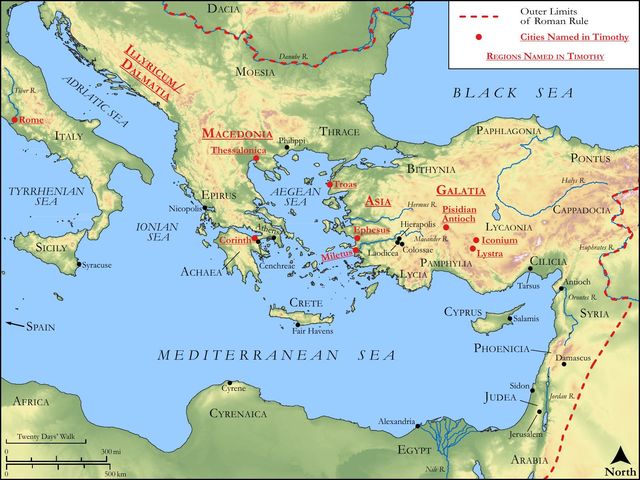
See on the biblical-era maps

Study this verse
Public-domain commentary
Matthew Henry
From his Commentary on the Whole Bible. Henry comments on passages, not single verses — this entry covers 2 Timothy 1:6–14. His four-level outline is real structure in the source text, so it is rendered as structure.
Here is an exhortation and excitation of Timothy to his duty (Ti2 1:6): I put thee in remembrance. The best men need remembrancers; what we know we should be reminded of. Pe2 3:1, I write this, to stir up your pure minds by way of remembrance.
I.He exhorts him to stir up the gift of God that was in him.
Stir it up as fire under the embers. It is meant of all the gifts and graces the God had given him, to qualify him for the work of an evangelist, the gifts of the Holy Ghost, the extraordinary gifts that were conferred by the imposition of the apostle's hands. These he must stir up; he must exercise them and so increase them: use gifts and have gifts. To him that hath shall be given, Mat 25:29. He must take all opportunities to use these gifts, and so stir them up, for that is the best way of increasing them. Whether the gift of God in Timothy was ordinary or extraordinary (though I incline to the latter), he must stir it up, otherwise it would decay. Further, you see that this gift was in him by the putting on of the apostle's hands, which I take to be distinct from his ordination, for that was performed by the hands of the presbytery, Ti1 4:14. It is probable that Timothy had the Holy Ghost, in his extraordinary gifts and graces, conferred on him by the laying on of the apostle's hands (for I reckon that none but the apostles had the power of giving the Holy Ghost), and afterwards, being thus richly furnished for the work of the ministry, was ordained by the presbytery. Observe,
1.The great hindrance of usefulness in the increase of our gifts is slavish fear. Paul therefore warns Timothy against this: God hath not given us the spirit of fear, Ti2 1:7. It was through base fear that the evil servant buried his talent, and did not trade with it, Mat 25:25. Now God hath therefore armed us against the spirit of fear, by often bidding us fear not. "Fear not the face of man; fear not the dangers you may meet with in the way of your duty." God hath delivered us from the spirit of fear, and hath given us the spirit of power, and of love, and of a sound mind. The spirit of power, or of courage and resolution to encounter difficulties and dangers; - the spirit of love to God, which will carry us through the opposition we may meet with, as Jacob made nothing of the hard service he was to endure for Rachel: the spirit of love to God will set us above the fear of man, and all the hurt that a man can do us; - and the spirit of a sound mind, or quietness of mind, a peaceable enjoyment of ourselves, for we are oftentimes discouraged in our way and work by the creatures o our own fancy and imagination, which a sober, solid, thinking mind would obviate, and would easily answer.
2.The spirit God gives to his ministers is not a fearful, but a courageous spirit; it is a spirit of power, for they speak in his name who has all power, both in heaven and earth; and it is a spirit of love, for love to God and the souls of men must inflame ministers in all their service; and it is a spirit of a sound mind, for they speak the words of truth and soberness.
II.He exhorts him to count upon afflictions, and get ready for them:
"Be not thou therefore ashamed of the testimony of our Lord, nor of me his prisoner. Be not thou ashamed of the gospel, of the testimony thou hast borne to it." Observe,
1.The gospel of Christ is what we have none of us reason to be ashamed of. We must not be ashamed of those who are suffering for the gospel of Christ. Timothy must not be ashamed of good old Paul, though he was now in bonds. As he must not himself be afraid of suffering, so he must not be afraid of owning those who were sufferers for the cause of Christ.
(1.)The gospel is the testimony of our Lord; in and by this he bears testimony of himself to us, and by professing our adherence to it we bear testimony of him and for him.
(2.)Paul was the Lord's prisoner, his prisoner, Eph 4:1. For his sake he was bound with a chain.
(3.)We have no reason to be ashamed either of the testimony of our Lord or of his prisoners; if we are ashamed of either now, Christ will be ashamed of us hereafter. "But be thou partaker of the afflictions of the gospel, according to the power of God, that is, expect afflictions for the gospel's sake, prepare for them, count upon them, be willing to take thy lot with the suffering saints in this world. Be partaker of the afflictions of the gospel;" or, as it may be read, Do thou suffer with the gospel; "not only sympathize with those who suffer for it, but be ready to suffer with them and suffer like them." If at any time the gospel be in distress, he who hopes for life and salvation by it will be content to suffer with it. Observe,
[1.]Then we are likely to bear afflictions as well, when we fetch strength and power from God to enable us to bear them: Be thou partaker of the afflictions of the gospel, according to the power of God.
[2.]All Christians, but especially ministers, must expect afflictions and persecutions for the sake of the gospel.
[3.]These shall be proportioned, according to the power of God (Co1 10:13) resting upon us.
2.Mentioning God and the gospel, he takes notice what great things God has done for us by the gospel, Ti2 1:9, Ti2 1:10. To encourage him to suffer, he urges two considerations: -
(1.)The nature of that gospel which he was called to suffer for, and the glorious and gracious designs and purposes of it. It is usual with Paul, when he mentions Christ, and the gospel of Christ, to digress from his subject, and enlarge upon them; so full was he of that which is all our salvation, and ought to be all our desire. Observe,
[1.]The gospel aims at our salvation: He has saved us, and we must not think much to suffer for that which we hope to be saved by. He has begun to save us, and will complete it in due time; for God calls those things that are not (that are not yet completed) as though they were (Rom 4:17); therefore he says, who has saved us.
[2.]It is designed for our sanctification: And called us with a holy calling, called us to holiness. Christianity is a calling, a holy calling; it is the calling wherewith we are called, the calling to which we are called, to labour in it. Observe, All who shall be saved hereafter are sanctified now. Wherever the call of the gospel is an effectual call, it is found to be a holy call, making those holy who are effectually called.
[3.]The origin of it is the free grace and eternal purpose of God in Christ Jesus. If we had merited it, it had been hard to suffer for it; but our salvation by it is of free grace, and not according to our works, and therefore we must not think much to suffer for it. This grace is said to be given us before the world began, that is, in the purpose and designs of God from all eternity; in Christ Jesus, for all the gifts that come from God to sinful man come in and through Christ Jesus.
[4.]The gospel is the manifestation of this purpose and grace: By the appearing of our Saviour Jesus Christ, who had lain in the bosom of the Father from eternity, and was perfectly apprised of all his gracious purposes. By his appearing this gracious purpose was made manifest to us. Did Jesus Christ suffer for it, and shall we think much to suffer for it?
[5.]By the gospel of Christ death is abolished: He has abolished death, not only weakened it, but taken it out of the way, has broken the power of death over us; by taking away sin he has abolished death (for the sting of death is sin, Co1 15:56), in altering the property of it, and breaking the power of it. Death now of an enemy has become a friend; it is the gate by which we pass out of a troublesome, vexatious, sinful world, into a world of perfect peace and purity; and the power thereof is broken, for death does not triumph over those who believe the gospel, but they triumph over it. O death! where is thy sting? O grave! where is thy victory? Co1 15:55.
[6.]He has brought life and immortality to light by the gospel; he has shown us another world more clearly than it was before discovered under any former dispensation, and the happiness of that world, the certain recompence of our obedience by faith: we all with open face, as in a glass, behold the glory of God. He has brought it to light, not only set it before us, but offered it to us, by the gospel. Let us value the gospel more than ever, as it is that whereby life and immortality are brought to light, for herein it has the pre-eminence above all former discoveries; so that it is the gospel of life and immortality, as it discovers them to us, and directs us in the ready way that leads thereto, as well as proposes the most weighty motives to excite our endeavours in seeking after glory, honour, and immortality.
(2.)Consider the example of blessed Paul, Ti2 1:11, Ti2 1:12. He was appointed to preach the gospel, and particularly appointed to teach the Gentiles. He though it a cause worth suffering for, and why should not Timothy think so too? No man needs to be afraid nor ashamed to suffer for the cause of the gospel: I am not ashamed, says Paul, for I know whom I have believed, and am persuaded that he is able to keep that which I have committed unto him against that day. Observe, [1.] Good men often suffer many things for the best cause in the world: For which cause I suffer these things; that is, "for my preaching, and adhering to the gospel." [2.] They need not be ashamed, the cause will bear them out; but those who oppose it shall be clothed with shame. [3.] Those who trust in Christ know whom they have trusted. The apostle speaks with a holy triumph and exultation, as much as to say, "I stand on firm ground. I know I have lodged the great trust in the hands of the best trustee." And am persuaded, etc. What must we commit to Christ? The salvation of our souls, and their preservation to the heavenly kingdom; and what we so commit to him he will keep. There is a day coming when our souls will be enquired after: "Man! Woman! thou hadst a soul committed to thee, what hast thou done with it? To whom it was offered, to God or Satan? How was it employed, in the service of sin or in the service of Christ?" There is a day coming, and it will be a very solemn and awful day, when we must give an account of our stewardship (Luk 16:2), give an account of our souls: now, if by an active obedient faith we commit it to Jesus Christ, we may be sure he is able to keep it, and it shall be forthcoming to our comfort in that day.
III.He exhorts him to hold fast the form of sound words, Ti2 1:13.
1. "Have a form of sound words" (so it may be read), "a short form, a catechism, an abstract of the first principles of religion, according to the scriptures, a scheme of sound words, a brief summary of the Christian faith, in a proper method, drawn out by thyself from the holy scriptures for thy own use;" or, rather, by the form of sound words I understand the holy scriptures themselves. 2. "Having it, hold it fast, remember it, retain it, adhere to it. Adhere to it in opposition to all heresies and false doctrine, which corrupt the Christian faith. Hold that fast which thou hast heard of me." Paul was divinely inspired. It is good to adhere to those forms of sound words which we have in the scriptures; for these, we are sure, were divinely inspired. That is sound speech, which cannot be condemned, Tit 2:8. But how must it be held fast? In faith and love; that is, we must assent to it as a faithful saying, and bid it welcome as worthy of all acceptation. Hold it fast in a good heart, this is the ark of the covenant, in which the tables both of law and gospel are most safely and profitably deposited, Psa 119:11. Faith and love must go together; it is not enough to believe the sound words, and to give an assent to them, but we must love them, believe their truth and love their goodness, and we must propagate the form of sound words in love; speaking the truth in love, Eph 4:15. Faith and love which are in Christ Jesus; it must be Christian faith and love, faith and love fastening upon Jesus Christ, in and by whom God speaks to us and we to him. Timothy, as a minister, must hold fast the form of sound words, for the benefit of others. Of healing words, so it may read; there is healing virtue in the word of God; he sent his word, and healed them. To the same purport is that (Ti2 1:14), That good thing which was committed unto thee keep by the Holy Ghost, which dwelleth in us. That good thing was the form of sound words, the Christian doctrine, which was committed to Timothy in his baptism and education as he was a Christian, and in his ordination as he was a minister. Observe, (1.) The Christian doctrine is a trust committed to us. It is committed to Christians in general, but to ministers in particular. It is a good thing, of unspeakable value in itself, and which will be of unspeakable advantage to us; it is a good thing indeed, it is an inestimable jewel, for it discovers to us the unsearchable riches of Christ, Eph 3:8. It is committed to us to be preserved pure and entire, and to be transmitted to those who shall come after us, and we must keep it, and not contribute any thing to the corrupting of its purity, the weakening of its power, or the diminishing of its perfection: Keep it by the Holy Ghost that dwelleth in us. Observe, Even those who are ever so well taught cannot keep what they have learned, any more than they could at first learn it, without the assistance of the Holy Spirit. We must not think to keep it by our own strength, but keep it by the Holy Ghost. (2.) The Holy Ghost dwells in all good ministers and Christians; they are his temples, and he enables them to keep the gospel pure and uncorrupt; and yet they must use their best endeavours to keep this good thing, for the assistance and indwelling of the Holy Ghost do not exclude men's endeavours, but they very well consist together.
Historical interpretation
Nine Centuries of Reception
4 surviving comments on this verse. Each one is dated, so this reads as a timeline rather than a list.
Select a marker to jump to its quote. Markers stagger vertically where authors wrote within a few decades of each other.
I have become acquainted with your greatly-desired name in God, which ye have acquired by the habit of righteousness, according to the faith and love in Christ Jesus our Saviour. Being the followers of the love of God towards man, and stirring up yourselves by the blood of Christ, you have perfectly accomplished the work which was beseeming to you. For, on hearing that I came bound from Syria for the sake of Christ, our common hope, trusting through your prayers to be permitted to fight with beasts at Rome, that so by martyrdom I may indeed become the disciple of Him "who gave Himself for us, an offering and a sacrifice to God," [ye hastened to see me]. I have therefore received your whole multitude in the name of God, through Onesimus, a man of inexpressible love, and who is your bishop, whom I pray you by Jesus Christ to love, and that you would all seek to be like him. Blessed be God, who has granted unto you, who are yourselves so excellent, to obtain such an excellent bishop.
Paul urges Timothy to nurture his spirit with eagerness of mind, rejoicing in his faith, just as he once rejoiced in the newness of his ordination.
"Wherefore I put thee in remembrance that thou stir up the gift of God, which is in thee by the putting on of my hands." You see how greatly dispirited and dejected he considers him to be. He almost says, "Think not that I despise thee, but be assured that I do not condemn thee, nor have I forgotten thee. Consider, at any rate, thy mother and thy grandmother. It is because I know that thou hast unfeigned faith that I put thee in remembrance." For it requires much zeal to stir up the gift of God. As fire requires fuel, so grace requires our alacrity, that it may be ever fervent. "I put thee in remembrance that thou stir up the gift of God, that is in thee by the putting on of my hands," that is, the grace of the Spirit, which thou hast received, for presiding over the Church, for the working of miracles, and for every service. For this grace it is in our power to kindle or to extinguish; wherefore he elsewhere says, "Quench not the Spirit." (1 Thess. v. 19.) For by sloth and carelessness it is quenched, and by watchfulness and diligence it is kept alive. For it is in thee indeed, but do thou render it more vehement, that is, fill it with confidence, with joy and delight. Stand manfully.
For this reason, I remind you to rekindle the gift of God that is in you through the laying on of my hands.
For this reason. Since I am conscious of these things, Paul says.
you to rekindle the gift of God. Timothy had received the spiritual gift, and Paul urges that it be carried out with readiness of mind, attention, and vigilance more vehemently and effectively. For the opposites of these make it relaxed, as it is said elsewhere: "Do not extinguish the Spirit." (1 Thess. 5:19)
through the laying on of my hands. For as soon as Paul laid his hands on Timothy, appointing him bishop, a gift also came upon Timothy for the working of signs, for teaching, and for presiding over the Church.
Continue studying 2 Timothy 1:6 across the web’s major study libraries — every link below opens this exact verse, chapter, or book on the destination site.
Read & Compare
 BibleGatewayThis verse in more than 200 translations and 70 languages.
 Bible.comThe YouVersion reader — hundreds of translations, reading plans, and highlights.
 ESV.orgCrossway's official English Standard Version reader.
 NET BibleThe NET translation with 60,000+ translators' notes on every rendering decision.
 STEP BibleTyndale House's free study tool — original text, vocabulary, and scholarly resources.
 BibliaLogos Bible Software's free web reader.
 USCCBThe New American Bible (Revised Edition) with the U.S. bishops' study notes.
Commentaries
 BibleHub CommentariesDozens of classic commentaries on this verse, gathered on one page.
 StudyLightMore than 100 commentary sets — the largest collection on the web.
 BibleRefPlain-English commentary on what this verse means, verse by verse.
 Enduring WordDavid Guzik's free commentary on this chapter, widely used by Bible teachers.
 Bible Study ToolsVerse commentary alongside Greek and Hebrew study aids.
Original Language & Research
- BibleHub InterlinearThe verse word by word — original language, transliteration, and English.
- BibleHub LexiconEvery word's original-language definition and Strong's entry.
 Blue Letter BibleDeep-study tools — Strong's numbers, concordance, and word studies.
 CNTR CollationThe earliest Greek manuscripts of this verse, collated letter by letter.
Sermons, Hymns & Audio


TrulyRandomVerse is not affiliated with these sites and doesn’t control their content. They’re linked because they’re genuinely useful.
Summary
In 2 Timothy 1:6, the Apostle Paul issues a profound and urgent exhortation to his spiritual son, Timothy, urging him to actively rekindle and fan into full flame the spiritual endowment he received from God. This directive serves as a timeless reminder for all believers to diligently cultivate and deploy their divinely bestowed gifts, ensuring they remain vibrant and effective for the advancement of God's Kingdom rather than allowing them to languish or diminish through neglect or timidity.
Context
ShowHideLiterary Context
This verse is situated early in Paul's second letter to Timothy, one of the "Pastoral Epistles." The letter itself is a deeply personal and poignant communication, likely penned by Paul from Roman imprisonment as he faced imminent martyrdom, a reality he acknowledges in 2 Timothy 4:6-8. Paul writes to encourage Timothy, who appears to be struggling with timidity, discouragement, or the immense pressures of ministry in Ephesus, a city fraught with doctrinal challenges and spiritual opposition. The immediate preceding verses (2 Timothy 1:3-5) establish Paul's deep affection and gratitude for Timothy, recalling his sincere faith and the faith of his mother and grandmother. This personal affirmation sets the stage for the direct command in verse 6, which is then immediately followed by a powerful antidote to fear in 2 Timothy 1:7. The exhortation to "stir up the gift" is thus a call to renewed spiritual vitality and boldness in the face of daunting circumstances.
Historical & Cultural Context
Timothy served as a key leader in the early church, specifically in Ephesus, a prominent Roman city known for its diverse religious practices, including the widespread worship of Artemis. The early Christian community there faced significant external pressures from paganism and internal threats from false teachers (as evidenced throughout 1 Timothy and 2 Timothy). Paul's imprisonment under Roman authorities meant that the church was increasingly vulnerable, and its leaders, like Timothy, bore heavy responsibilities. The "laying on of hands" was a recognized practice in Israel, as when Moses laid his hands on Joshua, and in the early church, signifying identification, blessing, commissioning, or the impartation of authority and spiritual gifts, often in the context of ordination for ministry. This act, likely occurring at a pivotal moment in Timothy's call to ministry (perhaps referenced in 1 Timothy 4:14), would have been a public and solemn affirmation of God's call and equipping.
Key Themes
ShowHideThe central theme of 2 Timothy 1:6 is the stewardship of spiritual gifts. Paul emphasizes that the spiritual endowment Timothy possesses is not self-generated but is "the gift of God," highlighting its divine origin and gracious bestowal. This underscores the broader theological theme of divine equipping for ministry, where God sovereignly empowers believers for specific service within His Kingdom. Another crucial theme is perseverance and faithfulness in ministry, particularly when facing adversity. The command to "stir up" implies a potential for dormancy or decline, urging active engagement and renewed zeal. This ties into the theme of overcoming timidity with boldness, as Paul immediately follows this verse with a declaration that God has not given us a spirit of fear, but of power, love, and a sound mind (2 Timothy 1:7). Finally, the verse touches upon apostolic authority and succession, as Paul's "laying on of hands" signifies his role in affirming and commissioning Timothy for his God-given calling.
Exposition and Analysis
ShowHideKey Word Analysis
ShowHideThis vivid compound verb literally means "to kindle up again," "to fan into flame," or "to revive a fire." It paints a powerful picture of embers that are still present but smoldering, needing to be fanned back into a roaring fire. The prefix ana- (ἀνά) means "again" or "up," and zōpyreō (ζωπυρέω) means "to kindle" or "to keep alive." This implies that the gift is not lost or gone, but its intensity or effectiveness may have diminished. It calls for an active, intentional effort to reignite and invigorate what is already there, not to create something new.
From charizomai (χαρίζομαι), meaning "to grant graciously," this noun refers to a "divine gratuity," specifically a "spiritual endowment" or "miraculous faculty." It emphasizes that the ability or qualification for ministry is a gracious bestowal from God, not something earned or inherently possessed. The term underscores the unmerited favor of God in equipping His servants.
Derived from epitithēmi (ἐπιτίθημι), meaning "to place upon," this noun refers to "an imposition (of hands officially)." In the context of the early church, the laying on of hands was a significant act, often associated with commissioning, ordination, blessing, or the impartation/recognition of spiritual gifts and authority for ministry. It signifies a formal, public, and divinely sanctioned act of designation.
Verse Breakdown
ShowHide"Wherefore I put thee in remembrance"
Paul begins by drawing a conclusion ("Wherefore," G156 aitía - "for this cause/reason") from the preceding verses, which highlighted Timothy's sincere faith and Paul's deep affection for him. The phrase "I put thee in remembrance" (G363 anamimnḗskō) indicates that Paul is not introducing a new concept but is reminding Timothy of something he already knows or possesses, urging him to recall and act upon it. This sets a pastoral tone, not one of rebuke, but of loving encouragement and exhortation.
"that thou stir up the gift of God"
This is the core command of the verse. Timothy is exhorted to actively "fan into flame" (G329 anazōpyréō) the spiritual "gift" (G5486 chárisma) that originates from "God" (G2316 theós). This "gift" is understood to be a spiritual endowment for ministry, perhaps a specific ability like teaching, evangelism, or leadership, or the general spiritual capacity for faithful service. The imperative suggests that spiritual gifts require active cultivation and engagement to remain potent and effective, implying a danger of neglect or dormancy.
"which is in thee"
This clause (G3739 hós G2076 estí G1722 en G4671 soí) affirms that the gift is an inherent possession within Timothy. It is not something he needs to acquire, but something already divinely deposited within him. This provides assurance and underscores his responsibility to steward what he has already received.
"by the putting on of my hands"
This final phrase (G1223 diá G1936 epíthesis G3450 moû G5495 cheír) clarifies the channel or occasion through which the gift was recognized, affirmed, or perhaps imparted. The "putting on of my hands" refers to Paul's own participation in a significant event, likely Timothy's ordination or commissioning for ministry, an act that publicly acknowledged and perhaps conveyed a spiritual endowment or authority. This highlights the role of apostolic authority and communal affirmation in the recognition and activation of spiritual gifts.
Literary Devices
ShowHideThe most prominent literary device in 2 Timothy 1:6 is Metaphor. The Greek word anazōpyréō vividly employs the imagery of fanning embers into a flame, likening a spiritual gift to a fire that needs tending. This metaphor powerfully conveys the idea that spiritual gifts, though divinely given, are not static; they require active cultivation, renewed zeal, and intentional engagement to remain vibrant and effective. It suggests a potential for the gift to smolder or die out if neglected. Additionally, the verse functions as a strong Apostolic Exhortation, where Paul, as an apostle and spiritual father, issues a direct and urgent command to his protégé, emphasizing the importance of faithfulness and diligence in ministry. This hortatory tone underscores the gravity of the message and Paul's pastoral concern for Timothy's effectiveness.
Theological and Thematic Connections
ShowHidePaul's exhortation to Timothy in 2 Timothy 1:6 resonates deeply with the broader biblical theology of spiritual gifts and divine calling. It affirms that God sovereignly bestows unique endowments upon believers, not for personal aggrandizement, but for the common good and the building up of the body of Christ. The imperative to "stir up" underscores the human responsibility in stewarding these divine graces, implying that gifts can lie dormant or diminish if not actively exercised and fueled by spiritual discipline and devotion. This concept is foundational to understanding Christian service, where divine empowerment meets human diligence. It challenges believers to move beyond passive reception to active participation in God's redemptive purposes, recognizing that their gifts are integral to the church's health and mission in the world.
Reflection and Application
ShowHideThe command to "stir up the gift of God" is a timeless call to spiritual vitality and intentional stewardship for every believer. It challenges us to examine our own lives: are the spiritual gifts God has graciously bestowed upon us actively being used and cultivated, or are they merely smoldering embers, neglected and underutilized? This verse reminds us that our spiritual endowments are not static possessions but dynamic capacities that require consistent engagement, prayer, study of God's Word, and reliance on the Holy Spirit to flourish. It urges us to overcome any timidity, fear, or complacency that might hinder us from fully deploying our God-given abilities for His glory and the good of His church. Just as a fire needs oxygen and fuel to burn brightly, our spiritual gifts need active exercise and a vibrant relationship with Christ to fulfill their divine purpose, empowering us to serve with passion, purpose, and power in a world desperately in need of God's light.
Questions for Reflection
ShowHideFAQ
ShowHideWhat exactly is "the gift of God" that Timothy is told to stir up?
ShowHideWhile the precise nature of "the gift" (Greek, chárisma) is debated among scholars, it broadly refers to a spiritual endowment or qualification for ministry that God graciously bestowed upon Timothy. Given the context of the Pastoral Epistles, it likely encompasses his specific calling and abilities as an evangelist, teacher, and church leader, perhaps including the spiritual authority and wisdom necessary for his pastoral duties in Ephesus. It's not merely a natural talent but a divinely empowered capacity for service, recognized and affirmed through the laying on of hands.
What does it mean practically to "stir up" a spiritual gift today?
ShowHideTo "stir up" a spiritual gift means to actively cultivate, engage, and invigorate it, preventing it from becoming dormant or ineffective. Practically, this involves several actions:
What is the significance of "by the putting on of my hands" in relation to the gift?
ShowHideThe "putting on of my hands" (Greek, epíthesis cheirōn) refers to a significant moment in Timothy's life, likely his ordination or commissioning for ministry. This act, also mentioned in 1 Timothy 4:14, was a common practice in the early church. It symbolized several things: identification with the one laying hands on, blessing, the impartation or recognition of spiritual authority, and often the public affirmation of a divine call and the spiritual gifts associated with it. It served as a public, solemn, and divinely sanctioned act that designated Timothy for his specific work, confirming the gift already present within him.
Christ-Centered Fulfillment
ShowHideThe exhortation to "stir up the gift of God" finds its ultimate Christ-centered fulfillment in the person and work of Jesus Christ, the supreme Giver and Embodiment of all spiritual gifts. It is through Christ that believers receive the Holy Spirit, who then distributes these various charismata "as he wills" (1 Corinthians 12:11). Jesus Himself, as the perfectly endowed Son, perfectly utilized every divine gift and power for the Father's glory and the redemption of humanity, culminating in His sacrificial death and glorious resurrection. He is the one who, upon His ascension, "gave gifts to men" (Ephesians 4:8), equipping His church for its mission. Therefore, when believers "stir up" their gifts, they are not merely exercising personal abilities but are participating in the ongoing ministry of Christ through His Spirit, building up His body (Ephesians 4:12) and extending His Kingdom. Our gifts are ultimately for the glory of Christ, to make Him known, and to serve as instruments through which His love, power, and truth are manifested in the world, reflecting the very character of the One who perfectly stewarded His divine anointing.