


Acts 28:30
Bible text: King James Version (1769 Blayney text) · Public domain
Bible text: Berean Standard Bible · Public domain
Bible text: American Standard Version (1901) · Public domain
Bible text: World English Bible, Messianic edition · Public domain
Bible text: Geneva Bible (1599) · Public domain
Bible text: Young's Literal Translation · Public domain
- ἘνέμεινενEnemeinenHe abidedG1696V-AAI-3SVerb Aorist Active Indicative 3rd Singular
- δὲdethenG1161CONJConjunction
- ὁho<the>G3588T-NSMDefinite article Nominative Singular Masculine
- ΠαῦλοςPaulosPaulG3972N-NSM-PNoun Nominative Singular Masculine Individual
- διετίανdietiantwo yearsG1333N-ASFNoun Accusative Singular Feminine
- ὅληνholēnwholeG3650A-ASFAdjective Accusative Singular Feminine
- ἐνeninG1722PREPPreposition
- ἰδίῳidiōhis ownG2398A-DSNAdjective Dative Singular Neuter
- μισθώματιmisthōmatirented houseG3410N-DSNNoun Dative Singular Neuter
- καὶkaiandG2532CONJConjunction
- ἀπεδέχετοapedechetowas welcomingG588V-INI-3SVerb Imperfect Middle Or Passive Deponent Indicative 3rd Singular
- πάνταςpantasallG3956A-APMAdjective Accusative Plural Masculine
- τοὺςtousthoseG3588T-APMDefinite article Accusative Plural Masculine
- εἰσπορευομένουςeisporeuomenouscomingG1531V-PNP-APMVerb Present Middle Or Passive Deponent Participle Accusative Plural Masculine
- πρὸςprosuntoG4314PREPPreposition
- αὐτὸνautonhimG846P-ASMPersonal pronoun Accusative Singular Masculine
English is a literal word-by-word gloss of the Greek, not the KJV's wording. Why?
This is the original text the KJV's translators worked from — each Greek word with its own literal English meaning in this verse, prepared by scholars at Tyndale House, Cambridge. The KJV translates whole sentences, not word by word, so its wording differs: one Greek word can become several English words, and the KJV may choose “charity” where the gloss reads “love”. Both are faithful — they answer different questions. For the KJV's own rendering, switch to the KJV text.
Details
See on the biblical-era maps
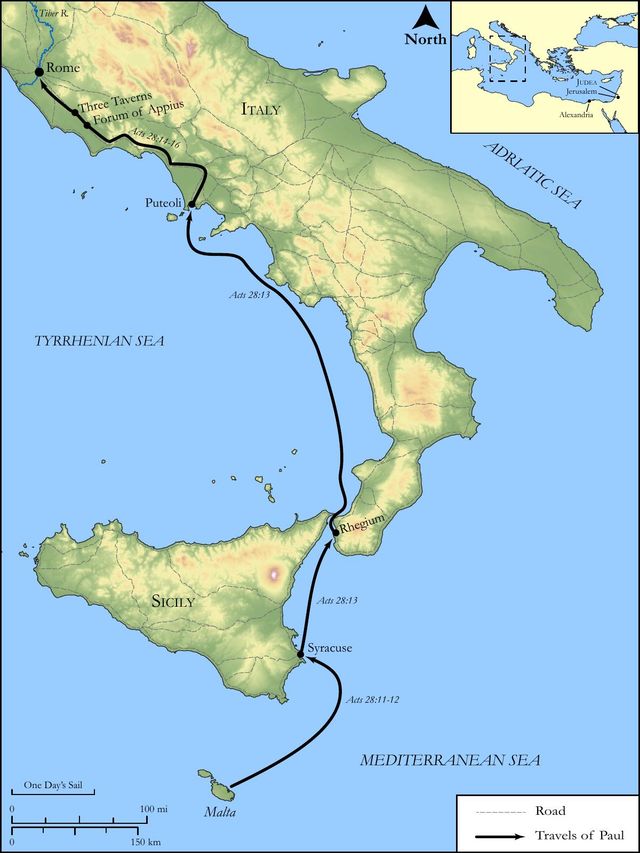
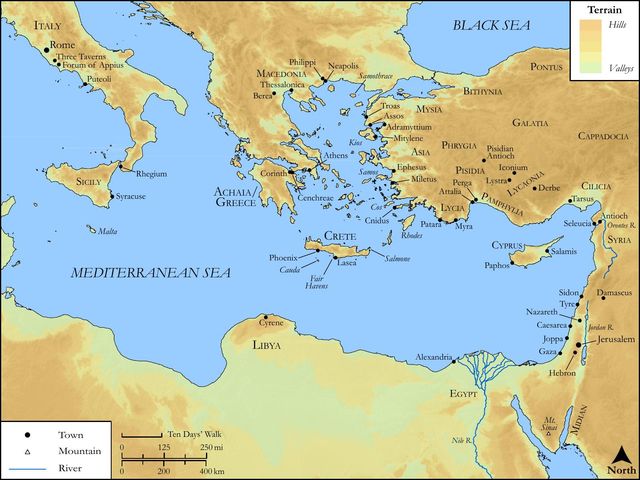
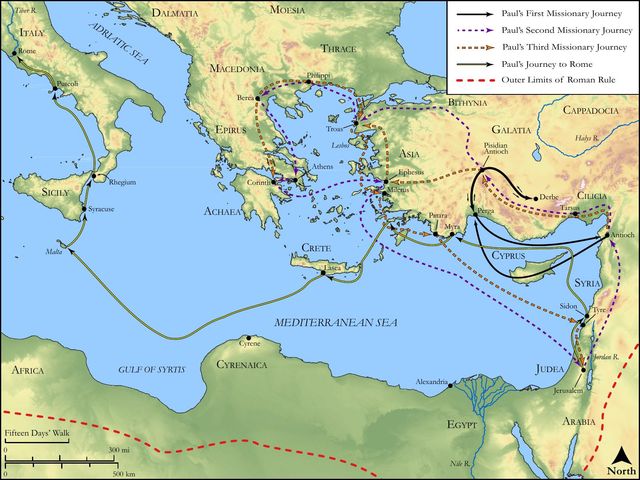
Study this verse
Public-domain commentary
Matthew Henry
From his Commentary on the Whole Bible. Henry comments on passages, not single verses — this entry covers Acts 28:30–31. His four-level outline is real structure in the source text, so it is rendered as structure.
We are here taking our leave of the history of blessed Paul; and therefore, since God saw it not fit that we should know any more of him, we should carefully take notice of every particular of the circumstances in which we must here leave him.
I.It cannot but be a trouble to us that we must leave him in bonds for Christ, nay, and that we have no prospect given us of his being set at liberty. Two whole years of that good man's life are here spent in confinement, and, for aught that appears, he was never enquired after, all that time, by those whose prisoner he was. He appealed to Caesar, in hope of a speedy discharge from his imprisonment, the governors having signified to his imperial majesty concerning the prisoner that he had done nothing worthy of death or bonds, and yet he is detained a prisoner. So little reason have we to trust in men, especially despised prisoners in great men; witness the case of Joseph, whom the chief butler remembered not, but forgot, Gen 40:23. Yet some think that though it be not mentioned here, yet it was in the former of these two years, and early too in that year, that he was first brought before Nero, and then his bonds in Christ were manifest in Caesar's court, as he says, Phi 1:13. And at this first answer it was that no man stood by him, Ti2 4:16. But it seems, instead of being set at liberty upon this appeal, as he expected, he hardly escaped out of the emperor's hands with his life; he calls it a deliverance out of the mouth of the lion, Ti2 4:17, and his speaking there of his first answer intimates that since that he had a second, in which he had come off better, and yet was not discharged. During these two years' imprisonment he wrote his epistle to the Galatians, then his second epistle to Timothy, then those to the Ephesians, Philippians, Colossians, and to Philemon, in which he mentions several things particularly concerning his imprisonment; and, lastly, his epistle to the Hebrews just after he was set at liberty, as Timothy also was, who, coming to visit him, was upon some account or other made his fellow-prisoner (with whom, writes Paul to the Hebrews, Plm 1:13 :23, if he come shortly, I will see you), but how or by what means he obtained his liberty we are not told, only that two years he was a prisoner. Tradition says that after his discharge he went from Italy to Spain, thence to Crete, and so with Timothy into Judea, and thence went to visit the churches in Asia, and at length came a second time to Rome, and there was beheaded in the last year of Nero. But Baronius himself owns that there is no certainty of any thing concerning him betwixt his release from this imprisonment and his martyrdom; but it is said by some that Nero, having, when he began to play the tyrant, set himself against the Christians, and persecuted them (and he was the first of the emperors that made a law against them, as Tertullian says, Apol. cap. 5), the church at Rome was much weakened by that persecution, and this brought Paul the second time to Rome, to re-establish the church there, and to comfort the souls of the disciples that were left, and so he fell a second time into Nero's hand. And Chrysostom relates that a young woman that was one of Nero's misses (to speak modishly) being converted, by Paul's preaching, to the Christian faith, and so brought off from the lewd course of life she had lived, Nero was incensed against Paul for it, and ordered him first to be imprisoned, and then put to death. But to keep to this short account here given of it,
1.It would grieve one to think that such a useful man as Paul was should be so long in restraint. Two years he was a prisoner under Felix (Act 24:27), and, besides all the time that passed between that and his coming to Rome, he is here two years more a prisoner under Nero. How many churches might Paul have planted, how many cities and nations might he have brought over to Christ, in these five years' time (for so much it was at least), if he had been at liberty! But God is wise, and will show that he is not debtor to the most useful instruments he employs, but can and will carry on his own interest, both without their services and by their sufferings. Even Paul's bonds fell out to the furtherance of the gospel, Phi 1:12-14.
2.Yet even Paul's imprisonment was in some respects a kindness to him, for these two years he dwelt in his own hired house, and that was more, for aught I know, than ever he had done before. He had always been accustomed to sojourn in the houses of others, now he has a house of his own - his own while he pays the rent of it; and such a retirement as this would be a refreshment to one who had been all his days an itinerant. He had been accustomed to be always upon the remove, seldom staid long at a place, but now he lived for two years in the same house; so that the bringing of him into this prison was like Christ's call to his disciples to come into a desert place, and rest awhile, Mar 6:31. When he was at liberty, he was in continual fear by reason of the lying in wait of the Jews (Act 20:19), but now his prison was his castle. Thus out of the eater came forth meat, and out of the strong sweetness.
II.Yet it is a pleasure to us (for we are sure it was to him) that, though we leave him in bonds for Christ, yet we leave him at work for Christ, and this made his bonds easy that he was not by them bound out from serving God and doing good. His prison becomes a temple, a church, and then it is to him a palace. His hands are tied, but, thanks be to God, his mouth is not stopped; a faithful zealous minister can better bear any hardship than being silenced. Here is Paul a prisoner, and yet a preacher; he is bound, but the word of the Lord is not bound. When he wrote his epistle to the Romans, he said he longed to see them, that he might impart unto them some spiritual gift (Rom 1:11); he was glad to see some of them (Act 28:15), but it would not be half his joy unless he could impart to them some spiritual gift, which here he has an opportunity to do, and then he will not complain of his confinement. Observe,
1.To whom he preached: to all that had a mind to hear him, whether Jews or Gentiles. Whether he had liberty to go to other houses to preach does not appear; it is likely not; but whoever would had liberty to come to his house to hear, and they were welcome: He received all that came to him. Note, Ministers' doors should be open to such as desire to receive instruction from them, and they should be glad of an opportunity to advise those that are in care about their souls. Paul could not preach in a synagogue, or any public place of meeting that was sumptuous and capacious, but he preached in a poor cottage of his own. Note, When we cannot do what we would in the service of God we must do what we can. Those ministers that have but little hired houses should rather preach in them, if they may be allowed to do that, than be silent. He received all that came to him, and was not afraid of the greatest, nor ashamed of the meanest. He was ready to preach on the first day of the week to Christians, on the seventh day to Jews, and to all who would come on any day of the week; and he might hope the better to speed because they came in unto him, which supposed a desire to be instructed and a willingness to learn, and where these are it is probable that some good may be done.
2.What he preached. He does not fill their heads with curious speculations, nor with matters of state and politics, but he keeps to his text, minds his business as an apostle.
(1.)He is God's ambassador, and therefore preaches the kingdom of God, does all he can to preach it up, negotiates the affairs of it, in order to the advancing of all its true interests. He meddles not with the affairs of the kingdoms of men; let those treat of them whose work it is. He preaches the kingdom of God among men, and the word of that kingdom; the same that he defended in his public disputes, testifying the kingdom of God (Act 28:23), he enforced in his public preaching, as that which, if received aright, will make us all wise and good, wiser and better, which is the end of preaching.
(2.)He is an agent for Christ, a friend of the bridegroom, and therefore teaches those things which concern the Lord Jesus Christ - the whole history of Christ, his incarnation, doctrine, life, miracles, death, resurrection, ascension; all that relates to the mystery of godliness. Paul stuck still to his principle - to know and preach nothing but Christ, and him crucified. Ministers, when in their preaching they are tempted to diverge from that which is their main business, should reduce themselves with this question, What does this concern the Lord Jesus Christ? What tendency has it to bring us to him, and to keep us walking in him? For we preach not ourselves, but Christ.
3.With what liberty he preached.
(1.)Divine grace gave him a liberty of spirit. He preached with all confidence, as one that was himself well assured of the truth of what he preached - that it was what he durst stand by; and of the worth of it - that it was what he durst suffer for. He was not ashamed of the gospel of Christ.
(2.)Divine Providence gave him a liberty of speech: No man forbidding him, giving him any check for what he did or laying any restraint upon him. The Jews that used to forbid him to speak to the Gentiles had no authority here; and the Roman government as yet took no cognizance of the profession of Christianity as a crime. Herein we must acknowledge the hand of God,
[1.]Setting bounds to the rage of persecutors; where he does not turn the heart, yet he can tie the hand and bridle the tongue. Nero was a bloody man, and there were many, both Jews and Gentiles, in Rome, that hated Christianity; and yet so it was, unaccountably, that Paul though a prisoner was connived at in preaching the gospel, and it was not construed a breach of the peace. Thus God makes the wrath of men to praise him, and restrains the remainder of it, Psa 76:10. Though there were so many that had it in their power to forbid Paul's preaching (even the common soldier that kept him might have done it), yet God so ordered it, that no man did forbid him.
[2.]See God here providing comfort for the relief of the persecuted. Though it was a very low and narrow sphere of opportunity that Paul was here placed in, compared with what he had been in, yet, such as it was, he was not molested nor disturbed in it. Though it was not a wide door that was opened to him, yet it was kept open, and no man was suffered to shut it; and it was to many an effectual door, so that there were saints even in Caesar's household, Phi 4:22. When the city of our solemnities is thus made a quiet habitation at any time, and we are fed from day to day with the bread of life, no man forbidding us, we must give thanks to God for it and prepare for changes, still longing for that holy mountain in which there shall never be any pricking brier nor grieving thorn.
Historical interpretation
Three Centuries of Reception
4 surviving comments on this verse. Each one is dated, so this reads as a timeline rather than a list.
Select a marker to jump to its quote. Markers stagger vertically where authors wrote within a few decades of each other.
"And Paul dwelt two whole years in his own hired house, and received all that came in unto him, preaching the kingdom of God, and teaching those things which concern the Lord Jesus Christ, with all confidence, no man forbidding him. Amen." It shows the freedom he had now: without hindrance in Rome, he who had been hindered in Judea; and he remained teaching there for two years.
"Discoursed," it says, "the things concerning the kingdom of God:" mark, nothing of the things of sense, nothing of the things present.
However, he remained for two whole years in his own hired house, that is, in the lodgings he had rented for himself, preaching Christ to all, not only to the Jews but also to the Gentiles, who he said were to be saved, those who were rejected.
He remained in his lodging for a full two years and welcomed all who came to him, preaching the kingdom of God. Jerome makes mention of this place in a letter to Lucinius: “Paul enters Rome in chains, to free those chained by errors of superstition; he remains in his rented lodging for two years, to render to us the eternal gift of both instruments.” By this exposition, he taught that all other things that are written in this volume, either about Paul the apostle himself or about others, do not only present the fruits of ecclesiastical doctrine on the surface of the letter: but truly also if anyone has perfectly understood, they possess the essence of spiritual sense, pregnant with virtue.
Continue studying Acts 28:30 across the web’s major study libraries — every link below opens this exact verse, chapter, or book on the destination site.
Read & Compare
 BibleGatewayThis verse in more than 200 translations and 70 languages.
 Bible.comThe YouVersion reader — hundreds of translations, reading plans, and highlights.
 ESV.orgCrossway's official English Standard Version reader.
 NET BibleThe NET translation with 60,000+ translators' notes on every rendering decision.
 STEP BibleTyndale House's free study tool — original text, vocabulary, and scholarly resources.
 BibliaLogos Bible Software's free web reader.
 USCCBThe New American Bible (Revised Edition) with the U.S. bishops' study notes.
Commentaries
 BibleHub CommentariesDozens of classic commentaries on this verse, gathered on one page.
 StudyLightMore than 100 commentary sets — the largest collection on the web.
 BibleRefPlain-English commentary on what this verse means, verse by verse.
 Enduring WordDavid Guzik's free commentary on this chapter, widely used by Bible teachers.
 Bible Study ToolsVerse commentary alongside Greek and Hebrew study aids.
Original Language & Research
- BibleHub InterlinearThe verse word by word — original language, transliteration, and English.
- BibleHub LexiconEvery word's original-language definition and Strong's entry.
 Blue Letter BibleDeep-study tools — Strong's numbers, concordance, and word studies.
 CNTR CollationThe earliest Greek manuscripts of this verse, collated letter by letter.
Sermons, Hymns & Audio


TrulyRandomVerse is not affiliated with these sites and doesn’t control their content. They’re linked because they’re genuinely useful.
Summary
Acts 28:30 provides a concise yet profound summary of Paul's initial two-year period of imprisonment in Rome. Despite being under house arrest, he maintained a remarkable degree of freedom, dwelling in a rented house where he consistently and hospitably welcomed all who came to him, continuing his vital ministry of proclaiming the Kingdom of God and teaching about the Lord Jesus Christ without hindrance. This verse marks a pivotal moment, showcasing the unstoppable advance of the gospel even in restrictive circumstances, serving as a powerful testament to God's sovereignty and Paul's unwavering commitment to his divine mission.
Context
ShowHideLiterary Context
Acts 28:30 serves as a crucial transition point and a summary statement within the book of Acts. It immediately follows Paul's final recorded interaction with the Jewish leaders in Rome, where he quotes Isaiah 6:9-10 to explain their rejection of the gospel, concluding with the declaration that God's salvation has now been sent to the Gentiles (Acts 28:28). This verse then sets the stage for the book's concluding statement in Acts 28:31, which emphasizes the unhindered preaching of the Kingdom of God. Together, these verses encapsulate the overarching narrative arc of Acts: the gospel's journey from Jerusalem to Rome, from Jew to Gentile, demonstrating its unstoppable momentum despite opposition and imprisonment. The preceding chapters detail Paul's arduous journey to Rome, including shipwrecks and trials, culminating in his arrival as a prisoner who, remarkably, is granted significant liberty.
Historical & Cultural Context
Paul's situation in Rome, described as dwelling "in his own hired house," points to a specific form of Roman custody known as custodia libera or "free custody." This arrangement was typically granted to Roman citizens of some standing who were awaiting trial, especially if they were not deemed a flight risk or a danger to the public. Instead of being confined to a common prison, the accused could rent a private dwelling, albeit under the supervision of a Roman guard (implied by Paul's chains elsewhere, e.g., Acts 28:20). This practice allowed Paul a unique opportunity to continue his ministry. Rome at this time was the heart of the empire, a melting pot of cultures and religions, making it a strategic location for the spread of the gospel. The emperor Nero, known for his later persecution of Christians, was in power, though the full extent of his hostility had not yet manifested. Paul's ability to receive visitors and preach openly for two years underscores the relative religious tolerance of the early Roman Empire towards new cults, provided they did not disrupt public order.
Key Themes
ShowHideThis verse powerfully encapsulates several key themes that run throughout the book of Acts and Paul's ministry. Firstly, it highlights the unhindered advance of the gospel, demonstrating that God's mission is not constrained by human limitations or imprisonment. Paul, though a prisoner, becomes a strategic outpost for the Kingdom. Secondly, it underscores Paul's unwavering commitment to his apostolic calling to preach the gospel to both Jews and Gentiles, as seen in his receiving "all that came in unto him." This openness reflects the universal scope of God's salvation, a theme central to Acts, particularly after the decisive moment in Acts 10. Thirdly, the passage subtly reveals God's sovereign providence, orchestrating circumstances to bring Paul to Rome, fulfilling his long-held desire to preach the gospel in the imperial capital (Romans 1:15). This period is traditionally believed to be when Paul penned his "Prison Epistles" (Ephesians, Philippians, Colossians, and Philemon), further extending his theological and pastoral influence far beyond the walls of his rented house.
Exposition and Analysis
ShowHideKey Word Analysis
ShowHideA primary verb meaning "to stay (in a given place, state, relation or expectancy)." Here, it denotes Paul's fixed residence for a significant period. It implies not just physical presence but a settled, continuous state, highlighting the duration and stability of his stay despite his prisoner status. This "dwelling" was not a temporary stop but a sustained period of residence and ministry.
Meaning "a rented building." This specific term clarifies Paul's living arrangement. It was not a prison cell provided by the authorities, nor was it his own property. The fact that it was "hired" suggests either Paul had personal funds, or more likely, he was supported by fellow believers or patrons, enabling him to secure a private residence. This detail is crucial for understanding the nature of his "free custody" and his ability to host visitors.
Meaning "to take fully, i.e., welcome (persons), approve (things); accept, receive (gladly)." This verb emphasizes Paul's active and hospitable posture. He didn't merely tolerate visitors; he "gladly received" them. This indicates his eagerness to engage with people, reflecting his commitment to sharing the gospel and providing spiritual instruction to all who sought him out, irrespective of their background.
Verse Breakdown
ShowHide"And Paul dwelt two whole years in his own hired house"
This clause establishes the duration and nature of Paul's initial Roman imprisonment. The "two whole years" (G1333, dietía) signify a substantial period, indicating a delay in his trial before Caesar. The phrase "in his own hired house" (G3410, místhōma with G2398, ídios) highlights his unique status of custodia libera, allowing him a degree of autonomy and privacy not afforded to ordinary prisoners. This arrangement was likely due to his Roman citizenship and possibly the lack of immediate pressing charges or evidence against him.
"and received all that came in unto him"
This second clause describes Paul's continued ministry activity during his house arrest. The verb "received" (G588, apodéchomai) implies a welcoming and hospitable attitude. The phrase "all that came in unto him" (G3956, pâs with G1531, eisporeúomai) signifies an open-door policy, emphasizing his accessibility to everyone—Jew or Gentile, rich or poor, learned or unlearned. This demonstrates his unwavering commitment to proclaiming the gospel and teaching, even while awaiting trial, turning his confinement into a center for evangelism and discipleship.
Literary Devices
ShowHideActs 28:30 employs several powerful Literary Devices. The most prominent is Juxtaposition, contrasting Paul's status as a prisoner ("dwelt... in his own hired house") with his active, unhindered ministry ("received all that came in unto him"). This highlights the paradoxical nature of God's work, which often flourishes in seemingly restrictive circumstances. There is also a strong element of Irony: Paul, brought to Rome in chains, becomes an even more effective evangelist from his "prison," reaching people who might otherwise have been inaccessible. His "hired house" functions as a Symbol of the uncontainable nature of the gospel; it is a physical boundary that paradoxically becomes a gateway for spiritual liberation. Furthermore, the verse serves as a Summary Statement, encapsulating a significant period of Paul's life and ministry, providing a concise overview of his activities before the narrative of Acts concludes. This summary also subtly employs Foreshadowing, hinting at the continued, unhindered proclamation of the gospel described in the very next verse (Acts 28:31), thus reinforcing the overarching theme of the Spirit's unstoppable mission.
Theological and Thematic Connections
ShowHideActs 28:30 powerfully illustrates the theological truth that God's word is not bound, even when its messengers are. Paul's "hired house" becomes a strategic outpost for the Kingdom, demonstrating that physical limitations cannot hinder the spiritual advance of the gospel. This period of house arrest, far from being a setback, was providentially used by God to establish a Christian presence at the very heart of the Roman Empire and to enable Paul to write some of his most profound theological letters. It underscores the theme of divine sovereignty, where God orchestrates circumstances, even adverse ones, for the fulfillment of His redemptive purposes, turning what might appear to be an impediment into an opportunity for wider gospel dissemination.
Reflection and Application
ShowHideActs 28:30 offers profound lessons for contemporary believers, challenging us to re-evaluate our understanding of ministry, limitations, and God's providence. Paul's example teaches us that our effectiveness for God is not dependent on external circumstances or perfect freedom, but on our faithfulness and availability. Even in what might seem like a personal setback or confinement, God can transform our "hired houses" into centers of influence, ministry, and spiritual growth. We are called to cultivate a spirit of hospitality and openness, eagerly "receiving all that came in unto" us, recognizing every interaction as a potential opportunity to share the hope of the gospel. This verse encourages us to persevere in our faith and witness, trusting that God's overarching plan for His Kingdom will advance, often in surprising ways, even when our own resources or freedom seem limited. It reminds us that true impact is measured not by the size of our platform, but by the faithfulness with which we steward the opportunities God provides, no matter how humble or constrained they may appear.
Questions for Reflection
ShowHideFAQ
ShowHideWhat was the nature of Paul's imprisonment in Acts 28:30?
ShowHidePaul's imprisonment was a form of "house arrest" or custodia libera (free custody), a common practice in the Roman legal system for citizens awaiting trial. Instead of being held in a common prison, Paul was allowed to rent his own dwelling ("hired house") in Rome. While he was still technically a prisoner and likely under guard (as indicated by his chains mentioned in Acts 28:20), this arrangement granted him significant freedom to receive visitors and continue his ministry. This was a privilege often extended to those of higher status or those whose cases were not considered immediate threats to public order.
What did Paul do during these "two whole years" in Rome?
ShowHideDuring his two years under house arrest, Paul was incredibly active in ministry. Acts 28:30 states he "received all that came in unto him," and the following verse, Acts 28:31, specifies that he was "preaching the kingdom of God, and teaching those things which concern the Lord Jesus Christ, with all confidence, no man forbidding him." This period was a hub of evangelism and discipleship. Traditionally, it is also believed that Paul wrote his "Prison Epistles" during this time: Ephesians, Philippians, Colossians, and Philemon. These letters demonstrate his continued theological work and pastoral care, extending his influence far beyond the walls of his rented house.
Does Acts 28:30 mark the end of Paul's story in the Bible?
ShowHideActs 28:30, along with Acts 28:31, concludes the narrative of the book of Acts. While the Bible does not explicitly detail Paul's release or subsequent activities after these two years, early church tradition strongly suggests that Paul was acquitted after this first Roman imprisonment. He then engaged in further missionary journeys (possibly to Spain, as he had planned in Romans 15:24), before being rearrested and ultimately martyred under Emperor Nero, likely around 67 AD. Letters like 1 Timothy and Titus are often dated to this period between his first and second Roman imprisonments, and 2 Timothy is believed to have been written during his final imprisonment, shortly before his death.
Christ-Centered Fulfillment
ShowHideActs 28:30, while focusing on Paul's ministry, profoundly points to the ongoing, unstoppable reign of Christ and the advancement of His Kingdom. Paul's ability to "dwell two whole years in his own hired house" and "receive all that came in unto him" is not merely a testament to his resilience, but a direct consequence of Christ's promise that the gates of hell would not prevail against His church (Matthew 16:18). Paul's unhindered preaching of the Kingdom of God and teaching about the Lord Jesus Christ (Acts 28:31) is the fulfillment of the Great Commission given by the resurrected Christ (Matthew 28:18-20). Jesus, as the ultimate Lamb of God (John 1:29) who conquered sin and death, empowers His followers to continue His redemptive work, even from places of apparent confinement. Paul's "hired house" in Rome symbolically represents the universal reach of Christ's dominion; it is from this seemingly humble and restricted location that the message of the King, Jesus Christ, continued to radiate outward, demonstrating that no earthly power, no imprisonment, and no human opposition can ultimately thwart the divine plan of God to gather His people and establish His eternal Kingdom through the cross and resurrection of His Son (Colossians 1:13-14). Paul's ministry in Rome, therefore, is a powerful echo of Christ's own mission to seek and save the lost (Luke 19:10), demonstrating that the gospel, centered on Christ, is truly "the power of God for salvation to everyone who believes" (Romans 1:16).