


Acts 28:15
- κἀκεῖθενkakeithenAnd from thereG1564CONJ + G1564=ADV
- οἱhoitheG3588T-NPMDefinite article Nominative Plural Masculine
- ἀδελφοὶadelphoibrothersG80N-NPMNoun Nominative Plural Masculine
- ἀκούσαντεςakousanteshaving heardG191V-AAP-NPMVerb Aorist Active Participle Nominative Plural Masculine
- τὰtathe [things]G3588T-APNDefinite article Accusative Plural Neuter
- περὶpericoncerningG4012PREPPreposition
- ἡμῶνhēmōnusG3165P-1GPPersonal pronoun Genitive 1st Plural
- ἦλθανēlthanthey came outG2064V-2AAI-3PVerb 2nd Aorist Active Indicative 3rd Plural
- εἰςeistoG1519PREPPreposition
- ἀπάντησινapantēsinmeetG529N-ASFNoun Accusative Singular Feminine
- ἡμῖνhēminusG3165P-1DPPersonal pronoun Dative 1st Plural
- ἄχριachrias far asG891PREPPreposition
- ἈππίουAppiouof AppiusG675N-GSM-LNoun Genitive Singular Masculine Location
- φόρουphorou[the] marketG5410N-GSN-LNoun Genitive Singular Neuter Location
- καὶkaiandG2532CONJConjunction
- ΤριῶνTriōn[the] ThreeG5140A-GPF-LAdjective Genitive Plural Feminine Location
- ταβερνῶνtabernōnTavernsG4999N-GPF-LNoun Genitive Plural Feminine Location
- οὓςhouswhomG3739R-APMRelative pronoun Accusative Plural Masculine
- ἰδὼνidōnhaving seenG1492V-2AAP-NSMVerb 2nd Aorist Active Participle Nominative Singular Masculine
- ὁho<the>G3588T-NSMDefinite article Nominative Singular Masculine
- ΠαῦλοςPaulosPaulG3972N-NSM-PNoun Nominative Singular Masculine Individual
- εὐχαριστήσαςeucharistēsashaving given thanksG2168V-AAP-NSMVerb Aorist Active Participle Nominative Singular Masculine
- τῷtō<the>G3588T-DSMDefinite article Dative Singular Masculine
- θεῷtheōto GodG2316N-DSM-TNoun Dative Singular Masculine Title
- ἔλαβενelabentookG2983V-2AAI-3SVerb 2nd Aorist Active Indicative 3rd Singular
- θάρσοςtharsoscourageG2294N-ASNNoun Accusative Singular Neuter
English is a literal word-by-word gloss of the Greek, not the KJV's wording. Why?
This is the original text the KJV's translators worked from — each Greek word with its own literal English meaning in this verse, prepared by scholars at Tyndale House, Cambridge. The KJV translates whole sentences, not word by word, so its wording differs: one Greek word can become several English words, and the KJV may choose “charity” where the gloss reads “love”. Both are faithful — they answer different questions. For the KJV's own rendering, switch to the KJV text.
Details
See on the biblical-era maps
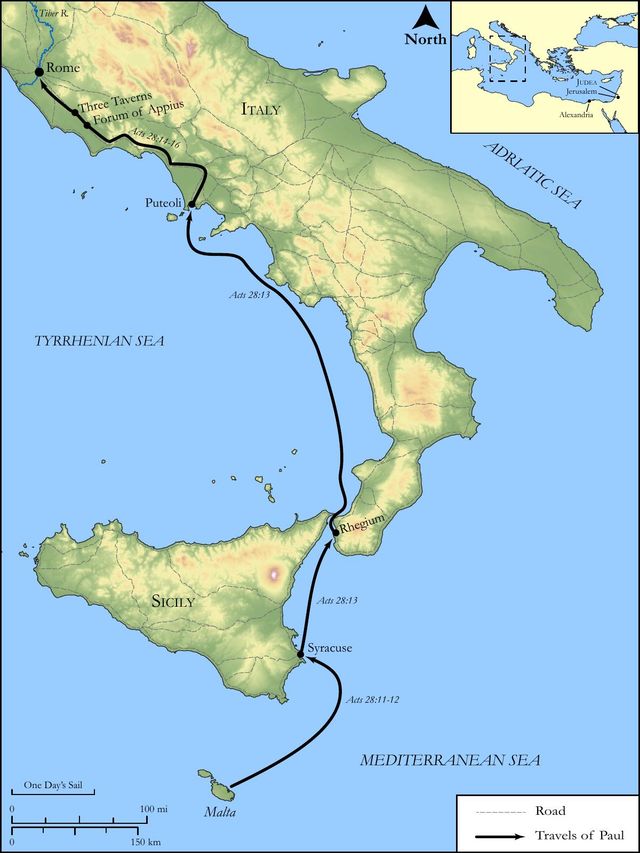
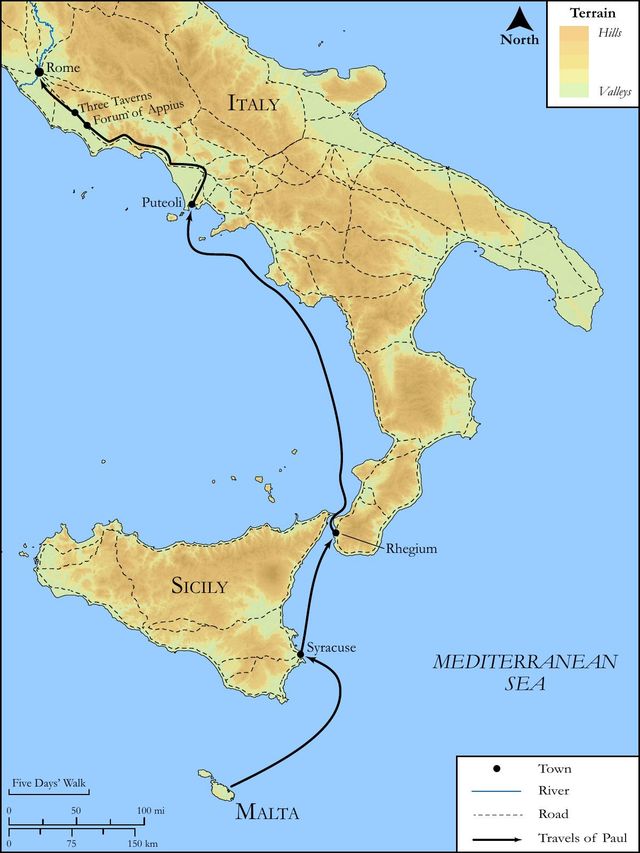
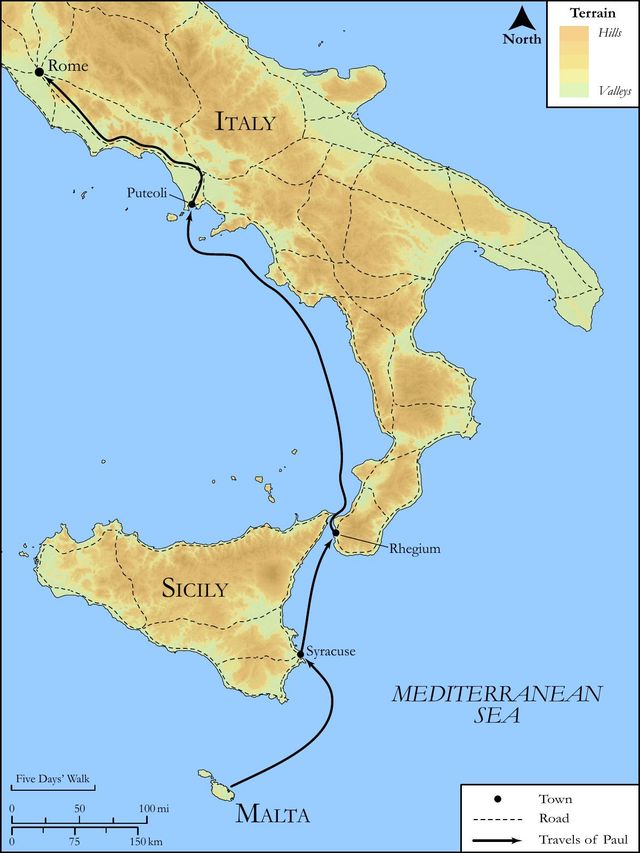
Study this verse
Public-domain commentary
Matthew Henry
From his Commentary on the Whole Bible. Henry comments on passages, not single verses — this entry covers Acts 28:11–16. His three-level outline is real structure in the source text, so it is rendered as structure.
We have here the progress of Paul's voyage towards Rome, and his arrival there at length. A rough and dangerous voyage he had hitherto had, and narrowly escaped with his life; but after a storm comes a calm: the latter part of his voyage was easy and quiet.
Per varios casus, per tot discrimina rerum,
Tendimus ad Latium -
Through various hazards and events we move
To Latium.
Tendimus ad coelum.
We make for heaven.
- Dabit Deus his quoque finem.
To these a period will be fixed by Heaven.
We have here,
I.Their leaving Malta.
That island was a happy shelter to them, but it was not their home; when they are refreshed they must put to sea again. The difficulties and discouragements we have met with in our Christian course must not hinder us from pressing forward. Notice is here taken,
1.Of the time of their departure: After three months, the three winter months. Better lie by, though they lay upon charges, than go forward while the season was dangerous. Paul had warned them against venturing to sea in winter weather, and they would not take the warning; but, now that they had learned it by the difficulties and dangers they had gone through, he needed not to warn them: their learning did them good when they had paid dearly for it. Experience is therefore called the mistress of fools, because those are fools that will not learn till experience has taught them.
2.Of the ship in which they departed. It was in a ship of Alexandria; so was that which was cast away, Act 27:6. This ship had wintered in that isle, and was safe. See what different issues there are of men's undertakings in this world. Here were two ships, both of Alexandria, both bound for Italy, both thrown upon the same island, but one is wrecked there and the other is saved. Such occurrences may often be observed. Providence sometimes favours those that deal in the world, and prospers them, that people may be encouraged to set their hands to worldly business; at other times Providence crosses them, that people may be warned not to set their hearts upon it. Events are thus varied, that we may learn both how to want and how to abound. The historian takes notice of the sign of the ship, which probably gave it its name: it was Castor and Pollux. Those little foolish pagan deities, which the poets had made to preside over storms and to protect seafaring men, as gods of the sea, were painted or graven upon the fore-part of the ship, and thence the ship took its name. I suppose this is observed for no other reason than for the better ascertaining of the story, that ship being well known by that name and sign by all that dealt between Egypt and Italy. Dr. Lightfoot thinks that Luke mentions this circumstance to intimate the men's superstition, that they hoped they should have better sailing under this badge than they had had before.
II.Their landing in or about Italy, and the pursuing of their journey towards Rome.
1.They landed first at Syracuse in Sicily, the chief city of that island. There they tarried three days, probably having some goods to put ashore, or some merchandise to make there; for it seems to have been a trading voyage that this ship made. Paul had now his curiosity gratified with the sight of places he had often heard of and wished to see, particularly Syracuse, a place of great antiquity and note; and yet, it should seem, there were no Christians there.
2.From Syracuse they came to Rhegium, a city in Italy, directly opposite to Messina in Sicily, belonging to the kingdom of Calabria or Naples. There, it seems they staid one day; and a very formal story the Romish legends tell of Paul's preaching here at this time, and the fish coming to the shore to hear him, - that with a candle he set a stone pillar on fire, and by that miracle convinced the people of the truth of his doctrine, and they were many of them baptized, and he ordained Stephen, one of his companions in this voyage, to be their bishop, - and all this, they tell you, was done in this one day; whereas it does not appear that they did so much as go ashore, but only came to an anchor in the road.
3.From Rhegium they came to Puteoli, a sea-port town not far from Naples, now called Pozzolana. The ship of Alexandria was bound for that port, and therefore there Paul, and the rest that were bound for Rome, were put ashore, and went the remainder of their way by land. At Puteoli they found brethren, Christians. Who brought the knowledge of Christ hither we are not told, but here it was, so wonderfully did the leaven of the gospel diffuse itself. God has many that serve and worship him in places where we little think he has. And observe,
(1.)Though it is probable there were but few brethren in Puteoli, yet Paul found them out; either they heard of him, or he enquired them out, but as it were by instinct they got together. Brethren in Christ should find out one another, and keep up communion with each other, as those of the same country do in a foreign land.
(2.)They desired Paul and his companions to tarry with them seven days, that is, to forecast to stay at least one Lord's day with them, and to assist them in their public worship that day. They knew not whether ever they should see Paul at Puteoli again, and therefore he must not go without giving them a sermon or two, or more. And Paul was willing to allow them so much of his time; and the centurion under whose command Paul now was, perhaps having himself friends or business at Puteoli, agreed to stay one week there, to oblige Paul.
4.From Puteoli they went forward towards Rome; whether they travelled on foot, or whether they had beasts provided for them to ride on (as Act 23:24), does not appear; but to Rome they must go, and this was their last stage.
III.The meeting which the Christians at Rome gave to Paul.
It is probable that notice was sent to them by the Christians at Puteoli, as soon as ever Paul had come thither, how long he intended to stay there, and when he would set forward for Rome, which gave an opportunity for this interview. Observe,
1.The great honour they did to Paul. They had heard much of his fame, what use God had made of him, and what eminent service he had done to the kingdom of Christ in the world, and to what multitudes of souls he had been a spiritual father. They had heard of his sufferings, and how God had owned him in them, and therefore they not only longed to see him, but thought themselves obliged to show him all possible respect, as a glorious advocate for the cause of Christ. He had some time ago written a long epistle to them, and a most excellent one, the epistle to the Romans, in which he had not only expressed his great kindness for them, but had given them a great many useful instructions, in return for which they show him this respect. They went to meet him, that they might bring him in state, as ambassadors and judges make their public entry, though he was a prisoner. Some of them went as far as Appiiforum, which was fifty-one miles from Rome; others to a place called the Three Taverns, which was twenty-eight miles (some reckon it thirty-three miles) from Rome. They are to be commended for it, that they were so far from being ashamed of him, or afraid of owning him, because he was a prisoner, that for that very reason they counted him worthy of double honour, and were the more careful to show him respect.
2.The great comfort Paul had in this. Now that he was drawing near to Rome, and perhaps heard at Puteoli what character the emperor Nero now had, and what a tyrant he had of late become, he began to have some melancholy thoughts about his appeal to Caesar, and the consequences of it. He was drawing near to Rome, where he had never been, where there were few that knew him or that he knew, and what things might befall him here he could not tell; but he began to grow dull upon it, till he met with these good people that came from Rome to show him respect; and when he saw them,
(1.)He thanked God. We may suppose he thanked them for their civility, told them again and again how kindly he took it; but this was not all: he thanked God. Note, If our friends be kind to us, it is God that makes them so, that puts it into their hearts, and into the power of their hands, to be so, and we must give him the glory of it. He thanked God, no doubt, for the civility and generosity of the barbarous people at Melita, but much more for the pious care of the Christian people at Rome for him. When he saw so many Christians that were of Rome, he thanked God that the gospel of Christ had had such wonderful success there in the metropolis of the empire. When we go abroad, or but look abroad, into the world, and meet with those, even in strange places, that bear up Christ's name, and fear God, and serve him, we should lift up our hearts to heaven in thanksgiving; blessed be God that there are so many excellent ones on this earth, bad as it is. Paul had thanked God for the Christians at Rome before he had ever seen them, upon the report he had heard concerning them (Rom 1:8): I thank my God for you all. But now that he saw them (and perhaps they appeared more fashionable and genteel people than most he had conversed with, or more grave, serious, and intelligent, than most) he thanked God. But this was not all:
(2.)He took courage. It put new life into him, cheered up his spirits, and banished his melancholy, and now he can enter Rome a prisoner as cheerfully as ever he had entered Jerusalem at liberty. he finds there are those there who love and value him, and whom he may both converse with and consult with as his friends, which will take off much of the tediousness of his imprisonment, and the terror of his appearing before Nero. Note, it is an encouragement to those who are travelling towards heaven to meet with their fellow travellers, who are their companions in the kingdom and patience of Jesus Christ. When we see the numerous and serious assemblies of good Christians, we should not only give thanks to God, but take courage to ourselves. And this is a good reason why respect should be shown to good ministers, especially when they are in sufferings, and have contempt put upon them, that it encourages them, and makes both their sufferings and their services more easy. Yet it is observable that though the Christians at Rome were now so respectful to Paul, and he had promised himself so much from their respect, yet they failed him when he most needed them; for he says (Ti2 4:16), At my first answer, no man stood with me, but all men forsook me. They could easily take a ride of forty or fifty miles to go and meet Paul, for the pleasantness of the journey; but to venture the displeasure of the emperor and the disobliging of other great men, by appearing in defence of Paul and giving evidence for him, here they desire to be excused; when it comes to this, they will rather ride as far out of town to miss him as now they did to meet him, which is an intimation to us to cease from man, and to encourage ourselves in the Lord our God. The courage we take from his promises will never fail us, when we shall be ashamed of that which we took from men's compliments. Let God be true, but every man a liar.
IV.The delivering of Paul into custody at Rome, Act 28:16. He is now come to his journey's end. And,
1.He is still a prisoner. He had longed to see Rome, but, when he comes there, he is delivered, with other prisoners, to the captain of the guard, and can see no more of Rome than he will permit him. How many great men had made their entry into Rome, crowned and in triumph, who really were the plagues of their generation! But here a good man makes his entry into Rome, chained and triumphed over as a poor captive, who was really the greatest blessing to his generation. This thought is enough to put one for ever out of conceit with this world.
2.Yet he has some favour shown him. He is a prisoner, but not a close prisoner, not in the common jail: Paul was suffered to dwell by himself, in some convenient private lodgings which his friends there provided for him, and a soldier was appointed to be his guard, who, we hope, was civil to him, and let him take all the liberty that could be allowed to a prisoner, for he must be very ill-natured indeed that could be so to such a courteous obliging man as Paul. Paul, being suffered to dwell by himself, could the better enjoy himself, and his friends, and his God, than if he had been lodged with the other prisoners. Note, This may encourage God's prisoners, that he can give them favour in the eyes of those that carry them captive (Psa 106:46), as Joseph in the eyes of his keeper (Gen 39:21), and Jehoiachin in the eyes of the king of Babylon, Kg2 25:27, Kg2 25:28. When God does not deliver his people presently out of bondage, yet, if he either make it easy to them or them easy under it, they have reason to be thankful.
Historical interpretation
Historical reception
1 surviving comment on this verse from the historical church.
"And from thence, when the brethren heard of us, they came to meet us as far as Appii forum, and the Three Taverns: whom when Paul saw, he thanked God, and took courage." Not fearing the danger. But observe also how Paul himself also was affected after the manner of men. For it says, "he took courage, when he saw the brethren." Although he had worked so many miracles, nevertheless even from sight he received an accession of confidence. From this we learn, that he was both comforted after the manner of men, and the contrary.
Continue studying Acts 28:15 across the web’s major study libraries — every link below opens this exact verse, chapter, or book on the destination site.
Read & Compare
 BibleGatewayThis verse in more than 200 translations and 70 languages.
 Bible.comThe YouVersion reader — hundreds of translations, reading plans, and highlights.
 ESV.orgCrossway's official English Standard Version reader.
 NET BibleThe NET translation with 60,000+ translators' notes on every rendering decision.
 STEP BibleTyndale House's free study tool — original text, vocabulary, and scholarly resources.
 BibliaLogos Bible Software's free web reader.
 USCCBThe New American Bible (Revised Edition) with the U.S. bishops' study notes.
Commentaries
 BibleHub CommentariesDozens of classic commentaries on this verse, gathered on one page.
 StudyLightMore than 100 commentary sets — the largest collection on the web.
 BibleRefPlain-English commentary on what this verse means, verse by verse.
 Enduring WordDavid Guzik's free commentary on this chapter, widely used by Bible teachers.
 Bible Study ToolsVerse commentary alongside Greek and Hebrew study aids.
Original Language & Research
- BibleHub InterlinearThe verse word by word — original language, transliteration, and English.
- BibleHub LexiconEvery word's original-language definition and Strong's entry.
 Blue Letter BibleDeep-study tools — Strong's numbers, concordance, and word studies.
 CNTR CollationThe earliest Greek manuscripts of this verse, collated letter by letter.
Sermons, Hymns & Audio


TrulyRandomVerse is not affiliated with these sites and doesn’t control their content. They’re linked because they’re genuinely useful.
Summary
Acts 28:15 captures a pivotal moment in Paul's arduous journey to Rome, where, despite enduring a shipwreck and numerous trials, he is profoundly encouraged by the unexpected and loving reception from fellow believers who traveled to meet him. This encounter not only renews his spirit and resolve but also serves as a powerful testament to the sustaining power of Christian fellowship and God's faithfulness in guiding His servant toward His divine purpose in the heart of the Roman Empire.
Context
ShowHideLiterary Context
This verse immediately follows Paul's arrival at Puteoli, a port city on the west coast of Italy, as detailed in Acts 28:13-14. Having survived a perilous shipwreck off the coast of Malta (narrated in vivid detail in Acts 27), Paul and his companions spent three days at Puteoli. The narrative in Acts 28 then shifts its focus to Paul's final approach to Rome. Verse 15 marks the culmination of the journey's most dangerous phase and introduces a moment of profound spiritual and emotional relief for the apostle before he faces the challenges of imprisonment and ministry in the capital. It sets the stage for Paul's initial interactions with the Jewish leaders and his subsequent ministry in Rome, as described in Acts 28:16-31.
Historical & Cultural Context
Paul's journey to Rome was along the famous Appian Way (Via Appia), one of the earliest and most strategically important Roman roads, connecting Rome to Brindisi (Brundisium) on the southeast coast. This road was a vital artery for trade, military movements, and communication. "Appii forum" (Forum of Appius), approximately 43 miles southeast of Rome, was a bustling market town and a common staging post for travelers, often noted for its inns and canal. "The three taverns" (Tres Tabernae), about 33 miles from Rome, was another well-known resting point. For Roman believers to travel such distances to meet Paul demonstrates significant dedication and the strong, interconnected nature of early Christian communities. Travel by foot or slow carriage over such distances was arduous, highlighting their commitment to welcoming a revered, though perhaps personally unknown, apostle.
Key Themes
ShowHideThe encounter in Acts 28:15 contributes significantly to several overarching themes in Acts. Firstly, it underscores the power and importance of Christian fellowship and mutual encouragement. The proactive journey of the Roman believers to meet Paul, a weary and trial-worn apostle, exemplifies the practical outworking of Christian love and solidarity, mirroring the call for believers to bear one another's burdens as seen in Galatians 6:2. Secondly, it highlights God's unwavering faithfulness in fulfilling His purposes, even amidst immense adversity. Despite assassination plots, a tumultuous sea voyage, and a shipwreck, God consistently guided Paul to Rome, fulfilling His earlier promise that Paul would bear witness in the capital (Acts 23:11). This moment of encouragement was a divine provision, demonstrating that God often uses His people as instruments of His grace and strength, enabling His servants to persevere in their calling.
Exposition and Analysis
ShowHideKey Word Analysis
ShowHideA primary verb meaning "to see (literally or figuratively); by implication, (in the perfect tense only) to know." In this context, Paul's act of "seeing" these brethren is more than mere visual perception; it implies a profound recognition and understanding of their presence as a divine provision. It's the moment of full awareness that these were his brothers and sisters in Christ, a tangible sign of God's care.
Meaning "to be grateful, i.e. (actively) to express gratitude (towards); specially, to say grace at a meal." Paul's immediate response of thanking God indicates a deep, heartfelt acknowledgment that this encounter was not coincidental but a direct blessing from God. It highlights his consistent posture of gratitude, even after enduring extreme hardship.
Meaning "boldness (subjectively)." This word signifies a profound inner strengthening or emboldening. Paul, though spiritually resilient, was humanly exhausted and facing an uncertain future in Rome. The sight of the believers infused him with renewed boldness and resolve, enabling him to face the impending challenges with a fresh spirit of confidence and trust in God.
Verse Breakdown
ShowHide"And from thence, when the brethren heard of us, they came to meet us as far as Appii forum, and The three taverns"
This clause details the remarkable initiative of the Roman Christian community. "From thence" refers to Puteoli, where Paul had disembarked. News of his arrival, likely spread by fellow travelers or merchants, reached the believers in Rome. Their response was not passive; they actively "came to meet" Paul. The mention of "Appii forum" and "The three taverns" specifies the considerable distances they traveled along the Appian Way, demonstrating their eagerness and commitment to welcome the apostle. This act underscores the strong bonds of fellowship and mutual care within the early church.
"whom when Paul saw, he thanked God, and took courage"
This second clause reveals Paul's deeply personal and spiritual reaction to the encounter. The sight of these believers, many of whom he had never met, was a profound source of comfort and encouragement. His immediate response was to "thank God," acknowledging divine providence in orchestrating this meeting. Furthermore, he "took courage," indicating a significant renewal of his inner strength and resolve. This was not merely a fleeting emotion but a spiritual bolstering that prepared him for the demanding ministry and imprisonment awaiting him in Rome.
Literary Devices
ShowHideThe verse effectively employs Narrative Progression by marking a significant transition in Paul's journey, moving from the perils of the sea to the embrace of the Christian community on land, signaling his imminent arrival in Rome. Symbolism is also present: the journey of the Roman believers to meet Paul symbolizes the proactive nature of Christian love and fellowship, reaching out to those in need. Their presence at "Appii forum" and "The three taverns"—places of public transit and rest—underscores the idea that Christian community is found not just in formal gatherings but also in the everyday pathways of life. Finally, Juxtaposition is subtly used, contrasting Paul's recent trials (shipwreck, dangers) with the immediate comfort and encouragement he receives, highlighting God's provision and the restorative power of fellowship after suffering.
Theological and Thematic Connections
ShowHideActs 28:15 powerfully illustrates the theological truth that God often uses His people as instruments of His grace and encouragement. Paul, though an apostle of immense spiritual fortitude, was still human and susceptible to weariness and discouragement after his harrowing journey. The timely appearance of the Roman believers was a tangible expression of God's care, reminding Paul that he was not alone and that his mission was supported by a wider body of believers. This encounter underscores the vital role of community in sustaining faith and perseverance, demonstrating that mutual encouragement is a divine provision for the journey of discipleship. It reflects the New Testament emphasis on the body of Christ, where each member contributes to the strength and well-being of the whole.
Reflection and Application
ShowHideActs 28:15 provides a timeless blueprint for Christian living, urging believers to actively embody the spirit of the Roman brethren. In a world often marked by isolation and hardship, the proactive love and solidarity demonstrated by these early Christians serve as a powerful reminder of our call to be sources of encouragement and support for one another. Just as Paul, a spiritual giant, found his strength renewed through the presence of fellow believers, so too do we all need the tangible expression of Christ's love through His body. This verse challenges us to look beyond our immediate circles, to extend hospitality, to offer a listening ear, or to simply be present for those who are weary, struggling, or transitioning. It underscores the profound truth that our faith journey is not meant to be walked alone, and that God often chooses to minister His strength and comfort through the hands and hearts of His people. By valuing and nurturing Christian fellowship, we not only uplift others but also find our own faith deepened and our courage renewed for the challenges ahead.
Questions for Reflection
ShowHideFAQ
ShowHideWhy did the Roman brethren travel so far to meet Paul, given that they had never met him?
ShowHideThe Roman brethren's journey to meet Paul, traveling approximately 33 to 43 miles from Rome to "Appii forum" and "The three taverns," demonstrates the profound sense of unity and spiritual connection within the early Christian community. Although many may not have met Paul personally, his reputation as a leading apostle, his extensive missionary journeys, and his profound theological teachings (especially known through his Letter to the Romans, which they had likely received and studied) would have made him a highly revered figure. News of his impending arrival, especially after surviving a shipwreck, would have stirred a deep desire to welcome and honor him. Their act was a tangible expression of fellowship, solidarity, and love for a fellow servant of Christ, recognizing his immense contributions to the spread of the Gospel and the building up of the church. It highlights the strong bonds that transcended personal acquaintance, rooted in their shared faith in Jesus Christ.
Christ-Centered Fulfillment
ShowHideActs 28:15, while focusing on Paul's human experience of encouragement, ultimately points to the greater Christ-centered reality of divine provision and the sustaining power of the Holy Spirit. The brethren's loving welcome, which brought renewed courage to Paul, is a beautiful illustration of how Christ ministers to His people through His body, the Church. Just as Jesus Himself was strengthened by His Father in moments of intense trial (Luke 22:43), so too does He empower and encourage His followers through the presence and love of fellow believers. This encounter foreshadows the ultimate comfort and strength found in Christ, who promises never to leave or forsake His own (Hebrews 13:5). The courage Paul received was not merely human resolve but a divine infusion, mediated through human instruments, enabling him to continue bearing witness to the Kingdom of God in Rome (Acts 28:31). Thus, the scene becomes a testament to Christ's ongoing work in His Church, building up and empowering His servants for the fulfillment of His global mission until His glorious return (Matthew 28:19-20).