


1 Samuel 30:6
Bible text: King James Version (1769 Blayney text) · Public domain
Bible text: King James Version with Strong's numbers · Public domain
Bible text: Berean Standard Bible · Public domain
Bible text: American Standard Version (1901) · Public domain
Bible text: World English Bible, Messianic edition · Public domain
Bible text: Geneva Bible (1599) · Public domain
Bible text: Young's Literal Translation · Public domain
- וַתֵּצֶרva·Te·tzerand it was distressH3334Conj-w ¦ V-Qal-ConsecImperf-3fsVerb Qal Consecutive Imperfect 3rd Singular Feminineוַandתֵּצֶרit was distress
- לְדָוִדle·da·Vidto DavidH1732Prep-l ¦ N-proper-mNoun Proper MasculineלְtoדָוִדDavid
- מְאֹדme·'OdexceedinglyH3966Adj-msAdjective Numerical Singular Masculine Absolute
- כִּיkiforH3588PrtParticle Conditional
- אָמְרוּ'a·me·Ruthey saidH559V-Qal-Perf-3cpVerb Qal Perfect 3rd Plural common gender
- הָעָםha·'Amthe peopleH5971Art ¦ N-msNoun Singular Masculine Absoluteהָtheעָםpeople
- לְסָקְלוֹle·sa·ke·Loto stone himH5619Prep-l ¦ V-Qal-Inf ¦ 3msVerb Qal Infinitive Constructלְtoסָקְלstoneוֹhim
- כִּיkiforH3588PrtParticle Conditional
- מָרָהma·rahit was bitterH4784V-Qal-Perf-3fsVerb Qal Perfect 3rd Singular Feminine
- נֶפֶשׁNe·fesh[the] soul ofH5315N-fscNoun Singular Feminine Construct
- כָּלkolallH3605N-mscNoun Singular Masculine Construct
- הָעָםha·'Amthe peopleH5971Art ¦ N-msNoun Singular Masculine Absoluteהָtheעָםpeople
- אִישׁ'isheveryoneH376N-msNoun Singular Masculine Absolute
- עַל'alonH5921PrepPreposition
- בָּנָיוbe·novhis sonsH1121N-mpc ¦ 3msNoun Plural Masculine Constructבָּנָיsonsוhis
- וְעַלve·'aland onH5921Conj-w ¦ PrepPrepositionוְandעַלon
- בְּנֹתָיוbe·no·Tavhis daughtersH1323N-fpc ¦ 3msNoun Plural Feminine Constructבְּנֹתָיdaughtersוhis
- וַיִּתְחַזֵּקvai·yit·cha·Zekand he strengthened himselfH2388Conj-w ¦ V-Hithpael-ConsecImperf-3msVerb Hithpael Consecutive Imperfect 3rd Singular Masculineוַandיִּתְחַזֵּקhe strengthened himself
- דָּוִדda·VidDavidH1732N-proper-mNoun Proper Masculine
- בַּיהוָהba·Yah·wehin YahwehH3068Prep-b ¦ N-properNoun Proper TitleבַּinיהוָהYahweh
- אֱלֹהָיו'e·lo·Havhis GodH430N-mpc ¦ 3msNoun Plural Masculine ConstructאֱלֹהָיGodוhis
English is a literal word-by-word gloss of the Hebrew, not the KJV's wording. Why?
This is the original text the KJV's translators worked from — each Hebrew word with its own literal English meaning in this verse, prepared by scholars at Tyndale House, Cambridge. The KJV translates whole sentences, not word by word, so its wording differs: one Hebrew word can become several English words, and the KJV may choose “the LORD” where the gloss reads “Yahweh”. Both are faithful — they answer different questions. For the KJV's own rendering, switch to the KJV text.
Details
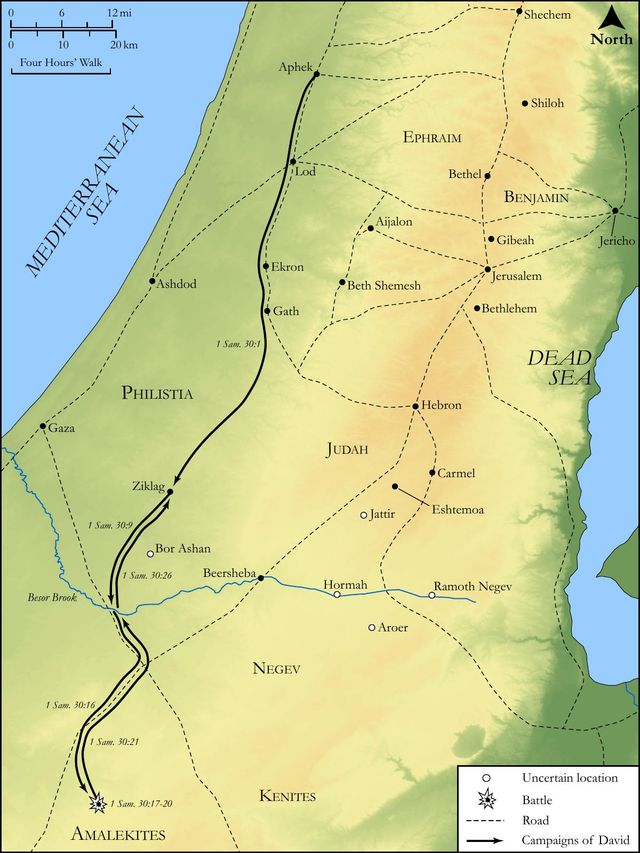
See on the biblical-era map
Study this verse
Public-domain commentary
Matthew Henry
From his Commentary on the Whole Bible. Henry comments on passages, not single verses — this entry covers 1 Samuel 30:1–6. His two-level outline is real structure in the source text, so it is rendered as structure.
Here we have, I. The descent which the Amalekites made upon Ziklag in David's absence, and the desolations they made there. They surprised the city when it was left unguarded, plundered it, burnt it, and carried all the women and children captives, Sa1 30:1, Sa1 30:2. They intended, by this to revenge the like havoc that David had lately made of them and their country, Sa1 27:8. He that had made so many enemies ought not to have left his own concerns so naked and defenceless. Those that make bold with others must expect that others will make as bold with them and provide accordingly. Now observe in this, 1. The cruelty of Saul's pity (as it proved) in sparing the Amalekites; if he had utterly destroyed them, as he ought to have done, these would not have been in being to do this mischief. 2. How David was corrected for being so forward to go with the Philistines against Israel. God showed him that he had better have staid at home and looked after his own business. When we go abroad in the way of our duty we may comfortably hope that God will take care of our families in our absence, but not otherwise. 3. How wonderfully God inclined the hearts of these Amalekites to carry the women and children away captives, and not to kill them. When David invaded them he put all to the sword (Sa1 27:9), and no reason can be given why they did not retaliate upon this city, but that God restrained them; for he has all hearts in his hands, and says to the fury of the most cruel men, Hitherto thou shalt come, and no further. Whether they spared them to lead them in triumph, or to sell them, or to use them for slaves, God's hand must be acknowledged, who designed to make use of the Amalekites for the correction, not for the destruction, of the house of David.
II.The confusion and consternation that David and his men were in when they found their houses in ashes and their wives and children gone into captivity. Three days' march they had from the camp of the Philistines to Ziklag, and now that they came thither weary, but hoping to find rest in their houses and joy in their families, behold a black and dismal scene was presented to them (Sa1 30:3), which made them all weep (David himself not excepted), though they were men of war, till they had no more power to weep, Sa1 30:4. The mention of David's wives, Ahinoam and Abigail, and their being carried captive, intimates that this circumstance went nearer his heart than any thing else. Note, It is no disparagement to the boldest and bravest spirits to lament the calamities of relations and friends. Observe,
1.This trouble came upon them when they were absent. It was the ancient policy of Amalek to take Israel at an advantage.
2.It met them at their return, and, for aught that appears, their own eyes gave them the first intelligence of it. Note, When we go abroad we cannot foresee what evil tidings may meet us when we come home again. The going out may be very cheerful, and yet the coming in be very doleful. Boast not thyself therefore of tomorrow, nor of tonight either, for thou knowest not what a day, or a piece of a day, may bring forth, Pro 27:1. If, when we come off a journey, we find our tabernacles in peace, and not laid waste as David here found his, let the Lord be praised for it.
III.The mutiny and murmuring of David's men against him (Sa1 30:6):
David was greatly distressed, for, in the midst of all his losses, his own people spoke of stoning him,
1.Because they looked upon him as the occasion of their calamities, by the provocation he had given the Amalekites, and his indiscretion in leaving Ziklag without a garrison in it. Thus apt are we, when we are in trouble, to fly into a rage against those who are in any way the occasion of our trouble, while we overlook the divine providence, and have not that regard to the operations of God's hand in it which would silence our passions, and make us patient.
2.Because now they began to despair of that preferment which they had promised themselves in following David. They hoped ere this to have been all princes; and now to find themselves all beggars was such a disappointment to them as made them grow outrageous, and threaten the life of him on whom, under God, they had the greatest dependence. What absurdities will not ungoverned passions plunge men into? This was a sore trial to the man after God's own heart, and could not but go very near him. Saul had driven him from his country, the Philistines had driven him from their camp, the Amalekites had plundered his city, his wives were taken prisoners, and now, to complete his woe, his own familiar friends, in whom he trusted, whom he had sheltered, and who did eat of his bread, instead of sympathizing with him and offering him any relief, lifted up the heel against him and threatened to stone him. Great faith must expect such severe exercises. But it is observable that David was reduced to this extremity just before his accession to the throne. At this very time, perhaps, the stroke was struck which opened the door to his advancement. Things are sometimes at the worst with the church and people of God just before they begin to mend.
IV.David's pious dependence upon the divine providence and grace in this distress:
But David encouraged himself in the Lord his God. His men fretted at their loss. The soul of the people was bitter, so the word is. Their own discontent and impatience added wormwood and gall to the affliction and misery, and made their case doubly grievous. But 1. David bore it better, though he had more reason than any of them to lament it; they gave liberty to their passions, but he set his graces on work, and by encouraging himself in God, while they dispirited each other, he kept his spirit calm and sedate. Or, 2. There may be a reference to the threatening words his men gave out against him. They spoke of stoning him; but he, not offering to avenge the affront, nor terrified by their menaces, encouraged himself in the Lord his God, believed, and considered with application to his present case, the power and providence of God, his justice and goodness, the method he commonly takes of bringing low and then raising up, his care of his people that serve him and trust in him, and the particular promises he had made to him of bringing him safely to the throne; with these considerations he supported himself, not doubting but the present trouble would end well. Note, Those that have taken the Lord for their God may take encouragement from their relation to him in the worst of times. It is the duty and interest of all good people, whatever happens, to encourage themselves in God as their Lord and their God, assuring themselves that he can and will bring light out of darkness, peace out of trouble, and good out of evil, to all that love him and are the called according to his purpose, Rom 8:28. It was David's practice, and he had the comfort of it, What time I am afraid I will trust in thee. When he was at his wits' end he was not at his faith's end.
Continue studying 1 Samuel 30:6 across the web’s major study libraries — every link below opens this exact verse, chapter, or book on the destination site.
Read & Compare
 BibleGatewayThis verse in more than 200 translations and 70 languages.
 Bible.comThe YouVersion reader — hundreds of translations, reading plans, and highlights.
 ESV.orgCrossway's official English Standard Version reader.
 NET BibleThe NET translation with 60,000+ translators' notes on every rendering decision.
 STEP BibleTyndale House's free study tool — original text, vocabulary, and scholarly resources.
 BibliaLogos Bible Software's free web reader.
 USCCBThe New American Bible (Revised Edition) with the U.S. bishops' study notes.
Commentaries
 BibleHub CommentariesDozens of classic commentaries on this verse, gathered on one page.
 StudyLightMore than 100 commentary sets — the largest collection on the web.
 BibleRefPlain-English commentary on what this verse means, verse by verse.
 Enduring WordDavid Guzik's free commentary on this chapter, widely used by Bible teachers.
 Bible Study ToolsVerse commentary alongside Greek and Hebrew study aids.
Original Language & Research
- BibleHub InterlinearThe verse word by word — original language, transliteration, and English.
- BibleHub LexiconEvery word's original-language definition and Strong's entry.
 Blue Letter BibleDeep-study tools — Strong's numbers, concordance, and word studies.
 SefariaThe Hebrew text with Rashi and centuries of Jewish commentary.
Sermons, Hymns & Audio


TrulyRandomVerse is not affiliated with these sites and doesn’t control their content. They’re linked because they’re genuinely useful.
Summary
1 Samuel 30:6 captures David at a moment of profound crisis, facing not only the devastation of Ziklag and the abduction of his and his men's families by the Amalekites but also the existential threat of stoning from his own grief-stricken and enraged followers. In this crucible of personal anguish and leadership failure, when all human support and hope seemed to vanish, David's response stands as a powerful and enduring testament to his unwavering faith and active reliance on the Lord his God, illustrating the divine source of true spiritual resilience in the face of overwhelming despair.
Context
ShowHideLiterary Context
This pivotal verse is situated within a dramatic and deeply personal narrative arc in David's life, immediately following his strategic dismissal from the Philistine army by King Achish and the Philistine lords in 1 Samuel 29. This apparent setback, preventing David from fighting against his own people, Israel, was in fact a profound act of divine providence. Upon returning to their base at Ziklag after a three-day journey, David and his men discovered their city ransacked and burned, and their wives, sons, and daughters taken captive by the marauding Amalekites (1 Samuel 30:1-2). The verses immediately preceding 1 Samuel 30:6 vividly portray the overwhelming grief that consumed David and his men, so intense that "they lifted up their voice and wept, until they had no more power to weep" (1 Samuel 30:3-4). It is out of this abyss of collective sorrow and despair that the men's grief tragically morphs into murderous rage against David, setting the stage for his profound and singular act of faith. The narrative then shifts to David's inquiry of the Lord, God's clear instruction to pursue, and the successful recovery of all that was lost, culminating in a demonstration of David's wise and generous leadership (1 Samuel 30:7-31).
Historical & Cultural Context
The events of 1 Samuel 30 unfold during a tumultuous and transitional period in Israel's history, specifically the waning years of King Saul's reign and David's prolonged time as a fugitive. David, though divinely anointed by Samuel as the future king, was living as a servant of the Philistine king in Ziklag, a border town in the Negev region, to escape Saul's relentless pursuit. The Amalekites were a nomadic, predatory people, ancient and persistent enemies of Israel, against whom God had commanded perpetual warfare due to their unprovoked attack on Israel during the Exodus (Exodus 17:16). Their raid on Ziklag was typical of the opportunistic tribal warfare prevalent in the era, targeting undefended settlements for plunder and captives. The threat of stoning was a recognized and severe form of capital punishment in ancient Israelite society, often prescribed for severe offenses against God or the community. Here, its mention highlights the extreme emotional distress and sense of betrayal felt by David's men, who, in their raw grief, viewed him as directly responsible for their catastrophic loss. The cultural expectation was that a leader would protect his people; David's perceived failure led to this violent outburst, underscoring the immense pressure on ancient leaders and the volatile nature of loyalty in times of crisis.
Key Themes
ShowHide1 Samuel 30:6 powerfully encapsulates several enduring themes present throughout the book of Samuel and David's life narrative. Firstly, it highlights Leadership Under Duress, demonstrating that even God's anointed leaders face immense pressure, isolation, and opposition, sometimes from their closest and most trusted allies. David, despite his divine calling, was deeply human and vulnerable to the crushing weight of his circumstances. Secondly, the verse underscores the Destructive Power of Despair, as the overwhelming grief of the people leads them to irrational and violent thoughts, illustrating how unchecked sorrow can erode trust, ignite rebellion, and blind individuals to reason. Thirdly and most significantly, it champions the theme of Finding Strength in God Alone. When all human resources fail and the situation appears utterly hopeless, David's deliberate act of "encouraging himself in the LORD his God" provides a profound and timeless example of spiritual resilience and unwavering faith. This moment is a cornerstone in understanding David's character as a man after God's own heart, emphasizing that his strength, wisdom, and ability to lead were not inherent but derived from his intimate and active relationship with Yahweh, the covenant God of Israel. It foreshadows the many psalms where David expresses his profound reliance on God in times of trouble, such as Psalm 46:1 and Psalm 62:5-8.
Exposition and Analysis
ShowHideKey Word Analysis
ShowHideThe Hebrew verb יָצַר (yâtsar) means "to press (intransitive)," "to be narrow," or "to be in distress." It conveys a profound sense of being hemmed in, confined, or under immense pressure, both physically by the threat of stoning and emotionally by the devastation and betrayal. David's distress was not merely sadness but a profound anguish, a feeling of being trapped with no apparent way out, emphasizing the overwhelming nature of his predicament.
The word מָרַר (mârar) literally means "to be bitter" or "to be sorrowful." It denotes a deep, intense, and often agonizing sorrow, akin to the bitterness of gall. The text states "the soul of all the people was grieved," indicating a collective, profound, and soul-deep bitterness that permeated their entire being. This bitterness, a direct result of their devastating loss of family and possessions, led them to irrational and violent thoughts, highlighting the destructive power of unchecked sorrow.
The verb חָזַק (châzaq) means "to be strong," "to be firm," "to be courageous," or "to seize, grasp." When used reflexively, as here ("encouraged himself"), it signifies an active, deliberate, and intentional act of strengthening one's inner resolve. This was not a passive waiting for comfort or a mere wish for strength, but a conscious effort to lay hold of strength. The crucial addition "in the LORD his God" specifies the exclusive and divine source of this strength: it was not self-generated but derived from his active faith and intimate covenant relationship with Yahweh, indicating a deliberate turning to God's character, promises, and power.
Verse Breakdown
ShowHide"And David was greatly distressed;"
This opening clause immediately establishes David's profound personal state. Despite his anointing, his military prowess, and his leadership, he was not immune to the crushing weight of his circumstances. His distress was not a superficial sadness but a deep, overwhelming anguish, a natural human reaction to the immense loss of his family and possessions, compounded by the betrayal and threat from his own loyal followers. It highlights his humanity and vulnerability, making his subsequent act of faith all the more remarkable.
"for the people spake of stoning him, because the soul of all the people was grieved, every man for his sons and for his daughters:"
This section explains the immediate cause of David's distress and the depth of the leadership crisis. The people's grief, described as soul-deep and universal ("every man for his sons and for his daughters"), was so overwhelming that it morphed into a desire for violent retribution against David. This vividly demonstrates the irrationality and danger of unchecked despair, where loyalties can swiftly turn hostile and murderous under extreme pressure, viewing their leader as responsible for their calamity.
"but David encouraged himself in the LORD his God."
This final clause presents the dramatic pivot and the spiritual climax of the verse. The strong adversative conjunction "but" (וַיִּתְחַזֵּק, vayyithchazzeq) signals a sharp contrast to the surrounding despair, threat, and human failure. David's response was not to succumb to fear, anger, or self-pity, nor to retaliate against his mutinous men. Instead, he actively, deliberately, and intentionally sought strength and courage from his covenant relationship with Yahweh. This was an internal, spiritual act of faith, a conscious choice to remind himself of God's unchanging character, His past faithfulness, and His unfailing promises, thereby drawing strength from a divine source when all human sources had failed him.
Literary Devices
ShowHideThe verse is rich in literary devices that amplify its profound message and underscore David's unique response. The most prominent is Juxtaposition and Contrast, which powerfully sets David's profound personal distress and the people's murderous despair against his singular act of faith in God. This stark contrast highlights the unique nature of David's spiritual resilience and the divine source of his strength. The phrase "the soul of all the people was grieved, every man for his sons and for his daughters" employs Hyperbole to emphasize the all-consuming and universal nature of their sorrow, underscoring the extremity of the situation David faced and the depth of the threat. There is also a strong element of Irony, as David, the anointed king and a "man after God's own heart," finds himself threatened with death by the very men who had followed him faithfully through years of hardship, a testament to the unpredictable and volatile nature of human loyalty under duress. This moment serves as a powerful Turning Point in the narrative, shifting abruptly from utter despair and the brink of rebellion to a demonstration of divine reliance that precedes God's direct intervention and David's subsequent triumphant recovery.
Theological and Thematic Connections
ShowHide1 Samuel 30:6 stands as a profound theological statement on the nature of true faith and resilience in the face of overwhelming adversity. It teaches that even God's chosen leaders and most devout servants are not exempt from deep personal suffering, isolation, and the betrayal of those closest to them. However, it also powerfully illustrates that ultimate strength, encouragement, and hope are found not in human resources, self-pity, or retaliation, but in an active, intentional turning to God. David's deliberate act of "encouraging himself in the LORD his God" is a prototype for believers across all ages, demonstrating that when human understanding, comfort, and support fail, God remains the steadfast, sufficient, and unchanging source of hope and power. This principle resonates throughout Scripture, affirming God's role as our refuge and strength in times of trouble and our ever-present help.
Reflection and Application
ShowHide1 Samuel 30:6 offers timeless and deeply practical lessons for every believer navigating the complexities and inevitable trials of life. In a world where personal loss, professional setbacks, relational betrayals, and overwhelming despair are constant possibilities, David's experience provides a profound and actionable model for spiritual resilience. When we feel "greatly distressed," hemmed in by seemingly insurmountable circumstances, or even threatened by those we expected to support us, our natural inclination might be to succumb to despair, lash out in anger, or withdraw into self-pity. However, David's response challenges us to actively and intentionally turn to God. It's not about mustering strength from within ourselves, which is finite and often fails, but about deliberately reminding ourselves of who God is—His unchanging character, His unfailing promises, His past faithfulness in our lives and in history—and drawing courage and hope from that divine wellspring. This act of "encouraging oneself in the LORD" is a conscious, spiritual discipline: a deliberate choice to fix our gaze on the sovereign, unchanging God amidst chaotic and threatening circumstances, allowing His peace and power to sustain us when all else crumbles. It reminds us that our ultimate refuge, our deepest comfort, and our inexhaustible source of strength is always found in our intimate, active relationship with Him.
Questions for Reflection
ShowHideFAQ
ShowHideWhat does it mean that "David encouraged himself in the LORD his God"?
ShowHideThis phrase signifies an active, deliberate, and intentional spiritual discipline on David's part. It means that David, rather than succumbing to despair, fear, or anger, consciously chose to recall God's unchanging character, His past faithfulness, and His unfailing promises. By meditating on who Yahweh is—His power, sovereignty, and covenant loyalty—David strengthened his own faith and resolve. It wasn't a passive waiting for comfort to descend, but a conscious act of turning his heart and mind to God, reminding himself of divine truths that transcended his immediate, devastating circumstances. In a moment when all human support had vanished and even turned hostile, David looked beyond his immediate plight and found his courage, hope, and direction in his personal relationship with God. This profound act of faith allowed him to transcend his despair and prepare for divine guidance and action, as seen in his immediate inquiry of the Lord in 1 Samuel 30:7-8.
Christ-Centered Fulfillment
ShowHide1 Samuel 30:6 offers a powerful prefigurement of Christ, showcasing David's experience as a type of the ultimate suffering servant and victorious King. Like David, who was rejected and threatened by his own people despite being God's anointed, Jesus faced profound distress and rejection, even from His closest disciples, particularly in the Garden of Gethsemane where He experienced overwhelming sorrow, "even to the point of death" (Matthew 26:38). Yet, in His deepest anguish, Jesus, like David, did not succumb to despair or lash out. Instead, He "encouraged himself" by turning to His Father in prayer, submitting His will perfectly to God's divine plan, even to the point of sweating drops of blood (Luke 22:42-44). David's reliance on "the LORD his God" foreshadows Christ's perfect dependence on the Father, a dependence that sustained Him even through the agony of the cross. Ultimately, Jesus, the true Lamb of God who takes away the sin of the world, suffered rejection and death not for His own perceived failures but for the sins of humanity. Through His resurrection, He became the ultimate source of strength, encouragement, and eternal hope for all who are distressed. We are called to fix our eyes on Jesus, the author and perfecter of our faith, who, for the joy set before Him, endured the cross, despising its shame, and now sits at the right hand of the throne of God, offering us the very strength and unwavering hope that David found in his God.