


1 Samuel 30:5
Bible text: King James Version (1769 Blayney text) · Public domain
Bible text: Berean Standard Bible · Public domain
Bible text: American Standard Version (1901) · Public domain
Bible text: World English Bible, Messianic edition · Public domain
Bible text: Geneva Bible (1599) · Public domain
Bible text: Young's Literal Translation · Public domain
- וּשְׁתֵּיu·she·Teiand [the] twoH8147Conj-w ¦ N-fdcNoun Dual Feminine Constructוּandשְׁתֵּי[the] two
- נְשֵׁיne·shei[the] wives ofH802N-mpcNoun Plural Masculine Construct
- דָוִדda·VidDavidH1732N-proper-mNoun Proper Masculine
- נִשְׁבּוּnish·Buthey had been taken captiveH7617V-Niphal-Perf-3cpVerb Niphal Perfect 3rd Plural common gender
- אֲחִינֹעַם'a·chi·No·'amAhinoamH293N-proper-fNoun Proper Feminine
- הַיִּזְרְעֵלִיתhai·yiz·re·'e·Litthe Jezreelite [woman]H3158Art ¦ N-fsNoun Gentilic Singular Feminine AbsoluteהַtheיִּזְרְעֵלִיתJezreelite [woman]
- וַאֲבִיגַיִלva·'a·vi·Ga·yiland AbigailH26Conj-w ¦ N-proper-fNoun Proper FeminineוַandאֲבִיגַיִלAbigail
- אֵשֶׁת'E·shet[the] wife ofH802N-fscNoun Singular Feminine Construct
- נָבָלna·ValNabalH5037N-proper-mNoun Proper Masculine
- הַכַּרְמְלִיHa·kar·me·Lithe CarmeliteH3761Art ¦ N-msNoun Gentilic Singular Masculine AbsoluteהַtheכַּרְמְלִיCarmelite
English is a literal word-by-word gloss of the Hebrew, not the KJV's wording. Why?
This is the original text the KJV's translators worked from — each Hebrew word with its own literal English meaning in this verse, prepared by scholars at Tyndale House, Cambridge. The KJV translates whole sentences, not word by word, so its wording differs: one Hebrew word can become several English words, and the KJV may choose “the LORD” where the gloss reads “Yahweh”. Both are faithful — they answer different questions. For the KJV's own rendering, switch to the KJV text.
Details
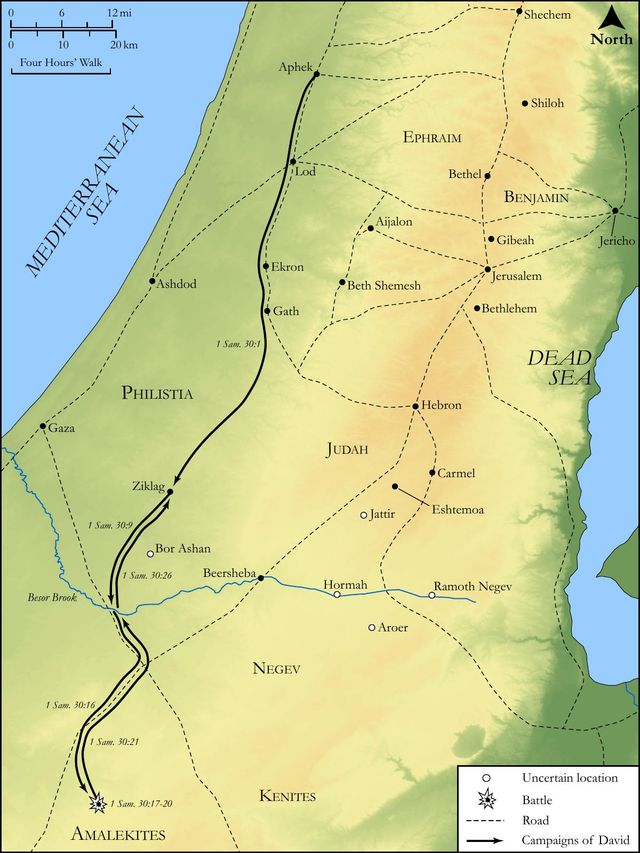
See on the biblical-era map
Study this verse
Public-domain commentary
Matthew Henry
From his Commentary on the Whole Bible. Henry comments on passages, not single verses — this entry covers 1 Samuel 30:1–6. His two-level outline is real structure in the source text, so it is rendered as structure.
Here we have, I. The descent which the Amalekites made upon Ziklag in David's absence, and the desolations they made there. They surprised the city when it was left unguarded, plundered it, burnt it, and carried all the women and children captives, Sa1 30:1, Sa1 30:2. They intended, by this to revenge the like havoc that David had lately made of them and their country, Sa1 27:8. He that had made so many enemies ought not to have left his own concerns so naked and defenceless. Those that make bold with others must expect that others will make as bold with them and provide accordingly. Now observe in this, 1. The cruelty of Saul's pity (as it proved) in sparing the Amalekites; if he had utterly destroyed them, as he ought to have done, these would not have been in being to do this mischief. 2. How David was corrected for being so forward to go with the Philistines against Israel. God showed him that he had better have staid at home and looked after his own business. When we go abroad in the way of our duty we may comfortably hope that God will take care of our families in our absence, but not otherwise. 3. How wonderfully God inclined the hearts of these Amalekites to carry the women and children away captives, and not to kill them. When David invaded them he put all to the sword (Sa1 27:9), and no reason can be given why they did not retaliate upon this city, but that God restrained them; for he has all hearts in his hands, and says to the fury of the most cruel men, Hitherto thou shalt come, and no further. Whether they spared them to lead them in triumph, or to sell them, or to use them for slaves, God's hand must be acknowledged, who designed to make use of the Amalekites for the correction, not for the destruction, of the house of David.
II.The confusion and consternation that David and his men were in when they found their houses in ashes and their wives and children gone into captivity. Three days' march they had from the camp of the Philistines to Ziklag, and now that they came thither weary, but hoping to find rest in their houses and joy in their families, behold a black and dismal scene was presented to them (Sa1 30:3), which made them all weep (David himself not excepted), though they were men of war, till they had no more power to weep, Sa1 30:4. The mention of David's wives, Ahinoam and Abigail, and their being carried captive, intimates that this circumstance went nearer his heart than any thing else. Note, It is no disparagement to the boldest and bravest spirits to lament the calamities of relations and friends. Observe,
1.This trouble came upon them when they were absent. It was the ancient policy of Amalek to take Israel at an advantage.
2.It met them at their return, and, for aught that appears, their own eyes gave them the first intelligence of it. Note, When we go abroad we cannot foresee what evil tidings may meet us when we come home again. The going out may be very cheerful, and yet the coming in be very doleful. Boast not thyself therefore of tomorrow, nor of tonight either, for thou knowest not what a day, or a piece of a day, may bring forth, Pro 27:1. If, when we come off a journey, we find our tabernacles in peace, and not laid waste as David here found his, let the Lord be praised for it.
III.The mutiny and murmuring of David's men against him (Sa1 30:6):
David was greatly distressed, for, in the midst of all his losses, his own people spoke of stoning him,
1.Because they looked upon him as the occasion of their calamities, by the provocation he had given the Amalekites, and his indiscretion in leaving Ziklag without a garrison in it. Thus apt are we, when we are in trouble, to fly into a rage against those who are in any way the occasion of our trouble, while we overlook the divine providence, and have not that regard to the operations of God's hand in it which would silence our passions, and make us patient.
2.Because now they began to despair of that preferment which they had promised themselves in following David. They hoped ere this to have been all princes; and now to find themselves all beggars was such a disappointment to them as made them grow outrageous, and threaten the life of him on whom, under God, they had the greatest dependence. What absurdities will not ungoverned passions plunge men into? This was a sore trial to the man after God's own heart, and could not but go very near him. Saul had driven him from his country, the Philistines had driven him from their camp, the Amalekites had plundered his city, his wives were taken prisoners, and now, to complete his woe, his own familiar friends, in whom he trusted, whom he had sheltered, and who did eat of his bread, instead of sympathizing with him and offering him any relief, lifted up the heel against him and threatened to stone him. Great faith must expect such severe exercises. But it is observable that David was reduced to this extremity just before his accession to the throne. At this very time, perhaps, the stroke was struck which opened the door to his advancement. Things are sometimes at the worst with the church and people of God just before they begin to mend.
IV.David's pious dependence upon the divine providence and grace in this distress:
But David encouraged himself in the Lord his God. His men fretted at their loss. The soul of the people was bitter, so the word is. Their own discontent and impatience added wormwood and gall to the affliction and misery, and made their case doubly grievous. But 1. David bore it better, though he had more reason than any of them to lament it; they gave liberty to their passions, but he set his graces on work, and by encouraging himself in God, while they dispirited each other, he kept his spirit calm and sedate. Or, 2. There may be a reference to the threatening words his men gave out against him. They spoke of stoning him; but he, not offering to avenge the affront, nor terrified by their menaces, encouraged himself in the Lord his God, believed, and considered with application to his present case, the power and providence of God, his justice and goodness, the method he commonly takes of bringing low and then raising up, his care of his people that serve him and trust in him, and the particular promises he had made to him of bringing him safely to the throne; with these considerations he supported himself, not doubting but the present trouble would end well. Note, Those that have taken the Lord for their God may take encouragement from their relation to him in the worst of times. It is the duty and interest of all good people, whatever happens, to encourage themselves in God as their Lord and their God, assuring themselves that he can and will bring light out of darkness, peace out of trouble, and good out of evil, to all that love him and are the called according to his purpose, Rom 8:28. It was David's practice, and he had the comfort of it, What time I am afraid I will trust in thee. When he was at his wits' end he was not at his faith's end.
Historical interpretation
Historical reception
1 surviving comment on this verse from the historical church.
Indeed, even the two wives of David were taken captive, etc. It has already been said above that David's wives signify both the active and contemplative lives of the holy Church, which rejoice to serve the true King in the present. However, the Church has often been enveloped by such a storm from heretics and pagans, as was made clear by the great Arian sedition, that not only the decorum of the contemplative life was lost – which, according to the name Jezrahel, the very Author of graces sowed in the hearts of the serene and humble spirits – but also the constancy of the active life, which those who recently escaped the hands of the ancient enemy are accustomed to exercise, seems to disappear under the force of the persecutor's wrath.
Continue studying 1 Samuel 30:5 across the web’s major study libraries — every link below opens this exact verse, chapter, or book on the destination site.
Read & Compare
 BibleGatewayThis verse in more than 200 translations and 70 languages.
 Bible.comThe YouVersion reader — hundreds of translations, reading plans, and highlights.
 ESV.orgCrossway's official English Standard Version reader.
 NET BibleThe NET translation with 60,000+ translators' notes on every rendering decision.
 STEP BibleTyndale House's free study tool — original text, vocabulary, and scholarly resources.
 BibliaLogos Bible Software's free web reader.
 USCCBThe New American Bible (Revised Edition) with the U.S. bishops' study notes.
Commentaries
 BibleHub CommentariesDozens of classic commentaries on this verse, gathered on one page.
 StudyLightMore than 100 commentary sets — the largest collection on the web.
 BibleRefPlain-English commentary on what this verse means, verse by verse.
 Enduring WordDavid Guzik's free commentary on this chapter, widely used by Bible teachers.
 Bible Study ToolsVerse commentary alongside Greek and Hebrew study aids.
Original Language & Research
- BibleHub InterlinearThe verse word by word — original language, transliteration, and English.
- BibleHub LexiconEvery word's original-language definition and Strong's entry.
 Blue Letter BibleDeep-study tools — Strong's numbers, concordance, and word studies.
 SefariaThe Hebrew text with Rashi and centuries of Jewish commentary.
Sermons, Hymns & Audio


TrulyRandomVerse is not affiliated with these sites and doesn’t control their content. They’re linked because they’re genuinely useful.
Summary
1 Samuel 30:5 marks a profoundly personal and devastating moment for David, specifically naming his two wives, Ahinoam the Jezreelitess and Abigail the Carmelite, among those abducted by the Amalekites. This verse sharply focuses the widespread tragedy of the Ziklag raid onto David's immediate household, underscoring the intimate and agonizing nature of his loss and setting the stage for his subsequent emotional and spiritual journey.
Context
ShowHideLiterary Context
This verse is strategically placed within the dramatic narrative of 1 Samuel chapter 30, immediately following the horrifying discovery by David and his 600 men. Having been dismissed by the Philistine lords from accompanying them to battle against Israel, David's company returns to their base at Ziklag to find it utterly destroyed by fire and its inhabitants—their wives, sons, and daughters—taken captive (1 Samuel 30:1-3). Verse 5 zeroes in on David's personal anguish, explicitly naming his two wives. This personalization intensifies the collective grief, highlighting that David, despite his leadership, is deeply affected by the tragedy. It serves as a crucial setup for David's profound distress and his subsequent, pivotal act of "strengthening himself in the Lord his God" (1 Samuel 30:6), demonstrating that even a divinely chosen leader must navigate personal despair. The mention of Ahinoam and Abigail also subtly recalls their respective introductions into David's life, adding depth to his personal stakes.
Historical & Cultural Context
The Amalekites were a persistently hostile, nomadic people, long-standing enemies of Israel, known for their opportunistic and brutal raids on vulnerable communities (Exodus 17:8-16 and Deuteronomy 25:17-19). Their attack on Ziklag, a Philistine town granted to David by King Achish of Gath, was characteristic of the warfare of that day, where undefended settlements were prime targets for plunder and the capture of inhabitants. Women and children were particularly valuable as spoils of war, destined for ransom, slavery, or integration into the captors' society. David's precarious position, living in Philistine territory as a refugee from Saul, meant he and his men were constantly exposed to the volatile regional conflicts. The specific origins of his wives, Jezreel and Carmel, ground them geographically within the land of Judah, emphasizing their Israelite identity even while David was operating from a Philistine base.
Key Themes
ShowHideThis verse powerfully contributes to several overarching themes within the book of Samuel. Firstly, it underscores the personal vulnerability and suffering inherent in the human condition, even for those divinely chosen and highly favored like David. His anointing and military prowess do not exempt him from devastating personal loss and the harsh realities of a fallen world. Secondly, it emphasizes David's shared humanity and solidarity with his men; his grief is not detached but deeply intertwined with that of his followers, fostering a crucial bond of empathy and shared experience. This shared distress is foundational for understanding David's compassionate and effective leadership in the subsequent recovery effort. Thirdly, the explicit naming of his wives, Ahinoam and Abigail, reinforces the theme of family, lineage, and the continuity of David's household. Abigail's presence specifically recalls her dramatic story from 1 Samuel chapter 25, reminding the reader of David's growing influence and the personal dimensions of his journey towards kingship. This event tests not only David's faith but also the very fabric of his nascent royal household.
Exposition and Analysis
ShowHideKey Word Analysis
ShowHideThe verb שָׁבָה (H7617, shâbâh) is a primitive root meaning "to transport into captivity," "to carry away," or "to lead away." It vividly describes the violent and involuntary act of seizing individuals, typically in warfare, to be held as prisoners or slaves. In this context, its use emphasizes the profound loss of freedom, security, and agency experienced by David's wives and the other inhabitants of Ziklag, conveying the gravity of their subjugation.
This term (H3159, Yizrᵉʻêʼlîyth) is the feminine form identifying Ahinoam as originating from Jezreel. This was likely the city in southern Judah mentioned in Joshua 15:56, distinct from the more famous Jezreel in the north. This geographical identifier provides specific detail about David's first wife, whom he took after Saul had given Michal to Palti (1 Samuel 25:43). Its inclusion grounds Ahinoam within the Israelite landscape, even as David resided in Philistine territory.
This descriptor (H3761, Karmᵉlîy) indicates Abigail's origin from Carmel, a town in the southern hill country of Judah mentioned in Joshua 15:55, known for its fertile pastures. The explicit mention of her being "the wife of Nabal (H5037, Nâbâl) the Carmelite" serves as a direct and poignant reference back to the detailed narrative in 1 Samuel chapter 25. This specific detail connects the current crisis to David's past and highlights the continuity of his personal story and the divine providence that brought Abigail into his household.
Verse Breakdown
ShowHide"And David's two wives were taken captives"
This opening clause immediately establishes the deeply personal nature of the tragedy for David. While the entire community suffered, the text highlights his specific loss, emphasizing the vulnerability of even a powerful leader. The passive voice "were taken captives" underscores the unexpected, overwhelming, and violent nature of the Amalekite raid, against which David and his men were powerless in their absence.
"Ahinoam the Jezreelitess"
This identifies David's first named wife, Ahinoam, and her place of origin. Her inclusion signifies that even his long-standing companion and the mother of his children (2 Samuel 3:2) was not spared, intensifying the sense of personal violation and loss for David.
"and Abigail the wife of Nabal the Carmelite"
The naming of Abigail, with the explicit reminder of her previous marriage to Nabal, serves multiple purposes. It confirms her identity as David's second wife and implicitly recalls her story of wisdom, courage, and divine intervention that brought her into David's household (1 Samuel 25:39-42). Her capture underscores that no one in David's inner circle, regardless of their past or future significance, was safe from this devastating attack, amplifying the scale of the crisis.
Literary Devices
ShowHideThe verse employs several effective literary devices to convey the depth of the crisis. Specific Naming is paramount, as the explicit mention of Ahinoam and Abigail, along with their geographical identifiers, grounds the narrative in concrete reality and intensely personalizes the tragedy for David. This detail creates profound Pathos, evoking immediate sympathy for David and his men, who return to find their homes destroyed and families abducted. The Juxtaposition of David's recent military engagement (accompanying the Philistines to battle) with his complete vulnerability and absence during the raid on his own home creates a stark contrast, highlighting the unpredictable nature of life and the limitations of human foresight. Furthermore, the concise, factual reporting of the capture, largely devoid of overt emotional adjectives in this specific verse, paradoxically amplifies the emotional impact through Restraint. By presenting the stark reality without embellishment, the text allows the reader to fully grasp the devastating implications and the profound shock experienced by David and his men.
Theological and Thematic Connections
ShowHide1 Samuel 30:5, while detailing a moment of profound personal crisis for David, serves as a powerful theological statement about human vulnerability and the testing of faith. Even a man chosen by God and destined for kingship is not exempt from devastating loss and suffering. This event is not merely a setback but a crucible, designed to refine David's character and deepen his reliance on God. It demonstrates that God often works through adversity, allowing His servants to experience the depths of human despair so that their ultimate deliverance and strength are clearly seen as coming from Him alone. This narrative foreshadows the broader biblical truth that suffering can be a pathway to greater spiritual maturity and a deeper understanding of God's sustaining power, proving that God remains a present help in trouble.
Reflection and Application
ShowHideThe capture of David's wives in 1 Samuel 30:5 presents a raw, relatable portrayal of unexpected personal crisis and profound loss. It serves as a stark reminder that even those in positions of strength, leadership, or divine favor are not immune to the harsh realities of life in a fallen world. David, the mighty warrior and future king, experiences the same gut-wrenching despair as his men, highlighting our shared human vulnerability. This moment of profound personal anguish became a pivotal point for David, compelling him to "strengthen himself in the Lord his God" (1 Samuel 30:6). For us, this narrative underscores the vital importance of acknowledging our pain, lamenting our losses, and then intentionally turning to God as our ultimate source of strength and hope when life's unforeseen devastations strike. It challenges us to cultivate a faith that is resilient in the face of adversity, recognizing that God is present even in our darkest moments, and that He can sovereignly use our deepest losses to draw us closer to Him, refine our character, and prepare us for future purposes in His kingdom.
Questions for Reflection
ShowHideFAQ
ShowHideWhy are David's wives specifically named in this verse, rather than just saying "their families"?
ShowHideThe specific naming of Ahinoam the Jezreelitess and Abigail the Carmelite serves several crucial purposes within the narrative. Firstly, it intensely personalizes the tragedy for David, highlighting that his immediate family, not just the general populace, was directly affected. This underscores the depth of his personal anguish, setting the stage for his subsequent emotional distress and spiritual resolve described in 1 Samuel 30:6. Secondly, it connects this event to David's broader narrative and the development of his household. Abigail, in particular, has a significant backstory detailed in 1 Samuel chapter 25, where her wisdom and Nabal's foolishness led to her becoming David's wife. Her mention here reminds the reader of David's growing influence and the personal stakes involved in his fugitive life. It emphasizes that even those closest to him were vulnerable, making his eventual recovery of them even more significant and a testament to divine favor.
Who were the Amalekites, and why did they attack Ziklag?
ShowHideThe Amalekites were a nomadic, predatory people, long-standing enemies of Israel, first encountered in Exodus 17:8-16 and later marked for complete destruction due to their persistent hostility and attack on the Israelites during their wilderness wanderings (Deuteronomy 25:17-19). They attacked Ziklag opportunistically. David and his men, who were living in Ziklag (a Philistine town granted to David by King Achish), had left the city to accompany the Philistine army to battle. Seeing Ziklag undefended, the Amalekites seized the chance to raid it, plunder its goods, and take captives, a common practice in ancient warfare for economic gain and to weaken rival groups. Their attack was a continuation of their historical animosity towards any Israelite presence, even one allied with the Philistines, and a direct act of plunder against an undefended settlement.
Christ-Centered Fulfillment
ShowHideThe profound personal crisis of David in 1 Samuel 30:5, where his beloved wives are taken captive, serves as a poignant foreshadowing of the ultimate loss and restoration found in Christ. David's experience of deep distress and his subsequent strengthening in the Lord (1 Samuel 30:6) mirrors, in a limited but significant way, the suffering and ultimate triumph of Jesus. Christ, the greater David, truly knew what it meant to be vulnerable and to experience profound loss, ultimately laying down His life on the cross. Yet, His suffering was not for His own sin, but for the sake of humanity, which had been "taken captive" by sin and death. Through His death and resurrection, Christ triumphs over the ultimate enemy, bringing about a restoration far grander than David's recovery of his family. He reclaims those who were enslaved by sin and the devil (Colossians 2:15), offering them freedom and abundant new life (John 10:10). Just as David pursued and recovered "all that the Amalekites had carried away" (1 Samuel 30:18), so Christ, through His victorious work, restores us to fellowship with God, promising a future where there will be no more death, mourning, crying, or pain (Revelation 21:4), fulfilling the ultimate recovery of all that was lost through the Fall.