


1 Samuel 25:42
Bible text: King James Version (1769 Blayney text) · Public domain
Bible text: King James Version with Strong's numbers · Public domain
Bible text: Berean Standard Bible · Public domain
Bible text: American Standard Version (1901) · Public domain
Bible text: World English Bible, Messianic edition · Public domain
Bible text: Geneva Bible (1599) · Public domain
Bible text: Young's Literal Translation · Public domain
- וַתְּמַהֵרva·te·ma·Herand she made hasteH4116Conj-w ¦ V-Piel-ConsecImperf-3fsVerb Piel Consecutive Imperfect 3rd Singular Feminineוַandתְּמַהֵרshe made haste
- וַתָּקָםva·Ta·komand she aroseH6965Conj-w ¦ V-Qal-ConsecImperf-3fsVerb Qal Consecutive Imperfect 3rd Singular Feminineוַandתָּקָםshe arose
- אֲבִיגַיִל'a·vi·Ga·yilAbigailH26N-proper-fNoun Proper Feminine
- וַתִּרְכַּבva·tir·Kavand she rodeH7392Conj-w ¦ V-Qal-ConsecImperf-3fsVerb Qal Consecutive Imperfect 3rd Singular Feminineוַandתִּרְכַּבshe rode
- עַל'alonH5921PrepPreposition
- הַחֲמוֹרha·cha·Morthe donkeyH2543Art ¦ N-csNoun Singular common gender Absoluteהַtheחֲמוֹרdonkey
- וְחָמֵשׁve·cha·Meshand fiveH2568Conj-w ¦ N-csNoun Singular common gender Absoluteוְandחָמֵשׁfive
- נַעֲרֹתֶיהָna·'a·ro·Tei·haher maidsH5291N-fpc ¦ 3fsNoun Plural Feminine Constructנַעֲרֹתֶיmaidsהָher
- הַהֹלְכוֹתha·ho·le·Khotwho walkedH1980Art ¦ V-Qal-Prtcpl-fpVerb Qal Participle Plural Feminine Absoluteהַwhoהֹלְכוֹתwalked
- לְרַגְלָהּle·rag·Lahto her footH7272Prep-l ¦ N-fsc ¦ 3fsNoun Singular Feminine Constructלְtoרַגְלָfootהּher
- וַתֵּלֶךְva·Te·lekhand she wentH1980Conj-w ¦ V-Qal-ConsecImperf-3fsVerb Qal Consecutive Imperfect 3rd Singular Feminineוַandתֵּלֶךְshe went
- אַחֲרֵי'a·cha·ReiafterH310Adj-mpcAdjective Numerical Plural Masculine Construct
- מַלְאֲכֵיmal·'a·Khei[the] messengers ofH4397N-mpcNoun Plural Masculine Construct
- דָוִדda·VidDavidH1732N-proper-mNoun Proper Masculine
- וַתְּהִיva·te·hiand she becameH1961Conj-w ¦ V-Qal-ConsecImperf-3fsVerb Qal Consecutive Imperfect 3rd Singular Feminineוַandתְּהִיshe became
- לוֹloof himPrep-l ¦ 3msSuffix Personal 3rd Singular Masculineלofוֹhim
- לְאִשָּׁהle·'i·Shah<into> a wifeH802Prep-l ¦ N-fsNoun Singular Feminine Absoluteלְ<into>אִשָּׁהa wife
English is a literal word-by-word gloss of the Hebrew, not the KJV's wording. Why?
This is the original text the KJV's translators worked from — each Hebrew word with its own literal English meaning in this verse, prepared by scholars at Tyndale House, Cambridge. The KJV translates whole sentences, not word by word, so its wording differs: one Hebrew word can become several English words, and the KJV may choose “the LORD” where the gloss reads “Yahweh”. Both are faithful — they answer different questions. For the KJV's own rendering, switch to the KJV text.
Details
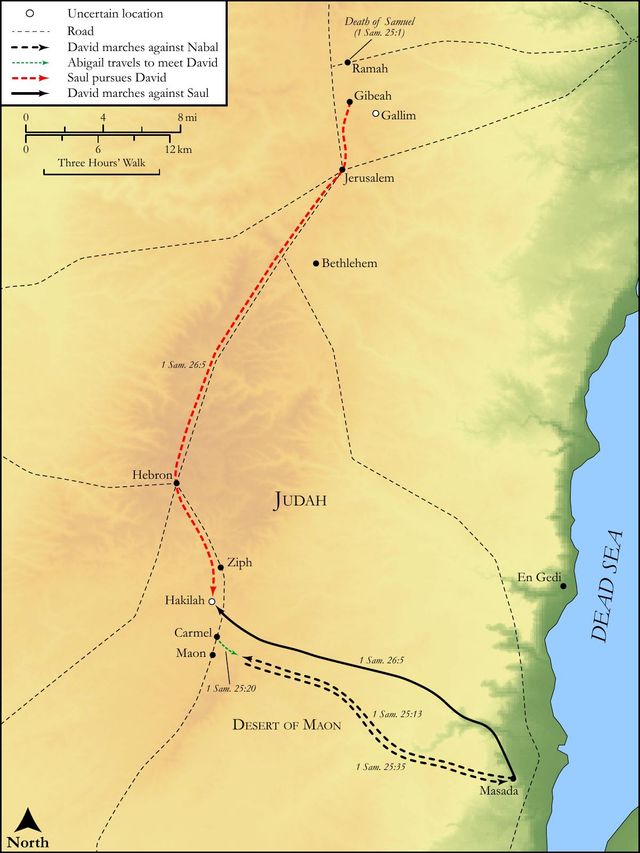
See on the biblical-era map
Study this verse
Public-domain commentary
Matthew Henry
From his Commentary on the Whole Bible. Henry comments on passages, not single verses — this entry covers 1 Samuel 25:36–44. His three-level outline is real structure in the source text, so it is rendered as structure.
We are now to attend Nabal's funeral and Abigail's wedding.
I.Nabal's funeral.
The apostle speaks of some that were twice dead, Jde 1:12. We have hare Nabal thrice dead, though but just now wonderfully rescued from the sword of David and delivered from so great a death; for the preservations of wicked men are but reservations for some further sorer strokes of divine wrath. Here is,
1.Nabal dead drunk, Sa1 25:36. Abigail came home, and, it should seem, he had so many people and so much plenty about him that he neither missed her nor the provisions she took to David; but she found him in the midst of his jollity, little thinking how near he was to ruin by one whom he had foolishly made his enemy. Sinners are often most secure when they are most in danger and destruction is at the door. Observe,
(1.)How extravagant he was in the entertainment of his company: He held a feast like the feast of a king, so magnificent and abundant, though his guests were but his sheep-shearers. This abundance might have been allowed if he had considered what God gave him his estate for, not to look great with, but to do good with. It is very common for those that are most niggardly in any act of piety or charity to be most profuse in gratifying a vain humour or a base lust. A mite is grudged to God and his poor; but, to make a fair show in the flesh, gold is lavished out of the bag. If Nabal had not answered to his name, he would never have been thus secure and jovial, till he had enquired whether he was safe from David's resentments; but (as bishop Hall observes) thus foolish are carnal men, that give themselves over to their pleasures before they have taken any care to make their peace with God.
(2.)How sottish he was in the indulgence of his own brutish appetite: He was very drunk, a sign he was Nabal, a fool, that could not use his plenty without abusing it, could not be pleasant with his friends without making a beast of himself. There is not a surer sign that a man has but little wisdom, nor a surer way to ruin the little he has, than drinking to excess. Nabal, that never thought he could bestow too little in charity, never thought he could bestow too much in luxury. Abigail, finding him in this condition (and probably those about him little better, when the master of the feast set them so bad an example), had enough to do to set the disordered house to-rights a little, but told Nabal nothing of what she had done with reference to David, nothing of his folly in provoking David, of his danger or of his deliverance, for, being drunk, he was as incapable to hear reason as he was to speak it. To give good advice to those that are in drink is to cast pearls before swine; it is better to stay till they are sober.
2.Nabal again dead with melancholy, Sa1 25:37. Next morning, when he had come to himself a little, his wife told him how near to destruction he had brought himself and his family by his own rudeness, and with what difficulty she had interposed to prevent it; and, upon this, his heart died within him and he became as a stone. Some suggest that the expense of the satisfaction made to David, by the present Abigail brought him, broke his heart: it seems rather that the apprehension he now had of the danger he had narrowly escaped put him into a consternation, and seized his spirits so that he could not recover it. He grew sullen, and said little, ashamed of his own folly, put out of countenance by his wife's wisdom. How is he changed! His heart over-night merry with wine, next morning heavy as a stone; so deceitful are carnal pleasures, so transient the laughter of the fool. The end of that mirth is heaviness. Drunkards are sometimes sad when they reflect upon their own folly. Joy in God makes the heart always light. Abigail could never, by her wise reasonings, bring Nabal to repentance; but now, by her faithful reproof, she brings him to despair.
3.Nabal, at last, dead indeed: About ten days after, when he had been kept so long under this pressure and pain, the Lord smote him that he died (Sa1 25:38), and, it should seem, he never held up his head; it is just with God (says bishop Hall) that those who live without grace should die without comfort, nor can we expect better while we go on in our sins. Here is no lamentation made for Nabal. He departed without being lamented. Every one wished that the country might never sustain a greater loss. David, when he heard the news of his death, gave God thanks for it, Sa1 25:39. He blessed God,
(1.)That he had kept him from killing him: Blessed be the lord, who hath kept his servant from evil. He rejoices that Nabal died a natural death and not by his hand. We should take all occasions to mention and magnify God's goodness to us in keeping us from sin.
(2.)That he had taken the work into his own hands, and had vindicated David's honour, and not suffered him to go unpunished who had been abusive to him; hereby his interest would be confirmed, and all would stand in awe of him, as one for whom God fought.
(3.)That he had thereby encouraged him and all others to commit their cause to God, when they are in any way injured, with an assurance that, in his own time, he will redress their wrongs if they sit still and leave the matter to him.
II.Abigail's wedding.
David was so charmed with the beauty of her person, and the uncommon prudence of her conduct and address, that, as soon as was convenient, after he heard she was a widow, he informed her of his attachment to her (Sa1 25:39), not doubting but that she who approved herself so good a wife to so bad a husband as Nabal would much more make a good wife to him, and having taken notice of her respect to him and her confidence of his coming to the throne.
1.He courted by proxy, his affairs, perhaps, not permitting him to come himself.
2.She received the address with great modesty and humility (Sa1 25:41), reckoning herself unworthy of the honour, yet having such a respect for him that she would gladly be one of the poorest servants of his family, to wash the feet of the other servants. None so fit to be preferred as those that can thus humble themselves.
3.She agreed to the proposal, went with his messenger, took a retinue with her agreeable to her quality, and she became his wife, Sa1 25:42. She did not upbraid him with his present distresses, and ask him how he could maintain her, but valued him,
(1.)Because she knew he was a very good man.
(2.)Because she believed he would, in due time, be a very great man. She married him in faith, not questioning but that, though now he had not a house of his own that he durst bring her to, yet God's promise go him would at length be fulfilled. Thus those who join themselves to Christ must be willing now to suffer with him, believing that hereafter they shall reign with him.
Lastly, On this occasion we have some account of David's wives. 1. One that he had lost before he married Abigail, Michal, Saul's daughter, his first, and the wife of his youth, to whom he would have been constant if she would have been so to him, but Saul had given her to another (Sa1 25:44), in token of his displeasure against him and disclaiming the relation of a father-in-law to him. 2. Another that he married besides Abigail (Sa1 25:43), and, as should seem, before her, for she is named first, Sa1 27:3. David was carried away by the corrupt custom of those times; but from the beginning it was not so, nor is it so now that Messias has come, and the times of reformation, Mat 19:4, Mat 19:5. Perhaps Saul's defrauding David of his only rightful wife was the occasion of his running into this irregularity; for, when the knot of conjugal affection is once loosed, it is scarcely ever tied fast again. When David could not keep his first wife he thought that would excuse him if he did not keep to his second. But we deceive ourselves if we think to make others' faults a cloak for our own.
Historical interpretation
Three Centuries of Reception
2 surviving comments on this verse. Each one is dated, so this reads as a timeline rather than a list.
Select a marker to jump to its quote. Markers stagger vertically where authors wrote within a few decades of each other.
David had two wives, Ahinoam the Jezreelite, and Abigail, whom he took later. The first was somewhat severe, the other full of mercy and graciousness, a kindly and generous soul who saw the Father with face unveiled, gazing on his glory. She received that heavenly dew of the grace of the Father, as her name is interpreted. What is the dew of the Father but the Word of God, which fills the hearts of all with the waters of faith and justice?Beautifully does the true David say to this soul what was said to Abigail: “Blessed be the Lord God of Israel, who sent you this day to meet me, and blessed be your customs.” And again he says to her, “Go in peace into your house, behold now I have heard your voice and have honored your face.” In the Canticles, too, these are the words of the bridegroom to his bride: “Show me your face and let me hear your voice.”
Then she was sent away, since she had another husband who was called, in Hebrew, Nabal, which, in Latin, means foolish, harsh, unkind, ungentle, ungrateful, for he did not know how to show gratitude. Later, when her husband died, David the prophet took her as his wife, since she was set free from the law of her husband. Through this union is signified the mystery of the church of the Gentiles which would believe, for, after losing her husband to whom she was at first united, she made her way to Christ, bringing a dowry of piety, of humility and of faith, and enriched with the heritage of mercy.
And she rode upon an ass, etc. Following the messengers of the Lord's word, the faithful synagogue, the closer it comes to receiving His gifts, the more surely it recognizes its own foolishness, slowness, and impurity. This can also be rightly understood of each faithful soul which, having mounted an ass, also leads five maidens with her to David; when recognizing her natural sluggishness and dullness, whatever she can do by seeing, hearing, tasting, smelling, and touching, she joyfully expends all this in fulfilling the commands of her master. Otherwise, coming to David, Abigail has five maidens as companions; because the synagogue, to be coupled with the mysteries of Christ, brings with her none other than souls imbued with the rites of the law, which is written in five books. If anyone doubts that after the slaughter inflicted upon the Jews by Vespasian and Titus, the Church was gathered from their number, let him read ecclesiastical history, and he will find that after the destruction of Jerusalem was completed, Christians dwelling there, especially of the circumcision, who had fled from the Roman sword the Lord revealing it, immediately returned; and there for more than sixty years until the final destruction, which was done under Hadrian, there were not lacking Jews who served the Lord faithfully in the Church, so that during all that time bishops in Jerusalem were chosen from no other source but circumcision. Therefore, Abigail, holding the type of the faithful synagogue, not only signifies the persons of any one time, but sometimes those who began to believe in the Lord existing in the flesh; sometimes those who, after His ascension, repented at the preaching of the apostles; sometimes those who even from their number could reach the office of preaching; sometimes those who, after the killers, sellers, and dispersers of Christ and the Church, came to faith. Since they all learned to have one Lord, one faith, one baptism, one God and Father, rightly they are all signified by the same Abigail, a very prudent and beautiful woman, whose name is transferred to the rejoicing of the Father; truly signifying that one whom, assisting at His right hand in vesture of gold, that is, in works of charity shining in glory, the same Father rejoicing addresses: Hear, O daughter, and see, and incline your ear, and forget your people and your father's house, because the King has desired your beauty (Psalm XLIV).
Continue studying 1 Samuel 25:42 across the web’s major study libraries — every link below opens this exact verse, chapter, or book on the destination site.
Read & Compare
 BibleGatewayThis verse in more than 200 translations and 70 languages.
 Bible.comThe YouVersion reader — hundreds of translations, reading plans, and highlights.
 ESV.orgCrossway's official English Standard Version reader.
 NET BibleThe NET translation with 60,000+ translators' notes on every rendering decision.
 STEP BibleTyndale House's free study tool — original text, vocabulary, and scholarly resources.
 BibliaLogos Bible Software's free web reader.
 USCCBThe New American Bible (Revised Edition) with the U.S. bishops' study notes.
Commentaries
 BibleHub CommentariesDozens of classic commentaries on this verse, gathered on one page.
 StudyLightMore than 100 commentary sets — the largest collection on the web.
 BibleRefPlain-English commentary on what this verse means, verse by verse.
 Enduring WordDavid Guzik's free commentary on this chapter, widely used by Bible teachers.
 Bible Study ToolsVerse commentary alongside Greek and Hebrew study aids.
Original Language & Research
- BibleHub InterlinearThe verse word by word — original language, transliteration, and English.
- BibleHub LexiconEvery word's original-language definition and Strong's entry.
 Blue Letter BibleDeep-study tools — Strong's numbers, concordance, and word studies.
 SefariaThe Hebrew text with Rashi and centuries of Jewish commentary.
Sermons, Hymns & Audio


TrulyRandomVerse is not affiliated with these sites and doesn’t control their content. They’re linked because they’re genuinely useful.
Summary
1 Samuel 25:42 marks the pivotal moment of Abigail's immediate and humble acceptance of David's marriage proposal, culminating a dramatic narrative of divine justice and providential elevation. Following the swift judgment upon her former husband, Nabal, this verse details Abigail's decisive action to join David, highlighting her wisdom, humility, and the significant shift in her status from a discerning but subjugated wife to a key figure in David's burgeoning kingdom. Her prompt departure underscores a readiness to embrace God's unfolding plan, not only for her own life but also in the larger narrative of David's ascent to the throne of Israel.
Context
ShowHideLiterary Context
This verse serves as the concluding resolution to the intense narrative arc introduced in 1 Samuel chapter 25. The chapter begins with David's desperate need for provisions while in exile, leading to his interaction with the wealthy but churlish Nabal. Nabal's insulting refusal provokes David's wrath, prompting him to march with 400 men to destroy Nabal and his household. Abigail's swift, wise, and humble intervention, unbeknownst to Nabal, averts this impending disaster, demonstrating her exceptional discernment and diplomatic skill. Upon returning home and learning of Abigail's actions, Nabal suffers a fatal stroke, a clear act of divine judgment as acknowledged by David in 1 Samuel 25:39. David, recognizing Abigail's character and God's hand in these events, sends for her to become his wife, and this verse describes her immediate and willing response, effectively transitioning her from Nabal's house to David's camp, a significant step in David's journey toward kingship.
Historical & Cultural Context
In ancient Israelite society, marriage was often a strategic alliance, particularly for leaders. Women typically had limited autonomy, and their status was largely determined by their male relatives or husbands. Abigail's proactive and independent action in confronting David (without Nabal's knowledge) was highly unusual and indicative of her extraordinary character and wisdom, as noted in 1 Samuel 25:3. Her immediate acceptance of David's proposal, without hesitation or negotiation, reflects the cultural expectation of a woman's submission to a suitor, especially one of David's rising stature. The mention of "five damsels" indicates her social standing, as a woman of wealth and position would have attendants. Riding on an ass (donkey) was a common and practical mode of travel, signifying humility and expediency rather than a grand, ostentatious procession, which further speaks to Abigail's character.
Key Themes
ShowHideThe narrative of Abigail, Nabal, and David powerfully illustrates several key themes. Divine Providence is central, as God orchestrates Nabal's death and Abigail's elevation, demonstrating His active involvement in the lives of His people and His justice against the wicked, as seen in 1 Samuel 25:39. Wisdom versus Folly is starkly contrasted between Abigail's discerning actions and Nabal's foolish arrogance, emphasizing that true wisdom leads to life and blessing, while folly leads to destruction. Humility and Elevation are beautifully portrayed through Abigail's character; her humble appeal to David prevents bloodshed and ultimately leads to her elevation to a position of honor as David's wife, a stark contrast to Nabal's prideful downfall. Furthermore, the narrative highlights David's Character Development, showing his capacity for both righteous anger and merciful restraint, and his recognition of God's hand in events, which is crucial for his future role as king, as seen in his anointing in 1 Samuel 16:13. Abigail's swift obedience in this verse underscores the theme of Readiness to Respond to God's Call, even when it requires leaving behind a familiar past for an uncertain future.
Exposition and Analysis
ShowHideKey Word Analysis
ShowHideThe verb "hasted" (מִהֲרָה, miharah) emphasizes Abigail's immediate, eager, and decisive response. It conveys a sense of urgency and willingness, indicating that she did not hesitate or delay in accepting David's proposal. This swift action is consistent with her discerning character, suggesting she recognized the divine hand in the events and the significance of David's offer, understanding it as a divinely ordained elevation and a new beginning. Her promptness stands in stark contrast to Nabal's sluggishness and folly.
The mention of "rode upon an ass" (עַל־הַחֲמוֹר, ‘al-haḥămôr) is significant. While a common mode of transport, it also carries connotations of humility and practicality, especially when compared to a more regal or ostentatious procession. It suggests that Abigail, despite her impending elevation to the wife of a future king, maintained her humble and pragmatic disposition. This choice of transport reinforces her character as a woman of good understanding, focused on the task at hand rather than outward displays of grandeur, even in a moment of profound personal change.
The phrase "became his wife" (לְאִשְׁתּוֹ, lĕ'ishttô) signifies more than a mere marital status change; it represents a profound transformation of identity and destiny. From being bound to Nabal, a "son of Belial" (1 Samuel 25:25), Abigail is now united with David, God's anointed future king. This union elevates her status and integrates her into the lineage and purposes of God's chosen leader, marking her transition from a life of potential subjugation and danger to one of honor and divine favor.
Verse Breakdown
ShowHide"And Abigail hasted, and arose, and rode upon an ass,"
This opening clause vividly describes Abigail's immediate and purposeful action. The sequence of verbs – "hasted," "arose," "rode" – conveys a sense of urgency and determination. Her promptness signifies her full acceptance of David's proposal and her readiness to transition from her former life. The choice to ride an "ass" (donkey) underscores her humility and practicality, indicating a swift, unpretentious departure rather than a grand, ceremonial procession, aligning with her character as a discerning and wise woman.
"with five damsels of hers that went after her;"
This detail provides insight into Abigail's social status and the practicalities of her departure. Having "five damsels" (female attendants) indicates her position as a woman of means and standing, as such servants were common for wealthy households. Their accompanying her signifies her preparation for establishing a new household with David, bringing with her not just herself but also the necessary support for her new life, underscoring the comprehensive nature of her commitment.
"and she went after the messengers of David,"
This phrase emphasizes Abigail's active pursuit of her new destiny. She did not merely wait to be escorted but actively followed David's representatives, demonstrating her initiative and eagerness to fulfill the proposal. This act of "going after" highlights her agency and willingness to embrace the future that God, through David, was opening up for her, leaving her past behind.
"and became his wife."
This final, declarative statement is the culmination of the entire narrative arc for Abigail. It signifies the successful completion of David's proposal and Abigail's full integration into his household. This union is not merely a social event but a divinely orchestrated elevation, transforming her status from the wife of a foolish man to the wife of God's anointed, the future king of Israel. It marks a profound new beginning, fulfilling God's providential plan for both Abigail and David.
Literary Devices
ShowHideThe verse employs several effective literary devices. Juxtaposition is subtly present, contrasting Abigail's swift, humble, and wise response with Nabal's earlier foolish, arrogant, and ultimately fatal delay. This highlights the theme of divine justice and the reward for discernment. Symbolism is evident in Abigail riding an ass, which often symbolizes humility and peace in biblical narratives, contrasting with the horses of war. This choice of transport underscores her character and the nature of her elevation. The presence of "five damsels" can symbolize her status and the practical preparation for a new life, but also the completeness of her break from her old life. The entire narrative of Abigail's elevation serves as foreshadowing for David's own ascent to kingship; just as Abigail is elevated from a humble position to a place of honor, so too will David be elevated from a fugitive to the king of Israel, demonstrating God's pattern of exalting the humble and bringing down the proud.
Theological and Thematic Connections
ShowHide1 Samuel 25:42 powerfully illustrates God's providential care and His sovereign hand in orchestrating events for His purposes. Abigail's swift elevation from the wife of a foolish, condemned man to a future queen is a testament to God's justice and His favor upon the humble and wise. It underscores the biblical principle that God opposes the proud but gives grace to the humble, demonstrating that faithfulness and discernment are rewarded. Her story serves as a profound example of how God can redeem difficult circumstances and open new doors of blessing for those who trust and obey Him, aligning their will with His divine plan.
Reflection and Application
ShowHideAbigail's immediate and humble response in 1 Samuel 25:42 offers a profound model for believers today. Her story challenges us to cultivate a spirit of discernment, recognizing God's hand in our circumstances, even when they are challenging or unexpected. Her promptness in action, leaving behind a life of hardship for a new, divinely appointed future, encourages us to respond with readiness and faith when God calls us to new seasons or pathways. It reminds us that embracing change, especially when it aligns with God's will, can lead to unexpected blessings and elevations. Just as Abigail was prepared for a new role, we too are called to be prepared to step into the purposes God has for us, trusting that He will provide all that is needed for the journey. Her journey from Nabal's house to David's camp is a powerful metaphor for leaving behind the "old self" and embracing the "new creation" in Christ, trusting in God's transformative power and His promise of a better future.
Questions for Reflection
ShowHideFAQ
ShowHideWhy did Abigail "haste" so quickly, and what does it signify?
ShowHideAbigail "hasted" (מִהֲרָה, miharah) so quickly because she was a woman of exceptional discernment and wisdom, as described in 1 Samuel 25:3. She understood the profound implications of David's proposal. Firstly, it was an escape from her marriage to Nabal, a "churlish and evil" man whose recent death was a clear act of divine judgment, as David himself acknowledged in 1 Samuel 25:39. Secondly, she recognized David's rising stature as God's anointed future king, a man of destiny. Her swiftness signifies not just eagerness, but also a deep spiritual understanding and readiness to align herself with God's unfolding plan. It demonstrates her faith and willingness to embrace a new, divinely ordained future without hesitation.
Christ-Centered Fulfillment
ShowHideAbigail's story, culminating in her becoming David's wife, beautifully foreshadows the ultimate union between Christ and His Church. Just as Abigail, a humble woman, was called out of a life of hardship and bondage to a foolish man to become the bride of a future king, so too is the Church, a collection of humble and often flawed individuals, called out of the bondage of sin and the dominion of the "prince of this world" to become the glorious Bride of Christ. Abigail's immediate and humble response mirrors the call to repentance and faith, where believers are invited to leave their old lives behind and embrace a new identity in Christ, as described in 2 Corinthians 5:17. Her journey on an ass, a symbol of humility, resonates with Jesus' own humble entry into Jerusalem on a donkey, as prophesied in Zechariah 9:9 and fulfilled in Matthew 21:5. Ultimately, Abigail's elevation to David's wife points to the eschatological hope of the Church's union with Christ, the true King, in the heavenly marriage supper of the Lamb, as depicted in Revelation 19:7-9, where His bride has made herself ready.