


Genesis 24:67
Bible text: King James Version (1769 Blayney text) · Public domain
Bible text: King James Version with Strong's numbers · Public domain
Bible text: Berean Standard Bible · Public domain
Bible text: American Standard Version (1901) · Public domain
Bible text: World English Bible, Messianic edition · Public domain
Bible text: Geneva Bible (1599) · Public domain
Bible text: Young's Literal Translation · Public domain
- וַיְבִאֶהָvay·vi·'E·haand he brought herH935Conj-w ¦ V-Hiphil-ConsecImperf-3ms ¦ 3fsVerb Hiphil Consecutive Imperfect 3rd Singular Masculineוַandיְבִאֶhe broughtהָher
- יִצְחָקyitz·ChakIsaacH3327N-proper-mNoun Proper Masculine
- הָאֹהֱלָהha·'O·he·lahthe tent of towardsH168Art ¦ N-ms ¦ SfxNoun Singular Masculine Absoluteהָtheאֹהֱלָtent ofהtowards
- שָׂרָהsa·RahSarahH8283N-proper-fNoun Proper Feminine
- אִמּוֹ'i·Mohis motherH517N-fsc ¦ 3msNoun Singular Feminine Constructאִמּmotherוֹhis
- וַיִּקַּחvai·yi·Kachand he tookH3947Conj-w ¦ V-Qal-ConsecImperf-3msVerb Qal Consecutive Imperfect 3rd Singular Masculineוַandיִּקַּחhe took
- אֶת'et<obj.>H853DirObjMParticle Object Indicator
- רִבְקָהriv·KahRebekahH7259N-proper-fNoun Proper Feminine
- וַתְּהִיva·te·hiand she becameH1961Conj-w ¦ V-Qal-ConsecImperf-3fsVerb Qal Consecutive Imperfect 3rd Singular Feminineוַandתְּהִיshe became
- לוֹloof himPrep-l ¦ 3msSuffix Personal 3rd Singular Masculineלofוֹhim
- לְאִשָּׁהle·'i·Shah<into> a wifeH802Prep-l ¦ N-fsNoun Singular Feminine Absoluteלְ<into>אִשָּׁהa wife
- וַיֶּאֱהָבֶהָvai·ye·'e·ha·Ve·haand he loved herH157Conj-w ¦ V-Qal-ConsecImperf-3ms ¦ 3fsVerb Qal Consecutive Imperfect 3rd Singular Masculineוַandיֶּאֱהָבֶhe lovedהָher
- וַיִּנָּחֵםvai·yi·na·Chemand he was comfortedH5162Conj-w ¦ V-Niphal-ConsecImperf-3msVerb Niphal Consecutive Imperfect 3rd Singular Masculineוַandיִּנָּחֵםhe was comforted
- יִצְחָקyitz·ChakIsaacH3327N-proper-mNoun Proper Masculine
- אַחֲרֵי'a·cha·ReiafterH310Adj-mpcAdjective Numerical Plural Masculine Construct
- אִמּוֹ'i·Mohis motherH517N-fsc ¦ 3msNoun Singular Feminine Constructאִמּmotherוֹhis
English is a literal word-by-word gloss of the Hebrew, not the KJV's wording. Why?
This is the original text the KJV's translators worked from — each Hebrew word with its own literal English meaning in this verse, prepared by scholars at Tyndale House, Cambridge. The KJV translates whole sentences, not word by word, so its wording differs: one Hebrew word can become several English words, and the KJV may choose “the LORD” where the gloss reads “Yahweh”. Both are faithful — they answer different questions. For the KJV's own rendering, switch to the KJV text.
Details
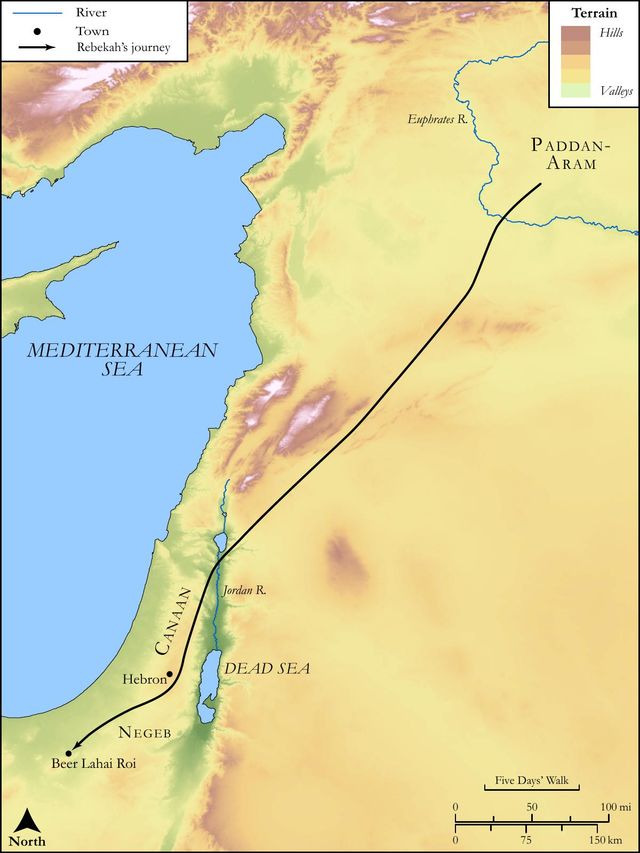
See on the biblical-era maps


Study this verse
Public-domain commentary
Matthew Henry
From his Commentary on the Whole Bible. Henry comments on passages, not single verses — this entry covers Genesis 24:62–67. His two-level outline is real structure in the source text, so it is rendered as structure.
Isaac and Rebekah are, at length, happily brought together. Observe,
I.Isaac was well employed when he met Rebekah:
He went out to meditate, or pray, in the field, at the even-tide, Gen 24:62, Gen 24:63. Some think he expected the return of his servants about this time, and went out on purpose to meet them. But, it should seem, he went out on another errand, to take the advantage of a silent evening and a solitary field for meditation and prayer, those divine exercises by which we converse with God and our own hearts. Note,
1.Holy souls love retirement. It will do us good to be often left alone, walking alone and sitting alone; and, if we have the art of improving solitude, we shall find we are never less alone than when alone.
2.Meditation and prayer ought to be both our business and our delight when we are alone; while we have a God, a Christ, and a heaven, to acquaint ourselves with, and to secure our interest in, we need not want matter either for meditation or prayer, which, if they go together, will mutually befriend each other.
3.Our walks in the field are then truly pleasant when in them we apply ourselves to meditation and prayer. We there have a free and open prospect of the heavens above us and the earth around us, and the host and riches of both, by the view of which we should be led to the contemplation of the Maker and owner of all.
4.The exercises of devotion should be the refreshment and entertainment of the evening, to relieve us from the fatigue occasioned by the care and business of the day, and to prepare us for the repose and sleep of the night.
5.Merciful providences are then doubly comfortable when they find us well employed and in the way of our duty. Some think Isaac was now praying for good success in this affair that was depending, and meditating upon that which was proper to encourage his hope in God concerning it; and now, when he sets himself, as it were, upon his watch-tower, to see what God would answer him, as the prophet (Hab 2:1), he sees the camels coming. Sometimes God sends in the mercy prayed for immediately, Act 12:12.
II.Rebekah behaved herself very becomingly, when she met Isaac:
understanding who he was, she alighted off her camel (Gen 24:64), andtook a veil, and covered herself (Gen 24:65), in token of humility, modesty, and subjection. She did not reproach Isaac for not coming himself to fetch her, or, at least, to meet her a day's journey or two, did not complain of the tediousness of her journey, or the difficulty of leaving her relations, to come into a strange place; but, having seen Providence going before her in the affair, she accommodates herself with cheerfulness to her new relation. Those that by faith are espoused to Christ, and would be presented as chaste virgins to him, must, in conformity to his example, humble themselves, as Rebekah, who alighted when she saw Isaac on foot, and must put themselves into subjection to him who is their head (Eph 5:24), as Rebekah, signifying it by the veil she put on, Co1 11:10.
III.They were brought together (probably after some further acquaintance), to their mutual comfort, Gen 24:67. Observe here,
1.What an affectionate son he was to his mother: it was about three years since her death, and yet he was not, till now, comforted concerning it; the wound which that affliction gave to his tender spirit bled so long, and was never healed till God brought him into this new relation. Thus crosses and comforts are balances to each other (Ecc 7:14), and help to keep the scale even.
2.What an affectionate husband he was to his wife. Note, Those that have approved themselves well in one relation, it may be hoped, will do so in another: She became his wife, and he loved her; there was all the reason in the world why he should, for so ought men to love their wives even an themselves. The duty of the relation is then done, and the comfort of the relation is then enjoyed, when mutual love governs; for there the Lord commands the blessing.
Historical interpretation
Two Centuries of Reception
2 surviving comments on this verse. Each one is dated, so this reads as a timeline rather than a list.
Select a marker to jump to its quote. Markers stagger vertically where authors wrote within a few decades of each other.
By the joy [which he received] from Rebekah, who came three years later, Isaac was comforted from the mourning of his mother with which he had been shrouded for three years.
Therefore Isaac took Rebekah “and led her into the tent of his mother.” Christ also took the church and established it in place of the synagogue.… As the apostle says, by pride “the branches” of the olive tree “have been broken off,” in order that the lowly wild olive may be engrafted. For this reason Isaac took Rebekah, “and because he loved her he was consoled for the loss of his mother.” Christ took the church and loved it so much that by this very love he tempered the grief that was occasioned by the death of his mother, the synagogue. Indeed, just as the synagogue’s lack of faith caused Christ sorrow, so the church’s faith produced joy in him.… Moreover, dearly beloved, because from us Christ the Lord prepared for himself a spiritual spouse that, as I said, he even redeemed with his precious blood. Therefore, with his help, each one of us should not only guard the benefits conferred … by divine gift but also should strive to increase them. Thus there will appear to [that one] nothing sordid because of luxury, nothing puffed up with pride or consumed with anger, nothing blind with avarice or struck with the snakelike poison of envy. Truly it is right that our spouse, “fairer in beauty than the sons of men,” should find in us none of the above-mentioned sins to offend the eyes of his majesty. To him, together with the Father and the Holy Spirit, is honor and might forever. Amen.
Continue studying Genesis 24:67 across the web’s major study libraries — every link below opens this exact verse, chapter, or book on the destination site.
Read & Compare
 BibleGatewayThis verse in more than 200 translations and 70 languages.
 Bible.comThe YouVersion reader — hundreds of translations, reading plans, and highlights.
 ESV.orgCrossway's official English Standard Version reader.
 NET BibleThe NET translation with 60,000+ translators' notes on every rendering decision.
 STEP BibleTyndale House's free study tool — original text, vocabulary, and scholarly resources.
 BibliaLogos Bible Software's free web reader.
 USCCBThe New American Bible (Revised Edition) with the U.S. bishops' study notes.
Commentaries
 BibleHub CommentariesDozens of classic commentaries on this verse, gathered on one page.
 StudyLightMore than 100 commentary sets — the largest collection on the web.
 BibleRefPlain-English commentary on what this verse means, verse by verse.
 Enduring WordDavid Guzik's free commentary on this chapter, widely used by Bible teachers.
 Bible Study ToolsVerse commentary alongside Greek and Hebrew study aids.
Original Language & Research
- BibleHub InterlinearThe verse word by word — original language, transliteration, and English.
- BibleHub LexiconEvery word's original-language definition and Strong's entry.
 Blue Letter BibleDeep-study tools — Strong's numbers, concordance, and word studies.
 SefariaThe Hebrew text with Rashi and centuries of Jewish commentary.
Sermons, Hymns & Audio


TrulyRandomVerse is not affiliated with these sites and doesn’t control their content. They’re linked because they’re genuinely useful.
Summary
Genesis 24:67 masterfully concludes the divinely guided narrative of Isaac's search for a wife, portraying his tender act of bringing Rebekah into his deceased mother Sarah's tent, their immediate marital union, and the profound love and comfort he found in her presence. This pivotal verse not only establishes the next generation of the covenant line but also beautifully illustrates the themes of divine providence, deep companionship, and healing from grief within a foundational biblical family.
Context
ShowHideLiterary Context
Genesis 24 stands as the longest chapter in the book, meticulously detailing Abraham's mission to secure a wife for Isaac from his own kindred, rather than from the local Canaanite population. The preceding verses recount Abraham's trusted servant's arduous journey to Mesopotamia, his prayer for divine guidance, and God's miraculous leading to Rebekah at the well. The servant's subsequent negotiations with Rebekah's family, her willing consent, and the journey back to Canaan are all carefully narrated, building anticipation for this climactic meeting. Verse 67 serves as the tender and definitive resolution to this extended narrative, marking the successful fulfillment of Abraham's mission and God's providential care.
Historical & Cultural Context
Among the patriarchs, arranged marriages were the norm, often serving strategic family, economic, and social purposes rather than being solely based on romantic love. The act of a man "taking" a woman into his tent or home often constituted the marriage itself, following the negotiation of a bride-price or dowry. Sarah's tent, specifically mentioned, held significant cultural weight as the domain of the matriarch, a place of domestic authority and intimate family life. Her death three years prior (as noted in Genesis 23:1-2) would have left a significant void, making Rebekah's entry into this specific space profoundly symbolic of her assumption of Sarah's esteemed role and the continuity of the patriarchal household.
Key Themes
ShowHideThis verse powerfully encapsulates several overarching themes of Genesis and the broader biblical narrative. It highlights Divine Providence and Covenant Faithfulness, as God meticulously orchestrates the union crucial for the continuation of the Abrahamic covenant and the promised lineage (Genesis 12:1-3). The explicit mention of Isaac's love for Rebekah introduces the theme of Love and Companionship in Marriage, demonstrating that even in an arranged context, genuine affection is valued and divinely blessed, echoing the ideal of oneness found in Genesis 2:24. Furthermore, Isaac's comfort after his mother's death underscores the theme of God's Provision of Comfort and Healing through human relationships, illustrating how companionship can bring solace in times of profound grief.
Exposition and Analysis
ShowHideGenesis 24:67 offers a concise yet profoundly meaningful description of the culmination of Isaac and Rebekah's story, marking a tender and pivotal moment in the covenant narrative.
Key Word Analysis
ShowHideMeaning "a tent (as clearly conspicuous from a distance); covering, (dwelling) (place), home, tabernacle." The specific mention of "Sarah's tent" is highly significant. It is not just any dwelling, but the intimate, personal space of the deceased matriarch. Bringing Rebekah into this particular tent symbolizes her immediate and full integration into the family, her assumption of Sarah's esteemed place, and the continuity of the matriarchal line within the covenant household. It signifies more than just a physical dwelling; it represents the transfer of domestic authority and spiritual legacy.
A primitive root meaning "to have affection for (sexually or otherwise); (be-) love(-d, -ly, -r), like, friend." This word is crucial. While the marriage was arranged, the text explicitly states that Isaac "loved" Rebekah. This is not a casual liking but denotes a deep, abiding affection, the same root used to describe God's love for Israel and the profound love between spouses. It emphasizes that despite the cultural practice of arranged marriages, genuine emotional connection and profound affection were present and valued in this divinely orchestrated union, establishing a foundation of deep relational intimacy.
A primitive root meaning "properly, to sigh, i.e. breathe strongly; by implication, to be sorry, i.e. (in a favorable sense) to pity, console or (reflexively) rue; or (unfavorably) to avenge (oneself); comfort (self), ease (one's self), repent(-er,-ing, self)." Isaac had been grieving his mother Sarah for three years. The use of "comforted" here indicates a profound sense of relief, consolation, and the easing of deep sorrow. Rebekah's presence filled the void left by Sarah, providing emotional solace, stability, and a new source of joy. This highlights the healing power of companionship and a loving relationship in times of profound grief, underscoring Rebekah's immediate and significant role as a true partner and source of emotional support for Isaac.
Verse Breakdown
ShowHide"And Isaac brought her into his mother Sarah's tent"
This opening clause describes Isaac's deliberate and symbolic action. By leading Rebekah into Sarah's tent, Isaac not only formally established their shared home but also symbolically transferred the matriarchal mantle to Rebekah. This act signifies her immediate integration into the family and her assumption of the esteemed place previously held by Sarah, ensuring continuity within the covenant lineage. It was a gesture of deep respect for both his mother's legacy and Rebekah's new role.
"and took Rebekah, and she became his wife"
This phrase succinctly describes the formalization of their marital union. In that day, the act of "taking" a woman into one's home, often after negotiations and agreements, constituted the marriage itself. There was no prolonged engagement period or elaborate public ceremony as we might imagine today; the union was consecrated upon her arrival and acceptance into his household, marking her as his legitimate spouse.
"and he loved her"
This is a profound and pivotal statement within the verse. Given that their marriage was arranged, the explicit mention of Isaac's love for Rebekah underscores that their union was not merely a matter of duty or custom but blossomed into genuine, deep affection. This highlights the ideal of emotional connection and companionship within marriage, demonstrating that divine guidance can lead to profound personal connection and love.
"and Isaac was comforted after his mother's [death]"
This final clause reveals the profound emotional impact of Rebekah's arrival on Isaac. Having mourned Sarah for three years, Rebekah's presence brought him solace, healing, and a renewed sense of stability and joy. Her companionship filled the void left by his mother's passing, demonstrating the restorative power of a loving relationship in alleviating grief and loneliness. It highlights Rebekah's immediate and significant role as a source of emotional support and stability in Isaac's life.
Literary Devices
ShowHideThe verse employs several significant literary devices. Symbolism is paramount, particularly in the mention of "his mother Sarah's tent." This specific location is not arbitrary; it symbolizes the transfer of matriarchal authority and the continuity of the covenant line. Rebekah's entry into this sacred space signifies her assumption of Sarah's role and the establishment of a new domestic order. The narrative also uses Conciseness to powerful effect, packing a wealth of meaning into a few clauses. The rapid succession of actions—brought, took, became, loved, comforted—creates a sense of immediate fulfillment and divine orchestration. Finally, the verse functions as a Narrative Climax and Resolution, bringing the extended story of Abraham's servant's mission to a tender and satisfying conclusion. The quest for a wife for Isaac, crucial for the covenant's continuation, is here definitively resolved, paving the way for the next generation of patriarchs and matriarchs.
Theological and Thematic Connections
ShowHideGenesis 24:67 is rich with theological significance, demonstrating God's meticulous care for His covenant people and His design for human relationships. The entire narrative of Isaac's marriage underscores God's providential hand in bringing the right partners together, fulfilling His promises to Abraham regarding his descendants and the continuation of the chosen lineage. Beyond mere arrangement, the explicit mention of Isaac's love for Rebekah emphasizes that genuine affection and deep companionship are vital components of a healthy and enduring union, bringing joy and strength. Furthermore, Isaac's profound comfort "after his mother's death" highlights God's provision of human relationships as a means of healing and support during seasons of sorrow, underscoring the restorative power of companionship.
Reflection and Application
ShowHideGenesis 24:67 offers timeless lessons for believers today, inviting us to reflect on divine providence, the nature of love in relationships, and the healing power of companionship. Just as God meticulously guided Abraham's servant to Rebekah, we are reminded to trust in His sovereignty and guidance in all areas of life, especially in significant decisions like relationships and marriage. This verse encourages us to seek God's will, knowing that His plans are perfect and often unfold in ways beyond our immediate comprehension. The explicit statement of Isaac's love for Rebekah underscores that while circumstances of marriage may vary, genuine affection, deep companionship, and mutual respect are vital components of a healthy and enduring union, bringing joy and strength. We are called to cultivate such love within our own relationships, reflecting God's design for intimacy and partnership. Furthermore, Isaac's comfort in Rebekah's presence illustrates God's design for human relationships to provide solace and healing during times of grief and loss. This reminds us of the importance of being present for one another in times of sorrow, offering comfort, and allowing ourselves to receive it from our communities, trusting that God often ministers His comfort through the loving presence of others.
Questions for Reflection
ShowHideFAQ
ShowHideWhy did Isaac bring Rebekah into Sarah's tent?
ShowHideThis act was deeply symbolic and practical. By bringing Rebekah into his mother Sarah's tent, Isaac signified her immediate integration into the family and her assumption of the matriarchal role previously held by Sarah. It represented continuity, respect for his mother's legacy, and the establishment of a new household under the blessings and traditions of Abraham and Sarah. It was a public and intimate declaration of her new status as his wife and the new mistress of the household.
Was Isaac and Rebekah's marriage an arranged one, and how does "he loved her" fit into this?
ShowHideYes, their marriage was arranged by Abraham through his trusted servant, a common and culturally accepted practice in that era. However, the explicit statement "and he loved her" is profoundly significant. It demonstrates that despite being an arranged union, a genuine and deep affection developed between Isaac and Rebekah. This highlights that divine guidance can lead to profound personal connection and love, showing that God's will is not antithetical to human affection, but rather can be the very foundation upon which it flourishes. Their story exemplifies that love can grow and deepen within the framework of a divinely ordained or culturally established union.
What is the significance of Isaac being comforted after his mother's death?
ShowHideSarah had died three years prior when Isaac was 37, and he was still grieving her loss deeply at 40 years old. Rebekah's arrival and their subsequent union brought him profound solace and healing. The Hebrew word for "comforted" (H5162, nâcham) implies a sense of relief and consolation from sorrow. Her presence filled the void left by his mother, demonstrating the restorative power of companionship and a loving relationship in overcoming profound grief and loneliness. It underscores the emotional depth of their bond and Rebekah's immediate role as a source of comfort and stability in his life, highlighting God's provision of human relationships as a means of healing.
Christ-Centered Fulfillment
ShowHideThe union of Isaac and Rebekah, divinely orchestrated and bringing comfort and new life to the covenant line, powerfully foreshadows the ultimate union between Christ and His Church. Just as Rebekah became Isaac's beloved bride and source of solace, Christ, the ultimate Bridegroom, establishes a new covenant with His people, the Church, offering profound spiritual comfort, unconditional love, and the fulfillment of God's eternal promises. Isaac's bringing Rebekah into Sarah's tent can be seen as a type of Christ bringing His Church into His glorious presence, preparing her as a pure and spotless bride (Ephesians 5:25-27). The comfort Isaac found in Rebekah points to the ultimate comfort and rest found only in Christ, who invites all who are weary and burdened to come to Him for solace (Matthew 11:28). Their marriage, crucial for the lineage of the Messiah, points to the spiritual family of God established through Christ's redemptive work, where He provides ultimate comfort and eternal companionship to His chosen bride, culminating in the joyous marriage supper of the Lamb (Revelation 19:7-9).