


Genesis 24:65
Bible text: King James Version (1769 Blayney text) · Public domain
Bible text: King James Version with Strong's numbers · Public domain
Bible text: Berean Standard Bible · Public domain
Bible text: American Standard Version (1901) · Public domain
Bible text: World English Bible, Messianic edition · Public domain
Bible text: Geneva Bible (1599) · Public domain
Bible text: Young's Literal Translation · Public domain
- וַתֹּאמֶרva·To·merand she saidH559Conj-w ¦ V-Qal-ConsecImperf-3fsVerb Qal Consecutive Imperfect 3rd Singular Feminineוַandתֹּאמֶרshe said
- אֶל'eltoH413PrepPreposition
- הָעֶבֶדha·'E·vedthe servantH5650Art ¦ N-msNoun Singular Masculine Absoluteהָtheעֶבֶדservant
- מִיmiwho?H4310InterrogPronoun Interrogative
- הָאִישׁha·'Ish[is] the manH376Art ¦ N-msNoun Singular Masculine Absoluteהָ[is] theאִישׁman
- הַלָּזֶהha·la·ZehthisH1976PrtParticle Demonstrative
- הַהֹלֵךְha·ho·Lekhwho is walkingH1980Art ¦ V-Qal-Prtcpl-msVerb Qal Participle Singular Masculine Absoluteהַwhoהֹלֵךְis walking
- בַּשָּׂדֶהba·sa·Dehin the fieldH7704Prep-b ¦ N-msNoun Singular Masculine Absoluteבַּin theשָּׂדֶהfield
- לִקְרָאתֵנוּlik·ra·Te·nuto meet usH7122Prep-l ¦ V-Qal-Inf ¦ 1cpVerb Qal Infinitive Constructלִtoקְרָאתֵmeetנוּus
- וַיֹּאמֶרvai·Yo·merand he saidH559Conj-w ¦ V-Qal-ConsecImperf-3msVerb Qal Consecutive Imperfect 3rd Singular Masculineוַandיֹּאמֶרhe said
- הָעֶבֶדha·'E·vedthe servantH5650Art ¦ N-msNoun Singular Masculine Absoluteהָtheעֶבֶדservant
- הוּאhu'itH1931Pro-3msPronoun Personal 3rd Singular Masculine
- אֲדֹנִי'a·do·Ni[is] my masterH113N-msc ¦ 1csNoun Singular Masculine Constructאֲדֹנִ[is] masterיmy
- וַתִּקַּחva·ti·Kachand she tookH3947Conj-w ¦ V-Qal-ConsecImperf-3fsVerb Qal Consecutive Imperfect 3rd Singular Feminineוַandתִּקַּחshe took
- הַצָּעִיףha·tza·'Ifthe veilH6809Art ¦ N-msNoun Singular Masculine Absoluteהַtheצָּעִיףveil
- וַתִּתְכָּסva·tit·Kasand she covered herselfH3680Conj-w ¦ V-Hithpael-ConsecImperf-3fsVerb Hithpael Consecutive Imperfect 3rd Singular Feminineוַandתִּתְכָּסshe covered herself
English is a literal word-by-word gloss of the Hebrew, not the KJV's wording. Why?
This is the original text the KJV's translators worked from — each Hebrew word with its own literal English meaning in this verse, prepared by scholars at Tyndale House, Cambridge. The KJV translates whole sentences, not word by word, so its wording differs: one Hebrew word can become several English words, and the KJV may choose “the LORD” where the gloss reads “Yahweh”. Both are faithful — they answer different questions. For the KJV's own rendering, switch to the KJV text.
Details
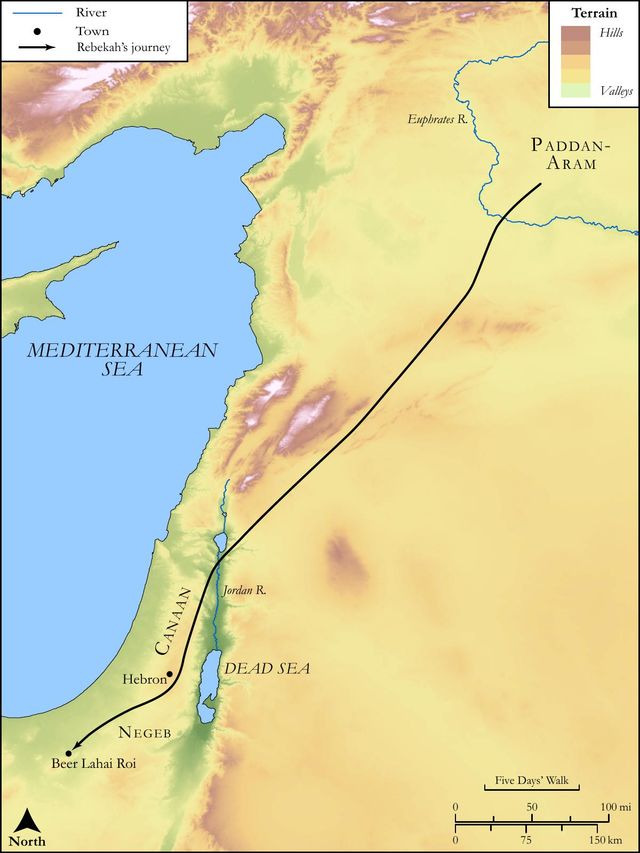
See on the biblical-era maps


Study this verse
Public-domain commentary
Matthew Henry
From his Commentary on the Whole Bible. Henry comments on passages, not single verses — this entry covers Genesis 24:62–67. His two-level outline is real structure in the source text, so it is rendered as structure.
Isaac and Rebekah are, at length, happily brought together. Observe,
I.Isaac was well employed when he met Rebekah:
He went out to meditate, or pray, in the field, at the even-tide, Gen 24:62, Gen 24:63. Some think he expected the return of his servants about this time, and went out on purpose to meet them. But, it should seem, he went out on another errand, to take the advantage of a silent evening and a solitary field for meditation and prayer, those divine exercises by which we converse with God and our own hearts. Note,
1.Holy souls love retirement. It will do us good to be often left alone, walking alone and sitting alone; and, if we have the art of improving solitude, we shall find we are never less alone than when alone.
2.Meditation and prayer ought to be both our business and our delight when we are alone; while we have a God, a Christ, and a heaven, to acquaint ourselves with, and to secure our interest in, we need not want matter either for meditation or prayer, which, if they go together, will mutually befriend each other.
3.Our walks in the field are then truly pleasant when in them we apply ourselves to meditation and prayer. We there have a free and open prospect of the heavens above us and the earth around us, and the host and riches of both, by the view of which we should be led to the contemplation of the Maker and owner of all.
4.The exercises of devotion should be the refreshment and entertainment of the evening, to relieve us from the fatigue occasioned by the care and business of the day, and to prepare us for the repose and sleep of the night.
5.Merciful providences are then doubly comfortable when they find us well employed and in the way of our duty. Some think Isaac was now praying for good success in this affair that was depending, and meditating upon that which was proper to encourage his hope in God concerning it; and now, when he sets himself, as it were, upon his watch-tower, to see what God would answer him, as the prophet (Hab 2:1), he sees the camels coming. Sometimes God sends in the mercy prayed for immediately, Act 12:12.
II.Rebekah behaved herself very becomingly, when she met Isaac:
understanding who he was, she alighted off her camel (Gen 24:64), andtook a veil, and covered herself (Gen 24:65), in token of humility, modesty, and subjection. She did not reproach Isaac for not coming himself to fetch her, or, at least, to meet her a day's journey or two, did not complain of the tediousness of her journey, or the difficulty of leaving her relations, to come into a strange place; but, having seen Providence going before her in the affair, she accommodates herself with cheerfulness to her new relation. Those that by faith are espoused to Christ, and would be presented as chaste virgins to him, must, in conformity to his example, humble themselves, as Rebekah, who alighted when she saw Isaac on foot, and must put themselves into subjection to him who is their head (Eph 5:24), as Rebekah, signifying it by the veil she put on, Co1 11:10.
III.They were brought together (probably after some further acquaintance), to their mutual comfort, Gen 24:67. Observe here,
1.What an affectionate son he was to his mother: it was about three years since her death, and yet he was not, till now, comforted concerning it; the wound which that affliction gave to his tender spirit bled so long, and was never healed till God brought him into this new relation. Thus crosses and comforts are balances to each other (Ecc 7:14), and help to keep the scale even.
2.What an affectionate husband he was to his wife. Note, Those that have approved themselves well in one relation, it may be hoped, will do so in another: She became his wife, and he loved her; there was all the reason in the world why he should, for so ought men to love their wives even an themselves. The duty of the relation is then done, and the comfort of the relation is then enjoyed, when mutual love governs; for there the Lord commands the blessing.
Historical interpretation
Two Centuries of Reception
3 surviving comments on this verse. Each one is dated, so this reads as a timeline rather than a list.
Select a marker to jump to its quote. Markers stagger vertically where authors wrote within a few decades of each other.
However, in regard to those who are betrothed, I can declare and avow this with more than my usual firmness: their heads should be covered from the day when they first trembled at the kiss and handclasp of their future husband. For in these symbols they have pledged every bit of themselves—their life throughout its full development, their flesh throughout their lifetime, their spirit through their understanding [of the contract], their modesty through the exchange of a kiss, their hope through their expectation and their mind through their willingness. For us, Rebekah stands as sufficient example; when her future husband had been pointed out to her, she covered her head with her veil merely because she knew she was to marry him.
Like Rebecca, who, upon learning that Isaac was coming towards her, descended from the camel and covered herself with a cloak (Genesis 24:65): so too this bridal soul anticipated the marriage insignia, lest she be rejected as not having the bridal garment; or lest she veil her head because of the angels.
(Verse 65.) And he took a theristrum, and covered himself. Theristrum is called a cloak, also a type of Arabian garment, with which the women of that province are veiled.
Continue studying Genesis 24:65 across the web’s major study libraries — every link below opens this exact verse, chapter, or book on the destination site.
Read & Compare
 BibleGatewayThis verse in more than 200 translations and 70 languages.
 Bible.comThe YouVersion reader — hundreds of translations, reading plans, and highlights.
 ESV.orgCrossway's official English Standard Version reader.
 NET BibleThe NET translation with 60,000+ translators' notes on every rendering decision.
 STEP BibleTyndale House's free study tool — original text, vocabulary, and scholarly resources.
 BibliaLogos Bible Software's free web reader.
 USCCBThe New American Bible (Revised Edition) with the U.S. bishops' study notes.
Commentaries
 BibleHub CommentariesDozens of classic commentaries on this verse, gathered on one page.
 StudyLightMore than 100 commentary sets — the largest collection on the web.
 BibleRefPlain-English commentary on what this verse means, verse by verse.
 Enduring WordDavid Guzik's free commentary on this chapter, widely used by Bible teachers.
 Bible Study ToolsVerse commentary alongside Greek and Hebrew study aids.
Original Language & Research
- BibleHub InterlinearThe verse word by word — original language, transliteration, and English.
- BibleHub LexiconEvery word's original-language definition and Strong's entry.
 Blue Letter BibleDeep-study tools — Strong's numbers, concordance, and word studies.
 SefariaThe Hebrew text with Rashi and centuries of Jewish commentary.
Sermons, Hymns & Audio


TrulyRandomVerse is not affiliated with these sites and doesn’t control their content. They’re linked because they’re genuinely useful.
Summary
Genesis 24:65 captures the pivotal moment of Rebekah's arrival in Canaan and her initial encounter with Isaac. As she identifies the man approaching them in the field as her future husband, Rebekah immediately takes a veil and covers herself, a deeply significant cultural gesture that communicates modesty, humility, and a reverent readiness to enter into the divinely ordained marital covenant.
Context
ShowHideLiterary Context
Genesis chapter 24 is a masterpiece of narrative theology, meticulously detailing Abraham's final act of faith in securing a wife for Isaac from his own kindred, rather than from the Canaanites. The entire chapter functions as a testament to divine providence, with Abraham's trusted servant acting as the primary agent of God's will. The narrative builds suspense through the servant's journey, his prayer for a sign, Rebekah's providential appearance, and her family's eventual consent. Verse 65 marks the climactic culmination of this journey, bringing the two central figures of the patriarchal covenant, Isaac and Rebekah, face-to-face for the first time, thereby setting the stage for the continuation of God's promises through their lineage.
Historical & Cultural Context
Marriage among the patriarchs was primarily an arranged affair, often involving extensive negotiations between families, as seen earlier in Genesis 24:50-51. The role of the "servant" (Hebrew: ʻebed) was crucial, acting as a trusted emissary for the patriarch. Veiling was a widespread cultural practice, particularly for women, and carried various meanings depending on the context. In this specific scenario, a woman veiling herself upon meeting her prospective husband for the first time was a powerful non-verbal communication of modesty, respect, humility, and an acknowledgment of the solemnity and new status associated with marriage. It signified her transition from her father's household to her husband's, and her acceptance of her new role within the covenantal union.
Key Themes
ShowHideThis verse, within the broader narrative of Genesis 24, powerfully underscores several key themes. Foremost is Divine Providence, as God meticulously orchestrates every detail of Isaac and Rebekah's union, fulfilling His promise to Abraham. The servant's prayer and the subsequent events clearly demonstrate God's guiding hand, as highlighted in Genesis 24:27. Another significant theme is Covenant Fidelity, as Abraham's desire for Isaac to marry within his family lineage reflects his commitment to the covenant promises. Rebekah's immediate and respectful response also introduces the theme of Humility and Modesty in the face of significant life transitions, particularly within the sacred context of marriage.
Exposition and Analysis
ShowHideKey Word Analysis
ShowHideThis word refers to a man as an individual or a male person. Rebekah's question "What man is this..." uses this term to inquire about the identity of the approaching figure, emphasizing her curiosity about this specific individual rather than just a generic person.
A primitive root meaning "to walk" with a wide range of applications, both literal and figurative. Here, it literally describes Isaac's movement in the field, but it can also imply his purposeful presence or even his meditative stroll, as suggested by Genesis 24:63.
A primitive root meaning "to plump, i.e. fill up hollows; by implication, to cover (for clothing or secrecy)." This action signifies a complete covering, not merely a light drape, emphasizing the thoroughness of Rebekah's act of concealment and self-presentation.
Verse Breakdown
ShowHide"For she had said unto the servant, What man is this that walketh in the field to meet us?"
As the caravan approaches, Rebekah's keen observation and curiosity are evident. Her direct question to the servant indicates her awareness of the significant moment and her desire to identify the man who has come out to meet them, setting the stage for the revelation of Isaac's identity.
"And the servant had said, It is my master:"
The servant's immediate and unequivocal identification of Isaac as "my master" is crucial. This declaration not only reveals Isaac's identity but also his status and authority, prompting Rebekah's subsequent, culturally appropriate response. The term "master" (Hebrew: ʼâdôwn) here denotes Isaac's position as the head of Abraham's household and the heir to the covenant promises.
"therefore she took a vail, and covered herself."
This is the climactic action of the verse. Upon learning the identity of her prospective husband, Rebekah's immediate response is to take a tsâʻîyph (veil) and cover herself. This act was a profound gesture of modesty, humility, and respect in that day, signifying her deference to her future husband and her readiness to enter into the marital covenant and her new role within his household.
Literary Devices
ShowHideThe passage makes effective use of Symbolism, primarily through the act of veiling. Rebekah's veil (Hebrew: tsâʻîyph) is not merely an article of clothing but a powerful symbol of her modesty, humility, and respectful submission to her future husband. It visually communicates her readiness to transition from her maiden status to that of a wife, accepting her new role and the covenantal responsibilities that come with it. Furthermore, the narrative employs Narrative Climax, as this verse represents the culmination of the entire chapter's journey, bringing the two main characters together after a long and divinely guided process. The immediate, decisive action of Rebekah underscores the significance of this meeting and her understanding of its profound implications.
Theological and Thematic Connections
ShowHideGenesis 24:65 serves as a powerful illustration of divine providence culminating in the formation of a covenantal family. The entire chapter showcases God's meticulous hand in guiding the servant to Rebekah and bringing her to Isaac, ensuring the continuation of the Abrahamic covenant through the divinely chosen lineage. Rebekah's immediate and respectful act of veiling underscores the reverence and seriousness with which the nations of that day, and implicitly, God's people, approached the sacred institution of marriage, viewing it as a foundational covenant. This moment highlights the themes of obedience to God's leading, the importance of preparation for significant life commitments, and the beauty of humility and respect in human relationships.
Reflection and Application
ShowHideRebekah's immediate and intentional action in Genesis 24:65 offers timeless principles for believers today, even as cultural practices evolve. Her humility and reverence in the face of a momentous life transition—meeting her future husband—challenge us to approach our own significant commitments, particularly those with spiritual implications like marriage, vocational calling, or covenant relationships within the church, with similar intentionality, seriousness, and a spirit of honor. This passage encourages us to cultivate a posture of humility and respect in all our interactions, recognizing the dignity of others and the sacredness of relationships. It reminds us that true preparation for life's significant moments often involves an inner disposition of readiness and reverence, rather than merely external displays. How might we, in our contemporary context, embody the spirit of modesty and respect that Rebekah demonstrated, especially in forming new relationships or entering into sacred commitments?
Questions for Reflection
ShowHideFAQ
ShowHideWhy did Rebekah take a veil and cover herself?
ShowHideRebekah's act of veiling was a customary cultural practice in Rebekah's day, signifying modesty, humility, and profound respect, especially when a woman was meeting her prospective husband for the first time. It also symbolized her readiness and acceptance of the impending marital covenant and her new status as a wife, transitioning from her father's household to Isaac's.
What was the significance of the "vail" (Hebrew tsâʻîyph)?
ShowHideThe tsâʻîyph was a substantial head covering or cloak that typically covered much of the face and body. Its significance lay in visually communicating the wearer's humility, deference, and modesty, particularly in formal or highly significant encounters like the first meeting between a bride and groom. It was a public declaration of her respectful posture and her acceptance of the union.
Does Rebekah's veiling imply that all women should veil today?
ShowHideWhile the specific cultural practice of veiling is not a universal requirement for Christian women today, the underlying principles of modesty, humility, and respect that Rebekah's action represented are timeless virtues. Believers are called to express these principles in culturally appropriate ways that honor God and others, rather than strictly adhering to ancient customs that may not carry the same meaning in contemporary contexts. The emphasis is on the heart attitude of reverence and humility, which can be expressed in various ways.
What does Isaac's presence in the field signify in this encounter?
ShowHideGenesis 24:63 states that Isaac "went out to meditate in the field at the eventide." His presence there suggests a posture of prayer, reflection, or anticipation, indicating his readiness and spiritual preparation for the arrival of his bride. It paints a picture of a man attuned to God's leading, mirroring the providential journey of Rebekah.
Christ-Centered Fulfillment
ShowHideThe narrative of Isaac and Rebekah beautifully prefigures the relationship between Christ and His Church. Just as Abraham, representing God the Father, sent his trusted servant (a type of the Holy Spirit) to find a bride for his beloved son Isaac, so too has God the Father sent the Holy Spirit to gather and prepare a bride, the Church, for His Son, Jesus Christ. Rebekah's journey from a distant land to meet a groom she had not yet seen, and her act of veiling in reverence upon His approach, powerfully foreshadows the Church's journey of faith toward Christ. The Church, as the bride of Christ, is called to prepare herself in holiness and humility, eagerly awaiting the glorious return of her Groom, adorned in righteousness, ready for the eternal covenant union, as described in Revelation 19:7-8. This divine romance culminates in the ultimate union of Christ and His redeemed people, a fulfillment of the covenant promises initiated in Genesis and brought to perfection in the New Jerusalem (see Revelation 21:2).