


Genesis 24:66
Bible text: King James Version (1769 Blayney text) · Public domain
Bible text: Berean Standard Bible · Public domain
Bible text: American Standard Version (1901) · Public domain
Bible text: World English Bible, Messianic edition · Public domain
Bible text: Geneva Bible (1599) · Public domain
Bible text: Young's Literal Translation · Public domain
- וַיְסַפֵּרvay·sa·Perand he recountedH5608Conj-w ¦ V-Piel-ConsecImperf-3msVerb Piel Consecutive Imperfect 3rd Singular Masculineוַandיְסַפֵּרhe recounted
- הָעֶבֶדha·'E·vedthe servantH5650Art ¦ N-msNoun Singular Masculine Absoluteהָtheעֶבֶדservant
- לְיִצְחָקle·yitz·Chakto IsaacH3327Prep-l ¦ N-proper-mNoun Proper MasculineלְtoיִצְחָקIsaac
- אֵת'et<obj.>H853DirObjMParticle Object Indicator
- כָּלkolallH3605N-mscNoun Singular Masculine Construct
- הַדְּבָרִיםha·de·va·Rimthe thingsH1697Art ¦ N-mpNoun Plural Masculine Absoluteהַtheדְּבָרִיםthings
- אֲשֶׁר'a·SherwhichH834RelParticle Relative
- עָשָׂה'a·Sahhe had doneH6213V-Qal-Perf-3msVerb Qal Perfect 3rd Singular Masculine
English is a literal word-by-word gloss of the Hebrew, not the KJV's wording. Why?
This is the original text the KJV's translators worked from — each Hebrew word with its own literal English meaning in this verse, prepared by scholars at Tyndale House, Cambridge. The KJV translates whole sentences, not word by word, so its wording differs: one Hebrew word can become several English words, and the KJV may choose “the LORD” where the gloss reads “Yahweh”. Both are faithful — they answer different questions. For the KJV's own rendering, switch to the KJV text.
Details
See on the biblical-era maps


Study this verse
Public-domain commentary
Matthew Henry
From his Commentary on the Whole Bible. Henry comments on passages, not single verses — this entry covers Genesis 24:62–67. His two-level outline is real structure in the source text, so it is rendered as structure.
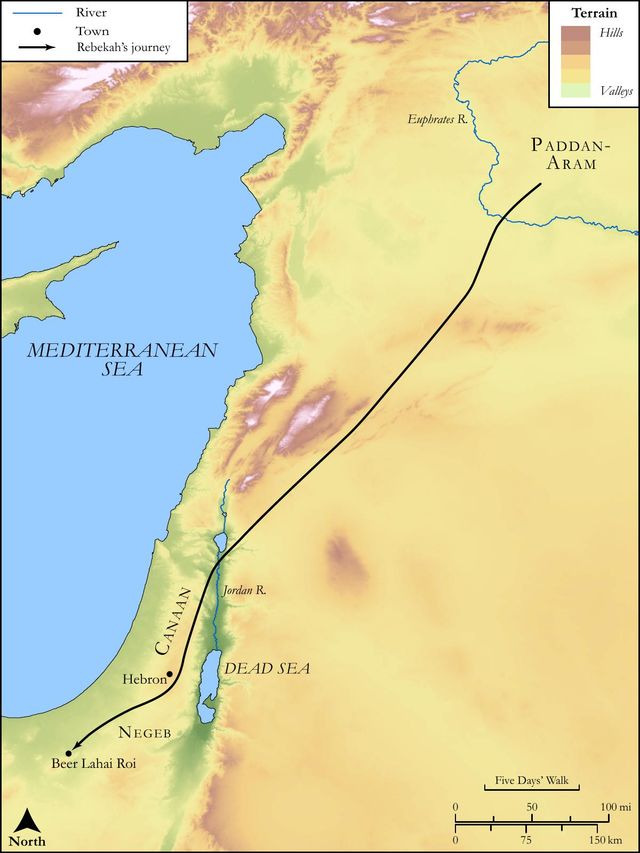
Isaac and Rebekah are, at length, happily brought together. Observe,
I.Isaac was well employed when he met Rebekah:
He went out to meditate, or pray, in the field, at the even-tide, Gen 24:62, Gen 24:63. Some think he expected the return of his servants about this time, and went out on purpose to meet them. But, it should seem, he went out on another errand, to take the advantage of a silent evening and a solitary field for meditation and prayer, those divine exercises by which we converse with God and our own hearts. Note,
1.Holy souls love retirement. It will do us good to be often left alone, walking alone and sitting alone; and, if we have the art of improving solitude, we shall find we are never less alone than when alone.
2.Meditation and prayer ought to be both our business and our delight when we are alone; while we have a God, a Christ, and a heaven, to acquaint ourselves with, and to secure our interest in, we need not want matter either for meditation or prayer, which, if they go together, will mutually befriend each other.
3.Our walks in the field are then truly pleasant when in them we apply ourselves to meditation and prayer. We there have a free and open prospect of the heavens above us and the earth around us, and the host and riches of both, by the view of which we should be led to the contemplation of the Maker and owner of all.
4.The exercises of devotion should be the refreshment and entertainment of the evening, to relieve us from the fatigue occasioned by the care and business of the day, and to prepare us for the repose and sleep of the night.
5.Merciful providences are then doubly comfortable when they find us well employed and in the way of our duty. Some think Isaac was now praying for good success in this affair that was depending, and meditating upon that which was proper to encourage his hope in God concerning it; and now, when he sets himself, as it were, upon his watch-tower, to see what God would answer him, as the prophet (Hab 2:1), he sees the camels coming. Sometimes God sends in the mercy prayed for immediately, Act 12:12.
II.Rebekah behaved herself very becomingly, when she met Isaac:
understanding who he was, she alighted off her camel (Gen 24:64), andtook a veil, and covered herself (Gen 24:65), in token of humility, modesty, and subjection. She did not reproach Isaac for not coming himself to fetch her, or, at least, to meet her a day's journey or two, did not complain of the tediousness of her journey, or the difficulty of leaving her relations, to come into a strange place; but, having seen Providence going before her in the affair, she accommodates herself with cheerfulness to her new relation. Those that by faith are espoused to Christ, and would be presented as chaste virgins to him, must, in conformity to his example, humble themselves, as Rebekah, who alighted when she saw Isaac on foot, and must put themselves into subjection to him who is their head (Eph 5:24), as Rebekah, signifying it by the veil she put on, Co1 11:10.
III.They were brought together (probably after some further acquaintance), to their mutual comfort, Gen 24:67. Observe here,
1.What an affectionate son he was to his mother: it was about three years since her death, and yet he was not, till now, comforted concerning it; the wound which that affliction gave to his tender spirit bled so long, and was never healed till God brought him into this new relation. Thus crosses and comforts are balances to each other (Ecc 7:14), and help to keep the scale even.
2.What an affectionate husband he was to his wife. Note, Those that have approved themselves well in one relation, it may be hoped, will do so in another: She became his wife, and he loved her; there was all the reason in the world why he should, for so ought men to love their wives even an themselves. The duty of the relation is then done, and the comfort of the relation is then enjoyed, when mutual love governs; for there the Lord commands the blessing.
Continue studying Genesis 24:66 across the web’s major study libraries — every link below opens this exact verse, chapter, or book on the destination site.
Read & Compare
 BibleGatewayThis verse in more than 200 translations and 70 languages.
 Bible.comThe YouVersion reader — hundreds of translations, reading plans, and highlights.
 ESV.orgCrossway's official English Standard Version reader.
 NET BibleThe NET translation with 60,000+ translators' notes on every rendering decision.
 STEP BibleTyndale House's free study tool — original text, vocabulary, and scholarly resources.
 BibliaLogos Bible Software's free web reader.
 USCCBThe New American Bible (Revised Edition) with the U.S. bishops' study notes.
Commentaries
 BibleHub CommentariesDozens of classic commentaries on this verse, gathered on one page.
 StudyLightMore than 100 commentary sets — the largest collection on the web.
 BibleRefPlain-English commentary on what this verse means, verse by verse.
 Enduring WordDavid Guzik's free commentary on this chapter, widely used by Bible teachers.
 Bible Study ToolsVerse commentary alongside Greek and Hebrew study aids.
Original Language & Research
- BibleHub InterlinearThe verse word by word — original language, transliteration, and English.
- BibleHub LexiconEvery word's original-language definition and Strong's entry.
 Blue Letter BibleDeep-study tools — Strong's numbers, concordance, and word studies.
 SefariaThe Hebrew text with Rashi and centuries of Jewish commentary.
Sermons, Hymns & Audio


TrulyRandomVerse is not affiliated with these sites and doesn’t control their content. They’re linked because they’re genuinely useful.
Summary
Genesis 24:66 marks the climactic return of Abraham's unnamed servant to Isaac, where he delivered a comprehensive and meticulous report of "all things that he had done." This pivotal verse signifies the successful divine orchestration of Rebekah's journey to become Isaac's wife, ensuring the continuation of the promised covenant lineage and highlighting God's faithful guidance in the most significant life decisions.
Context
ShowHideLiterary Context
Genesis chapter 24 stands as one of the longest and most detailed narrative accounts in the Pentateuch, entirely dedicated to Abraham's mission to secure a wife for his son, Isaac. Preceded by the death of Sarah in Genesis 23, Abraham, now old and desiring to see his son settled, takes a solemn oath from his most trusted servant. The narrative meticulously chronicles the servant's journey to Mesopotamia, his prayer for divine guidance at the well, the providential encounter with Rebekah, the confirmation of her lineage, and the negotiations with her family. Verse 66 serves as the crucial bridge, concluding the servant's mission and initiating Isaac's personal reception of his divinely chosen bride, setting the stage for their union in Genesis 24:67. This verse acts as the narrative resolution, bringing the extensive journey to its intended conclusion.
Historical & Cultural Context
The events of Genesis 24 unfold within the patriarchal society of Abraham's family, where arranged marriages were the norm, often serving strategic family and tribal interests rather than individual romantic preference. The emphasis on marrying within one's kin (from Abraham's homeland) was crucial for maintaining cultural and religious purity, avoiding the Canaanite influence that God had forbidden. The servant's solemn oath (placing a hand under Abraham's thigh) was a deeply binding cultural practice, invoking the covenant God. The well served as a vital social hub and a common place for significant encounters, highlighting the cultural importance of hospitality to strangers. The extensive gifts given to Rebekah and her family were customary "bride-price" or mohar, signifying her value and the seriousness of the proposal. The long journey itself underscores the servant's diligence and the inherent risks of ancient travel, making the successful return and detailed report all the more significant.
Key Themes
ShowHideGenesis 24, culminating in the servant's report, powerfully illustrates several overarching themes. Foremost is Divine Providence and Guidance, demonstrating God's active and meticulous involvement in the lives of His covenant people, even in seemingly mundane details like finding a spouse. The servant's constant prayer and recognition of God's hand (Genesis 24:27) underscore this. Another key theme is Covenant Faithfulness, both God's faithfulness to His promises to Abraham regarding his numerous descendants (Genesis 12:2) and Abraham's faithfulness in seeking a suitable wife for Isaac to perpetuate this lineage. The servant embodies Faithful Stewardship and Obedience, diligently executing his master's charge and providing a thorough account. Finally, the chapter emphasizes The Continuation of the Messianic Line, as Isaac and Rebekah's union is essential for the unfolding of God's redemptive plan through the promised seed.
Exposition and Analysis
ShowHideKey Word Analysis
ShowHideMeaning "a servant; bondman, (bond-) servant, (man-) servant." This term emphasizes the unnamed individual's role as one bound by duty and loyalty to Abraham. His identity is subsumed by his function, highlighting his complete dedication to his master's will and, by extension, to God's providential plan. The success of the mission is attributed not to his personal ingenuity but to his obedient service.
Meaning "to score with a mark as a tally or record, i.e. (by implication) to inscribe, and also to enumerate; intensively, to recount, i.e. celebrate; declare, number, speak, talk, tell (out)." This verb suggests more than a casual recounting; it implies a detailed, perhaps even an itemized, declaration. The servant is not merely informing Isaac but systematically laying out the entire narrative, as if presenting a meticulously kept record of his actions and God's interventions.
Meaning "a word; by implication, a matter (as spoken of) or thing; act, affair, business, deed, report." The phrase "all things" (Hebrew: kāl-haḏḏəḇārîm) signifies the completeness and thoroughness of the servant's account. It encompasses every detail of his journey, every prayer, every encounter, and every providential sign, leaving nothing unsaid. This comprehensive report assures Isaac of the divine hand at work and the legitimacy of Rebekah's selection.
Verse Breakdown
ShowHide"And the servant told Isaac"
This opening clause immediately establishes the agent of the report (the unnamed servant) and its recipient (Isaac). The servant's immediate action upon his return is to report, indicating his diligence, accountability, and the urgency of the mission's outcome. Isaac, who has been waiting, is now brought into the full understanding of the divine work on his behalf.
"all things"
This phrase emphasizes the exhaustive nature of the servant's communication. It implies a full, unedited, and transparent disclosure of every event, every challenge, and every providential intervention that occurred during his journey. This thoroughness is crucial for building Isaac's trust and understanding of the divinely guided process that brought Rebekah to him.
"that he had done"
This concluding phrase clarifies the scope of the report: it covers the entirety of the servant's mission, from the moment he left Abraham's presence until his return. While the actions were his, the underlying narrative of Genesis 24 makes it clear that these "things he had done" were ultimately the result of God's guiding hand, making the report a testimony to divine providence.
Literary Devices
ShowHideThe verse employs several literary devices to convey its significance. Narrative Climax is evident, as this verse represents the successful culmination of the extensive journey detailed throughout the chapter, resolving the primary plot point of finding Isaac a wife. The phrase "all things" functions as a form of Hyperbole or Emphasis, underscoring the completeness and meticulousness of the servant's report, assuring Isaac (and the reader) that no detail of the divinely guided mission was omitted. The deliberate Anonymity of the servant throughout the chapter, culminating in this verse, serves to highlight his role as a faithful instrument rather than an individual protagonist, thereby magnifying the Divine Providence that truly orchestrated the events. This anonymity directs the reader's focus away from human agency and towards God's sovereign hand in fulfilling His covenant promises.
Theological and Thematic Connections
ShowHideGenesis 24:66 serves as a powerful testament to God's meticulous providence and faithfulness in fulfilling His covenant promises. The servant's detailed report confirms that God actively guided every step of the mission, from the initial prayer at the well to the family's consent, ensuring that the chosen bride for Isaac was indeed divinely appointed. This narrative underscores that God is intimately involved in the significant decisions of His people, particularly those that bear upon His redemptive plan. The servant's exemplary diligence and transparent accountability also model faithful stewardship, demonstrating that God often works through obedient human agents to accomplish His divine purposes, requiring integrity and thoroughness in their service.
Reflection and Application
ShowHideThe account of Genesis 24:66 offers profound lessons for contemporary believers. It encourages us to cultivate a deep and unwavering trust in God's sovereign hand, especially when navigating life's most significant and often daunting decisions, such as career paths, major moves, or finding a life partner. Just as the servant sought and received divine guidance, we are reminded to seek God's will through prayer and obedience, confident that He guides the steps of those who commit their ways to Him. Furthermore, the servant's meticulous reporting exemplifies the enduring importance of integrity, diligence, and clear communication in all our responsibilities. Whether in our personal relationships, professional duties, or spiritual service, being thorough, transparent, and accountable for our actions builds trust, honors those we serve, and ultimately glorifies God. Finally, Isaac, having patiently waited, receives the detailed report of God's provision for him, serving as a powerful reminder that God often works through others and through specific, sometimes lengthy, processes to bring about His perfect will, culminating in comfort and blessing, as seen in Isaac finding solace in Rebekah.
Questions for Reflection
ShowHideFAQ
ShowHideWhy is the servant unnamed in this chapter?
ShowHideThe servant remains unnamed throughout Genesis 24 to emphasize his role as a faithful instrument of God's will and Abraham's authority, rather than an individual protagonist. His anonymity serves to direct the reader's focus away from human agency and onto the divine orchestration of events, highlighting the faithfulness of his service and God's meticulous providential care for Abraham's covenant lineage. This literary choice underscores that the true hero of the story is God Himself, working through His obedient servant.
What is the significance of the servant telling Isaac "all things that he had done"?
ShowHideThe phrase "all things" (Hebrew: kāl-haḏḏəḇārîm) signifies a complete, detailed, and transparent account of the entire mission. This thorough report was crucial for several reasons: it assured Isaac that the mission was divinely guided and successfully completed according to Abraham's precise instructions; it built Isaac's trust and prepared him to receive Rebekah as his divinely appointed bride; and it demonstrated the servant's exemplary integrity, diligence, and accountability in fulfilling such a monumental task. It was not merely an update but a full testimony to God's hand at work.
How does this verse contribute to the theme of divine guidance in Genesis 24?
ShowHideGenesis 24:66 is the culmination of the servant's journey, where his detailed report explicitly recounts how God guided every step, from the initial prayer at the well (Genesis 24:12-14) to the confirmation of Rebekah's family (Genesis 24:48). The "all things" he reported were essentially "all things God had done" through him, reinforcing the chapter's overarching theme of God's active, meticulous, and sovereign providence in human affairs, particularly in the critical matter of perpetuating the covenant line. The report leaves no doubt that Rebekah's arrival was a divine appointment.
Christ-Centered Fulfillment
ShowHideGenesis 24:66, and the broader narrative of the unnamed servant's mission, offers a profound typological foreshadowing of Christ and the Church. The unnamed servant, diligently seeking a bride for the son (Isaac), can be seen as a powerful type of the Holy Spirit, sent by the Father to gather and prepare a bride (the Church) for the Son, Jesus Christ. Just as the servant reported "all things" to Isaac, detailing the divine orchestration of Rebekah's journey, so the Holy Spirit continually bears witness to Christ and His redemptive work, revealing the Father's will and preparing believers for their ultimate union with Him. The Spirit guides believers into all truth (John 16:13) and testifies of Christ (John 15:26). The successful completion of the servant's mission, culminating in Isaac receiving Rebekah and finding comfort in her presence (Genesis 24:67), beautifully points to Christ's ultimate reception of His Church, whom He loved and gave Himself up for (Ephesians 5:25-27). This narrative thus anticipates the joyous "marriage supper of the Lamb" (Revelation 19:7-9), ensuring the fulfillment of God's eternal covenant promises through His Son, the ultimate Seed of Abraham.